International Journal of Innovative Technology and Exploring Engineering (IJITEE) ISSN: 2278-3075, Volume-9 Issue-2, December 2019
Abstract: Usage and adoption of infotainment system calls for reliable and sustaining communication scheme which should offer better connectivity along with the mobility of the vehicle. Such forms of connection also demands cost effectiveness as well as error free transmission too. Review of existing scheme towards infotainment system is just in its infancy stage and there are many developments to carry forward. Therefore, this manuscript presents a discussion of a novel framework of the infotainment system that is capable of processing massive stream of data when used with the vehicular network as well as adhoc-based networks too. The idea is also to offer quality data while attempting accessing of data/services towards any critical online services. The simulated outcome of the study is analyzed in MATLAB to find that it offers better throughput and reduced delay with the increasing scope of the grid.
Keywords : Infotainment, vehicular network, adhoc network, data propagation, critical service relaying, vehicular cloud.
I. INTRODUCTION
With the increasing usage of infotainment in almost all the cadre of vehicles in present time, its importance towards supportability in increasing [1] [2]. At present, the commercial application of the infotainment system is mainly reported to be used majorly for navigation services, internal car safety, and entertainment purpose. However, there are various limited features as an infotainment device in true sense can actually assists in communication among different neighboring cars [3]. Apart from this, the existing communication in infotainment system is supported by service provider relayed data transmission [4]. Such communication system is not only expensive but also depends upon the coverage and connectivity with the nearest service towers. In such situation, adhoc network and vehicular networks offers a cost effective communications system without any dependency of the infrastructure [5]. However, there are various challenges associated with using such form of network in supporting complete operation of infotainment system. Usually an infotainment system has priviledge to run multiple applications at same time which demands higher channel capacity. Unfortunately, such forms of concurrent access to services is not possible in dynamic topology based
Revised Manuscript Received on December 05, 2019.
* Correspondence Author
Reshma S, Assistant Professor, Dept. of CS&E , Global Academy of Technology, Bangalore, India .
Chetana Prakash, Professor, Department of CS&E, B.I.E.T.,Davanagere, India
Mohammed Rafi, Professor, Department of CS&E, U.B.D.T.C.E, Davanagere, India
Poornima B, Professor, Department of IS&E, B.I.E.T.,Davanagere, India
networks in existing system, Even if the set is carried out properly assuming the availability of number of vehicles in common transmission area, there are various other problems associated with it viz. load balancing, security, congestion, signal attenuation, etc [6-9].
Therefore, this paper has introduced a simplified modeling of a scheme that processes massive stream of data for generating error free data in infotainment system. Section II discusses about the existing research work followed by problem identification in Section III. Section IV discusses about proposed methodology followed by elaborated discussion of system design implementation in Section V. Comparative analysis of accomplished result is discussed under Section VI followed by conclusion in Section VII.
II. RELATEDWORK
There has been various research works being carried out towards the area of infotainment system [10]. The most recent study carried out by Choi et al. [11]have used
machine-to-machine communication approach of
Internet-of-Things where the focus is mainly on evolving an effective management technique. Kazmi et al. [12] have used a combined approach towards developing an infotainment system considering 5G networks in distributed manner. The works carried out by Costantino et al. [13] have used social network aspect for addressing the data leakage problems in infotainment. Gupte and Askhedkar [14] have presented a design of the infotainment system for curtailing overhead as well as cost of the system. Yu et al. [15] have incorporated infotainment system integrated with bus system of communication in power line. The study presented by Kovacevic et al. [16] have used application programing interface in order to offer more comprehensive design. Kula et al. [17] have presented discussion of a biometric-based application to be executed over infotainment system. Gaffar and Kouchak [18] have presented an optimized design for an infotainment system in order to study the distraction behaviour of driver. Sachara et al. [19] have used neural network for performing data transformation for supporting application of gesture recognition. Kovacevic et al [20] have used java-based approach in order to integrate infotainment with android system. Nii et al. [21] have used power management system in order to automate the process of infotainment system. Han et al. [22] have presented a discussion about infotainment system on the basis of reliability factor and analysis of finite elements. Das et al. [23] have developed a prototype for infotainment system for gesture identification is carried out in involuntary manner. The work of Felice et al. [24] has presented a design of the infotainment system that uses
self-healing mechanism in order
Framework for Infotainment System for
Processing Massive Data Stream of Critical
Online Services
to support critical application. Chen et al. [25] have used television spectrum bands for relaying services over infotainment system. Luddecke et al. [26] have used Bayesian network in order to model an infotainment system. Rene et al. [27] have presented architecture towards improved infotainment uses using deep packet inspection. Apart from this, the other approaches are architecture with heterogeneous supportability (Sadek et al., [28]), android-based (Udovicic et al.[29]),a nd raptor codes (Abdullah et al. [30]).
III. PROBLEMDESCRIPTION
Review of existing approaches towards infotainment system shows that there are certain level of problems that are yet open ended viz. i) there are less number of studies focusing on improving the streams quality relayed in the infotainment system, ii) with the usage of multi-carrier based signaling system, the throughput in vehicular network can be increased but it will be also error-prone, iii) Usage of vehicular adhoc network offers challenges towards achieving error free transmission due to dynamic topology, maximized rate of transmission, etc, iv) existing system doesn’t considers coverage of signal leading to collision. The next section discusses about the solution to the above mentioned problems in proposed system.
IV. PROPOSEDMETHODOLOGY
The prime purpose of the proposed system is to evolve up with a framework for generating error-free data over the services running in infotainment system considering the case study of vehicular network. Fig.1 highlights the block diagram of it.
Develop Graph
Vehicular Nodes Communication
Channel Link
Network Model (Vehicular Cloud) Problem Formulation
Selection of vehicle
Selection of vehicle from next hop
Streaming Massive Data
Constraints of Infotainment
Fig.1 Block Diagram of Proposed System
The block diagram highlights the flow of the proposed implementation scheme that considers the constraints associated with infotainment system using graph theory. The idea deals with selection of vehicles that can assist in performing communication along with facilitation of it. Apart from this, the proposed system also deals with optimization of the resources by using simplified network encoding system that has direct effect on saving channel capacity.
V. SYSTEMDESIGNIMPLEMENTATION
The core logic of the proposed system is to evolve up with a framework that facilitates faster transmission of heavier data files over a bigger stream in critical online services. Hence, the idea of the system design is to develop an effective plan for ensuring error free transmission of data. This section discusses about the planning that has been carried out considering a case study of vehicular networks.
A. Implementation Process
The precise interpretation of the development target is as follows:
Constraints of Infotainment System: As the proposed system is basically an analytical solution therefore it is designed considering various constraints that maps with the hardware and software configurations-capabilities of infotainment system. The various abstract parameters that ismodeled in infotainment system are as follows: memory of infotainment devices, number of different options (or services used by user), number of network port, etc. Consideration of all these parameters in modeling will ensure that proposed system offers complete applicability on streaming services on any defined infotainment system. Modeling Solution via Vehicular Network: As the proposed system targets to relay seamless and error free data transmission, therefore, the proposed system develops a network model which combines the characteristics of vehicular adhoc network and cloud environment. The brief discussion of blocks in proposed model is as follows: Problem Formulation: Consider a vehicle v1 is in
neighborhood of v2 as well as v3. It will mean that v2 and v3 will act as a neighbor node for v1. The proposed system considers that vehicular cloud (a network of vehicles and its respective information maintained in cloud ecosystem and can be accessed via road side units) is used for performing communication. Therefore, the biggest problem will be to perform selection of a definitive path in presence of information obtained from multi-carrier channel (e.g. 5G). A degree of orientation ϕ is considered between v1v2 and v1v3 where v1 is common source node. Basically, it is found that this degree of orientation ϕ is directly dependent on error-prone signals for each vehicular nodes present in different communication links in different hops H. Basically, if ϕ increases than communication link decreases thereby controlling the error prone data. The proposed system hypothesize that this degree of orientation ϕ is critically essential to calculate prior to transmit some massive streams over different communication links between sources to destination. However, with a dynamic topology and heavy traffic on cloud, this calculation is quite challenging and novel problem.
International Journal of Innovative Technology and Exploring Engineering (IJITEE) ISSN: 2278-3075, Volume-9 Issue-2, December 2019
The model also appends communication channel as another prominent parameter in the network model owing to inclusion of vehicular cloud system. The network model also includes line of sight problem while performing massive data streaming from neighboring vehicles. Line of sight problems are required to be considered as routing destination of different vehicles may be different and hence if the vehicle travels in their respective routes than proposed system attempts to hold the communication. However, presence of different impediment e.g. tall buildings or large heavy slow moving vehicles could obstruct the streaming process. Hence, this problem is also modeled geometrically.
Selection of Vehicle: This is the next part of implementation which aims at minimizing the various artifacts e.g. noise, scattering, interference, shadowing, etc present in the vehicular cloud in order to select the best vehicle from it. The advantage of this process is basically controlling the possible overhead during data streaming on infotainment system. The essential condition in this part of implementation is to prevent the selection of any routes (from vehicular cloud) which has artifacts in it. A matrix is designed for this purpose which retains and updates the artifacts encounters and is shared with vehicular cloud system which can be also accessed by other vehicles. Hence, even if some of the vehicles are not directly connected or may be far away from each other, they may potential contribute a remote vehicle to select a better path of data streaming. The process of selection of vehicle (node) is - a condition is formulated which checks for length of initial (v1v2) and next path (v1v3) is positive. All the consecutive paths are identified and sorted in ascending order using distance equation. If length of both the paths are more than number of vehicular nodes in them than it checks for another condition – where if the degree of orientation ϕlies between minimum range rmin and maximum range rmax, than it selects the vehicular node or else it rejects it followed by increasing the count to check for same condition. The process results in selection of multiple routes that do not have any common node present within it. Selection of Vehicle for Next Hop: This is the continuation of prior implementation step which ensures to extract the search thread and execute the search thread on different hops connected with source point (i.e. last relay node, it could be v2 or v3). Accomplishment of this step, ensure establishment of multiple paths (via vehicular cloud system) between source and destination vehicle until and unless the complete transmission is over.
Streaming Massive Data: In this implementation step, the massive stream is splitted as per the number of distinct hops obtained in prior steps. This process ensures lower transmission delay as well as minimal loss of signal. Hence, a successful streaming of data among the vehicles are obtained. Apart from this, the target advantageous point of this part of implementation is that it optimizes the saturation state of the existing channel capacity and hence a better form of resource management is taken care of.
B. Algorithm for Message Transmission in Infotainment System
This algorithm is responsible for performing transmission of data from one to another vehicle so that application running over infotainment system within a vehicle is not affected. The idea of this algorithm is mainly to evolve up with a
streamlined data encoding system so that multiple tasks over the services running within the vehicles are relayed faster. The algorithm takes the input of nv(number of vehicle), gs (grid size for partition), and ccap (channel capacity), which after processing yields an outcome of msgpool (transmitted message). The steps of the algorithm are as follows:
Algorithm for message transmission in infotainment system
Input:nv(number of vehicle), gs (grid size for partition), ccap (channel capacity)
Output:msgpool (transmitted message) Start
1.initnv, gs, ccap 2. For i=1: nv
3. [d, e, n]dsplit(p,q) 4. [xc yc](x, y)idx 5. θf1(b)
6. divide into grids & virtual machine 7. msgpoolf2(msg, e, n)
8. End End
The discussions of the steps are as follows: The algorithm initializes all the input variables (Line-1). For all the vehicles (Line-2), the next process is associated with the random deployment of vehicles as well as data splitting process that can actually optimize the allocated channel capacity. For this purpose, an exclusive function dsplit(x) is constructed that performs the splitting of the data on the basis of the two prime number p and q (Line-3) which gives an outcome arguments of d, e, and n. The next part of the implementation is about generating a random index idx which is used for tagging with the new and old position of nodes i.e. (x, y) and (xc, yc) respectively (Line-4). This operation is followed by applying a function f1(x) which is responsible for carrying out random mobility for existing position of nodes b in order to obtain a direction θ (Line-5). This operation is followed by applying specific number of grids along with deployment of virtual machines over each grid system (Line-6). The next part of the implementation is associated with encoding mechanism using an explicit function f2(x) which take the input arguments of message msg and the splitted version of the data (e, n) obtained from Line-3 (Line-7).The variable msgpool is basically a matrix that holds all the encoded streams of data that not only reduces the size of data stream but also optimizes the channel capacity to a very large extent. The encoded signal is broadcasted from source vehicle, obtained and forwarded by the relay vehicle and received finally by the destination node where the decoding process is carried out. Apart from this, proposed system can also use the virtual machine to share the task in case there is a situation of overhead. It eventually means that proposed system always offer streamline transmission of data and service over the infotainment system in vehicular network.
VI. RESULTSDISCUSSION
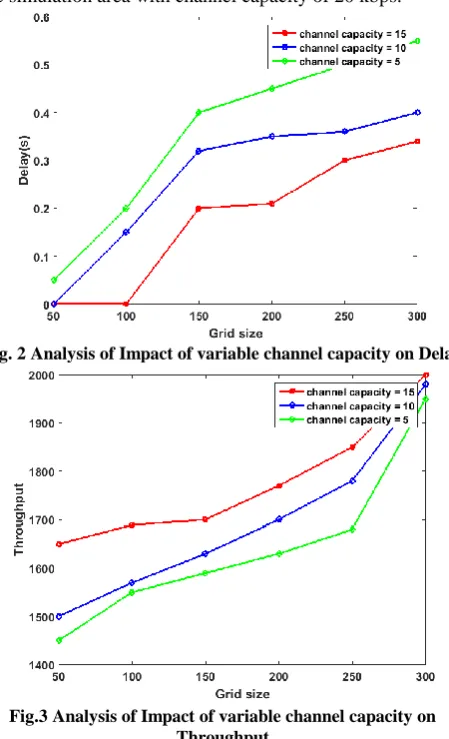
The implementation of the proposed system is carried out over the tracks obtained from the satellite image of an OpenStreetMap [31] fitted over the simulation area of 1200x1000m2 with simulation time of 300 seconds. The analysis is carried out
transmission probability with 100-500 vehicles spread over the simulation area with channel capacity of 20 kbps.
[image:4.595.57.282.73.443.2]Fig. 2 Analysis of Impact of variable channel capacity on Delay
Fig.3 Analysis of Impact of variable channel capacity on Throughput
Although increase of channel capacity is always anticipated to offer more supportability to relaying services, but focus is given to understand the degree of influence of channel capacity over delay and throughput. From Fig.2, it can be seen that channel capacity of 10-15 kbps is found to offer optimal reduction in delay. From Fig.3, it can be seen that variable ranges of channel capacity do not have much significant impact on the throughput. The prime reason behind it is that mechanism of selection of potential node within a group as well as adoption of graph-based model that makes the system quite reliable.
VII. CONCLUSION
This paper has discussed about a novel design of the infotainment system that is carried out on the top of a vehicular cloud system. The contributions of the proposed system are as follows: i) the study implements the complete algorithm over the graph which makes the network topology construction easier and simpler to maintain, which is required during dynamic topology of vehicle, ii) the applicability of the proposed system can be highly acclaimed as it is implemented over map system where visualization of results are validated, iii) the complete modeling is carried out considering the constraint of the existing infotainment system which shows better practicality of proposed system.
REFERENCES
1. Cheng, Ho Ting, Hangguan Shan, and Weihua Zhuang. "Infotainment
and road safety service support in vehicular networking: From a communication perspective." Mechanical Systems and Signal Processing 25, no. 6 (2011): 2020-2038.
2. Morales, Mike, and Robb Groner. "Interchangeable rear seat
infotainment system." U.S. Patent Application 10/063,904, filed August 28, 2018.
3. Sonnenberg, Jan. "Service and user interface transfer from nomadic devices to car infotainment systems." In Proceedings of the 2nd International Conference on Automotive User Interfaces and Interactive Vehicular Applications, pp. 162-165. ACM, 2010. 4. Chesnutt, Elizabeth, Sethu K. Madhavan, Iqbal Surti, and Jijin Yin.
"Synchronization and segment type detection method for data transmission via an audio communication system." U.S. Patent 7,912,149, issued March 22, 2011.
5. Cheng, Ho Ting, Hangguan Shan, and Weihua Zhuang. "Infotainment
and road safety service support in vehicular networking: From a communication perspective." Mechanical Systems and Signal Processing 25, no. 6 (2011): 2020-2038.
6. Khaluf, Yara, and Achim Rettberg. "Towards a Load Balancing
Middleware for Automotive Infotainment Systems." In International Embedded Systems Symposium, pp. 238-249. Springer, Berlin, Heidelberg, 2009.
7. Sonnenberg, Jan. "Service and user interface transfer from nomadic devices to car infotainment systems." In Proceedings of the 2nd International Conference on Automotive User Interfaces and Interactive Vehicular Applications, pp. 162-165. ACM, 2010.
8. Sepulcre, Miguel, Jens Mittag, Paolo Santi, Hannes Hartenstein, and
Javier Gozalvez. "Congestion and awareness control in cooperative vehicular systems." Proceedings of the IEEE 99, no. 7 (2011): 1260-1279.
9. Ricci, Christopher P. "Network selector in a vehicle infotainment system." U.S. Patent Application 13/829,799, filed August 22, 2013.
10. Reshma, M., and Priestly B. Shan. "ORetinex-DI: Pre-processing
Algorithms for Melanoma Image Enhancement." Biomedical and Pharmacology Journal 11, no. 3 (2018): 1381-1387.
11. Choi, Dong-Kyu, Joong-Hwa Jung, Ji-In Kim, and Juyoung Park.
"In-Vehicle Infotainment Management System in Internet-of-Things Networks." In 2019 International Conference on Information Networking (ICOIN), pp. 88-92. IEEE, 2019.
12. Kazmi, SM Ahsan, Tri Nguyen Dang, Ibrar Yaqoob, Anselme
Ndikumana, Ejaz Ahmed, Rasheed Hussain, and Choong Seon Hong. "Infotainment Enabled Smart Cars: A Joint Communication, Caching, and Computation Approach." IEEE Transactions on Vehicular Technology 68, no. 9 (2019): 8408-8420.
13. Costantino, Gianpiero, Antonio La Marra, Fabio Martinelli, and Ilaria
Matteucci. "CANDY: A social engineering attack to leak information from infotainment system." In 2018 IEEE 87th Vehicular Technology Conference (VTC Spring), pp. 1-5. IEEE, 2018.
14. Gupte, Ms Sayali, and A. R. Askhedkar. "An Innovative Wireless Design for a Car Infotainment System." In 2018 Second International Conference on Intelligent Computing and Control Systems (ICICCS), pp. 1751-1754. IEEE, 2018.
15. Su, Ke-Yu, Yu-Ching Mo, Liang-Bi Chen, Wan-Jung Chang,
Wei-Wen Hu, Chao-Tang Yu, and Jing-Jou Tang. "An in-vehicle infotainment platform for integrating heterogeneous networks interconnection." In 2018 IEEE International Conference on Consumer Electronics-Taiwan (ICCE-TW), pp. 1-2. IEEE, 2018.
16. Kovacevic, Branimir, Marko Kovacevic, Tomislav Maruna, and Istvan
Papp. "A java application programming interface for in-vehicle
infotainment devices." IEEE Transactions on Consumer
Electronics 63, no. 1 (2017): 68-76.
17. Kula, Irfan, Robert K. Atkinson, Rod D. Roscoe, and Russell J.
Branaghan. "A biometric usability evaluation of instrument cluster and infotainment systems in two hybrid cars." In 2017 IEEE SmartWorld, Ubiquitous Intelligence & Computing, Advanced & Trusted Computed, Scalable Computing & Communications, Cloud & Big Data Computing, Internet of People and Smart City Innovation (SmartWorld/SCALCOM/UIC/ATC/CBDCom/IOP/SCI), pp. 1-6. IEEE, 2017.
18. Gaffar, Ashraf, and Shokoufeh Monjezi Kouchak. "Minimalist design:
An optimized solution for intelligent interactive infotainment
systems." In 2017 Intelligent
International Journal of Innovative Technology and Exploring Engineering (IJITEE) ISSN: 2278-3075, Volume-9 Issue-2, December 2019
19. Sachara, Fabian, Thomas Kopinski, Alexander Gepperth, and Uwe
Handmann. "Free-hand gesture recognition with 3D-CNNs for in-car infotainment control in real-time." In 2017 IEEE 20th International Conference on Intelligent Transportation Systems (ITSC), pp. 959-964. IEEE, 2017.
20. Kovacevic, Branimir, Marko Kovacevic, Tomislav Maruna, and Davor
Rapic. "Android4Auto: A proposal for integration of Android in vehicle infotainment systems." In 2016 IEEE International Conference on Consumer Electronics (ICCE), pp. 99-100. IEEE, 2016.
21. Nii, Koji, Makoto Yabuuchi, Yuichiro Ishii, Miki Tanaka, Mitsuhiko
Igarashi, Kazuki Fukuoka, and Shinji Tanaka. "A dynamic/static SRAM power management scheme for DVFS and AVS in advanced automotive infotainment SoCs." In 2016 IEEE Symposium on VLSI Technology, pp. 1-2. IEEE, 2016.
22. Han, Ru, Min Pei, Sibasish Mukherjee, Milena Vujosevic, Kenneth
Darschewski, and Robert Kwasnick. "In Vehicle Infotainment and
Advanced Driver Assistance Systems: Advantages of
Knowledge-Based Qualification over Standard-Based Qualification for Solder Joint Reliability." In 2016 IEEE 66th Electronic Components and Technology Conference (ECTC), pp. 1946-1951. IEEE, 2016.
23. Das, Sounak Rajan, T. Emima Jakulin, and K. Gerard Joe Nigel.
"Linear and rotational air gesture detection using optical sensors setup in automotive infotainment system." In 2016 International Conference on Communication and Signal Processing (ICCSP), pp. 1164-1169. IEEE, 2016.
24. De Felice, Mario, Ian Victor Calcagni, Francesca Pesci, Francesca
Cuomo, and Andrea Baiocchi. "Self-healing infotainment and safety application for vanet dissemination." In 2015 IEEE International Conference on Communication Workshop (ICCW), pp. 2495-2500. IEEE, 2015.
25. Chen, Jiacheng, Bo Liu, Haibo Zhou, Lin Gui, Ning Liu, and Yiyan
Wu. "Providing vehicular infotainment service using VHF/UHF TV
bands via spatial spectrum reuse." IEEE transactions on
broadcasting 61, no. 2 (2015): 279-289.
26. Lüddecke, Daniel, Christoph Seidl, Jens Schneider, and Ina Schaefer.
"Modeling user intentions for in-car infotainment systems using bayesian networks." In 2015 ACM/IEEE 18th International Conference on Model Driven Engineering Languages and Systems (MODELS), pp. 378-385. IEEE, 2015.
27. Rene, Sergi, Ernesto Expósito, Mathieu Gineste, Juanjo Alins, and
Oscar Esparza. "Multipath TCP architecture for infotainment multimedia applications in vehicular networks." In 2015 IEEE 81st Vehicular Technology Conference (VTC Spring), pp. 1-5. IEEE, 2015.
28. Sadek, Noha M., Hassan H. Halawa, Ramez M. Daoud, Hassanein H.
Amer, and Nora A. Ali. "Heterogeneous LTE/Wi-Fi architecture for ITS traffic control and infotainment." In 2015 International Conference on Electrical Systems for Aircraft, Railway, Ship Propulsion and Road Vehicles (ESARS), pp. 1-6. IEEE, 2015.
29. Udovicic, Ksenija, Nenad Jovanovic, and Milan Z. Bjelica. "In-vehicle
infotainment system for android OS: User experience challenges and a proposal." In 2015 IEEE 5th International Conference on Consumer Electronics-Berlin (ICCE-Berlin), pp. 150-152. IEEE, 2015.
30. Abdullah, Nor Fadzilah, Angela Doufexi, and Robert J. Piechocki.
"Raptor codes-aided relaying for vehicular infotainment
applications." IET Communications 7, no. 18 (2013): 2064-2073.
31. Graf, Franz, Hans-Peter Kriegel, Matthias Renz, and Matthias
Schubert. "MARiO: multi-attribute routing in open street map." In International Symposium on Spatial and Temporal Databases, pp. 486-490. Springer, Berlin, Heidelberg, 2011.
AUTHORS DETAIL
Reshma S received her degree in Computer Science and Engineering from UBDT college of Engineering (2001)-Davanagere. She received her masters (M.Tech) degree from BIET (2009)-Davanagere. She worked as Lecturer in Govt. Polytechnic college (2002), BIET (2002-2005) and STJIT (2005-2009). Currently, she is working as Assistant professor in Global Academy of Technology (from 2011), Bangalore. She had been counselor in IGNOU for two years. She has authored or published 2 publications. Her areas of
interest are Networking and cloud computing.