Abstract: Vehicular Ad hoc Network (VANET) is divided as Mobile Ad-hoc Networks (MANETs) application which comprises the capability to offer Intelligent Transportation System (ITS) and to enhance road safety. VANET has many difficulties that various from instability problem that gives higher topological change and higher energy utilization with many advantages. The main aim to construct a route optimal path technique is to reduce the probability of linkage failure and decrease the node energy utilization within the network. ACO heuristic for vehicle routing is proposed in this paper. In this method mobility prediction is employed for stability of network and to reduce the utilized energy two-tier mechanism is employed by Location Aided Routing (LAR) protocol. The simulation outcomes in Network simulator 2 of the proposed method enhanced the node energy utilization within the network and it takes lower energy.
Keywords : VANET; Routing; Energy utilization; Mobility prediction; Intelligent Transportation System.
I. INTRODUCTION
Advancement in field of Science and Technology has additionally spread its armada in transportation and communication industry by means of improvement and deployment of VANET (Vehicular Ad Hoc Network) technology. Execution of Web of Vehicles through VANET has pulled in both transportation and administrations. Immediately, transportation industry is thriving at a fast rate because of expanding human needs. Disturbing increment being used of transportation offices, regardless of whether private or open vehicle, makes roads become frightful. Thus, advancement and air of VANET technology has end up being both basic and manageable for guaranteeing one's adventure free from any potential harm. VANET, a critical and engaging use of MANET, has intrigued enthusiasm of both transportation industry and academia. VANET incorporates vehicles, substituted as portable hubs, and furnished with on-board units (OBU) giving wireless technology. Likewise, road fragments are utilized with roadside units (RSU) giving ongoing data about traffic and road topology.
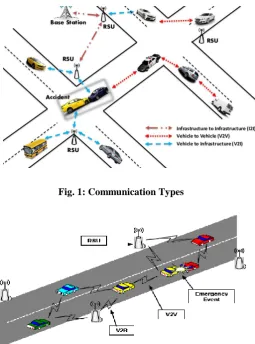
VANET enables enormous number of vehicles to be connected to couple of many meters, by utilizing OBUs and RBUs, shaping a network. VANET addresses two sorts of communication: V2V (VEHICLE to VEHICLE), every
Revised Manuscript Received on September2, 2019.
First Author Name*, his/her department, Name of the affiliated College or University/Industry, City, Country. Email: [email protected]
Second Author Name, department, Name of the affiliated College or University/Industry, City, Country. Email: [email protected]
Third Author Name, department, Name of the affiliated College or University/Industry, City, Country. Email: [email protected]
vehicle sends messages to different vehicles either straightforwardly or through multi-hop component. V2I (VEHICLE to Foundation), vehicles sets up an association with RSU and conveys through shaped routes to spread required data as appeared in Figure 1.
[image:1.595.305.561.344.689.2]VANET can be sent in one of streaming structural way: Unadulterated Cellular/WLAN, where access points (RSU) at intersections or cellular passages to give access to network and accumulate information. Ad-hoc network, a self-sorted network allowing vehicle-to-vehicle communication and no requirements for foundation [2]. Hybrid network, including administrations given by both V2I and V2V communication.
[image:1.595.307.565.349.520.2]Fig. 1: Communication Types
Fig 2: Architecture of Networks
Modified Ant Colony Optimization (ACO)
Algorithm for Routing in Vehicular Adhoc
Networks
II. LITERATURE REVIEW
A Secure Routing Protocol for Vehicular Ad Hoc Network: A Survey [3]
Mukesh Tripathi and Sandeep Rai (2015): Vehicular communication includes taking part hubs to speak with other portable hubs in scope of 100 - 300 meters and makes a framework with wide range. This expands odds of vindictive assaults by adversaries. The paper proposes security and assurance qualities by utilizing conveyed registering condition where confided in cloud condition is practiced, that is controlled together by client and cloud condition administrator. Moreover, adequacy is examined with expanding number of center points and measure of replication utilizing supreme world development conditions. Likewise centers around effect of encryption and unscrambling of verifiers and investigates its impact on computation.
A Review: Position Based Routing Protocol in VANET [4] Kirti R. Rathod and K.H. Wandra(2015): Exploration finishes up analyzes diverse steering conventions, for example, GPSR, GSR, GPCR, B-MFR, RBTV. This paper determines VANET directing network can work in two modes: vehicle to vehicle and vehicle to roadside foundation transmission. It additionally spotlight different conventions and difference them dependent on a few parameters as sending methodology, road maps, reproduction situations and conveyance rate execution. It presumes that a convention, for example, GSR needs road maps. B-MFR and Geo DTN+Nav conventions are able for less thick regions like roadways though RVBT and IGPR suits exceptionally thick regions, for example, city. An Energy-Efficient Routing for Vehicular Ad Hoc Networking Using Real-Time Perception of Node Information [5]
Zhongwei CUI et al(2015): In this work they proposed Vehicular open door route dependent on ongoing information(VORI). Under squeezed work hubs assemble continuous territory data and build up hot-zone for best between region choice for message conveyance. Reproduction consequences of proposed VORI calculation are then contrasted and traditional directing calculation, for example, Pestilence calculation, Prophet calculation, Shower and Hold up calculation regarding message conveyance rate, combined postpone likelihood, normal cushion time, normal number of hops and normal overhead proportion. Message conveyance rate of VORI is close to Splash and Hold up calculation from 0 to 12,000. Delay rate is lower than Pandemic calculation and close to Shower and Hold up calculation from 4,000 to 9,000. Reference to average support time and normal number of hops VORI calculation is close to Scourge and Prophet calculation individually. Additionally, VORI calculation can keep up status of neighbor hub by utilizing Hi parcels. Research finishes up VORI calculation is similarly more vitality effective than old style directing calculation.
Priority Based Congestion Control for VANET: Review [6]
Meenal Pannase(2014): It proposed Need Based Clog Control Convention (PBCCP) to improve network throughput other than parcel conveyance proportion and diminish delay. Data spread from such a large number of sources with
limitation of opportune and conveyance of message causes blockage issue in vehicular communication, consequently guaranteeing bundle dropping, low vitality productivity and broadened delay. Planned plan vanquish blockage issue progressively application by shortening delay, clog shirking and lessens parcel misfortune. Proposed work incorporates Blockage Discovery Unit (BDU) and Clog Notice Unit(CNU) to such an extent that both bundles drop and time postpone proportion are limited. The thought of parent and child hubs is utilized where descendants’ hubs of parent hub tune in blockage data cautioning. Deferral is processed utilizing current time as the parameter and arbitrary need is enlisted to messages. Execution of proposed work is evaluated regarding throughput, conveyance proportion and defer making it definitive for ongoing applications and limit parcel drop proportion just as protract delay.
Improving Energy and Efficiency in cluster based VANETS through AODV protocol [7]
Prerana Deshmukh et al(2014): It proposed an upgraded AODV(Ad hoc On Interest Separation Vector) convention that improves execution by utilizing area-based grouping instrument. Research strategy is completed in stages as: Network development, Determination of Methods of transmission. At that point LB-VANET(Location Based VANET) calculation is utilized. In addition, it refines repetition disclosure stage and make light of vitality use during message scattering by drawing in two level system. Improved convention additionally leads to decrease in overhead for each route and is equipped for managing different traffic conditions.
An Energy-Efficient Routing Protocol Using Movement Trends in Vehicular Ad-Hoc Networks[8]
Daqiang Zhang et al (2013): Plotted ERBA, an energy effective routing protocol utilizes development patterns thinking about driver's conduct and vehicle order. Development propensity is conveyed by considering present and future headings. ERBA empowers packet dissemination by utilizing proactive, prediction-based routing protocol for picking manageable routes for application where delay is basic. Picked system follows that little and proficient route is chosen without any loops. ERBA investigates genuine urban situation from Shanghai venture embraced and associates with AODV and ROMGSP considering execution measurements, for example, throughput, likelihood density function, neighbourhood solid connections and start to finish delay. It infers that ERBA outflanks others in accomplishing better execution and least energy usage by choosing imagines routes.
Design and Implementing PGP Algorithm in Vehicular Ad Hoc Network [9]
Navdeep Kaur Randhawa(2012): It proposed Pretty Good Privacy(PGP) calculation that licenses secure start to finish communication past interference. The proposed calculation is increasingly light-footed and secure interestingly with existing algorithms.PGP depends on pressure procedure and session key utilizing encryption and decoding calculation. Paper additionally spotlight scope, different applications and dangers engaged with VANET.
Signatures, Privacy and Declarations.
A VANET-Based A* Route Planning Algorithm for Travelling Time- and Energy- Efficient GPS Navigation App [10]
Inn-Chau Chang et al.(2013): VANET based A* route planning calculation is favoured that objectives to decide and choose the route with most minimal fuel utilization or briefest voyaging time. The calculation gets required continuous traffic data from two sources and updates the vehicle route's as per constant traffic and road conditions. An application is created and actualizes on Android stage. One of data source is ready, the units prepared in vehicles that reports traffic data, for example, regardless of whether vehicle has crossed a convergence or its speed. This data is scattered among nodes through IEEE 802.11p wireless connection. Second wellspring of data is Google maps. This data from the two sources is collected so to furnish drivers with exact and adequate route for sending. Pervasive reproductions have been finished by contrasting executed calculation and different protocols, for example, Dijkstra, A*, TTU-A*(angle), TTU-A*(angle+speed),VBA*(fuel) and VBA*(time) thinking about time, separation and fuel as execution metric. It accomplishes down turning of normal voyaging time and fuel utilization by sending it in both clogged and non-blocked time interim.
Routing Protocols in Vehicular Ad Hoc Network: A Survey and Future Perspectives[11]
Yun-Wei Lin et al(2010): The paper ends up assorted routing protocols feature three noteworthy arrangement: Unicast routing, multicast and geocast routing and broadcast routing protocols. It additionally deciphers difficulties and viewpoints for each. It presumes that routing protocols must be planned with the end goal that there is low communication overhead, low time cost and adaptability for adjusting as per traffic density.
A Fixed Sensor-Based Intersection Collision Warning System in Vulnerable Line-of-Sight and/or Traffic-Violation-Prone Environment [12]
Jeong-Ah Jang(2006): In this paper, to recognize and localizing the Sybil nodes in VANETs, another security strategy is proposed. This technique is based on the measurement investigation of the signal quality circulation. Through this technique, every vehicle present on the road can distinguish the Sybil vehicles closer to them with the assistance of this appropriated and localized component. This is done through check of the asserted positions. A fundamental signal quality based position check plan is first presented. Here, the traffic designs just as the help from the roadside base stations are utilized something like their advantages. Here, two factual algorithms are utilized for upgrading the precision of the positional confirmation. The confirmation blunder rate is brought down with the assistance of the measurement idea of these algorithms. For the discovery of Sybil nodes in GPS just as RSSI, the signal estimations are utilized. The revealed places of the vehicles are affirmed with the assistance of Vehicle-to-Vehicles communication utilized inside this plan. The RSSI estimations are utilized for reference purposes. The parameters, for example, vehicle portability, traffic examples
and supports from the roadside are utilized for redressing the errors distinguished in the RSSI estimations.
III. ACO heuristic for vehicle routing A. Route Construction
ACO assists in the creation of a vehicle by incorporating a single insect, route selection is accomplished by selecting the customers till the total number of customers who have visited the concerned site satisfies. The beginning point opted by an insect is the stop point followed by which the order of the customers for the respective visit would be left empty. The rundown points of the practical areas can be visited by the customer suitably selected by the subterranean insect, refreshment of the total volume levels would be accomplished prior to the next visit by a customer. Once the entire lot of customer visit ceases and once the expected limitation levels are met by the vehicle the subterranean insect would get back to its initial stop point. The target function is denoted by the absolute separation L which is thus considered as an incentive for the entire route of the concerned counterfeit subterranean insect. The computation procedure adopted by the ACO is to develop a combined visit concerning the main insect prior to the initialization of the subsequent subterranean insect’s visit. The above mentioned procedures would continue till a foreordained number of ant’s m develops a practical route. Adopting the benefits of the ACO each and every individual insect is expected to develop a prescribed vehicle route that visits each and every customer. For the purpose of selecting a customer j, the insect makes use of the accompanying probabilistic equation j Z arg max.
B. Trail Updating
Refreshment of the ants is essential for establishing the insect's presentation and for discovering the order of the concerned arrangements. The above mentioned strategy is thus observed as the key component to the adaptive learning procedure of the ACO and thus ensures the efficiency of the out coming arrangements. The composition of the neighbourhood trail upgrades after the generation of the individual arrangements and the global upgrades of the best ordered path resulting after the practice of a foreordained number of arrangements has been observed as the trail upgrade.
The above mentioned upgrade essentially energizes the use of shorter pathways and thereby elaborates the option wherein the future pathways would make use of the curves pertaining in the best arrangements. This strategy would be essentially rehashed for a foreordained number of iterations, followed by which the best arrangement opted from the majority of the iterations would be then established as a yield of the concerned model and would turn out as a perfect guess of the ideal answer for the corresponding issue.
C. Route Improvement Strategies
The above illustrated route building procedures and pheromone upgrading strategies have been observed as the run of the mill for the ACO since it is correlated with the travelling salesman issue in any situation. The development of the VRP wholly depends on the
route selection procedures in the corresponding computations.
The initial procedure of the above illustrated strategy is to concentrate on the neighbourhood trade technique as an improvement heuristic within the pathways identified by the concerned individual vehicles. The methodology thus adopted here is the basic 2-pick heuristic, in this strategy all the conceivable pair wise trades of the existing customer areas would be thus viewed by the individual vehicles for the purpose of verifying the enhancement in the established target functions. It has been observed that the concerned main vehicle travels from its prescribed station to all the other areas {1, 6, 5}. The heuristic will has been found to evaluate the corresponding separations for all the related pair wise permutations {{6, 1, 5}, {1, 5, 6}, {5, 6, 1}} of the concerned set comprising of those three customer areas. At the outset the accomplished arrangements have been found to enhance the related goal function, once achieved the corresponding arrangement would be then modified prior to the sparing task as it has been found to with hold the best arrangement and the leading pheromone upgrade for the opted route. The above mechanism contributes to the total volume of individual blends that are essentially verified by the pursuit and has been further viewed as a strategy for settling a limited number of TSPs in the wake of doling out the corresponding customers to vehicles.
D. Multiple Ant Colonies
The wiring portion incorporates the necessary recommendations related to the adoption of certain unique gatherings or groups of ants, yet this procedure has been observed to lack actualization in past research for the VRP. Certain ideologies based on the unique employment nature of the ants such as the arranging quality, scrounging or protecting ability of its home has led to the incorporation of the separate gathering mechanism of the ants. Crucial thinking mechanism would turn out as an essential and required task if unique and separate colony of ants possessing pheromone stores is incorporated and used for every individual vehicle. The above illustrated separation essentially classifies the ordinary routes used in the principal vehicle route from those utilized by the consequent vehicles, this method has been considered powerful as the size of the concerned issue and the volume of the vehicles required gradually increases. Let us consider an issue comprising of 50 customer areas, in this case an appropriate arrangement would probably with hold at least five separate vehicles, where each of them would possess a separate and unique pathway to and from the main warehouse area. Adoption of the multiple insect states would preferably locate the primary vehicle's route integrated with the pheromone apart from the subterranean insect colony #1, it has been viewed that these stores will least assist in deciding the pathway for the subsequent vehicle. On the other hand the route for the subsequent colony would essentially depend upon the pheromone stores created by the subterranean insect colony #2, etc. The limitation of this procedure is that it adds to a minimized level of breaking point on the communication track. Yet this methodology has been found to assist in the discovery of multiple paths where its stratification levels would essentially add to the concentrated endeavours. The
vehicle here has been observed to make use of the identified routes and thereby isn't occupied by the pheromone paths of the ants appointed to the various vehicles.
[image:4.595.301.554.333.497.2] [image:4.595.304.556.594.833.2]IV. EXPERIMENTAL EVALUATION In this segment the exploratory consequences of the projected strategy are examined. The projected strategy was recreated utilizing NS-2 on Ubuntu variant 14.04 working framework that has a processor of 2.30 GHz Intel Centre i7 with 4GB Slam and 500 HDD. This framework adopted similar parameters utilized by Laroiya and Lekhi (2017), these parameters are: NS-2 Test system, re-enactment time of 500 seconds, 35, 50 and 75 versatile nodes, 1000 m X 1000 m reproduction zone, Steady Bit Rate (CBR) traffic type, packet size of 512 bytes. The presentation of the proposed framework was estimated based on three situations; Energy devoured by every hub when utilizing 35 nodes, Energy devoured by every hub when utilizing 50 nodes and Energy devoured by every hub when utilizing 75 nodes. Energy consumption analysis is given in fig. 3 and table 1 by both the existing and proposed ACO Algorithm.
Table 1: Energy Consumed (Joules) Simulation
time (sec)
No. of Nodes
Energy consumed (existing)
Modified route optimal path
Prop osed
500 35 39 26 20
500 50 89.44 54 29
500 75 112.32 72 35
Figure 3: Graphical Analysis of Energy Consumption
V. CONCLUSION
Execution of Web of Vehicles through VANET has pulled in both transportation and administrations. Immediately, transportation industry is thriving at a fast rate because of expanding human needs. The main aim to construct a route optimal path technique is to reduce the probability of linkage failure and decrease the node energy utilization within the network. ACO heuristic for vehicle routing is proposed in this paper. The experimental outcomes are given. The utilized energy by the existing method are higher when compared with the projected methods. The proposed method attains increased performances with the compared methods by means of energy utilization.
REFERENCES
1.Jakubiak, Jakub; & Kocheryavy, Yevgeni (2008). ”State of the art and research challenges for VANETs.” IEEE.
2.Lin, Yun-Wei;Chen, Yuh-Shyan;Lee, Sing-Ling.(2010).”Routing
Protocols in Vehicular Ad Hoc Network: A Survey and Future Perspectives.” International Journal of Information Science and Engineering, 26, Pages: 913-932.
3.Tripathi M; & Rai, Sandeep(2015). ”A Secure Routing Protocol for Vehicular Ad Hoc Network: A Survey.” IJARCCE, Volume: 4, Issue: 5. 4.Rathod, Kirti R; & Wandra, K.H. (2015) ”A Review: Position based
Routing Protocol in VANET.” RHIMRJ, Volume: 2, Issue: 10.
5.CUI, Zhongwei; ZHAO, Yong; XU, Daoyun; &
ZUO,YU(2015,June).”AN ENERGY-EFFICIENT ROUTING FOR VEHICULAR AD HOC NETWORKING USING REAL-TIME PERCEPTION OF NODE INFORMATION.” International Journal on Smart Sensing and Intelligent System, Volume: 8, Issue: 2.
6.PannaseMeenal, (2014,January).”Priority Based Congestion Control for
VANET: Review.” International Journal of Advance Research in Computer Science and Management Studies, Volume: 2, Issue: 1.
7.Deshmukh P; & Sonekar, Shrikant(2014). ”Improving Energy and
Efficiency in cluster based VANETS through AODV protocol.” International Journal of Computer Science and Information Technologies, Volume: 5, Issue: 3.
8.Zhang D; Yang Z; Raychoudary V; Chen, Z; & Lloret, J.(2013). ”An EnergyEfficient Routing Protocol Using Movement Trends in Vehicular Ad-Hoc Networks.” Computer Journal, Volume: 56, Issue: 8, Pages: 938-946.
9.Randhawa, Navdeep Kaur,(2012). ”Design and Implementing PGP
Algorithm in Vehicular Ad Hoc Network.” International Journal of Engineering Research and Applications, Volume: 2, Issue: 3.
10. Chang, Inn-Chau.; Tai,Hung-Taet al.(2013).”A VABET-Based A*
Route Planning Algorithm for Travelling Time- and Energy- Efficient GPS Navigation App.” International Journal of Distributed Sensor Networks.
11. Lin, Yun-Wei; Chen,Yuh-Shyan; Lee, Sing-Ling.(2010). ”Routing
Protocols in Vehicular Ad Hoc Network: A Survey and Future Perspectives.”International Journal of Information Science and Engineering, Volume: 26, Pages: 913-932.
12. Jeong-Ah Jang(2006).”A Fixed Sensor-Based Intersection Collision
Warning System in Vulnerable Line-of-Sight and/or
Traffic-Violation-Prone Environment”, IEEE Transactions on Intelligent Transportation Systems, Pages: 1-11.
AUTHORS PROFILE
Dr. C Anbu Ananth, is currently working as Associate Professor in Department of Computer Science and Engineering, Annamalai University, Chidambaram, Tamilnadu, India. He is currently guiding 08 research scholars. He is having 16 years of experience and expert in Computer Networks, Wireless Communication and Computer Graphics.
He has published 10 International Journals, and presented the research articles in 2 International Conferences and 5 national Conferences. He is a Life member of ISTE, CSI etc..