library management system which is extremely helpful to implement such an automated library management system. The system includes 3 layers for operation wherein these are a hardware system, a software system, and ware layer. The functioning of each and every module is described in the projected paper. The project is implemented for university/college/school libraries. The system explains whole functioning starting from and ending to circulation of books.
Index Terms— RFID Tag, RFID Reader, Library Management, Automatic System, Bar Code.
I. INTRODUCTION
Conventional process for management of a library is very much time consuming, as the manual process require much time and makes the system slow which results in wastage of time for readers as well as for inventory. There are always large number of books are present in every library and it increases as time passes. So, the management of a library is very difficult task for a person in a traditional way[1]. Libraries require large numbers of books, we cannot do any compromise in this because these are very necessary for both students and teachers. The advancement in management increases the efficiency and service quality. The use of RFID for management of book releases many librarians. The flow of books can be amplified by the introduction of technology in the system and librarians can do other work also[2][3].
The present paper is designed to manage the libraries of colleges/universities/schools which completely relied on “Radio Frequency Identification and Detection technology”. The technology for management makes the system automatic and intelligent. In this paper second section describes projected work, Third section of the paper explains the combination of RFID technology and management system. Third section is focuses on functioning of every module present in the system[4][5][6].
Now-a-days, street lights consume large part of power. The experimentation by following the work done.
Revised Manuscript Received on September 10, 2019.
Sarmistha Satrusallya, Dept. of Electronics & Communication Engineering, Siksha O Anusandhan Deemed to be University, Odisha, India.
(E-mail:[email protected])
Aneesh Wunnava, Dept. of Electronics & Communication Engineering, Siksha O Anusandhan Deemed to be University, Odisha, India.
(E-mail:[email protected])
uses electromagnetic waves to transmit related data. ‘RFID’ (radio frequency identification) is a sort of wire restricted technology for communication and technology. An ‘RFID system’ comprises of three basic elements that are a scanning antenna and transceiver and a transponder, the RFID card. An ‘RFID’ card consists of memory, microchip and antenna. The RFID reader module is network-connecting device that is indelibly portable. To convey signals technology follows radio frequency waves that make the card activated. After the activation of the card, the card or tag directs a wave to the consisting antenna back, wherein it’s transformed into a data form[7][8].
b) Application of the Technology:
RFID system, a self-determined system for management that comprises software atmosphere and hardware atmosphere both but to perform a definite function it the technology is combined with other technologies. The RFID based library consists of 3 layers wherein first layer is made up of RFID System, second layer is a ware layer, and third one is a layer for library management[9].
The first layer is made up of hardware and software system. Second layer which is a ware layer is interlinked between management system and RFID system. The second layer is comprising an interface and a component to process the data.System consists a structure of application interfacing that is used to interlock with further technical structure, thus the related data in diverse systems to attain resource-sharing
i. Hardware System:
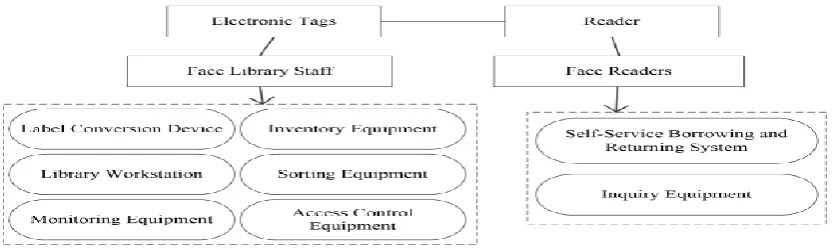
the hardware system also comprises label alteration devices, workstations for librarian, sorting equipment, inventory equipment, entrance control, safety amenities, borrowing and returning system, review apparatus.
ii. Software System:
System software because of the spreading of Web apps and diverse n/w atmosphere with the help of “Sun's Java 2 Platform Enterprise Edition” (J2EE) as a stage for developing software. “J2EE” is intended for huge enterprise hostleve type computing, provided the decent frame-work to build scalable, easily-maintained, and flexible business systems. The frame-work helps all features of enterprise applications from design progress to definite applications. The “J2EE” stage comprises a service set, different protocols, and application program interfaces (APIs). “J2EE”for accessing various type of database via the “Java Database Connectivity” (JDBC), usages “Enterprise Java Bean (EJB)” to progress and implement dispersed business logic, uses the “Java Server Pages (JSP)” response to client, then realize the layer operation
iii. Second Layer (Ware Layer):
[image:2.595.102.519.91.216.2]The second layer is intermediate link between RFID software and application system. The layer is a message leaning layer. The data is which is related, is dispersed in the procedure of message from a program to other and then further. Middle layer is used for providing a shared set of application programming interface (API) that attaches to the reader, and analyses the respective RFID tag’s data and other processes. The second layer consists of 3 components as shown in the Figure 2 that are reader adapter, event manager and an application interfacing.
Figure 2 Representation of second layer
III. LIBRARY MANAGEMENT SYSTEM AND RFID TECHNOLOGY
Figure 3 Flow chart for the system with RFID technology
The system for managing libraries that uses “RFID technology” implements “Business Process Reengineering (BPR)” to shorten the process, recovers the effectiveness of the staff, advance the circulation rate of the books and expand the facility of a library. System expansion precise duty process analysis, combined with “RFID technology management system”, the book into the library after the first categorization of cataloguing and label work related to writing and related to reading, and after that the sorting system is used to categorise the types of books and shelves, afterwards books can be borrowed by the readers. The choice between manual borrow process and self-help system depends on the readers, the sorting system is used to return the book the books are classified and shelved. In accumulation, one can also custom the RFID joint with automatic record equipment literature resources inventory enquiry operation of the library. Explanation, RFID based, business process for library is categorized into editing, borrowing, inventory of the 4 major processes and sorting. It can be seen from Figure 3.
Figure 4 Process of electronic label conversion
IV. METHODOLOGY & RESULTS
The model operation embraces a label alteration subsystem, a system for the self-service lending and returning, record counting sub-system, access control of security access, etc. Explicit module operation examination is given as:
A. Sub-system for converting label:
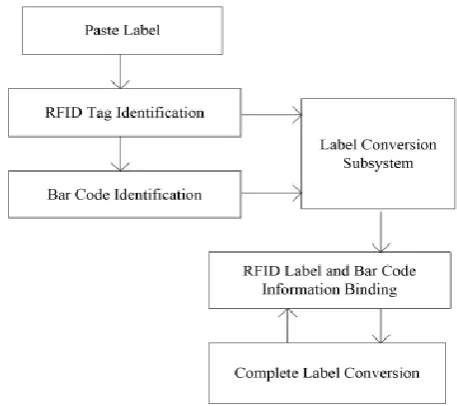
For the purpose of fast exchange of Label to “RFID” tag this sub-system is employed. The sub-system works with mainly an “RFID” tag transfiguration hardware equipment and software system for exchange; IN accordance of the necessity of user the software sub-system would be modified. The label conversion equipment is interlinked with the software and “RFID” tag is attached to the book in any hidden page of the book. Contactless interpretation of “RFID” tags, while the bar-code has been read, and after that the related data of the code of the book is rapidly transcribed to label. Bar code and RFID tag information bonded in series completing the conversion of the label of a book. Precise procedure is represented by Figure 4.
[image:3.595.72.285.52.248.2]Figure 5 Self-service lending and repaying subsystem
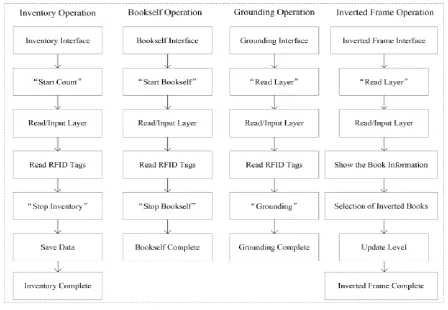
Figure 6 Flow chart for of sub-system for inventory count Checking the damage, debts, and all related information.
First enter the given password to sign in and get the data of library card, and then the “RFID” tag is scanned by the reader and recognise the RFID tag no. is registered or not, then get the data of the bar code, modification in the status of lending or returning/renewing books. The “RFID” reader is able to read upto 20 “RFID” tag data of books at a time. For renewal of the books, sign in the system’s central interface and press the "renew “button ,documentation of the certificates is done by scanning of the card (library card), then password would be entered and there is a button
[image:4.595.77.526.322.632.2]authorizations of reader and information about the books, in the absence of the library card the books are not moved by the reader for take out the security access, an alarm and light would be generated. The system is employed with the security controlling system to stop the books from missing out of library.
V. CONCLUSION
The projected work utilizes the “RFID” technology which provides high security, confidentiality, worthy standard presentation, modest procedure and intelligent controlling. The presented project helps in solving the difficulties of traditional management system for library, such as difficult, time taking, less secure system etc. The advanced Library management system can be achieved by using “RFID technology”. Present paper emphases on the
scheme of management system for a
university/college/school library centred on RFID, the building of the hardware system and software system environment. The system management design in the real time use, to recover the passage of book-rate, release employees, and improve the speed of operation of library facility
VI. REFERENCES
1. X. Yang, Q. Wei, and X. Peng, “System architecture of library 2.0,” Electron. Libr., 2009.
2. A. Tripathi, “Online Library Management System,”
IOSR J. Eng., 2013.
3. U. Dhanalakshmi, M. and Mamatha, “RFID based
Library Management System,” Proc. ASCNT, 2009. 4. K. Coyle, “Management of RFID in libraries,” J. Acad.
Librariansh., 2005.
5. Y. K. Dwivedi, K. K. Kapoor, M. D. Williams, and J. Williams, “RFID systems in libraries: An empirical examination of factors affecting system use and user satisfaction,” Int. J. Inf. Manage., 2013.
6. K. Kapoor, Y. Dwivedi, N. C. Piercy, B. Lal, and V. Weerakkody, “RFID integrated systems in libraries: Extending TAM model for empirically examining the use,” J. Enterp. Inf. Manag., 2014.
7. X. Jia, Q. Feng, T. Fan, and Q. Lei, “RFID technology and its applications in Internet of Things (IoT),” in 2012 2nd International Conference on Consumer Electronics, Communications and Networks, CECNet 2012 -
Proceedings, 2012.
8. J. Zhou and J. Shi, “RFID localization algorithms and applications-A review,” J. Intell. Manuf., 2009.