International Journal of Innovative Technology and Exploring Engineering (IJITEE) ISSN: 2278-3075, Volume-8 Issue-8S, June 2019
Abstract: In this paper optimized spectrum detection method with dynamic threshold adjustment is proposed, to improve the spectrum efficiency of cooperative sensing and to reduce the system overhead. Based on single sensing node minimum error detection probability an expression for dynamic threshold under different channel environment is derived. Optimal sensing node number is obtained according to the constant detection and constant false alarm rate, and the system detection error probability is obtained by combining the optimal number of sensing nodes with the adaptive threshold. Simulation result shows that the proposed method can improve the detection probability and reduce the detection error probability.
Keywords: Cognitive Radio (CR), Cooperative Spectrum Sensing (CSS), cognitive radio networks(CRN).
I. INTRODUCTION
With the development of wireless communication systems, the demand for higher data rates has gradually increased. On one hand, due to limited spectrum resources, fixed frequency allocation schemes cannot meet the increased spectrum requirements [1]. On the other hand, the spectrum utilization rates of different frequency bands vary widely. In the United States, for example, the US Federal Communications Commission reports that the spectrum, utilization rate varies with time, region and frequency band, and ranges from 15% to 85%. Cognitive Radio (CR) is an effective means to improve the efficiency of spectrum use [2]. It is an intelligent wireless communication system that allows secondary users to take advantage of the primary environment by using an embedded set of methods to understand the environment and adaptively adjust its internal parameters, such as frequency bands and transmit power, when spectrum that user is not using. Spectrum sensing is a key technology in cognitive radio technology. Commonly used spectrum sensing has matching filter detection, energy detection and periodic stationary process feature detection [3], in which the energy calculation has low computational complexity, and has received extensive attention.
One of the challenges of spectrum sensing is the hidden terminal problem, which occurs when the cognitive user (also known as the secondary user) is behind the building or due to severe multipath fading,
Revised Manuscript Received on May 22, 2019.
Yedunuri Shekar, ECE Department, S R Engineering College, Warangal, India
Kanne Naveen, ECE Department, S R Engineering College, Warangal, India
Rajkumar Maharaju, ECE Department, S R Engineering College, Warangal, India
while the primary user is nearby secondary user [4]. Due to the hidden terminal problem, the cognitive user will wrongly believe that the primary user is not using the frequency band at this time, thereby recognizing that the user accesses the channel and causing interference to the authorized user (also referred to as the primary user). Cooperative spectrum sensing by multiple cognitive radio users can effectively solve hidden terminal problems in cognitive radio networks. Cooperative spectrum sensing needs to cooperate among different secondary users. First, each secondary user needs to make independent decisions. In order to reduce the overhead in the communication process, the binary decision result of the hard decision “0” or “1” will be sent to fusion centre. The fusion centre then collects information from each sub-user, and finally decides whether or not the primary user has a present at the fusion centre. The literature [5] shows that the performance of cooperative spectrum sensing is greatly improved with the increase of the number of cooperative users, but from literature the threshold according to the minimum error detection probability of the system is solved, and does not give the final expression, nor gives a relational expression for each secondary user threshold and signal to noise ratio. Reference [6] gives the optimal number of users involved in cooperative detection, but fixed threshold is assumed.
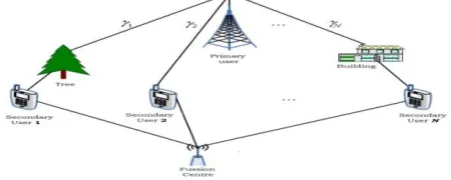
[image:1.595.324.550.557.647.2]In this paper, a cooperative spectrum sensing method with dynamic threshold adjustment is proposed, and the dynamic thresholds in different channel environments are given. The system's constant false alarm rate and constant detection rate are used to find the optimal number of cooperative users respectively and the optimal cooperative users are obtained. The number and dynamic thresholds are obtained by cooperative detection probability and system detection error probability.
Fig. 1 Cooperative spectrum detection model in cognitive radio systems
II. SYSTEM MODEL AND ENERGY DETECTION
TECHNOLOGY
Optimized Dynamic Threshold Adjustment
Method for Cooperative Detection
The proposed method is based on the cooperative spectrum detection model shown in Figure 1, with N secondary users, a primary user, and an information fusion centre.
It can be seen from Figure 1, due to the fading or shadow effect, single-node detection will not be able to detect the primary user, but N secondary users can improve the detection efficiency of the entire system through cooperative spectrum sensing. In cooperative spectrum sensing, in order to minimize the overhead in the communication process, each secondary user will report the sensed result “0” or “1” after using the hard decision to the information fusion centre, where “0” indicates that the primary user does not exist and “1” indicates the presence of primary user. The Information Fusion Centre then uses relevant decision fusion criteria (such as the OR criteria) to determine if the primary user is present. In Figure 1, is defined as signal-to-noise ratio of the primary user to secondary user, and
is the threshold for the secondary user detection. Because it is difficult to obtain the relevant information of the primary user signal in reality, and the computational complexity and complexity of the energy detector are relatively low, in this paper energy detection algorithm is used.
Spectral sensing based on energy detection can be expressed as the following hypothesis test problem [7]:
(1)
where is the signal received by secondary user,
is the signal sent by the primary user;
is the additive white Gaussian noise (AWGN) ;
is the sensed channel gain between the ithsecondary user and the primary user; means the primary user does not exist, means the primary user exists. The energy detection decision statistic E obeys the following distribution [8]:
(2)
where is a chi-square distribution with a degree of freedom of 2TW; is a non-central chi-square distribution with a degree of freedom of 2TW; the non-central coefficient is ; TW is the time-bandwidth product. For ease of derivation, it is assumed that TW is a positive integer and is represented by u.
In cooperative spectrum sensing, the performance of spectrum sensing will be determined by the false alarm probability , the missed detection probability and the system detection error probability . In a non-fading environment, the channel gain h is a certain amount. The secondary user's detection probability, false alarm probability and missed detection probability expression are as follows
(3)
(4)
(5)
where, is markov function, and
represents incomplete and complete gamma functions, respectively.
III. THRESHOLD DYNAMIC ADJUSTMENT
ALGORITHM AND USER SELECTION STRATEGY Threshold dynamic adjustment method for cooperative spectrum sensing
Based on Figure 1, it is assumed that the signal-to-noise ratio of the primary user to each secondary user is
, and the corresponding threshold values are
. From the section 2, the detection probability, false alarm probability and miss probability expression of the secondary user are as follows
(6)
0 −1 − (7) , =1− , (8)
Where, is the number of secondary users in the cognitive radio network. The probability of detection errors for secondary user is:
(9)
Where, and are respectively expressed as probability that the primary user does not occupy the channel and occupy the channel.
The rate , is related and it is also related to the probability of miss detection . The false alarm probability , and the size will affect the opportunity of the secondary user to access the channel, and the missed detection probability will cause interference to the primary user. Therefore, in spectrum sensing, the probability of error is detected, not only affect the secondary users, but also affects the primary users, which forces the pursuit of detection error to achieve the minimum.
The following is a relational expression between the threshold value and the signal-to-noise ratio at which the probability of single-point detection error is minimized. Since the false alarm probability of the secondary user is related to the threshold value , and the missed detection probability of the secondary user is not only related to the threshold value but also related to the signal-to-noise ratio . For the error detection probability, is derivation
of the threshold value . Let
, then: (10)
According to(6) ~ (8) can be obtained: (11) (12)
Substituting equations (11) and (12) into equation (10):
(13)
Assuming that the
International Journal of Innovative Technology and Exploring Engineering (IJITEE) ISSN: 2278-3075, Volume-8 Issue-8S, June 2019
not occupying the channel are equal,
that is, there is , and thus equation (13) can be
changed to:
(14) Where
(15)
Since the function containsu −1 order type 1 modified Bessel function, it is difficult to find the explicit function expression of each secondary user threshold and the signal to noise ratio . Therefore, an implicit function relation expression between the two is given. Since it is difficult to solve the implicit function , the threshold value corresponding to different signal-to-noise ratios is obtained.
Method of selecting the optimal number of users
The literature [6] gives the optimal number of cooperative users based on the system constant false alarm rate or constant detection rate. The optimal number of secondary users used in this method is also N. After the optimal number of users is determined, selecting secondary users to participate in cooperation can be done as follows:
Each secondary user sends the signal-to-noise ratio measured at its receiving end to the information fusion center.
The information fusion centre sorts the signal-to-noise ratio sent by each sensing node from high to low and puts it into the row vector .
Select the secondary user from the first element in . The number of selected elements is determined by the optimal number of users .
After the required signal-to-noise ratio is determined, the equation (14) is solved, so that the corresponding threshold value can be obtained.
Bring the different corresponding into equations (6) to (9) to obtain the corresponding detection probability , false alarm probability , miss detection probability and detection error probability, .
Based on the OR fusion criterion, the cooperative detection probability and the cooperative false alarm probability can be obtained and the probability of error
to obtain the system error probability .
IV. SIMULATION RESULTS AND ANALYSIS
In order to verify the validity of the method proposed in this paper, the simulation results are carried out by using MATLAB software, and the performance is compared with the existing methods.
Single point error probability detection
Here we assume that there are 1 primary user and 41 secondary users in the cognitive radio network. The signal-to-noise ratio of each link is not the same, namely:
, time Bandwidth product .
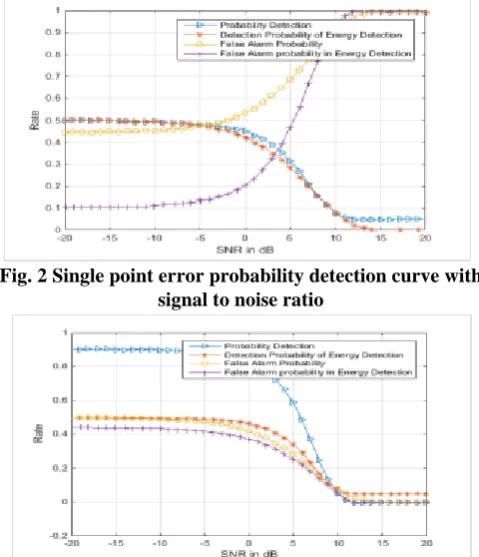
Figure 2 and Figure 3 show the curves of single point detection probability (false alarm probability) and detection error probability with signal-to-noise ratio respectively. In order to facilitate comparison, Figure 2 also gives the simulation results of the traditional method under the constant false alarm, and sets the single point constant false alarm rate, .
[image:3.595.48.284.94.243.2]It can be seen from Fig. 2 that at low SNR, the single-point detection probability of this method is significantly higher than that of the traditional method, and the difference between the two is less obvious with the increase of SNR. Moreover, regardless of the channel environment, the detection error probability of the proposed method is lower than the detection error probability of the traditional method. Figure 3 is a comparison of the traditional method with constant detection, with a single point constant detection rate of . It can be seen that in the case of poor channel environment, the single-point false alarm probability of this method is smaller than the single-point false alarm probability of the traditional method, and as the channel environment becomes better, the two tend to be consistent. Moreover, regardless of the quality of the channel environment, the detection error probability of this method is smaller than the detection error probability of the traditional method.
Fig. 2 Single point error probability detection curve with signal to noise ratio
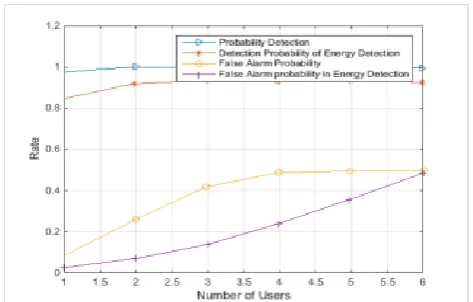
[image:3.595.306.546.422.701.2]Fig. 4 Cooperative error detection probability curve with the number of users
Fig. 5 Cooperative false alarm probability and system detection error probability curve with number of
cooperative users
Cooperative detection rate and system error probability detection in cooperative spectrum sensing
Here we assume that there are 1 primary user and 33 secondary users in the cognitive radio network. The signal-to-noise ratio of each link is not the same, namely:
, time Bandwidth product .
Figure 4 shows the cooperative detection probability and the system error detection probability as a function of the number of cooperative users. For the sake of comparison, the simulation results of the traditional method system, constant false alarm are also given, and the system constant false alarm rate is . When the system has a constant false alarm rate, the number of optimal users participating in the collaboration can be found based on the OR criterion (option is indicated by a circle in the figure). Because when the number of cooperative users is , the detection performance of the system can be optimized. Therefore, only the number of cooperative users is given as a result.
It can be seen from Fig. 4 that the cooperative detection probability of the proposed method is higher than that of the traditional method, and the system detection error probability is lower than the traditional system detection error probability.
Here we assume that 1 primary user and 36 secondary users in the cognitive radio network. The signal-to-noise
ratio of each link is not the same, namely:
, time Bandwidth product .
Figure 5 shows the curve of cooperative false alarm probability and system detection error rate with the number of cooperative users. In order to facilitate comparison, the simulation results of constant detection of traditional method are given at the same time, and the system constant detection rate is set, and the number of optimal cooperative secondary users is also obtained based on the OR criterion ( is marked in the figure with a circle). It can be seen that the cooperative false alarm probability of this method and the probability of system detection error are lower than the probability of cooperative false alarm and the probability of system detection error under the traditional method.
V. CONCLUSION
In cognitive radio networks, fading and shadowing effects reduce the sensing performance of single-point detection. In order to avoid interference with primary users, this paper studies the cooperative spectrum sensing technology in cognitive radio networks. In order to adapt to the dynamic change based on the energy detection threshold, this paper introduces the detection error probability into a single-aware node, and derives the dynamic threshold in different geographical environments by minimizing the detection error probability of the single-aware node, and at the same time, to reduce the fusion. The processing time of the centre selects the best sub-users to participate in the cooperative. The simulation results show that compared with the existing cooperative sensing method, the optimal cooperative detection method based on threshold dynamic adjustment can improve the cooperative detection probability and reduce the probability of system detection error. In the study of this paper, it is assumed that the control channel is error-free transmission, which simplifies the problem, but it is only an ideal situation. Sensed node throughput and error propagation issues will be the focus of further research.
REFERENCES
1. Yucek, Tevfik, and Huseyin Arslan. "A survey of spectrum sensing algorithms for cognitive radio applications." IEEE communications surveys & tutorials 11.1 (2009): 116-130.
2. Zhang, Xiaodan, et al. "Power control algorithm in cognitive radio system based on modified shuffled frog leaping algorithm." AEU-International Journal of Electronics and Communications 66.6 (2012): 448-454.
3. Quan, Zhi, Shuguang Cui, and Ali H. Sayed. "Optimal linear cooperation for spectrum sensing in cognitive radio networks." IEEE Journal of selected topics in signal processing 2.1 (2008): 28-40. 4. Unnikrishnan, Jayakrishnan, and Venugopal V. Veeravalli.
"Cooperative sensing for primary detection in cognitive radio." IEEE Journal of selected topics in signal processing 2.1 (2008): 18-27. 5. Zhang, Wei, Ranjan K. Mallik, and Khaled Ben Letaief. "Cooperative
International Journal of Innovative Technology and Exploring Engineering (IJITEE) ISSN: 2278-3075, Volume-8 Issue-8S, June 2019
6. Peh, Edward, and Ying-Chang Liang. "Optimization for cooperative sensing in cognitive radio networks." 2007 IEEE Wireless Communications and Networking Conference. IEEE, 2007.
7. Stotas, Stergios, and Arumugam Nallanathan. "Overcoming the sensing-throughput tradeoff in cognitive radio networks." 2010 IEEE International Conference on Communications. IEEE, 2010.