International Journal of Innovative Technology and Exploring Engineering (IJITEE) ISSN: 2278-3075, Volume-8 Issue-8 June, 2019
Design And Thermal Validation Of Four Wheeler
Disc Brake Using Different Material
Purusothaman M, Sunil Kumar M, Praveen kumar V, Suraj kumar, Senthamizh Selvan S
Abstract: Safety concern in a vehicle plays a major role in development of any vehicle. Hence each and every vehicle has been studied in order to meet their safety requirement. In which, braking system is one of the major concern in safety as well as during breaking the heat is rejected to environment which leads to increase of global temperature. In this paper, the study of thermal analysis is carried out in rotor type disc brake with design modification as with and without cross drilled holes for various types of materials such as stainless steel, cast iron and aluminium alloy. Disc brakes are exposed to large thermal stresses during routine braking and extraordinary thermal stresses during hard braking. In order to overcome the thermal stress, disc brake rotor type is designed with cross drilled hole. The design is carried out by using CATIA V5 R21 and thermal analysis is carried out by using ANSYS. The result shows that the aluminium material with cross drilled hole has high thermal capacity for braking system among the other two materials such as cast iron and stainless steel.
Keywords: Disc brake, Temperature gradient, Thermal flux, Cross drilled hole, Different materials.
I. INTRODUCTION
The failure of braking system will leads to disastrous. So, consideration of braking system is most important. The basic principle behind the braking system is, it will coverts momentum into heat that is, and it will converts kinetic energy into thermal energy [6]. When car is under motion, the force which is applied will convert into a force ten times greater than an applied force. So, due to this brakes can be affected by thousands of pounds of pressure due to braking system. The thermal analysis of disc brake with rotor type is carried out by FEM method [10].
The basic components of braking systems are master cylinder – situated under hood and it is directly connected to brake pedal in which converts mechanical pressure into the hydraulic pressure. Brake lines made up of steel and flexible brake hoses are used to connect the master cylinder to slave cylinder, which is located at each wheel, where brake fluid is used. Drag force is created in order to slow down the car by pushing the shoes and pads to connect the drum and rotors by slave cylinder. Drum type doesn’t exists sufficient resistance for brake fad but rotor type has a sufficient resistance to overcome brake fade [5]. Ventilation cannot be achieved greatly in the drum brakes. It can be achieved better in disk brakes [3]. Disc is connected either in wheels or axle.
Revised Manuscript Received on June 05, 2019
Purusothaman M*, Assistant Professor, School of Mechanical Engineering, Sathyabama Institute of Science and Technology, Chennai-600119, India.
Sunil Kumar M, Students, School of Mechanical Engineering, Sathyabama Institute of Science and Technology, Chennai-600119, India. Praveen kumar V, School of Mechanical Engineering, Sathyabama Institute of Science and Technology, Chennai-600119, India.
Suraj kumar, School of Mechanical Engineering, Sathyabama Institute of Science and Technology, Chennai-600119, India.
senthamizh selvan S, Students, 5Department of Mechanical
Engineering, Karunya Institute of Technology and Sciences, Coimbatore-641114, India
Warping, scarring, cracking and rusting are the major damaging modes. In most of the service shops, the new discs is provided if the cost of new disc is lower than the cost of resurfacing the old disk. Warping - the excessive heat will causes warping. When the friction area is at substantially higher temperature than inner portion, it will leads to greater thermal expansion in inner portion in which warping occurs and it can be minimized by floating [8].
Scarring is the brake pedal are not changed periodically, there will be considerable worn out and scarring occurs. In order to overcome scarring, prompt check-up of brake pads is necessary. Cracking is due to drilling the disc. Hairline cracks are occurs in cross drilled metal disc due to large amount of heat stored in disc. The only way to overcome cracking is changing the disc, if crack occurs in the disc. Disc is made up of cast iron as shown in Fig.1, it will raises to surface rust. In order to overcome rusting, the contact area of brake pads are kept clean by regular usage [7].
Fig. 1 Four wheeler disc brake
II. MATERIALS AND METHODS
In order to overcome the cost and safety concern, the selection of best material will play a vital role. In this paper, three materials are selected such as stainless steel, cast iron and aluminium alloy because of their own individual properties. The density of stainless steel, cast iron and aluminium alloy are 7612, 7100 and 2810 Kg/m3 respectively.
The properties of stainless steel have important features such as Aesthetics, Resistance to fire, Corrosion resistance, and clean ability. Whereas cast iron have some features like strong in compression and weak in tension, good fluidity, hard and little brittle, and shrinks on cooling and finally low melting point and aluminium alloy having some features like good corrosion resistance [9].
III.DESIGN OF DISK BRAKE There are two types
[image:1.595.318.538.369.518.2]cross drilled hole, in which these two types of design is analyzed under various material. The weight of the cross drilled hole and without cross drilled holes are 2.58 kg and 2.733 kg. The design of disc is done by CATIA software, the thermal analysis of disc brake is carried out by ANSYS. Temperature distribution and other related thermal quantities are calculated by thermal analysis. Temperature distributions, temperature gradient, Thermal fluxes and amount of heat lost or gained is the main quantities of interest [4]. Thermal analysis is used to calculate the thermal stress by many engineers, thermal stress is a stress caused by thermal expansions or contractions. Fig.4 Stress variation of Tubular Tow Pin
IV. RESULT AND DISCUSSION
Thermal analysis of disc break with and without cross drilled holes for different material properties like Stainless steel, cast iron and aluminium alloy were done after meshing the component in tetrahedral mesh type. Nodal temperature, thermal flux & temperature gradient for each material property were determined.
A Thermal analysis of Stainless steel
Thermal analysis of disc break without cross drilled holes for Stainless steel was done and the maximum nodal temperature occurred was 353 K as shown in Fig.2. Thermal analysis of disc break with cross drilled holes for Stainless steel was done and the maximum nodal temperature occurred was 353 K as shown in Fig.3
Fig.2 Nodal Temperature without holes
Fig.3 Nodal Temperature with holes
Thermal analysis of disc break without cross drilled holes for Stainless steel was done and the maximum temperature gradient was 84.381 K/mm as shown in Fig 4. Thermal analysis of disc break with cross drilled holes for Stainless steel was done and the maximum temperature gradient was 99.08 K/mm as shown in Fig 5.
International Journal of Innovative Technology and Exploring Engineering (IJITEE) ISSN: 2278-3075, Volume-8 Issue-8 June, 2019
Fig.5 Temperature gradient with holes
Fig.6 Thermal flux without holes
Thermal analysis of disc break without cross drilled holes for Stainless steel was done and the maximum thermal flux was 21.095 W/mm2as shown in Fig.6. Thermal analysis of disc break without cross drilled holes for Stainless steel was done and the maximum thermal flux was 24.951 W/mm2as shown in Fig.7.
Fig.7 Thermal flux with holes B. Thermal analysis of Cast Iron
Thermal analysis of disc break without cross drilled holes of cast iron was done and the maximum nodal
analysis of disc break with cross drilled holes of cast iron was done and the maximum nodal temperature occurred was 353 K as shown in Fig.9. Thermal analysis of disc break without cross drilled holes of cast iron was done and the maximum temperature gradient was 98.891 K/mm as shown in Fig.10. Thermal analysis of disc break with cross drilled holes of cast iron was done and the maximum temperature gradient was 200.49 K/mm as shown in Fig.11.
Fig.8 Nodal Temperature without holes
Fig.9 Nodal Temperature with holes
Fig.11 Temperature gradient with holes
Thermal analysis of disc break without cross drilled holes of cast iron was done and the maximum nodal temperature occurred was 353 K as shown in Fig.12. Thermal analysis of disc break with cross drilled holes of cast iron was done and the maximum thermal flux was 20.024 W/mm2 as shown in Fig.13.
Fig.12 Thermal flux without holes
Fig.13 Thermal flux with holes
C. Thermal analysis of Aluminium Alloy
Thermal analysis of disc break without cross drilled holes for Aluminium alloy was done and the maximum nodal temperature occurred was 353 K as shown in Fig.14. Thermal analysis of disc break with cross drilled holes for Aluminium alloy was done and the maximum nodal temperature occurred was 353 K as shown in Fig.15. Thermal analysis of disc break without cross drilled holes for Aluminium alloy was done and the maximum temperature gradient was 118.733 K/mm as shown in Fig.16. Thermal analysis of disc break with cross drilled holes for Aluminium alloy was done and the maximum temperature gradient was 220.033 K/mm as shown in Fig.17. Thermal analysis of disc break without cross drilled holes for Aluminium alloy was done and the maximum thermal flux was 11.175 W/mm2 as shown in Fig.18. Thermal analysis of disc break with cross drilled holes for Aluminium alloy was done and the maximum thermal flux was 24.864 W/mm2 as shown in Fig.19
Fig.14 Nodal Temperature without holes
International Journal of Innovative Technology and Exploring Engineering (IJITEE) ISSN: 2278-3075, Volume-8 Issue-8 June, 2019
[image:5.595.316.525.50.199.2]Fig. 16 Temperature gradient without holes
Fig.17 Temperature gradient with hole
[image:5.595.64.272.271.441.2]Fig.18 Thermal flux without holes
Fig.19 Thermal flux with holes
D. Comparison of thermal analysis
The comparison results of thermal analysis in which nodal temperature, temperature gradient and thermal flux are given in Table.1. The results of disc brake without cross drilled holes are given in which nodal temperature is same for every material and temperature gradient is high in cast iron as 198.89 k/mm and thermal flux is high for stainless steel as 21.095 W/mm2 . The thermal flux of cast iron is very high compared to other two materials hence it can be used as a disc brake material.
Table 1 Thermal analysis of disc brake without holes.
Analysis Stainless
Steel
Cast Iron
Aluminium Alloy Nodal
Temperature (K) 353 353 353
Temperature Gradient
(K/mm)
84.38 198.8
9 118.73
Thermal Flux
(W/mm2) 21.09 0.593 11.17
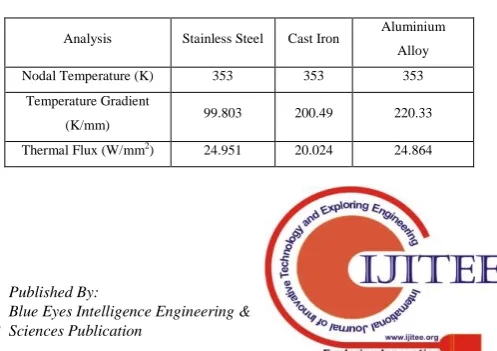
In Table 2, results of disc brake with cross drilled holes are given in which nodal temperature is same for all the material and temperature gradient is high for aluminium as 220.33 k/mm and thermal flux is same for stainless steel as well as aluminium as 24.85 W/mm2 approximately.
Table 2 Thermal analysis of disc brake with holes.
Analysis Stainless Steel Cast Iron Aluminium Alloy
Nodal Temperature (K) 353 353 353
Temperature Gradient
(K/mm)
99.803 200.49 220.33
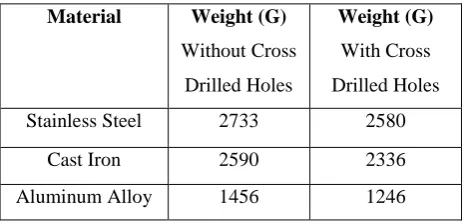
[image:5.595.65.273.476.650.2] [image:5.595.307.556.663.838.2]The comparison results between with and without cross drilled hole, the aluminium with holes disc brake gives the better results than the other materials. As well as comparison of weight between the materials, aluminium seems to be unique feature. That is the weight is less for aluminium with cross drilled holes disk. The aluminium with cross drilled holes disk brake is selected.
Table 3 Weight of various materials
Material Weight (G) Without Cross
Drilled Holes
Weight (G) With Cross Drilled Holes
Stainless Steel 2733 2580
Cast Iron 2590 2336
Aluminum Alloy 1456 1246
V. CONCLUSION
Thermal analysis for various materials such as stainless steel, cast iron and aluminium alloy is carried out. By observing thermal analysis results, temperature gradient is more for aluminium alloy that is heat transfer rate is more for aluminium alloy by comparing with other two materials. The design of disc brake is changed by adding holes. From the results, it seems that the aluminium has the property that can be used as disk material with cross drilled hole design in which weight is 1246kg and nodal temperature, temperature gradient and thermal flux are 353 k, 220.33 k/mm and 24.864 W/mm2. By adding holes, temperature gradient has increased when compared with the present design. Hence by changing the design of disc brake the heat transfer rate increases and using aluminium alloy is better.
REFERENCES
1. Afzanizam.M.R, Ahmad.R, Nurfaizey. A.H., Radzai M.S.,
Ridzuan.M.M, and Zaid. M.A. “ An investigation of disc brake
rotor by finite element analysis”, Journal of Advanced Manufacturing Technology, Vol. 3, No. 2, 2009, pp. 37-48.
2. Barton.D. C, Buckingham.J.T, Crolla.D.A, and Grieve.D.G, “Design of
a lightweight automotive brake disc using finite element and Taguchi techniques”, Proc. Instn Mech Engrs, Part D: J. Automobile Engineering, Vol. 212, 1998, pp. 245-254.
3. Cho C.D and Cho H.J, “A study of thermal and mechanical behaviour
for the optimal design of automotive disc brakes”, Proc. IMechE, Part D: J. Automobile Engineering, Vol. 222, 2008, pp. 895-915.
4. Dufrenoy.P “Two-/three-dimensional hybrid model of the thermo
mechanical behaviour of disc brakes”, Proc. Instn Mech Engrs, Part F: J. Rail and Rapid Transit, Vol. 218, 2004, pp. 17-30.
5. Gibbens .P, Morris.R, Tirovic.M, and Voller.G.P “Analysis of
automotive disc brake cooling characteristics”, Proc. Instn Mech Engrs, Part D: J. Automobile Engineering, Vol. 217, 2003, pp. 657-666.
6. Ali Belhocine, Mostefa Bouchentara (2012). Thermal analysis of a
solid brake disc. Applied Thermal Engineering 32 (2012) 5- 67.
7. G. Cuevaa, A. Sinatorab, W.L. Guesserc, A.P. Tschiptschina, (2003).
Wear resistance of cast irons used in brake disc rotors. Wear 255 (2003) 1256–1260.
8. Aleksander Yevtushenko, Michal Kuciej, Ewa Och, Olena
Yevtushenko (2018). Frictional heating of the brake disc with essential nonlinearity thermal barrier coating. 95 (2018) 210 – 216.
9. A.A. Agbeleye, D.E. Esezobor, S.A. Balogun, J.O. Agunsoye, J. Solis,
A. Neville (2017). “Tribological Properties of Aluminium-Clay composites for brake disc rotor applications”. S1018-3647(17)30834-0.
10. N.K.Kharatea, Dr.S.S.Chaudharib (2017). “Effect of material
properties on disc brake squeal and performance using FEM and EMA approach”, Materials Today: Proceedings 5 (2018) 4986–4994.
AUTHORS PROFILE
M.Purusothaman was born at Madurai, Tamil Nadu on 10.04.1984 and author has completed his Master of Engineering in Refrigeration and Air
condition with Distinction and GOLD Medal
from College of Engineering Guindy, Chennai and Bachelor of Engineering in Mechanical from RVS college of Engineering and Technology, Dindigul. Author’s major field of interest is Greenhouse solar
Dryer, Refrigeration and Air Conditioning,
Computational Fluid Dynamics, and IC Engines. He has 10 years of Teaching and 1 year of Industry experiences and currently working as an Assistant professor in Sathyabama Institute of
Science and Technology, Chennai. He has published 12 Scopus indexed
journals in various international and national journals. Mr.M.Purusothaman becomes members in various Professional bodies like Indian Society of Heating and Refrigeration and Air-conditioning Engineers (ISHRAE), Society of Automobile Engineers (SAE), International Association of Engineers (IAENG), Hong kong society of Mechanical Engineers (HKSME).
M. Sunil Kumar was born at Krishnagiri, Tamil Nadu on 24.06.1997 and author is studying his Master of
Engineering in Thermal Engineering from
Sathyabama Institute of Science and Technology, Chennai and completed his Bachelor of Engineering in Mechanical with Anna University Rank Holder from Saveetha Engineering College, Chennai. Author’s major area of interest is Renewable energy, Computational Fluid Dynamics and Product Development. He has published round 5 Scopus indexed journals.
V.Praveen kumar was born at vellore, Tamil Nadu on 21.09.196 and author has completed his Bachelor of Engineering in Mechanical at Hindustan University and currently pursuing Master of Engineering in Thermal Engineering from Sathyabama Institute of Science and Technology. He has published few international and national journals and also active member in ISHRAE.
Suraj kumar was born at Bhagalpur, Bihar on 15.05.1996 and author completed his Bachelor of Technology in Mechanical from Gla University, Mathura and pursuing his Master of Engineering in Thermal Engineering from Sathyabama Institute of Science and Technology, Chennai. Author’s major field of interest is Thermodynamics, Refrigeration Air Conditioning, Fluid Dynamics and IC engines.
Senthamizh Selvan.S was born at Vellore, Tamil Nadu on 13th June 1997 and the author is doing
![Fig.1, it will raises to surface rust. In order to overcome rusting, the contact area of brake pads are kept clean by regular usage [7]](https://thumb-us.123doks.com/thumbv2/123dok_us/8200540.260690/1.595.318.538.369.518/raises-surface-order-overcome-rusting-contact-brake-regular.webp)