International Journal of Innovative Technology and Exploring Engineering (IJITEE) ISSN: 2278-3075,Volume-8 Issue-12, October 2019
Abstract: The purpose of this study is to determine the effect of managerial effectiveness, work environment, and teamwork on work engagement. The population of this study is all lecturers of College of Economics in East Jakarta who have a National Lecturer Registration Number. The population of this study is 377 lecturers. The data analysis method used in this study is Structural Equation Modeling (SEM); for data processing, this study using Partial Least Square-Structural Equation Models (PLS-SEM) software. The results of the study show that (1) managerial effectiveness is not empirically tested has a direct effect on work engagement, (2) work environment has positive direct effect on work engagement, (3) team work has a positive direct effect on work engagement, (4) managerial effectiveness has a positive direct effect on work environment, (6) managerial effectiveness has a positive direct effect on team work, (7) environment has a positive direct effect on team work.
Keywords : Managerial Effectiveness, Work Environment, Team Work, Work Engagement
I. INTRODUCTION
In terms of the development of the quality of human resources, a good and quality education system is one of the keys. Colleges hold a strategic position as an institution tasked with forging the quality of the nation's citizens. Law of the Republic of Indonesia Number 12 of 2012, concerning Higher education has a strategic role in educating the life of the nation and advancing science and technology. This means that higher education institutions have a large role in the development of Indonesian human resources. One of the key holders of success in the process is the teaching profession in the college education system.
In the news on Ristekdikti on May 9, 2016, it was stated that as a professional educator, a lecturer is required to have the highest academic qualifications to carry out the Tridharma of Higher Education (ie covering Education, Research and Community Service) to the maximum that not everyone can do well. The problems are caused by busy lecturers in the field of teaching, and ignoring research and community service resulting in many lecturers who do not have functional positions. The administration system that has not been good also supports the number of lecturers who do not have functional positions. For example, more lecturers who feel comfortable occupying structural positions than carrying out their main functions become academic leaders (Ristekdikti,
Revised Manuscript Received on October 05, 2019.
* Correspondence Author
Diah Pranitasari*, Management Department, Sekolah Tinggi Ilmu Ekonomi Indonesia Jakarta, Indonesia. Email: [email protected]
2016a). This is similar to what was conveyed by the Deputy Chair of the Indonesian Academy of Sciences, Satryo Soemantri Brodjonegoro, that Indonesia lacked researchers. in universities, many lecturers are focused on teaching or busy being consultants for a number of projects (Ristekdikti, 2016b).
One indicator of the competitiveness of a country's higher education is also seen from scientific publications produced by universities in the country concerned. Scientific publications in international journals by certified lecturers are mostly carried out by lecturers from State Universities, lecturers at Private Universities are still very few. Whereas when viewed from the number of comparisons of state and private tertiary institutions as the data from the Higher Education Data Base (PDDIKTI) states that there are 370 State Universities in Indonesian Universities. Whereas for Private Universities there are 4,043 universities. Similarly, the number of lecturers. According to the national recapitulation of the 2015/2016 semester even by PDDIKTI it was stated that the number of lecturers of State Universities was only 69,662 lecturers. The figure is quite small when compared to private university lecturers which numbered 190,769 (Hidayati, 2016).
With the large number of private university lecturers, lecturer performance in the implementation of the Tri Dharma of Higher Education should be further improved. This happened to most private university lecturers in Indonesia, including lecturers from private universities at the College of Economics in Jakarta, the results of a survey of managers of several Economics Colleges, information that some institutions complained about lecturers' dedication to teaching, namely lack of discipline in teaching time, and the delivery of material by lecturers should be in accordance with the Semester Lecture Plan.
In the conduct of research and community service, the lecturers were considered not to have the same enthusiasm to conduct research and community service. Although there are several institutions that provide funds to carry out these activities, they have not been able to encourage lecturers to conduct research and community service. As explained above, publications in international scientific journals add to the competitiveness of universities, thereby increasing the performance of universities.
The interviews conducted by several lecturers of the College of Economics turned out to be more or less the same, namely the lecturers complained about the current conditions which were very different from the
previous conditions, now there are
The Effect of Managerial Effectiveness, Work
Environment,and Team Work on Lecturer’s
Work Engagement
Engagement
many demands that they must fulfill and carry out as alecturer. In contrast to the old days which only assigned lecturers to only teach. This reflects the lack of enthusiasm and contribution of the lecturers in carrying out their duties as lecturers.
From the results of interviews with several managers and lecturers of Private Universities can be used as an interesting study to be studied in the private university lecturers regarding the description of the contribution and work engagement given by a lecturer, which is the main factor for the development of the education world today. Work Engagement is one of the conditions that can describe one's attachment in achieving optimal performance. Schaufeli & Baker (2011) define work engagement as a condition in which a person has a positive mind so that he is able to express himself both physically, cognitively and affective in doing his work.
This study aims to examine the effect of managerial effectiveness, work environment, and team work on the work engagement of lecturers at the College of Economics in East Jakarta.
II. THEORETICAL BASIS 1. Work Engagement
The concept of work engagement was first put forward by William H. Khan who stated that employees who have attachments will work and express themselves physically, cognitively, emotionally and mentally at work. Engagement means being psychologically and physically present when working and carrying out roles in the organization (Schaufeli & Baker, 2011, p. 12).
Sakovska (2012, p. 6) points out the frequently used definitions of attachment, namely attachments including cognitive, emotional, and behavioral. The cognitive aspects of engagement include employee beliefs about the organization, management and working conditions. Emotional components define employee positive attitudes, how their perception about their leaders, the values of the organization and the work environment. The behavioral component measures the willingness of individuals to act in a certain way, offered skills and willingness to engage "extras". Bakker (2011, pp. 265–269) explains the meaning of work engagements that he had previously written with Schaufeli, is a statement that relating to work positive active that characterized by enthusiasm, dedication, and absorption. Excitement refers to high levels of energy and mental endurance at work, while dedication refers to someone who is very involved in work and experiences a sense of importance, enthusiasm and challenge. Absorption is characterized by being fully concentrated and happily engrossed in work, such as time passed quickly.
Work engagement is the attachment and satisfaction of individuals with enthusiasm for work (Taylor, 2014, p. 194). Work engagement is the extent to which employees are fully involved in their work and the strength of commitment to their work (Raymond A. Noe, John R. Hollenbeck, 2017). Engagement is influenced by the way managers treat employees and their human resource practices, such as recruitment, selection, training and development,
performance management, work design, and compensation. Based on the description above, it can be synthesized that work engagement is a person's involvement in work and his role is positively active both physically, psychologically and cognition with indicators of vigor, dedication and absorption.
2. Managerial Effectiveness
Managerial Effectiveness ‘shows the degree to which what the manager has done with what the manager should do. This is about performance, which refers to what people do (their achievements) and how people do it (their behavior). To measure effectiveness it is necessary to understand and define both sides of the equation; i.e. input (skills and behavior) and output (results). Measuring effectiveness and performance compares expectations about achievement and behavior with actual results and behavior (Taylor, 2014, p. 25).
The five dimensions for measuring managerial effectiveness, first, managing and leading are traditional leadership behaviors that set direction, inspire, and motivate and relate to the activities of selection, development, training and managing conflict; second, interpersonal relationships, namely relationships with fellow and senior managers in the organization; third, knowledge and initiative that is characted with huge knowledge and good competence with personal attributes which include trust, independence, and initiative; fourth, success orientation, namely achieving goals and achieving the desired results of the organization; fifth, contextual independence is external focus and includes the ability to manage external relations (Leslie, 2015, pp. 7–8).
In the research of Kaur and Chadha in Gupta (2013) explaining managerial effectiveness is the extent to which a manager carries out activities to achieve organizational goals and work effectively of the organization and more productively. Furthermore Gupta (2013) uses a questionnaire developed by Kaur and Chadha using 16 dimensions (ie trust subordinates, communication and assignment, networking, relationships, discipline, use of resources, management of the market environment, conflict resolution, integrity and communication, management and client competence, motivating, delegating, building image, welfare management, consulting and inspection and innovation and innovation) .
Adekola in Rana, Rastogi, & Garg (2016) describes managerial effectiveness as follows: Managerial Effectiveness It depends on the situation and the manager's ability to plan, organize, coordinate, motivate, control and have a positive influence on organizational goals. Wang in Rana et al. (2016) identified eight different indicators to measure managerial effectiveness, namely supporting, caring, fair, engaging, disciplined, selfless, responsible and knowledgeable.
International Journal of Innovative Technology and Exploring Engineering (IJITEE) ISSN: 2278-3075,Volume-8 Issue-12, October 2019
3. Work Environment
The success of an organization is influenced not only by the human resources in it, but also by other resources, namely funding, materials and equipment, technology and work mechanisms. Likewise whether the work environment or work situation provides comfort that encourages employee performance. Also includes the conditions of relations between humans in the organization, both between superiors and subordinates and among colleagues (Wibowo, 2016, p. 70). The above is in accordance with the definition of work environment proposed by Taylor (2014, p. 446), namely: The work environment consists of systems of work, the design of jobs, working conditions and ways that people are engaged in by their managers and co-workers.
There are two components of the work environment namely the physical component and the behavioral component. The physical work environment relates to the physical relationship between employees and the work environment, while the behavioral environment relates to good relations between employees, and the influence of the work environment on employees. Productivity of physical components consists of the layout of the work environment and the comfort of the work environment (the suitability of the office environment with work processes). The two main components of the work environment are interaction and disruption (Oswald, 2012, pp. 9-10).
Razak, Ma’amor, & Hassan (2016) explain work environment affects employee job satisfaction. When employees are happy in carrying out their work because they have a pleasant and comfortable work environment, the end result is high organizational productivity, few employees experience work fatigue, stress and conflict and will increase employee work commitments.
In research on measuring the validity and reliability of the instrument's work environment, indicators are used for instrument work environments. In general, the indicators used for the work environment are physical and social. Then Caplan et al .; Loscocco & Spitze; Lowe & Northcott added indicators for co-workers and management leaders. Furthermore Efraty and Sirgy claim that the work environment includes a decentralized organizational structure, team work, parallel structure and environmental quality, and ethical corporate culture as indicators of the work environment. And Sirgy et al., Concluded that the work environment of employees includes physical, cognitive, emotional and job demands (Razak et al., 2016).
From the description above, it can be synthesized that the work environment is a condition around the workplace both physically and non-physically which can affect employee performance, with indicators: physical and non-physical.
4. Team Work
Raymond A. Noe, John R. Hollenbeck (2017, p. 59) describes teamwork as part of a method for increasing employee responsibility and control. Team work usually consists of several employees who have various skills interacting to produce a product or service.
Hanaysha (2016, pp. 167–168) stated about teamwork, the definition previously considered that teamwork is a collection of several employees to achieve a certain goal. This
was refuted by Hanaysha who stated that teamwork is a number of people who work together to achieve common goals. Between employees in the group share the skills to achieve the desired goals. So that the higher the level of collaboration between team members, the higher the opportunity to learn together and also increase its productivity. Working in teams makes employees feel empowered and this motivates employees to develop themselves, which can increase job satisfaction and minimize stress levels.
The Hagopian Institute argues that teamwork is that several employees work together to achieve a shared vision. Guest explained that the meaning of teamwork involves functional cooperation: working together towards a common goal (Cater & Jones, 2014, pp. 176-186). Riley et al., Explained that teamwork is the ability of collaboration among team members to achieve shared goals (Lower, Newman, & Anderson-Butcher, 2017, pp. 716-725). Furthermore Anderson-Butcher, Amorose, et al .; Baker, Horvath, Campion, Offermann, & Salas; Gould & Carson states that teamwork involves group members interacting with one another using various social skills and group processes such as problem solving, negotiation, giving feedback, and describing responsibility and accountability (Lower et al., 2017). Alvarez and Stauffer also suggested that teamwork was interplayed by team members and the sense of ownership of the team. Specifically, it can be defined that teamwork focuses on team functioning and working together, centering on constructs, namely team dynamics, team cohesiveness, and interpersonal relationships (Lower et al., 2017).
Based on the study of a number of reference concepts above, it can be synthesized teamwork is a number of people who join to interact and influence each other, and are responsible for carrying out tasks to achieve organizational goals. Indicators used: cooperation, interaction, and mutual assistance.
III. RESEARCH METHODOLOGY
The population or unit of analysis in this study are all permanent lecturers who have a National Lecturer Registration Number at the College of Economics in East Jakarta with an active and accredited status of 377 people. The number of samples is 200 lecturers using the proportionally random sampling technique. proportionally random sampling is chosen because it is known to be a representative of the total population, or it is known that it will produce the appropriate group (Pandey, 2015, p. 54).
To analysis data in this study was use Structural Equation Modeling (SEM), is a multivariate analysis technique which is a combination of regression analysis applied to the analysis of latent variables with factor analysis applied to the analysis between indicators (Sanjiwani, Jayanegara, Eka, & Kencana, 2015, pp. 98–103). The reason for using SEM analysis is because this analysis technique can process data using Partial Least Square-Structural Equation Models (PLS-SEM) software, which is an alternative method of variant-based SEM. There are two models in PLS namely inner model, namely the relationship between latent variables and other latent variables and the
Engagement
relationship between latent variables and indicators(Sanjiwani et al., 2015).
The instrument was developed based on references from several experts, work attachment variable Schaufeli, Bakker, & Salanova (2006); managerial effectiveness variable of Gupta (2013), Srivastava (2011), and Rana et al. (2016); work environment variable Razak et al. (2016); team work variables Lower et al. (2017) and Baker & Salas (1992). This research model is illustrated in the chart below:
Chart 1. The Research Model
Based on conceptual study and theoretical framework, it can be formulated research hypothesis as follows:
a. Managerial effectiveness has positive direct effect on work engagement.
b. Work environment has positive direct effect on work engagement.
c. Team work has positive direct effect on work engagement
d. Managerial effectiveness has positive direct effect on the work environment
e. Managerial effectiveness has positive direct effect on team work
f. Work environment has positive direct effect on team work
IV. RESEARCH RESULTS
Data analysis in this study used Smart Partial Least Square (PLS). Data analysis includes outer model analysis and inner model analysis.
1. Outer Model Analysis
Outer model analysis is done by looking at the results of indicator validity (convergent validity and discriminant validity) and construct reliability.
a. Testing the Construct Validity
Validity is a measure that shows the level of validity or validity of an instrument. From the results of convergent validity, namely the value of factor loading on latent variables with indicators, there are manifest variables that do not meet the factor loading requirement ≥ 0.5 or invalid, namely one item managerial effectiveness instrument and three-point work engagement instrument so that the manifest variable must be excluded from model.
b. Testing of Construction Reliability
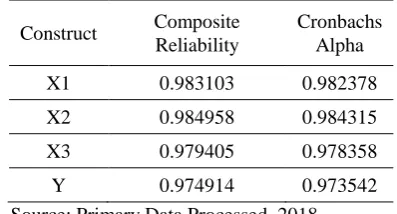
[image:4.595.48.296.158.353.2]Reliability is a series of measurements that see the consistency of a data if the measurement is done repeatedly. Evaluation of construct reliability values was measuredby Cronbach alpha value and composite reliability. The rule of thumb for the cronbachalpha value is ≥ 0.6 and composite reliability ≥ 0.7. Cronbach alpha values and composite reliability are shown as follows:
Table 1. Composite Reliability and Cronbachs Alpha
Construct Composite Reliability
Cronbachs Alpha
X1 0.983103 0.982378
X2 0.984958 0.984315
X3 0.979405 0.978358
Y 0.974914 0.973542
Source: Primary Data Processed, 2018
In the table above the cronbach's alpha value all constructs have a value greater than 0.6 and Composite Reliability all constructs are greater than 0.7, so it can be concluded that the construct has good reliability.
[image:4.595.350.549.168.275.2]The analysis of the outer model by looking at the results of validity and reliability of each construct, obtained as follows:
Table 2. Indicators and Instruments with Dominant Loading Factors
Variable Indicator with dominant loading factor
Instrument with dominant factor loading
Work Engagement (Y)
Dedication Enthusiastic to carrying out research assignments
Managerial Effectivenes s (X1)
Managing and leading
The head of study program can develop a strategy for the development of lecturer professionalism Work
Environmen t (X2)
Non-Physical Leaders, lecturers, and employees trust each other
Team Work (X3)
Interaction Team members together carry out tasks in accordance with a predetermined plan
2. Inner Model Analysis
In evaluating structural models, evaluations are made through observations on the significance of the relationship between constructs indicated by the t-statistic value by looking at the output of the bootstrap. Haryono (2017, p. 410) explains that variables that have a t-statistic value ≥ 1.96 are said to be
International Journal of Innovative Technology and Exploring Engineering (IJITEE) ISSN: 2278-3075,Volume-8 Issue-12, October 2019
Chart 2. Research T-statistics
Based on the chart above, it is known that there is one path that is not significant, namely the effect of managerial effectiveness (X1) on work engagement (Y),
then the path is omitted and data processing is done again, and the following results are obtained:
Chart 3. Research Path Coefficient
Based on the figure above then obtained as follows:
a. The work environment has positive direct effect of 0.4 and significant to the work engagement. b. Team work has positive direct effect of 0.275 and
significant to work engagement.
c. Managerial effectiveness has positive direct effect of 0,616 and significant to the working environment. d. Managerial effectiveness has positive direct effect of
0.309 but not significant to team work.
e. Work environment has positive direct effect of 0.558 and significant to self-development.
V. DISCUSSION
Managerial effectiveness is not empirically tested and has a direct effect on work attachments because the management of private universities, which are the property of the foundation, in decision making, especially those related to the development of lecturers and universities, is at the chairman or foundation. In addition, lecturers from private universities have a tendency to teach not only in one institution, this is because the lecturers' dominant
compensation is still in semester credit unit fees or teaching fees. This is contrary to the results of the study of Stanley (2016), Mendes & Stander (2011), Ravikumar (2013) stating managerial positive direct effect on work engagement. While the results of the study of Luthans & Peterson (2002) concluded that managerial influences work engagement through the work environment.
The work environment has a direct positive effect of 0.4 on the work attachments of lecturers. This means that the better the work environment, physically and non-physically, will increase the work attachment of lecturers. This is in line with the results of the study of Bakker (2011), Macey in Taylor (2014, p. 194), Sakovska (2012, p. 6), Stander & Rothmann (2010) stating an influential work environment directly towards work attachments. To increase work attachment can be done by improving the work environment, including by way of: 1) university leaders, lecturers and employees need to establish harmonious relationships so as to create a pleasant work atmosphere, family, and mutual trust with each other; 2) higher education leaders implement clarity and fairness of the work system for all lecturers and employees; 3) higher education leaders implement openness and fairness in policy and promotion so as to create mutual trust between leaders, lecturers and employees; 4) provision of facilities to support the implementation of lecturer duties, such as facilities in class such as in focus, facilities in the workspace such as the internet network, computer equipment along with programs or software that assist the implementation of lecturer duties, and facilities in the library with the availability of the latest books.
Team work has a direct positive effect of 0.275 on work engagement. This means that the better the work of the team will increase the work attachment of the lecturer. This is in line with the results of research Federman (2009, p. 32), Hedger (2007, pp. 31–37), Ketter (2016), Ravikumar (2013) stating that work engagement is directly influenced positively by teamwork. To increase the attachment of lecturers' work can be done by increasing team work, including: 1) higher education is more effective in determining the specialization of lecturers in teaching, so that it can support the work of the lecturer team of subject groups; 2) increasing cooperation in the team, such as exchanging ideas and finding joint solutions to problem solving, being open to each other and having a harmonious relationship; 3) increased interaction between team members such as the preparation of activity schedules every semester, continuity of communication between members, routine meeting agenda and sharing information about the development of team work activities; 4) Helping each other between team members in completing tasks and encouraging each other colleagues to carry out tasks and improve the ability and knowledge of lecturers. This will motivate lecturers to always carry out self-development.
Managerial effectiveness has a positive direct effect of 0.616 on the work environment. This means that the more effective managerial outcomes will improve a conducive work environment. This is in line with the results of research by Mendes & Stander (2011), Guest in Taylor (2014, p. 200), Bamford, Wong, and Laschinger in Shu (2015), Szu-Fang (2013) states that managerial directly influences the work environment.
Engagement
more effective a student in carrying out his duties will be moreable to improve teamwork. This is in line with the results of Gregory & Griffin (2013, pp. 283–284), Stephen (2015, pp. 211–212), Tohidi (2011), Schmidt-Wilk (2017) concluding the importance of managerial roles in team work.
The work environment has a positive direct effect of 0.558 on team work. This means that the more conducive the work environment will provide a sense of security and comfort, allowing lecturers to complete work optimally both individually and teamwork. This is in line with the results of research by Tarricone & Luca (2002) and Logan (2016) stating that teamwork is influenced by working environment conditions.
VI. CONCLUSION
The work environment has a direct positive effect of 0.4 on the work engagements of lecturers. This means that the better the work environment, physically and non-physically, will increase the work engagement of lecturers. Team work has a direct positive effect of 0.275 on work engagement. This means that the better the work of the team will increase the work engagement of the lecturer. Managerial effectiveness has a positive direct effect of 0.616 on the work environment. This means that the more effective managerial outcomes will improve a conducive work environment. Managerial effectiveness has a positive direct effect of 0.309 on teamwork. This means that the more effective a student in carrying out his duties will be more able to improve teamwork. The work environment has a positive direct effect of 0.558 on team work. This means that the more conducive the work environment will provide a sense of security and comfort, allowing lecturers to complete work optimally both individually and teamwork.
VII. ACKNOWLEDGMENTS
Thank you to the Indonesian Ministry of Research, Technology and Higher Education for funding this research as a doctoral dissertation research and was presented and accounted for on 19-20 November 2018 in Depok Indonesia.
REFERENCES
1. Baker, D. P., & Salas, E. (1992). Principles for measuring teamwork
skills. Human Factors, 34(4), 469–475.
https://doi.org/10.1177/001872089203400408
2. Bakker, A. B. (2011). An evidence-based model of work engagement.
Current Directions in Psychological Science, 20(4), 265–269. https://doi.org/10.1177/0963721411414534
3. Cater, M., & Jones, K. Y. (2014). Measuring Perceptions of
Engagement in Teamwork in Youth Development Programs. Journal
of Experiential Education, 37(2), 176–186. https://doi.org/10.1177/1053825913503114
4. Federman, B. (2009). Employee Engagement: A Road For Creating
Profits, Optimizing Perfomance, And Increasing Loyalty. SanFransisco: Jossey Bass.
5. Gregory, M., & Griffin, R. W. (2013). Organizational Behavior. Singapore: Cengage Learning Asia Pte Ltd.
6. Gupta, R. (2013). A study of managerial effectiveness and its co relates in selected Indian Organizations. Maharshi Dayanand University. Retrieved from http://hdl.handle.net/10603/7901
7. Hanaysha, J. (2016). Testing the Effects of Employee Empowerment ,
Teamwork , and Employee Training on Employee Productivity in
Higher Education Sector, 6(1), 164–178.
https://doi.org/10.5296/ijld.v6i1.9200
8. Haryono, S. (2017). Metode SEM Untuk Penelitian Manajemen
AMOS LISREL PLS (1st ed.). Jakarta: Luxima Metro Media.
9. Hedger, A. (2007). Five Ways to Strengthen Your Engagement and
Retention Strategies. Workforce Management Vol. 86 No. 8, 31–37.
10. Hidayati, N. (2016). Comparison of the Number of Private Colleges
and State Universities 2. Retrieved from
https://www.duniadosen.com/perbandingan-jumlah-perguruan-tingg i-swasta-dan-perguruan-tinggi-negeri-2/
11. Ketter, P. (2016). What’s the big deal about employee engagement?
Journal T+D, v62 n1, 44–49.
12. Leslie, J. B. (2015). Managerial effectiveness in a global context.
Retrieved from
http://insights.ccl.org/wp-content/uploads/2015/04/ccl_managerialef fectiveness.pdf
13. Logan, T. R. (2016). Influence of Teamwork Behaviors on Workplace
Incivility as It Applies to Nurses. Creighton Journal of
Interdisciplinary Leadership, 2(1), 47–53. https://doi.org/10.17062/cjil.v2i1.28
14. Lower, L. M., Newman, T. J., & Anderson-Butcher, D. (2017).
Validity and Reliability of the Teamwork Scale for Youth. Research
on Social Work Practice, 27(6), 716–725. https://doi.org/10.1177/1049731515589614
15. Luthans, F., & Peterson, S. J. (2002). Employee engagement and manager self-efficacy: implications for managerial effectiveness and
development. Journal of Management Development, 21(5), 376–387.
https://doi.org/10.1108/02621710210426862
16. Mendes, F., & Stander, M. W. (2011). Positive organisation: The role
of leader behaviour in work engagement and retention. SA Journal of
Industrial Psychology, 37(1).
https://doi.org/10.4102/sajip.v37i1.900
17. Oswald, A. (2012). The Effect of Working Environment on Workers
Performance: The Case of Reproductive and Child Health Care
Providers in Tarime District. Unpublished.
18. Pandey, P. P. dan M. M. (2015). Reserach Methodology: Tools And
Techniques. Romania: Bridge Center.
19. Rana, G., Rastogi, R., & Garg, P. (2016). Work Values and Its Impact
on Managerial Effectiveness: A Relationship Study in Indian Context. Vision: The Journal of Business Perspective, 20(4), 300–311. https://doi.org/10.1177/0972262916668713
20. Ravikumar, T. (2013). A Study on Impact of Team Work , Work
Culture , Leadership and Compensation on Engagement Level of
Employees in MSMEs in India. International Journal of Advanced
Research in Management and Social Sciences, 2(8), 175–185.
21. Raymond A. Noe, John R. Hollenbeck, B. G. dan P. M. W. (2017).
Human Resources Management: gaining a competitive advantage. New York: McGraw-Hill Education.
22. Razak, N. A., Ma’amor, H., & Hassan, N. (2016). Measuring
Reliability and Validity Instruments of Work Environment Towards
Quality Work Life. Procedia Economics and Finance, 37(16),
520–528. https://doi.org/10.1016/S2212-5671(16)30160-5
23. Ristekdikti. (2016a). Menristekdikti Encourages Lecturers to Increase
Scientific Publication. Retrieved from
http://sumberdaya.ristekdikti.go.id/index.php/2017/03/30/menristek dikti-dorong-dosen-tingkatkan-publikasi-ilmiah/
24. Ristekdikti. (2016b). Aging and Poor-Quality Research HR.
Retrieved from
http://www.kopertis12.or.id/2016/09/20/sdm-riset-menua-dan-kuran g-berkualitas.html
25. Sakovska, M. (2012). Importance of Employee Engagement in
Business Environment: Measuring the engagement level of administrative personnel in VUC Aarhus and detecting factors requiring improvement. Denmark: Aarhus Universitet Business And
Social Science. Retrieved from
https://www.scribd.com/document/149960249/Employee-Engageme nt-pdf
26. Sanjiwani, M., Jayanegara, K., Eka, I. P., & Kencana, N. (2015). Analysis Of Customer Satisfaction Satisfaction Restaurant Using
Partial Least Square Method (Case Study : Burger King Bali ), 4(3),
98–103.
27. Schaufeli, W. B., & Baker, A. B. (2011). Defining & measuring work
engagement: Bringing clarity to concept. In Work engagement: A
handbook of essential theory and research (pp. 10– 24). New York: Psychology Press.
International Journal of Innovative Technology and Exploring Engineering (IJITEE) ISSN: 2278-3075,Volume-8 Issue-12, October 2019
29. Schmidt-Wilk, J. (2017). Building Leadership, Teamwork, and
Resiliency Skills. Management Teaching Review, 2(4), 256–257.
https://doi.org/10.1177/2379298117736849
30. Shu, C.-Y. (2015). The Impact of Intrinsic Motivation on The
Effectiveness of Leadership Style towards on Work Engagement. Contemporary Management Research, 11(4), 327–350. https://doi.org/10.7903/cmr.14043
31. Srivastava, S. (2011). Assessing the Relationship between Personality
Variable and Managerial Effectiveness: An Empirical Study on
Private Sector Managers. Management and Labour Studies, 36(4),
319–333. https://doi.org/10.1177/0258042X1103600402
32. Stander, M. W., & Rothmann, S. (2010). Psychological
empowerment, job insecurity and employee engagement. SA Journal
of Industrial Psychology, 36(1), 1–9. https://doi.org/10.4102/sajip.v36i1.849
33. Stanley, T. (2016). Work Environments , Creative Behaviours , and
Employee Engagement.
34. Stephen, R. dan T. A. J. (2015). Organizational Behavior. New
Jersey: Pearson Education, Inc.
35. Szu-Fang, C. (2013). Essential skills for leadership effectiveness in
diverse workplace development. Online Journal for Workforce
Education and Development, 6(1), 1–23. Retrieved from http://opensiuc.lib.siu.edu/cgi/viewcontent.cgi?article=1133&contex t=ojwed
36. Tarricone, P., & Luca, J. (2002). Successful teamwork: A case study.
Proceedings of the 25th HERDSA Annual Conference, Perth, Western Australia, 7-10 July 2002, (July 2002), 640–646.
37. Taylor, M. A. dan S. (2014). Amstrong’s Handbook of Human
Resource Management Practice (13th ed.). Hong Kong: Graphicraft Limitted.
38. Tohidi, H. (2011). Teamwork productivity & effectiveness in an organization base on rewards, leadership, training, goals, wage, size,
motivation, measurement and information technology. Procedia
Computer Science, 3, 1137–1146.
https://doi.org/10.1016/j.procs.2010.12.185
39. Wibowo. (2016). Performance management. Jakarta: Raja Grafindo
Perkasa.
AUTHORS PROFILE
Diah Pranitasari has completed her studies at the Doctoral study program in the Department of Management, Human Resource Management Concentration at Jakarta State University from September 2015 to January 2019 with the title of dissertation entitled Effect of Leadership Effectiveness, Work Environment, Team Work, and Personal Development Towards Work Attachment of a Lecturer in the School of Economics in East Jakarta. He was born in Semarang on August 15, 1969. The fifth child of five siblings, a couple (late) S. Baribin and Raminah. Father as Indonesian Navy and mother as professor at Semarang State University. Married in 2000 and blessed with one son, Fadhil Farrelian Narantaka and one daughter, Callista Kalyanabila.
Starting basic education at Petompon Semarang State Elementary School graduated in 1982, Semarang Public Middle School 2 graduated in 1985, Semarang State High School 1 graduated in 1988. In 1988 continued Strata 1 lectures through PMDK (Interest and Ability Tracking) at the Faculty of Agriculture, Institute Bogor Agriculture, graduated in 1993. Then in 1994 continued his education in the Wijawiyata Management program at PPM School of Management Jakarta and completed his Masters in Management in 1998.