This is a repository copy of
Simplifying transformations for nonlinear systems: Part I, an
optimisation-based variant of normal form analysis
.
White Rose Research Online URL for this paper:
http://eprints.whiterose.ac.uk/100123/
Version: Accepted Version
Proceedings Paper:
Dervilis, N., Worden, K. orcid.org/0000-0002-1035-238X, Wagg, D.J.
orcid.org/0000-0002-7266-2105 et al. (1 more author) (2016) Simplifying transformations
for nonlinear systems: Part I, an optimisation-based variant of normal form analysis. In:
Nonlinear Dynamics. 33rd IMAC, A Conference and Exposition on Structural Dynamics,
February 2-5, 2015, Orlando, Florida. Conference Proceedings of the Society for
Experimental Mechanics Series , 1 . Springer International Publishing , pp. 315-320. ISBN
9783319152202
https://doi.org/10.1007/978-3-319-15221-9_28
[email protected] https://eprints.whiterose.ac.uk/ Reuse
Unless indicated otherwise, fulltext items are protected by copyright with all rights reserved. The copyright exception in section 29 of the Copyright, Designs and Patents Act 1988 allows the making of a single copy solely for the purpose of non-commercial research or private study within the limits of fair dealing. The publisher or other rights-holder may allow further reproduction and re-use of this version - refer to the White Rose Research Online record for this item. Where records identify the publisher as the copyright holder, users can verify any specific terms of use on the publisher’s website.
Takedown
If you consider content in White Rose Research Online to be in breach of UK law, please notify us by
Simplifying Transformations for Nonlinear Systems: Part I, An
Optimisation-Based Variant of Normal Form Analysis
N. Dervilis
1, K. Worden
1, D.J. Wagg
1, S.A. Neild
21
Dynamics Research Group, Department of Mechanical Engineering,
University of Sheffield, Mappin Street, Sheffield S1 3JD, UK
2
Department of Mechanical Engineering, Queens Building,
University of Bristol, Bristol BS8 1TR, UK
email: [email protected]
Abstract
This paper introduces the idea of a ‘simplifying transformation’ for nonlinear structural dynamic systems. The idea simply stated; is to bring under one heading, those transformations which ‘simplify’ structural dynamic systems or responses in some sense. The equations of motion may be cast in a simpler form or decoupled (and in this sense, nonlinear modal analysis is encompassed) or the responses may be modified in order to isolate and remove certain components. It is the latter sense of simplification which is considered in this paper. One can regard normal form analysis in a way as the removal of superharmonic content from nonlinear system response. In the current paper, this problem is cast in an optimisation form and the differential evolution algorithm is used.
Key words: nonlinearity, differential evolution, optimisation, simplifying transformation, su-perharmonics.
1
Introduction
The machine learning methods that are introduced in this paper via an optimisation algorithm that aims to address the problem of validity relating to the modal analysis of nonlinear structures. Modal analysis is an important tool in structural dynamics as it is used to understand the dynamical characteristics of the structure. Many methods have been proposed in recent years regarding nonlinear analysis, such as nonlinear normal modes or the method of normal forms [1, 2, 3, 4, 5, 6, 7, 8, 9, 10].
The motivation for this paper comes from the problem of how to transform second-order equations of motion into a simpler form, as vibration problems are naturally expressed via such differential equations. The method of normal forms can be used as an analytical tool when vibration problems are surrounded by nonlinearities in order to recast the equations of motion in a simpler form.
One can regard normal form analysis in a way as the removal of some superharmonic content from nonlinear system response. In the current work, this problem is cast in an optimisation form and the differential evolution algorithm is used. The advantage of this data-based approach introduced here is that complicated algebraic analysis is not needed and the details of the equations of motion are not required.
2
Simplifying transformation strategy and differential evolution
In vibration analysis, the relationship between system resonances and external forcing is particularly important especially when nonlinearities are present. Using the approach that is proposed here, leads to a simpler form when simulating resonant behaviour by removing the dominant superharmonic.
The transformation is as simple as a polynomial expansion. Adopting a machine learning approach, one can learn the undetermined coefficients from measured data, freeing the system from the dominant superharmonic. A different approach to both analytic solutions and pattern recognition methods is to treat the removal of superharmonic content from nonlinear system response in terms of an optimisation problem, where the aim is to choose parameters such that the new signal is free from the 1st
superharmonic that appears at three times the natural frequency (for a symmetric nonlinearity). For this purpose, a nonlinear optimisation algorithm based on differential evolution will be used here. For the purposes of this paper a brief description of differential evolution is given and readers are referred to [11, 12, 13] for more details. A section will follow with results using the technique on data simulated to represent the theoretical situation that was discussed. Differential evolution, introduced by Storn and Price [12], is an evolutionary algorithm in the same sense as a genetic algorithm that begins with an initial population of trial solutions to a problem and via successive cycles of mutation, crossover and selection computes an optimal set of solutions. These trial solution are subject to a suitable objective function, in respect to the given problem. In turn, for the current analysis the trial solutions are a vector of parameter guesses that satisfy the condition that the new signal is a simplified transformation as described before.
The optimisation algorithm is summarised in Fig. 1. The routine, although seeming complicated, follows a smooth but powerful procedure. An initial population of parameter vectors are randomly generated. Then to each parameter vector of this initial population, the objective function specifies a cost value and a new generation of solutions is born from this initial population. A target vector is chosen from the initial population and then a trial vector is created by ‘mutation’. Mutation takes two random parameter vectors A and B according to Fig. 1 from the population and subtracts one from the other by multiplying it by some constant or scaling factor and finally adds it to a third randomly chosen parameter vector (C) from the initial population. The trial vector can be considered as the ‘child’ of the target vector and the mutated vector. After this chain of actions a new parameter vector is born between mutated trial vector and the target vector and the procedure is called ‘crossover’. A predefined hyperparameter determines if the trial vector takes a parameter value from the target vector or the mutated vector. This new vector will then be selected for the next generation if its cost value is lower than that of the target vector. If not, the target vector is forwarded to the next generation population. This procedure is repeated several times and as the process evolves through a chain of generations, parameter vectors with low cost values will be constructed.
In this analysis a slight variation of DE was used called self-adaptive differential evolution (SADE) [11, 13]. This algorithm evolves in a similar fashion to the DE procedure except that it also learns which values of scaling factor and hyperparameter are most likely to result in a trial vector that will be forwarded to the next generation, giving faster convergence compared to DE algorithm. The main advantage of using this evolutionary population based tool in respect to the parameter estimation problem is that the algorithm will potentially converge on the global minimum cost value rather than a local minimum.
3
An example
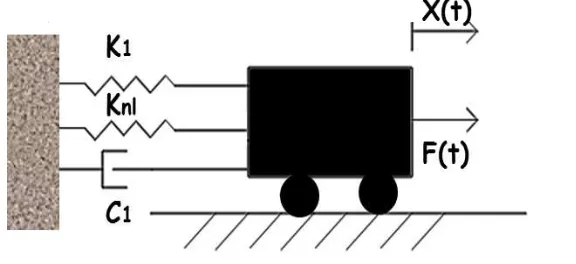
The system of interest will be a nonlinear one-DOF lumped parameter system (see Fig.2). Data were simulated using a fixed-step 4th
-order Runge-Kutta algorithm with harmonic excitation and the associated displacement was extracted. The model parameters adopted were: m= 1,c1= 0.001, k1= 50,knl= 103.
The nonlinearity that is assumed is cubic.
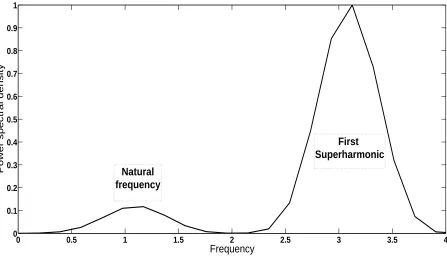
Fig. 3 shows the resulting power spectral density (PSD) for the simulated physical variable. The method that is used in order to calculate the power spectral densities (PSDs) which follow is the Welch method based on time averaging over short, modified periodograms which could decolour the effect of different random excitation inputs [15]. The signals are split into sections and the periodograms of each section are averaged. Through the Welch method these data sections are overlapped and a window, such as the Hanning window is applied in order to filter each section. The overlapping of the signal sections is usually either 50% (as in this paper) or 75%.
For all the graphs the vertical axis is thePSD of displacementand thefrequency is in Hz.
As can be seen, the third order superharmonic (which as expected appeared at three times the natural frequency) is the dominant trend in the signal. Following this evidence a simplifying transformation of a polynomial expansion is adopted in the form of:
z(i) =a+by(i) +cy(i)3
+dy(i)5
(1)
where {z}is the transformed signal,{y}is the initial signal and [a, b, c, d] the undetermined parameters of the polynomial expansion.
The task of the optimisation algorithm is to determine the polynomial coefficients and at the same time transform the new signal by zeroing the 1st
dominant superharmonic that appears at three times from the natural frequency.
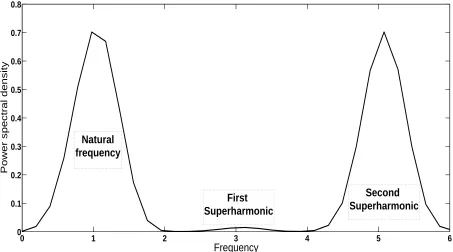
As can be seen in Fig. 4 the method that is introduced successfully removes the superharmonic. However, as can be noted in Fig. 5 if the frequency spectrum is widened then the second superharmonic (5th
order) is rising in magnitude to counter balance the reduction of the the 3rd
order superharmonic. This problem will be investigated in the second part of this paper.
[image:5.612.142.430.460.592.2]0 0.5 1 1.5 2 2.5 3 3.5 4 0
0.1 0.2 0.3 0.4 0.5 0.6 0.7 0.8 0.9 1
Power spectral density
Frequency
Natural
frequency
First
Superharmonic
Fig. 3: PSD for physical variable.
0 0.5 1 1.5 2 2.5 3 3.5 4
0 0.1 0.2 0.3 0.4 0.5 0.6 0.7 0.8
Power spectral density
Frequency
Natural
frequency
First
Superharmonic
[image:6.612.66.513.80.337.2] [image:6.612.59.515.94.667.2]0 1 2 3 4 5 6 0
0.1 0.2 0.3 0.4 0.5 0.6 0.7 0.8
Power spectral density
Frequency
Natural
frequency
First
Superharmonic
Second
Superharmonic
Fig. 5: PSD for transformed variable including second superharmonic (5th
order).
4
Conclusion
The purpose of this paper is to highlight the key utility of some machine learning methods, not only for dynamic analysis of structure but as well as a method of simplification for nonlinear mechanical systems. The main benefit of the approach taken here is that complicated algebraic analysis is not necessary. Furthermore, the physical equations of the system are not needed. As a result, this machine learning approach is suited to experimental investigation of nonlinear systems using only the measured output responses. A further work in the second part of this paper investigates the apperance of higher order superharmonics.
Acknowledgments
The support of the UK Engineering and Physical Sciences Research Council (EPSRC) through grant reference number EP/J016942/1 and EP/K003836/2 is gratefully acknowledged.
References
[1] Gaetan Kerschen, Jean-claude Golinval, Alexander F Vakakis, and Lawrence A Bergman. The method of proper orthogonal decomposition for dynamical characterization and order reduction of mechanical systems: an overview. Nonlinear dynamics, 41(1-3):147–169, 2005.
[2] Alexander F Vakakis. Non-linear normal modes (nnms) and their applications in vibration theory: an overview. Mechanical systems and signal processing, 11(1):3–22, 1997.
[3] Keith Worden and Geoffrey R Tomlinson. Nonlinearity in structural dynamics: detection, identification and modelling. CRC Press, 2000.
[image:7.612.62.515.55.307.2][5] Keith Worden and Peter L Green. A machine learning approach to nonlinear modal analysis. In
Dynamics of Civil Structures, Volume 4, pages 521–528. Springer, 2014.
[6] Reinhardt Mathias Rosenberg. The normal modes of nonlinear n-degree-of-freedom systems. Journal of applied Mechanics, 29(1):7–14, 1962.
[7] Steven W Shaw and Christophe Pierre. Normal modes for non-linear vibratory systems. Journal of sound and vibration, 164(1):85–124, 1993.
[8] Simon A Neild and David J Wagg. Applying the method of normal forms to second-order nonlinear vibration problems. Proceedings of the Royal Society A: Mathematical, Physical and Engineering Science, 467(2128):1141–1163, 2011.
[9] Fabien Poncelet, Ga¨etan Kerschen, J-C Golinval, and Damien Verhelst. Output-only modal analysis using blind source separation techniques. Mechanical Systems and Signal Processing, 21(6):2335–2358, 2007.
[10] N Dervilis, DJ Wagg, PL Green, and K Worden. Nonlinear modal analysis using pattern recognition.
Proceedings of ISMA2014, pages 3017–3027, 2014.
[11] Keith Worden, Graeme Manson, Hoon Sohn, and CR Farrar. Extreme value statistics from differential evolution for damage detection. InProceedings of the 23rd International Modal Analysis Conference (IMAC XXIII), pages 2009–3, 2005.
[12] Rainer Storn and Kenneth Price. Differential evolution–a simple and efficient heuristic for global optimization over continuous spaces. Journal of global optimization, 11(4):341–359, 1997.
[13] A Kai Qin and Ponnuthurai N Suganthan. Self-adaptive differential evolution algorithm for numerical optimization. In Evolutionary Computation, 2005. The 2005 IEEE Congress on, volume 2, pages 1785–1791. IEEE, 2005.
[14] Elizabeth Cross. On structural health monitoring in changing environmental and operational conditions. 2012 (PhD thesis).
![Fig. 1: Schematic of a typical differential evolution algorithm [14].](https://thumb-us.123doks.com/thumbv2/123dok_us/7829299.174696/4.612.120.457.217.542/fig-schematic-typical-dierential-evolution-algorithm.webp)