This is a repository copy of
Secrecy rate optimization for secure multicast communications
.
White Rose Research Online URL for this paper:
http://eprints.whiterose.ac.uk/103629/
Version: Accepted Version
Article:
Cumanan, Kanapathippillai orcid.org/0000-0002-9735-7019, Ding, Zhiguo, Xu, Mai et al. (1
more author) (2016) Secrecy rate optimization for secure multicast communications. IEEE
Journal of Selected Topics in Signal Processing. pp. 1417-1432. ISSN 1932-4553
https://doi.org/10.1109/JSTSP.2016.2600518
[email protected] https://eprints.whiterose.ac.uk/ Reuse
Items deposited in White Rose Research Online are protected by copyright, with all rights reserved unless indicated otherwise. They may be downloaded and/or printed for private study, or other acts as permitted by national copyright laws. The publisher or other rights holders may allow further reproduction and re-use of the full text version. This is indicated by the licence information on the White Rose Research Online record for the item.
Takedown
If you consider content in White Rose Research Online to be in breach of UK law, please notify us by
Secrecy Rate Optimization for Secure Multicast
Communications
Kanapathippillai Cumanan,
Member, IEEE
, Zhiguo Ding,
Senior Member, IEEE
,
Mai Xu,
Member, IEEE
and H. Vincent Poor
Fellow, IEEE
Abstract—Recently, physical layer security has been recognized as a new design paradigm to provide security in wireless networks. In contrast to the existing conventional cryptographic methods, physical layer security exploits the dynamics of fading channels to enhance security of wireless communications. This paper studies optimization frameworks for a multicasting net-work in which a transmitter broadcasts the same information to a group of legitimate users in the presence of multiple eavesdroppers. In particular, power minimization and secrecy rate maximization problems are investigated for a multicasting secrecy network. First, the power minimization problem is solved for different numbers of legitimate users and eavesdroppers. Next, the secrecy rate maximization problem is investigated with the help of private jammers to improve the achievable secrecy rates through a game theoretic approach. These jammers charge the transmitter for their jamming services based on the amount of interference caused to the eavesdroppers. For a fixed interference price scenario, a closed-form solution for the optimal interference requirement to maximize the revenue of the transmitter is derived. This rate maximization problem for a non-fixed interference price scenario is formulated as a Stackelberg game in which the jammers and transmitter are the leaders and follower, respectively. For the proposed game, a Stackelberg equilibrium is derived to maximize the revenues of both the transmitter and the private jammers. To support the derived theoretical results, simulation results are provided with different numbers of legitimate users and eavesdroppers. In addition, these results show that physical layer security based jamming schemes could be incorporated in emerging and future wireless networks to enhance the quality of secure communications.
Index Terms—Physical layer security, multicasting network, convex optimization, game theory.
I. INTRODUCTION
In traditional wireless networks, security is achieved in the upper layers based on conventional cryptographic methods. However, some emerging networking paradigms present chal-lenges in terms of key exchange and distribution. Recently, physical layer based secret communication has received con-siderable attention due to its suitability for dynamic network
Copyright(c) 2016 IEEE. Personal use of this material is permitted. How-ever, permission to use this material for any other purposes must be obtained from the IEEE by sending a request to [email protected].
K. Cumanan is with the Department of Electronics, University of York, YO10 5DD, UK (email: [email protected]). Z. Ding is with the School of Computing and Communications, Lancaster Univer-sity Lancaster, LA1 4WA, UK (email: [email protected]). M. Xu is with School of Electronic and Information Engineering, Beihang University (email: [email protected]). H. V. Poor is with Department of Electri-cal Engineering, Princeton University, Princeton, NJ 08544, USA (mail: [email protected]).
The work of K. Cumanan and Z. Ding was supported by H2020-MSCARISE-2015 under grant number 690750. The work of Z. Ding was supported in part by the Royal Society International Exchange Scheme and in part by the U.K. EPSRC under grant EP/N005597/1. The work of M. Xu was supported by the NSFC project under Grant 61573037, and the Fok Ying Tung Education Foundation under Grant 151061. The work of H. V. Poor was supported by the U.S National Science Foundation under Grant CMMI-1435778. Corresponding author: Mai Xu.
configurations and distributed processing techniques [1]–[3]. In addition, this approach implements security in the physical layer as a complement to the cryptographic methods by exploiting channel state information (CSI) of legitimate parties as well as eavesdroppers.
The ideas behind physical layer security were first investi-gated in [4] and [5] based on information theoretic concepts by defining the secrecy capacity of wiretap and related channels. Recently, multiantenna secrecy channels have received con-siderable attention in the research community since the use of multiple antennas yields spatial diversity and additional se-crecy degrees of freedom [6]–[14]. In [6], the sese-crecy capacity of multiple-antenna wiretap channels was presented under an average power constraint, whereas the same secrecy capacity was established in [7] as the saddle point solution to a min-max problem. A transmit covariance matrix design was considered in [8] to maximize the ergodic secrecy rate with a power constraint for a multiple-input single-output (MISO) wiretap channel model, whereas an optimal transmit design through the semidefinite programming approach is proposed in [9] for the same channel model as in [8]. In [10], full rank solutions have been derived for the multiple-input multiple-output (MIMO) wiretap channel with an average power constraint and an alternative solution based on Taylor series has been proposed for the same problem in [11].
2
into the study of secure wireless communications for decision making and resource allocation, e.g., [24]–[30]. In [24], a novel cooperative paradigm has been proposed to improve the secrecy of primary users with the help of the secondary users in cognitive radio networks through a Stackelberg game approach. Secure games have been formulated for a secret communication network with an unfriendly jammer through a non-cooperative zero-sum continuous game in [25]. Physical layer security has been also investigated in a two way untrusted relay system through a Stackelberg game in [26]. In [27], a game theoretic framework has been developed for multi-hop networks in the presence of eavesdroppers. Transmission strategies have been proposed for MIMO secret communica-tion networks in the presence of a multi-antenna eavesdropper through game theoretic approaches in [28], whereas a secrecy game for a Gaussian MISO interference channel has been investigated in [29].
In this paper, we consider a secure multicasting network as shown in Figure 1 where a transmitter broadcasts the same information to multiple legitimate users. To the best of the authors’ knowledge, only a few works have investigated multicasting secrecy networks with multiple eavesdroppers. In [31], multicasting secrecy rate maximization was investigated for MISO channels with multiple eavesdroppers equipped with multiple antennas based on convex approximation techniques, whereas performance analysis has been derived for a secure multicasting network consisting of a single-antenna transmitter with multiple multi-antenna receivers as well as multiple multi-antenna eavesdroppers in [32]. In [33], a multicarrier based physical layer security scheme has been investigated for multicasting systems and a waveform design has been proposed for secure single-input single-output multicasting transmission in [34]. Recently, different capacities have been derived for secure multicasting in stochastic MIMO networks, whereas a joint beamforming and user selection scheme has been proposed for MISO wiretap channels with multiple single-antenna eavesdroppers in [35]. However, secure mul-ticasting communications with cooperative jamming has not been considered in these works. In this paper, we propose secrecy rate optimization frameworks with cooperative jam-ming, in which a game theoretic approach is used to derive the optimal strategies of the legitimate transmitter and the jammers. The contributions of this paper are summarized as follows:
1) Power minimization: We consider a beamforming design for a secure communication network consisting of a legitimate user and an eavesdropper, where our goal is to minimize the transmit power with a secrecy rate constraint. This problem can be easily formulated as a second order cone programming (SOCP) problem. Furthermore, we derive a closed-form optimal solution based on the dual problem and Karush-Kuhn-Tucker (KKT) conditions. The derived optimal solution is val-idated through a comparison with the SOCP results via simulations. Next, the power minimization problem is considered for a scenario with multiple legitimate users and multiple eavesdroppers. This problem is not convex in terms of the beamformer at the transmitter.
However, we formulate this problem as a semidefinite programming problem by introducing a new variable and also using semidefinite relaxation.
2) Game theory based secrecy rate maximization: In the above power minimization schemes, the legitimate trans-mitter requires a certain amount of transmit power to satisfy the required secrecy rates. However, it is not always possible to realize the predefined secrecy rates, either because the available transmit power is limited or because it might be expensive to use the required amount of power. To overcome these issues, external jammers can be employed to introduce interference to the eavesdroppers, which will improve the achievable se-crecy rate at the legitimate users. Therefore, we consider a multicasting secrecy network with multiple legitimate users and multiple eavesdroppers as shown in Figure 2 in which private jammers introduce interference to the eavesdroppers. Particularly, these private jammers charge the transmitter for their jamming service based on the amount of interference caused at the eavesdroppers. On the other hand, the legitimate users also pay the transmitter according to their achieved secrecy rates, which provides a profit to the transmitter and compen-sates for the charges of the private jammers. Based on the revenues at both transmitter and the private jammers, we formulate this problem as a Stackelberg game in which the private jammers and the transmitter are the
leadersand thefollower, respectively. For the proposed game, we derive a Stackelberg equilibrium solution with different numbers of legitimate users and eavesdroppers, which maximizes the revenues of the transmitter as well as the private jammers.
The remainder of the paper is organized as follows. The system model is described in Section II. Section III presents the power minimization problem with different numbers of legitimate users and eavesdroppers. The Stackelberg game is introduced in Section IV, whereas Stackelberg equilibrium solutions are derived for the proposed game in Section V for different scenarios. Section VI provides simulation results to support the theoretical results. Finally, Section VII concludes the paper.
A. Notation
We use upper case boldface letters for matrices and lower case boldface letters for vectors.(·)Hdenotes conjugate trans-pose. Tr(·)and E{·} stand for the trace of a matrix and the expectation of a random variable. A≽0indicates that A is a positive semidefinite matrix. I denotes the identity matrix of appropriate size.∥ · ∥2 represents the Euclidean norm of a matrix.[x]+ denotesmax{x,0}.
II. SYSTEMMODEL
h1
Transmitter
hK
Legitimate User 1
Eavesdropper 1
Eavesdropper L
g1 gL LegitimateUser K
Fig. 1: A multicasting secrecy network in the presence of multiple eavesdroppers.
between the legitimate transmitter and thekth legitimate user and between the legitimate transmitter and lth eavesdropper are denoted by hk ∈CNT×1 andgl ∈CNT×1, respectively. Here, it is assumed that the transmitter has perfect CSI of the legitimate users and the eavesdroppers. This assumption is appropriate for the multicasting network being considered here, in which potential eavesdroppers are also legitimate members of the network, but do not have the permission to receive a particular multicast content being protected. This assumption has been widely used in the literature [2], [16], [19], [23], [36]–[41]. The noise powers at the kth legitimate user and the eavesdroppers are assumed to be σ2
k and σe2, respectively. The received signals at the kth legitimate user andlth eavesdropper can be written as follows:
yk = hHk ws+nk, yl=gHl ws+nl, (1)
wheres(E{s2}= 1), andw∈CNT×1
are the signal intended to the legitimate users and the beamformer at the legitimate transmitter, respectively.nk andnldenote the noise at thekth legitimate user and lth eavesdropper, respectively. Assuming additive white Gaussian noise, the achievable secrecy rate at the kth legitimate user is given by [7]
Rk=
[
log
(
1+w
Hh khHk w
σ2
k
)
−max
1≤l≤Llog
(
1+w
Hg lglHw
σ2
e
)]+
.
III. SECRECYRATEOPTIMIZATIONS
In this section, we consider the power minimization problem for a multicasting secrecy network in which the transmitter provides the required secrecy rates for all the legitimate users in the presence of multiple active eavesdroppers. This problem can be formulated as an optimization framework in which the total transmit power is minimized to satisfy the secrecy rate constraints.
A. Power Minimization
First, the power minimization problem is investigated with a single legitimate user and an eavesdropper. For this problem, a closed-form optimal solution can be derived based on the dual problem and KKT conditions. For the scenario of multiple legitimate users in the presence of multiple eavesdroppers, it is formulated into a semidefinite programming framework through semidefinite relaxation.
Single Legitimate User and Single Eavesdropper
With a single legitimate user and a single eavesdropper, the power minimization problem can be formulated with the secrecy rate constraint as follows:
min
w ∥w∥
2 2
s.t.log
(
1+w
Hh1hH 1 w
σ2
1
)
−log
(
1+w
Hg1gH 1 w
σ2
e
)
≥R¯s,(2)
where h1 and g1 are the channels between the legitimate transmitter and legitimate user and between the legitimate transmitter and the eavesdropper, respectively. In addition,R¯s is the required secrecy rate of the legitimate user. The problem in (2) can be formulated into an SOCP problem. However, we derive a closed-form optimal solution based on the dual problem and KKT conditions. In the simulation section, we validate this closed-form solution by comparing it with SOCP results.
Lemma 1:The optimal solution of (2) is given by
w∗=√p∗w˜∗, w˜∗= w1 ∥w1∥2
,w1=vmax
(
ˆ h1hˆH1−2
¯ Rs
ˆ g1ˆg1H
)
p∗=λ∗
s
(
2R¯s
−1), λ∗
s=
1
λmax
(
ˆ
h1ˆhH1 −2 ¯ Rsˆg
1ˆgH1
), (3)
where ˆh1 = hσ11, ˆg1 =
g1
σe and λmax(·),vmax(·) denote the maximum eigenvalue and the eigenvector corresponding to the maximum eigenvalue, respectively.
Proof: Please refer to Appendix A.
Multiple Legitimate Users and Multiple Eavesdroppers
The power minimization problem with multiple legitimate users and multiple eavesdroppers can be formulated as
min
w ∥w∥
2 2
s.t.log
(
1+w
Hh khHkw
σ2
k
)
−max
1≤l≤Llog
(
1+w
Hg lglHw
σ2
e
)
≥R¯k,
k= 1,· · ·, K, l= 1,· · · , L, (4)
whereR¯k is the target secrecy rate of thekth legitimate user. This problem is not convex in terms of the transmit beam-former. However, by introducing a new semidefinite matrix W= wwH and relaxing the rank-one constraint, the above problem can be formulated into a semidefinite programming (semidefinite relaxation problem) as follows:
min
W≽0 Tr{W}
s.t. 1 +Tr{h˜kh˜HkW} −2 ¯ Rk
Tr{˜gl˜gHl W} ≥2 ¯ Rk
, k= 1,· · · , K, l= 1,· · ·, L, (5)
where ˜hk = hσkk and ˜gl =
gl
σe. If the solution of the above problem is rank-one, then it will be the optimal solution of the original problem in (4). In case of a non-rank-one solution, randomization techniques can be used to construct a rank-one solution from the non-rank-one solution of (5) [42], [43].
IV. GAMETHEORYBASEDSECRECYRATEOPTIMIZATION
4
h1
Transmitter
hK
Legitimate User 1
g1
gL LegitimateUser K
Jammer L
gjL
Eavesdropper 1 Jammer 1
gj1 Eavesdropper L
Fig. 2: A multicasting secrecy network with multiple legitimate users, multiple eavesdroppers and private jammers.
is not always possible to provide the target secrecy rates due to limited transmit power or because it might require a significant amount of transmit power which will be infeasible in terms of hardware implementations at the transmitter. On the other hand, in multicasting networks, it is difficult to achieve the target secrecy rates at different legitimate users with a single beamformer. To overcome these issues, cooperative jamming would be a solution, which will enhance the secrecy performance at the legitimate users. Here, we consider a mul-ticasting secrecy network in which a set of private (friendly) jammers are employed to provide jamming services as shown in Figure 2. These private jammers introduce interference to the eavesdroppers who overhear the multicasting transmission from the transmitter. In addition, these jammers ensure that there is no interference leakage to the legitimate users, which could be achieved by appropriately designing the beamformers at the jammers and employing a dedicated jammer near to each eavesdropper. Since, a dedicated jammer is closely located to the corresponding eavesdropper, each eavesdropper receives interference only from the corresponding private jammer1. These private jammers charge the transmitter for their ded-icated jamming service based on the amount of interference caused to each eavesdropper. To compensate for these interfer-ence prices, the legitimate transmitter also introduces charges to the legitimate users for its enhanced secured service based on the achieved secrecy rates. For this scenario, we consider secrecy rate maximization with multiple legitimate users, multiple eavesdroppers and multiple corresponding jammers. We formulate this problem as a Stackelberg game and then investigate the Stackelberg equilibrium for the proposed game. A Stackelberg game consists of two set of players, namely, leaders and followers, where both of them try to maximize their revenues or profits. The leaders make a move first and then their followers will move according to the leaders’ strategy. The leaders (private jammers) announce a set of unit interference prices for each eavesdropper. Then, the follower (transmitter) decides on the interference requirements at the eavesdroppers according to the interference prices.
1Here, it is assumed that the jammers have the perfect CSI of the
corresponding eavesdroppers. This is a reasonable assumption, for networks in which the eavesdroppers are also part of the system [16], [19], [23].
A. Stackelberg Game
The interference received at the lth eavesdropper from the corresponding private jammer can be written as follows:
Il=pl|gjl|2, (6)
where |gjl|2 is the power gain between the corresponding private jammer and the lth eavesdropper and the power al-location at thelth private jammer is represented by pl. Here, we are only interested in the power allocation policy at the jammer, where the beamformer at the jammer is appropriately designed with no interference leakage to the legitimate users and hence interference is introduced only to the corresponding eavesdropper.
The private jammers’ objective is to maximize their revenue by selling interference to the transmitter. The revenue of the
lth private jammer can be written as follows:
φl(µl, pl) =µlpl|gjl|2, (7)
whereµl is the unit interference price charged by the corre-sponding jammer to cause interference at theltheavesdropper. Depending on the interference requirement at the lth eaves-dropper, the interference price should be determined by the corresponding jammer to maximize its revenue. The prices for interference at each eavesdropper can be obtained by solving the following optimization problem:
Problem (A): max
µ≽0 L
∑
l=1
φl(µl, pl), (8)
where µ = [µ1· · ·µL] represents the interference prices for all the eavesdroppers.
At the same time, the transmitter should maximize its utility by introducing a price for secret communication established between the transmitter and the corresponding legitimate users. The revenue function at the transmitter can be written as
ψL(p,µ) = K
∑
k=1 λkRk−
L
∑
l=1
µlpl|gjl|2, (9)
whereλk and Rk are the unit price for the secrecy rate and the achievable secrecy rate at the kth user, respectively. In addition, it is assumed that the unit price for the secrecy rate for each user is fixed to a certain value. Hence, the transmitter should determine the beamforming vector and decide on the interference requirements at different eavesdroppers to maximize its revenue. However, we are only interested in de-termining the interference requirements at each eavesdroppers for a given beamformer at the transmitter. This problem can be formulated as follows:
Problem (B): max
p≽0 ψL(p,µ), (10) wherep= [p1· · ·pL] represents the power allocation policy at all jammers.
transmitter and the jammers come to an agreement on the interference requirements and the interference price at each eavesdropper. The deviation of either the transmitter or the jammers from this equilibrium will introduce loss in their revenues.
B. Stackelberg Equilibrium
The Stackelberg equilibrium for the proposed game is defined as follows:
Stackelberg equilibrium: Let p∗ be the optimal solution for
Problem (B), whereasµ∗contains the best prices forProblem (A). The solutionsp∗
andµ∗ define the Stackelberg
equilib-rium point if the following conditions are satisfied for any set of pandµ:
ψL(p∗,µ∗)≥ψL(p,µ∗), φl(p∗l, µ
∗
l)≥φl(p∗l, µl),∀l.
V. STACKELBERGEQUILIBRIUMSOLUTION
In this section, we derive Stackelberg equilibrium solutions for the proposed game described in the previous section with different numbers of legitimate users and eavesdroppers. First, the best response of the transmitter is derived in terms of power allocation at the jammers for fixed interference prices. Then, the optimal interference prices are obtained to maximize the revenue of the jammers. In order to obtain the Stackelberg equilibrium points, the best responses of the follower (legitimate transmitter) and the leaders (jammers) should be obtained by solving Problem (B) and Problem (A), respectively. Since, the leaders (jammers) derive the optimal interference prices determined by the interference requirements from the legitimate transmitter, the best response function of the follower should be derived first in terms of the interference requirements. For the proposed game, the Stackelberg equilibrium can be derived by obtainingp∗ from Problem (B) first and then by obtaining the best interference pricesµ∗ fromProblem (A). In the following subsections, we
solve the proposed Stackelberg game with different numbers of legitimate users and eavesdroppers.
A. Single Legitimate User and Single Eavesdropper
In this subsection, the proposed game is considered with a single legitimate user and an eavesdropper. First, the optimal interference requirement (best response) at the transmitter is obtained to maximize its revenue for the fixed interference price at the jammer. Then, a Stackelberg equilibrium is derived for this game where both the legitimate transmitter and jammer attain an equilibrium by achieving their maximum revenues.
Fixed Interference Price
Here, the optimal interference requirement is obtained for a fixed interference price at the jammer. For a given beamformer at the transmitter, the achievable secrecy rate of the legitimate user in the presence of an eavesdropper is defined as
RSL−SE = log(1 +β0)−log
(
1 + β1
σ2
e+p1α1
)
, (11)
where
β0= w
H h1hH1w
σ2 , β1=w
H
g1gH1 w, α1=|gj1|2. (12)
Hence, the optimal interference requirement at the eavesdrop-per can be obtained by solving the following optimization problem:
max
p1≥0
λ1RSL−SE−µ1p1α1, (13)
wherep1 is the power allocation policy at the corresponding jammer. This problem is convex and the corresponding proof has been provided in the next subsection. Hence, the optimal power allocation can be obtained through standard interior point methods [44]. However, we derive the closed-form solution for the power allocationp1to realize the Stackelberg equilibrium in the following subsection.
Stackelberg Game
In this subsection, we derive the Stackelberg equilibrium with a legitimate user and an eavesdropper. To obtain this equilibrium, the best response (i.e.,p∗
1) of the follower (trans-mitter) is derived for a given interference price (µ1), since the leader (jammer) derives its best response from the interference requirement decided by the follower (transmitter). Note that a closed-form solution for the best response should be obtained to derive the Stackelberg equilibrium of the proposed game. The best response of the follower can be obtained by solving the following problem:
max
p1≥0
ψSL-SE(p1, µ1), (14)
whereψSL-SE(p1, µ1)is the revenue function for the transmitter and is defined in (15) at the top of the next page.λ1andµ1are the unit prices for the secrecy rate at the legitimate user and the price for the interference introduced at the eavesdropper. The optimal interference requirement for a given w and µ1 can be obtained by solving the following problem:
max
p1≥0
λ1
[
log(1+β0)−log
(
1 + β1
σ2
e+p1α1
)]
−µ1p1α1,(16)
where
β0=w
H h1hH1 w
σ2 1
, β1=wHg1gH1w andα1=|gj1|2. (17)
Lemma 2: The optimal interference requirement from the jammer with a given interference priceµ1 is given by
p∗1=
1
α1
√
β2 1
4 +
λ1β1 µ1 −
(2σ2e+β1)
2
+
(18)
Proof: Please refer to Appendix B.
Corollary 1: With a given w and λ1, the interference priceµ1 is bounded as follows:
µ1≤ λ1β1
σ2
e(σe2+β1)
. (19)
Sincep1≥0,
√
β2
1
4 +
λ1β1
µ1 ≥
(2σ2 e+β1)
2 ⇒µ1≤
λ1β1
σ2
e(σe2+β1)
.(20)
6
ψSL-SE(p1, µ1) =λ1
[
log
(
1 +w
H h1hH1w
σ2 1
)
−log
(
1 +w
H g1gH1 w σ2
e+p1α1
)]
−µ1p1α1 (15)
interference price µ1 to maximize its revenue by selling the interference to the transmitter. The optimal unit interference price can be obtained by solving the following optimization problem:
max
µ1≥0
φ1(p∗1, µ1) =µ1p
∗
1α1 (21)
Lemma 3: The optimal unit interference priceµ1 is given as follows:
µ∗1= c2
2c1
[
c0
√
c2 0−c1
−1
]
, (22)
where
c0=
(
2σe2+β1
)
2α1 , c1 = β12
4α2 1
and c2=λ1β1
α2 1
. (23)
Proof: Please refer to Appendix C.
Hence, a Stackelberg equilibrium for the proposed game with a single legitimate user and an eavesdropper is (p∗
1, µ∗1). Any deviation from this equilibrium point will cause loss to both the follower (legitimate transmitter) and leader (jammer). Hence, both of them will operate at this Stackelberg equilibrium to maximize their revenues.
Proposition 1: There is a unique Nash equilibrium for the proposed game and the derived Stackelberg equilibrium solution achieves this unique Nash equilibrium.
Proof: As mentioned before, the revenue function of the legitimate transmitter is a concave function of the power allocation policy at the jammer. Hence, the optimal and unique jammer power allocation policy has been derived for a given interference price. Similarly, the revenue function of the jammer is also a concave function in terms of the interference price which results in an optimal and unique interference price. Since, both solutions are unique and optimal, this equilibrium achieves a unique Nash equilibrium
for the proposed game.
B. Multiple Legitimate Users and Single Eavesdropper
In this subsection, we extend the proposed game to the sce-nario with multiple legitimate users and a single eavesdropper. As in the previous subsection, first, the optimal interference requirement is obtained for a fixed interference price and then, a Stackelberg equilibrium is derived for the proposed game.
Fixed Interference Price
The achievable secrecy rate of the ith user can be defined as
RM L−SE(i) = log(1 +βi)−log
(
1 + βe
σ2
e+p2α1
)
, (24)
where
βi=
wHhihHi w
σ2 , βe=w
H
g1gH1w α1=|gj1|2. (25)
The optimal power allocation policy at the jammer for a fixed interference price can be formulated as
max
p1≥0
K
∑
i=1
λiR(SL−M Ei) −µ1p2α1, (26)
Lemma 4:The optimal power allocation policy at the jammer to maximize the revenue at the legitimate transmitter is given by
p∗2=
1
α1
v u u tβe2
4 +
βe
( ∑K
i=1λi
)
µ1 −
(2σe2+βe)
2
+
(27)
Proof: The proof is similar to that ofLemma 2.
Stackelberg Game
In order to derive the Stackelberg equilibrium with multiple legitimate users and an eavesdropper, the best response of jammer should be obtained by solving the following problem:
max
µ2≥0
φ1(p∗2, µ2) =µ2p∗2α1 (28)
Lemma 5: The optimal unit interference priceµ2 is given as follows:
µ∗2=
¯
c2
2c1
[
c0
√
c2 0−c1
−1
]
, (29)
where
c0=
(
2σ2e+βe
)
2α1 , c1= βe2
4α2 1
and¯c2=βe
∑K i=1λi
α2 1
. (30)
Proof: The proof is similar to that ofLemma 3.
Hence, the Stackelberg equilibrium of the proposed game with multiple legitimate users and single eavesdropper is defined as(p∗
2, µ∗2).
C. Single Legitimate User and Multiple Eavesdroppers
Here, the proposed game is investigated with a single legitimate user and multiple eavesdroppers. This problem is different from the above problems due to the fact that there are the multiple active eavesdroppers. As in the previous subsec-tion, first the fixed-interference scenario is solved, followed by the derivation of the Stackelberg equilibrium of the proposed game.
Fixed Interference Prices
The achievable secrecy rate with multiple eavesdroppers can be defined as
RSL−M E= log(1 +β0)−max
1≤i≤Llog
(
1 + βi
σ2
e+piαi
)
, (31)
where
β0= w
H h1hH1w
σ2 , βi=w
H
gigHi w, αi=|gji|2. (32)
achieved secrecy rate of the legitimate user. By introducing jamming to this eavesdropper, the secrecy rate can be im-proved by reducing the achievable rate at the corresponding eavesdropper. After this jamming, another eavesdropper might now have the highest achievable rate which will deteriorate the achievable secrecy rate of the legitimate user. Hence, it is important to jam this eavesdropper in order to match the achieved rate of the previous eavesdropper. Therefore, only a subset of eavesdroppers require the interference from the jammers and the rest of them do not need any interference from the jammers, since their impact on the secrecy rate is not dominant. Here, we divide these eavesdroppers into two sets, namely, super-active and non-super-active eavesdroppers. The eavesdroppers who receive interference from the jammers and determine the achievable secrecy rate of the legitimate user are called super-active eavesdroppers and the rest of them are defined as non-super active eavesdroppers. In order to improve the revenue of the legitimate transmitter, the optimal interference requirements problem can be formulated as follows:
max
p≽0 λ1RSL−M E−
∑
i∈K
µipiαi, (33)
where the vector p = {pi\i ∈ K} represents the power allocations of private jammers in the set K consisting of all super-active eavesdroppers. The optimal interference require-ments from private jammers corresponding to the super-active eavesdroppers can be obtained by formulating the problem as follows:
max
p≽0, ti, t0
λ1[log(1 +β0)−t0]−
∑
i∈K
µipiαi
s.t. log
(
1 + βi
σ2
e+piαi
)
≤ti, i∈K
max{ti\i∈K}=t0, ti≥0, i∈K. (34)
The problem in (34) is convex in pand can be easily solved by interior point methods. However, one issue that might arise is how to obtain the super-active eavesdroppers’ set K from all available active eavesdroppers. This can be addressed by solving the following optimization problem:
max
p≽0, ti, t0
λ1[log(1 +β0)−t0]− L
∑
i=1
µipiαi
s.t.log
(
1 + βi
σ2
e+piαi
)
≤ti, ∀i
max{t1,· · · , tL}=t0, ti≥0, ∀i, (35)
where the super-active eavesdroppers’ set K is removed and all the available eavesdroppers have been incorporated into the optimization problem.
Proposition 2: At the optimal solution of (35), the achieved rates of the super-active eavesdroppers (i.e., ti, i ∈ K) will be equal and power allocations pis of non-super-active eavesdroppers (i.e., i /∈K) will be all zeros.
Proof: Assume that ti, i ∈ K are not equal. Let consider
the minimum ti =tmin < t0 from all ti, i = 1,· · · , L, and the corresponding pi will be higher than that of tmin = t0. Hence, the revenue of the transmitter (cost function of (35)) with ti = tmin will be less than that with ti = t0. Thus, the achieved rates of the super-active eavesdroppers (i.e.,
ti, i∈K) will be equal at the optimal solution and the power allocations strategy corresponding to the non-super-active eavesdroppers (i.e.,i /∈K) will be zeros.
Therefore, the optimal interference requirements from the private jammers with fixed interference prices can be obtained by solving the convex problem in (35).
Stackelberg Game
As in the previous subsections, this problem is formulated as a Stackelberg game and the Stackelberg equilibrium is defined for the proposed game. The best response of the transmitter for a given set of interference prices can be determined by solving the following problem:
max
p≽0 λ1RSL−M E−
∑
i∈K
µipiαi, (36)
whereprepresents power allocations of the private jammers in the setKwhich is the set consisting of all the super-active eavesdroppers. This problem can be formulated into a convex problem as in (35) and the optimal power allocation strategy can be obtained. However, it is necessary to find a closed-form solution to derive a Stackelberg equilibrium for the proposed game.
Lemma 6: The optimal power allocation policy at the ith jammer is given by
p∗i =
1
αi
[
βi
γ∗
0
−σe2
]+
, (37)
where
βi = wHgigiHw
γ∗
0 =
∑K
i=1µiβi+
√ ∑K
i=1µiβi
(
4λ1+∑Ki=1µiβi
)
2λ1
(38)
Proof: Please refer to Appendix D.
The optimal interference requirement has been derived to maximize the transmitter’s revenue for a given set of interference prices. However, the jammers should announce their optimal interference prices to maximize their revenues. The optimal interference price can be obtained by solving the following problem:
max
µ≽0
L
∑
l=1
φi(p∗i, µi) = L
∑
l=1
µip∗iαi. (39)
By substituting the optimal power allocations p∗
is in (37) in terms of the interference prices µis, the above optimization problem can be rewritten as
max
µ≽0
2λ1∑K i=1µiβi
∑K i=1µiβi+
√ ∑K
i=1µiβi
(
4λ1+∑K i=1µiβi
)
−σ2e K
∑
i=1 µi
+
8
It is very difficult to find a closed-form solution for the optimal interference pricesµis and the problem in (40) generally must be solved using existing numerical methods. However, we can find a closed-form solution if we assume that each private jammer announces the same interference prices (i.e., µ1 =
µ2 = · · · = µL = µ0). For this uniform interference price scenario, the optimization problem in (40) can be modified as
max
µ0≥0
2λ1µ0∑K i=1βi
µ0∑K i=1βi+
√
µ0∑K i=1βi
(
4λ1+µ0∑K i=1βi
)
−Kσe2µ0
+ (41)
Lemma 7: The optimal interference priceµ∗
0 in (41) is given by
µ∗0 = 1 2
[
−4λ1Kσ2η1+ 2λ1√
Kσ2η2+ 4K2σ4η2 1
]
Kσ2η2 (42)
where
η1=
(
1 +Kσ
2
¯
c2
)
, η2=(
¯
c2+Kσ2)
, ¯c2=
K
∑
i=1
βi. (43)
Proof: Please refer to Appendix E.
The Stackelberg equilibrium of the proposed uniform price game with a single legitimate user and multiple eavesdroppers is given by (p∗
i ∀ i, µ∗0). By using this equilibrium solution, both the legitimate transmitter and the jammers achieve their maximum revenues.
D. Multiple Legitimate Users and Multiple Eavesdroppers
In this subsection, the proposed game is extended to the scenario with multiple legitimate users and multiple eaves-droppers. As in the previous subsections, the fixed interference price scenario and Stackelberg game are investigated.
Fixed Interference Prices
The achievable secrecy rate of the ith user can be defined as
R(M L−M Ei) = log
(
1 +β0(i)
)
−max
1≤i≤Llog
(
1 + βi
σ2
e+piαi
)
, (44)
where
β(0i)=
wHhihHi w
σ2 , βi=w
H
gigHi w. (45)
As mentioned in the previous subsection, all the eavesdroppers might not be active due to the different achieved rates. By considering only super-active eavesdroppers, the optimal inter-ference requirements can be obtained by solving the following problem:
max
p≽0
K
∑
i=1
λiR(SL−M Ei) −
∑
i∈K
µipiαi, (46)
where the vector p represents power allocations of private jammers in the set K which is the set consisting of all the active eavesdroppers. As in the previous subsection, the opti-mal interference requirements can be obtained by considering both super-active and non-super-active eavesdroppers through
the following problem:
max
p≽0, ti, t0 K
∑
i=1
λi
[
log(1 +β(i)0
)
−t0
]
−
L
∑
i=1
µipiαi
s.t. log
(
1 + βi
σ2
e+piαi
)
≤ti, ∀ i
max{t1,· · ·, tL}=t0, ∀i, ti≥0, ∀i,(47)
At the optimal solution of (47), the achieved rates of the super-active eavesdroppers will be equal and power allocations corresponding to the non-super-active eavesdroppers will be zeros, where the corresponding proof is similar to that of
Proposition 2.
Stackelberg Game
Here, we solve the Stackelberg game for the scenario with multiple legitimate users and multiple eavesdroppers. The derivation of the Stackelberg equilibrium is similar to that of the scenario with a single legitimate user and multiple eavesdroppers. The best response of the legitimate transmitter can be obtained by solving the following problem:
max
p≽0
K
∑
i=1
λiR(M L−M Ei) −
∑
i∈K
µipiαi, (48)
where the vector p consists of all the power allocations of the jammers corresponding to the super-active eavesdroppers.
Lemma 8: The optimal power allocation strategy at the
ith jammer is given by
p∗iM L
−M E= 1
αi
[
βi
γ1 −σ 2
e
]+
, (49)
where
βi =wHgigHi w
γ1=
∑K
i=1µiβi+
√ ∑K
i=1µiβi
(
4∑K
i=1λi+∑Ki=1µiβi
)
2∑K
i=1λi
Proof: The proof is similar to that ofLemma 6.
For this interference requirement, the jammers should determine their optimal interference prices to maximize their revenues which can be obtained by solving the following problem:
max
µ≽0
K
∑
i=1
φi(p∗i, µi) = L
∑
i=1
µip∗iαi. (50)
However, it is difficult to find a closed-form optimal solution for the problem in (50) with different interference prices µis at each jammer. In the case of the uniform interference price (i.e.,µ1 =µ2 =· · · , µL = µ0), the problem in (50) can be modified as follows:
max
µ0≥0
2µ0¯c3¯c2 µ0¯c2+√
µ0c2¯ (4¯c3+µ0¯c2)−Kσ
2
eµ0 (51)
where ¯ c2= K ∑ i=1
βi, ¯c3= K
∑
i=1
Lemma 9:The optimal interference priceµ∗
0 is given by
µ∗M L−M E =
1 2
[
−4Kσ2¯c3η1+ 2¯c3√Kσ2η2+ 4K2σ4η2 1
]
Kσ2η2 (53)
where
η1= 1 +
Kσ2
¯
c2
, η2= ¯c2+Kσ2. (54)
Proof: The proof is similar to that ofLemma 7.
Hence, a Stackelberg equilibrium of the proposed game with multiple legitimate users and multiple users is defined by (p∗
iM L−M E, ∀ i, µ
∗
M L−M E) which provides the maximum revenues for both the legitimate transmitter and the private jammers.
VI. SIMULATIONRESULTS
In this section, we provide simulation results to support the theoretical results derived in the previous sections. In order to evaluate the performance of the proposed schemes, we consider a multicasting secrecy network in which the trans-mitter broadcasts the same information to all the legitimate users in the presence of multiple eavesdroppers. In addition, private jammers are employed to confuse the eavesdroppers by introducing interference in order to improve the secrecy rates at the legitimate users. The legitimate transmitter is equipped with three antennas, whereas the legitimate users and the eavesdroppers have a single-antenna. The unit secrecy rate price has been set to 5 (i.e., λ1 = 5). In this secrecy network, all channels have been generated using zero-mean circularly symmetric independent and identically distributed complex Gaussian random variables. The noise power at all the terminals has been assumed to be 0.1.
A. Power Minimization
In this subsection, we provide simulation results to support the closed-form results derived in (3) for the scenario with a single legitimate user and an eavesdropper. As mentioned before, the original power minimization problem can be formulated into a convex optimization (SOCP) framework. However, we derived a closed-form solution in (3). We have obtained the required transmit power and the corresponding beamformer based on the closed-form solution as well as the convex optimization framework for different sets of channels as provided in Table 1 where the target secrecy rate has been set to 3.5. As seen in Table 1, both results are the same which validates the accuracy of the closed-form solution in (3). Due to space limitations, the performance for the corresponding beamformers as well as the simulation results for the case with multiple legitimate users and multiple eavesdroppers are not provided here.
B. Fixed Interference Prices
In this subsection, we evaluate the performance of the proposed schemes with private jammers, where the legitimate transmitter is charged with fixed interference prices. The simulation results are provided with different numbers of legitimate users and eavesdroppers.
[image:10.612.332.538.51.125.2]Channels Required Transmit Power Closed Form Convex Optimization Channel 1 1.1610 1.1610 Channel 2 1.3431 1.3431 Channel 3 1.2069 1.2069 Channel 4 0.7455 0.7455 Channel 5 0.6082 0.6082
TABLE 1: The required transmit power for the closed-form and convex optimization based solutions.
0 2 4 6 8 10
3 4 5 6 7 8 9
Power allocation: Jammer (p1)
Revenue of Legitimate Transmitter
[image:10.612.48.303.67.150.2]Channel 1 Channel 2 Channel 3 Channel 4 Channel 5
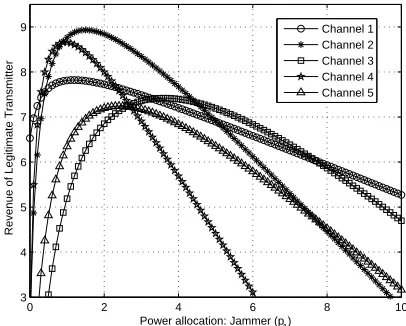
Fig. 3: The revenue of the legitimate transmitter against power allocation at the private jammer for different channels
with fixed interference price (i.e., µ1= 1).
Single Legitimate User and Single Eavesdropper
[image:10.612.334.537.183.346.2]10
Channels Power Allocation: Jammer
Achieved Secrecy Rate
[image:11.612.123.490.52.136.2]Revenue: Legitimate Transmitter Derivation Simulation Derivation Simulation Derivation Simulation Channel 1 1.1809 1.2000 1.6445 1.6458 7.8207 7.8206 Channel 2 1.5019 1.5000 2.0534 2.0531 8.9325 8.9325 Channel 3 3.5984 3.6000 2.0505 2.0507 7.4198 7.4198 Channel 4 0.9452 1.0000 1.9921 2.0041 8.6606 8.6583 Channel 5 2.4107 2.4000 1.8168 1.8152 7.2427 7.2427
TABLE 2: The optimal power allocation policy of the private jammers with fixed interference pricesµ1= 1, achievable secrecy rates and revenues of legitimate transmitter for single legitimate transmitter and single eavesdropper obtained from
the closed-form solution and simulation for different sets channels.
Channels Power Allocation: Jammer 1
Power Allocation: Jammer 2
Achieved Secrecy Rate
[image:11.612.69.545.184.269.2]Revenue: Legitimate Transmitter Derivation Simulation Derivation Simulation Derivation Simulation Derivation Simulation Channel 1 0.3324 0.3324 0.7457 0.7458 2.7083 2.7241 13.0855 12.8145 Channel 2 0.1264 0.1264 0.5729 0.5430 3.3334 3.3223 15.2002 15.2016 Channel 3 3.3886 3.3889 1.0284 1.0284 2.8085 2.8234 13.4161 13.4203 Channel 4 1.1613 1.1614 1.0441 1.0442 2.9185 2.9296 13.7907 13.7928 Channel 5 0.2778 0.2778 2.0209 2.0211 3.2938 3.2949 15.1031 15.1031
TABLE 3: The optimal power allocation policy of the private jammers with fixed interference pricesµ1= 1 andµ2= 3, achievable secrecy rates and revenues of legitimate transmitter. The unit price for the achieved secrecy rate at the legitimate
user is 5 (λ1= 5).
Single Legitimate User and Multiple Eavesdroppers
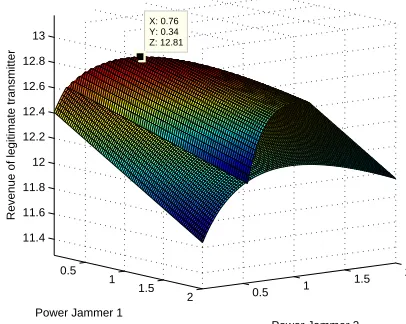
Here, we consider a multicasting secrecy network with a single legitimate user and two eavesdroppers. The price used by the jammers to charge the legitimate transmitter is 1 and 3 (i.e.,µ1= 1, µ2= 3), respectively, for unit interference. Simi-lar to the previous simulations, first, we validate the convexity of the revenue function of the legitimate transmitter in (35) in terms of power allocations (i.e., p1 andp2) at the private jammers for different sets of channels. Then, the correctness of the derived theoretical results is supported through numerical results. Figure 4 depicts the revenue functions of the legitimate transmitter for Channel 1 provided in Table 3 which confirms the convexity of the revenue function in terms of power allocation policy at the jammers. In addition, Table 3 provides the theoretical and simulation based optimal power allocations at the private jammers which maximize the revenue of the transmitter for five sets of channels. As seen in Table 3, the theoretical and simulation results are indistinguishable, which validates the derivation of the closed-form power allocations in (37). On the other hand, the maximum revenue from Figure 4 is the same as that of Channel 1 in Table 3 with the same power allocations at the private jammers. This confirms the optimality of the results obtained in Table 3 for different sets of channels. Note that we have only presented the revenue of the transmitter for Channel 1 in Figure 4; however, the rest of the channels in Table 3 provide similar results. We have not presented those results here due to space limitations.
C. Stackelberg Game
In this subsection, we validate the equilibrium of the pro-posed Stackelberg games for different numbers of legitimate users and eavesdroppers.
Single Legitimate User and Single Eavesdropper
To support the derived Stackelberg equilibrium, a secrecy network with a single legitimate user and an eavesdropper is
0.5 1
1.5 2
0.5 1
1.5 2 11.4
11.6 11.8 12 12.2 12.4 12.6 12.8 13
Power Jammer 2
X: 0.76 Y: 0.34 Z: 12.81
Power Jammer 1
Revenue of legitimate transmitter
Fig. 4: The revenue of the legitimate transmitter for Channel 1 with different power allocations at both the private
jammers for fixed interference prices.
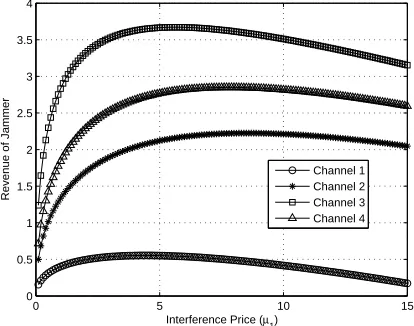
considered. First, for different sets of channels, the revenue function of the jammer is evaluated with different interference prices as shown in Figure 5. These results confirm that the jammer revenue function is concave with respect to the interference price (i.e., µ1) and support the proof provided in Appendix C. The choices for the optimal interference prices and the maximum revenues of the jammers are provided in Table 4, which verifies the accuracy of the analytical results. The Stackelberg equilibria (p∗
[image:11.612.332.535.331.493.2]Channels Interference Price (µ1): Revenue of Jammer: Stackelberg Equilibrium:
(p∗1, µ∗
1) Derivation Simulation Derivation Simulation
Channel 1 4.4313 4.4000 0.5534 0.5530 (0.3670,4.4313)
Channel 2 8.5462 8.5000 2.2242 2.2240 (0.2929,8.5462)
Channel 3 5.6251 5.6000 3.6714 3.6715 (0.8291,5.6251)
Channel 4 8.5640 8.6000 2.1736 2.1735 (0.1863,8.5640)
[image:12.612.120.492.53.136.2]Channel 5 7.8066 7.8000 2.8496 2.8495 (0.4779,7.8066)
TABLE 4: The optimal interference prices and revenues of the private jammer as well as Stackelberg equilibrium for different sets of channels. The unit price for the achieved secrecy rate at the legitimate user is 5 (λ1= 5).
Channels Interference Price: Revenue of Jammers: Stackelberg Equilibrium:(p∗
1, p∗2, µ∗0) Derivation Simulation Derivation Simulation
Channel 1 4.0721 4.1000 1.5381 1.5378 (0.0677,0.3070,4.0721)
Channel 2 2.1647 2.2000 0.5372 0.5378 (0.3076,0.6900,2.1647)
Channel 3 2.6639 2.7000 0.7088 0.7084 (0.1501,1.0917,2.6639)
Channel 4 3.1023 3.1000 0.8887 0.8892 (0.1501,0.6996,3.1023)
Channel 5 4.0322 4.0000 1.4932 1.4935 (2.5895,0.7858,4.0322)
TABLE 5: The optimal interference prices and revenues of the private jammers as well as Stackelberg equilibrium for different sets of channels. The unit price for the achieved secrecy rate at the legitimate user is 5 (λ1= 5).
0 5 10 15
0 0.5 1 1.5 2 2.5 3 3.5 4
Interference Price (µ1)
Revenue of Jammer
Channel 1 Channel 2 Channel 3 Channel 4
Fig. 5: The revenue of the jammer with a single legitimate user and a single eavesdropper for different sets of channels.
Single Legitimate User and Multiple Eavesdroppers
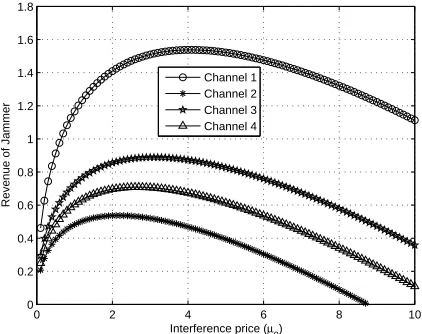
In order to validate the proposed Stackelberg equilibrium, the same secrecy network as in the fixed interference price case is considered with a single legitimate user and multiple eavesdroppers. First, we evaluate the revenue function of the legitimate transmitter (f(γ0)) in (76) in terms of γ0 for different sets of channels. Figure 6 plots the revenues of the legitimate transmitter versusγ0 with fixed interference prices (i.e., µ1 = 1, µ2 = 3) for different sets of channels. This confirms the derivation of the convexity of f(γ0)(Appendix D) in terms of γ0. In addition, the achievable maximum revenues are the same as the derived solutions represented in Table 5. Next, we evaluate the achievable revenues of the jammers with different interference prices where it is assumed that the all the jammers introduce the same interference price (i.e., µ1 = µ2 = µ0). Figure 7 plots the revenues of the jammers versus the interference price µ0 for different sets of channels which confirms the convexity of the revenue
[image:12.612.68.275.312.475.2]of the jammers in the interference price µ0 (Appendix E). Table 5 provides the theoretical and simulation based optimal interference prices (i.e., µ∗
0s) and corresponding revenues of the jammers for the proposed Stackelberg game with different sets of channels, where the theoretical results are the same as the simulated results. In addition, Stackelberg equilibria of the proposed game are also provided in Table 5. The deviation of the legitimate transmitter and jammers from this equilibrium solution will introduce a loss in their corresponding revenues as evidenced by Figures 6 and 7.
0 0.5 1 1.5 2
6 7 8 9 10 11 12 13 14 15 16
γ0
Revenue of legitimate transmitter Channel 1
[image:12.612.329.540.443.610.2]Channel 2 Channel 3 Channel 4
Fig. 6: The revenue of the transmitter in terms ofγ0 with fixed interference prices for different sets of channels.
VII. CONCLUSIONS
12
0 2 4 6 8 10
0 0.2 0.4 0.6 0.8 1 1.2 1.4 1.6 1.8
Interference price (µ
0)
Revenue of Jammer
[image:13.612.66.277.60.227.2]Channel 1 Channel 2 Channel 3 Channel 4
Fig. 7: The revenue of the jammer with different interference prices for different sets of channels.
the case with multiple legitimate users and multiple eaves-droppers. On the other hand, optimization problems have been considered for a multicasting secrecy network with jammers to improve the achievable secrecy rates. These private jam-mers introduce charges for their jamming service. For fixed interference prices, we have derived the optimal interference requirements for different numbers of legitimate users and eavesdroppers. For non-fixed interference prices, we have formulated the optimization problem into a Stackelberg game in which jammers and the transmitter are the leaders and follower, respectively. A Stackelberg equilibrium has been developed for the proposed game with different numbers of legitimate users and eavesdroppers. To validate the derived theoretical results, simulation results have been provided for a variety of scenarios.
APPENDIXA:PROOF OFLEMMA1
The original power minimization problem in (2) can be written without of loss of generality as
min
p,w˜ pw˜
Hw˜
s.t. ˜
wH(I+pˆh 1ˆhH1
)
˜ w
˜ wH(
I+pˆg1ˆgH1)w˜ ≥2 ¯ Rs
, w˜Hw˜= 1, p≥0,(55)
where ˆh1 = hσ11 andˆg1 =
g1
σe. In order to obtain the optimal solution of (55) (i.e., w˜∗, p∗), we derive the corresponding
dual problem. The Lagrangian of (2) can be defined as
L(w,λs)=wHw+λs
[
2R¯s(
1+wHgˆ1ˆg1Hw
)
−(1+wHˆh1hˆH1w
)]
,
where λs is the Lagrange multiplier associated with the secrecy rate constraint. The corresponding dual problem can be defined as
max
λs≥0
λs(2Rs−1), s.t. Z,I−λs
(
ˆ
hˆhH−2R¯sˆgH 1gˆ1
)
≽0.(56)
The constraint in (56) means that the matrix Z should have at least one zero eigenvalue. On the other hand, λs can take the maximum to satisfy the positive semidefinite constraint in
(56) as
λ∗s =
1
λmax(ˆhˆhH−2R¯sgˆH 1ˆg1
), (57)
where λmax(·) denotes the maximum eigenvalue of its ar-gument. The original problem in (2) can be formulated as a convex problem. Hence, strong duality holds between the original problem in (2) and the corresponding dual problem in (56). The required minimum power to achieve the secrecy rate constraint is
p∗=λ∗s
(
2R¯s
−1). (58)
On the other hand, the optimalwshould be in the null space of Z:
w1 = vmax
(
ˆ
hˆhH−2RsˆgH 1 ˆg1
)
, w˜∗= w1
∥w1∥2, (59) where vmax(·) denotes the the eigenvector corresponding to the maximum eigenvalue. Hence the optimal solution of (2) can be expressed as in (3). This completes the proof forLemma
1.
APPENDIXB:PROOF OFLEMMA2
We first show that the problem in (16) is a convex problem by showing that the following function is concave in p1:
f(p1) =λ1
[
log(1+β0)−log
(
1+ β1
σ2
e+p1α1
)]
−µ1p1α1. (60)
The concavity of this function can be shown by finding the second derivative respect top1 as follows:
∂f(p1)
∂p1 =
λ1α1β1
(σ2
e+p1α1+β1)(σ2e+p1α1)
−µ1α1 (61)
∂2f(p1)
∂p2 1
=− λ1α1β1
(
2α2
1p1+ 2α1σe2+β1α1
)
[α2
1p21+ (2σ2e+β1)α1p1+β1σe2+σ4e]2
. (62)
Since ∂ 2
f(p1) ∂p2
1 <0,f(p1)is a concave function in terms ofp1. Hence the optimal solution should satisfy the KKT conditions as follows [44]:
∂f(p1)
∂p1 =
λ1α1β1
(σ2
e+p1α1+β1)(σ2e+p1α1)
−µ1α1= 0. (63)
By arranging the terms of (63), we obtain the following:
α12p21+
(
2σ2e+β1
)
α1p1+β1σe2+σ4e−
λ1β1
µ1 = 0. (64) By solving this equation, the optimal power allocation policy
p1 at the jammer is obtained asp1≥0,
p∗1=
1
α1
√
β2 1
4 +
λ1β1 µ1 −
(2σ2e+β1)
2
+
. (65)
This completes the proof ofLemma 2.
APPENDIXC:PROOF OFLEMMA3
The problem in (21) can be proven to be a convex problem by showing the following function is concave in the interfer-ence price µ1 forp∗1(>0) in (18):
f(µ1) =µ1
(√
c1+c2
µ1 −c0
)
, (66)
toµ1 as follows:
∂f(µ1)
∂µ1 =
(
c1+ c2
µ1
)12
− c2
2µ1
(
c1+ c2
µ1
)−12
−c0 (67)
∂2f(µ1)
∂µ2 1
=− c
2 2
4µ3 1
(
c1+ c2
µ1
)−32
. (68)
Hence the second derivative of f(µ1) with respect to µ1 is negative (i.e., ∂
2 f(µ1) ∂µ2
1 <0), andf(µ1) is a concave function in µ1. In addition, the optimal interference price µ∗
1 should satisfy the KKT conditions as follows [44]:
∂f(µ1)
∂µ1 =
(
c1+ c2
µ1
)12
− c2
2µ1
(
c1+ c2
µ1
)−12
−c0= 0. (69)
By rearranging the (69), we obtain the following:
4c1(
c20−c1
)
µ21+ 4c2
(
c20−c1
)
µ1−c22= 0. (70)
By solving the above equation, the optimal interference price
µ∗
1 to maximize the jammer’s revenue is obtained asµ1>0,
µ∗1= c2 2c1 [ c0 √ c2 0−c1
−1
]
. (71)
This completes the proof of Lemma 3.
APPENDIXD:PROOF OFLEMMA6
With the optimal power allocation in (34), the achieved rates of the super-active eavesdroppers (i.e., i ∈K) will be equal as stated in Proposition 2. Hence, the power allocation at the
ith private jammer can be written as
βi
σ2
e+piαi
=γ0,=⇒pi=
1
αi
[
βi
γ0 −σ 2
e
]+
. (75)
The original optimization problem in (34) can be formulated in terms ofγ0 as follows:
max
γ0≥0
λ1[log(1 +β0)−log(1+γ0)]−
1
γ0
K
∑
i=1
µiβi+σe2
K
∑
i=1
µi
,f(γ0) (76)
The optimal γ∗
0 should satisfy the KKT conditions and there-fore we obtain the following:
∂f(γ0)
∂γ0
=− λ1 1+γ0
+ τ
γ2
0
, ∂
2f(γ 0)
∂γ2
0
= λ1
(1+γ0)2−
2τ
γ3
0
, (77)
where τ =∑K
i=1µiβi. The function f(γ0) is concave if the following condition is satisfied:
γ30
(1 +γ0)2 ≤
2τ
λ1. (78)
Hence, the optimal γ∗
0 can be obtained ifλ1 is large enough to satisfy the above condition. This means that the legitimate transmitter should charge the legitimate user a reasonable price to make a profit by introducing interference to the eavesdroppers with the help of the private jammers. However, the optimalγ∗
0 should satisfy the KKT conditions ∂f(γ0)
∂γ0 = 0. The optimal γ∗
0 can be obtained by solving the following equation:
λ1γ02−γ0
K
∑
i=1 µiβi−
K
∑
i=1
µiβi= 0, (79)
andγ0>0,
γ0∗=
∑K
i=1µiβi+
√ ∑K
i=1µiβi
(
4λ0+∑K i=1µiβi
)
2λ1 . (80)
Hence the optimal power allocation policy of the ith can be written as
p∗i =
1 αi [ βi γ∗ 0
−σe2
]+
. (81)
This completes the proof ofLemma 6.
APPENDIXE:PROOF OFLEMMA7
We first show that the revenue function of the jammers in (41) is concave in terms ofµ0forpi>(0)in (37) and then we derive the optimal interference priceµ∗
0. The revenue function of the jammers is defined as
f(µ0) = 2λ1µ0¯c1
µ0¯c1+√
µ0¯c1(4λ1+µ0¯c1) −Kσ
2
eµ0, (82)
where¯c1=∑Ki=1βi. The concavity of f(µ0) can be proven by finding the second derivative with respect toµ0as in (72), which is at the top of the next page. In order to prove that the function in (82) is concave, we need to show that the second derivative (i.e.,∂
2 f(µ0) ∂µ2
0 ) is negative. This has been proved in (73) and (74) which are at the top of the next page. This confirms that the revenue function of the jammers is concave inµ0 and the optimal µ∗0 should satisfy the KKT conditions
∂f(µ0)
∂µ0 = 0 [44]:
2λ1c¯1
µ0¯c1+q −
2λ1c¯1µ0
(
¯
c1+¯c
2
1µ0+2λ1c¯1 µ0¯c1+q
)
(µ0¯c1+q)2
= 0, (83)
µ∗0 = 1 2
[
−4λ1Kσ2η1+ 2λ1√Kσ2η2+ 4K2σ4η2 1
]
Kσ2η2 .
This completes the proof of Lemma 7.
REFERENCES
[1] Y. Liang, H. V. Poor, and S. Shamai, “Information theoretic security,” Found. Trends Commun. Info. Theory, vol. 5, no. 4-5, pp. 355–580, 2009.
[2] L. Dong, Z. Han, A. P. Petropulu, and H. V. Poor, “Improving wireless physical layer security via cooperating relays,” IEEE Trans. Signal Process., vol. 58, no. 3, pp. 1875–1888, Mar. 2010.
[3] X. Tang, R. Liu, P. Spasojevi´c, and H. V. Poor, “Interference assisted se-cret communication,”IEEE Trans. Inf. Theory, vol. 57, no. 5, pp. 3153– 3167, May 2011.
[4] A. D. Wyner, “The wire-tap channel,”Bell Syst. Tech. Journ., vol. 54, pp. 1355–1387, Jan. 1975.
[5] I. Csiszár and J. Körner, “Broadcast channels with confidential mes-sages,”IEEE Trans. Inf. Theory, vol. 24, pp. 339–348, May 1978. [6] T. Liu and S. Shamai, “A note on the secrecy capacity of the
multiple-antenna wiretap channel,” IEEE Trans. Inf. Theory, vol. 55, no. 6, pp. 2547–2553, Jun. 2009.
[7] A. Khisti and G. W. Wornell, “Secure transmission with multiple antennas II: The MIMOME wiretap channel,”IEEE Trans. Inf. Theory, vol. 56, no. 11, pp. 5515–5532, Nov. 2010.
[8] J. Li and A. P. Petropulu, “On ergodic secrecy rate for Gaussian MISO wiretap channels,” IEEE Trans. Wireless Commun., vol. 10, no. 4, pp. 1176–1187, Apr. 2011.
[9] Q. Li and W.-K. Ma, “Optimal and robust transmit designs for MISO channel secrecy by semidefinite programming,” IEEE Trans. Signal Process., vol. 59, no. 8, pp. 3799–3812, Aug. 2011.