Heat shock increases conjugation ef
fi
ciency in
Clostridium dif
fi
cile
*
Joseph A. Kirk, Robert P. Fagan
*Krebs Institute, Department of Molecular Biology and Biotechnology, University of Sheffield, Sheffield, S10 2TN, UK
a r t i c l e i n f o
Article history: Received 26 May 2016 Received in revised form 15 June 2016
Accepted 29 June 2016 Available online 1 July 2016
Keywords: Clostridium difficile PCR ribotype 027 Conjugation
a b s t r a c t
Clostridium difficileinfection has increased in incidence and severity over the past decade, and poses a unique threat to human health. However, genetic manipulation ofC.difficileremains in its infancy and the bacterium remains relatively poorly characterised. Low-efficiency conjugation is currently the only available method for transfer of plasmid DNA intoC.difficile. This is practically limiting and has slowed progress in understanding this important pathogen. Conjugation efficiency varies widely between strains, with important clinically relevant strains such as R20291 being particularly refractory to plasmid transfer. Here we present an optimised conjugation method in which the recipient C.difficileis heat treated prior to conjugation. This significantly improves conjugation efficiency in allC.difficilestrains tested including R20291. Conjugation efficiency was also affected by the choice of media on which conjugations were performed, with standard BHI media giving most transconjugant recovery. Using our optimised method greatly increased the ease with which the chromosome of R20291 could be precisely manipulated by homologous recombination. Our method improves on current conjugation protocols and will help speed genetic manipulation of strains otherwise difficult to work with.
©2016 The Authors. Published by Elsevier Ltd. This is an open access article under the CC BY license (http://creativecommons.org/licenses/by/4.0/).
1. Introduction
Clostridium difficileposes a significant threat to human health and is the most common cause of antibiotic associated diarrhoea
[1]. Both incidence and mortality has increased over the last decade. This is due, at least in part, to the emergence of epidemic lineages such as ribotype 027 and 078[1]. Despite the increase incidence and severity ofC. difficileinfections, relatively little is known about the molecular basis of disease. However, an increased recognition of the importance ofC.difficilein human health has led to an increased interest in this bacterium. Despite this, genetic manipulation ofC.difficileremains in its infancy. One limitation in
C.difficileresearch is the reliance on low-efficiency conjugation, as this is the only useable method for DNA transfer intoC.difficile[2]. This is less of a problem when using strains with relatively high conjugation efficiencies such as the laboratory strain CD630. However, clinically relevant epidemic strains, such as the ribotype 027 strain R20291, display very low conjugation efficiencies. This makes genetic manipulation of these strains particularly difficult.
Conjugation efficiencies of other bacteria, such asCampylobacter
jejuniand Corynebacterium glutamicum, have been shown to in-crease in response to heat treatment[3,4]. Here we demonstrate that conjugation efficiency in a panel of C. difficile strains is increased in response to heat treatment and we provide an opti-mised conjugation protocol that will increase the ease with which the species may be genetically manipulated.
2. Materials and methods
2.1. Growth and handling of organisms
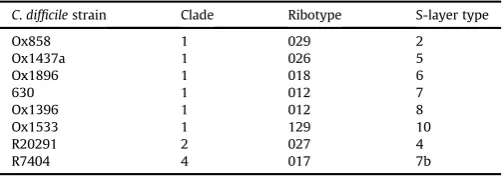
C.difficilestrains, outlined inTable 1, were propagated either in TY broth without thioglycolate[5]or on BHI agar. Cultures were incubated at 37C in an anaerobic environment composed of 80% nitrogen, 10% hydrogen and 10% carbon dioxide.Escherichia coliwas routinely grown in LB broth or on LB agar. E.coli strain CA434 (HB101 carrying R702) was used as the conjugation donor throughout. NEB5
a
(New England Biolabs) was used for cloning and plasmid propagation. Growth media was supplemented with chloramphenicol (15m
g/ml), thiamphenicol (15m
g/ml) or cyclo-serine (250m
g/ml) as appropriate.2.2. Viability of C. difficile after heat treatment
C.difficilestrain R20291 was grown overnight in TY broth. 200
m
l *This paper has been recommended for acceptance by Elisabeth Nagy.*Corresponding author.
E-mail addresses: Jakirk1@sheffield.ac.uk (J.A. Kirk), r.fagan@sheffield.ac.uk (R.P. Fagan).
Contents lists available atScienceDirect
Anaerobe
j o u r n a l h o m e p a g e : w w w . e l s e v i e r . c o m / l o c a t e / a n a e r o b e
http://dx.doi.org/10.1016/j.anaerobe.2016.06.009
samples were incubated at 44, 46, 48, 50, and 52C for 5, 15, 30, 45, or 60 min. An unheated control was included. Samples were then serially diluted and 10
m
l of each dilution was spotted onto well-dried BHI plates and incubated overnight. Enumerations were performed in triplicate on biological duplicates. Colonies of C.difficilewere counted and viability calculated as CFU/ml.
2.3. Plasmid conjugations
A previously described and widely used conjugation protocol was used as the starting point for development of our improved method[2]. 200
m
l samples ofC.difficileovernight cultures were heated, as above, and incubated at 37C for 2 min. 1 ml of overnightE.coliconjugant donor (CA434) culture was harvested by centri-fugation at 4000g for 2 min and transferred into the anaerobic workstation. E.colicell pellets were then gently resuspended in 200
m
l of heat treated or untreatedC.difficileculture. This mixed cell suspension was then pipetted onto well-dried, non-selective agar plates (1010m
l spots) and allowed to dry. BHI agar was used routinely but BHIS (BHI agar supplemented with 0.1% (w/v) cysteine and 0.5% (w/v) yeast extract), TY[5]and Brazier’s (Brazier’s CCEY media, 1% (v/v) defibrinated horse blood, 4% (v/v) egg yolk emulsion) agar were also tested. All solid media contained 1.5% agar. Conjugations were then incubated for 8e24 h following which growth was harvested using 900m
l of TY broth, serially diluted and spread on plates containing either cycloserine (for totalC.difficileCFU counts), or cycloserine and thiamphenicol (to select for transconjugants). Approximate conjugation efficiency was then calculated as transconjugant CFU/total C. difficile CFU. These ex-periments were performed using biological duplicates with tech-nical triplicates. Statistical significance of these results was determined using either individual student t-tests or in combina-tion with one way analysis of variance (ANOVA), performed using GraphPad Prism 6.Pvalues of<0.05 were considered statistically significant.
2.4. Creation of a chromosomal divIVA-SNAP fusion mutant and
fluorescence microscopy
1.2 kb upstream and downstream of the 30region ofdivIVAwere
amplified using RF439
(CGTAGAAA-TACGGTGTTTTTTGTTACCCTACTGTAGCAATATTAAATTCTACAAATG) with RF440 (CAGCAGCTGCCTCGAGTTCTAAAGTTGTAGCAGCTTC) and RF443 (CCAGGACTTGGGTAAGCTTGTAATTTGTTTATTTTTTATG) with RF444 (GGGATTTTGGTCATGAGATTATCAAAAAGGA-CATTTGATGGTAAAGTCCATG) respectively. A C. difficile codon-optimised SNAP-tag coding sequence was cloned from pFT46[6]
using RF441 (GCTACAACTTTAGAACTCGAGGCAGCTGCTGAT) and RF442 (AAACAAATTACAAGCTTACCCAAGTCCTGGTTTCC). pMTL-SC7215 [7] was linearized using RF311 (TAGGGTAACAAAAAA-CACCG) and RF312 (CCTTTTTGATAATCTCATGACC). These fragments
were then combined using a combination of SOEing PCR[8]and Gibson assembly[9]using the HiFi DNA assembly kit (New England Biolabs). The resulting plasmid (pJAK050) was then conjugated into
C.difficilestrain R20291 and mutants selected using the method previously described[7]. Correct insertion of the SNAP-tag coding sequence into the chromosome was confirmed by PCR using RF445 (GGTTTAAGAGGGTATAGAGATG) and RF545 (CGAGTTA-TAAATCGCGTTACCACC). Forfluorescent labelling of DivIVA-SNAP, 1 ml of exponentially growing R20291 and R20291divIVA-SNAP
was incubated anaerobically with 250 nM SNAP TMR-star (New England Biolabs) for 30 min before slides were prepared for stan-dardfluorescence microscopy, or lysates prepared. Proteins in the lysates were resolved on 12% SDS-PAGE gels and visualised using a BioRad ChemiDoc MP imaging system. Slides were visualised using a Nikon Ti Eclipse inverted epifluorescence microscope.
3. Results and discussion
3.1. Heat treatment of R20291 increases conjugation efficiency
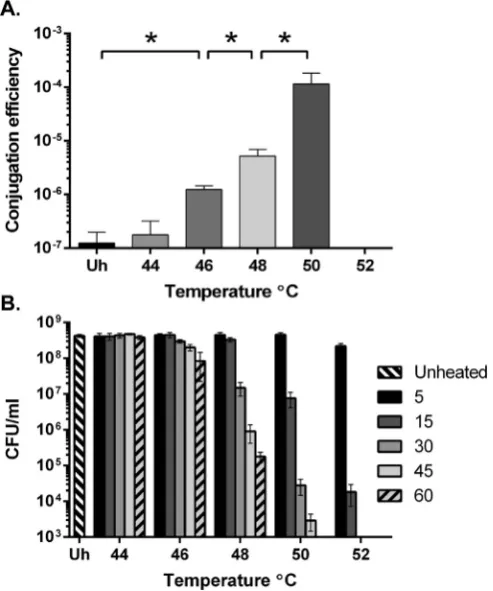
C.difficilestrain R20291 was chosen for these experiments due to its clinical relevance and relatively low conjugation efficiency. The effect of heat treatment on conjugation efficiency was tested. R20291 cultures were heated to 44e52 C for 15 min prior to conjugation with the E. coli donor CA434 bearing the plasmid pRPF185 [10]. pRPF185 was chosen as it is a commonly used plasmid inC.difficile research and contains the nativeC.difficile
replicon pCD6. A clear increase in conjugation efficiency was observed with increasing temperatures, from 46 C to 50 C (Fig. 1A). However, no transconjugants were observed when treated at 52C for 15 min. Additionally, although conjugation efficiency was increased at 50 C relative to 48 C, lower total CFUs and transconjugant CFUs were recorded. To test the effect of the heat treatment onC.difficileviability, cultures were heated to 44e52C for 5e60 min and viable cells enumerated (Fig. 1B). Viability was unaffected by incubation at 44 C but there was a significant reduction in viability at temperatures above this and viability further decreased with increasing incubation time. Based on these data it is clear that the total number of transconjugants recovered is a compromise between increasing conjugation efficiency and decreasing viability. Although heat treatment at 52C for 15 min resulted in recovery of no transconjugants, this treatment did reduce viability by more than four orders of magnitude. As shorter heat treatments minimised the impact on viability, conjugation was tested following a 52C heat treatment for 5 min. This treatment almost doubled the recovery of transconjugants compared to the next best condition (approx. 2800 CFU/ml following 52C, 5 min compared with 1500 CFU/ml following 50C, 15min). These con-ditions were used as standard for the remainder of the experiments described below unless otherwise stated.
3.2. Conjugation efficiency is affected by media choice
There appears to be no standard media choice forC.difficile
[image:2.595.33.285.93.181.2]conjugations in the current literature. For this reason, the effect of media choice on conjugation efficiency, after heat treatment, was investigated. Conjugations were performed on BHI, BHIS, TY, and Braziers agar (Fig. 2). The highest conjugation efficiency was recorded when conjugations were performed using BHI agar. Although conjugation efficiency was lower when using BHIS rela-tive to TY, higher numbers of transconjugants were recovered when using TY due to a higher total CFU count recorded when using this growth medium. TotalC.difficileCFUs recovered from Brazier’s was the lowest of all tested media, and resulted in the recovery of no transconjugants. While this observation is unlikely to be due to the
Table 1
C.difficilestrains used in this study including their respective clade, ribotype, and S-layer type.
C.difficilestrain Clade Ribotype S-layer type
Ox858 1 029 2
Ox1437a 1 026 5
Ox1896 1 018 6
630 1 012 7
Ox1396 1 012 8
Ox1533 1 129 10
R20291 2 027 4
media having a direct effect on the actually conjugation process, it is likely that population equilibrium betweenC.difficileandE.coliis affected, which may in turn impact overall conjugation efficiency.
3.3. Heat treatment improves conjugation efficiency of a plasmid containing a non-native replicon
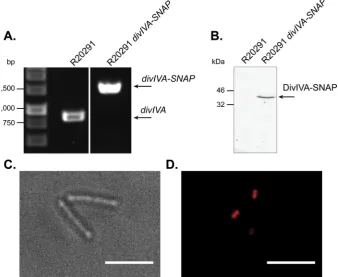
The precise manipulation of the genome of R20291 can be achieved through the use of the allele-exchange vector pMTL-SC7215. This pseudosuicide vector contains the pBP1 replicon, which replicates at a rate lower than that of the host cell chro-mosome. The result is non-exponential growth, limited by the rate of plasmid replication, when under antibiotic selection[7]. How-ever, plasmids based upon this vector are difficult to conjugate into strain R20291 and the number of publications describing the use of this plasmid remains low. For this reason a pMTL-SC7215 based vector was created to add the SNAP-tag coding sequence to the chromosomaldivIVAgene. This plasmid, pJAK050, was then used in heat treated and unheated conjugations. Due to the extremely low conjugation efficiency when using this plasmid, 24 h conjugations were performed following a 50C for 15 min heat treatment. No transconjugants were recovered using the standard unheated conjugation protocol. However, using our optimised heat treatment protocol large numbers of transconjugants were recovered, allow-ing adivIVA-SNAPmutant to be isolated in little over 2 weeks after the plasmid was constructed. Correct insertion of the SNAP-tag coding region into the C.difficilegenome was confirmed by PCR (Fig. 3A). Fluorescence imaging of lysates of SNAP TMR-star treated R20291 divIVA-SNAP resolved by SDS-PAGE shows a band at approximately 40 kDa, the estimated size of DivIVA-SNAP (Fig. 3B). SNAP TMR-star treated R20291 divIVA-SNAP displayed mostly septal and some polar localisation offluorescence (Fig. 3C and D), similar to DivIVA localisation observed in other bacterial species
[11]. Taken together, these results suggest correct insertion of the SNAP-tag coding sequence into theC.difficilechromosome at the appropriate genetic locus.
3.4. Heat treatment increases conjugation efficiency in a panel of C. difficile strains
In order to determine whether the improved conjugation pro-tocol was more widely applicable, conjugations were performed with pRPF185 on a panel of C.difficilestrains. The strains tested represented a further 6 ribotypes and the majority of C. difficile
clades and S-layer types [12]. All strains tested displayed an in-crease in conjugation efficiency after heat treatment, although the observed improvement was greatest for strain R20291 (Fig. 4). Although efficiency was improved, heat treatment did not result in a significant increase in the number of transconjugants recovered for strains Ox1396 and Ox1437a. This is likely due to a decrease in viability following heat treatment and may be improved by extending the conjugation time. Using the standard 52C for 5 min heat treatment, conjugation efficiency into strain R7404 was too low to accurately measure after an 8 h conjugation and no signif-icant increase in conjugation efficiency was observed when con-jugations were extended to 24 h. R7404 conjugation was then tested after incubation at 50C for 15 min followed by a 24 h in-cubation. This resulted in a significant increase in both conjugation efficiency (Fig. 4) and in the number of transconjugants recovered. These results indicate that our heat treatment conjugation protocol is broadly applicable to the majority ofC.difficilestrains and may be further optimised for specific applications.
4. Conclusions
[image:3.595.46.293.67.363.2]C. difficile shows considerable strain-to-strain variation in conjugation efficiency. Conjugation efficiency is improved in a panel of strains, representing the majority of clades and S-layer types, through heat treatment of the recipientC.difficile prior to
Fig. 1.Effect of heat treatment on conjugation efficiency and viability ofC.difficile strain R20291.(A)Conjugation efficiency of unheated and heat treated (44e52C for 15 min)C.difficilestrain R20291. Asterisks (*) denote statistical significance between heat treatment conditions (P<0.05). Each bar represents the mean and standard deviation of data collected from experiments performed in triplicate using biological duplicates.(B) Viability of R20291 after heat treatment at varying temperatures (44e52C) and incubation times (5e60 min). Each bar represents the mean and standard deviation of data collected from experiments performed in triplicate using biological duplicates.
[image:3.595.46.291.468.639.2]conjugation. Conjugation efficiency is dependent on the media choice on which the conjugation is performed, with the highest number of transconjugants being recovered from BHI agar in this study. Using an optimised heat treatment conjugation protocol significantly improved the ease in which a pMTL-SC7215 based plasmid was introduced into R20291, facilitating chromosomal manipulation of the R20291 genome by homologous
recombination. Heating the recipientC.difficileto 52C for 5 min prior to conjugation proved to be optimum for an 8 h conjugation, although conjugation efficiency can be increased by coupling more stressful heat treatments with longer conjugation times.
Acknowledgements
We wish to thank the UK Medical Research Council (grant number MR/N000900/1) forfinancial support and the University of Sheffield for funding JAK’s PhD studentship. We would also like to thank Dr Kate Dingle, Prof Neil Fairweather, Prof Nigel Minton and Prof Adriano Henriques for providingC.difficile strains and plas-mids used in this study.
References
[1] W.K. Smits, D. Lyras, D.B. Lacy, M.H. Wilcox, E.J. Kuijper,Clostridium difficile
infection, Nat. Rev. Dis. Prim. 2 (2016) 16020.
[2] D. Purdy, T.A. O’Keeffe, M. Elmore, M. Herbert, A. McLeod, M. Bokori-Brown, et al., Conjugative transfer of clostridial shuttle vectors fromEscherichia colito
Clostridium difficile through circumvention of the restriction barrier, Mol. Microbiol. 46 (2002) 439e452.
[3] X. Zeng, D. Ardeshna, J. Lin, Heat shock-enhanced conjugation efficiency in standardCampylobacter jejunistrains, Appl. Environ. Microbiol. 81 (2015) 4546e4552.
[4] A. Schafer, J. Kalinowski, A. Puhler, Increased fertility of Corynebacterium glutamicumrecipients in intergeneric matings withEscherichia coliafter stress exposure, Appl. Environ. Microbiol. 60 (1994) 756e759.
[5] B. Dupuy, A.L. Sonenshein, Regulated transcription ofClostridium difficiletoxin genes, Mol. Microbiol. 27 (1998) 107e120.
[6] F.C. Pereira, L. Saujet, A.R. Tome, M. Serrano, M. Monot, E. Couture-Tosi, et al., The spore differentiation pathway in the enteric pathogenClostridium difficile, PLoS Genet. 9 (2013) e1003782.
[image:4.595.125.464.69.346.2][7] S.T. Cartman, M.L. Kelly, D. Heeg, J.T. Heap, N.P. Minton, Precise manipulation of theClostridium difficilechromosome reveals a lack of association between
Fig. 3. Precise manipulation of the R20291 genome accelerated by the use of optimised conjugation.(A)0.8% Agarose gel showing PCR fragments amplified using primersflanking the SNAP-tag coding sequence insertion site in the chromosomaldivIVAgene. The increase of approximately 550bp from 885 bp (R20291) to 1443 bp (R20291divIVA-SNAP)suggests the correct insertion of the SNAP-tag coding sequence.(B)12% SDS-PAGE gel imaged using afluorescence imager, showing resolved lysates from SNAP TMR-star treated R20291 and R20291divIVA-SNAP. A band at approximately 40 kDa in the mutant corresponds to the addition of a SNAP-tag on DivIVA.(C)Brightfield and(D)fluorescence microscopy of exponentially growing R20291divIVA-SNAPstained with 250 nM SNAP TMR-star for 30 min, showing mostly septal and some polar localisation offluorescence. This demonstrates successful modification of the R20291 genome. Scale bar represents 5mm.
[image:4.595.36.282.427.577.2]thetcdCgenotype and toxin production, Appl. Environ. Microbiol. 78 (2012) 4683e4690.
[8] R.M. Horton, H.D. Hunt, S.N. Ho, J.K. Pullen, L.R. Pease, Engineering hybrid genes without the use of restriction enzymes: gene splicing by overlap extension, Gene 77 (1989) 61e68.
[9] D.G. Gibson, L. Young, R.Y. Chuang, J.C. Venter, C.A. Hutchison 3rd, H.O. Smith, Enzymatic assembly of DNA molecules up to several hundred kilobases, Nat. methods 6 (2009) 343e345.
[10] R.P. Fagan, N.F. Fairweather,Clostridium difficilehas two parallel and essential
Sec secretion systems, J. Biol. Chem. 286 (2011) 27483e27493.
[11] D.H. Edwards, J. Errington, TheBacillus subtilisDivIVA protein targets to the division septum and controls the site specificity of cell division, Mol. Micro-biol. 24 (1997) 905e915.