This is a repository copy of
Differential cross section for γd → ωd using CLAS at Jefferson
Lab
.
White Rose Research Online URL for this paper:
http://eprints.whiterose.ac.uk/136377/
Version: Published Version
Article:
Chetry, T., Hicks, K., Compton, N. et al. (109 more authors) (2018) Differential cross
section for γd → ωd using CLAS at Jefferson Lab. Physics Letters B. pp. 646-651. ISSN
0370-2693
https://doi.org/10.1016/j.physletb.2018.06.003
[email protected]
https://eprints.whiterose.ac.uk/
Reuse
This article is distributed under the terms of the Creative Commons Attribution (CC BY) licence. This licence
allows you to distribute, remix, tweak, and build upon the work, even commercially, as long as you credit the
authors for the original work. More information and the full terms of the licence here:
https://creativecommons.org/licenses/
Takedown
If you consider content in White Rose Research Online to be in breach of UK law, please notify us by
Contents lists available atScienceDirect
Physics
Letters
B
www.elsevier.com/locate/physletb
Differential
cross
section
for
γ
d
→
ω
d
using
CLAS
at
Jefferson
Lab
T. Chetry
a,
∗
,
K. Hicks
a,
∗
,
N. Compton
a,
M. Sargsian
m,
S. Adhikari
m,
J. Ball
h,
I. Balossino
r,
L. Barion
r,
M. Battaglieri
t,
V. Batourine
aj,
z,
I. Bedlinskiy
x, A.S. Biselli
k,
f,
S. Boiarinov
aj,
W.J. Briscoe
p,
W.K. Brooks
ak,
aj,
V.D. Burkert
aj,
D.S. Carman
aj,
A. Celentano
t,
G. Charles
ad,
G. Ciullo
r,
l,
L. Clark
am,
Brandon
A. Clary
j,
P.L. Cole
q,
M. Contalbrigo
r,
V. Crede
n,
A. D’Angelo
u,
af,
N. Dashyan
aq,
R. De Vita
t,
E. De Sanctis
s,
A. Deur
aj,
C. Djalali
ah,
R. Dupre
w,
A. El Alaoui
ak,
L. El Fassi
aa,
P. Eugenio
n,
G. Fedotov
a,
ag,
R. Fersch
i,
ap,
A. Filippi
v, G. Gavalian
aj,
ab,
Y. Ghandilyan
aq,
K.L. Giovanetti
y, F.X. Girod
aj, E. Golovatch
ag,
R.W. Gothe
ah,
K.A. Griffioen
ap,
L. Guo
m,
aj,
K. Hafidi
b,
N. Harrison
aj,
M. Hattawy
b,
M. Holtrop
ab, Y. Ilieva
ah,
p,
D.G. Ireland
am,
B.S. Ishkhanov
ag,
E.L. Isupov
ag,
D. Jenkins
an,
S. Johnston
b,
M.L. Kabir
aa,
D. Keller
ao,
G. Khachatryan
aq,
M. Khachatryan
ad,
M. Khandaker
ac,
A. Kim
j,
W. Kim
z,
F.J. Klein
g,
V. Kubarovsky
aj,
ae,
L. Lanza
u,
P. Lenisa
r,
K. Livingston
am,
I.J.D. MacGregor
am,
N. Markov
j,
B. McKinnon
am,
V. Mokeev
aj,
ag,
A. Movsisyan
r,
C. Munoz Camacho
w,
P. Nadel-Turonski
aj,
S. Niccolai
w,
G. Niculescu
y,
M. Osipenko
t,
A.I. Ostrovidov
n,
M. Paolone
ai, R. Paremuzyan
ab,
K. Park
aj,
z,
E. Pasyuk
aj,
c,
W. Phelps
m,
O. Pogorelko
x,
J.W. Price
d,
Y. Prok
ad,
ao,
M. Ripani
t,
D. Riser
j,
B.G. Ritchie
c,
A. Rizzo
u,
af,
G. Rosner
am,
C. Salgado
ac,
R.A. Schumacher
f, Iu. Skorodumina
ah,
G.D. Smith
al,
D.I. Sober
g,
D. Sokhan
am,
N. Sparveris
ai,
S. Stepanyan
aj,
I.I. Strakovsky
p,
S. Strauch
ah,
p,
M. Taiuti
o,
J.A. Tan
z,
M. Ungaro
aj,
ae,
H. Voskanyan
aq,
E. Voutier
w,
L.B. Weinstein
ad,
M.H. Wood
e,
ah,
N. Zachariou
al,
J. Zhang
ao,
Z.W. Zhao
adaOhioUniversity,Athens,OH 45701,UnitedStatesofAmerica
bArgonneNationalLaboratory,Argonne,IL 60439,UnitedStatesofAmerica cArizonaStateUniversity,Tempe,AZ 85287-1504,UnitedStatesofAmerica
dCaliforniaStateUniversity,DominguezHills,Carson,CA90747,UnitedStatesofAmerica eCanisiusCollege,Buffalo,NY,UnitedStatesofAmerica
fCarnegieMellonUniversity,Pittsburgh,PA 15213,UnitedStatesofAmerica gCatholicUniversityofAmerica,Washington,D.C.20064,UnitedStatesofAmerica hIRFU,CEA,Universit’eParis-Saclay,F-91191Gif-sur-Yvette,France
iChristopherNewportUniversity,NewportNews,VA 23606,UnitedStatesofAmerica jUniversityofConnecticut,Storrs,CT 06269,UnitedStatesofAmerica
kFairfieldUniversity,FairfieldCT06824,UnitedStatesofAmerica lUniversita’diFerrara,44121Ferrara,Italy
mFloridaInternationalUniversity,Miami,FL 33199,UnitedStatesofAmerica nFloridaStateUniversity,Tallahassee,FL 32306,UnitedStatesofAmerica oUniversitàdiGenova,16146Genova,Italy
pTheGeorgeWashingtonUniversity,Washington,DC20052,UnitedStatesofAmerica qIdahoStateUniversity,Pocatello,ID 83209,UnitedStatesofAmerica
rINFN,SezionediFerrara,44100Ferrara,Italy
sINFN,LaboratoriNazionalidiFrascati,00044Frascati,Italy tINFN,SezionediGenova,16146Genova,Italy
uINFN,SezionediRomaTorVergata,00133Rome,Italy vINFN,SezionediTorino,10125Torino,Italy
wInstitutdePhysiqueNucléaire,CNRS/IN2P3andUniversitéParisSud,Orsay,France xInstituteofTheoreticalandExperimentalPhysics,Moscow,117259,Russia yJamesMadisonUniversity,Harrisonburg,VA 22807,UnitedStatesofAmerica zKyungpookNationalUniversity,Daegu41566,RepublicofKorea
aaMississippiStateUniversity,MississippiState,MS39762-5167,UnitedStatesofAmerica abUniversityofNewHampshire,Durham,NH 03824-3568,UnitedStatesofAmerica acNorfolkStateUniversity,Norfolk,VA 23504,UnitedStatesofAmerica
adOldDominionUniversity,Norfolk,VA 23529,UnitedStatesofAmerica
https://doi.org/10.1016/j.physletb.2018.06.003
aeRensselaerPolytechnicInstitute,Troy,NY 12180-3590,UnitedStatesofAmerica afUniversita’diRomaTorVergata,00133Rome,Italy
agSkobeltsynInstituteofNuclearPhysics,LomonosovMoscowStateUniversity,119234Moscow,Russia ahUniversityofSouthCarolina,Columbia,SC 29208,UnitedStatesofAmerica
aiTempleUniversity,Philadelphia,PA19122,UnitedStatesofAmerica
ajThomasJeffersonNationalAcceleratorFacility,NewportNews,VA 23606,UnitedStatesofAmerica akUniversidadTécnicaFedericoSantaMaría,Casilla110-V,Valparaíso,Chile
alEdinburghUniversity,EdinburghEH93JZ,UnitedKingdom amUniversityofGlasgow,GlasgowG128QQ,UnitedKingdom anVirginiaTech,Blacksburg,VA 24061-0435,UnitedStatesofAmerica aoUniversityofVirginia,Charlottesville,VA 22901,UnitedStatesofAmerica
apCollegeofWilliamandMary,Williamsburg,VA 23187-8795,UnitedStatesofAmerica aqYerevanPhysicsInstitute,375036Yerevan,Armenia
a
r
t
i
c
l
e
i
n
f
o
a
b
s
t
r
a
c
t
Articlehistory:
Received19February2018
Receivedinrevisedform23April2018 Accepted3June2018
Availableonline6June2018 Editor:V.Metag
Keywords:
VectorMesonDominance Differentialcrosssection Singlescattering Doublescattering
The crosssectionfor coherent
ω
-mesonphotoproduction offthe deuteronhasbeenmeasuredforthe firsttimeasafunctionofthemomentumtransfert=(Pγ−Pω)2andphotonenergyEγ usingtheCLAS detector attheThomasJeffersonNational AcceleratorFacility. Thecross sectionsare measuredin the energyrange1.4<Eγ<3.4 GeV.Amodel basedonω
−Nrescatteringisconsistentwiththedataat lowandintermediatemomentumtransfer,|t|.For2.8<Eγ<3.4 GeV,thetotalcross-sectionofω
−N scattering,basedonfitswithintheframeworkoftheVectorMesonDominancemodel,isintherangeof 30–40mb.2018TheAuthors.PublishedbyElsevierB.V.ThisisanopenaccessarticleundertheCCBYlicense (http://creativecommons.org/licenses/by/4.0/).FundedbySCOAP3.
1. Introduction
Vectormeson photoproductionoff protonsat highenergies is welldescribed[1] theoreticallyusingthephenomenologicalVector MesonDominance (VMD)model, inwhich the photon fluctuates intoavirtuallightvectormeson(havingthesamequantum num-bersasthephoton)andthenscattersoffthetarget [2].TheVMD modelhasbeenverysuccessfulatpredictingvectormeson produc-tion athigh energies. However, atphoton energies closer to the production threshold, other diagrams, such as pseudoscalar me-sonexchangeinthet-channel,cancontribute [3].Thismakesthe reactiondynamicsofvectormesonphotoproductionoffproton tar-getsmorecomplexnearthreshold.Additionalcomplexitynearthe thresholdmaycomefromnucleonresonancesinthes-channel. Co-herent
ω
-mesonproductionoffthedeuteronavoidssuch complex-ities.Sinceboththedeuteronandthefinalω
dstateareisosinglets, exchangeofnon-isosinglet(e.g.pseudoscalar)mesonscannot con-tribute. Hence, natural parity exchange in the t-channel, usually describedbyPomeronexchange(seeFig.1a),isexpectedto domi-nateatlowmomentumtransfer(low|
t|
,wheret=
(
Pγ−
Pω)
2and Piisthefour-momentumofparticlei)forvectormesonphotopro-ductionoffdeuterium,thussimplifyingtheoretical interpretations ofthedata.
At higher momentum transfer (
|
t|
>
0.
5 GeV2/
c2) secondary scattering diagrams, where theω
is produced off one nucleon and scatters from the second, as shown in Fig. 1b, enable both nucleons to remain bound as a deuteron in the final state [4]. Thesediagrams providean opportunity to extract theω
−
N to-tal scattering cross section,σ
ωN, from comparisons of data andcalculations.Similarstudiesweredoneforcoherent
φ
-meson pho-toproduction from the deuteron [5,6], resulting in the first-ever estimatesof theφ
−
N total cross section. Information on these vector meson–nucleon total crosssections is virtually impossible*
Correspondingauthors.E-mailaddress:[email protected](T. Chetry).
toextractcleanlyviaother methods,duetotheshortlifetimesof thesemesons.
Experimentalinformationon
σ
ωN isofinterestcurrentlyduetoprogresswithinlatticeQCD,whichcannowextractmeson–meson scatteringphase shiftsdirectly[7]. The HadronSpectroscopy Col-laboration [7] isworkingon extractingmeson–nucleonscattering phaseshifts,whicharedirectlyrelatedtothetotalcrosssections. Thisisasignificant advancebecauseitconnectsQCD calculations toexperimentalobservables,suchasthetotalcrosssections.Such adirectconnectionbetweennon-perturbativeQCDandexperiment hasbeenrareuntilnow.The
ω
mesonisaparticularlygoodchoice for these studies, since it decays into three pions about 89% of thetime.Onthelattice,thelight quarkmassesareinputs. Lattice results are often shown for pion masses heavierthan in nature, as the lattice calculations are easier to compute there. Theω
is thusastableparticleinlatticecalculationswherethepionmassis somewhathigherthanitsphysicalvalue.Scatteringphaseshiftsof stableparticlesareeasiertoobtainonthelatticethanforunstable particles.Hence,measurementsofσ
ωN aretimelyandcansoonbecomparedwithpredictionsfromlatticecalculations.
Previousexperimentaldataoncoherent
ω
photoproductionare scarce.Bubblechambermeasurements[1] havelowstatistical pre-cision. The best data on this reaction are from the Weizmann Institute [8], using a photon beam of energy 4.3 GeV and at|
t|
<
0.
2 GeV2/
c2,whichistoo smalltoseethe effectof double-scatteringasshowninFig. 1b.Data oncoherentρ
photoproduc-tionhavebeenmeasuredathigher|
t|
atSLAC[9],whichwasused toextractσ
ρN.Nopreviousdataexistthatwouldallowanextrac-tionof
σ
ωN.Here,wepresentdataoncoherent
ω
photoproductionoff deu-teriumatphotonenergiesrangingfrom1.4to3.4 GeVoverawide rangeinthemomentumtransfert.Thet-dependenceofthecross section ismeasured out to|
t|
∼
2.
0 GeV2/
c2, whichis compared withtheoreticalcalculationsthatincludethedouble-scattering di-agrams,allowinganextractionofthetotalscatteringcrosssectionσ
ωN.ThiscompletesthemeasurementofscatteringcrosssectionsFig. 1.t-Channeldiagramsshowingtwoω-mesonphotoproductionmechanismsvia
(a)Singleand(b)Doublescattering.Thephotonfluctuatestotheω,whichscatters offthenucleon(s).ThedashedlinerepresentstheexchangeofaPomeron.
2. Experiment
The g10dataset,withunpolarizedbeam, was collected inthe spring of 2004 using the Continuous Electron Beam Accelerator Facility (CEBAF) and the CEBAF Large Acceptance Spectrometer (CLAS) at the Thomas Jefferson NationalAccelerator Facility (Jef-ferson Lab). CLAS was designedaround sixsuperconducting coils arranged in a toroidal configuration that produced a field in the azimuthaldirection.Theparticledetectionsystemconsistedofsix sets of drift chambersto determine charged-particle trajectories, gas Cherenkov counters to identify electrons, scintillator coun-ters for measuring the time-of-flight (TOF) and electromagnetic calorimeters to detect neutrons andshowering particles such as electrons.Thesesegments were instrumentedindividually sothat they formedactually independentmagneticspectrometerswitha commontarget,triggeranddata-acquisitionsystem [10].
The g10 experiment used a continuous electron beam with incident electron energy, Ee
=
3.
767 GeV. This beam producedbremsstrahlungphotons when passed through a thin gold radia-tor[10]. Thetaggersystem[11] wasused tomeasurethe energy ofthephotons, which interactedwithan unpolarizedliquid deu-terium target measuring 24cm in length and4 cm indiameter. Thereactionproductstraversedthelargedriftchambersand tim-ingdetectors.Thethree-momentawerereconstructedbythedrift chambersandtheparticleidentificationwasdeterminedbythe ar-rivaltimeoftheproducts.
Thedataacquisitiontriggerrequiredtwochargedparticles de-tectedincoincidencewiththetaggedphoton.Thetimeofflightof aparticlewasdeterminedusingthescintillatorpaddlesinthestart counter [12] that surrounded the target and the Time of Flight (ToF)scintillatorpaddlesthatsurroundedtheexteriorofCLAS[13]. Thechargeoftheparticlewasdeterminedbyitsdirectionof bend-inginthemagneticfield.Weusedthelowermagneticfield(torus magnetcurrentsetat2250A) g10datasettooptimizethe accep-tanceforlow-momentumin-bending
π
−[14].3. Dataanalysis
Theexclusive reaction
γ
d→
ω
dwas identified bydetecting a final-state deuteron andtwo charged pions fromω
→
π
+π
−π
0 decay. The unmeasuredπ
0 was reconstructed from the missing mass.Chargedparticleswereidentifiedfromtheirmeasured three-momentumandmeasuredflighttime,usingδ
t=
tmeasured−
dpathc
p2
+
m2p
,
(1)wheredpath is thereconstructedpath lengthof theparticlefrom
the event vertexto the ToF paddles, p is its momentum, andm
is the assumedmass. The time difference for a charged particle about
δ
t=
0 wasfitasafunctionoftheparticlemomentumwith aGaussianfunctionforseveralmomentumbins.A3σ
cut around thecentroidofδ
t ineachmomentumbinwasusedtoidentifythe particlesincoincidencewithasinglephoton.Thevertextimeforeachchargedparticlewas comparedtothe arrival time foreach photon (from the photon tagger). The pho-tonwiththetimethatmostcloselymatchedwiththevertextime was selected. In orderto remove multiplephotons linked toone event, atiming cut of
±
1 ns wasmade. Thiscut helpedtoavoid ambiguityinselectingthe“good”incidentphotonassociatedwith an eventofinterest. Theeventsrejectedbythiscutwere studied separatelyandanoverallcorrection,γ
corr,of6.8%wasfound.γ
corris theratio ofthe numberofrejectedphotons tothe total num-ber of photons associated with the final state detected particles for each event. The measured photon energy is slightlydifferent fromtherealphotonenergyduetoaslightgeometricalmismatch, therefore photon energy correction (correction factor within 5%) explained in [15] wasalso applied to the energyof the selected photons.
With the identity of each scattered particle established, cor-rections weremadeforthe energylostby eachdetected charged particlewhiletravelingthroughdifferentmaterialsofthedetector [16].Inadditiontotheenergylosscorrectionsforthecharged par-ticletracks,slightcorrectionswerealsonecessaryforthe momen-tum ofeach track, due to uncertainties inthe magnetic field, by requiringfour-momentum conservationusingtheexclusive
γ
d→
π
+π
−dchannel[17].Cutswerealsomadetoremovepoorlyper-formingToFpaddles.Events associatedwithbeamtrips werealso removedfromtheanalysis.
In addition to the above, fiducial region cuts were made to removeeventsthattrackedbacktonon-physicalregionsofthe de-tectorortoregionsofthedetectorwheretheefficiencywaslowor changingrapidly.Minimummomentumcutswereusedtoexclude particleswithlowdetectionefficiency.Eventsthattrackedbackto outsidethetargetregionwerealsoremoved[17].
The data analysis for
γ
d→
ω
d consisted of two main steps: two-pion background rejection andω
yield extraction from the multi-meson background.The two-pionbackground isdominated by theγ
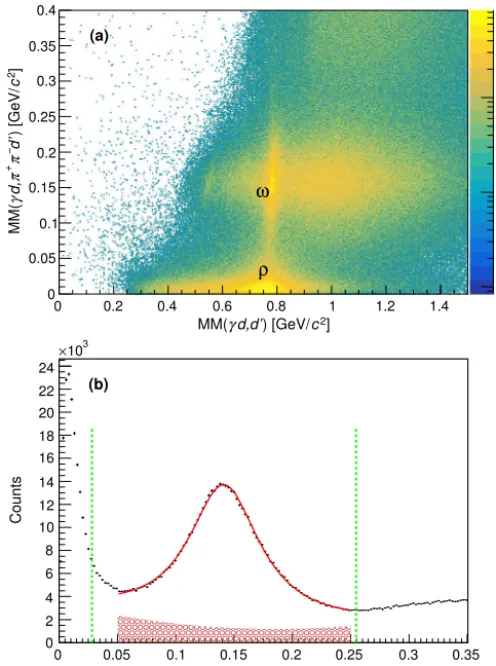
d→
ρ
d channel as can be seen from Fig. 2a. The majority of this background was eliminated by requiring that the missing mass from the deuteron given by, M M(
γ
d,
d′)
=
(
Pd+
Pγ−
Pd′)
2, equaled mω, assuming the three pion decaymodeforthe
ω
.Amissing
π
0peakcanbeseenontopofasmoothbackground inFig.2b,whichwasestimatedbyemployingaLorentzianforthe peakandasecond-orderpolynomialforthebackground.A3σ
cut, shownbytheverticaldashedlinesinFig.2b,wasappliedtoselect exclusiveω
eventswithsomebackground.The missing mass spectra were then divided into four Eγ
bins in 1
.
4<
Eγ<
3.
4 GeV, which were further split into dif-ferent|
t|
bins within 0.
3<
−
t<
2.
0 GeV2/
c2. A total of 25 en-ergyandmomentumtransferbinswereusedtoextractthe num-ber ofω
-events. Theω
-meson yield was obtained from a fit to the M M(
γ
d,
d′)
distribution by aGaussian-convoluted LorentzianFig. 2. (a)The y-axis represents the missing mass, Y, in the reaction γd→
π+π−d′Y whilethex-axisshowsthedistributionofthemissingmass, X,inthe
reactionγd→d′ X.(b)Shownisthey-axisprojectionof(a).Theverticaldashed
linesrepresentthepositionofthemissingmasscutmadetoselectω-eventsusing thefitshownbythesolidcurve.Anestimateofthepossiblebackgroundshapeis shownbytheshadedregion.
p1
+
p2x+
p3x2waschosentoestimatethemulti-pionbackground, wherex≡
M M(
γ
d,
d)
,andthepiarefitparameters.TheyieldwasdeterminedbyintegratingtheVoigtianfunction.Alinearfunction was used to estimate the systematiceffect of the choice of the background function. An average systematic effect of about 8.6% was founddue tothe uncertaintyof thebackground subtraction. ThefitforonetypicalbinisshowninFig.3.
Measurementofthedifferentialcross-sectionrequireda calcu-lationoftheCLASacceptancebaseduponthegeometrical efficien-ciesof the detectorsubsystems. The CLAS acceptance was deter-mined by performing a GEANT-basedMonte-Carlo simulation. As the acceptance is reaction dependent,
γ
d→
ω
d→
π
+π
−d′(
π
0)
events were generated. These events underwent the same event processingasthedata.Foreachkinematicbin,theacceptancewas calculated as the ratio of the number of accepted to the gener-ated events. The simulated distributions were also fit similar to thedata.Theaverageacceptanceforthischannelwasfoundtobe 8.1%.The target luminosity was calculated from the incident pho-tonflux(Nγ)forthecollimatedphotonbeam,targetdensity(
ρ
T),atomicweight (Md
=
2.
014 g/
mol) and length of the target (lT)usingtherelation,
L
(
Eγ)
=
ρ
T NAlT Md [image:5.612.322.553.67.235.2]Nγ
(
Eγ),
(2)Fig. 3.YieldextractionfitusingthemissingmassdistributionforEγ=1.4–1.8 GeV and|t|=0.94–1.15 GeV2/c2.Thebackgroundisestimatedusingapolynomial
[image:5.612.42.290.68.401.2]func-tion(dashed-dotted)which,alongwiththesignal(dashed,shadedregion),describe thetotaldistribution(solidcurve).Theyieldisthenumberofeventsintheshaded regionwithintheverticaldashedlines.
Fig. 4.Differentialcrosssectionforγd→ωd.Theinnererrorbarsrepresentthe statisticaluncertaintieswhiletheoutererrorbarsincludesystematicuncertainties addedinquadraturewiththestatisticaluncertainties.
where NA is Avogadro’s number. In each energy bin, the
differ-ential crosssectionsin momentumtransfer binsofwidth t are calculatedusingtherelation,
d
σ
dt=
YD t A
L
×
Ŵ
ωŴ
ω→π+π−π0×
γ
corr (3)where YD is the yield, A is the detector acceptance,
L
is thetarget luminosity for the photon energy range considered and,
Ŵ
ω→π+π−π0/Ŵ
ω is the branching ratio. The quantityγ
corr is thecorrectionfactorduetothephotonselectionconditionmentioned previously.Thestatisticaluncertaintyonthedifferentialcross sec-tion was propagated from the uncertainties of each quantity in Eq. (3). The differential cross section for
γ
d→
ω
d is shown in Fig.4asafunctionof|
t|
foreachincidentphotonenergybin. [image:5.612.332.541.301.518.2]system-Table 1
Summaryof theg10 systematiceffects associated with the γd→ωdchannel,estimatingatotalaverage point-to-pointuncertainty.
Source Systematic uncertainty Luminosity/Flux Consistency 8%
Variation of Cuts/Analysis 4.4% Yield Extraction 8.6% Branching Ratio 0.7%
Total (Added in quadrature) 12.5%
Fig. 5.Differentialcrosssection ofγd→ωd asafunctionof|t|for2.8<Eγ<
3.4 GeVcomparedtothatofacalculation [21] basedon[4].Eachcurvecorresponds toaspecificb, ddtσ
t=0
,γN andσωNvalue,aslistedinTable2.Thelegendforeach curveisdefinedrespectivelyfortheseparameters.Thesolidcurverepresentsthe contributionofthesinglescatteringforinputparameterscorrespondingtothatof thedashed-dottedcurve.Intheinset,thesolidpointsaretheresultsfrom[8] for anincidentphotonenergyof4.3 GeV.
atic uncertainties calculated inthisexperiment. Due tothe large variation of the statistical uncertainty involved in this analysis, a point-to-point systematicapproach was not realistic. Therefore, anestimationofthe systematicerrors wasmadeby varyingeach cut and taking the average relative difference in the final result for each variation. These variations are summarized as different groupsinTable1.
4. Results
InFig.5,thedifferentialcrosssectionfor2
.
8<
Eγ<
3.
4 GeVis comparedwithatheoreticalcalculationusingarescatteringmodel [4]. This is a three-parameter model allowing us to determine a rangeofσ
ωN byafittotheexperimentaldata.Thescatteringam-plitudeof
γ
N→
ω
N givenbyfγN→ωN
=
σ
γ∗ω(
i+
α
γN)
e −bγN2 t
,
(4)dealswithsinglescattering.Asimilarequationcanbealsowritten forthescatteringamplitude of
ω
N→
ω
N thatmeasuresthe con-tributionoftherescattering [4].Thequantityσ
γ∗ω isparametrizedusinganinputparameter ddtσ
[image:6.612.57.264.106.406.2] t=0,γN,whichisthedifferentialcross section ofγ
N→
ω
N reactionat t=
0. The initial guessfor this parameterwas basedonpublisheddataonγ
p→
ω
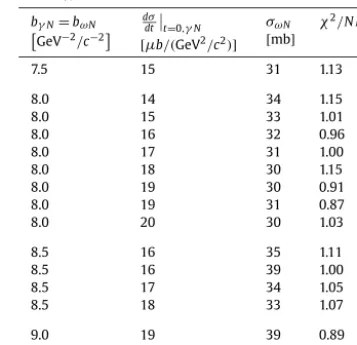
p[19,20].TheTable 2
Summaryoftheoryparametersusedtocomparedatafor 2.8<Eγ<3.4 GeV.Theparametersshownherearewithin
15%ofχ2=1.0 (theidealvalue).
bγN=bωN
GeV−2/c−2 dσ
dt t=0,γN
[μb/(GeV2/c2)]
σωN
[mb]
χ2/N D F
7.5 15 31 1.13
8.0 14 34 1.15
8.0 15 33 1.01
8.0 16 32 0.96
8.0 17 31 1.00
8.0 18 30 1.15
8.0 19 30 0.91
8.0 19 31 0.87
8.0 20 30 1.03
8.5 16 35 1.11
8.5 16 39 1.00
8.5 17 34 1.05
8.5 18 33 1.07
9.0 19 39 0.89
9.0 20 38 0.87
other twoinputparametersarebγN orbωN and
σ
ωN.Atinterme-diate andhigherphoton energies,VMDassumestheslope factors of the corresponding amplitudes,bγN andbωN,to be equal. The
variables,
α
γN andα
ωN,definedastheratiooftherealtoimag-inarypartsofthecorresponding scatteringamplitudes,were kept fixedandequaltoaphenomenologicalvalueof
−
0.
4.At interme-diate energies, therealpartof thescatteringamplitudesfor pro-ton andneutrontargetsarenot exactlythesame,butthismodel omits thisdifference sinceω
productionfromd isdominated by isospinaveragedamplitudes [4].Now,forvariousslopefactors,the strength of single scatteringgauged by ddtσ t=0,γN isvaried. Each setofvariationswasfedtothecalculationforvariousσ
ωN valuesasaninputparameterandthedifferentialcrosssection valuesfor aparticularenergy(bincenter)werecalculated.Theoutputs were compared withthe datausinga
χ
2 test.Table 2summarizesthe valuesoftheseparametersthatresultedinareducedχ
2 between 0.85and1.15. The datais consistentwiththe rescatteringmodel with30<
σ
ωN<
40 mbintheframeworkoftheVMDmodel.5. Conclusion
Inconclusion,wehavepresentedthefirstmeasurementofthe differential crosssectionsforcoherent
ω
photoproductionon the deuteronuptot= −
2 GeV2/
c2forincidentphotonenergies1.4to 3.4 GeVusingCLASatJeffersonLab.Amodelbasedonrescattering is consistent withthe data atintermediate andhigh momentum transfer. Thedifferentialcrosssection atlarge|
t|
shows contribu-tions from double scattering. For 2.
8<
Eγ<
3.
4 GeV, the datais consistent with
σ
ωN within 30–40 mb. This range is typicalof hadroniccrosssections inthisenergy range.Whilemore data would be valuable, thisdataset dramatically improves the world data on the
γ
d→
ω
d reaction andopens up the possibility for furtherstudyoftheω
−
N interaction.Acknowledgements
[image:6.612.338.517.108.281.2]Nu-cleare;theFrenchCentreNationaldelaRechercheScientifique;the French Commissariat àl’Energie Atomique; the U.S. National Sci-enceFoundation; andthe NationalResearchFoundation ofKorea. Jefferson Science Associates, LLC, operates the Thomas Jefferson NationalAcceleratorFacilityfortheU.S.DepartmentofEnergy un-derContractNo.DE-AC05-06OR23177.
References
[1] T.H.Bauer,R.D.Spital,D.R.Yennie,F.M.Pipkin,Thehadronicpropertiesofthe photoninhigh-energyinteractions,Rev.Mod.Phys.50(1978)261–436,https:// doi.org/10.1103/RevModPhys.50.261.
[2] J.Sakurai,Theoryofstronginteractions,Ann.Phys.11 (1)(1960)1–48,https:// doi.org/10.1016/0003-4916(60)90126-3.
[3] Y.Oh,A.I.Titov,T.S.H.Lee,Electromagneticproductionofvectormesonsat low-energies,in:ExcitedNucleonsandHadronicStructure.Proceedings,Conference, NSTAR2000,NewportNews,USA,February16–19,2000,2000,pp. 255–262, arXiv:nucl-th/0004055,https://arxiv.org/pdf/nucl-th/0004055.pdf.
[4] L.Frankfurt, et al.,Coherent photo- andlepto-productionofvector mesons from deuterium, Nucl. Phys. A 622 (4) (1997) 511–537, http://www. sciencedirect.com/science/article/pii/S0375947497806975.
[5] T.Mibe,etal.,Measurementofcoherentφ-mesonphotoproductionfromthe deuteronatlowenergies,Phys. Rev.C76(2007)052202,https://doi.org/10. 1103/PhysRevC.76.052202.
[6] W.C. Chang, et al., Forward coherent phi-meson photoproduction from deuteronsnearthreshold,Phys. Lett.B658(2008)209–215,https://doi.org/ 10.1016/j.physletb.2007.11.009,arXiv:nucl-ex/0703034.
[7] D.J.Wilson,R.A.Briceño,J.J.Dudek,R.G.Edwards,C.E.Thomas,Coupledπ π,
kKscatteringinp-waveandtheρ resonancefromlatticeQCD,Phys.Rev.D 92(2015)094502,https://doi.org/10.1103/PhysRevD.92.094502.
[8] Y.Eisenberg,B.Haber,E.Kogan,U.Karshon,E.Ronat,A.Shapira,G.Yekutieli, Vectormesonproduction by4.3GeVpolarizedphotonsondeuterium,Nucl. Phys.B104 (1)(1976)61–97,https://doi.org/10.1016/0550-3213(76)90073-0.
[9] R.L.Anderson,etal.,Determinationoftheρ-meson–nucleoncrosssectionfrom elastic ρ photoproductionon deuterium,Phys. Rev.D4(1971)3245–3250,
https://doi.org/10.1103/PhysRevD.4.3245.
[10] B. Mecking,etal., The{CEBAF}largeacceptance spectrometer(CLAS), Nucl. Instrum. MethodsA 503 (3)(2003)513–553,https://doi.org/10.1016/S0168 -9002(03)01001-5.
[11] D.Sober,etal.,ThebremsstrahlungtaggedphotonbeaminhallbatJLab,Nucl. Instrum. MethodsA 440 (2)(2000)263–284,https://doi.org/10.1016/S0168 -9002(99)00784-6.
[12] Y.Sharabian,etal.,AnewhighlysegmentedstartcounterfortheCLAS detec-tor,Nucl.Instrum.MethodsA556 (1)(2006)246–258,https://doi.org/10.1016/ j.nima.2005.10.031.
[13] E. Smith, et al., The time-of-flight system for CLAS, Nucl. Instrum. Meth-odsPhys.Res.,Sect.A,Accel.Spectrom.Detect.Assoc.Equip.432 (2)(1999) 265–298,https://doi.org/10.1016/S0168-9002(99)00484-2.
[14] N.Compton,etal.,Measurementofthedifferentialandtotalcrosssectionsof theγd→K0(p)reactionwithintheresonanceregion,Phys.Rev.C96(2017)
065201,https://doi.org/10.1103/PhysRevC.96.065201.
[15] S.Stepanyan,et al.,Energycalibrationofthehall bbremsstrahlungtagging systemusingamagneticpairspectrometer,CLAS-Note012,https://misportal. jlab.org/ul/Physics/Hall-B/clas/viewFile.cfm/2005-012.pdf?documentId=179. [16] E. Pasyuk, Energy loss corrections for charged particles in CLAS,
CLAS-Note 016, https://misportal.jlab.org/ul/physics/hall-b/clas/viewFile.cfm/2007 -016.pdf?documentId=423.
[17] T.Chetry,K.Hicks,Coherentω-mesonphotoproductionoffthedeuteron, CLAS-Note 103, https://misportal.jlab.org/ul/Physics/Hall-B/clas/viewFile.cfm/2017 -006.pdf?documentId=778.
[18] C.Patrignani,etal.,Reviewofparticlephysics, Chin.Phys.C40 (10)(2016) 100001,https://doi.org/10.1088/1674-1137/40/10/100001.
[19] F.Dietz,etal.,Photoproductionofωmesonsoffprotonsand neutrons,Eur. Phys.J.A51 (1)(2015)6,https://doi.org/10.1140/epja/i2015-15006-3. [20] M.Battaglieri,etal.,Photoproductionoftheωmesonontheprotonatlarge
momentumtransfer,Phys.Rev.Lett.90(2003)022002,https://doi.org/10.1103/ PhysRevLett.90.022002.