culture
.
White Rose Research Online URL for this paper:
http://eprints.whiterose.ac.uk/126877/
Version: Published Version
Article:
Bell, Taryn and Spikins, Penny orcid.org/0000-0002-9174-5168 (2018) The object of my
affection : Attachment security and material culture. Time and Mind. pp. 23-39.
https://doi.org/10.1080/1751696X.2018.1433355
[email protected] https://eprints.whiterose.ac.uk/ Reuse
This article is distributed under the terms of the Creative Commons Attribution-NonCommercial-NoDerivs (CC BY-NC-ND) licence. This licence only allows you to download this work and share it with others as long as you credit the authors, but you can’t change the article in any way or use it commercially. More
information and the full terms of the licence here: https://creativecommons.org/licenses/
Takedown
If you consider content in White Rose Research Online to be in breach of UK law, please notify us by
Full Terms & Conditions of access and use can be found at
http://www.tandfonline.com/action/journalInformation?journalCode=rtam20
Time and Mind
The Journal of Archaeology, Consciousness and Culture
ISSN: 1751-696X (Print) 1751-6978 (Online) Journal homepage: http://www.tandfonline.com/loi/rtam20
The object of my affection: attachment security
and material culture
Taryn Bell & Penny Spikins
To cite this article: Taryn Bell & Penny Spikins (2018) The object of my affection: attachment security and material culture, Time and Mind, 11:1, 23-39, DOI: 10.1080/1751696X.2018.1433355
To link to this article: https://doi.org/10.1080/1751696X.2018.1433355
© 2018 The Author(s). Published by Informa UK Limited, trading as Taylor & Francis Group
Published online: 02 Mar 2018.
Submit your article to this journal
Article views: 451
View related articles
The object of my affection: attachment security and
material culture
Taryn Bell and Penny Spikins
Department of Archaeology, University of York, York, UK
ABSTRACT
Archaeological research into how objects affect us emotionally is still in its infancy, with our affiliative responses to objects–
those related to socially close and harmonious relationships–
being particularly understudied. Psychological research has however revealed that objects can have powerful effects on emotional wellbeing, acting as attachment figures which pro-vide a sense of comfort and security in the absence of loved ones, and promoting the confidence to explore and develop positive relationships. Here we discuss the phenomenon of theseattachment objects, drawing on recent survey research, and applying this concept to new interpretations of two parti-cularly meaningful prehistoric artefacts–the Stonehenge pig
‘toy’and the Hohle Fels ‘Venus’. We conclude that a better understanding of attachment objects will provide considerable insight into the emotional significance of particular cherished artefacts throughout time.
ARTICLE HISTORY
Received 11 December 2017 Accepted 9 January 2018
KEYWORDS
Attachment; emotional wellbeing; security; prehistory; materiality
Introduction
We all feel vulnerable, insecure or anxious at some point in our lives. At these times certain unique cherished objects can often hold a remarkable power to reassure us, to connect us to loved ones and to provide us with a sense of comfort and security.
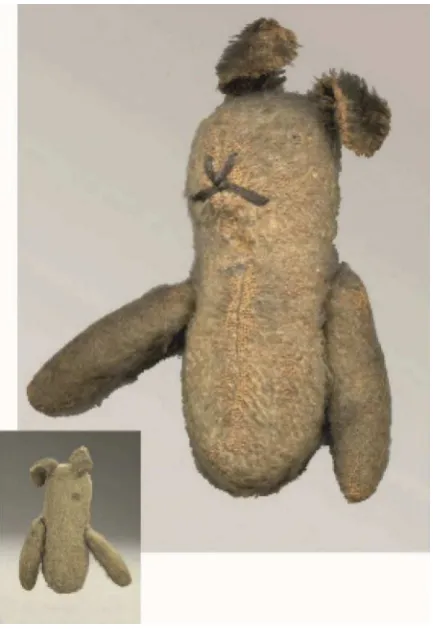
Perhaps one of the most famous modern examples of one such object is a tattered teddy bear which was chosen as the most significant of nearly 3000 First World War artefacts submitted to the Memory Project of The Globe and
Mail and the Dominion Institute (Figure 1).1 This small teddy bear was the
treasured possession of a girl called Aileen Rogers who, at the age of 10, sent her bear in a care package to her father Lawrence who was working as a medic during the First World War. Lawrence treasured the bear, writing in a letter:
Tell Aileen I still have the Teddy Bear and I will try to hang on to it for her. It is dirty and his hind legs are kind of loose but he is still with me.
CONTACTTaryn Bell [email protected] Department of Archaeology, King’s Manor, University of York, York YO1 7EP, UK.
VOL. 11, NO. 1, 23–39
https://doi.org/10.1080/1751696X.2018.1433355
© 2018 The Author(s). Published by Informa UK Limited, trading as Taylor & Francis Group
When Lawrence was killed at Passchendaele in 1917, the bear, by then having lost both legs and eyes, was found with him and was returned home, later becoming one of the most significant artefacts in the Canadian War Museum.
Unpicking why the story of the Rogers bear is so profoundly moving casts insight into the powerful role of attachment objects in our lives. The emo-tional significance of this worn teddy bear is driven in large part by our human responses not only to each other but to attachment objects. The initial emotional power of the bear for Aileen herself comes from its role as
what is termed a‘transitional object’(Winnicott1953), prompting a sense of
comfort and security like that of a care-giver but in its own right, and
providing a ‘safe haven’ and a ‘secure base’ to return to when a parent or
[image:4.493.139.356.51.366.2]carer is absent. The same transitional objects (such as teddy bears and blankets) can hold significance long into adulthood, though other objects, sometimes gifted from others, perform a similar role as sources of the same feelings of comfort and security. As a gift from his daughter, the bear also
became an attachment object to Lawrence, a source of comfort that he kept close to him until his death.
A better understanding of the basis of our attachment to objects can bring significant insights into interpretations of certain significant artefacts. Attachment objects may be personal, but structured patterns of attachment and common characteristics of such objects influence how they provide com-fort and security, and in what personal, social and environmental contexts they might be found. Understanding attachment objects brings a new theoretical approach to our understanding of particularly emotionally significant artefacts in the archaeological record.
Feeling our way: archaeological approaches to affiliative emotions
Archaeological approaches to any structured emotional engagement with objects are still relatively new. We acknowledge that our lives are inextricably
entangled with things (Hodder 2012; Malafouris 2015); however, our
under-standing of the emotional nature of this entanglement is still in its infancy. Emotions can be seen as woolly, indefinable and difficult to interpret (Harris 2006; Harris and Sørensen 2010) so research tends to focus on the social,
technological and political meanings of material culture (Foxhall 2012;
Tarlow2012). Moreover to date most archaeological research which explicitly
deals with emotions has tended to focus on attempts to identify the presence of individual emotions, in particular those which are aversive, such as grief
(see, for example, Fleisher and Norman2015; Grguric 2008; McCartney2006).
While objects have been acknowledged to have agency (Barrett2001) there
has been only limited acknowledgement among archaeologists of their
capa-city to stimulate emotions (Harris and Sørensen 2010), in particular affiliative
emotions. Some novel work has been undertaken linking emotions and mate-riality; for example, Creese (2016) has skilfully explored the formation and
continuation of political power structures through the concept of ‘emotion
work’ and affective technologies among the Iroquois. Hamilakis (2010, 2017),
on the other hand, has been a prominent proponent of phenomenological
approaches to material culture, stressing the importance of the ‘affective
import’ of assemblages. However discussions of affiliative and affective
emo-tions in relation to objects are often limited only to specific examples such as
art objects (Robb2017).
Archaeology struggles to engage proactively with the concept of emotion, though without it our understanding of past societies is arguably much
lessened (Creese 2016; Harris 2006; Harris and Sørensen 2010; Tarlow 2012).
Without an understanding of affiliative emotions concepts such as‘gift-giving’
can all too easily become an apparent exercise in the exchange of obligations
(Mauss1967). Research into the dynamics between affiliative emotions and the
significant artefacts. Here we consider objects as sources of positive affiliative emotions, focusing specifically on their role as attachment objects. We argue that affiliative emotions in general, and attachment in particular, are an essential element of the interpretation of past material culture.
Objects and affiliative emotions
Objects can stimulate feelings related to positive, supportive and harmonious
social relationships oraffiliative emotions and feelingsin several ways. Things
can stimulate a sense of belonging through shared meaning and identity, as hypothesised for European Upper Palaeolithic beads, which show regional
styles (White2007). In this case the similarity of such objects to all the others
in one’s ethnic group is key to their meaning and influences how we feel. The
sensory nature of certain objects (‘huggable objects’) can make us feel calmer
and more trusting of others (Sumioka et al. 2013; Takahashi et al. 2017).
Objects can also stimulate a nurturing response (Spikins 2015, 2017; Spikins
et al.2014), and we can feel motivated to care for objects which are seen to
be vulnerable or have been abandoned (Gorman and Wallis 2017). Objects
can also provoke specific affiliative memories (Depue and
Morrone-Strupinsky2005).
Attachment objects are a particular class of objects which provoke positive social feelings. Such objects provoke specific emotions related to the intense closeness we feel with our care-givers as a child and with close loved ones as adults in relationships in which we feel supported and cared for.
Objects and attachment
Our attachment to objects is driven by a deeply rooted behavioural and hormonal response which is an extension of our innate mammalian
attach-ment system (Bowlby 1969). This attachment system leads us to seek out
attachment figures who provide us with feelings of comfort and security
(Bowlby 1969; Gillath, Karantzas, and Fraley 2016). The secure attachment
figure provides two benefits: a safe haven, and a secure base (Bowlby 1988;
Coan 2008; Keefer, Landau, and Sullivan 2014). The former of these encom-passes the feeling and knowledge that we are cared for, and that we have someone to go to for comfort, while the latter gives us the confidence to explore our environment in the knowledge that support is available, should it
be needed (Feeney and Van Vleet 2010; Keefer, Landau, and Sullivan 2014;
Nedelisky and Steele 2009). Interactions with attachment figures affect one’s
‘internal working model’ or ‘script’: the way we view the world, the way we
Secure attachment is central to our emotional wellbeing and the ability to overcome difficulties, affecting how we view all our social relationships
(Mikulincer and Shaver2010). As children, loving responses to our needs and
consistent support from attachment figures (such as parents or grandparents) help us to develop a secure attachment style, which then influences mental
and physical wellbeing in later life (Feeney and Van Vleet 2010; Fraley et al.
2015; Groh et al. 2017; Keefer et al. 2012; Mikulincer and Shaver 2007;
Mikulincer, Shaver, and Rom 2011; Shaver, Mikulincer, and Shemesh-Iron
2010; Wu and Yang 2012). One of the most significant benefits of secure attachment is enhanced emotion regulation, or the ability to feel emotions
and integrate them with‘rational’thought, fostering a sense of resilience and
enabling individuals to maintain a positive mood (Keefer et al.2012; Mikulincer
and Shaver 2007; Mikulincer et al. 2005; Mikulincer, Shaver, and Rom 2011;
Mikulincer and Shaver2012; Shaver, Mikulincer, and Shemesh-Iron2010).
Secure attachment is therefore vital for our sense of comfort and security, but it also has wide-reaching effects on behaviour. A sense of attachment
security enhances prosociality (Gillath, Shaver, and Mikulincer2005; Mikulincer
et al. 2005), increasing our empathy and tendency to behave altruistically,
towards both those we know and complete strangers (Carnelley and Rowe 2010; Mikulincer et al.2001; Mikulincer and Shaver2007). Secure attachment is also key to the exploration of new situations, providing us with a secure base from which to explore our environments with confidence (Gillath, Shaver, and
Mikulincer 2005; Mikulincer, Shaver, and Rom 2011) as well as facilitating
increased resilience, problem-solving abilities and willingness to explore,
even acting as a buffer against pain (Jakubiak and Feeney 2016; Mikulincer,
Shaver, and Rom2011). Fostering a sense of attachment security is central to
child-rearing practices amongst small-scale societies such as the Baka of
Cameroon (Spikins, Forthcoming; Hewlett, Lamb, and Leyendecker 2000).
When we feel vulnerable, anxious or insecure an attachment figure can restore our sense of attachment security. Whereas in other animals attachment is limited to care-givers who are present, our capacity for attachment relation-ships has extended to cover nonhumans, such as pets, inanimate objects,
places or even abstract concepts (such as love or justice) (Allen et al. 1991;
Barker et al. 2010; Beck and Madresh 2008; Friedmann 1995; Zilcha-Mano,
Mikulincer, and Shaver 2012). We can gain similar feelings of comfort and
security from these‘proxy’nonhuman attachment figures as from their human
counterparts, a major advantage in insecure environments or for insecure
individuals (Keefer et al.2012; Keefer, Landau, and Sullivan2014).
While the importance of attachment objects has long been recognised by
child psychologists (Winnicott 1953), it has taken longer to recognise their
significance to adults (Arnould, Price, and Curasi1999; Gjersoe, Hall, and Hood
(Barrett 2001); however, they are of course physically unresponsive. Objects
make us feel securebecauseof their inertness, however, rather than in spite of
it, providing both a permanence and portability that can be lacking in other people. Adult attachment objects often function at first as mnemonic devices,
providing reminders of significant places, people, or events–often reminding
individuals of other attachment figures–and their initial meaning comes from
these memories (Diesendruck and Perez 2015). Objects are however not just
proxies; this term denies them their full agency and infers material passivity, as
if they are just stand-ins for others (Olsen2010). Instead, over time, attachment
objects become important subjects in themselves (Foxhall 2012). We imbue
these objects with memory and meaning and become attached to them, and they become important in their own right. They invoke feelings of comfort and security, with the initial memories no longer necessary to evoke these feelings.
The modern material culture of attachment
Our research into modern attachment objects has provided useful insights.2
Not all objects which are seen as being highly emotionally significant are attachment objects; for example, family heirlooms can be valued for their ancestry and a trophy might remind us of a sporting success. However, unique cherished objects which are acknowledged to provide a sense of comfort and security are remarkably common. Such objects tend to be much cared for, typically often handled and portable in nature. In many ways such objects are similar to childhood transitional or attachment objects, with sometimes the same cuddly toy carefully looked after from childhood. However, whereas children crave and need proximity to their attachment object, proximity is not as essential to adults. Adults also develop a subtly different and more dynamic relationship to cherished objects, much as adult attachment to their partners develops childhood attachment patterns into a more mutually
dynamic context (Mikulincer and Shaver 2010). Adult attachment objects are
not just providers of comfort but tend also to be cared for. Some treasured
objects recorded in our study were treated in an almost reverential manner in order to care for and preserve the object. One participant chose to talk about a mug that she had bought for her late father when she was a child, which had come into her possession after his death. He had never used the mug, keeping it instead as an ornament, and she continued not to use it, and never allowed anyone else to, because she did not want it to break. She keeps the mug in a
cupboard with all of her other cups, but states that‘If I hold it or even look at it
. . . I am filled with all the love I felt from him’.
A common theme throughout all of the objects mentioned in the survey was that they were originally gifts, or reminders of a loved one. Many of
the respondents noted that they derived comfort from the object’s
safe supportive friend. As gifts, however, such attachment objects can be very varied in form and whilst sensory qualities such as warmth and
soft-ness are important in children’s attachment objects, they are less essential
to adults.
Some attachment objects are soft and‘huggable’, for example a toy guinea
pig, described as ‘multi-coloured yellow, brown, white and very soft,’ which
was described in these terms: ‘I suppose it comforts me a lot because he’s
been with me through everything, so it’s a very stable presence. It reminds me
of being at home with friends and family.’Others are hard but highly portable
and wearable, for example two silver bracelets (one charm bracelet and one
bangle) which were described thus: ‘I get some of the same comfort from
wearing these two bracelets as I would from speaking to my parents or
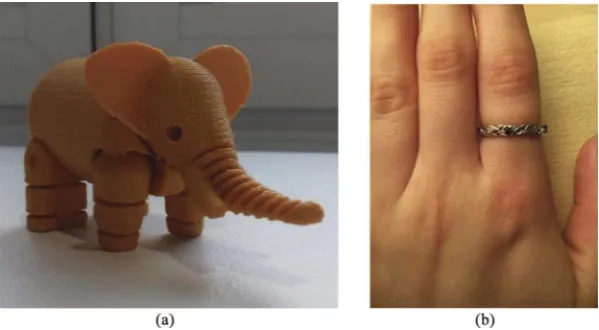
grandad. . .’The creation of something as a gift can be particularly important,
as in the case of a 3D-printed elephant (Figure 2(a)):‘My brother made it for
me when I left home for undergraduate, I’ve kept it the whole time . . . It just
reminds me of home when I feel homesick.’ However, objects can remind us
not of one person but of a whole family in the case of a treasured eternity ring heirloom (Figure 2(b)) with this description:
It reminds me of [my grandmother], and also of my family because we’d all spend time together when we saw her. I think there is a particular comfort in feeling close to family even when they are far away or no longer here.
[image:9.493.97.397.455.620.2]Some people were very aware of the feelings of strength and resilience associated with their object. A dark brown teddy bear (grizzly bear), with patches of fur missing and a slightly damaged nose has this description for example:
He has a patch of fur missing on his neck from where I lay on him to sleep during difficult times and that reminds me when I feel scared that I’ve survived difficult things before and of my family so I know that I’m not alone.
Object attachment results from a deep-seated psychological need for emo-tional support, a need which is not always fulfilled by other people and which is not merely a representation of a modern, capitalist obsession with material things. Rather, attachment objects function for the benefit of our wellbeing,
prosociality and ability to adapt to adverse circumstances (Keefer et al.2012;
Keefer, Landau, and Sullivan 2014; Mikulincer and Shaver 2007; Mikulincer,
Shaver, and Rom2011).
Cherished prehistoric artefacts: insights from attachment
An understanding of attachment objects allows us to reconsider how some apparently significant artefacts are interpreted. Archaeologists often struggle to interpret items which do not neatly fit into existing palaeoeconomic inter-pretations. In many cases such objects are forgotten or attributed to vague
ritual or symbolic reasons (Langley 2017). An attachment perspective of the
archaeological record recognises how some objects can in fact be vital emo-tional tools.
Stonehenge pig ‘toy’
One such item is a small figurine, thought to represent a pig (or less probably a hedgehog), discovered in a pit dug into the top of the Stonehenge Palisade
(Figure 3). It was one of a number of deposits found in a very young infant’s
grave dating to the Middle Bronze Age (J. Pollard: personal communication, November 28, 2017). The item is very small, only 55mm in length, with small stubs for legs and large, floppy ears, and has been interpreted as either a
crudely carved‘plaything’or a piece of representational art (ibid.)
The Stonehenge pig attracted the attention of the media at the time of its
discovery, being lauded as ‘Britain’s oldest toy’ (Owen 2008; “Is This Britain’s
Oldest Toy?”2008). However, neither the concept of a toy or plaything nor that
and her father in different ways and at different times, this figurine would have been expected to provide comfort and security to a number of people, in slightly different ways; to a child in life, acting as both a plaything and a transitional object, and to their kin after death, in the knowledge perhaps that the child was protected by the figurine.
Worn or crudely made figurines and other objects are sometimes found in
children’s burials throughout prehistory, with one such example being the
crude horse figurine found with the child burials (a boy [Sunghir 2] and a girl
[Sunghir 3], about 12–13 and 9–10 years old) at Sunghir, dated to 29–31,000
years ago (Formicola and Buzhilova 2004; Otte2017). These objects are often
seen as enigmatic, but however become explicable when we understand the significance of transitional objects to child emotional wellbeing. In a modern ethnographic context Langley (2017) notes the presence of crude dolls and figurines, often made of perishable materials, in many hunter-gatherer
socie-ties, such as the Inuit. It isn’t difficult to understand why highly emotionally
significant transitional objects would be included in infant and children’s
graves at death no matter how crudely made or worn.
An attachment perspective therefore gives us an appreciation of how certain artefacts in the archaeological record become emotionally significant to children and adults. Material culture relating to children receives very little
academic attention and as a result is often ignored (Shea2006; Langley2017),
[image:11.493.99.398.52.235.2]but children are the members of society most likely to have attachment objects, so an attachment perspective of material culture may be of great benefit to those wishing to study the relationship between children and material culture. Capacities for adult attachment to objects are formed during childhood, and our childhood attachment allows us to understand and
empathise with children’s dependence on such objects (as potentially seen
here with the Stonehenge pig‘toy’). Our childhood attachment to objects also
influences the ways in which we attach powerful meanings to objects through-out life.
Hohle Fels‘Venus’
What of adult attachment objects? A potential adult attachment object
con-sidered here is the Hohle Fels ‘Venus’ (Figure 4), discovered in 2008 in the
Swabian Jura area of southwestern Germany. This figurine, carved from
mam-moth ivory, is both the oldest uncontested example of a so called ‘Venus’
[image:12.493.135.356.254.622.2]figurine known to date and one of the most recently discovered.
Figure 4.The Hohle Fels‘Venus’(Height 6 cm).
Small enough to fit in the palm of the hand, the Hohle Fels figurine was found to be at least 35,000 years old, making it one of the oldest known
examples of figurative art (Conard2009; Cook2013). The left arm and shoulder
are missing, but it is strikingly well preserved (Conard 2009). While its short,
squat form makes it seem similar to many other Venus figurines, the Hohle Fels figurine has a number of unique features. Most interestingly, instead of a head, on top of the figurine there sits a suspension loop which shows signs of polish,
suggesting it was worn as part of a pendant (Conard2009).
Nicholas Conard, leader of the team who discovered the figurine, has
emphasised the figurine’s deliberate exaggeration of sexual features, and has
argued that it may have been an expression of fertility (Conard 2009). The
discovery of the figurine made headlines around the world, depicted by the
press as‘prehistoric pornography’ (Cook2013; Curry2012).
There are, however, other perspectives. In reference to similar ivory sculp-tures of female figures, found at Nebra in Germany, Jill Cook (2013, 238) of the
British Museum notes that ‘given the skill and time required to produce the
figure it seems an unlikely example of adolescent sexual awakenings and the deposition in the pit suggests some wider social, ritual or ceremonial
signifi-cance’. The same can be said of the‘Venus’ of Hohle Fels. The intricacy and
time spent creating and curating these objects gives weight to the idea that they may have had emotional significance, and encouraged emotional
attach-ments. Moreover‘Venus’ figurines tend to depict mature women, rather than
young adults or adolescents, consistent with being caring figures, rather than
erotica (Dixson and Dixson2012).
Might the Hohle Fels‘Venus’have been an attachment object? Certainly its
size, degree of handling and uniqueness suggest that it had a personal, rather
than a shared, significance. Whatever its original‘meaning’in spiritual, cultural
or symbolic terms it might also have become an attachment object. Rather than representing prehistoric erotica or a fertility symbol, this object may even have been a visual reminder of someone else, providing comfort and security for the wearer. Indeed, the polish on the suspension loop suggests that this object was worn often and whatever the acknowledged reason for keeping this object close, such close proximity may also relate to the emotional support it provided. Other figurines found in Upper Palaeolithic contexts, where eco-logical conditions impose high levels of mobility and logistical organisation on hunter-gatherer groups, such as portable art featuring animal figurines (Spikins
et al.,Forthcoming), may also equally have functioned as attachment objects.
Discussion
The Rogers bear, the Stonehenge pig ‘toy’ and the Hohle Fels‘Venus’display
objects have typically been much curated, as well as tending to be handheld and easily portable. As a result of such handling their original form may be lost, with any features such as eyes or facial expression no longer important, and the human or animal form they represent hardly recognisable. They are also highly individual, with an effect which tends to be specific to one person. They
are quite literally ‘one of a kind’.
Objects which become significant as attachment figures are of course different in different cultures, reflecting as they do both cultural patterns and the plasticity of object attachment. There are cultural regularities to what is deemed appropriate as a transitional object for children for example (such as teddy bears in modern industrialised contexts). However, our attachment system is sufficiently versatile that we can become attached to almost any object. In prehistoric contexts we might expect to see cultural trends as well as individual variability.
Whenever we encounter unique, small, cherished and highly worn objects, we should consider their potential significance as attachment objects, and their powerful potential to provide emotional comfort and security. These objects may have been given as gifts, and are often reflec-tions of significant social relareflec-tionships, which become imbued in the objects themselves. In some cases they may be objects that archaeologists have struggled to interpret as they do not fit known interpretations related to status, economics, ethnicity or symbolism. They may be broken, tattered and unimpressive to our eyes, but to someone they will have been a major source of comfort and security.
Conclusions
Our archaeological understanding of how material culture has a positive effect on emotional wellbeing is as yet in its infancy. An attachment perspective on cherished objects has the potential to provide a significant insight for interpretations of certain personal objects which may appear unimpressive to our eyes but yet held fundamental emotional significance to their users. Much like care-givers and loved ones, such attachment objects literally calm our fears, comfort our anxieties and give us the confidence to fully engage in a complex social world. Appreciating the emotional attachments which people make with these cherished objects allows us to appreciate the complexity of past feelings, and gives us a fuller sense of how our shared emotional experiences play out within different cultural contexts.
We argue that from the Rogers bear, to the Stonehenge pig ‘toy’, to the
Hohle Fels ‘Venus’, an understanding of attachment objects brings a new
Notes
1. Artefact number 20040015-001 in the Canadian War Museum. For online catalo-gue with further details see http://www.warmuseum.ca/collections/artifact/ 1368588/.
2. The survey of 223 adults was carried out as part of an interdisciplinary study at the University of York, funded by the Archaeology Research Priming Fund. The research was carried out between May and November 2017 (Penny Spikins, Barry Wright and Dorothea Debus, with Taryn Bell as research assistant). Applicants were asked to describe and discuss an object which was important to them, and to fill out a survey measuring their attachment score.
Acknowledgements
We would like to thank the John Templeton Foundation for part of the research time put towards this paper and the Archaeology Research Priming Fund for support for the survey. Barry Wright and Dorothea Debus helped with survey design and finding respondents, and with discussions of significant objects. We are indebted to the anonymous partici-pants of our survey.
We would also like to thank Joshua Pollard and Anne Teather for providing further information about the Stonehenge pig‘toy’, and Adam Stanford for permission to use the image, Marcel Otte and Mary Etienne for further information about the horse figurine from the Sunghir double burial and the Canadian War Museum for permission to use the image of the Rogers bear.
Finally, thanks also to the anonymous reviewers, whose comments were extremely helpful.
Disclosure statement
Neither author has any financial interest or benefit arising from the direct application of this research.
Funding
This work was supported by the John Templeton Foundation [grant number 59475] and by the University of York’s Archaeology Research Priming Fund.
Notes on contributors
Taryn Bellcompleted her M.Sc. in Early Prehistory at the University of York in 2016, with a
ORCID
Taryn Bell http://orcid.org/0000-0002-1642-2588
Penny Spikins http://orcid.org/0000-0002-9174-5168
References
“Is This Britain’s Oldest Toy?” 2008. Current Archaeology. December 5, 2008. Accessed November 24, 2017. https://www.archaeology.co.uk/articles/features/is-this-britains-old est-toy.htm.
Allen, K. M., J. Blascovich, J. Tomaka, and R. M. Kelsey.1991.“Presence of Human Friends and Pet Dogs as Moderators of Autonomic Responses to Stress in Women.” Journal of Personality and Social Psychology61 (4): 582–589.
Arnould, E. J., L. L. Price, and C. F. Curasi.1999.“Cherished Possessions.”Anthropology News
40 (2): 17–18.
Barker, S. B., J. S. Knisely, N. L. McCain, C. M. Schubert, and A. K. Pandurangi. 2010.
“Exploratory Study of Stress-Buffering Response Patterns from Interaction with a Therapy Dog.”Anthrozoös 23 (1): 79–91.
Barrett, J. C.2001.“Agency, the Duality of Structure, and the Problem of the Archaeological Record.” In Archaeological Theory Today, edited by I. Hodder, 141–164. Cambridge: Cambridge University Press.
Beck, L., and E. A. Madresh.2008.“Romantic Partners and Four-Legged Friends: An Extension of Attachment Theory to Relationships with Pets.”Anthrozoös21 (1): 43–56.
Bowlby, J.1969.Attachment and Loss: Attachment. V. New York: Basic Books.
Bowlby, J. 1988. A Secure Base: Clinical Applications of Attachment Theory. London: Routledge.
Carnelley, K. B., and A. C. Rowe. 2010. “Priming a Sense of Security: What Goes through People’s Minds?”Journal of Social and Personal Relationships27 (2): 253–261.
Coan, J. A. 2008. “Toward a Neuroscience of Attachment.” In Handbook of Attachment: Theory, Research, and Clinical Applications, edited by J. Cassidy and P. R. Shaver, 241–
265. 2nd ed. New York: Guilford Press.
Conard, N. J. 2009. “A Female Figurine from the Basal Aurignacian of Hohle Fels Cave in Southwestern Germany.”Nature 459 (7244): 248–252.
Cook, J.2013.Ice Age Art: The Arrival of the Modern Mind. London: British Museum Press. Creese, J. L. 2016. “Emotion Work and the Archaeology of Consensus: The Northern
Iroquoian Case.”World Archaeology48 (1): 14–34.
Curry, A.2012.“The Cave Art Debate.”Smithsonian.com. March 2012. Accessed October 6, 2017.https://www.smithsonianmag.com/history/the-cave-art-debate-100617099/. Depue, R. A., and J. V. Morrone-Strupinsky. 2005.“A Neurobehavioral Model of Affiliative
Bonding: Implications for Conceptualizing a Human Trait of Affiliation.”The Behavioral and Brain Sciences28 (3): 313–350.
Diesendruck, G., and R. Perez.2015.“Toys Are Me: Children’s Extension of Self to Objects.”
Cognition 134: 11–20.
Dixson, A. F., and B. J. Dixson.2012.“Venus Figurines of the European Paleolithic: Symbols of Fertility or Attractiveness?”Journal of Anthropology2011, ID569120.
Feeney, B. C., and M. Van Vleet. 2010. “Growing through Attachment: The Interplay of Attachment and Exploration in Adulthood.”Journal of Social and Personal Relationships
Fleisher, J., and N. Norman. 2015. The Archaeology of Anxiety: The Materiality of Anxiousness, Worry, and Fear. New York: Springer-Verlag.
Formicola, V., and A. P. Buzhilova. 2004. “Double Child Burial from Sunghir (Russia): Pathology and Inferences for Upper Paleolithic Funerary Practices.”American Journal of Physical Anthropology124 (3): 189–198.
Foxhall, L.2012.“Material Values: Emotion and Materiality in Ancient Greece.”InThe Role of Emotions in Classical Antiquity, edited by A. Chaniotis and P. Ducrey. Stuttgart: Steiner Verlag.
Fraley, R. C., N. W. Hudson, M. E. Heffernan, and N. Segal.2015.“Are Adult Attachment Styles Categorical or Dimensional? A Taxometric Analysis of General and Relationship-Specific Attachment Orientations.”Journal of Personality and Social Psychology109 (2): 354–368. Friedmann, E. 1995. “The Role of Pets in Enhancing Human Well-Being: Physiological
Effects.”The Waltham Book of Human-Animal Interaction: Benefits and Responsibilities of Pet Ownership, edited by I. Robinson, 33–53. Oxford: Pergamon.
Gillath, O., G. C. Karantzas, and R. C. Fraley.2016.Adult Attachment: A Concise Introduction to Theory and Research. Cambridge, MA: Academic Press.
Gillath, O., P. R. Shaver, and M. Mikulincer.2005.“An Attachment-Theoretical Approach to Compassion and Altruism.” In Compassion: Conceptualisations, Research and Use in Psychotherapy, edited by P. Gilbert, 121–147. New York: Routledge.
Gjersoe, N. L., E. L. Hall, and B. Hood.2015.“Children Attribute Mental Lives to Toys When They Are Emotionally Attached to Them.”Cognitive Development34: 28–38.
Gorman, A., and L. Wallis.2017. Loveable: The Stories Behind Thriftshop Objects. Brighton, SA: Wallis Heritage Consulting.
Grguric, N. K. 2008. “Fortified Homesteads: The Architecture of Fear in Frontier South Australia and the Northern Territory, Ca. 1847–1885.”Journal of Conflict Archaeology 4 (1–2): 59–85.
Groh, A. M., R. M. Pasco Fearon, M. H. van IJzendoorn, M. J. Bakermans-Kranenburg, and G. I. Roisman.2017.“Attachment in the Early Life Course: Meta-Analytic Evidence for Its Role in Socioemotional Development.”Child Development Perspectives11 (1): 70–76.
Hamilakis, Y.2017.“Sensorial Assemblages: Affect, Memory and Temporality in Assemblage Thinking.”Cambridge Archaeological Journal27 (1): 169–182.
Hamilakis, Y. 2010.“Re-collecting the Fragments: Archaeology as Mnemonic Practice.” In
Material Mnemonics: Everyday Memory in Prehistoric Europe, edited by K. T. Lillios, and V. Tsamis, 188–199. Oxford: Oxbow.
Harris, O. J. T.2006.“Identity, Emotion and Memory in Neolithic Dorset.”PhD diss., University of Cardiff.
Harris, O. J. T., and T. M. Sørensen. 2010. “Rethinking Emotion and Material Culture.”
Archaeological Dialogues17 (2): 145–163.
Hewlett, B. S., M. E. Lamb, and B. Leyendecker.2000.“Internal Working Models, Trust, and Sharing among Foragers.”Current Anthropology41 (2): 287–297.
Hodder, I.2012.Entangled: An Archaeology of the Relationships between Humans and Things. Malden: Wiley-Blackwell.
Langley, M. C.2017.“Magdalenian Children: Projectile Points, Portable Art and Playthings.”
Oxford Journal of Archaeology 37 (1): 1–22.
Malafouris, L.2015.“Metaplasticity and the Primacy of Material Engagement.”Time and Mind
8 (4): 351–371.
Mauss, M.1967.The Gift. Translated by I. Cunnison. London: Cohen & West.
McCartney, M.2006.“Finding Fear in the Iron Age of Southern France.”Journal of Conflict Archaeology2 (1): 99–118.
Mikulincer, M., O. Gillath, V. Halevy, N. Avihou, S. Avidan, and N. Eshkoli.2001.“Attachment Theory and Reactions to Others’ Needs: Evidence That Activation of the Sense of Attachment Security Promotes Empathic Responses.” Journal of Personality and Social Psychology 81 (6): 1205–1224.
Mikulincer, M., and P. R. Shaver.2007.“Boosting Attachment Security to Promote Mental Health, Prosocial Values, and Inter-Group Tolerance.”Psychological Inquiry18 (3): 139–156. Mikulincer, M., and P. R. Shaver.2010. Attachment in Adulthood: Structure, Dynamics, and
Change. New York: Guilford Press.
Mikulincer, M., P. R. Shaver, and E. Rom.2011.“The Effects of Implicit and Explicit Security Priming on Creative Problem Solving.”Cognition & Emotion25 (3): 519–531.
Mikulincer, M., P. R. Shaver, O. Gillath, and R. A. Nitzberg.2005.“Attachment, Caregiving, and Altruism: Boosting Attachment Security Increases Compassion and Helping.”Journal of Personality and Social Psychology89 (5): 817–839.
Mikulincer, M., and P. R. Shaver. 2012. “Attachment Theory.” In Handbook of Theories of Social Psychology, edited by P. Van Lange, A. Kruglanski, and E. Higgins, 160–179. London: Sage.
Nedelisky, A., and M. Steele. 2009. “Attachment to People and to Objects in Obsessive-Compulsive Disorder: An Exploratory Comparison of Hoarders and Non-Hoarders.”
Attachment & Human Development11 (4): 365–383.
Olsen, B. 2010. In Defense of Things: Archaeology and the Ontology of Objects. Lanham: Rowman Altamira.
Otte, M.2017.“La Civilisation Du Sungirien.”InThe Sungirian and Streletskian in the Context of the Eastern European Early Upper Paleolithic. Act of the Conference of the UISPP Commission 8 in Saint-Petersbourg, edited by S. Vasilyex, A. Sinitsyn, and M. Otte, 7–19. Liège: Etudes et Recherches Archéologiques de l’Université de Liège.
Owen, J. 2008. “Britain’s Oldest Toy Found Buried with Stonehenge Baby?” National Geographic. October 21, 2008. Accessed November 24, 2017. https://news.nationalgeo
graphic.com/news/2008/10/081021-stonehenge-toy.html.
Robb, J. 2017. “‘Art’ in Archaeology and Anthropology: An Overview of the Concept.”
Cambridge Archaeological Journal27 (4): 587–597.
Shaver, P. R., M. Mikulincer, and M. Shemesh-Iron.2010.“A Behavioral Systems Perspective on Prosocial Behavior.”InProsocial Motives, Emotions, and Behavior: The Better Angels of Our Nature, edited by M. Mikulincer and P. R. Shaver, 73–92. Washington, DC: American Psychological Association.
Shea, J. J. 2006.“Child’s Play: Reflections on the Invisibility of Children in the Paleolithic Record.”Evolutionary Anthropology15 (6): 212–216.
Spikins, P.2015. How Compassion Made Us Human: The Evolutionary Origins of Tenderness, Trust and Morality. Barnsley: Pen and Sword.
Spikins, P, G. Hitchens, A. Needham, and H. Rutherford. 2014. “The Cradle of Thought: Growth, Learning, Play and Attachment in Neanderthal Children.” Oxford Journal of Archaeology33 (2): 111–134.
Anthropology of Hunter-Gatherers, edited by N. Levi and D. Friesem. Cambridge: MacDonald Institute Monographs.
Spikins, P. 2017. “Prehistoric Origins: The Compassion of Far Distant Strangers.” In
Compassion: Concepts, Research and Applications, edited by P. Gilbert, 16–30. Oxford: Taylor and Francis.
Spikins, P., T. Bell, B. Wright, and D. Debus. Forthcoming. “Attachment Objects? The Significance of Attachment Plasticity to Interpretations of Much Worn Portable ‘art’
from the Upper Palaeolithic.”
Sumioka, H., A. Nakae, R. Kanai, and H. Ishiguro.2013.“Huggable Communication Medium Decreases Cortisol Levels.”Scientific Reports3: 3034.
Takahashi, H., M. Ban, H. Osawa, J. Nakanishi, H. Sumioka, and H. Ishiguro.2017.“Huggable Communication Medium Maintains Level of Trust during Conversation Game.”Frontiers in Psychology8: 1862.
Tarlow, S.2012.“The Archaeology of Emotion and Affect.”Annual Review of Anthropology 41 (1): 169–185.
Waters, H.S., and E. Waters.2006.“The Attachment Working Models Concept: Among Other Things, We Build Script-like Representations of Secure Base Experiences.”Attachment & Human Development8 (3): 185–197.
White, R. 2007. “Systems of Personal Ornamentation in the Early Upper Palaeolithic: Methodological Challenges and New Observations.” In Rethinking the Human Revolution: New Behavioural and Biological Perspectives on the Origin and Dispersal of Modern Humans, edited by P. Mellars, K. Boyle, O. Bar-Yosef, and C. Stringer, 287–302. Cambridge: McDonald Institute for Archaeological Research.
Winnicott, D. W. 1953. “Transitional Objects and Transitional Phenomena: A Study of the First Not-Me Possession.”The International Journal of Psycho-Analysis34 (2): 89–97. Wu, C., and C. Yang.2012.“Attachment and Exploration in Adulthood: The Mediating Effect
of Social Support.”International Journal of Psychology: Journal International de Psychologie
47 (5): 346–354.