I
AN ANALYSIS OF THE EVOLUTION OF THE IELTS TEST
AND AN INVESTIGATION OF ITS FACE VALIDITY
by
Declaration
I certify that this thesis contains no material which has been accepted for the award of any other degree or diploma in any tertiary institution, and that, to the best of my knowledge and belief, it contains no material previously published or written by another person, except where due acknowledgement is made in the text of the thesis.
Signature of Author
Teresa Thiel
_)
Permission to Copy
I hereby give permission to the staff of the University Library and to the staff and students of the School of Education within the University of Tasmania to copy this thesis in whole or in part without reference to me. This permission covers single copies made for study purposes, subject to the normal conditions of acknowledgement.
X"(~
Signature of Author ...
!: ...
~
... .
Abstract
First, the purpose of this study was to analyse the evolution of the International English Language Testing System (IELTS), an internationally recognized language proficiency test, within the context of developments in language proficiency testing in the last decade. Approaches to the validation of language proficiency tests are discussed with particular reference to face val.idity and washback validity. Second, the purpose of this study was to determine the face validity of the IEL TS test from an investigation into international students' perceptions of the test. To these ends, a questionnaire was administered at the University of Tasmania to international students (n=40) who had taken an IELTS test. A focus group interview was also conducted with students who had taken both the IELTS test and the Test of English as a Foreign Language (TOEFL). It was found that the IELTS test generally had high face validity amongst the sample of international students in this study. Positive washback effects appeared to reinforce the face validity of the IELTS. Test preparation was perceived to be relevant to the target situation of academic study. It was also found that an English language proficiency score of IELTS Band 6 may be an unrealistic minimum entry level in meeting the linguistic demands of some courses of study at the University of Tasmania. Tentative conclusions from this study suggest that both the overall band score and the diagnostic profile of IELTS test results should be examined carefully when admitting international students to tertiary institutions. In addition, there are also non-linguistic factors which can affect the potential academic success of international students. Recommendations concerning the key role of English language support and study skills courses conclude this
study.
Acknowledgements
I wish to acknowledge the support and guidance given by the following people in the writing of this work:
DrThaoU
Associate Professor R.J:S· Macpherson
My colleagues in the English Language Centre and International Student Office
at the-University of Tasmania, Launceston
and
my dear friend and colleague
Dr Mohammed Ahmed
Table of Contents
List of Tables IX
Glossary of Terms Used x
Chapter 1 Introduction
Background to the Study 1
Purposes of the Study 2
/
Research Rationale and the Structure of this Thesis 3
The Study in Perspective 6
Chapter 2 Analysis of an Innovation
Introduction 8
Background to the IEL TS 8
The Munby Model 10
Test Specifications 12
•
The Nature of Language Proficiency 13Test Constraints 14
Test Content 14
Test Methods 17
The Application of Bachman's Framework 19
Reporting Results 21
An International Context 22
Assessing an Innovation 23
The IELTS Test 1995 24
Concluding Note 26
Chapter 3 Literature Review
Introduction 28
Definitions of Language Proficiency 28
Chapter 4
The Purposes of Language Proficiency Testing English for Specific Purposes
Communicative Language Testing
A Model of Second Language Proficiency
Test Method Effect Test Performance Approaches to Validity
Content Validity Construct Validity 31 32 34 37 39 40 42 43 44
Criterion-Related Validity 46
Predictive Validity 47
Face Validity 50
Washback Validity 52
Introspective Methods 54
Summary of Approaches to Validity 55
Norm-Referenced and Criterion-Referenced Testing 57
Summary 60
Research Methodology Introduction
Background to the Investigation
Subjects of Research
Instrumentation
Pretesting the Questionnaire
Pretesting the Interview
Design Procedure
Limitations of Methodology
Chapter S
Chapter 6
Data Analysis and Interpretation Introduction
Sample Characteristics Test Content
Proficiency Level
The IELTS Test as a Predictor Test Time Diagnostic Profile 75 75 79 83 87 89 90
Target Situation 93
Authenticity 94
Subjects of Interview 94
Target Situation oflnterviewees 95
The Nature of Language Proficiency 96
Background Knowledge 96
Further Comparisons 97
Test Methods 98
Authenticity of Tasks 100
Final Comments 101
Limitations of the Data Analysis and Interpretation 102
Summary 103
Tentative Conclusions and Recommendations Introduction
Research Findings and the IELTS Test Changes Tentative Generalizations
Tentative Conclusions
Biblio_g~~phy 117
[f
Appendices
Appendix I 130
Appendix II 131
Appendix III 132
Appendix IV 136
AppendixV 137
Appendix VI 138
Appendix VII 144
List of Tables and Figures
Table 2.1 The English Language Testing Service, 1980 15' Table 2.2 The International English Language Testing System, 1989 16 Table 2.3 The International English Language Testing System, 1995 24
Figure 5.1 Nationality of subjects 76
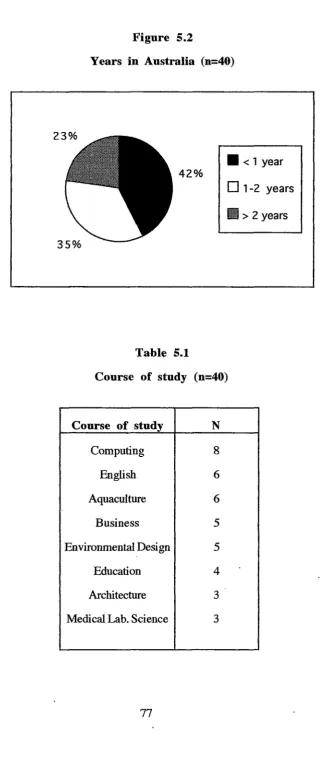
Figure 5.2 Years in Australia 77
..
Table 5.1 Course of study 77Figure 5.3 Number of times IELTS test taken 78
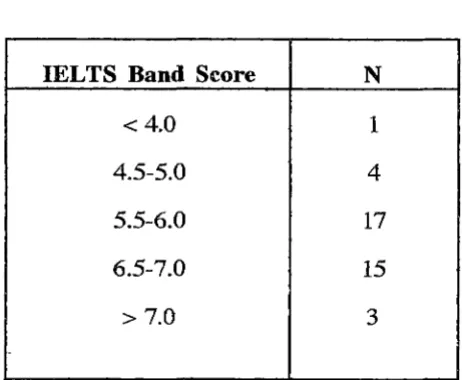
Table 5.2 IELTS overall band scores 79
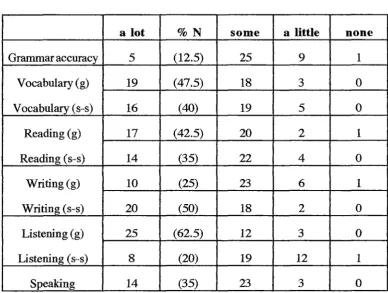
Table 5.3 Perceptions of test content 80
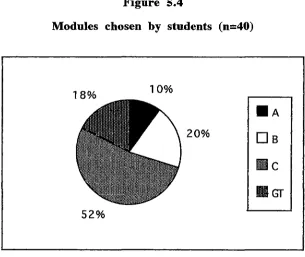
Figure 5.4 Modules chosen by students 82
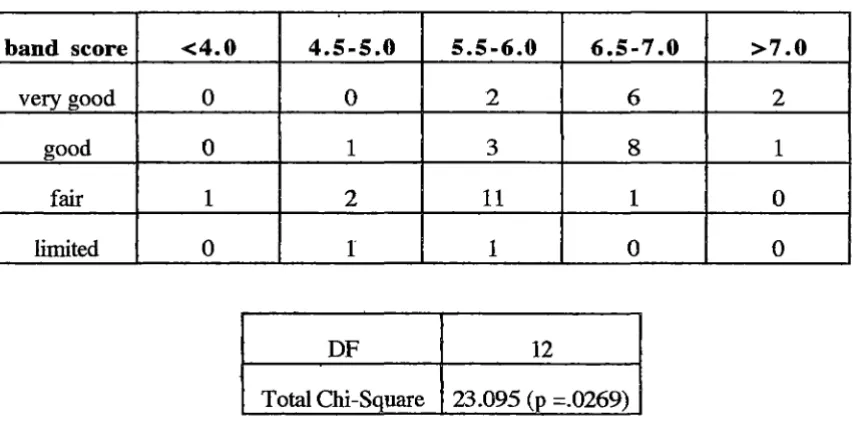
Table 5.4 Perceptions of Band 6 by level of study 83
Table 5.5 Perceptions of test performance 85
Table 5.6 Perceptions of English language level 86 Table 5.7 Perceptions of Band 6 as realistic 88
Table 5.8 Perceptions of test time 90
Figure 5.5 Perceptions of level of difficulty of subtests 91 Table 5.9 Rank result and level of difficulty (Reading) 92 Table 5.10 Rank result and level of difficulty (Listening) 92
I
Figure 5.6 Importance of macroskills in target situation 93
.,
DEET
EAP
EFL
ELI COS
ELTS
ESL
ESP
GPA
GTIDP
IELTS
TAFE
TEEP
TOEFL
TSE
TWE
UC LES
Glossary of Terms Used
Department of Employment, Education and Training English for Academic Purposes
English as a Foreign Language
English Language Intensive Courses for Overseas Students
English Language Testing Service
English as a Second Language
English for Specific Purposes
Grade Point Average. The average score achieved by a student in
examinations over a given level or levels in the course being studied.
General Training module
International Development Program of Australian Universities and Colleges
International English Language Testing System
Colleges of Technical and Further Education
Test in English for Educational Purposes
Test of English as a Foreign Language
Test of Spoken English
Test of Written English
Chapter 1
Introduction
Background to the Study
The last two decades have witnessed the development of education into an international business. Competition to attract students from overseas into English-medium educational institutions now operates on a global scale providing significant export earnings for host countries. In recent years, the flow of international students, notably from Asia, into secondary and tertiary education in English-speaking countries, including Australia, the United Kingdom, Canada and the United States, has accelerated. Social, political and economic reasons are involved. In 1993, approximately 63,000 full fee-paying international students were studying in Australia, an increase of 20% between 1992 and 1993 (DEBT, 1993). 68% of students from overseas were in tertiary education and 9% were attending English Language Intensive Courses for Overseas Students (ELI COS).
Non-native speakers of English admitted to undergraduate and postgraduate courses in Australia are required to fulfil second language proficiency entry requirements, unless they attained senior high school educational qualifications in the medium of English. Therefore, significant judgements have to be made about the readiness of international students for overseas academic study. These judgements are usually based on internationally recognized standardized English language proficiency tests, primarily the International English Language Testing System (IELTS) and the Test of English as a Foreign Language (TOEFL).
The criteria for assessing second language proficiency have educational and ethical implications. Admission to the target academic environment creates high expectations
amongst international students. There are challenges in adapting to a new academic genre, together with issues of cultural adjustment and cultural differences in teaching and learning styles (Ballard and Clanchy, 1988; 1991). Moreover, linguistic difficulties experienced during overseas academic study are a major concern for international students (Ballard and Clanchy, 1988: 2; Bums, 1991; Nixon, 1993). Research has shown a frequent mismatch between the linguistic criteria for admission to tertiary institutions and the linguistic ctemands of academic courses (Elder, 1993; University of Adelaide, 1992: 4). Second language proficiency tests are not always reliable predictors of academic success as many variables intervene to affect the academic performance of international students in the new target situation (Gibson and Rusek, 1992: 60; Graham, 1987; Light et al., 1987). Key factors
affecting academic performance, apart from English language proficiency, include the educational system previously experienced, the type and duration of English language learning in the home country, the level of adjustment of a student to the new academic genre and the depth of academic background knowledge (Bums, 1991: 62). As the number of international students studying in Australia grows, tertiary institutions need to continually review the type and content of courses, 'teaching styles, international student support services, and the provision of English language courses available in the target situation. Taking into account these considerations, crucial decisions about the English language proficiency entry requirements for international students need to be as effective as possible.
Purposes of the Study
The research reported in this thesis has two purposes. First, it aimed to analyse the evolution .of an internationally recognized second language proficiency test, the IELTS. This research was undertaken at a significant stage in the evolution of the IELTS test. The 1989 version of the test was in the process of a major revision to culminate in a new version, available in
)
Secondly, this study investigated international students' perceptions of the 1989 version of the IELTS test in order to determine its face validity, before the introduction of a revised and updated 1995 test version. Test takers are seldom asked by examination bodies for their perceptions of second language proficiency tests and of their test-taking experience, their views on test methods and format, and whether standardized proficiency tests appear to fairly assess their ability.
During the 1985 National Foundation for Educational Research conference, Alderson (1986) appealed for consideration of a student-centred perspective on test validity, an appeal that was
reiterated at the 1990 Regional Seminar on Language Testing and Language Programme Evaluation (Alderson, 1991). He suggested that test takers should be asked to reflect on their responses to test items, and to comment on any discrepancy between their test performance and their own view, or their teachers' views, of their language ability. In other words, Alderson argued that test takers should be encouraged to contribute to future developments in language testing (1991: 21). This significant, if radical propos~l, influenced the direction of the research reported here. The research aimed to consult a sample of IELTS test takers studying at an Australian university for their views on this internationally recognized second language proficiency test. Testing has major consequences for the future of individuals and yet 'very few people have actually consulted the insiders, the test takers, themselves' for their
views on language testing (Alderson, 1986: 99).
Research Rationale and the Structure of this Thesis
Chapter Two is an outline of the evolution of the IELTS as an internationally recognized test.
It replaced the ELTS test which had been designed to assess the English language proficiency of international students entering British universities. The analysis of the IELTS test undertaken in this thesis sought to-determine the underlying construct oflanguage proficiency
in the design and development of the test, the relationship between test content and target language use, and the communicative language learning paradigm reflected in the test. In
addition, Bachman's theoretical framework (1990) of factors influencing performance on language tests is used to further the analysis of test content and test methods. Chapter Two also includes an examination of the most recent evolution in the IELTS test, a revised and updated version effective from April 1995. Major changes to the test have implications for test takers and test users and reflect a shift in the construct of language proficiency underlying the IELTS test.
Language testing evolved as an academic subfield in the 1960s due to the rapid increase in the demand for language tests to solve both practical problems and theoretical issues (Cooper, 1986: 240). Changes in test design reflect changes in theories of the nature of language and the nature of testing (Morrow, 1986: 11 ). Chapter Three of this thesis is a review of the relevant literature and developments in the field of language proficiency testing since the 1980s, characterised by a shift in the focus of language testing research from the 'how' of testing to the 'what' of testing (Skehan, 1988: 211). From theoretical discussions about the structure of general language proficiency, descriptive models of underlying communicative-competence emerged (Canale and Swain, 1980; Canale, 1987). Bachman (1990; 1991) has extended these descriptive models into a working model of communicative language ability which includes both competence and performance. Furthermore, communicative language testing and the testing of English for Specific Purposes (ESP) have significantly influenced
taker characteristics on language test performance (Chen and Henning, 1985; Chapelle, 1988) have revealed potential sources of test bias (Bachman, 1991: 675).
Recent research into language proficiency testing has shown a 'far greater concern ... with validity as opposed to an earlier overriding concern with test reliability' (Weir, 1993: 166). In Chapter Three, therefore, there is an overview of approaches to test validity and a discussion of the role of these approaches in the validation of the IELTS test. It is shown that the face· validity of a test is often defined simply as test appeal. In addition, the extent to which a test appears to be relevant to the test users and test takers is dismissed as inconsequential (Cronbach, 1984, cited in Bachman, 1990: 286). Nevertheless, Bachman (1990: 288) has pointed out:
Even those who have argued against test appeal as an aspect of validity have at the same time recognized that test appearance has-a considerable effect on the acceptability of tests to both test takers and test users.
Stevenson stated that 'face validity judgements are na'ive because appearances in testing are treacherous, and well-established deceivers' (1985b: 114). However, not all experts agree. 'Face validity is becoming recognized as an increasingly important factor affecting test development and indeed test performance' (Alderson, 1986: 100). Chapter Three includes an examination of the controversial role of face validity in language proficiency testing
In responding to Alderson's appeal for a greater focus on test takers, 'their interests, perspectives and insights' (Alderson, 1991: 5), this thesis also reports on an investigation into international students' perceptions of the IELTS test. Chapter Four is a description of the methodology chosen for the study, a questionnaire survey and focus group interview undertaken at the University of Tasmania. The questionnaire survey was designed to ascertain test takers' perceptions of the appropriateness of the minimum recommended entry
requirement, IELTS Band 6, for academic study at tertiary institutions in Australia, and of the IELTS test as a predictor of academic success. The survey also attempted to determine perceptions of test content and test methods, and to establish the perceived relationship between the IELTS test and the target situation of academic study. The focus group interview was intended as a means of validating the questionnaire and of finding out test takers' comparative perceptions of two internationally recognized language proficiency tests, the IELTS and the TOEFL. An analysis of the research findings from the questionnaire survey and interview are provided in Chapter Five.
On the basis of the investigation into international students' perceptions of the 1989 version of the test, conclusions are then drawn about the face validity of the IELTS test in Chapter Six. For the purposes of this study, face validity is defined as 'the appearance or perception of the test and how this may affect test performance and test use' (Bachman, 1990: 302). Furthermore, recommendations are made for the effective interpretation of English language proficiency test scores by test users and for ways of overcoming the mismatch between
]
, minimum English language proficiency entry requirements and the linguistic demands of academic courses. Possible directions for further research are also outlined.
The Study in Perspective
insight into the strategies used by test-takers in taking tests (Cohen, 1984; Grotjahn, 1987; Nevo, 1989).
Weir (1993: 166) has pointed out three major directions for second language proficiency testing in the 1990s. Firstly, there is a need for further research to determine the washback validity of tests, that is, the 'quality of the relationship between a test and associated teaching' (Alderson and Wall, 1993: 116). Research by Hughes (1988b) showed that the 'washback' effects of second language proficiency testing can bring about innovations in classroom teaching and learning. Secondly, there is scope for further developments in the communicative or authentic approach to language testing, and in the design of tests that are performance related. Thirdly, closing the gap between language testing and language use has implications for English for Specific Purposes and English for Academic Purposes (EAP) test development which relates a specifiable context to the target situation.
In addition, test design and the context and appropriacy of test items depend to a large degree on the judgements of 'experts'. Testing is a judgemental activity (Alderson, 1991: 21; Hughes, 1986: 40). According to Alderson (1991: 22) judgements made by experts are not always accurate or reliable and, therefore, should not be assumed to reflect a consensus or the only means of establishing test validity. The test takers also need to be consulted for their views on test cont~nt and test method to establish whether tests appear to be measuring what they claim to be measuring. In Alderson's terms (1986: 98), there is a need for more consumer research in second language proficiency testing. Future innovations in language testing should perhaps aim for higher face validity amongst test takers and test users. The role of the language learner in testing can no longer be that of 'an obedient examinee, a disinterested consumer, a powerless patient or even an unwilling victim' (Canale, 1985, cited
in Milanovic 1991: 136).
Chapter 2
Analysis of an Innovation
It is important that designers of tests should take account of generally accepted views of the nature of language, language proficiency, and language use (Alderson and Clapham, 1992: 149).
Introduction
In this chapter, the development of the International English Language Testing System is analysed from its inception in 1989 to a revised version of the test introduced in 1995. The necessity for an international innovation in language proficiency testing in 1989 is examined.
It is suggested that the IELTS test represented an evolution rather than a revolution in second language proficiency ~esting. Contributory reasons were the lack of a theoretical framework
for language proficiency testing at the time and test constraints imposed by the examining body. A recent evolution in the IELTS test is also analysed in this chapter. It is shown that changes in the 1995 version of the test have major implications for test takers.
Background to the IELTS
The IELTS test, established in 1989, is jointly managed by the British Council, UCLES and the International Development Program of Australian Universities and Colleges (IDP). By 1993, there were some 200 centres in 110 countries where candidates could sit for the IELTS test Although growing in international recognition, the IELTS does not have the widespread impact of the TOEFL test, and it mainly affects those international students planning to study in Australia and Britain. In 1993, 34,000 IELTS tests were taken worldwide, of which 15,000 were taken in Australia; this emphasizes the importance of the test for entrance to Australian academic institutions (IELTS Australia, 1994).
The IELTS test has four main aims. First, it tests the language proficiency of international students and determines whether they have the required level of competence for tertiary studies in English. Second, it aims to diagnose areas of weakness in proficiency, thus enabling appropriate courses of language instruction to be designed. Third, it is intended to provide a test of general language proficiency for students at ELI COS centres in Australia. Finally, it aims to provide an internationally recognized proficiency test which has high face validity (Ingram, 1991: 186).
As an internationally recognized test, the IELTS replaced the English Language Testing Service test. The ELTS test, introduced by the British Council and UCLES in 1980, underwent a lengthy validation study commissioned from Edinburgh University (Criper and Davies, 1988) and the results contributed to the ELTS Revision Project. This project, which was conducted jointly by Britain and Australia, included a review of the literatu~e on testing English for Academic Purposes, a report on a needs analysis of sample target populations of international students, consultations with-language testers and teachers in tertiary institutions, feedback from ELTS test centres and receiving institutions, and a conference of language researchers to debate the content and form of a new language proficiency test. A key task of the Revision Project, directed by Professor J.C. Alderson of the University of Lancaster,
•·
was to identify and define an appropriate model of language proficiency for a revised test to replace the ELTS.
Whilst the ELTS Revision Project was in progress, a survey was conducted of twenty-two applied linguists in the UK and North America in order to reach a consensus on a model of language proficiency appropriate for a new international test. In a letter accompanying the survey, with reference to the existing ELTS test, Alderson and Clapham (1992: 167) claimed, that:
There is a feeling in the field that theories of language use and ESP have now changed, and that the test is based on outdated models. Our intention is in part to verify or question this judgement and in part to identify a more suitable theoretical model for the 1990s.
Alderson and Clapham acknowledged the disappointingly low response rate of 50% to the survey. However, their findings, outlined in this chapter, are evidence of a transition period in language testing within which the IELTS emerged in 1989.
The Mnnby Model
)
learning context'. Munby's classification of communicative language needs for specific target situations was the basis for the design of the ELTS as an English for Academic Purposes/English for Specific Purposes test.
However, by the early 1980s, there was criticism of the Munby model as outdated and inadequate. Furthermore, Munby's taxonomy failed to provide an appropriate hierarchy of the enabling skills for test purposes. Skehan ( 1984: 209) was particularly critical:
The taxonomy has captured the aspects of language that seemed individually most interesting in that period, and frozen them in time as though they have status in a coherent, comprehensive model.
He further commented (Skehan, 1984: 212):
We have seen that the claims of the ELTS for construct validity are questionable, since the 'theory' on which they depend, the Munby model for syllabus design, is unsatisfactory internally, and bears insufficient relationship with reality.
In fact, a significant issue addressed by the Revision Project was the assumption that the
Munby model no longer reflected current thinking in language profiCiency testing. Only a minority of applied linguists in the survey supported the specification of a Munby-type taxonomy of underlying skills for the design of tasks in a new language proficiency test. Nevertheless, Alderson and Clapham (1992: 155) concluded from the ELTS Revision Project that 'there is no generally accepted, dominant paradigm or theory that can be said to have replaced the Munby model'.
Test Specifications
Test specifications should aim to state clearly a test's construct and thus, in the case of any new English language proficiency test, the underlying theory of language proficiency held by the test designers (Alderson, 1988). Test specifications should also specify target performance and provide guidelines to content and test methods for the production of parallel test versions. The 1988 validation study (Criper and Davies) had criticized the ELTS test for lack of content validity, that is, the extent to which it measured a representative sample of the langilll;ge proficiency skills it claimed to be measuring. The first step in establishing content validity is to analyse test specifications. However, the Revision Project produced no clear consensus amongst researchers on a construct for test specifications. The majority of applied linguists agreed on the importance of task appropriateness in the design of a new test, and the importance of a needs analysis of a sample target population. Alderson and Clapham (1992: 163) claimed that research conducted by Weir into the academic English language needs of international students entering higher education in the United Kingdom contributed to the new IELTS test specifications. However, Weir (1990: 21) was skeptical:
The recent ... revision project has forsaken such needs analysis and instead intends to rely on post hoe 'expert' comment to judge the 'authenticity' and other aspects of the products of the test writing teams.
The Nature of Language Proficiency
Alderson and Clapham (1992: 152) cite the view of language proficiency embodied in the ELTS test as defined by the validation study report (Criper and Davies, 1988: 9-10):
Firstly, it divides proficiency in the skills dimension, having separate tests of reading, listening, writing and speaking ... Secondly, it divides proficiency into 'general' and 'study' proficiency, having a test of 'study skills' distinct from the tests of the four skills referred to above ... Thirdly, it divides proficiency on the subject dimension, providing options in the form of 'modules'.
The ELTS Revision Project survey confirmed that Oller's hypothesis of an underlying unitary competence for English- language proficiency was no longer widely accepted by applied linguists. In fact, Oller (1983: 35) had already conceded that language proficiency does not simply consist of 'an exhaustive global factor'.
Although Palmer and Bachman's research (1981) into the nature of language proficiency had been published, in which they hypothesized that speaking and reading abilities are independently measurable, their research does not appear to have been influential in the design of the IELTS test. Recent studies, referred to in Chapter Three, have empirically validated the differentiation of language proficiency into skill areas at intermediate levels of
second language acquisition. On the other hand, the differentiation is less clear at higher proficiency levels (Milanovic, 1991: 135). According to Alderson and Clapham (1992: 164), the new IELTS test followed a skills-based approach because:
The applied linguists seemed to be content with the concept that proficiency is -divisible by skill, and there are thus tests of the four macro-skills: reading, writing, listening and speaking.
Test Constraints
Alderson and Clapham (1992: 154) claimed that the British Council set provisos which constrained the innovativeness of the IELTS. Firstly, the new test had to be administratively cheaper than the ELTS. Secondly, it had to be a shorter and more manageable test. Testing time was to be reduced from 180 to 145 minutes. Thirdly, the test was constrained by the need to administer it to large numbers of candidates in diverse international settings. Fourthly, the test had to be designed for administration and marking by clerical staff with
little training. The British Council also stipulated continuity with the ELTS test for reasons of face validity.
Test Content
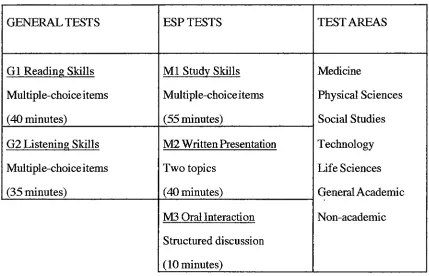
The ELTS test consisted of two general tests of reading skills and listening skills, and three modular academic tests of study skills, written presentation and oral interaction in five subject-specific areas, as illustrated in Figure 2.1.
In the ELTS validation study, two possible alternatives for a revised test were considered, 'one small set of general specific tests or to return to one overall proficiency test' (Davies, 1988a: 47). The former alternative was recommended. In actuality, the 1989 IELTS test
I
maintained the division between general language proficiency and ESP, but reduced thenumber of subject-specific areas to three broad fields of academic study. As Ingram (1991: 186) pointed out:
\
Figure 2.1
The English Language Testing Service, 1980 (Carroll, 1983: 91)
GENERAL TESTS ESP TESTS TEST AREAS
G 1 Reading Skills Ml Study Skills Medicine
Multiple-choice items Multiple-choice items Physical Sciences
( 40 minutes) (55minutes) Social Studies
G2 Listening Skills M2 Written Presentation Technology
Multiple-choice items Two topics Life Sciences
(35 minutes) (40 minutes) General Academic
M3 Oral Interaction Non-academic Structured discussion
( 10 minutes)
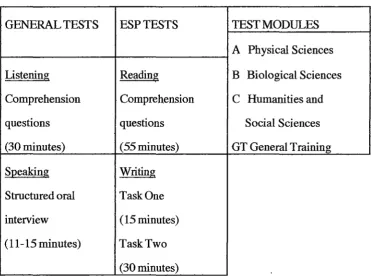
The 1989 version of IELTS consists of two general subtests of Listening and Speaking, academically related, and two ESP subtests of Reading and Writing in three broad fields of study referred to as academic modules A, B and C, as shown in Figure 2.2. The change from ELTS 'test areas' to IELTS 'modules' necessitated incorporating Technology under Physical
Sciences, Medicine under Biological Sciences, and creating a broad Humanities and Social Sciences module. A General Training module (GT) replaced the General Academic and Non-academic test areas of the ELTS. The new IELTS test gave candidates the option of being tested in the macroskills of Reading and Writing in one specific ESP module, according to their past or future academic specialism. Alternatively, candidates could opt for a less academically demanding General Training module appropriate for vocational and non-degree training courses. The 1989 version of the IELTS thus represented a compromise between an
[image:26.566.59.488.157.433.2]English language proficiency test offering an infinite number of academic modules to meet the diverse target situations of study and training, and a general EAP proficiency test, such as the TOEFL.
Figure 2.2
The International English Language Testing System, 1989 (Deakin, 1994: 2)
GENERAL TESTS ESP TESTS TEST MODULES
A Physical Sciences
Listening Reading B Biological Sciences
Comprehension Comprehension
c
Humanities andquestions questions Social Sciences
(30 minutes) (55 minutes) GT General Training
Speaking Writing
Structured oral Task One interview ( 15 minutes) (11-15 minutes) Task Two
(30 minutes)
[image:27.569.90.461.251.527.2]assuming one agrees that 'general' reading comprehension texts will tend to favour particular groups, either culturally or in subject-related content.
Although an ESP listening subtest based on academic lectures and notetaking was considered, a general listening subtest was adopted in the 1989 version of the IELTS test. This aimed to ease the problems of administration in testing centres without language laboratories and with large numbers of candidates (Ingram, 1991: 190). In addition, Alderson and Clapham's survey of applied linguists for the ELTS Revision Project revealed no strong opinions about the inclusion of a separate grammar component in a revised
language proficiency test. Even though draft tests of grammar were initially written for the IELTS, they were finally excluded as it was judged that the macroskills of reading and writing adequately cover grammatical competence.
Test Methods
The ELTS test included multiple-choice test items for reading, listening and study skills, arid directtestmethodsforwriting and speaking (see Figure 2.1). The new IELTS test reflected the trend towards communicative language testing, hence, a greater variety of testing methods; doze, true or false, and short answers. In addition, authentic texts and tasks in a
variety of genres were included to simulate the specific performance tasks required of students in tertiary level academic studies. Ingram (1991: 192) explained that 'neutral' rather than 'highly discipline-specific texts' are chosen for the Reading subtest to provide realistic contexts for a diverse target population of test takers.
A further change introduced in the 1989 version of the IELTS was the integration of reading comprehension texts and writing tasks. Test instructions encouraged candidates to evaluate the content of texts from the Reading subtest when answering task two in the Writing
subtest. Integrated skills tests have been subject to some criticism because performance on one task may depend on successful performance on another task (Weir, 1990: 85). For example, reading proficiency may interfere with a candidate's ability to complete writing tasks that build on reading comprehension texts. However, Weir (1990: 84) regarded the closer integration of listening, reading and writing tasks as more realistic of the target academic situation:
In academic life, for example, students have to read a variety of texts and process spoken discourse in lectures and seminars in preparation for writing tasks, and work is often discussed with others before a final version is presented for assessment.
Two types of questions were included in the Writing subtest; a guided task involving information transfer or reprocessing from a graph, table, or diagram, and an experience task using relevant reading comprehension passages, supported by the candidate's own experience, to present an argument or to suggest a solution to a problem. Further discussion of the development and design of the writing test component is to be found in a paper by Westaway (1988).
The General Training module for reading and writing was designed to be similar to the academic modules previously described. However, tasks are related more specifically to
survival skills in an academic environment, such as writing letters, completing application forms and following instructions. In addition, reading comprehension texts are shorter, and less demanding lexically.
authentic language use. For administrative purposes, input is aural from a pre-recorded cassette tape, and visual stimuli, such as sketch maps and drawings, may be included in the initial part of the test. Test items include note-taking, form-filling and short answers, as well as cloze and multiple-choice types. The Listening subtest does not attempt to simulate the situation of an authentic extended academic lecture. One factor possibly affecting reliability is the variation in quality of sound equipment used between test centres.
The 1989 version of the IELTS Speaking subtest assesses a range of language proficiency levels by adopting a guided, five-phase oral interview format. It was recognized that IELTS examiners worldwide would inevitably vary in their skill and level of training as interviewers, and therefore a carefully structured interview would increase reliability (Ingram, 1991: 191). The time allocated to the Speaking test, 11 to 15 minutes, was constrained by the need to reduce overall testing time compared with the ELTS, and for purposes of administration in test centres with large numbers of candidates. The five stages of the Speaking test, introduction, extended discourse, elicitation, speculation and attitudes, and conclusion, assess oral proficiency within the context of general knowledge and authentic situations relevant to the candidate. Although the interview format allows scope for some initiative by the candidate, particularly in phase three, the interviewer essentially retains control.
The Application of Bachman' s Framework
Bachman's theoretical framework of factors influencing performance on language tests is discussed in Chapter Three. Within the framework, the categorization of test method facets is applicable to the analysis of a second language proficiency test in four ways: for describing the content of language tests and making comparisons between tests (Bachman et al., 1988);
for designing and developing new tests; for examining test validity; and for contributing to
If:
•
research into the effects of test methods on performance (Bachman, 1990). However, in this study the framework will only be applied in describing the content of the IELTS test.
Bachman (1990: 119) classifies five test method facets: the testing environment, the test rubric, input, expected response, and the relationship between input and response. Since the IELTS is administered worldwide and in diverse situations, the testing environment, that is, the place of testing and the personnel, may be familiar for some test takers and unfamiliar for others. Furthermore, the physical conditions under which students are tested will vary unavoidably.
The facet of test rubric in the IELTS test has been discussed in detail earlier in this chapter. To summarize, the test is organized into four parts or subtests that are given different time allocations, and, since the Reading and Writing subtests are integrated to some extent, the sequencing of subtests is important. In addition, test takers have the opportunity to become familiar with test instructions by obtaining a specimen test paper. However, a recent administrator's report suggests that cultural factors may affect the ability of test takers to follow test instructions (IELTS Australia, 1994). For example, the instruction 'Write an essay for a university teacher' is open to cultural niisinterpretation and may elicit the response 'Dear respected teacher'. The degree of 'speededness' as perceived by the test takers and the
possible influence of testing time on performance are considered further in Chapter Five.
•
nonreciprocal in the IELTS, with the exception of the oral interview which is both reciprocal and adaptive.Reporting Results
Brindley (1986) defines a proficiency rating scale as descriptors of stages of language behaviour along a continuum . A proficiency rating scale was used to report test scores on the ELTS test and nine bands were chosen for reasons of discriminating over a wide range of proficiency levels using general overall descriptions (Carroll, 1983: 98). The British Council favoured a continuation of this accepted and recognized system in a revised international test. Consequently, the IELTS test results are reported on nine bands of language proficiency which describe communicative and linguistic criteria from Non-User, Band 1, to Expert User, Band 9 (see Appendix II). A candidate's test report forrn shows results in two ways: first, as an average band score that gives an overall impression -0f competence; and, second, as a diagnostic profile of band scores on four macroskills, which reveals a test taker's strengths and weaknesses. For example, an overall IELTS score of Band 6 may be composed of 6.0 (Reading), 5.0 (Writing), 7.5 (Listening), and 5.0 (Speaking).The primary intention has-been to enable test users to interpret ri;:LTS test results easily.
Alderson (199lb) discussed in some detail the process of defining a nine-point proficiency rating scale for the new IELTS test. He outlined the procedure for converting raw scores on the indirect subtests of Reading and Listening into band scores. An explanation was also given of profile and global band descriptors for rating test takers on the direct subtests of Writing and Speaking. Alderson explained the process of directly converting a test taker's performance on each of these subtests to band scales from 1 to 9. Whereas it was decided to focus the ESP subtests of Reading and Writing around proficiency level Band 6, the subtests
•·
of Listening and Speaking and the General Training module were designed to focus around Band 4 (Ingram, 1991: 193).
Since the General Training module is designed for candidates entering technical and vocational training courses, or senior secondary school, UCLES has set an upper limit of Band 6 on the Reading and Writing subtests for candidates taking this module. 'The logic, practical value and validity of this decision have yet to be fully tested' (Ingram, 1991: 189).
However, Brindley (1986: 22) pointed out that 'a general proficiency description cannot be regarded, nor should it be accepted, as a definitive scientific measurement of any given individual's language behaviour~.· Proficiency level descriptors are not discreet and a test taker's performance may cross proficiency level boundaries. In addition, he suggested that proficiency rating scales tend to be 'impressionistic, subjective, relative in interpretation and therefore unreliable' (Brindley, 1986: 19). A number of research projects have been commissioned by IELTS to revise and validate bandscales for the Reading, Writing and Listening subtests, and to evaluate inter-rater reliability on the Speaking subtest (IELTS Australia, personal correspondence, May 1994).
An International Context
carefully in the design of a new IELTS test (Ingram, 1991: 195). Whether the IELTS has been successful in its selection of issues and contexts shared by English-speaking cultures is an area of potential research. Furthermore, within the international arena the IELTS is a relatively new test and has some way to go before it is as widely established as the TOEFL.
Assessing an Innovation
According to Alderson (1986), the process of innovation in testing necessitates some fundamental questions. Why is there a need for a new test? From where does the need for change emanate? What evidence is there that the former test is ineffective? Do the test takers and test users perceive a need for innovation? It has been demonstrated in this chapter that by 1986 there was a generally held view amongst language testers and test users that the ELTS test was in need of revision. The Munby model, which had provided the construct on which ELTS was based, had been criticized as inadequate and outdated by applied linguists. The key issue in innovation was to search for an appropriate model of language proficiency for the development of a revised test. The Edinburgh Validation Study (Criper and Davies, 1988) inferred that the ELTS was effective as an ESP test; nevertheless, the model on which it was based was ineffective. Clearly the ELTS was established and accepted by test users, and any innovation would at least need to retain the level of face validity of the existing test.
The IELTS test was designed without a clear theoretical framework in a period of transition between the demise of the Munby model and the emergence of Bachman's framework for the design of language proficiency tests. As a consequence, although it is claimed that the IELTS 'reflects new developments in language testing' (IELTS, 1992: 2), it retains much of the legacy of the ELTS test which it replaced, and the test constraints imposed by the British Council. In terms of innovation in testing, it reflects evolution rather than revolution.
The IELTS Test 1995
Five years after its inception the IELTS test has undergone a further evolution. An updated version has been available for examination from April 1995. The revised test includes six major changes to the 1989 version which affect test takers. The description of these changes outlined below is based on the Information Circular, IELTS 1995 (UCLES, 1994a).
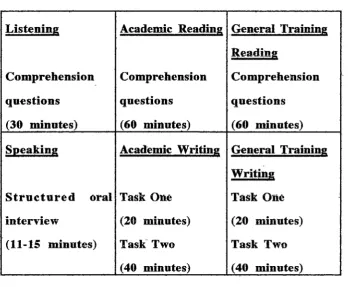
Firstly, although lhe macroskills-based structure of the test remains, the new IELTS test offers candidates a choice of two EAP modules rather than four for the Reading and Writing subtests, as shown in Figure 2.3. The ESP modules, A, B and C of the 1989 version, are replaced by one Academic module; however, the General Training module is retained.
Figure 2.3
The International English Language Testing System, 1995
(Deakin, 1994: 2)
Listening Academic Reading General Training
Reading
Comprehension Comprehension Comprehension
qut?stions questions questions
(30 minutes) ( 60 minutes) (60 minutes)
Seeaking Academic Writing General Training
Writing
Structured oral Task One
Task One
interview (20 minutes) (20 minutes)
(11-15 minutes) Task-Two Task Two
[image:35.565.101.456.437.724.2]Secondly, test time is increased from 145 to 165 minutes. This- represents an addition of five minutes for the Reading subtest and fifteen minutes for the Writing subtest. Despite an increase in tiffi.€ av~ilable to test ta.leers, the required- word count for the two writing tasks- is also increased, from 250 words for the ESP modules and 200 words for the General Training module, to 400 words in total for each module, Academic and GT.
Thirdly, the Reading subtest for both the Academic and the General Training modules is divided into three reading comprehension sections, whereas this was not standardized ben.veen modules and versions in the 1989 IELTS test. There is no longer a link between the Reading and Writing modules; reading and writing were previously integrated.
Fourthly, there is a change in the order in which candidates take the subtests: Listening, Reading, Writing, Speaking. In the 1989 version of the IELTS test, Listening followed the Writing subtest. In addition, the Speaking subtest may be completed by candidates on a separate examination day, up to I two days ~fter the other subtests1 'at the discretion of the test
centre' (UCLES, 1994a: 2).
In the 1989 version of the IELTS test, the General Training module was assessed over six
proficiency rating scales or bands, and was considered to be less academically demanding. The 1995 version of the General Training module is comparable to the Academic module for both the Reading and Writing subtests. Both modules require two writing tasks of at least 150 words and 250 words, whereas 80 words and 120 words were previously required for the General Training module. Consequently, a fifth change is that Reading and Writing subtests for both Academic and GT modules are to be assessed over 9 Bands in the revised test. This increases the chances of test takers who choose the GT module scoring above Band 6 overall.
_l
A sixth change which affects the test takers is an increase in the number of IELTS test versions to be made available to test centres in proportion to their number of candidates. Furthermore, test material is planned to remain in use for no more than one year. This should improve test security by reducing the likelihood of candidates facing recycled test material.
Proposed changes to the administration of the !ELTS test will affect candidates indirectly and have implications for further research (UCLES, 1994a). Increasing numbers of international students are taking the !ELTS test, particularly in Australia. The necessity for computerised administration at test centres should ensure continued rapid reporting of test results, test security and effective operation of the three month candidate waiting period between !ELTS test retakes. The reliability of the subjective marhng of the Writing and Spea!c..ing subtests is to be improved by double chechng of borderline candidates. !n future, all oral interviews are to be recorded to maintain test reliability.
A ch~nge in the process of data collection will enable more information to be gathered about test takers, item difficulty and discrimination, and the responses of particular cultural and linguistic groups to test items. The data bank should encourage further research into these areas and contribute to the preparation of an annual validation report (UCLES, 1994a: 5). The possible implications for test takers of revisions to the !ELTS test are considered in Chapter Six.
Concluding Note
•
measuring what it purports to measure, that is, English language proficiency and readiness for academic study. An investigation into international students' perceptions of the 1989 version of the IELTS test is discussed in Chapters Four and Five. The issue of face validity, as\vell as other approaches to validating language tests, is first discussed in Chapter Three which is a review of the research literature in second language proficiency testing .
)
Chapter 3
Literature Review
Confusion, disagreement and uncertainty are reflected in much of the writing associated with language testing, a confusion which can be partly explained by a lack of agreement about the nature of language, language learning and use (Nunan, 1991: 47).
Introduction
This chapter is a review of recent research literature in second language proficiency testing. There have been major paradigm shifts in language testing that have reflected changes in the interpretation of language proficiency and in the terminology associated with it. The relevance of developments in English for Specific Purposes and communicative language testing to the design of language proficiency tests is demonstrated in this chapter. In addition, it includes
'
consideration of a recently developed theoretical fram~work of communicative language ability. A summary follows of research into the effects of testing method on test reliability and validity and studies of test taker characteristics that affect test performance. Approaches to validating proficiency tests, particularly the-IELTS test, are then examined. Finally, the importance of distinguishing between norm-referenced and criterion-referenced language testing is discussed.
Definitions of Language Proficiency
•••
'performancet refers to what the person does with the language (Nunan, 1991: 47). He also stated th-at language proficiency is commonly held to be 'the ability to perform certain communicative tasks with a certain degree of skill' but argued that this definition is unsatisfactory (Nunan, 1988: 127). Nevertheless, Ingram (1985: 220) defined proficiency as 'not just knowledge but the ability to mobilize that knowledge in carrying out particular communication tasks in particular contexts or situations'. He also stated that defining language proficiency involves more than simply the ability to carry out tasks. A 'behavioural' definition of proficiency is needed to incorporate 'how' communication tasks are carried out (Ingram, 1985: 221).
Bachman (1989: 252) used the term 'communicative language ability' to include both competence (knowledge) and performance (a demonstration of the ability to use competence). Weir (1990: 7) sup_ported this wider definition oflanguage proficiency, but noted that it is difficult to distinguish between performance and competence in practice. Bachman's definition was based on the distinction between competence and performance originally proposed by Canale and- Swain (1980). Bachman (1989: 251) stated that recent research studies in language testing tended to support the hypothesis that 'language proficiency consists of several distinct abilities that are related to each other or which are related to a higher order, general ability'.This hypothesis has replaced the 'unitary competence hypothesis' discussed below.
The psycholinguistic-sociolinguistic era in language testing in the 1970s was characterised by a trend away from discrete point tests towards global integrative tests, such as doze and dictation (Weir, 1990: 3). Oller (1979, cited in Skehan, 1984: 202) argued that the structure of language proficiency consisted of one unitary factor, general or overall language ability, rather than a skills-based division of specific abilities. Furthermore, he asserted that overall language proficiency was most appropriately measured by integrative tests. According to Oller (1979, cited in Weir, 1990; 3), integrative tests, compared with discrete point tests,
more closely reflected the process of language use. However, Oller's Unitary Competence Hypothesis was subject to considerable criticism on both theoretical and empirical grounds applying principal components and confirmatory factor analyses (Hughes and Porter, 1983). Oller (1983) responded by conceding that he had overstated the theory of language proficiency as a single integrated trait, based on a 'pragmatic expectancy grammar' underlying language performance.
Controversy amongst applied linguists revived in the late 1980s. Does language proficiency consist of one unitary factor or is it divisible into separate and discrete factors, or
alternatively, does it have both unitary and divisible aspects? However, research studies offered no clear-cut conclusions in favour of either the unitary or the divisible hypothesis (Buck, 1992: 315). The notion of a single psychological construct underlying language proficiency was replaced by the notion that language proficiency is 'multicomponential, consisting of a number of interrelated specific abilities as well as a general ability or set of general strategies or procedures' (Bachman, 1991; 673).
The issue of whether language proficiency consists of separate subskills or specific traits rather than a single unitary trait has implications for the design of second language proficiency tests. Multitrait/multimethod research design and confirmatory factor analysis were used in a number of studies to establish the construct validity of measures of communicative language ability. Palmer and Bachman (1981) found empirical support for the
'
,
In addition, research suggested that the construct of language proficiency varies according to the level of proficiency (Alderson, 1991a: 12). At the lower and intermediate levels of second language acquisition, instructed language learners demonstrated differentiated proficiency on tests of macroskills (Milanovic, 1991: 135). Advanced learners, however, demonstrated more integrated language abilities or general proficiency, performing similarly in all macroskills. The test performance of beginners also tended to be unifactorial, rather than multifactorial.
The Purposes of Language Proficiency Testing
Firstly, the purpose of second language proficiency testing is to make judgements about the language abilities of test takers whose academic, cultural and linguistic backgrounds may be heterogeneous. Proficiency tests, unlike achievement tests, 'look forward rather than backward' and therefore predict future performance in diverse target situations (Alderson, 1988b: 17). Language proficiency tests are most frequently used to predict the readiness of non-native speakers of English to undertake English medium academic study. Together with an individual's previous academic records and profile, proficiency tests are also used to predict the probability of an international student being academically successful in the future target situation. Internationally recognized language proficiency tests, such as the IELTS and
the TOEFL, claim to fulfill this purpose.
Secondly, language proficiency tests may be used for diagnostic purposes. A diagnostic profile of a test taker's language ability showing strengths and weaknesses can determine an individual's need for and the extent of further English language instruction. IELTS test results are presented as a diagnostic profile of the test taker's language proficiency on four macroskills (reading, writing, listening and speaking). In addition, results are also shown as an overall mean band score on the IELTS proficiency rating scale (see Appendix II). In brder
'-.
I
to fulfill the two purposes of language proficiency testing, tests should be designed to measure language abilities that correspond to the communicative language abilities required in nontest language use, and test tasks should effectively simulate the target situation (Bachman,
1991: 681).
English for Specific Purposes
In meeting the goals of second language proficiency testing on an international scale, the
question arises of how specific should proficiency testing be (Alderson, 1988b ). The target situations of test takers will be diverse. In some respects, a practical solution is to produce one internationally recognized and standardized language proficiency test, such as the TOEFL test, for all test takers. Whilst the design and validation of one general proficiency test may be practical in time and money, is one test for all test takers fair and valid? (Alderson, 1988b: 18). Furthermore, do test takers perceive a general English language proficiency test to be acceptable, or do they perceive specific tests for specific academic purposes to have greater test appeal? Alderson (1988b: 18) commented that 'face validity, perhaps, argues for specific tests'; however, as face validity is unquantifiable, it is frequently given a low priority in the validation of second language tests.
testing. Alderson (1988b: 19) argued that the content validity of a proficiency test depends not only on a needs analysis of diverse target situations, but also on analyses of the difficulties international students encounter in their academic studies and their perceptions of test appropriacy. Skehan criticized the Mun by model for not providing an adequate framework to address the main difficulties which international students come across in academic study. He cited research by Johns and Dudley-Evans (1980, cited in Skehan, 1984: 210) which demonstrated that the comprehension of lecturers' styles and the content area of vocabulary knowledge were major difficulties faced by international students. Consequently, Skehan claimed-that the Munby model had weaknesses when applied to
ESP
testing because it was primarily linguistic-and did not 'take account of actual psycholinguistic processes that are important in language functioning' (Skehan, 1984: 211). For instance, the model did not take into account the effect of relevant cultural and background knowledge on ~exfcomprehension. In the period since the Munby model was devised, needs analyses of second language learners have become more complex and sophisticated (Johns and Dudley-Evans, 1991: 299).
Designing 'general' second language proficiency tests or English for Specific Purposes tests raises the issue of the relationship between background knowledge and language proficiency. Research has shown that previous background knowledge affects the performance of test takers on tests of listening comprehension and reading comprehension (Alderson, 1988b: 20). Therefore, it seems logical if the intention is to test general language proficiency that tests should be based on 'neutral' texts and tasks to avoid potential bias in favour of test takers with specific background knowledge described by Bachman (1990: 278):
However, it is questionable whether completely neutral and unbiased texts are an achievable goal and whether it is valid to predict from general proficiency tests with tneutral' texts to performance in specific target situations. On the other hand, it may not be valid to interpret from content specific tests to generalized knowledge (Bachman, 1990: 274).
'It is argued that appropriately differentiated tests in different skills areas need to be made available for evaluating different groups of examinees with different target situation needs.' (Weir, 1990: 11). However, in practice an infinite number of communicative language tests tailored to an infinite number of test purposes seems unworkable. Furthermore, distinguishing between generalized and specialized knowledge, and between general and
specific language abilities is difficult (Bachman, 1990: 274).
Alderson (1988b: 18) raised the issue of parallelism or equivalent levels of difficulty between different academic modules in ESP testing. 'Ensuring parallelism through empirical, rather than descriptive, means is somewhat problematic.' (Alderson, 1988b: 28). This point is relevant to the 1989 version of the IELTS test, analysed in Chapter Two, which included parallel academic modules in three broad fields of study.
Communicative Language Testing
Communicative language testing is said to generalize to the target situation by testing within a meaningful communicative situation (Canale and Swain, 1980: 34). Weir (1990: 7) pointed out that:
Skehan (1988: 215) and Weir (1993: 167) both cited the work of Canale and Morrow to characterise the features of communicative language testing as follows: language is interaction-based and unpredictable; stimulus materials are relevant and authentic; language has a context; language is used for a puipose; discourse processing activities are realistic; and language is outcome evaluated. Weir (1993: 167) stated that 'we cannot build into our tests
all the features of real life all the time. But we should maximise the involvement of these features'. Bachman (1991: 678) chose to focus on four characteristics to distinguish communicative language tests: the creation of an information gap requiring the processing of information from several sources of input; the interdependency of test tasks; the integration of test tasks and content Within a given context; and the measurement of a broad range of language abilities.
Davies (1988b: 6) expressed the opinion that communicative language tests have no clear-cut definition. On the other hand, Weir (1990: 5) argued categorically that 'only direct tests which simulate relevant authentic communication tasks can claim to mirror actual communicative interaction'. However, Skehan (1984: 208) asserted that the inclusion of authentic communication tasks in a test can neither guarantee an adequate sample of communicative language use nor effective predictions of performance in the target situation.
As Shohamy and Reves (1985: 55) pointed out, the goal of interaction in a test is to assess the test taker's language performance and, hence, communication between participants is usually artificial. The examiner and the test taker are unlikely to interact in the same way in an oral proficiency test as in real life. For example, the topic of communication is imposed by the examiner. In addition, the physical environment is inauthentic and there are time constraints. Although some tests appear to test authentic language behaviour, particularly oral interviews, they are in fact simply assessing authentic 'test language' (Shohamy and Reves,
1985:· 57; Stevenson, 1985a: 47). Spolsky (1985a: 39) explained:
Any language test is by its very nature inauthentic, abnormal language behaviour, for the test taker is being asked not to a11:swer a question giving information but to display knowledge or skill.
Is the goal of authentic language testing unattainable, therefore? The authenticity oflanguage testing is an area that has generated considerable research in the past decade and 'authenticity has been defined in a number of different ways' (Bachman, 1991: 689). First, there is the 'direct' approach. However, according to Bachman, this approach in language testing is unattainable since inferences about language ability must be based on indirect observations. Second, there is the real-life approach to authenticity. This is problematic when the target situations of test takers are diverse since language use in real life is varied and complex (Bachman, 1990: 312). Third, there is the face validity approach to defining authenticity. However, Bachman (1991: 690) claimed 'this definition refers to
a
purely subjective response on the part of the evaluator'. He proposed two different approaches: situational authenticity and interactional authenticity. Situational authenticity is 'the perceived relevance of the test method characteristics to the features of a specific target language use situation'; interactional authenticity 'is a function of the extent and type of involvement of test takers' language ability in accomplishing a test task' (Bachman, 1991: 690-691). Introspection techniques, discussed below, provide an understanding_ of test takers' strategies m completing test tasks and may help in assessing iilteractional authenticity (Cohen, 1984).According to Weir (1988; 76), authenticity is probably an 'unattainable goal in mass language testing' but 'a realistic context is not'. For example, the Test in English for Educational
linguistic and non-linguistic variables, and as a result, language performance can be complex, varied and difficult to control.
In Bachman's terms (1990: 317) test authenticity is essentially synonymous with communicative language use. He addressed the characteristics of the interactional/ability approach to authenticity by proposing theoretical frameworks of communicative language ability and test method facets. 'Two factors, the test taker and the characteristics of the test method, will jointly codetermine the extent to which a given test or test task is authentic' (1990: 318). In addition, the characteristics of _the testing context were considered in the model.
A Model of Second Language Proficiency
Canale and Swain (1980) proposed a model of communicative competence consisting of three dimensions of knowledge and skills (grammatical, sociolinguistic and strategic competencies) rather than one global dimension as postulated by Oller. The model was later revised and expanded to include discourse competence. Within the framework, grammatical competence was defined as knowledge of the language code, sociolinguistic competence as the 'extent to which utterances are produced and understood appropriately in different sociolinguistic contexts', strategic competence as knowledge of verbal and non-verbal communication strategies, and discourse competence as coherence and cohesion (Swain, 1985: 37). The model was based on an assumption that learners develop competence in each area of knowledge and skills independently.
The application of psychometric theory to language testing was still dominant in the 1980s. However, criticism was being voiced of existing language proficiency tests based on norm-referenced testing. Bachman and Clark (1987: 21) commented that 'language testing