NJF Report • Vol. 2 • No 5 • 2006
NJF Seminar 373
Transport and retention of
pollutants from different
production systems.
NJF Report Vol.2 No 5, 2006 NJF Seminar 373
Transport and retention of pollutants from different production systems. Tartu, Estonia, 11–14 June 2006
Editors Toomas Tamm and Liisa Pietola
Liisa Pietola: University of Helsinki, Department of Applied Chemistry and Microbio-logy P.O. Box 27, FIN-00014 Helsinki, FINLAND
Present address: Kemira GrowHow Oyj, Research Centre, P.O. Box 2, FIN-02271 Espoo, FINLAND
Toomas Tamm: Estonian University of Life Scienses, Department of Water Manage-ment. Kreutzwald Str 5, EE51014 Tartu, ESTONIA.
Photo on the cover: Toomas Tamm (view from South-Western Finland)
ISSN No. 1653–2015
Tartu University Press www.tyk.ee
NJF373 Tartu 2006 (140–142)
Buffer zone water repellency:
effects of the management practice
Kimmo Rasa
1, Mari Räty
1, Olga Nikolenko
1, Rainer Horn
2,
Markku Yli-Halla
1, Jaana Uusi-Kämppä
3, Liisa Pietola
11 Environmental Soil Science, Department of Applied Chemistry and Microbiology,
P.O. Box 27, 00014, University of Helsinki, Finland. [email protected] 2 Institute of Plant Nutrition and Soil Science. CAU Kiel, Germany
3 MTT Agrifood Research Finland, Plant Production Research, Jokioinen, Finland
Abstract
Water repellency index R was measured in a heavy clay and a sandy loam, used as arable land or buffer zone (BZ). Further, effect of management practise and ageing of BZs were studied. Water repellency was proved to be a common phenomenon on these soils. Harvesting and grazing increased water repellency as does ageing. Low water repellency is supposed to prevent preferential flows and provide evenly distributed water infiltration pattern through large soil volume, which favours nutrient retention.
1. Introduction
Soil water repellency (WR) is a world wide known phenomenon. Pietola et al. (2005) have tentatively found that WR does exist also in Finnish heavy clay soil pasture. There is inadequate data about water repellent behaviour of Finnish soils situated in humid climate zone. WR has an impact on soil hydrological properties, especially water infiltration into the soil. Delayed soil wetting process increases preferential flow and results in an uneven wetting pattern (Dekker & Ritsema 1996a) or may expose soil to surface runoff and consequent erosion.
Buffer zones (BZ) are established to prevent soil erosion and nutrient transport to surface waters. However, Uusi-Kämppä (2005) reported unability of BZs to reduce molybdate-reactive (i.e. bioavailable) phosphorus. We assume that low WR promotes evenly distributed water infiltration through the entire soil volume and favours nutrient retention, especially that of bioavailable phosphorus.
Buffer zone water repellency: effects of the management practice 141
2. Material and methods
Soils samples were taken from two experimental sites. The Lintupaju soil in Jokioinen, South-Western Finland, was classified as a Vertic Cambisol. Experiments were conducted on six BZs and on an adjacent cultivated field. BZs were 1) old (15 years) natural vegetation with wild hay and scrubs or 2) without scrubs, 3) old and 4) young (3 years) BZ with grass species harvested annually, 5) old and 6) young BZ with grass species grazed by cattle. In Maaninka, Central Finland, the soil was classified as a Dystric Regosol. Experimental sites were two BZ and cultivated field. BZs were 1) old (10 years) natural vegetation with grass species, and 2) young (2 years) BZ with grass species harvested annually. Soil characteristics are presented in Table 1.
Table 1. Soil characteristics.
Site cmol(+)kgCEC –1 saturation% Base Clay % Silt % Sand % C pH
Lintupaju 0–6 cm 28.3 85 51 42 7 5.4 6.2
Maaninka 0–30 cm 9.4 81 8 47 45 1.4 6.6
Six replicates of undisturbed 100 cm3 soil cores were collected from each site at the depth of 0–5 cm. The WR measurements were carried out under various water contents, first field moisture (at the time of sampling) and then from saturated soil to oven dried at 105°C.
The infiltration of water and ethanol (95%) on 20°C was measured using apparatus described by Leeds-Harrison et al. (1994) and modified by Hallett and Young (1999). Sorptivity (S) of water (Sw) and ethanol (Se) was calculated according to equation 1 (Leeds-Harris et al. 1994).
S=(Qf/4br)–1/2 (1)
where Q is steady rate of water flow (measured within 75 s), f is the air-fillable porosity and r is the radius of the infiltration tip 1.5 mm. The value for parameter b is 0.55 (White & Sully 1987). The pressure head of –2 cm was used. The WR index (R) is calculated (2) from Sw and Se (Tillman et al. 1989) as follows:
R=1.95(Se/Sw) (2) R index > 1.95 represents water repellent soil. Statistical analysis was carried out for R
K. Rasa, M. Räty, O. Nikolenko, R. Horn, M. Yli-Halla, J. Uusi-Kämppä, L. Pietola
142
3. Results and discussion
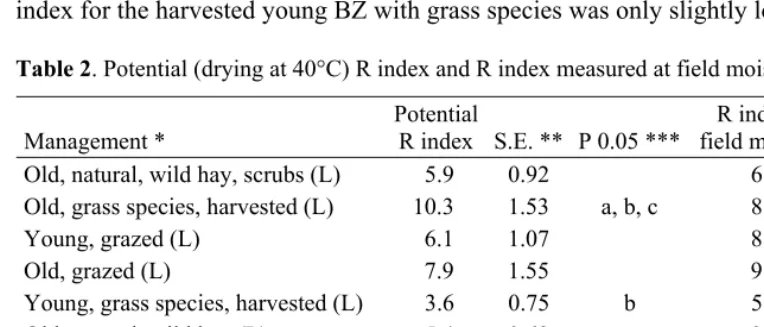
Soil WR proved to be a common phenomenon in BZs. This is in agreement with findings of Dekker and Ritsema (1996a), who measured WR on alluvial heavy clay soil used as a grassland pasture in Netherlands. Old annually harvested BZ with grass species resulted in highest potential R index (Fiq. 1 and Table 2), water infiltration was delayed by 10-fold. This site was apparently covered with mosses, which is supposed to be reason for high WR. Mosses were not present at the young annually harvested BZ with grass species, which had statistically lower R index (3.6). Statistically lower R index (5.4) was measured also in old natural BZ with wild hay although accumulation of organic matter was expected (data for content of organic matter not yet available). This old natural BZ with wild hay had only slightly lower R index than the old natural BZ with scrubs (5.9). The quality of organic matter and waxes excreted by plants differ in their water repellent properties, but this divergence was proved to be minor.
1 2 3 4 5 6 7 8 9 10 11 0 0,1 0,2 0,3 0,4 0,5 0,6
Volumetric water content
R index Natural, scrubs Harvested Grazed Natural 1 2 3 4 5 6 7 8 9 10 11 0 0,1 0,2 0,3 0,4 0,5 0,6
Volumetric water content
R i nd ex Grazed Harvested cultivated 1,0 1,5 2,0 2,5 3,0 3,5 4,0 4,5 0 0,1 0,2 0,3 0,4 0,5 0,6
Volumetric water content
[image:5.595.75.420.269.632.2]R i nd ex Old, natural Young, harvested cultivated
Buffer zone water repellency: effects of the management practice 143
In Figure 1 the topmost chart represent data for 3 years old young BZs and cultivated field in Lintupaju, the middle chart represent data for 14 years old BZs in Lintupaju and the lowest chart for BZs and cultivated field in Maaninka. Symbols connected by line represent drying treatments (as mentioned in the text). Black symbols stand for R index at field moisture at the time of sampling. Gray symbols stand for potential WR after drying at 40°C.
The young (R = 6.1) and old (R = 7.9) grazed BZs exhibited higher WR than either the old natural or the young harvested BZs. Pietola et al. (2005) found also that in the heavy Finnish clay soil pasture, intense cattle trampling increased water repellency compared to pasture with no visible trampling.
[image:6.595.63.445.252.415.2]WR was less severe in Maaninka and no statistical differences were found between the experimental sites. However, the old BZ showed the highest R index (3.8) and the index for the harvested young BZ with grass species was only slightly lower (R = 2.5).
Table 2. Potential (drying at 40°C) R index and R index measured at field moisture.
Management * Potential R index S.E. ** P 0.05 *** field moistureR index at S.E.
Old, natural, wild hay, scrubs (L) 5.9 0.92 6.8 0.92
Old, grass species, harvested (L) 10.3 1.53 a, b, c 8.2 0.90
Young, grazed (L) 6.1 1.07 8.2 1.58
Old, grazed (L) 7.9 1.55 9.9 0.97
Young, grass species, harvested (L) 3.6 0.75 b 5.0 0.64
Old, natural, wild hay (L) 5.4 0.69 a 3.3 0.50
Cultivated field (L) 3.1 0.31 c 3.1 0.32
Old, grass species (M) 3.8 0.53 4.3 0.54
Young, grass species, harvested (M) 2.5 0.33 2.7 0.21
Cultivated field (M) 2.0 0.17 3.7 0.45
* (L) stand for Lintupaju and (M) stand for Maaninka ** S.E. stand for standard errors of the mean
** *values with the same letter differ significantly according to Tukeys´s test
K. Rasa, M. Räty, O. Nikolenko, R. Horn, M. Yli-Halla, J. Uusi-Kämppä, L. Pietola
144
4. Conclusions
In the Lintupaju soil, volumetric soil water content at the moment of sampling was lower at grazed and harvested BZ than in the old natural BZs, due to lack of covering vegetation. Frequently drying top soil is often recognized water repellent, which is in agreement with our results. Moreover we found that ageing (also in Maaninka) increases soil WR and combined with harvesting it may prepare the way for mosses, which we assume to further increase water repellency.
In shrinking and swelling clay soils, drying (i.e. shrinking) combined with increasing WR expose soil to preferential flow and uneven wetting pattern (Dekker and Ritsema 1996a). This may contribute to leaching of bioavailable phosphorus from BZs. Fast water movement through macro pores and cracks does not allow sorption or at least diminishes contact between soil and water (Dekker and Ritsema 1996b).
References
Dekker, L. and Ritsema, C.1996a. Preferential flow paths in a water repellent clay soil with grass cover. – Water resource Research, 32(5):1639–1249.
Dekker, L. and Ritsema, C. 1996b. Uneven moisture pattern in water repellent soils. – Geoderma, 70:87–99.
Hallett, P. and Young, I. 1999. Changes to water repellence of soil aggregates caused by substrate-induced microbial activity. – European Journal of Soil Science, 50:35–45.
Hallett, P., Baumgartl, T. and Young, I. 2001. Subcritical water repellency of aggregates from range of soil management practices. – Soil Science Society of America Journal, 65:184– 190.
Leeds-Harrison, P., Youngs, E. and Uddin, B. 1994. A device to determine the sorptivity of soil aggregates. – European Journal of Soil Science, 45:269–272.
Pietola, L., Horn, R. and Yli-Halla, M. 2005. Effects of trampling by cattle on hydraulic and mechanical properties of soil. – Soil & Tillage Research, 82:99–108.
Uusi-Kämppä, J. 2005. Phosphorus purification in buffer zones in cold climates. – Ecological Engineering, 24:491–502.