Amalgamated Generalized Low Density Parity Check and Luby Transform Codes for the Wireless
Internet
T. D. Nguyen, FC. Kuo, L. L. Yang and
1L. Hanzo
School of ECS, University of Southampton, SO17 1BJ, UK.
Tel: +44-23-8059 3125, Fax: +44-23-8059 4508
Email:
1[email protected], http://www-mobile.ecs.soton.ac.uk
Abstract – Luby Transform codes (LT) were originally designed for the Binary Erasure Channel (BEC) encoun-tered owing to randomly dropped packets in the statisti-cal multiplexing aided Internet, where transmitted pack-ets are not affected by the fading or noise of the environ-ment. For the sake of transmitting data over the BEC rou-tinely encountered in statistical multiplexing aided wire-less Internet-style scenarios, LT codes have to be combined with classic channel codes. In this paper we introduce a novel almagamated LT coding and Generalized Low Den-sity Parity Check (G-LDPC) coding scheme. Upon ex-ploiting the packet erasure information provided by the G-LDPC decoder for the LT decoder, the proposed scheme achieves a low Bit Error Ratio (BER) for Packet Error Ra-tio (PER)Eb/N0values in excess of 3.2dB when transmit-ting data over the AWGN-BEC channel having a packet erasure probability ofPe=0.1. When communicating over the Rayleigh-BEC channel atPe=0.1, anEb/N0value of 5.3 dB was required. In comparison to the serially concate-nated LT-GLDPC scheme using no information exchange between the G-LDPC decoder and the LT decoder, the amalgamated LT-GLDPC arrangement achieved anEb/N0 gain of up to 1.6-2.5 dB .
1. INTRODUCTION
Generalized Low Density Parity Check (G-LDPC) codes [1] [2] offer the beneficial design option of replacing the simple par-ity check codes of classic LDPC codes by more sophisti-cated constituent encoders, such as for example binary or non-binary Bose-Chaudhuri-Hocquenghem (BCH) codes [3]. They also benefit from innovatively combining low-complexity con-stituent encoders and decoders with intelligent iterative detec-tion in the interest of approaching the attainable capacity at a moderate complexity. In this treatise GLDPC codes are amal-gamated with Luby Transform (LT) codes [4], which were orig-inally designed for achieving an infinitesimally low packet er-ror ratio (PER) over the Binary Erasure Channel (BEC) rou-tinely encountered in statistical multiplexing aided wireless Internet-style scenarios. However, LT codes were not intended for communications over gravely error-infested hostile chan-nels encountered in the wireless Internet. Hence,the novel
con-tribution of this paper is that we amalgamated LT codes with GLDPC codes, where the latter combats the effects of chan-nel errors and informs the LT decoder, as to when it is unsafe to carry out LT decoding without catastrophic error propaga-tion across the LT-encoded packets. We will demonstrate that as a result,Eb/N0 gains of 1.6 - 2.5 dB are achievable in the Rayleigh- faded wireless Internet environment considered. In fact, owing to their potentially avalanche-like decoding error propagation across LT-encoded packets, the employment of LT codes may catastrophically degrade the overall system perfor-mance, unless they are combined with powerful Forward Er-ror Connection (FEC) codes. As a benchmarker, we used the powerful combination of an iteratively detected Bit Interleaved Coded Modulation and LT coding scheme [5]. However, the operation of the BICM-ID and LT schemes in [5] was based on simply passing the channel-decoded bits to the LT decoder, rather than on intrinsically amalgamating their operation. Any potential residual errors persisting at the output of the BICM-ID decoder were passed to the LT decoder, which may have pre-cipitated the errors by propagating them to further LT-encoded packets. Hence, in this treatise LT codes are intrinsically amal-gamated with GLDPC codes [1] [2] [6]. More explicitly, before LT decoding ensues, each GLDPC codeword is tested by the classic parity check ofX ·HT=0, to ensure that a legitimate although not necessarily error-free codeword was generated, whereXrepresents a legitimate GLDPC codeword, whileHT is the transpose of the parity check matrix. This measure pre-vents the LT decoder from propagating GLDPC decoding er-rors from one LT-encoded packet to another, unless the GLDPC decoder failed to recognize that a legitimate, but erroneously decoded codeword was encountered.
In Section 2 we describe the proposed GLDPC-LT scheme, while in Section 3 we characterise its achievable performance. Finally, in Section 4 we offer our conclusions.
2. AMALGAMATED LT AND GLDPC CODING
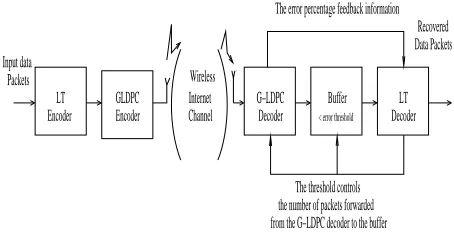
constituent encoders and decoders for creating powerful, near-capacity iterative decoding schemes having a moderate com-plexity. The liaison of the GLDPC decoder with the LT de-coder is based on counting the number of illegitimate GLDPC codewords in an LT-encoded packet and then comparingE to an appropriately chosen thresholdT. To elaborate a little fur-ther, the decoding operations commence by setting the thresh-old T to zero, indicating that only error-free GLDPC pack-ets are allowed to be passed to the LT decoder, in order to avoid LT-decoding-induced inter-packet error propagation. If we have E= 0, no erroneous GLDPC codewords were found within the current LT-encoded packet and hence this packet is ready for LT decoding. If this error free LT-packet is a degree-one packet, LT decoding may commence immediately. By con-trast, if no degree-one packet is available at the LT decoder, the commencement of the LT-decoding process is defened until the arrival of a degree-one packet. For the sake of avoiding the risk of losing all the remaining undecoded source packets, in the absence of a degree-one packet, we may decide to increase the thresholdT, in order to request further LT-encoded pack-ets, which now containsE >0number of erroneous GLDPC codewords. If this is the case, the residual error of the current LT-encoded packets are passed on to other packets in the same bit position owing to their modulo-2 relationship. To elabo-rate a little further, it is determined by the degree of the packet concerned, how many further errors are caused. Therefore er-roneous GLDPC codewords should only by considered for LT decoding, if they belong to degree-one packets, since the ab-sence of an error-free degree one packet results in losing all the remaining packets. This measure prevents the propagation of GLDPC decoding errors to other LT packets, since degree-one packets are decoded without the aid of other packets, while avoiding the risk of losing all the remaining packets owing to the absence of degree-one packets.
By contrast, in case of GLDPC decoding errors in LT pack-ets having a higher degree the erasure of the packet does not prevent decoding the rest of the packets, but would propagate the errors to as many LT-encoded packets, as the degree of the packet concerned. Hence, higher-degree packets contain-ing GLDPC decodcontain-ing errors have to be considered as erased. However, given the ability of the LT decoder to fill the erased codewords, the amalgamated scheme is expected to outperform both its components at a modest complexity. For simplicity, we refer to the system benefiting from information exchange be-tween the LT decoder and the GLDPC decoder as Scheme 1, while the one dispensing with it is termed as Scheme 2.
3. SYSTEM PARAMETERS AND PERFORMANCE
[image:2.612.328.555.75.193.2]The parameters of the system investigated are summarized in Table 1. The GLDPC encoder used the binary BCH(n,k,t)= BCH(15,11,1) constituent codes, which operated over the Ga-lois Field GF(16) and each BCH codeword was capable of cor-recting t=1 error, when using classic algebraic decoding [3].
Input data Packets
Decoder G−LDPC GLDPC
Encoder LT
Encoder
Buffer
< error threshold Decoder LT The error percentage feedback information
The threshold controls the number of packets forwarded from the G−LDPC decoder to the buffer
Data Packets Recovered
Wireless Channel Internet
Figure 1: Amalgamated GLDPC codes and LT codes
01
02
24 0i
H1
N=360 n−k=4
n=15
H
H
H
H
[image:2.612.330.554.223.396.2]H2
Figure 2: The structure of the GLDPC parity check matrix
C1 C2 C3 C4 C5 C23 C24
15bits 15bits 15bits 15bits 15bits 15bits 15bits LT packet contains
168 bits
[image:2.612.318.566.430.543.2]360 bits a GLDPC Subcodeword
Figure 3: The relation between the LT-encoded packet and the G-LDPC codewords
Erasure probability Pe= 0.1
LT code parameters δ= 0.5 c= 0.1 Number of bits per LT packet 168 Number of source packets 10000 Number of encoded LT packets 13000 GLDPC component codes BCH(15,11,1) Component code rate of GLDPC r=11 15
Code rate of GLDPC 157
Modulation BPSK
[image:2.612.347.538.587.689.2]The number of input data bits per LT-encoded packet was 168 and each of these packets was mapped to 24 GLDPC code-words, as seen in Fig. 3. We can calculate the number of GLDPC subcodewords in an LT-encoded packet as follows. We denote the code rate of the component BCH codes byr, while
R is the overall code rate of the GLDPC code. Observe in Fig. 2 that the parity matrix of the GLDPC encoder has two superblocks, namely H1 andH2, whereH2 represents a per-muted version ofH1 as detailed in [1] [2] [6]. More specif-ically, H1 contains L= 24 parity matrices corresponding to the BCH(15,11,1) codes given that we use J= 2 GLDPC su-perblocks and that the number of parity bits is(n−k)= 4, the resultant GLDPC code has a totall of4·5=8 parity bits hence the resultant GLDPC code becomes R= 157. More generally, the overall code rateR is given by R= 1-J·(1-nk) [2], where again,J= 2 is the number of the so-called GLDPC superblocks and r=nk=1115, therefore we arrive at R=157. Hence, as seen in Fig. 3, the number of GLDPC subcodewords used by the GLDPC scheme encoding a single LT source packet equals to
168
7 =24. The LT encoder used the Robust Soliton Distribution (RSD) designed in [5] and imposed a 30% packet overhead, while using the LT encoder parameters ofδ=0.5 andc = 0.1
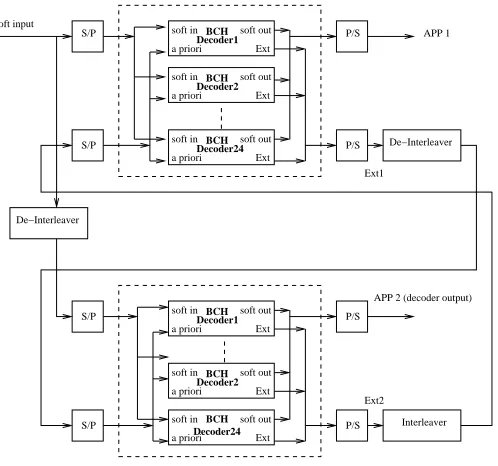
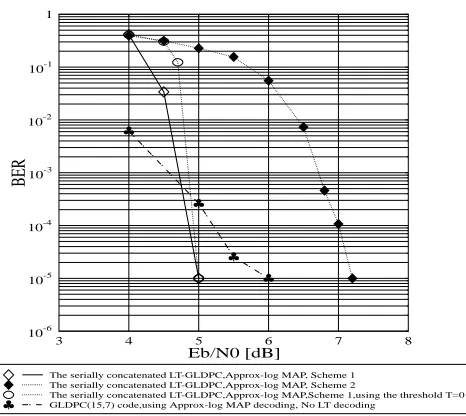
detailed in [5]. The number of GLDPC decoding iterations was set toI=10 in the schematic of Fig. 4. The BER perfor-mance of the system using the parameters of Table 1 is shown in Figures 5 and 6, when communicating over both AWGN and Rayleigh channels, initially inflicting no erasures, ie. when we havePe=0. By contrast, in Fig. 7 and Fig. 8 we used a some-what unconventional channel model, which may be encoun-tered in AWGN-contaminated and Rayleigh-faded radio links also subjected to a statistical multiplexing-induced LT-packet erasure probability of Pe=0.1. Naturally, the packet erasure events may have been imposed by other phenomena, such as shadow-fading-infested GLDPC packets.
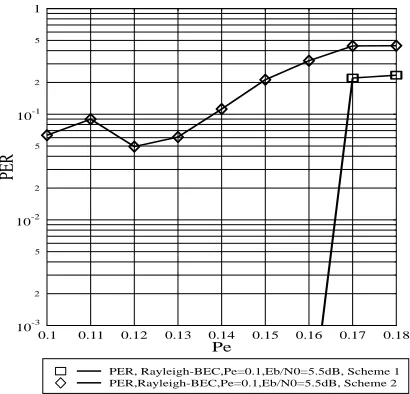
Observe in Fig. 7 that the amalgamated LT-GLDPC Scheme 1 exhibits an approximately 1.6 dBEb/N0 gain over Scheme 2, when using the Approximate-log MAP decoder [3]. Similar performance trends were observed in Fig. 8 for trans-mission over uncorrelated Rayleigh channels, exhibiting an ap-proximately 1.5dB gain for Scheme 1 employing the proposed threshold-based information exchange between the GLDPC and LT decoders. Fig. 9 and 10 characterise the Packet Er-ror Ratio (PER) performance of the amalgamated LT-GLDPC Scheme 1 as well as that of Scheme 2, when the data is trans-mitted over the AWGN-BEC channel atEb/N0= 4dB employ-ing both decodemploy-ing methods, namely that benefittemploy-ing from pass-ing moderately contaminated degree-one packets to the LT de-coder from the GLDPC dede-coder and that erasing them. We ob-serve from Fig. 9 and Fig. 10 that the performance of Scheme 1 is better than that of Scheme 2. As seen in Fig. 9 and Fig. 10, Scheme 1 is capable of achieving error free atPe= 0.16, while the latter has a PER of about10−1even atP
e= 0.10.
BCH
soft out soft in soft out
Ext a priori BCH soft in Decoder2 soft out Ext a priori BCH
soft in soft out
Ext a priori
BCH
soft in soft out
Ext a priori
BCH
soft in
Decoder2soft out
Ext a priori Decoder1 Decoder24 Decoder1 BCH soft in
a prioriDecoder24 Ext
Interleaver Ext1
Ext2 APP 1
[image:3.612.320.569.71.304.2]APP 2 (decoder output) soft input De−Interleaver De−Interleaver P/S S/P S/P P/S P/S S/P S/P P/S
Figure 4: The GLDPC Decoder
4. SUMMARY AND CONCLUSION
In this contribution an amalgamated LT-GLDPC coding scheme was proposed, where the constituent decoders ex-changed information. In an effort to avoid curtailing the LT de-coding operation in the absence of degree-one packets, Scheme 1 allowed the GLDPC decoder to pass a maximum of T ille-gitimate GLDPC codewords to the LT decoder. By contrast, Scheme 2 allowed the GLDPC decoder to pass all GLDPC codewords to the LT decoder, which causes the error propa-gation during the LT decoding operation. As a result,Eb/N0 gains of 1.6 and 2.5 dB were achieved over the BEC-AWGN and BEC-Rayleigh channels considered.
5. REFERENCES
[1] M. Lentmaier, K.S. Zigangirov., “On Generalized Low-Density Parity-Check Codes Based on Hamming Component Codes,”IEEE Communi-cations Letters, pp. 248–250., Aug 1999.
[2] FC. Kuo, L. Hanzo., “Symbol-Flipping Based Decoding of Generalized Low-Density Parity-Check Codes over GF(q),”Proceedings and CDROM of IEEE WCNC 2006, 3-6 April,2006, Las Vegas, vol. 138, pp. 1207–1211, May 2006.
[3] L. Hanzo,T.H. Liew and B.L.Yeap,Turbo Coding, Turbo Equalisation and Space-Time Coding for Transmission over Fading Channels. wiley&
IEEE Press, 2002.
[4] M. Luby, “LT codes,” inProceeding of the 43rd Annual IEEE Symposium on Foundations of Computer Science, pp. 271–282, November 2002.
[5] R. Tee, T.D. Nguyen, L-L. Yang and L. Hanzo., “Serially Concatenated Luby Transform Coding and Bit-Interleaved Coded Modulation Using It-erative Decoding for the Wireless Internet,”Proceedings of VTC 2006 Spring, Melbourne,CD ROM,, vol. 138, pp. 177–182, May 2006.
2 3 4 5 6 Eb/N0 [dB]
10-6 10-5 10-4 10-3 10-2 10-1 1
BER
[image:4.612.331.552.105.294.2]The serially concatenated LT-GLDPC,Approx-log MAP, Scheme 1 The serially concatenated LT-GLDPC,Approx-log MAP, Scheme 2 GLDPC(15,7) code,using Approx-log MAP decoding, No LT decoding
Figure 5: The performance of the serially concatenated LT and G-LDPC code, using BPSK modulation for transmission over the AWGN channel,Pe=0
3 4 5 6 7 8
Eb/N0 [dB] 10-6
10-5 10-4 10-3 10-2 10-1 1
BER
The serially concatenated LT-GLDPC,Approx-log MAP, Scheme 1 The serially concatenated LT-GLDPC,Approx-log MAP, Scheme 2
The serially concatenated LT-GLDPC,Approx-log MAP,Scheme 1,using the threshold T=0 GLDPC(15,7) code,using Approx-log MAP decoding, No LT decoding
Figure 6: The performance of the serially concatenated LT and G-LDPC code, using BPSK modulation for transmission over the Rayleigh channel,Pe=0
2 3 4 5 6
Eb/N0 [dB] 10-6
10-5 10-4 10-3 10-2 10-1 1
BER
[image:4.612.69.295.106.292.2]The serially concatenated LT-GLDPC,Approx-log MAP, Scheme 1 The serially concatenated LT-GLDPC,Approx-log MAP, Scheme 2
Figure 7: The performance of the serially concatenated LT and G-LDPC code, using BPSK modulation for transmission over the BEC-AWGN channel,Pe=0.1
4 5 6 7 8
Eb/N0 [dB] 10-6
10-5 10-4 10-3 10-2 10-1 1
BER
The serially concatenated LT-GLDPC,Approx-log MAP, Scheme 1 The serially concatenated LT-GLDPC,Approx-log MAP, Scheme 2
[image:4.612.65.298.432.640.2] [image:4.612.332.545.434.617.2]0.1 0.11 0.12 0.13 0.14 0.15 0.16 0.17 0.18 Pe
10-3
2 5
10-2 2 5
10-1
2 5
1
PER
[image:5.612.70.276.107.300.2]PER, AWGN-BEC, Pe=0.1, Eb/N0=4dB, Scheme 1 PER, AWGN-BEC, Pe=0.1, Eb/N0=4dB, Scheme 2
Figure 9: PER performance of the amalgamated LT-GLDPC Scheme 1 and Scheme 2 versus Pe in AWGN-BEC channel,
Eb/N0=4dB
0.1 0.11 0.12 0.13 0.14 0.15 0.16 0.17 0.18
Pe 10-3
2 5
10-2
2 5
10-1
2 5
1
PER
PER, Rayleigh-BEC,Pe=0.1,Eb/N0=5.5dB, Scheme 1 PER,Rayleigh-BEC,Pe=0.1,Eb/N0=5.5dB, Scheme 2
Figure 10: PER performance of the amalgamated LT-GLDPC Scheme 1 and Scheme 2 versusPein Rayleigh-BEC channel,
[image:5.612.71.276.437.634.2]