Towards a Theory of Security Evaluation for
GOST-like Ciphers against Differential and Linear
Cryptanalysis
A. N. Alekseychuk∗, L. V. Kovalchuk∗∗
Institute of Special Communication and Information Security, National Technical University of Ukraine (KPI)
∗
[email protected] ∗∗lv kov [email protected]
Abstract
In this paper, we present new general techniques for practical security evalu-ation against differential and linear cryptanalysis for an extensive class of block ciphers similar to the cipher GOST. We obtain upper bounds of the average differential and linear characteristic probabilities for an arbitrary GOST-like ci-pher. The obtained bounds have similar form to the upper bounds of the average differential and linear characteristic probabilities known for some Markov Feistel ciphers. But, the expressions of our bounds contain new parameters (different from the classical differential and linear probabilities) of the cipher’s s-boxes. These parameters are very natural for GOST-like ciphers, since they inherit the type of operation (key addition modulo 2m) used in these ciphers. The methods our proofs are based on are of independent interest and can be used for investi-gation both of a wider class of block ciphers and of a wider class of attacks.
Application of our results to GOST shows that maximum values of the av-erage differential and linear characteristic probabilities of this cipher (with 32 rounds and some s-boxes) are bounded by 2−59.57 and 2−42, respectively. The
last two estimates of practical security of GOST against the differential and lin-ear cryptanalysis are not quite impressive. But, as far as we know, they are the best of such estimates obtained by an accurate mathematical proof.
1
Introduction
Differential and linear cryptanalysis are considered the most powerful cryptographic attacks known to date. In their basic form, they were applied to DES in early 90-s of the last century [1], [2] and were improved and extended in several ways during recent 20 years.
An important step in the development of differential and linear cryptanalysis was
the concept of Markov block cipher [3]. Informally, a block cipher is called Markov 1
one if average difference propagation probability over each round is independent of the round’s text input. There are numerous examples of Markov ciphers including DES, Rijndael, Camellia, and many others. For such ciphers, a quite developed theory of security evaluation and security proofs against differential and linear cryptanalysis is
1Hereafter the word-combination ”Markov block cipher” will denote a Markov cipher with respect
created, and general techniques for design of Markov (Feistel and SPN) block ciphers secure against such attacks are well known. The literature devoted to this topic includes dozens of published works. Let us mention here the papers [4] – [7], where one can find more detailed bibliography.
In spite of the progress in mathematical foundations of differential and linear crypt-analysis, there is no general theory of analysis and security proofs against the above-mentioned attacks for non-Markov ciphers such that the block cipher GOST [8]. A reason of that are some analytical difficulties accompanying security evaluation for such ciphers and the lack of adequate mathematical methods accounting their specific structure. In this paper, we present new general techniques for practical security evalu-ation against differential and linear cryptanalysis for GOST-like ciphers, and apply our results to the cipher GOST with independent and equiprobable random round keys.
1.1
Previous work on differential and linear cryptanalysis of
GOST
As is known, the most significant difference between GOST and others (ordinary
Markov) block ciphers consists in using of round key addition modulo 232. It leads
to analytical difficulties in security evaluation for this cipher against differential and linear cryptanalysis because the known traditional methods cannot be used for GOST, see [9] – [12]. In all works known to us that are devoted to differential and linear cryptanalysis of GOST its practical security against mentioned attacks is investigated. The round keys are usually assumed to be fully random and independent. The main purpose of the majority of this works (which are written generally in Russian or in Ukrainian) is to find high-probability differential and linear characteristics of GOST, using some assumptions about the key addition operation. For example, in [12] it is as-sumed in the calculation of differential characteristics probabilities that, with addition of input messages and keys in all rounds, the carry bits in 4th,8th, . . . ,28th digits of the
sum vanish (in other words, the carry bits between differents-boxes are ignored). It is
clear that such mathematical assumptions simplifying a block cipher cannot be taken a priori in security proofs against differential and linear cryptanalysis.
Especially we want to point out the work [13], which results are discussed in recent papers [14], [15]. In [13], the authors write that GOST is secure against differential cryptanalysis after 7 rounds and against linear cryptanalysis after 5 rounds. But, their ”proof” relies on numerous implicit assumptions similar to those mentioned above. Moreover, the work [13] contains some mathematical mistakes, so its results cannot be admitted as reliable. For example, it is claimed that ”the effectiveness of the linear
approximation of the addition mod 232 operation is equal to 2−i−1 and the best
ap-proximation of thei-th bit of result is the sum mod 2 of thei-th bit of the values” (see [13], P. 6). But, it is well-known that the effectiveness of such linear approximation does not depend oni and is equal to 3/4 (see [16]). It is a pity that all this facts were left unnoticed in [14], [15].
adduced in our paper [17]. In [18], [19] these results were extended. The present work contains systematic description of results from [17] – [19] in revised and improved form.
1.2
Contribution of this paper
Our main results are formulated in two theorems, which state upper bounds of the average differential and linear characteristic probabilities for an arbitrary GOST-like cipher. The obtained bounds have similar form to upper bounds of average differential and linear characteristic probabilities known for Markov Feistel ciphers with SPN round functions [7], [20]. But, the expressions of our bounds contain new parameters (different from the classical differential and linear probabilities) of the cipher’ss-boxes. Note that these parameters are very natural for GOST-like ciphers, since they inherit the type of
operation (key addition modulo 2m) used in these ciphers. Also note that the methods
our proofs are based upon are of independent interest and can be used for investigation both of a wider class of block ciphers (for example, containing ”mixed” key operations) and of a wider class of attacks (for example, bilinear cryptanalysis), see [21], [22].
Application of our results to GOST shows that maximum values of the average differential and linear characteristic probabilities of this cipher (with 32 rounds and some s-boxes) are bounded by 2−59.57 and 2−42, respectively. Note that these two
estimates of practical security of GOST against differential and linear cryptanalysis are not quite impressive. But, as far as we know, they are the best of such estimates obtained by an accurate mathematical proof.
The structure of the paper is as follows. Basic notation and definitions are in-troduced in Section 2. Our main results are presented in Section 3 and their proofs are given in Section 4. Finally, in Section 5 some applications, numerical examples, discussion of the obtained results, and also of the further research are described.
2
Preliminaries
2.1
Basic notation
Let l be an arbitrary natural number. We denote by Vl the set of all l-dimensional
Boolean vectors and bySVlthe symmetric group on the setV
l. For anyα= (α1, . . . , αl),
β = (β1, . . . , βl)∈Vl let us defineαβ =α1β1⊕ · · · ⊕αlβl,α⊕β = (α1⊕β1, . . . , αl⊕βl),
where ⊕ is the XOR operation. For any a, b ∈ Z, a ≤ b, denote by a, b the set
{a, a+ 1, . . . , b}.
In the sequel, we identify an arbitrary vector (x1, . . . , xl) ∈ Vl with the number
x = 2l−1 x
1 +· · ·+ 20xl and denote by x l
+ y the sum modulo 2l of the numbers
corresponding to the vectorsx, y ∈Vl. We also use the notationx+y instead ofx l
+y
if it does not cause the confusion and the valuel is defined from the context (i.e., from the condition x, y ∈Vl).
For any x, y ∈ Vl let’s denote by ν(x, y) the carry bit into the most significant
For any g ∈SVl,α, β ∈V
l let us define
gk(x) =g(x l
+k), x, k∈Vl,
Cg(α, β) = 2−l
X
x∈Vl
(−1)αg(x)⊕βx, (1)
l(g)(α, β) = 2−lX
k∈Vl
(Cgk(β, α))
2
, (2)
Λ(g)(α, β) = 2−lX
k∈Vl
2−l X
a∈{0,1}
X
x∈Vl:ν(x,k)=a
(−1)βg(x
l
+k)⊕αx
2
, (3)
Dx(g)(α, β) = 2−lX
k∈Vl
δ(gk(x⊕α)⊕gk(x), β), x∈Vl, (4)
d(g)(α, β) = 2−lX
k∈Vl
δ
g(k +l α)⊕g(k), β
, (5)
d(ag)(α, β) = 2−l X
k∈Vl:ν(α,k)=a
δ
g(k +l α)⊕g(k), β
, a∈ {0,1}, (6)
where δ(·,·) is the Kronecker delta: δ(u, v) = 1 if u=v, otherwise δ(u, v) = 0. It follows directly from (1)–(6) that
l(g)(α,0) = d(g)(α,0) =l(g)(0, α) = d(g)(0, α) =δ(α,0), (7)
Λ(g)(0,0) = 1, (8)
0≤l(g)(α, β)≤Λ(g)(α, β)≤1, (9)
0≤d(0g)(α, β) +d(1g)(α, β) = d(g)(α, β) =D(0g)(α, β)≤1, (10)
for any g ∈SVl, α, β ∈V
l.
In what follows we will omit the symbol of transposition in formulas like AzT,
supposing (as usual) that a vector z is a column if it is written on the left of a matrix A.
2.2
GOST-like ciphers
Let us consider an r-round Feistel cipher T with the encryption function
F :Vn× Kr → Vn, whereVn is the set of plaintexts (ciphertexts) andK =Vm is the
set of round keys of the cipher T, n = 2m, m ≥ 2. By definition, the transformation
of a plaintext x∈Vn into the ciphertext y ∈Vn with a key λ = (k(1), . . . , k(r)) ∈Kr
is defined as follows:
where the transformationf(k) (k ∈Vm) in each round from 1 to r takes the form
f(k)(x) =f(k)(x1, x2) = (x2, x1⊕φ(x2
m
+k)), (12)
x = (x1, x2) is the input of this round, x1, x2 ∈Vm, and φ ∈ SVm. Next, assume that
m=pt, p, t∈N, and
φ(z) = A s(z) = A(s(p−1)(z(p−1)), . . . , s(0)(z(0))), z = (z(p−1), . . . , z(0))∈Vm, (13)
where z(j) ∈Vt, s(j) ∈SVt, j ∈ 0, p−1, and A is an invertible m×m-matrix over the
field GF(2).
We say that T is a GOST-like cipher with the round function φ, the s-function s,
and s-boxes s(j), j ∈0, p−1, if the conditions (11) – (13) hold.
A well-known example in the GOST-like ciphers’s family is the block cipher GOST (with independent and equiprobable random round keys). Recall [8] that GOST is a
32-round Feistel cipher with the block size n = 64, whose round transformations and
the round function are defined by formulas (12) and (13), respectively. In our notation, m= 32, t= 4,p= 8, and the matrixA in (13) corresponds to the left cyclic shift to 11
positions on the setV32. It is known that thes-boxes of GOST are its key parameters
and, in principle, may be arbitrary substitutions from the symmetric group SV4.
2.3
Practical security of block ciphers against differential and
linear cryptanalysis
Two general approaches to security evaluation of any block cipher against differential and linear cryptanalysis are known. The difference between these approaches lies in using of different security measures. In the first case, to get the provable security of a block cipher against differential and linear cryptanalysis, the values of the maximum average differential probability and the maximum average linear hull probability of
the cipher are used. In the second case, to get the practical (or heuristical) security
of a block cipher, the values of the maximum differential and linear characteristic probabilities are used. We not discuss here the relation between these approaches (see [5], [7], [23] – [26] for complete details).
LetTbe a block cipher with the encryption function (11). A (differentialorlinear)
characteristic of the cipher T is an arbitrary sequence Ω = (ω0, ω1, . . . , ωr) of
non-zero Boolean vectors ω0, ω1, . . . , ωr ∈ Vn. For any fixed key λ = (k(1), . . . , k(r)) the differential probability of the characteristic Ω is defined as follows:
DP(λ)(Ω) =P
r
\
i=1
{Xi⊕Xi0 =ωi}|X⊕X0 =ω0
!
, (14)
where X and X0 are independent and equiprobable random Boolean vectors,
Xi = (f(k(i))◦ · · · ◦f(k(1)))(X), Xi0 = (f(k(i))◦ · · · ◦f(k(1)))(X
0), i ∈1, r. The expected
value
EDP(Ω) =|K|−r X
λ∈Kr
is called theaverage differential characteristic probability(of the characteristic Ω). The
average linear characteristic probability of Ω is a formal product
ELP(Ω) =
r
Y
i=1
2−m X
k∈Vm
Cf(k)(ωi, ωi−1) 2
!
, (16)
where Cf(k)(ωi, ωi−1),i∈1, r are defined by (1).
Let
MD(T) = max
(Ω) {EDP(Ω)}, (17)
ML(T) = max
(Ω) {ELP(Ω)}. (18)
According to generally accepted setting (see, for example, [7], [23]), a block cipher Tis practically secure against differential and linear cryptanalysis if the upper bounds of the values (17) and (18) are less than the security threshold. Thus, to evaluate the practical security of GOST-like ciphers against differential and linear cryptanalysis it is necessary to develop a general and acceptable method for determining the upper bounds of the values (17), (18), by analogy with well-known methods for Markov ciphers.
3
Main results
Let T be a GOST-like cipher with the round function (13). We use the following
definitions:
∆(T) = maxnd(s(j))(α, β) :α, β ∈Vt\ {0}, j ∈0, p−1
o
, (19)
∆0(T) = maxnd(as(j))(α, β) :α, β ∈Vt\ {0}, j ∈0, p−1, a∈ {0,1}
o
, (20)
Λ(T) = maxnl(s(j))(α, β) :α, β ∈Vt\ {0}, j ∈0, p−1
o
, (21)
ΛT = max
n
Λ(s(j))(α, β) : (α, β)∈Vt×Vt\ {(0,0)}, j ∈0, p−1
o
, (22)
where the numbersl(s(j))(α, β), Λ(s(j))(α, β),d(s(j))(α, β),and da(s(j))(α, β) are defined by
(2), (3), (5), and (6), respectively. Let z(j) ∈ V
t, j ∈ 0, p−1, then the weight of a vector z = (z(p−1), . . . , z(0)) ∈ Vm
is the number wt(z) = |{j ∈ 0, p−1 : z(j) 6= 0}|. We denote by W the following
subgroup of the Abelian group (Vm,⊕):
W ={(z(p−1), . . . , z(0))∈Vm :z(p−2) =· · ·=z(0) = 0}. (23)
The branch number of an m×m-matrix A over the field GF(2) is defined as follows [27]:
BA = min{wt(x) +wt(xA) :x∈Vm\ {0}}. (24)
Theorem 1. Let T be a GOST-like cipher with the round function (13). Then
MD(T)≤∆(T)[
2r
3]. (25)
Moreover, if
{Az :z ∈W} ∩W ={0} (26)
then
MD(T)≤max
n
∆(T)r−1, ∆(T)r+1−2dr3e∆0(T)d r 3e
o
. (27)
Theorem 2. Let T be a GOST-like cipher with the round function (13). Then
ML(T)≤Λ(T)[
2r
3]. (28)
Moreover,
ML(T)≤(ΛT)r if BA= 3 (29)
and
ML(T)≤(ΛT)[ r
4]BA if B
A≥4. (30)
Let us remark that the inequalities (25), (27), and (28) – (30) allows to evaluate the practical security of a GOST-like cipher against differential and linear cryptanalysis
directly on the information about the cipher’s s-function and the number of rounds r.
Note also that the inequalities (25), (28) – (30) are similar to the bounds of the average differential and linear characteristic probabilities known for Markov Feistel ciphers with SPN round functions [7], [20], and can be considered as an extension of these bounds to the class of GOST-like ciphers.
4
Proofs
4.1
Upper bounds for the
s
-function of a GOST-like cipher
In this subsection upper bounds of the parameters like (2) and (5) for the s-function
of an arbitrary GOST-like cipher are presented. These results play the key role in the follow-up statements and are of independent interest. The proofs of these results demonstrate the essence of our methods for obtaining the upper bounds of the values (17) and (18).
The following lemma was first proved in [17].
Lemma 1. Let t, m∈N, t < m, ψ(1) ∈SVt, ψ(2) ∈SVm−t, and
ψ(x2, x1) = (ψ(2)(x2), ψ(1)(x1)), x1 ∈Vt, x2 ∈Vm−t. (31)
Then, for any α = (α2, α1), β = (β2, β1) such that α1, β1 ∈ Vt, α2, β2 ∈ Vm−t the following inequality holds:
l(ψ)(α, β)≤Λ(ψ(1))(α1, β1)l(ψ
(2))
Proof. Let us make some preliminary remarks. For any vectorz ∈Vm denote byz1 and
z2 the sub-vectors ofz including its leasttsignificant bits and its mostm−tsignificant
bits, respectively. The vector z will take the form z = (z2, z1).
Let x = (x2, x1), k = (k2, k1), where x1, k1 ∈ Vt, x2, k2 ∈ Vm−t. Let’s consider the
numbers x=x1 + 2tx2 and k =k1+ 2tk2 corresponding to above-mentioned Boolean
vectors. Observe that x1, k1 ∈0,2t−1,x2, k2 ∈0,2m−t−1, and
x+m k=
x1
t
+k1
+ 2t
x2
m−t
+ k2
m−t
+ ν(x1, k1)
, (33)
where ν(x1, k1) is the carry bit to the t-th digit in the sum of the numbers x1 and k1
in the ring Z (see Subsection 2.1).
Let us define χ(a) = (−1)a for a ∈ {0,1}, fix any k = (k
2, k1), where k1 ∈ Vt,
k2 ∈Vm−t, and obtain an upper bound of the quantity
|Cψk(β, α)|= 2 −m X
x∈Vm
χ(βψ(x+k)⊕αx)
.
We have from (33)
|Cψk(β, α)|=
= 2−m
X
x1∈Vt, x2∈Vm−t
χ β1ψ(1)(x1+k1)⊕α1x1⊕β2ψ(2)(x2+k2+ν(x1, k1))⊕α2x2
=
= 2−m
X
a∈{0,1} X
x1∈Vt: ν(x1,k1)=a
χ β1ψ(1)(x1+k1)⊕α1x1
×
× X
x2∈Vm−t
χ β2ψ(2)(x2+k2+a)⊕α2x2
. (34)
For any a∈ {0,1}, k1 ∈Vt, k2 ∈Vm−t let’s define
uk1(a) = 2
−t X
x1∈Vt: ν(x1,k1)=a
χ β1ψ(1)(x1+k1)⊕α1x1
,
vk2(a) = 2
−(m−t) X
x2∈Vm−t
χ β2ψ(2)(x2+k2+a)⊕α2x2
,
uk1 =|uk1(0)|+|uk1(1)|.
Then from (34) we get
|Cψk(β, α)|=
X
a∈{0,1}
uk1(a)vk2(a) ≤ X
a∈{0,1}
Next, taking into account the convexity of the function x7→ x2, x≥ 0, we obtain the
following inequalities:
|Cψk(β, α)|
2 ≤(u
k1)
2
|
uk1(0)|
uk1
|vk2(0)|+
|uk1(1)|
uk1
|vk2(1)| 2
≤
≤(uk1)
2
|
uk1(0)|
uk1
|vk2(0)|
2+ |uk1(1)|
uk1
|vk2(1)|
2
=
=uk1 |uk1(0)| |vk2(0)|
2+|u
k1(1)| |vk2(1)|
2
. (35)
Hence, from (2) and (35) we have
l(ψ)(α, β) = 2−m X
k∈Vm
(Cψk(β, α))
2
≤2−m X
k1∈Vt, k2∈Vm−t
uk1 X
a∈{0,1}
|uk1(a)| |vk2(a)|
2 =
= 2−t X
k1∈Vt
uk1 X
a∈{0,1}
|uk1(a)|
2
−(m−t) X
k2∈Vm−t
|vk2(a)|
2
. (36)
Now observe that, for any a∈ {0,1},
2−(m−t) X
k2∈Vm−t
|vk2(a)|
2
=
= 2−(m−t) X
k2∈Vm−t
2
−(m−t) X
x2∈Vm−t
χ β2ψ(2)(x2+k2+a)⊕α2x2
2
.
Substituting the variable k02 = k2 +a in the right-hand side of the last equality, we
obtain
2−(m−t) X
k2∈Vm−t
|vk2(a)|
2 =
= 2−(m−t) X
k0 2∈Vm−t
2
−(m−t) X
x2∈Vm−t
χ β2ψ(2)(x2+k20)⊕α2x2
2
=
= 2−(m−t) X
k2∈Vm−t
Cψ(2) k
(β2, α2)
2
=l(ψ(2))(α2, β2).
So, from the previous equality, (36), and (3) we have
l(ψ)(α, β)≤2−t X
k1∈Vt
uk1
X
a∈{0,1}
|uk1(a)|
l(ψ (2))
(α2, β2) =
= Λ(ψ(1))(α1, β1)l(ψ
(2))
(α2, β2).
The following lemma gives two upper bounds of parameter (2) for thes-function of a GOST-like cipher.
Lemma 2. Let α= (α(p−1), . . . , α(0)), β = (β(p−1), . . . , β(0)), and
s(z) = (s(p−1)(z(p−1)), . . . , s(0)(z(0))), z= (z(p−1), . . . , z(0))∈Vm, (37)
where α(j), β(j), z(j) ∈V
t, s(j) ∈SVt, j ∈0, p−1. Then
l(s)(α, β)≤
p−1
Y
j=0
Λ(sj)(α(j), β(j)). (38)
Furthermore, if α6= 0 or β 6= 0 then
l(s)(α, β)≤Λ(T), (39)
where Λ(T) is defined by (21).
Proof. The inequality (38) follows directly from Lemma 1 and (9). To prove (39) assume, without loss of generality that
l(s)(α, β)6= 0 (40)
and hence, α6= 0 andβ 6= 0 (see equalities (7)). Let’s define
i1 = max
j ∈0, p−1 :α(j) 6= 0 , i2 = max
j ∈0, p−1 :β(j) 6= 0 .
We claim that i1 =i2. Indeed, suppose that i1 < i2. Then, applying Lemma 1 to the
substitutions
ψ(x) = s(x), x= (x(p−1), . . . , x(0)),
ψ(1)(x1) = (s(i1)(x(i1)), . . . , s(0)(x(0))), x1 = (x(i1), . . . , x(0)),
and
ψ(2)(x2) = (s(p−1)(x(p−1)), . . . , s(i1+1)(x(i1+1))), x2 = (x(p−1), . . . , x(i1+1)),
where x(j) ∈V
t,j ∈0, p−1, we obtain
l(s)(α, β) =l(ψ)(α, β)≤Λ(ψ(1))(α1, β1)l(ψ
(2))
(α2, β2). (41)
Since i1 < i2, it follows that
α2 = (α(p−1), . . . , α(i1+1)) = 0, β2 = (β(p−1), . . . , β(i1+1))6= 0.
Thusl(ψ(2))(α2, β2) = 0 and by (41)l(s)(α, β) = 0, which contradicts to (40). So i1 ≥i2
and by symmetryi1 =i2, which we had to prove.
To conclude the proof denote now by ψ, ψ(1), and ψ(2) the following substitutions:
ψ(˜x) = (s(i1)(x(i1)), . . . , s(0)(x(0))), x˜= (x(i1), . . . , x(0))∈V
ψ(1)(x(i1−1), . . . , x(0)) = (s(i1−1)(x(i1−1)), . . . , s(0)(x(0))), (x(i1−1), . . . , x(0))∈V
i1t,
ψ(2)(x(i1)) = s(i1)(x(i1)), x(i1) ∈V
t.
Let ˜α = (α(i1), . . . , α(0)), ˜β = (β(i1), . . . , β(0)). It follows directly from the condition
i1 =i2, (2), and (33) that l(s)(α, β) =l(ψ)( ˜α,β). In addition, by Lemma 1 we have˜
l(ψ)( ˜α,β)˜ ≤Λ(ψ(1)) (α(i1−1), . . . , α(0)),(β(i1−1), . . . , β(0))l(ψ(2))(α(i1), β(i1))≤
≤l(ψ(2))(α(i1), β(i1)).
Thus,l(s)(α, β)≤l(ψ(2))
(α(i1), β(i1))≤Λ(T) (where the last inequality follows from the
definition of i1 and Λ(T)). This completes the proof of Lemma 2.
Note that in [21] a generalization of two above lemmas on the case of bilinear approximations of the function (13) is obtained.
At the end of this subsection, we give an upper bound of parameter (5) for the s-function of a GOST-like cipher.
Lemma 3. Under the conditions of Lemma 2, the following inequalities hold:
d(s)(α, β)≤∆(T) (42)
if β ∈W (see formula (23)), and
d(s)(α, β)≤∆0(T) (43)
otherwise.
Proof. Assume, without loss of generality, that d(s)(α, β)6= 0 and hence, α 6= 0, β 6= 0 (see equalities (7)). Let’s define i = min{j ∈ 0, p−1 : β(j) 6= 0}. For any vector
z ∈Vm denote by z1 and z2 the sub-vectors of z including its least m1 =ti significant
bits and its most m2 =m−ti significant bits, respectively. Denote by s1 and s2 the
substitutions on the sets Vm1 and Vm2, respectively such that s(z) = (s2(z2), s1(z1)),
z = (z2, z1)∈Vm.
It follows directly from equalities β1 = 0,
x+m k =
x1
m1
+ k1
+ 2m1
x2
m2
+ k2
m2
+ ν(x1, k1)
, x, k∈Vm,
and formula (5) that
d(s)(α, β) = d(s2)(α
2, β2) (44)
Assume that β ∈W, i.e.,i=p−1. Since β(p−1) 6= 0, we obtain from (44) and (21)
that
d(s)(α, β) = d(s(p−1))(α(p−1), β(p−1))≤∆(T).
Assume now thatβ 6∈W. Taking into account (44), we can suppose, without loss of generality, thati= 0 < p−1. For any vector z ∈Vm let’s define z0 = (z(p−1), . . . , z(1))
and s0(z0) = (s(p−1)(z(p−1)), . . . , s(1)(z(1))). We have
d(s)(α, β) = 2−t X
k(0)∈V t
δ s(0)(α(0)+k(0))⊕s(0)(k(0)), β(0)×
×2−(m−t) X
k0∈V
m−t
δ s0(α0+k0+ν(α(0)+k(0)))⊕s0(k0), β0
=
= 2−t X
k(0)∈Vt: ν(α(0)+k(0))=0
δ s(0)(α(0)+k(0))⊕s(0)(k(0)), β(0)
d(s0)(α0, β0)+
+2−t X
k(0)∈Vt: ν(α(0)+k(0))=1
δ s(0)(α(0)+k(0))⊕s(0)(k(0)), β(0) d(s0)(α0+ 1, β0) =
=d(0s(0))(α(0), β(0))d(s0)(α0, β0) +d(1s(0))(α(0), β(0))d(s0)(α0+ 1, β0)≤
≤maxnd(0s(0))(α(0), β(0)), d(1s(0))(α(0), β(0))o d(s0)(α0, β0) +d(s0)(α0+ 1, β0),
where the numbers d(0s(0))(·,·) and d(1s(0))(·,·) are defined by (6). Thus, from the condition β(0) 6= 0 and the oblivious inequality
d(s0)(α0, β0) +d(s0)(α0 + 1, β0)≤1
we have d(s)(α, β) ≤ ∆0(T). This completes the proof of inequality (43) and also of
Lemma 3.
4.2
Proof of Theorem 1
Let Ω = (ω0, ω1, . . . , ωr) be an arbitrary differential characteristic of the cipher T. Let
us define
M DP(Ω) =
r
Y
i=1
2−mmax
x∈Vn
( X
k∈Vm
δ f(k)(x⊕ωi−1)⊕f(k)(x), ωi
)!
, (45)
where f(k) (k ∈V
m) are defined by (12).
Let us prove some auxiliary statements.
Statement 1. We have
EDP(Ω) ≤M DP(Ω). (46)
Proof. For any x ∈ Vn, (k(1), . . . , k(r)) ∈ Kr, and i ∈ 1, r let’s define F(i) = f(k(i))◦
· · · ◦f(k(1)), x
i ∈F(i)(x). From (14), (15) we get
EDP(Ω) =|K|−r X
(k(1),...,k(r))∈Kr
2−n X
x∈Vn
r
Y
i=1
δ F(i)(x⊕ω0)⊕F(i)(x), ωi
= 2−n X
x∈Vn
|K|−(r−1) X
(k(1),...,k(r−1))∈Kr−1
r
Y
i=1
δ F(i)(x⊕ω0)⊕F(i)(x), ωi
×
×2−m X
k(r)∈K
δ f(k(r))(xr−1⊕ωr−1)⊕f(k(r))(xr−1), ωr
. (47)
Since
2−m X
k(r)∈K
δ f(k(r))(xr−1⊕ωr−1)⊕f(k(r))(xr−1), ωr
≤
≤max
y∈Vn
2−m X
k(r)∈K
δ f(k(r))(y⊕ωr−1)⊕f(k(r))(y), ωr
,
it follows from (47) that
EDP(Ω)≤max
y∈Vn
2−m X
k(r)∈K
δ f(k(r))(y⊕ωr−1)⊕f(k(r))(y), ωr
×
×2−nX
x∈Vn
|K|−(r−1) X
(k(1),...,k(r−1))∈Kr−1
r
Y
i=1
δ F(i)(x⊕ω0)⊕F(i)(x), ωi
=
= max
y∈Vn
(
2−mX
k∈K
δ f(k)(y⊕ωr−1)⊕f(k)(y), ωr
)
EDP(Ω0),
where Ω0 = (ω0, ω1, . . . , ωr−1). Thus, the inequality (46) follows from the above
expres-sions by induction.
Let us remark that the inequality (46) holds for any block cipher T with the
en-cryption function (11). Moreover, this inequality turns into equality if (11) is a Markov cipher.
The following statement is similar to the one known for Markov Feistel ciphers [7].
Statement 2. Suppose that
M DP(Ω) 6= 0. (48)
Then there exists a sequence α0, α1, . . . , αr+1 ∈ Vm such that ωi = (αi, αi+1), i ∈ 0, r,
and
M DP(Ω) = Y
i∈N(Ω)
max
x∈Vm
Dx(s)(αi, A−1(αi−1⊕αi+1)) , (49)
where s is the s-function of the cipher T, Dx(s)(·,·) is defined by (4), and
N(Ω) ={i∈1, r :αi 6= 0}. (50)
In addition, the following inequality holds:
|N(Ω)| ≥
2r 3
Proof. Letωi = (αi, βi), where αi, βi ∈Vm, i∈0, r. Let’s define αr+1 =βr. Using (4),
(12), and (13) it is easy to check that βi =αi+1 for all i∈0, r, and
X
k∈Vm
δ f(k)(x⊕ωi−1)⊕f(k)(x), ωi
=D(xs2) αi, A−1(αi−1 ⊕αi+1)
(52)
for any x = (x1, x2), where x1, x2 ∈Vm. The equality (49) follows directly from (45),
(48), (50), and (52).
To prove the inequality (51) let us define N0(Ω) = 1, r\N(Ω) and prove that for
alli∈1, r
(i∈N0(Ω))⇒(((i+ 1≤r)⇒(i+ 1∈N(Ω))) &
& ((i+ 2≤r)⇒(i+ 2 ∈N(Ω)))). (53)
Then |N0(Ω)| ≤
r
3
and hence, (51) is true.
Let us prove the implication (53). Let i ∈ 1, r and αi = 0. It follows from (48),
(49) that αi−1 ⊕αi+1 = 0. Next, since ωi = (αi, αi+1) 6= (0,0), we have αi+1 6= 0 and
hence,αi+2 =αi⊕αi+2 6= 0 (in the opposite case we have
max
x∈Vm
Dx(s) αi+1, A−1(αi⊕αi+2) = 0,
and hence, M DP(Ω) = 0). Thus, (53) and so also Statement 2, are proved.
Now, let us prove the last auxiliary statement in this subsection. Recall that the
group W is defined by (23).
Statement 3. Under the conditions of Statement 2, for any i ∈ N(Ω) the following statements hold:
1) A−1(αi−1⊕αi+1)∈W if and only if αi ∈W;
2) if A−1(α
i−1⊕αi+1)∈W then
max
x∈Vm
Dx(s) αi, A−1(αi−1⊕αi+1) ≤∆(T); (54)
3) if A−1(αi−1⊕αi+1)6∈W then
max
x∈Vm
Dx(s) αi, A−1(αi−1⊕αi+1) ≤∆0(T). (55)
Proof. Letα =αi,β =A−1(αi−1⊕αi+1). Observe that, sincei∈N(Ω), we haveα 6= 0
and hence, by (4), (48), and (49),β 6= 0.
Let us prove the statement 1). It follows from (4), (48), and (49) that there exist x, k∈Vm such that
s((x⊕α) +k)⊕s(x+k) =β (56)
Let’s consider the mapping
Observe that for anyx, y ∈Vm
τ(x) =τ(y)⇔x−y ∈W, τ(s(x)) =τ(s(y))⇔τ(x) =τ(y).
Thus, it follows from (56) that
β ∈W ⇔τ(β) = 0⇔τ(s(x⊕α) +k) = τ(s(x+k))⇔
⇔τ((x⊕α) +k−x−k) = 0⇔τ(x)⊕τ(α) =τ(x)⇔τ(α) = 0⇔α∈W,
which we had to prove.
Let’s prove the statements 2) and 3). By (4), we have
max
x∈Vm
Dx(s)(α, β) = 2−mmax
x∈Vm
( X
k∈Vm
δ(s((x⊕α) +k)⊕s(x+k), β)
)
=
= 2−mmax
x∈Vm
( X
k∈Vm
δ(s(((x⊕α)−x) +k)⊕s(k), β)
) ≤
≤2−mmax
x∈Vm
( X
k∈Vm
δ(s(x+k)⊕s(k), β)
)
.
Hence, by (5),
max
x∈Vm
Dx(s)(α, β) ≤ max
x∈Vm
d(s)(x, β) .
Now, to conclude the proof of 2) and 3) we have to use Lemma 3.
We continue the proof of Theorem 1. Observe that from (5), (6), (19), and (20) we get
∆0(T)≤∆(T). (57)
Thus, the inequality (25) follows directly from (46), (51), and (54).
To conclude the proof it is sufficient to show that, under the condition (26), for any differential characteristic Ω such that M DP(Ω) 6= 0 the following inequality holds:
M DP(Ω) ≤maxn∆(T)r−1, ∆(T)r+1−2dr3e∆0(T)d r 3e
o
. (58)
Let us define
n1 =|{i∈N(Ω) :αi ∈W}|, n2 =|{i∈N(Ω) :αi 6∈W}|, n0 =r−n1−n2, (59)
where N(Ω) is defined by (50). It follows from (49) and Statement 3 that
M DP(Ω)≤(∆0(T))n2
(∆(T))n1
. (60)
In addition, by (51) and (59), we have
n1 ≥0, n2 ≥0, n1+n2 ≤r, n1+n2 ≥r−
lr
3
m
Let us prove the following inequality:
n1+ 2n2 ≥r−1. (62)
Observe that for anyi∈1, r−1
(αi = 0)⇒((αi+1 6∈W)∨(αi+2 6∈W)). (63)
Indeed, ifαi = 0 then, by (48) and (49), we haveαi+1 6= 0, αi+2 6= 0. Therefore, by the
statement 1) of Statement 3 the assumptionαi+1, αi+2 ∈W implies thatαi+2 ∈W\{0}
and A−1αi+2 = A−1(αi ⊕αi+2) ∈ W that contradicts to (26). Thus, the implication
(63) is true. Hence, we have n2 ≥n0−1 that is equivalent to (62).
Let’s denote by (v1, v2) the maximum point of the linear function n1ln ∆(T) +
n2ln ∆0(T) of variables n1 and n2 that satisfy the system of inequalities (61), (62).
Since the logarithmic function is monotone, (v1, v2) is also a maximum point of the
expression in the right-hand side of (60). Observe that all solutions (n1, n2) of the
inequalities (61) and (62) form a five-angle with the vertices
(r,0),(0, r),(r−1,0),0, r−lr
3
m
,r−2lr 3
m
+ 1,lr 3
m
(64)
So, (v1, v2) coincides with one of the points (64). From this using (57) and (60) it is
easy to obtain (27). This completes the proof of inequality (27) and also of Theorem 1.
4.3
Proof of Theorem 2
Let Ω = (ω0, ω1, . . . , ωr) be an arbitrary linear characteristic of the cipher T. Let us
assume, without loss of generality, that
ELP(Ω)6= 0 (65)
and prove that
ELP(Ω) ≤Λ(T)[23r], (66)
where Λ(T) is defined by (21).
We use the following statement, which can be proved in the same way as Statement 2.
Statement 4. Under the condition (65), there exists a sequence of m-dimensional Boolean vectors β0, β1, . . . , βr+1 such that ωi = (βi+1, βi), i∈0, r, and
ELP(Ω) = Y
i∈N(Ω)
l(s)(βi−1 ⊕βi+1, βiA), (67)
where s is the s-function of the cipher T and
N(Ω) ={i∈1, r:βi 6= 0}.
In addition, the following inequality holds:
|N(Ω)| ≥
2r 3
Now, applying (39) to each factor of (67) we obtain (66) from (68). This proves the inequality (28).
Let us prove (29) and (30). Let’s write the vectors β0, β1, . . . , βr+1 in the form
βi = (βi,p−1, . . . , βi,0), where βi,j ∈ Vt, i ∈ 0, r+ 1, j ∈ 0, p−1. Similarly, let’s write
the matrix A in the form A = (Ap−1, . . . , A0), where Aj is m×t-sub-matrix of the
matrix A that contains the columns of A with the numbers tj, tj+ 1, . . ., tj+t−1,
j ∈0, p−1 (it is assumed that the columns of the matrix Aare numbered from left to
right, beginning from the null). Let us define
V =(i, j)∈1, r×0, p−1 : (βi−1,j⊕βi+1,j, βiAj)6= (0,0) . (69)
It follows from (67) and (38) that
ELP(Ω)≤
r
Y
i=1
p−1
Y
j=0
Λ(s(j))(βi−1,j⊕βi+1,j, βiAj).
Hence, by (22) and (69), we have
ELP(Ω) ≤(ΛT)|V|. (70)
Moreover, by the definition of the set V,
|V| ≥
r
X
i=1
max|{j ∈0, p−1 :βi−1,j⊕βi+1,j 6= 0}|,|{j ∈0, p−1 :βiAj 6= 0}| =
=
r
X
i=1
max{wt(βi−1⊕βi+1), wt(βiA)}. (71)
Now let us obtain a lower bound of the sum (71). Let us group it’s terms in the groups of four successive terms and show that the sum of the numbers in each group is
not less than the branch number of A. Without loss of generality, let us consider the
first group:
S =
4
X
i=1
max{wt(βi−1⊕βi+1), wt(βiA)}.
It follows from the condition ωi 6= 0, i ∈ 0, r that β1⊕β3 6= 0 or β2⊕β4 6= 0. In
the first case we get
S ≥wt(β1A)⊕wt(β1 ⊕β3)⊕wt(β3A)≥wt((β1⊕β3)A)⊕wt(β1⊕β3)≥BA,
and in the second case
S ≥wt(β2A)⊕wt(β2 ⊕β4)⊕wt(β4A)≥wt((β2⊕β4)A)⊕wt(β2⊕β4)≥BA.
Thus, by (71), we have |V| ≥ r
4
BA. The inequality (30) follows directly from this
To prove the inequality (29) let’s obtain another bound for |V|. Let’s define
N0 = {i ∈ 1, r : βi = 0}. By (65), for any i ∈ N0 such that i ≤ r− 1 we have
βi+1 6= 0 and βi+2 6= 0. Thus, ifi∈N0, i≤r−1 then
i+2
X
j=i
max{wt(βj−1⊕βj+1), wt(βjA)} ≥wt(βj+2)⊕wt(βj+2A)≥BA. (72)
In addition, it follows from (68) that
|N0| ≤
lr
3
m
. (73)
Let’s define
V0 =
[
i∈N0
{i, i+ 1, i+ 2}, V1 ={1,2, . . . , r} \V0.
By the definition of the setN0, (72), and (73), we have
|V| ≥
r
X
i=1
max{wt(βi−1⊕βi+1), wt(βiA)}=
X
i∈V0
max{wt(βi−1⊕βi+1), wt(βiA)}+
+X
i∈V1
max{wt(βi−1⊕βi+1), wt(βiA)} ≥ |N0|BA+ (r−3|N0|) =r+|N0|(BA−3).
Thus, if BA= 3 we obtain that |V| ≥r. The inequality (29) follows directly from the
last bound, (70) and (13).
This completes the proof of Theorem 2.
5
Application, discussion, and further research
Let us apple the obtained results to practical security evaluation against differential and linear cryptanalysis for the cipher GOST (with independent and equiprobable random round keys). For any s∈SVt let’s define
d(s) = max
(
2−tX
k∈Vt
δ(s(k+α)⊕s(k), β) :α, β ∈Vt\ {0}
)
, (74)
d0(s) = max
2−t X
k∈Vt: ν(α,k)=a
δ(s(k+α)⊕s(k), β) :α, β ∈Vt\ {0}, a∈ {0,1}
, (75)
l(s) = max
2−tX
k∈Vt
2−tX
x∈Vt
(−1)βs(x+k)⊕αx
!2
:α, β ∈Vt\ {0}
Recall that in (74) – (76)δ(·,·) is the Kronecker delta, + denote the addition modulo 2t, and ν(α, k) is the carry bit into the t-th digit in the sum of α and k in the ring
Z
(see Subsection 2.1).
It is easy to check that the matrix A used in the round function of GOST (i.e., the
matrix corresponded to the left cyclic shift to 11 positions on the set V32) satisfies the
condition (26), and BA = 2. Hence, we obtain from (27), (28) that (forr = 32)
MD(T)≤max
(∆·∆0)11, ∆31 , ML(T)≤Λ21, (77)
where
∆ = maxnd(s(j)) :j ∈0,7o,∆0 = maxnd0(s(j)) :j ∈0,7o,
Λ = maxnl(s(j)):j ∈0,7o,
The inequalities (77) allow to estimate the maximum average differential and linear characteristic probabilities of the cipher GOST directly from the values (74) – (76) computed for s-boxess(j) (j ∈0,7) of this cipher. The computation of these values for
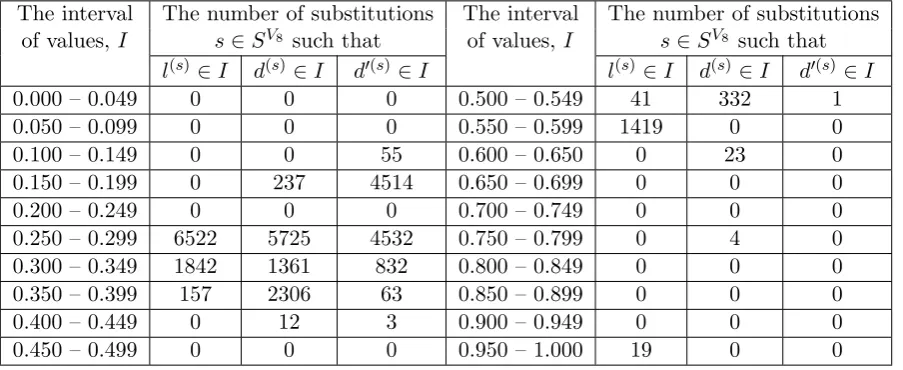
10000 random s-boxes shows that more than 6500, 5700, and 4500 of them take their
values (74), (75), and (76), respectively, in the interval [0.250, 0.299), see Table 1.
Table 1: The distributions of the parameters (74), (75), (76) for 4×4s-boxes (a sample of 10000 substitutions)
The interval The number of substitutions The interval The number of substitutions of values, I s∈SV8 such that of values, I s∈SV8 such that
l(s)∈I d(s)∈I d0(s) ∈I l(s) ∈I d(s) ∈I d0(s)∈I 0.000 – 0.049 0 0 0 0.500 – 0.549 41 332 1 0.050 – 0.099 0 0 0 0.550 – 0.599 1419 0 0 0.100 – 0.149 0 0 55 0.600 – 0.650 0 23 0 0.150 – 0.199 0 237 4514 0.650 – 0.699 0 0 0
0.200 – 0.249 0 0 0 0.700 – 0.749 0 0 0
0.250 – 0.299 6522 5725 4532 0.750 – 0.799 0 4 0 0.300 – 0.349 1842 1361 832 0.800 – 0.849 0 0 0 0.350 – 0.399 157 2306 63 0.850 – 0.899 0 0 0
0.400 – 0.449 0 12 3 0.900 – 0.949 0 0 0
0.450 – 0.499 0 0 0 0.950 – 1.000 19 0 0
Moreover, there exists a large set of s-boxes such that all three values (74), (75),
and (76) are small. For example, if
s(0) =. . .=s(7) = (1 2 7 10 3 4 11 14 6 15 5 9 8 12 13 0)
then ∆ = 0.1875, ∆0 = 0.1250, and Λ = 0.2500. In this case, by (77), we obtain the
following bounds:
Note that the last bounds didn’t allow us to make any conclusions about the provable security of GOST against differential and linear cryptanalysis. But, as far as we know, they are the best estimates of practical security of GOST obtained by an accurate mathematical proof.
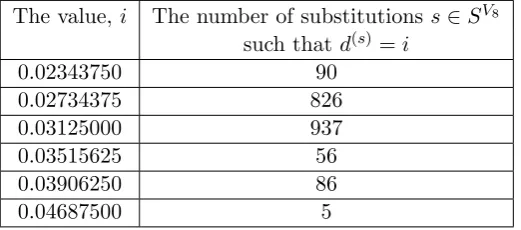
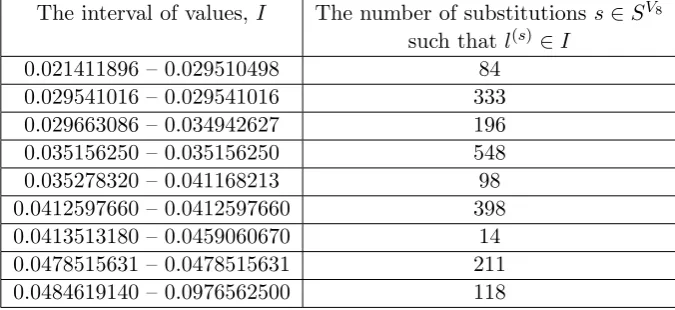
In Tables 2, 3, and 4 the distributions of the parameters (74), (75), and (76) are
given, obtained for 2000 random substitutions from the symmetric group SV8. In
this case, there exist also quite a lot of substitutions such that all three parameters (74) – (76) are rather small (for example, l(s) = 0.0295, d(s) = 0.0234, d0(s) = 0.0195).
But, during our calculations we did not find out any substitution s ∈ SV4 such that
l(s) <0.250 and also any substitution s∈SV8 such that l(s) <0.021.
Table 2: The distribution of the parameter (74) for 8×8 s-boxes (a sample of 2000
substitutions)
The value,i The number of substitutionss∈SV8 such that d(s)=i
0.02343750 90
0.02734375 826
0.03125000 937
0.03515625 56
0.03906250 86
0.04687500 5
Table 3: The distribution of the parameter (75) for 8×8 s-boxes (a sample of 2000
substitutions)
The value,i The number of substitutionss∈SV8 such thatd0(s)=i
0.01953125 6
0.02343750 965
0.02734375 868
0.03125000 148
0.03515625 11
0.03906250 1
0.04296875 1
In Tables 5, 6 the values of the upper bounds for parameters (17) and (18),
calcu-lated for a 32-round GOST-like cipher with the block size n = 64, are given. As we
see from the tables, increasing the size of s-boxes or of the branch numberBA leads to
essential decreasing of mentioned values.
Note that the bounds (25) and (28) don’t depend on the branch number of the
matrix. Moreover, as computer calculations show, the parameter ΛT in formulas (29),
Table 4: The distribution of the parameter (76) for 8×8 s-boxes (a sample of 2000 substitutions)
The interval of values, I The number of substitutionss∈SV8 such thatl(s)∈I
0.021411896 – 0.029510498 84 0.029541016 – 0.029541016 333 0.029663086 – 0.034942627 196 0.035156250 – 0.035156250 548 0.035278320 – 0.041168213 98 0.0412597660 – 0.0412597660 398 0.0413513180 – 0.0459060670 14 0.0478515631 – 0.0478515631 211 0.0484619140 – 0.0976562500 118
Table 5: The estimations of practical security of GOST-like ciphers against differential cryptanalysis
Parameters of the round function Upper bounds ofMD(T) computed
of a GOST-like cipher T(n= 64, r= 32)
t ∆(T) ∆0(T) by (25) by (27)
4 0.1875 0.1250 2−50.72 2−59.57 8 0.0234 0.0195 2−113.76 2−122.08
Table 6: The estimations of practical security of GOST-like ciphers against linear cryptanalysis
Parameters of the round function Upper bounds of ML(T) computed
of a GOST-like cipher T(n= 64, r= 32)
t Λ(T) ΛT BA by (28) by (30)
4 0.2500 0.3359 9 2−42 2−113.32 8 0.0295 0.3333 5 2−106.75 2−63.40
an important problem is to strengthen the obtained bounds. Note that, in the case
of linear cryptanalysis, an undesirable property of parameter Λ(g) (see formula (3))
causes essential difficulty. Namely, in contrast to the parameters (2) and (5), the value of Λ(g)(α, β) can be not equal to null if α= 0 andβ 6= 0 (or vice versa). This property
leads to difficulties in extension of the well-known active s-boxes counting technique
developed for Marcov ciphers on the class of GOST-ciphers [7], [20], [23], [24]. Next a problem that seems even more difficult is to find non-trivial estimates of provable security for GOST-like ciphers against differential and linear cryptanalysis, by analogy with the methods developed for Marcov ciphers [25], [26].
on a wider class of group operations used in round transformations of block ciphers, and also on a wider class of attacks. More information about this can be found in [19], [21], [22] and bibliography given there.
Acknowledgment
The authors wold like to thank Victor Bezditny, Sergey Pal’chenko, and Artur Shevtsov for their help in obtaining the numerical results described in Section 5.
References
[1] E. Biham and A. Shamir, ”Differential cryptanalysis of DES-like cryptosystems”,
Journal of Cryptology,4, No. 1, pp. 3-72, 1991.
[2] M. Matsui, ”Linear cryptanalysis methods for DES cipher”,Advances in
Cryptol-ogy – EUROCRYPT’93, LNCS765, pp. 386-397, Springer-Verlag, 1994.
[3] X. Lai, J.L. Massey, and S. Murphy, ”Markov ciphers and differential
cryptanaly-sis”,Advances in Cryptology– EUROCRYPT’91, LNCS547, pp. 17-38,
Springer-Verlag, 1991.
[4] A. Biryukov, ”Block ciphers and stream ciphers: the state of the art”,Cryptology
ePrint Archive, Report 2010/232, http://eprint.iacr.org/2004/094.
[5] S. Vaudenay, ”Decorrelation: a theory for block cipher security”,Journal of
Cryp-tology, 16, No. 4, pp. 249-286, 2003.
[6] J. Daemen J and V. Rijmen, ”Statistics of correlation and
differen-tials in block ciphers”, Cryptology ePrint Archive, Report 2005/212,
http://eprint.iacr.org/2005/212.
[7] M. Kanda, ”Practical security evaluation against differential and linear
cryptanal-ysis for Feistel ciphers with SPN round function”,Selected Areas in Cryptography,
SAC 2000, LNCS 2012, pp. 324-338, Springer-Verlag, 2001.
[8] GOST 28147-89. Information processing systems. Cryptographic protection. Al-gorithm for cryptographic transformation, Gosstandart SSSR, Moscow, 1989 [in Russian].
[9] C. Charnes, L. O’Connor, J. Pieprzyk, R. Safavi-Naini, and Y. Zhang, ”Comments
on soviet encryption algorithm”, Advaces in Cryptology – EUROCRYPT’94,
LNCS950, pp. 433-438, Springer-Verlag, 1995.
[11] B. Schneier. ”Applied cryptography”, New York: John Wiley & Sons, 1996, pp. 331-334.
[12] H. Seki and T. Kaneko, ”Differential cryptanalysis of reduced round of GOST”,
Selected Areas in Cryptography, SAC 2000, LNCS 2012, pp. 315-323, Springer-Verlag, 2001.
[13] V.V. Shorin, V.V. Jelezniakov, and E.M. Gabidulin, ”Linear and differential crypt-analysis of Russian GOST”, Univ. Bielefeld, SFB 343 Diskrete Strukturen in der Mathematik, 2001. – Preprint., available from ftp.uni-bielefeld.de.
[14] N.T. Courtois, ”Security evaluation of GOST 28147-89 in view of
inter-national standardization”, Cryptology ePrint Archive, Report 2011/211,
http://eprint.iacr.org/2011/211.
[15] N.T. Courtois and M. Misztal, ”Differential crytanalysis of GOST”, Cryptology
ePrint Archive, Report 2011/312, http://eprint.iacr.org/2011/312.
[16] O. Staffelbach and W. Meier, ”Cryptographic significance of the carry for ciphers
based on integer addition”, Advances in Cryptology – CRYPTO’90, LNCS 537,
pp. 601-615, Springer-Verlag, 1991.
[17] A.N. Alekseychuk and L.V. Kovalchuk, ”Upper bounds of maximum values of average differential and linear characteristic probabilities of Feistel cipher with
adder modulo 2m”, Theory of Stochastic Processes, 12(28), Nos. 1-2, pp. 20-32,
2006.
[18] A.N. Alekseychuk, L.V. Kovalchuk, and S.V. Pal’chenko,”Cryptographic
parame-ters of s-boxes that characterize the security of GOST-like block ciphers against
linear and differential cryptanalysis”, Zakhist Inform., No. 2, pp. 12-23, 2007 [in Ukrainian].
[19] L.V. Kovalchuk, ”Generalized Markov ciphers: evaluation of practical security against differential cryptanalysis”, in: Proc. 5th All-Russian Sci. Conf. ”Math-ematics and Safety of Information Technologies” (MaBIT-06), 25-27 Oct. 2006, MGU, Moscow, pp. 595-599, 2006 [in Russian].
[20] M. Kanda, Y. Takashima, T. Matsumoto, K. Aoki, and K. Otha, ”A strategy for constructing fast round functions with practical security against differential and
linear cryptanalysis”, Selected Areas in Cryptography, SAC 1998, LNCS 1556,
pp. 264-279, Springer-Verlag, 1999.
[21] A.N. Alekseychuk and A.S. Shevtsov, ”Upper estimates of imbalance of bilinear
approximations for round functions of block ciphers”, Cybernetics and Systems
Analysis,46, No. 3, pp. 376-385, 2010.
[22] L.V. Kovalchuk, ”Upper-bound estimation of the average probabilities of integer-valued differentials in the composition of key adder, substitution block and shift
[23] L.R. Knudsen, ”Practically secure Feistel ciphers”, Fast Software Encryption,
FSE’94, LNCS 809, pp. 211-221, Springer-Verlag, 1994.
[24] S. Vaudenay, ”On the security of CS-cipher”, Fast Software Encryption, FSE’99,
LNCS1636, pp. 260-274, Springer-Verlag, 1999.
[25] L. Keliher, ”Toward provable security against differential and linear cryptanalysis
for Camellia and related ciphers”, International Journal of Network Security, 5,
No. 2, pp. 167-175, 2007.
[26] S. Hong, S. Lee, J. Lim, J. Sung, D. Cheon, and I. Cho, ”Provable security against
differential and linear cryptanalysis for the SPN structure”,Fast Software
Encryp-tion, FSE’00, LNCS 1978, pp. 273-283, Springer-Verlag, 2000.