and ITS of the DSD
A dissertation to the Faculty of Commerce and Law
THE
UNIVERSITY OF TASMANIA
By
Glen T. Siggins, B.Comp
In partial fulfilment of the requirements for the degree of
Bachelor of Information Systems (Honours)
School of Information Systems University of Tasmania
The effective management of Human Resources (HR) and Information Technology Services (ITS) is crucial to the success of an organisation. HR and ITS are widely perceived to be two very distinct and separate entities. Consequently, they often operate autonomously and in isolation from each other. However, the common support role that both HR and ITS occupy within an organisation ensures a great deal of commonalities and overlap in the operations that they perform. Therefore, an opportunity exists for HR and ITS to enhance their operations by strengthening their relationship and working together to develop and exploit the issues that overlap the two fields.
This investigation seeks to gain insight into the issues associated with the relationship between the HR and ITS units of the Department of State Development (DSD).
The researcher adopted qualitative research techniques employing the interpretivist epistemology and a subjective ontology. Semi-structured face-to-face interviews were used as the principal data gathering technique, with observations being used as an additional source of information gathering. The data collected was analysed using a coding process that scrutinised and refined the data over three progressive levels of coding; open, axial and selective coding.
The investigation will reveal the major issues associated with the relationship between HR and ITS of the DSD as perceived by the staff employed within those business units, ultimately culminating in the identification of two dominant issues:
Firstly, I would like to thank my supervisor and honours coordinator, Leonie Thomas for the continued support and guidance she has given me throughout my time as an honour's student.
I would also like to thank Kristy Lawrence for sharing her in depth knowledge of qualitative research.
To Paul, Scott, Carole, Robyn, Andrew, Laurence, Matthew, John Fast and John Withers for participating in the investigation. A special thank you to Paul Leitch for the continued support and flexibility he granted, of which without, this investigation would not have been possible.
To the Head of the School, Professor Chris Keen, for providing me with constant guidance throughout my stay at university.
To Beth and Carole for there help in the editing phase of the project.
To Huey the Surf God, over the last few months you have summoned some almighty ground swells that have seen the East and South coast's of Tassie absolutely crank! You made it tough for me to stay in doors at times, but the stoke that surfing provided me with was an excellent motivating factor.
To Garfield and Bear for looking over me.
Of course, I would like to thank Mum and Dad. Thank you for support that you provided me with throughout my time at university. Most importantly, thank you for keeping the fridge stacked as to satisfy my constant flurry of snack breaks.
CHAPTER 1: INTRODUCTION 1
1.1 OBJECTNES 1
1.2
RESEARCH QUESTION2
1.3
LIMITATIONS2
1.4
SIGNIFICANCE3
1.5
METHODOLOGY4
1.6 ORIGINALITY OF THE STUDY
4
1.7
DEFINITIONS5
1.8
OUTLINE OF THE FOLLOWING CHAPTERS5
CHAPTER 2:LITERATURE RIVIEW 9
2.1
INTRODUCTION9
2.2
GOALS OF A LITERATURE REVIEW9
2.3
HUMAN RESOURCES 112.4
INFORMATION SYSTEMS 182.5
ISSUES RELATED TO BOTH HR AND ITS20
2.6
SUMMARY34
CHAPTER3:METHODOLOGY 36
3.1
INTRODUCTION36
3.2
RESEARCH APPROACH36
3.3
EPISTEMOLOGICAL POSITION40
3.4
ONTOLOGICAL POSITION42
3.5
PRELIMINARY RESEARCH PREPARATION43
3.6
DATA GATHERING TECHNIQUE44
3.7
DEVELOMENT OF CORE CATEGORIES49
3.8
CORE CATEGORIES51
3.9
INTERVIEW DEVELOPMENT52
3.10
INTERVIEW SET UP57
3.11
CONDUCTING THE INTERVIEWS58
3.12
DOCUMENTING THE INTERVIEWS 613.15
ETHICAL CONSIDERATIONS67
3.16
SUMMARY67
CHAPTER4:BACKGROUND 69
4.1
INTRODUCTION69
4.2
CULTURE AND STRUCTURE OF THE DSD69
4.3
THE INTERVIEWS 774.4
INTERVIEW RICH STORIES -EXAMPLES78
4.5
SUMMARY81
CHAPTER 5: ANALYSIS 84
5.1
INTRODUCTION84
5.2
THE ANALYTICAL PROCESS84
5.3
THE CODING PROCESS86
5.4
SUMMARY100
CHAPTER 6: FINDINGS AND FUTURE RESEARCH 102
6.1
INTRODUCTION102
6.2
RESEARCH OBJECTIVES102
6.3
OVERALL FIJ'.JDINGS102
6.4
ORGANISATIONAL RESTRICTIONS104
6.5
STRATEGIC FOCUS106
6.6
SUMMARY112
6.7
FUTURE RESEARCH113
BIBLIOGRAPHY 115
APPENDIX A e INTERVIEW SCHEDULE 126
APPENDIX B - INTERVIEW TRANSCRIPTS 131
APPENDIX C - INTERVIEWEE POSITION DESCRIPTIONS 154
Human Resources (HR) has been described as the single most influential factor related to an organisations overall success (Daft, 1994). Information Technology Services (ITS) have been referred to as the element most likely to influence the continued viability and success of an organisation into the future (Alter, 1996). HR and ITS arguably occupy the two most critical roles within any organisation. The invaluable support role that they both occupy invariably renders them indispensable and essential in an organisation's attempt to achieve its goals and targets.
Traditionally HR and ITS have been considered to be two highly distinct and autonomous fields. Restricting organisational structures and cultures have often influenced them to operate independently of each other with limited correspondence. Although HR and ITS are distinct entities in their own right, there is no disputing that the two functions intersect and overlap in much that they do. Consequently
organisations are presented with an opportunity to improve processes by enhancing the relationship between HR and ITS. An enhanced relationship between the two units could result in higher levels of communication, coordination and cooperation,
potentially culminating in improved strategies and efficiencies in the areas that overlap.
1.1 OBJECTIVES
The three primary objectives of this research are to identify employee knowledge and awareness of issues associated with the relationship between the Human Resources (HR) unit and Information Technology Service (ITS) unit of the Department of State Development (DSD). Secondly, to determine the perception and thoughts of
employees, in relation to the integration of HR and ITS. Thirdly, to identify the issues associated with the advancement of the link between HR and ITS. These objectives provide the basis from which the research question will be developed and ultimately provided the study with the direction necessary to generate valuable findings.
Through uncovering the perceptions of the staff, the researcher was able to seek ideas as to how the commonalities could be exploited and the differences defined in order to determine the value of an enhanced link between the two units. From this, the
research then sought to make suggestions and findings that were unique and valued in the business and academic world alike. Further, the researcher was able to suggest ideas for further research and present a polished, unique and informative thesis.
1.2 RESEARCH QUESTION
What are the issues associated with the relationship between the Information Technology Services Unit and the Human Resources Unit of the Department of State Development?
1.3 LIMITATIONS
As the scope of the investigation was limited to the DSD, the issues and findings identified by this investigation cannot be extended to other organisations.
The fact that the researcher was an employee of the DSD proved to be of considerable benefit, as staff members, resources and information were made readily available to the researcher. Furthermore, the researcher's internal exposure to the DSD proved invaluable in the researcher's ability to identify an area of investigation that was significant and important to the DSD. A topic that individuals internal and external to the DSD could appreciate the potential value of insights gained though the study.
To portray any changing perceptions that the researcher may have developed over the duration of the investigation the researcher wrote four rich stories describing the researcher's personal impressions of the organisation and the people within it. The first rich story was constructed in the first week that the researcher began employment with the DSD. This was to capture the researcher's first impressions of the
organisation, before the researcher had time to develop any perceptions or opinions of the workplace. The rich stories were completed at varying intervals as a means of mapping any changes in perceptions and opinions that had conjured due to the researcher's continued expose to the organisation. The rich stories are given in their entirety in Appendix D.
1.4 SIGNIFICANCE
Arguably, the most important element of any research is its level of significance. Research findings need to possess some worth and be considered useful and value adding. In ensuring that one's research is significant the researcher should address such questions as:
• Who cares as to whether or not the research is conducted?
• Who has an interest in the overall findings?
• What can the research add to society?
Ultimately providing the DSD with an opportunity to improve the relationship between HR and ITS. Which could potentially result in improved communication, productivity and efficiencies within the DSD. Such improvements within the DSD would have a positive impact upon society, as DSD would be better equipped to help advance Tasmania.
This research is of great interest and is highly significant to the DSD. Furthermore, the research adds value to society by providing information on a relatively unexposed area of research. Providing the basis from which to launch further research and ultimately develop a substantial base of information that will enable the substantiated findings and recommendations to be drawn.
1.5 METHODOLOGY
In order to undertake the investigation the researcher adopted an ontology that was based upon subjectivism and the epistemological viewpoint of an interpretivist. Accordingly, the research method was qualitative. Face-to-face interviews were the primary data gathering technique. Participant observations were employed as a subsidiary technique. Coding using open, axial and selective coding was used for the analysis of the data collected through the interviews.
1.6 ORIGINALITY OF THE STUDY
The concepts and issues associated with the enhanced linkage of HR and ITS units is a little studied phenomenon. It is widely recognised that the two fields are distinct functions that play a critical part in any organisations overall success. Whilst
conducting the review of the literature it became apparent to the researcher that most studies relating to HR and ITS addressed them as two distinct and separate business functions. When researcher's did study the two functions in conjunction with each other it was in a way that focussed on how IT could help HR operate more efficiently and effectively. However, there has been little or no research conducted that has investigated the awareness, knowledge, perceptions and thoughts associated with the communication between the HR and ITS on an individual employee basis.
1.7 DEFINITIONS
The researcher thought it important to clarify the following:
• Researcher, interviewer, author and investigator all refer to the individual who conducted the investigation.
• Interviewee, respondent, subject and participant all refer to the individuals who participated in study and contributed information.
• Across industry, there is no one distinct or fixed name for an Information Systems (IS) department. For example the following names have been used to refer to such: IS; Information Technology (IT); Computer Services; Network Services; Management Information Systems and Technical Services, just to a name a few. These names often fluctuate from organisation to organisation, however their roles are almost always very similar. The DSD has adopted Information Technology Services (ITS). Therefore, throughout this paper ITS will encompass all and represent IS departments. It should be noted that the ITS unit of the DSD deals with both IT and IS issues. Furthermore, the use of IS implies the entire IS discipline and encompasses IT as a subsidiary element.
• In several chapters, the researcher has included quotes from particular interviewees to illustrate findings and the like. These quotes are referenced through the use of footnotes. The footnotes identify the interviewee and the section of the interview from which the quote was adopted and are listed at the bottom of the corresponding page.
1.8 OUTLINE OF THE FOLLOWING CHAPTERS
1.8.1 Chapter 2: LITERATURE REVIEW
This chapter reveals the findings of the literature review conducted by the researcher in the initial information gathering phase of the investigation. The purpose of the literature review is to demonstrate an understanding of the major themes related to the research topic, identify prior research in the area and link the related research to the research topic and question under investigation (Neuman, 1997). The literature review discusses the following topics:
• The goals and roles of Human Resources • The goals and roles Information Systems
• External and internal influences upon HR and IS • HR and ITS as service providers
• The support role that HR and ITS play • Planning issues related to HR and ITS
• Training as a function that both HR and ITS need to consider with almost everything they do
• The influence of HR and ITS on staff turnover and remuneration levels
• Communication between the HR and ITS units of an organisation is particularly important
• The need for top management knowledge and support
• Human Resource Information Systems to help support management decisions
• The issues evoked during the implementation of a new system clearly demonstrates the combined involvement of the HR and ITS units • IS-user conflict as an issue for HR and ITS
1.8.2 Chapter 3: METHODOLOGY
The methodology chapter is a comprehensive description detailing how the researcher went about conducting the investigation. It discusses all the underlying research perspective's and techniques adopted by the researcher in this investigation. The following points are discussed in detail in the methodology chapter:
• The research approach, epistemology and ontology adopted throughout the study
• Preliminary research preparation
• Background review
• Research objectives
• The data gathering techniques adopted • The interview development
• The interview set up
• Conducting the interviews
1.8.3 Chapter 4: BACKGROUND
The background chapter provides details of the participants and the organisation
understudy. It is designed to give the reader a "feel" for the structure and culture of
the DSD and an idea of where the interviewees fit into the organisation. There is also
a brief discussion relating to how the interviews proceeded. An outline of the
background chapter is as follows:
• A discussion of the culture of the DSD, including the vision, mission and
values of the organisation
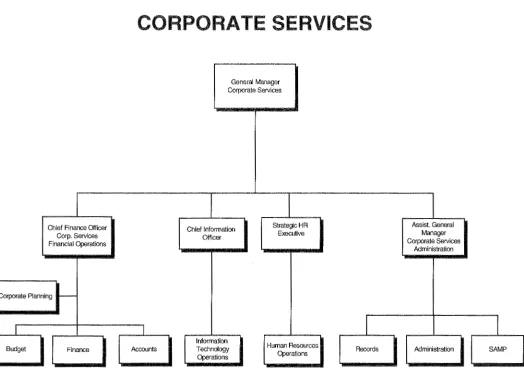
• The Corporate Service division and the HR and ITS units that lie within it
• Position descriptions of each of the HR and ITS participants
• Issues relating to how the interviews were conducted
• Two rich stories demonstrating the interview process
1.8.4 Chapter 5: DATA ANALYSIS
The data analysis chapter details the results of the coding process. It walks through the
process of how the findings were generated. The data analysis has the purpose of
indicating to the reader how the overall findings were generated. An outline of the
data analysis chapter is as follows:
• The data analysis process
• The coding process
• Open codes stated and examples given
• Axial Codes and examples given
• Indicate the direction of the selective codes, or overall Findings
1.8.5 Chapter 6: FINDINGS AND FUTURE RESEARCH
The final chapter of this study primarily summarises and discusses the overall
findings of the investigation. The codes identified in the data analysis chapter are
summarised into two selective codes, or overall findings. These findings are discussed
in some detail. At the conclusion of this chapter, with the knowledge gained through
the study, the researcher proposes suggestions for future work, involving the issues
2.1. INTRODUCTION
The purpose of this chapter is to identify and define the area of study. It was necessary to develop some insight into the questions posed in the research. A significant amount of prior reading of secondary and tertiary material in specific fields of Human
Resource Management and Information Systems Management was undertaken. A key component of the review was the search for issues whose relevance extended to both the HR and ITS fields. Through reviewing the literature the researcher was able to determine and enforce the originality and uniqueness of the research being conducted. Ultimately, enhancing the intellectual value of the research and ensuring the research was not simply regurgitation of the findings of previous research.
The chapter begins with a discussion relating to the goals of a literature review. Following is a detailed description of the purpose of both HR and ITS, on an individual basis. The focus of the review is then shifted to the identification and discussion of various issues that overlap and influence both disciplines.
2.2 GOALS OF A LITERATURE REVIEW
The literature review is considered to be a vital component in the preliminary
planning process of a research project. Gorman and Clayton (1997) suggest that there simply is no substitute for 'reading around' in the relevant literature before beginning a qualitative research project.
f!loals oJfllte £ite11ature Review
1. To demonstmte a J!amiliarity with a body oJ! knowledge and establish credibility
A review tells a reader that an investigator knows the research in an area and is aware of the major issues. A good review increases the reader's confidence in the
researcher's professional competence, ability and background.
2. To show the path oJ! prior research and how a current project is linked to it
A review outlines the direction of research on a question and shows the development of knowledge. A good review places a research project in context and demonstrates its relevance by making connections to a body of knowledge.
3. To integrate and summarise what is know in an area
A review pulls together and synthesises different results. A good review points out areas where prior studies agree, where they disagree, and where major questions remain. It collects what is know up to a point in time and indicates the direction for future research.
4. To learn J!rom others and stimulate new ideas
A review tells what others have found so that a researcher can benefit from the efforts of others. A good review identifies blind alleys and suggests hypotheses for
replication. It divulges procedures, techniques, and research designs worth copying so that a researcher can better focus hypotheses and gain new insights.
As a result of the literature review the researcher became aware of the roles and objectives of both HR and ITS, as defined by numerous academics. The researcher became aware of the commonalities and potential areas of overlap between the HR and ITS units.
The results of the research are summarised in this chapter. The chapter has been divided into specific subject headings in an attempt to highlight the issues and topics that the researcher identified as key elements in the area of the study.
2.3 HUMAN RESOURCES
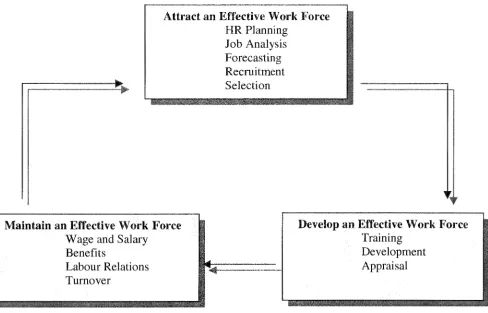
Many definitions abound as to what human resource management (HRM) actually is. Daft (1994) and believe that the term HRM refers to activities undertaken to attract, develop, and maintain an effective work force within an organisation. Stone (1991) believes HRM to be a function primarily concerned with the management of people within the employer-employee relationship. Specifically, to involve the productive utilisation of people in achieving the organisation's objectives and the satisfaction of individual needs. Robbins et al. (1994) postulates that HRM will affect both
individuals and groups through the organisation's policies and procedures in how it recruits, selects, develops and compensates employees.
Over the last decade or so there has been growing recognition of the increasing importance ofHRM. Many oftoday's organisations see HRM as a vital success component. Effective HRM can help an organisation achieve its overall strategies. Ultimately enabling that organisation to establish a competitive advantage over its rivals. However, Daft (1994) notes that despite its importance, the functions and operations of HRM still remain a mystery to employees. Furthermore, Robbins et al. ( 1997) postulates that effective education about the roles of HRM is essential.
2.3.1 Goals of HRM
Their subject areas encompass many subsidiary topics and a truly comprehensive discussion explaining all of the intricacies were neither possible nor appropriate in this investigation.
Attract an Effective Work Force HR Planning
Maintain an Effective Work Force Wage and Salary
Benefits
Labour Relations Turnover
Job Analysis Forecasting Recruitment Selection
Develop an Effective Work Force Training
[image:18.570.45.533.158.471.2]Development Appraisal
Figure 2.1: The Goals of HRM, adapted from Daft (1994:399)
2.3.2 Attract an Effective Work Force
According to Daft (1994) and Robbins et al. (1997) the first goal of HRM is to attract individuals whom are likely to add some value to the organisation. Individual's who show signs of becoming valued, productive and satisfied employees.
That is, the organisation attempts to attract or induce the desired applicant through
pay and benefits, meaningful work, advancement, challenge and training. The
applicant is sought after due to their ability, education, creativity, commitment and
expertise.
In order to attract such value adding employees Stone (1991) and Burnes (1996)
postulate that HRM professionals must place great emphasis upon their planning,
recruiting and selecting processes.
2.3.2.1 HR Planning
Human resource planning involves the forecasting of HR needs and the projected
matching of individuals with expected job vacancies (Robbins et al., 1997; Burnes,
1996; Milkovich, 1997). Forecasting of such enables an organisation to formulate HR
plans and visions at both the operational level and the strategic level. These plans and
visions provide the HR unit with goals and targets and the direction needed to achieve
those goals and targets. Achieving the HR targets helps to enable the overall strategic
objectives of the organisation to be realised. From a practical standpoint, the benefits
associated with HR planning are highly evident. For example, if a firm foresees an
opportunity to exploit new technologies, the HR unit is able to forecast an increase in
the need for personnel that are highly knowledgable in the new technologies.
Furthermore, the HR unit could prepare a training schedule for existing employees to
train them in the operation of the new technologies. The HR unit might also forecast
an increase in absenteeism and turnover and might benefit from the development of
contingencies that enable the organisation to deal with such issues.
2.3.2.2 Recruitment
Daft (1994: 268) defines recruiting as "the activities that define the desired
characteristics of applicants for specific jobs". Potential applicants can be recruited
externally and internally, depending on the organisational requirements. Both forms
of recruitment have their advantages and disadvantages. For example, internal
recruitment is less expensive than external recruitment, it enforces
"promote-from-within" policies and can result in higher employee commitment, satisfaction and
Whereas, external recruitment can be quite costly, particularly due to advertisement,
however, it does promote the recruitment of "fresh blood" into the organisation.
Organisations look upon recruitment as a means of attracting potentially valuable
employees, whom are likely to add some value to the organisation. When used in
compliance with the legalities involved, effective recruitment processes can provide
an organisation with the means to gain a competitive advantage over their rivals.
According to Kreitner (1995) once a pool of applicants has been recruited the next
step is to select the desired employee.
2.3.2.3 Selection
According to Daft (1994: 410) "selection is the process of determining the skills,
abilities, and other attributes a person needs to perform a particular job". It is then
necessary to assess the compatibility of the applicant attributes and the position
requirements in order to determine the "fit" between the two. The challenge faced by
the employer is one in which they must attempt to select an applicant whose
characteristics fit or meet the requirements and specifics of the position description
(PD). Robbins et al. (1994: 694) defines a position description as "a written statement of what a job-holder does, how it is done and why it is done". A PD generally consists
of a compilation of the primary objective of the position, specific accountabilities,
level of responsibility, direction received and desirable qualifications. The most
commonly used selection devices are the application form and the interview (Robbins
et al., 1997; Drucker, 1994).
2.3.3 Develop an Effective Work Force
Once an organisation has selected its employees it must then be prepared to develop
and mould its work force into a productive unit.
2.3.3.1 Training and Development
According to Daft ( 1994) and Fisher ( 1996) training and development represent a
planned effort by an organisation to facilitate employees' learning of job-related
behaviours. Training and development accounts for a substantial amount of an
organisation's budget. In 1987 IBM reported spending some $750 million on training
Training and development is fundamental to an organisation's success. In making distinction between the two functions of training and development, training refers to those activities that have the purpose of preparing an employee for a future event or task. Activities such as on-the-job-training, which encompasses job rotation,
apprenticeships, traineeships, and coaching. Also, off-the-job-training, which
encompasses training courses delivered by an external provider. Robbins et al. (1994) suggests that advances in communications technologies, particularly real-time
telecommunications such as video-conferencing, are vastly expanding training techniques and opportunities. Furthermore, according to Kreitner (1995) and Chong (1984), advances in IT will ultimately lead to the advancement of training, as employees will need to be educated in new technologies in order to effectively use them.
On the other hand, development refers to those activities that enable an employee to "grow". Robbins et al. (1994: 700) defines career development as "the means by which an organisation can sustain or increase the employees' current productivity, while, at the same time, prepare them for a changing world". The effective
development of employees depends largely upon the degree of autonomy, creativity, freedom, variety and challenge given by the employer. Combined together, training and development activities provide the means for an organisation to fully develop, utilise and satisfy their employees (Fisher, 1996).
Training and development is a function that has proven throughout history to be of great importance, as organisations have needed to educate their work force in such a way as to ensure they're up to speed with the changing technologies, policies and procedures mirrored in society. Drucker (1994) and Hitt at al. (1997) suggest that due to rapidly changing technologies the need for training and development is likely to increase considerably in coming years. Another important element inclusive in the employee development process is performance appraisal.
2.3.3.2 Performance Appraisal
Primarily performance appraisals are used for performance feedback, compensation
allocation, promotion, personnel planning, retention/discharge and research (Fisher,
1996). They can also be used to help identify training and development needs.
Through the feedback and promotion functions, performance appraisals also have the
ability to act as a motivational tool (Robbins et al., 1997).
The use of performance appraisals is a topical area that raises many questions, such as
what should be appraised? Who should do the appraisal? What method of
performance appraisal should be administered? The answers to these questions are
unique to the individual organisation and the surrounding circumstances.
2.3.4 Maintain an Effective Work Force
Once that an organisation has recruited, selected, trained and developed its work
force, it is of vital importance that the organisation retain and maintain the work force
in which it has invested vast amounts of money and time. A highly effective, yet
topical method of retention lies in compensation (Henderson, 1997; Milkovich, 1997).
2.3.4.1 Compensation
Daft (1994: 419) defines compensation as "monetary payments (wages, salaries) and
non-monetary goods/commodities (fringe benefits, vacations) used to reward
employees". Henderson ( 1997) and Milkovich ( 1997) postulate that the major parts
that can be included within a compensation program are base wages and salaries;
wage and salary add-ons; incentive payments both short and long term; and employee
benefits and services. An important point to be observed is that, ultimately,
compensation has the power to influence employees to express organisational
commitment and provides them with the motivation needed to perform at their utmost.
On the other hand, the ineffective or inadequate management of compensation and
benefits may be detrimental to an employee's commitment and motivation.
For example, if an employee senses or perceives inequality or inadequacy in an
organisation's remuneration policies that employee may well be inclined to work
2.3.4.2 Labour Relations
Deery et al. ( 1997) purpose, that in its broadest sense, labour relations are about the behaviour and interaction of people at work. "It is concerned with how individuals, groups, organisations and institutions make decisions that shape the employment relationship between employers and employees" (Deery et al., 1997:2). HRM is now seen as a tool that has the potential to drive labour relations and promote a
harmonious relationship between the employer and employee. Ultimately, helping to kerb the occurrence of industrial disputes and decrease the need for union
intervention. One of the most costly and disruptive events that results from poorly managed employee relations is staff turnover.
2.3.4.3 Turnover
Turnover can be beneficial to an organisation, or it can be detrimental. Milkovich (1997) suggests that it is healthy for an organisation to have an active turnover rate. It is of benefit to an organisation to terminate employees who are not "pulling their weight" or are poor performers. As unproductive workers can be costly to maintain and add little value to an organisation. Furthermore, their unproductive attitude can be contagious and other employees may tend to adopt a similar approach to work (Stone,
1995).
Robbins ( 1996) indicates that turnover incorporates those employees that leave voluntarily, those that have no option other than to leave due to mergers and
downsizing and those employees who are due for retirement. It goes without saying, that the loss of one or more "valuable" employees may considerably effect an organisations ability to operate. The effect is further pronounced when an employee leaves to work for a rival firm. Particularly if that organisation has invested
considerable time and money to advance that employees knowledge and value (Mcllwee, 1991).
It seems apparent that the research topic encompasses two distinct disciplines, in HR and IS. Having discussed the role of HR it is now time to shift the focus of the review to IS.
2.4 INFORMATION SYSTEMS
Avison and Fitzgerald (1995: 1) postulate that
"An information system in an organisation provides facts useful to its members and clients which should help it operate effectively".
In today's rapidly changing competitive environment many firms are finding it difficult to simply "keep their head above water" and continue operating. The effective management of IS presents firms with an opportunity to gain a competitive advantage over their rivals and help to ensure the firms success and viability in the long term (Kreitner, 1995). Boyton et al. (1993: 32) state that
"The effective and innovative use of information technology is at the heart of the new organisational designs and capabilities required to meet current competitive challenges".
Bettis and Hitt (1995: 7) contend that:
"Technology is rapidly altering the nature of competition and strategy in the late twentieth century, moving us toward a 'new competitive landscape' in the twenty-first century. The new landscape presents new issues, new concepts, new problems, and new challenges".
Bettis and Hitt (1995) go on to suggest that telecommunications and computer
According to Bettis and Hitt (1995: 9) there have been considerable changes in recent years. "Computers, software and telecommunications have been evolving in a rapid, complex and almost chaotic manner."
2.4.1 The role of IS
Lauden and Lauden (1999) contend that IS cannot be ignored by managers because they play such a critical role in contemporary organisations. The widening role of IS is forcing a new relationship between organisations and IS. Or as Lauden and Lauden (1999:15) state that:
"In contemporary organisations there is a growing interdependence between organisational business strategy, rules, and procedures and the organisation's information systems. Changes in strategy, rules, and procedures increasingly require changes in hardware, software, databases, and telecommunications. Existing systems can act as a constraint on organisations. Often, what the organisation would like to do depends on what its systems will permit it to do."
According to Licker (1997) and Lauden and Lauden (1999) the increasing complexity and scope of system projects is drawing upon more resources. That is, constructing systems today requires the involvement of a much larger part of the organisation than it did in the past. A Change in IS significantly affects many people throughout an organisation. The people affected by the changes need to be included in the
construction process as to ensure the affect of the change in IS has positive results.
Lauden and Lauden (1999: 29) state that:
"Today's managers must know how to arrange and coordinate the various computer technologies and business systems application to meet the
information needs of each level of their organisation, as well as the needs of the organisation as a whole."
An annual surveys conducted by Datamation (a leading practitioner journal of IS)
indicated that in 1993, 1994, and 1995 the most important role of IS is to support organisations in their attempt to (Turban et al., 1996: 5):
"1. Increase productivity (reduce cost, increase effectiveness). 2. Improve quality.
2. Create competitive advantage. 3. Attain company's strategy. 4. Reorganise andre-engineer.
5. Make better and more effective decisions.
6. Respond quickly to customer needs and to changes in the business or its environment.
7. Access a wealth of information.
8. Improve creativity and innovation. "
According to Turban et al. (1996) the primary purpose of IS is to assist management execute the above mentioned functions in an efficient and effective manner. Turban et al. (1996) suggests that IS plays a dual role. They are part of the pressures
(technology), but they can be used to diffuse pressures as well.
2.5 ISSUES RELATED TO BOTH HR AND ITS
Traditionally HR and ITS have been considered to be two highly distinct and
autonomous fields. They operated independently of each other and the common belief was that HR and ITS had little to gain by increasing their correspondence. HR was considered to be an expendable function. That is, management generally did not considered HR to be as crucial to an organisation's success as other organisational functions, such as finance and accounting. However, today, organisations are becoming increasingly aware of the integral influence that HR has upon an organisation's success (Stone, 1995).
That is, the ITS unit was considered to be a separate entity of the business and operated independently of other business units. Consequently, firms were not able to realise the benefits associated with fully integrating ITS into the business. Such benefits as, greater alignment of an organisations overall strategic objectives and the ITS strategic objectives. However, today firms generally understand that the
alienation of the ITS unit is detrimental to an organisation's overall success (Milkovich, 1997).
Indeed, HR and ITS are distinct entities in their own right. However, there is no disputing that the two functions intersect and overlap in much that they do. Following is a discussion identifying the commonalities between HR and ITS and the issues that relate directly to both units.
2.5.1 HR and ITS as Service Providers
Both the HR unit and the ITS unit of an organisation provide the employees of that organisation with a service. The Human Resources unit ensures that all employees are paid in an accurate and timely fashion. They provide staff and managers with
information pertaining to such issues as compensation, superannuation, training, recruitment and selection procedures, termination, payroll issues and much, much more.
The ITS unit provides staff with the technology required to help them operate more effectively and efficiently. They provide staff with an avenue for advice and
information in relation to ITS issues (Groe et al., 1996; Reid & Chung, 1995).
According to McLeod ( 1994) and Licker ( 1997) the services that HR and IS deliver are essential to an organisations overall viability and success.
2.5.2 Support Role
The support given by ITS is primarily concerned with helping employees to perform their job with the utmost efficiency, utilising information technology. Alternatively, HR is primarily concerned with ensuring that those employees are adequately looked after and compensated for (Groe et al., 1996).
2.5.3 Planning
One function that is vitally important for both HR and ITS alike is planning. Daft (1994: 9) defines planning as:
"The management function concerned with defining goals for future
organisational performance and deciding on the tasks and resource use needed to attain them."
Planning defines a pathway to future successes and the means to travel that pathway. Planning sets a vision for all to aspire to and can provide the motivation required to realise future goals. Perhaps the most important commonality between IS and HR is the need to plan for the future. Whether it be operational planning or strategic planning, it is essential (Hitt et al., 1997; Robbins, 1996).
Operational Planning
Operational planning refers to those plans developed at the organisation's lower levels that specify action steps toward achieving operational goals (Robbins et al., 1997). The operational plan is the departmental managers' tool for directing daily and weekly operations. They encompass all the regular transactions, operations and functions that need to be performed in order to keep things moving forward on a day-to-day basis.
In order to achieve their goals it is necessary for both HR and ITS to form operational plans. Porter (1996) and Kreitner (1995) believe that operational planning may well be necessary, but it is not solely sufficient. He postulates that operational
"The operational agenda involves continual improvement everywhere there are no trade-offs. Failure to do this creates vulnerability even for companies with a good strategy."
Robbins et al. (1997) believes that operational plans support strategic planning by ensuring that the organisation survives on a day-to-day basis.
Strategic Planning
Strategic planning encompasses plans that deal with issues at a higher level. It looks at the broader picture and sets plans for the long term (Turban et al., 1996). According to Robbins (1996) strategic plans define the action steps by which the company intends to achieve strategic objectives. They define the pathway that the organisation needs to pursue in order to realise its vision and mission. Lauden and Lauden (1999) suggest that strategic planning determines the objectives resources and policies of the organisation. Minzberg (1994: 112) believes that:
"Sometimes strategies must be left as broad visions, not precisely articulated, to adapt to a changing environment."
Miller (1998) has a strong opinion of the high importance of strategic planning. He suggests that management should consider outsourcing all non-strategic functions and let the HR function spend more time on value-added strategic thinking.
Bringing ITS into the picture, Boynton et al. (1993) suggests that managers must understand that at the heart of new strategic responses is innovative management through advanced ITS.
The importance of planning to both HR and ITS is clear, but how important is the integration of the planning process between business units? Kreitner ( 1995) suggests that management decisions made in isolation of the corporate vision and mission guarantee a division of resources, effort and direction. That is, the strategic plans of an organisation need to be echoed throughout that organisation. They need to be
This ensures that all employees and business units operate and make decisions in a fashion that is in alignment with the overall strategic objectives of the organisation. Promoting a common goal. It stands to reason that the strategic plans of individual business units should also be communicated throughout an organisation as their operations impact upon the strategies of other business units and the overall business strategy. Common sense would suggest that two business units sharing the multitude of commonalities, as do ITS and HR, should most definitely be included in and informed of each others strategic objectives (Perrow, 1986; Ward & Griffiths, 1996).
2.5.4 Training
Perhaps the most poignant of all, training is a function that both HR and ITS need to consider with almost all that they do. According to Daft (1994) and Fisher (1996) training represents a planned effort by a firm to facilitate employees' learning of job-related behaviours.
In establishing the high importance of continuous training, Robbins et al. (1994: 698) state that:
"Competent employees won't remain competent forever. Their skills can deteriorate; technology may make their skills obsolete; the organisation may move into new areas, changing the types of jobs that exist and the skills necessary to do them."
Milkovich (1997) and Ward and Griffiths (1996) suggest that people matter and unless adequate levels of resources are fed into the appropriate training and
professional development programs of all staff members any IT strategy or plan will face an uphill battle to be accepted, let alone survive.
2.5.5 Turnover
Robbins et al. (1994: 52) defines turnover as "voluntary and involuntary permanent
withdrawal from the organisation." Cafasso (1995) suggests that turnover is a big
problem.
Turnover is an issue related to both the ITS and HR functions. ITS need to provide
new employees with the equipment that they require in order to perform their job. The
job of ITS, is therefore made easier if HR communicate the departure of employees as
well as the arrival of new employees. HR need to process the related termination
paper work and they also need to recruit, select and employee someone to fill vacant
positions. Clearly, the HR unit has a direct involvement in the turnover of staff
(Licker, 1997; Stone, 1995).
Turnover of staff is a major problem facing ITS units. According to -Scheier (1997)
finding and keeping good people is the main issue facing most information systems
managers. Igbaria and Greenhaus (1992) suggest that IS people have historically
displayed a turnover rate that is approximately twice the average for business
managers and professionals. ITS managers are under constant pressure to recruit, hire
and maintain ITS professionals. Callas (1998) postulates that IS turnover is only one
of a number of symptoms related to the real problem of firms that fail to take a
strategic view of IT. A precedent of turnover is absenteeism.
Absenteeism
Robbins et al (1994: 52) define absenteeism as "the failure to report to work:'. In 1994 the cost of absenteeism to Australian employers was estimated to be over seven
billion dollars per year. Cotter and Williams (1997) suggest that statistics on the rates
and costs of absenteeism clearly illustrate that it has become a serious problem that
needs to be addressed immediately. Another precedent of turnover is poor
remuneration policy.
Remuneration
Perceived inadequacy or inequality of compensation and remuneration results in
It is vitally important for employees to feel as though they are being remunerated at an appropriate level. Furthermore, remuneration must be seen to be fair and just in its efforts to achieve equality in the workplace. According to Cafasso (1995) competitive salaries are still a key factor in retaining personnel.
2.5.6 Communication
Communication is an issue that is of great importance to both HR and ITS. Whether it is HR communicating policy changes to staff, or ITS communicating a service
interruption. Daft (1994:551) defines communication as:
"The process by which information is exchanged and understood by two or more people, usually with the intent to motivate or influence behaviour."
Turban et al. ( 1996) suggests that through communication, people exchange and share information as well as influence and understand each other.
Communication between the HR and ITS units of an organisation is particularly important. In discussing the issues associated with the implementation of an Intranet, Wallsten (1998: 83) states that:
"HR and IS can establish a good working relationship by openly communicating with one another to avoid problems in cooperation and communication."
Effective communication within an organisation is essential. Drucker (1994) and Ward and Griffiths (1996) suggest that it is particularly important to effectively communicate organisational strategies and visions throughout an organisation. This ensures that all employees are working in alignment and directing their energies toward a common goal. The communication of the vision provides employees with the direction and motivation needed to achieve a high level of proficiency.
2.5. 7 Top Management
Top management undoubtably has a marked impact upon all of the business units within an organisation. HR and ITS are no exception. Drucker (1994) indicates that top management consists of those individuals who hold a senior management position and have recognised authority and responsibility within an organisation. An obvious example of top management is the Chief Executive Officer. Two contentious issues relating to top management are: their own personal level of knowledge and the level of support that they provide.
Support
Robbins et al. (1997) postulates that for any project, initiative or idea to be a success it must have top management approval and support. Without top management support the funding, resources and permission to pursue a project are not forthcoming.
Lauden and Lauden (1999:321) state that
"If an information systems project has the backing and approval of
management at various levels, it is more likely to be perceived positively by both users and the technical information services staff."
Importantly, it indicates that those who are about to initiate a project should first assess the likelihood that their top management will refuse to fund their plan. It further suggests that planners need to learn to sell their ideas to top management to prevent them collecting dust on a bookshelf (Lederer & Sethi, 1989).
"Probably the most disturbing finding was that over half of the respondents rated the statement 'it is difficult to secure top management commitment for implementing the plan' as an extreme or major problem."
An observation of this kind implies that top management might not understand the plan or might lack confidence in the department's ability to carry it out. A blockage in the communication flow may also be an issue in such a situation.
Knowledge
Top management knowledge is a somewhat contentious issue. What level of knowledge and expertise does a top manager require? Does a top manager actually require any technical expertise at all? Drucker (1994) and Kreitner (1995) believe they do.
To find how large the discrepancy between technology and the expertise of executives might be, Opinion Research Corporation surveyed 558 executives in several
departments of varying types of companies. The survey results suggested that
technological expertise could become more important to HR executives, as ultimately, they are responsible for the explanation of the new technology to those who must use it productively (Fisher, 1986). Robbins et al. (1994) indicates that the core
competencies that managers need to be successful are technical skills, human skills and conceptual skills. Stone (1995) suggests that perhaps an acute awareness of what is going on around them is ultimately more important than intricate expertise in specific fields.
Indeed Hitt and Bettis (1995) stray away from the need for top management
knowledge and suggest that of increasing importance is a managers need to adapt a new managerial mindset that emphasises strategic flexibility.
2.5.8 Human Resource Information Systems
Furthermore, these IT based systems can be critical to a firms operations. Miller (1998) postulates that HRIS are revolutionising the HR function. That is, they are creating more time for HR professionals by limiting the administrivia' and
bureaucracy traditionally associated with HR. In effect enabling them to focus on the more strategic elements and to provide management the support needed to create an efficient and effective working environment. According to Coffee (1997) employers should view HRIS as more than just procedures training, payroll and records
retention. Furthermore, Coffee ( 1997) suggests that HRIS is the starting point for developing the creative, capable, problem-solving staff that are needed for vital tasks. In addressing the issue of top management support, as outlined previously Miller (1998: 21) states that:
"To successfully leverage HRIS's to accelerate the HR departments
transformation into top management's strategic partner, HR professionals must familiarise themselves with the expectations of senior managers from HR technology."
According to Spoor (1991) HRIS is an element that is highly dependent upon effective cooperation and communication between the HR and ITS units.
2.5.9 The Implementation of New Systems
An activity that highlights all of the afore mentioned issues is the implementation of a new computer system or information system. Whether it is an upgrade of a specific piece of software or a complete overhaul of hardware and software systems, the issues evoked during the implementation of a new system clearly demonstrates the combined involvement of the HR and ITS units (Launden & Lauden, 1999).
Callas (1998) suggests that when firms upgrade their systems, the approach is often more tactical and piecemeal, rather then strategic and integrated.
The system was a very expensive failure that elicited a very steady downward
progression for the once thriving institution. Although the computer system itself did have some faults, the software problems played a minor role in the failure of the system
Trust Bank was a very bureaucratic firm that had a highly formalised and rigid structure, as is traditionally associated with banks. The organisational structure was the precedent that ensured minimal user involvement in the development and implementation of FNS Banes. Top management took it upon themselves to initiate and complete the project. Top management had little knowledge of user requirements. They had limited knowledge and expertise in ITS and HR. In failing to involve users in the planning process of the project, Trust Bank left itself open to IS-User conflict. Indeed, that is what followed. Operational level staff were thrown into a very
unenviable situation. They were required "look professional" in the eyes of customers and operate a new computer system that they had had limited exposure to. A computer system that many did not understand the need for, nor did they perceive any benefits. To make matters worse the system was not at all running smoothly. There was an abundance of "bugs" that needed to be ironed out in order for the system to operate effectively.
Staff members were not committed to the changes that accompanied the new
computer system. What followed were high levels of IS-user conflict, user resistance, a dramatic increase in absenteeism and turnover and a marked decrease in motivation. Staff members felt as though they were not trained in such a way that would enable them to adequately operate the system. They also perceived an inadequacy in remuneration.
Trust Bank certainly demonstrated just how devastating an inappropriate development and implementation schedule can be. A system that highlights the need for a high level of communication between the HR and ITS units is an intranet. Its effective development, implementation and maintenance requires ongoing contributions and support from both the ITS and HR units. It is a good example of a situation where it is imperative that HR and ITS work together (Fisher, 1986).
Intranet
Lauden and Lauden (1999: 25) define and Intranet as "an internal network based on Internet and World Wide Web technology and standards." The Intranet is a means by which information can be effectively communicated throughout an organisation. Lauden and Lauden (1999: 288) state that
"Human Resources can use Intranets for on-line publishing of corporate policy manuals, job postings and internal job transfers, company telephone
directories, and training classes."
The creation of an Intranet is quite a complex task. HR and ITS are central to the development process. For example, HR need to be included in the creation of an intranet because, more so than any other business unit, the functions of an employees job are influenced by its implementation. Employees are effected by the decisions that are made in relation to an Intranet and it is, therefore, necessary to include HR in the development process. Furthermore, a large amount of the information contained on an Intranet site is directly related to HR policies and procedures.
It is also clear that ITS need to be involved in the process because, unlike other business units, it has the primary role of actually developing, implementing and maintaining the Intranet (Wallsten, 1998).
Openly Communicate with IS
The first and most critical element in the process of creating an Intranet is opening the channels of communication between HR and ITS. As HR and ITS are generally dealing with issues independent of one another, the key is to have the two business units focus on more general issues that influence the entire organisation. Rather than focusing on the day-to-day operational tasks, which may consequently lead to the development of an Intranet site that primarily deals with operational level issues. By promoting the discussion of general themes, such as increased access to and sharing information, it enables and motivates each unit to realise the possible benefits that can be achieved. Hence, promoting cooperation and communication between the two units.
Find a Middle Ground
After communication has been established, it is necessary to find the middle ground between HR' s wants and ITS's limitations. HR and ITS must attempt to determine common ground by communicating desires, limitations and capabilities to each other. They must attempt to understand the varying expectations that they may have.
Maintain Upper Management's Support
It is critical to the success of the Intranet that top management, particularly HR and IS executives, remain committed to the project. Karen Vander Linde, partner with Fairfax, Virginia-based PriceWaterhouseCo. states that, "The active support and
participation of management is critical. An Intranet can't succeed without it"
(Robbins et al., 1997). The continued support of HR and ITS executives is likely to enthuse other executives, in turn promoting the strategic focus and alignment of the Intranet.
Keep on Going
The above mentioned elements are suggested by Wallsten (1998) could, in fact, be extended beyond the sole task of intranet development. The elements mentioned are important in any project that involves both HR and ITS.
2.5.9.1
The UserArguably the most important contributor in development and implementation of new systems is the end user. According to Lauden and Lauden (1999: 321)
"Heavy user involvement in the design and operation of information systems afford them more opportunities to mould the system according to their
priorities and business requirements. In addition, they are more likely to react positively to the completed system because they have been active participants in the change process."
Ward and Griffiths ( 1996) contend that the level of user involvement in managing projects and in developing business cases together with the ITS unit gives an indication of the cooperation and communication present between the business and the ITS unit. Lauden and Lauden (1999) suggest a user-designer communications gap. Where the difference in histories, interests and priorities that hinder communication and problem solving among end users and IS experts. A communication gap as such can often result in IS-User conflict
2.5.9.2
IS-User ConflictIS-User conflict is a major issue in its own right. Its presence can have a marked negative effect upon an organisation's performance. Markinsons and Chong (1999:
123) state that
"Despite remarkable advances in information technology (IT), many computer-based information systems (IS) still fall short of performance
expectations. A growing share of these implementation failures are due to non-technical factors."
Lauden and Lauden (1999) indicate that increased user involvement and formal planning are necessary to successfully manage implementation.
Gaudin (1998) suggests that end-user resistance is often the biggest challenge ITS teams encounter when conducting a major systems migration. Gaudin (1998) goes on to identify substantial end-user training prior to rollout as critical to help employees deal with any change. End-users need to be involved from the very beginning and consulted throughout the process. According to Lewis (1996) ITS departments maintain a constant struggle to balance control and freedom of end-users.
For IS to be fully utilised IS-User conflict must be either overcome or considerably limited.
2.6 SUMMARY
Traditionally HR and ITS have been considered to be two very distinct, separate entities. It stands to reason that this would be the case, as HR primarily deals with people and ITS primarily deals with IT related issues. However, the preceding review of the literature has clearly identified a number of issues that are common to both HR and ITS. Issues such as communication, planning and training. Further suggesting that there may be some benefit in more fully integrating some of the common operations performed by both HR and ITS. Highlighting the significance of the relationship between the two units was the obvious similarity in the fundamental support role that they both occupy within the organisation. They provide invaluable support to staff and business units alike, assisting them to achieve their targets. HR and ITS reply upon each other and need to provide each other with a great deal of support in order to enable them to successfully assist an organisation to do things better.
3.1 INTRODUCTION
The following chapter is a comprehensive description detailing how the researcher went about conducting the investigation. It is a step-by-step account of the
methodology documenting why certain research approaches were adopted. This chapter describes in some detail the research techniques that were available to the researcher. Upon discussing and assessing these techniques the researcher identified the most appropriate technique. Face-to-face interviews were the primary technique employed. The selection of the appropriate research techniques enabled the researcher to develop a concise interview schedule and approach to interviewing. A discussion of data quality and data analysis completes the chapter.
3.2 RESEARCH APPROACH
Research methods are the means by which knowledge is developed. They need to be both relevant and rigorous in order to be accepted as legitimate within a particular field of knowledge (Miles & Huberman, 1994). Yin (1994) suggests that research methodology is a continuing process. Its is a continuum that is ever changing, ever developing, making it a somewhat complex subject topic.
There are two established research approaches available to investigators at present: quantitative and qualitative research. The two approaches can be employed together as a precedent for triangulation. However, they are generally adopted on an individual basis and are conceived as being two distinct approaches whose foundations clearly run at a tangent with one another (Miles & Huberman, 1994; Lofland & Lofland,
1984; Kvale, 1996; Herbert 1995).
3.2.1 Quantitative Research
Gorman and Clayton (1997: 28) suggest that the "quantitative researcher is looking for patterns in events, for normative behaviour and for causal relationships among variables". Quantitative research is based upon normal science. That is, it assumes that all new phenomenon can be reduced to, and described by formal models
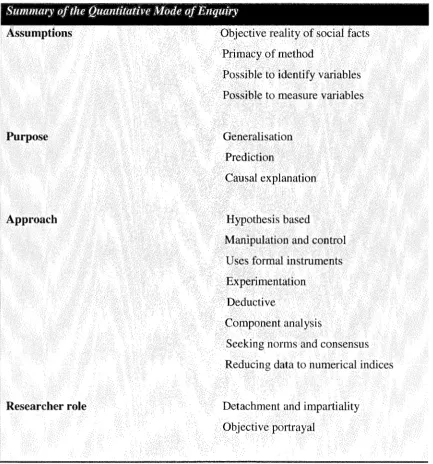
(Neuman, 1997). Table 3.1 presents a summary of the quantitative research approach to investigation.
8ummary o:f the (}Juantitative Mode o:f Enquiry
Assumptions
Purpose
Approach
Researcher role
Objective reality of social facts Primacy of method
Possible to identify variables Possible to measure variables
Generalisation Prediction
Causal explanation
Hypothesis based
Manipulation and control Uses formal instruments Experimentation
Deductive
Component analysis
Seeking norms and consensus Reducing data to numerical indices
[image:43.570.62.495.233.697.2]Detachment and impartiality Objective portrayal
Rubin and Rubin (1995) postulate that the primary reason for conducting quantitative research is to learn how many people in a population have (or share) a particular characteristic or group of characteristics. It focuses upon the production of accurate and reliable measurements that permit statistical analysis (Neuman, 1997).
3.2.2 Qualitative Research Lindlof (1995: 21) postulates that:
"Fundamentally, qualitative researchers seek to preserve the form and content of human behaviour and to analyse its qualities, rather than subject it to mathematical or other transformations".
Furthermore, Lindlof (1995) and Kvale (1996) suggest that actual talk, gesture, and other social action provide the foundations for analysis.
Qualitative research is a field of inquiry in its own right. It crosscuts disciplines, fields, and subject matter. Denzin and Lincoln (1994) offer a definition of qualitative research suggesting it is multi-method in focus, involving an interpretive, naturalistic approach to its subject matter. That is, qualitative researcher attempt to study things in their natural environment, attempting to make sense of, or interpret, phenomena in terms of the meaning people bring to them.
The qualitative researcher administers whatever strategies, methods, or empirical materials are needed and available to them (Miles & Huberman, 1994). Qualitative research is inductive by its very nature.
According to Neuman (1997) qualitative research involves personal feelings and thoughts; employs field studies of people in their natural environment; findings are relevant to context and phenomena only; seeks to determine the deep meaning. Furthermore, it deals with complex non-quantifiable data; strives to construct
Qualitative research accepts the participants at face value; captures and discovers meaning through immersion in the data and deals with concepts in the form of individuals, codes, taxonomies/categories and themes.
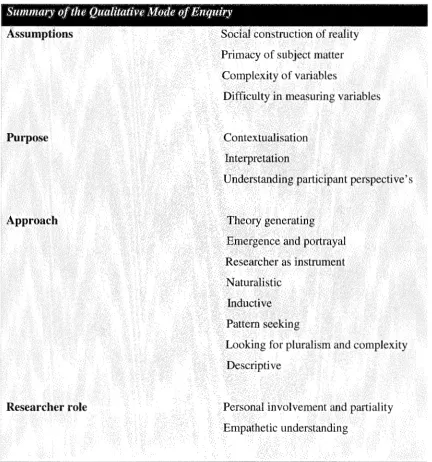
Table 3.2 presents a summary of the qualitative research approach to investigation.
~ummary o:fthe (/Jualitative Molle o:f!Etrquiry
Assumptions
Purpose
Approach
Researcher role
Social construction of reality Primacy of subject matter Complexity of variables
Difficulty in measuring variables
Contextualisation Interpretation
Understanding participant perspective's
Theory generating Emergence and portrayal Researcher as instrument Naturalistic
Inductive Pattern seeking
Looking for pluralism and complexity Descriptive
Personal involvement and partiality Empathetic understanding
3.2.3 Adopted Research Approach
Larkin ( 1985) and Kvale suggest that selecting and implementing a research method correctly, so that it yields evidence and not nonsense, always poses a challenge to researchers conducting an investigation. However, in this case, the research method was clear from the outset as qualitative research is widely recognised as the most appropriate method for studies related to IS.
Dey (1993) suggests that it is suitable to employ qualitative research methods when the intention is to gain a deep understanding, empathy or grasp of the richer meaning of a social setting. An inductive-proposition-forming mode of operation will yield greater insight, when one is content with findings, not conclusions (Lofland & Lofland, 1984; Marshall & Rossman, 1989).
This investigation sought to gain insight into the organisational culture of the DSD, as well as the personal understandings, perceptions, ideas, thoughts and beliefs of individuals. The research primarily focused upon human interpretations and meanings It was therefore apparent to the researcher that qualitative research approach would be most appropriate. Furthermore, the data extracted via the research method was not quantifiable. Therefore, quantitative research is not appropriate for this investigation.
3.3 EPISTEMOLOGICAL POSITION
Anon (2000, c) defines epistemology as "the branch of philosophy that studies the nature of knowledge, it's presuppositions and foundations, and it's extent and validity".
Weber (1997) suggests that epistemology is the study of the way in which we acquire knowledge. It encompasses our belief about knowledge. The three epistemological positions that can be held by a researcher are positivism, interpretivism and
criticalism. The following discussion addresses these philosophies.
3.3.1 Positivism