Using Aspect-Oriented State Machines for
Detecting and Resolving Feature Interactions
Tom Dinkelaker1, MohammedErradi2, and Meryeme Ayache2
1 Ericsson R&D, Frankfurt, Germany [email protected]
2 Networking & Distributed Systems Research Group, TIES, SIME Lab, ENSIAS, Mohammed V-Souissi University, Rabat, Morocco
[email protected], [email protected]
Abstract. Composing different features in a software system may lead to conflicting situations. The presence of one feature may interfere with the correct functionality of another feature, resulting in an incorrect be-havior of the system. In this work we present an approach to manage feature interactions. A formal model, using Finite State Machines (FSM) and Aspect-Oriented (AO) technology, is used to specify, detect and resolve features interactions. In fact aspects can resolve interac-tions by intercepting the events which causes troubleshoot. Also a Do-main-Specific Language (DSL) was developed to handle Finite State Machines using a pattern matching technique.
Keywords: feature interactions, aspect interactions, aspect-oriented programming, state machines, conflict detection, conflict resolution, object-oriented programming, formal methods, domain-specific aspect languages.
1.
Introduction
An important problem in modeling and programming languages is handling Feature Interactions. When composing different features in a software system, these may interact with each other. This can lead to a conflicting situation, where the presence of one feature may interfere with the correct functionality of another feature, resulting in an incorrect behavior of the system. Various techniques have been explored to overcome this problem. Among them, formal approaches have received much attention as a means for detecting feature interactions in communication service specifications.
Aspect-Oriented Programming (AOP) [4] uses a special kind of modules called aspects that supports localization of code from crosscutting features. AOP has been extended with special language concepts for controlling aspect interactions [5], [6], but AOP does not support controlling feature interactions with modules that are not aspects in particular objects.
To address the above problems, in this work we propose a formal ap-proach which uses an extension to finite state machines as the formalism for behavioral specification. The central idea behind using finite state machines as specification models is to have a strong mean to envision feature interac-tions. The formalism defines a process, which consists of the following steps: First, the developer gives a formal specification of each feature that extends the system’s core feature, even partial specifications are allowed. Second, using a suitable composition mechanism for FSMs (e.g., the FSM’s synchro-nized cross-product [7]), the developer makes a parallel composition of the selected feature specifications and analyzes this composition. Third, the de-veloper can identify conflicting states by analyzing the composed specifica-tion of the global system. Forth, to resolve feature interacspecifica-tions, the approach uses aspect-oriented state machines to intercept, prevent, and manipulate events that cause conflicts. We suggest a new formalism for aspect oriented state machines (AO-FSM) where pointcut and advice are used to adopt Do-main-Specific Language (DSL) [8] state machine artifacts. The advice de-fines a state and transition pattern that it applies at the selected points, i.e. it may insert new states and transitions as well as it may delete existing ones.
2.
Case Study: Telecommunication Systems
2.1. Plain Old Telephone Service (POTS)
Features in Telecommunication systems are packages providing services to subscribers. The Plain Old Telephone System (POTS) is considered as a feature providing basic means to set up a conversation between subscribers. In the following we provide the design and the specification of the basic ser-vice of a telephone system (POTS). We assume that a phone is identified by a unique number, and it can be either calling or being called.
In this specification, there are three objects that constitute the telephone system: the "user", the "agent" and the "call" as shown in Fig. 1. According to our semantics, the instantiation of these objects provides three objects run-ning in parallel. The communication between objects is based on operation calls using a rendezvous mechanism. Note that the behavior part of these objects is specified using a finite state machine model.
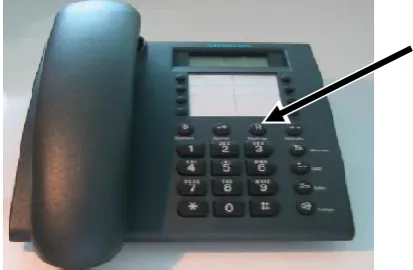
behavior of Fig. 1) picks up (offhook) his phone (Agent-1, an instance of the Agent automaton), the network (designated by the object "call") responds by sending a tone. This user is then ready to dial the telephone number of the called party (using the operation "dial") using a standard telephone interface (Fig. 2). Then the network sends back a signal (operation "Ring") which caus-es a ring on the called phone (Agent-2, another instance of Agent). An Echo_ring is then sent to the caller (operation Echo_ring). We assume that the called user is always ready to answer a call. When the called user picks up (offhook) his phone, the ring is then interrupted and the two users engage in a conversation.
Fig. 1. Partial automata specifying the three objects
Fig. 2. Standard telephone interface with a flash-hook button (labeled with “R”)
2.2. Features available for User Selection (User Services)
According to the definition provided by Pamela Zave [9]: “in a software sys-tem, a feature is an increment of functionality, usually with a coherent pur-pose. If a system description is organized by features, then it probably takes the form B + F1 + F2 + F3 . . ., where B is a base description, each Fi is a feature module, and + denotes some feature-composition operation”. There-fore, telecommunication software systems have been designed in terms of features. So different customers can subscribe to the features they need. Many features can be enabled or disabled dynamically by their subscribers. Among the telecommunications features provided by a telephone system we found: Call Waiting, Three Way Calling, Call Forwarding, and Originating Call Screening.
2.2.1 Call Waiting (CW)
A Call Waiting feature (CW) is a service added to the basic service POTS described earlier. It allows a subscriber A (having the service CW) already engaged in a communication with a user B to be informed if another user C tries to reach him. A can either ignore the call of C, or press a flash_hook button to get connected to C. In other words, if C makes a call to A, while A is in communication with B, then C receives an Echo_ring, as if A was availa-ble, and A receives an “on hold” signal. Then A could switch between B and C by pressing the flash_hook button. If B or C hangs up, then A will be in communication with the user still on line. The basic service POTS to which is added the Call Waiting feature is symbolically designated by POTS + CW.
2.2.2 Three Way Calling (TWC)
2.2.3 Call Forwarding on Busy (CFB)
Call forwarding on busy is a feature on some telephone networks that allows an incoming call to a called party, which would be otherwise unavailable, to be redirected to another telephone number where the desired called party is situated.
2.2.4 Originating Call Screening (OCS)
The OCS Feature allows a user to define a list of subscribers hoping to screen outgoing calls made to any number in this screening list. A user A (with the OCS feature) who registered user B on the list will no longer make a call to B, but B could call A.
2.3. Feature Interactions
Feature interactions could be considered as all interactions that interfere with the desired operation of a feature and that may occur between a feature and its environment, including other features. Therefore, a feature interaction may refer to situations where a combination of different services behaves differently than expected.
For instance, pressing a “tap” button can mean different things depending on which feature is anticipated. This is the case of a flash-hook signal (generated by pressing such button) issued by a busy party could mean adding a third party to an established call (Three Way Calling) or to accept a connection attempt from a new caller while putting the current conversation on hold (Call Waiting). Should the flash hook be considered the response of Call Waiting, or an initiation signal for Three-Way Calling?
Another feature interaction may occur if we consider a situation where a user A has subscribed to the Originating Call Screening (OCS) feature and screens calls to user C. Suppose that a user B has activated the service Call Forwarding (CF) to user C. In this situation, if A calls B, the intention of OCS not to be connected to C will be violated since the call will be established to C by way of B.
Usually, the causes of interactions may be due to the violation of assumptions related to the feature functionality, to the lack of a technical support from the network, or to problems related to the distributed implementation of a feature. Despite the lack of a formal definition of a feature interaction due to the diversity of the interactions types, the reader will find a detailed taxonomy of the features interactions in [10].
be a deadlock, a non-determinism, or constraints violation which may result from states incompatibility between two interacting features. The incompatibility between states can be detected using a “Model-Checking” technique.
3.
Problem Statement
Feature interaction is considered a major obstacle to the introduction of new features and the provision of reliable services. In practical service development, the analysis of interactions has often been conducted in an ad hoc manner.
However, the feature interactions problem is not limited to the telecommunications domain. The phenomenon of undesirable interactions between components of a system can occur in any software system that is subject to changes. This is certainly the case for service-oriented architectures. First, we can observe that interaction is at the very basis of the web services concept. Web services need to interact, and useful web services will emerge from the interaction of more specialized services. Second, as the number of web services increases, their interactions will become more complex. Many of these interactions will be desirable, but others may be unexpected and undesirable, and we need to prevent their consequences from occurring.
There is a broad body of research that addresses the problem of feature interactions. However, as elaborated in the following, there are important limitations how the state of the art can detect and resolve feature interactions.
3.1. OOP cannot localize crosscutting Code of Features
Object-oriented programming (OOP) enables a hierarchical decomposition of the system into classes that can be extended by other classes. Using an OO language, developers can completely describe the system behavior in form of an implementation that can be executed. However, standard OO languages (such as Java or C++) do not provide special means to control feature interactions at the implementation level.
Furthermore, there are certain features for which OOP does not allow a good Separation of Concerns [12] because their implementation is scattered over several classes and tangled with the implementation of other features [4]. Examples for such features are non-functional components like tracing, billing calls, or feature interaction resolution.
3.2. Feature Models can only detect anticipated Feature Interactions
Feature models (FMs) [3] are a well-known technique to model the functionality of a system. They also allow prevent interactions between features that the developer is already aware of.
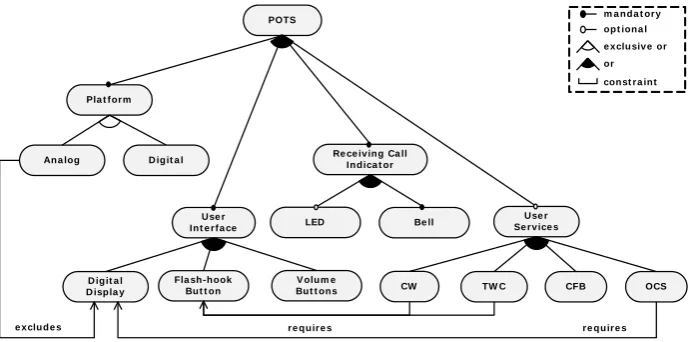
For example, Fig. 3 shows an FM for the telephone system, which does not only model features selected by the user, but choices made by the vendor. The telephone system has abstract features, such as a platform, a user interface, a receiving call indicator, and a set of user services, which can be implemented by a choice of features. The telephone platform can be either analog or digital (exclusive-or). If it is analog, then there can be a digital display. It must have a bell (mandatory feature), and in addition, it may have a LED (optional feature) that indicates receiving calls e.g. when the volume of the bell is low. The user may choose from the set of services from Section 2.2 (inclusive-or).
To model constraints of valid configurations that cannot be expressed using exclusive or inclusive or, the developer uses feature constraints. For example, the feature model in Fig. 3 defines that the features CW and TWC requires a flash_hook button has to be selected as well. In contrast, when selecting an analog platform, this excludes selecting a digital display.
D ig it a l
D isp la y CW TW C
Use r Se r v ice s
CFB POTS
Use r In t e r f a ce
OCS Fla sh -h ook
Bu t t on
V olu m e Bu t t on s
Re ce iv in g Ca ll In d ica t or
Be ll LED
r e q u ir e s
m a n d a t or y op t ion a l e xclu siv e or or con st r a in t
r e q u ir e s Pla t f or m
An a log D ig it a l
e xclu d e s
Fig. 3. A feature model of the telephone system (POTS)
3.3. AOP can only detect Aspect Interactions
Aspect-oriented programming (AOP) enables developers to modularize such non-functional concerns in OO languages. Important AOP concepts are pointcut, join point model, and advice. Pointcuts are predicates over program execution actions called join points. That is, a pointcut defines a set of join points related by some property; a pointcut is said to be triggered or to match at a join point, if the join point is in that set. It is also common to speak about join points intercepted by a pointcut. Such a join-point model (JPM) characterizes the kinds of execution actions and the information about them exposed to pointcuts (e.g. a method call). An Advice is a piece of code associated with a pointcut, it is executed whenever the pointcut is triggered, thus implementing crosscutting functionality. There are three types of advice, before, after, and around; relating the execution of advice to that of the action that triggered the pointcut the advice is associated with. The code of an around advice may trigger the execution of the intercepted action by calling the special method proceed.
However, there is a lack of a general approach to weave on code fragments of DSLs. The problem is that current AOP tools support only one JPM at a time, which is for most aspect-oriented (AO) languages one JPM for the events in the execution of an OO language [4]. Only for some DSLs, there is a domain-specific aspect language with a domain-specific JPM [13] (e.g. encompassing join points like a state transition in a state machine). Still, current AOP tools do not provide support for special quantifications for weaving aspects into programs written in several languages that have different kinds of join-point models.
For example, consider implementing a logging feature as an aspect that needs to be woven into the code of several languages for debugging, such as it need to be woven into code in Java with an Aspect-like JPM, code in SDL1 that defines a JPM for FSMs, and code in LOTOS2 that defines a JPM on top of protocols as communicating processes.
4.
Characterization of Aspect-Oriented FSMs
In this paper, we propose a new formalism for aspect-oriented state machines (AO-FSM) which is based on finite-state machines and the Essential Behavioral Model. An AO-FSM defines a set of states and transitions like a FSM, but states and transitions do not need to be completely specified. Developers can selectively omit states, transitions, and labels, and therefore
1 SDL: Specification and Definition Language: http://www.sdl-forum.org/SDL/index.htm
constitutes a partial FSM in which parts are missing so that it can be used as a pattern for matching against other FSMs and for manipulating them.
4.1. The Basic Finite State Machines (FSMs) Model
An automaton with a set of states, and its “control” moves from state to state in response to external “inputs” is called a Finite State Machine (FSM). A Finite State Machine provides the simplest model of a computing device. It has a central processor of finite capacity and it is based on the concept of state. It can also be given a formal mathematical definition. Finite State Machines are used for pattern matching in text editors, for compiler lexical analysis, for communication protocols specifications [15]. Another useful notion is the notion of the non-deterministic automaton. We can prove that deterministic finite State Machine, DFSM, recognize the same class of languages as Non-Deterministic Finite State Machine (NDFSM), i.e. they are equivalent formalisms.
Definition 1: A non-deterministic Finite State Machine is defined by a quad-ruplet Q, Σ, δ, q0 where Q is a set of states, Σ is an alphabet, δ is the transi-tion functransi-tion, and q0 is the initial state. The transitransi-tion functransi-tion is δ: Q× Σ → 2Q where 2Q is the set of subsets of Q.
An event σ ∈ Σ is accepted out from a state q ∈ Q if the occurrence of σ is possible from the state q, i.e. if δ(q,σ) is not empty, we denote this by δ(q,σ)! When δ(q,σ) is empty, we write δ(q,σ)¬!. We consider a blocking state q (deadlock) if no transition is possible from this state. Formally: q is blocking ⇐⇒ ∀σ ∈ Σ, δ(q σ)¬!.
Definition 2: A deterministic finite state machine is defined by a quadruplet Q, Σ, δ, q0 and corresponds to a particular case of the non-deterministic finite state machine where for any q and for any event σ, δ(q,σ) is either the empty set or a singleton. When δ(q,σ) is not empty, δ(q,σ) = {r} will be simply noted δ(q, σ) = r.
guards to characterize a given state according to the value of defined variables within such state.
Fig.1 gave an example of FSM. In addition, we give here additional exam-ples concerning the partial finite state machines corresponding to the Call Waiting (CW) and Three Way Calling (TWC) features:
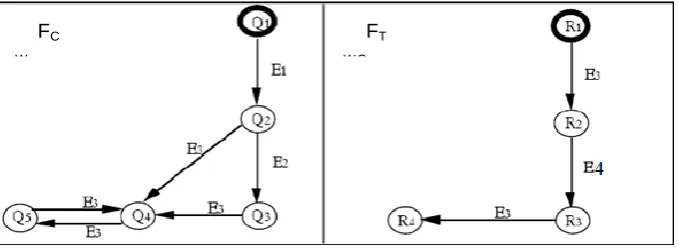
A partial formal specification of POTS+CW is a FSM FCW shown in Fig. 4. The shown states Qi, for i=1 to 5, have the following semantics:
Q1: A and B are connected and start communicating.
Q2: A and B are communicating, then a call from C occurs on the switch of A.
Q3: A and B are communicating, and A receives the signal call-waiting indicating that someone is calling.
Q4: B is waiting, A and C are communicating. Q5: C is waiting, A and B are communicating.
The events Ei, for i=1 to 3, have the following semantics: E1: a call from C arrived on the switch of A.
E2: A receives the signal call-waiting indicating that someone else is call-ing.
E3: A pushes the flash_hook button.
A partial formal specification of POTS+TWC is the FSM FTWC shown in Fig. 4. The states Ri, for i=1 to 4, have the following semantics:
R1: A and B are communicating. R2: B is waiting.
R3: B is waiting, A and C are communicating. R4: A, B and C are communicating.
The event E3 has already been defined for the specification POTS + CW. The event E4 has as its semantics:
E4: A is communicating with C.
Note that the states “in bold” Q1 and R1 represent nested FSM. For in-stance this means that the state Q1 corresponds to a FSM which is a portion of the global specification, nested in this state Q1.
Fig. 4. Specification FCW (left) and specification FTW C (right) FC
W
4.2. Aspect-Oriented Finite State Machines (AO-FSM)
In an AO-FSM aspect, there are two parts: a pointcut and advice – like in other aspect-oriented languages for GPLs, but our pointcut and advice adapt DSL state machine artifacts. There is a composition model that defines how aspects at the meta-level are composed with base-level state machines, which is elaborated in the following.
An AO-FSM pointcut defines a state and transition pattern that selects all FSMs that the advice adapts. This pattern (at the meta-level) describes a model that needs to be observed on the execution of other (base-level) state machines. When the first part of the pattern is observed, in other words when a base-level state machine enters the initial state of the pointcut’s state machine, our execution model creates a new meta-level instance of the state machine that describes the pattern and monitors the further execution of the base state machine. When observing new events at the base level, our composition model updates the meta-level instance in parallel to executing and updating the base-level instance. Finally, when the meta-level instance enters a final state, this means that the pattern has been recognized. In contrast, whenever the pointcut state machine does not define a matching transition for one of the observed events, the meta-level instance is deleted and garbage collected, since the pattern can no longer be fulfilled.
The advice defines a state and transition pattern that it applies at the selected points in the base-level state machine, i.e. it may insert new states and transitions as well as it may delete existing ones. As long as the meta-level instance remains in the final state, the advice is active, i.e. the changes are applied.
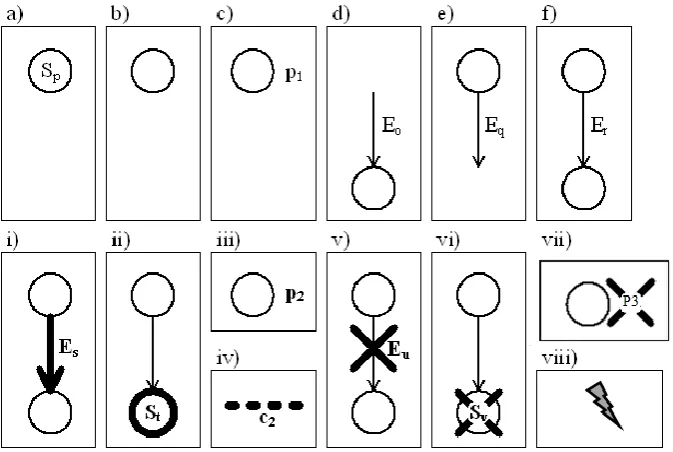
Fig. 5 shows visual models of all types of AO-FSMs. The upper row enumerates all pointcut types (alphabetic indices), in which only the shown parts define the pattern and omitted parts match like wildcards. The lower row enumerates all advice types (roman indices), in which only the bold parts adapt the corresponding parts of an FSM. When constructing an AO-FSM aspect, the different types of pointcut and advice types can be composed.
There are 6 different kinds of pointcuts: a) matches states with a particular label Sp, b) matches any state regardless of its label, c) matches a state in which a certain preposition p1 is true, d) matches a state that has an incoming transition with label Eo, e) matches a state with an outgoing transition with a label Eq, and f) matches a sequence of two states with a transition that has the label Er.
Fig. 5. Pointcut and advice types in aspect-oriented finite state machines
Usually, pointcut and advice compose the above basic patterns to more complex ones. For example, if we need a composite pointcut that matches a particular state Sp with an incoming transition with label Eo, then we would combine the basic patterns a) and f). For example, if we need a composite advice that adapts an existing state Sp by adding new transition Es to a new state St, then we would combine the basic patterns a), i) and ii). With these compositional semantics, rich adaption scenarios can be modeled.
To weave an aspect, we match all pointcuts and apply all advice for all FSMs. For a single FSM, the pointcut matches at every point in the FSM and applies the advice at each of these points. The adapted FSMs are then used for execution.
5.
Resolving Feature Interactions with AO-FSMs
singularities: 1) the composed EBM is non-deterministic, 2) the composed EBM has contradicting prepositions, or 3) the composed EBM has blocking states. The main advantage of our approach is that feature interactions can be directly identified from the model. Finally, the developer can resolve feature interactions by eliminating singularities using AO-FSM aspect.
5.1. The Composition Mechanisms
A composition mechanism models the way in which features are composed together to yield a single FSM model of the system. In this section we present two possible composition mechanisms: the synchronized product and the exclusive sum. Such operations are defined as follows3:
Definition 4: Consider two FSMs A=QA, ΣA, δA, qA0 and B=QB, ΣB, δB, qB0. Let Ω be a subset of ΣA and ΣB, in other words Ω ⊆ ΣA∩ΣB. The Synchro-nized Product of A and B, according to Ω, is a FSM represented by A∗B[Ω] = Q, Σ, δ, q0 defined formally as follows:
Q ⊆ QA×QB , Σ = ΣA∪ΣB , q0 = (qA0,qB0) ∀q=qA,qB∈ Q, ∀σ∈Ω:
(δ(q,σ)!) ⇐⇒ (δA(qA,σA)! ∧ δB(qB,σB)!) (δ(q,σ)!) ⇒ (δ(q,σ)) = (δA(qA,σ) × δB(qB,σ)) ∀q =qA, qB∈ Q, ∀σ
Ω:(δ(q,σ)!) ⇐⇒ (δA(qA,σA)! ∨ δB (qB,σB)!)
(δ(q,σ)!) ⇒ (δ(q,σ) = (δA(qA,σ)×{qB}) ∪ ({qA}×δB(qB,σ))
Intuitively, if A and B specifies two processes, then A∗B[Ω] is the global specification of the two processes composed in parallel and have to synchronize on Ω’s actions. By AB[] we will note the product of the automaton A and B obtained by removing the blocking states from the Synchronized Product A∗B[Ω]. When Ω is empty, the two processes are said to be independent and their product is called the cross-product of A and B. It is denoted by A∗B[]. When Ω = ΣA∩ΣB , their product is denoted A∗B.
Definition 5:(Sum of two FSMs, the Extension Relationship)
Consider two FSMs A=QA,A,A,qA0and B=QB,B,B,qB0. The extension relation of A and B is a FSM defined formally as follows:
Q ⊆(QA×QB) ∪ QA ∪ QB, Σ = ΣA∪ΣB , q0 = (qA0,qB0)
∀q=
qA,qB∈ Q ∩ (QA×QB), ∀σ ∈ Σ: (δ(q,σ)!) ⇐⇒ (δA(qA,σ)!∨ δB(qB,σ)!)(δA(qA,σ)!∧ δB(qB,σ)
!) ⇒ δ(q,σ) = δA(qA,σ)(δA(qA,σ)
!∧ δB(qB,σ)!) ⇒ δ(q,σ) = δB(qB,σ)(δA(qA,σ)!∧ δB(qB,σ)!) ⇒ (δ(q,σ)) = (δA(qA,σ) × δB(qB,σ))
∀q=qA∈ Q ∩ QA, ∀σ ∈ Σ: (δ(q,σ)!) ⇐⇒ (δA(qA,σ)!) (δ(q,σ)!) ⇒ δ(q,σ) = δA(qA,σ)
∀q=qB∈ Q ∩ QB, ∀σ ∈ Σ: (δ(q,σ)!) ⇐⇒ (δB(qB,σ)!) (δ(q,σ)!) ⇒ δ(q,σ) = δB(qB,σ)
Intuitively, if A and B specify two processes, then AB is the global speci-fication of the two processes behaving exclusively.
Fig. 6. Cross product of FCW and FTW C
and high-lighted with the ellipses. For example, the state(R3,Q3) has two tran-sitions to (R3,Q4) and to (R4,Q4) but using the same event E3. This non de-terminism reflects the presence of an interaction between the composed fea-tures (CW and TWC in this case).
5.2. The Essential Behavioral Model (EBM)
Recall that the principle of our method for managing feature interactions consists in three phases: the global behavior specification, the interaction detection and the interaction resolution. Interactions can be presented by states called conflicting states. This can be a deadlock (blocking) situation, a non-determinism or a constraints violation that is presented as an incompatibility between two states of features in interaction.
There are two steps that are necessary in order to design a global behavior specification for a system with a set of features:
Step 1: Specify formally each feature (involved in the interaction) with the basic system service (i.e. POTS in the case of a telecommunication system). This specification can possibly be partial.
Step 2: Make a composition of the features, using a suitable composition mechanism (e.g., synchronized product, a cross-product, a sum, …), leading to the global behavior defined by the EBM, which then is subject to further analysis. For instance, if the synchronized product is used, it implies making a synchronized automaton product (as shown in definition 4) of the behaviors of the composed features. Note that the synchroniza-tion alphabet could be possibly empty.
5.3. Interaction Detection
Interaction Detection consists in the identification of the conflicting states by analyzing the EBM automaton produced in Step 2 (see Section 5.2 above). Such states could be either a state where a given transition can lead to two distinct states (this is the case of non-determinism which is defined in definition 1), to a deadlock state (where one can execute no transition) or to a state constraints violation (i.e. a state belonging to the product of two features specifications, and that results from two incompatible states). Formally, this violation means that two incompatible states allocate different “logical” values to the same variable.
and A gets an incoming call from C, will the CW feature or the TWC feature be invoked?
m)
E
xE
xo)
p
z p
yp
y p
zp)
S
i
(S
i,
)
!
Fig. 7. Three detection aspects checking for composition singularities
When composing the aspects, a set of so-called detection aspects check the composition for possible conflicts. A detection aspect detects a singularity using a pointcut and its advice always declares a conflict, which makes the composition fail as long as the singularity is not corrected. Fig. 7 shows three detection aspects that detect the three aforementioned singularities: m) matches any state if there are more than one transition with the same event Ex, o) matches any state with contradicting prepositions py and pz, and p) matches every blocking state Si for which there is no outgoing transition. When necessary, developers can define their own detection aspects. Whenever one of the detection aspect’ pointcuts matches in a composed system, its advice will report a conflict.
Detection aspects are in particular useful when composing many models and aspects that manipulate those models. Detecting composition singularities prevents any further incorrect processing of the system in a potentially undefined state. The above three detection aspects help automatically detecting the most important composition singularities. Therefore, the developer does no longer have to worry about them. Similar to related work on aspects interaction [5], [16], automatic feature interaction detection is enabled. However, automatic feature conflict resolution is not possible in general [5].
5.4. Interaction Resolution
In order to solve feature interactions, a resolution aspect can implement different resolution strategies. For instance, in our previous works we used the following ones:
existing merge algorithms [15] for LTS (Labeled Transition Systems) based specifications. Such algorithm produces a specification where its behavior extends the merged ones. The definition of the “extension” re-lation was given in Definition 5.
Strategy 2: Solve the interaction by making a precedence order upon the occurrence of certain events of the features in interaction. This allows a feature to hide some events from the other feature.
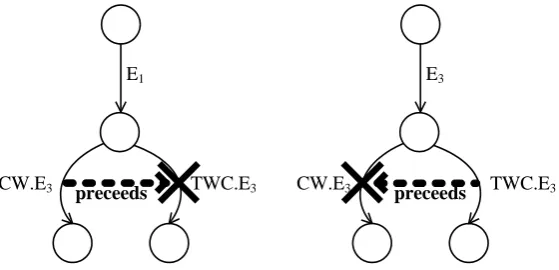
Strategy 3: Establish a protocol between features involved in an interac-tion. This protocol consists in exchanging the necessary information to avoid the interaction. This approach is more adapted in the case where the features are dedicated to be implemented on distant sites.However, these strategies are largely based on pre-established and rigid conventions. Therefore, in this paper we propose a more flexible and customizable approach: to use aspects also as an interaction resolution mechanism. According to this proposal, for resolving the conflict, the developer needs to specify a set of resolution aspects. Each aspect intercepts the reception of events, and removes one or more singularities (e.g. cases of non-determinism) from the composed specification. Depending on corresponding context (e.g. the path to the current state and the received events), the aspect can make a choice concerning which of the conflicting features should be active and which not. Therefore, a resolution aspect defines a pointcut and advice for the corresponding conflict resolution, which may have been detected using a detection aspect. Its pointcut matches the conflict situation. Further, its advice declares what states and transitions to remove from the composition such that it becomes deterministic. In the following we explain the suggested method in the case where an interaction occurs between the call waiting (CW) feature and the Three Way Calling (TWC) Feature specified in Section 2, when they are composed using the cross-product operation (see Fig. 6).
E1, then the TWC feature will be active. In this case, the right pointcut in Fig. 8 will match and temporarily remove the transition CW.E3.
TWC.E3
E3
CW.E3
TWC.E3
E1
preceeds
CW.E3 preceeds
Fig. 8. A resolution aspect that resolves the CW/TWC interaction
In this way, these aspects can be applied to the cross-product in Fig. 6 in order to eliminate the non-determinism from index 1 and 2. In particular, in these indexes the left pointcut in Fig. 8 applies, while the corresponding a vice gives precedence to CW E3 transition with respect to TCW one. Thus, the interaction is resolved in favor of CW.
6.
Implementation
This section describes the proof-of-concept implementation of the AO-FSM approach proposed in the previous sections. The proof-of-concept is provided as a domain-specific aspect language AO4FSM. On the one hand, we have implemented composition operators for state machines. On the other hand, we are using the implementation of AO4FSM to detect and to resolve feature interactions.
With this implementation, concrete solutions for feature interactions can be implemented by using aspects whose pointcuts detect conflict situations and advices to handle those situations.
We have implemented a prototype of AO4FSM in the Groovy language [18] using the POPART framework [17] that allows embedding DSLs and developing aspect-oriented extensions for those DSLs in form of plug-ins. Further, we have implemented the examples presented in [7] and which were used as a running example in this paper as a case study.
6.1. Embedded FSM DSL
The implementation of AO4FSM is based on an embedding of a small FSM DSL for describing finite state machines. The idea of embedding a lan-guage is to describe its syntax and semantics using an existing lanlan-guage – the host language – which is in our case Groovy. Basically, a language is implemented as a library, instead of implementing it with a parser and a compiler. Then the DSL programs are evaluated by invoking this library. Note that it is out of the scope of this paper to completely present the embedding of the FSM DSL. We therefore refer the reader who is interested in the gen-eral approach to [17].
The following excerpt in Lst. 1 gives a rough idea of how we embed FSMDSL into a Groovy class called FSMDSL. For the keyword in FSMDSL’s syntax, the class defines methods, such as fsm, state, transition, and when.
Lst. 1. Groovy Code for embedding FSMDSL
Our host language is Groovy. Indeed we chose Groovy because it allows embedding DSLs (such as FSM DSL). Furthermore, Groovy is lightweight, dynamic, and provides a higher level of abstraction, but at the same time, you can mix Groovy code with Java. If one needs to extend a DSL with As-pects, like in our FSM DSL, one can do so by exploiting the dynamicity of Groovy provided by its Meta-Object Protocol (MOP) [17]. Despite the addi-tional flexibility provided by using Groovy’s MOP, Groovy only enhances Java instead of replacing it. Hence, our implementation runs on every stand-ard JVM.
6.2. Domain-Specific Join Point Model
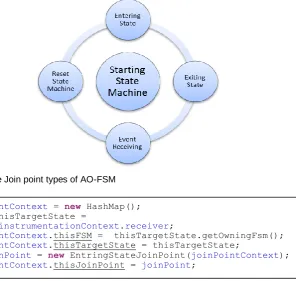
From a design point of view, Fig. 9 shows the join point types defined for AO4FSM. There are five join point types that represent points in the
execu-public class FSMDSL {
private State currentState;
public StateMachine fsm(Map params, Closure body) { StateMachine stateMachine = new StateMachine(…); body.delegate = this; body.call();
return stateMachine;}
public State state(Map params, Closure stateDefinition){
public void transitions(Closure transitionDefinitions) {…} public void when(Map params) {State from = currentState; def t = new Transition(from, params.to, params.event); from.addTransition(t);
tion of a FSM program. The joinpoint stargingStateMachine is triggered when a state machine is started. The EntringState joinpoint could be reified once a FSM enters into a given state. And when it exits the given state, ExitingState joinpoint is then reified. The ResetStateMachine joinpoint is reified when moving back to the starting state. As far as concerned, the EventReceiving joinpoint, it is reified when the FSM receives an event.
Fig. 9. The Join point types of AO-FSM
Lst. 2. Groovy Code for reifying an EntringStateJoinPoint instance
As shown in the Lst. 2, each join point holds a set of parameters that de-fines its context. For instance, the context of the EntringState join pointrefers to the name of the FSM and to the targeted State as parameters. To reify a join point at runtime, the POPART framework will execute this code, which creates an instance of the class EntringStateJoinPoint.
6.3. Domain-Specific Pointcut Language
The other important components of our implementation design are the pointcuts. In POPART, each pointcuts is implemented as a class which inher-its the Pointcut class. In FSMDSL, pointcut sub-classes match the current state parameters with the context of a corresponding join point. It returns “true” if the pointcut matches – and “false” if not. All pointcuts implement a
joinPointContext = new HashMap();
State thisTargetState =
(State)instrumentationContext.receiver;
joinPointContext.thisFSM = thisTargetState.getOwningFsm();
joinPointContext.thisTargetState = thisTargetState;
def joinPoint = new EntringStateJoinPoint(joinPointContext);
similar pattern, as shown in Lst. 3 for the EventReceivingPointcut. This pointcut only matches EventReceivingJoinPoint with an event name given by expectedEvent.
In addition to join point types mentioned in the Fig. 9, we added a more history-based pointcut to AO4FSM: the Stateful pointcut. This pointcut uses a state machine as a pattern that should match the execution trace of an ob-served state machine. The pattern state machine is only internally visible for the pointcut, to keep track of the events received by an observed state ma-chine.
Lst. 3. Excerpt of EventReceivingPointcut which matches reifications of EventReceivingJoinPoint
One can use the StatefulPointcut shown in Lst. 4 to detect the occur-rence of patterns in FSMs, such as non-determinism. The first thing that the pointcut will do is that it makes sure that the EventReceiving joinpoints is triggered. Then it verifies that the current event matches the event and the name of the current State are the same once in the context of the join points (respectively: esjp.getEvent() and esjp.getCurrentState()). If the first state matches, we have to check the event that leads us to get out that the state does match as well and so on until we arrive to the final state in our pattern. Then we have to check if the current state in the pattern is final or not, if it is the case then the pointcut matches, and then its corresponding advice is applied.
public class EventReceivingPointcut extends Pointcut {
String expectedEvent; //given by constructor
public boolean match(JoinPoint jp) {
if (jp instanceof EventReceivingJoinPoint) { EventReceivingJoinPoint esjp =
(EventReceivingJoinPoint)jp;
if (esjp.event.euqals(expectedEvent)) return true;
else
return false; }
Lst. 4. Excerpt of StatefulPointcut to track an execution history
6.4. Domain-Specific Advice Language
The last part of the implementation is the advice language. This language deals with making changes to FSMs to which pointcuts have been matched. When implementing an advice using this language, developers can avoid the problem of non-determinism as mentioned earlier in this paper. For example, to resolve a determinism, the advice can remove one of the non-deterministic outgoing edges as suggested by the resolution aspect in Fig. 8.
In the implementation of the advice language, we heavily exploit the Groovy language features. We use closures and aspects that advise the FSMDSL language implementation in order to embed the semantics of the advice languages. One can think of the advice language of AO4FSM as a DSL that produces aspects for Groovy that change the implementation of the embedded FSMDSL. As the FSMDSL is changed by aspects, the evaluation of FSMDSL programs is adapted as well.
To implement the keywords in the advice language, we use aspect tem-plates, which are closures whose evaluation returns a Groovy aspect that changes the behavior of some methods in FSMDSL. Such changes will re-main dynamic, they do not change the static structure of the state machine,
public class StatefulPointcut extends Pointcut {
StateMachine stateMachinePattern;
public boolean match(JoinPoint jp) {
State pCurrentState = stateMachinePattern. getCurrentState();
String pCurrentStateName = pCurrentState.getName(); if (jp instanceof EventReceivingJoinPoint) {
EventReceivingJoinPoint esjp = (…)jp; String jpCurrentStateName =
esjp.getCurrentState().getName();
if (((jpCurrentStateName == pCurrentStateName)) && (pCurrentState.getEvents().
contains(esjp.getEvent()))) { stateMachinePattern.receiveEvent(esjp.getEvent()); } else if((jpCurrentStateName == "*") &&
pCurrentState.getEvents().contains(esjp.getEvent())){ stateMachinePattern.receiveEvent(esjp.getEvent()); }
if(jpCurrentStateName.equals(
stateMachinePattern.getFinalState().getName())) {
return true;
} }
else
return false;
because there will be no changes conducted in the real FSM instance, but they will be only applied by the aspects. Hence, we can consider those changes as if they were applied to a “copy” of the real FSM. This part of the implementation refers to the patterns described in Fig. 8. Indeed each advice tries to change the behavior of an existing method in the State class.
For instance, the removeTransitionAdvice is the keyword that rep-resents the advice type at index v) from Fig. 5, whose implementation is shown in Lst. 5. The removeTransitionAdvice changes the behavior of a method called State.handleEvent, which is responsible for looking up the transition from the current to the next state. The advice eventually changes the behavior of the handleEvent method. If for the current state an event is received, that matches the event name passed in the advice template’s arguments, and if it finds a corresponding transition in the cur-rent state, then it will do nothing but it will proceed as if the transition does not exist. Otherwise, the advice calls proceed, which will execute the handleEvent as normal, i.e. without the change.
Lst. 5. Implementation of the AddTransitionAdvice
7.
Discussion
To validate the approach, we use the AO4FSM prototype to automatically detect the interactions, and we have developed a resolution aspect to revolve these interactions. We could achieve the objectives stated in our introduction, namely the support of the separation of concerns (in particular crosscutting features), the formalization of the behavior, and how to deal with interactions. With the current prototype, conflicts can be successfully detected and resolved. However, correct results depend on whether the developer completely specifies the model and correctly implements aspects with the AO-FSM tool.
In the remainder of this section, we discuss the details about generality and limitations of our approach with respect to our model (Section 7.1) and the current prototype implementation (7.2).
removeTransitionAdvice = { current, next, event -> aspect(name:"generatedName_" +
"removeTransitionAdvice\$instante\$" +
current+"\$"+next+"\$"+event, perInstance:current) { around(method_execution("handleEvent")){
if(matchesRemovedTransition(current,next,event)){ //omitting proceed ignores the transition
else {
7.1. Discussion about the Model
When using aspects for feature interaction detection and resolution, the de-veloper has to decide case by case what are all encountered interaction sin-gularities in a composed global behavior, which may have combinations of the basic singularities shown in Fig. 7. For example, there can be a non-deterministic transition with the same label (instance of index m) to a state which has two contradicting prepositions (instance of index o) within a com-position. Another example is the case where there are more than one block-ing states (instance of index p). The compositionality can lead to complex scenarios of interactions. Still, the detections aspects will seek all instances of the three kinds of interactions and combinations thereof.
Regarding the totality of feature interaction detection, also detecting other kinds of singularities is conceivable. Possible singularities can be derived from properties observed by the theory of finite state machine and graph theory. There are properties like connectivity and cycles. Some of these properties could indicate a singularity of a possible interaction. Other proper-ties are not relevant for interactions in our model. For example, with respect to the connectivity property from graph theory, all FSMs in an EBM are by definition a connected graph, i.e., there is a path from any node to any other node in the graph. It is trivial to conclude that all synchronized cross-product are connected. Therefore, this property does not need to be observed in our model.
An example of a property which could be relevant is the presence of cy-cles. A cycle in a directed graph is a path from one node back to the same node, which in our EBMs could indicate whether the execution of a feature’s behavior will not terminate. For instance, if there is no cycle, the behavior will terminate (i.e. there are only finite sequences of input that are recognized by the FSMs), or it stays alive (liveness property, i.e., something good can hap-pen). It can be interesting in certain domains, such as security or safety, whether an EBM has such a property or not. If there are two EBMs that are free of cycles, still there may be composition that has cycles, i.e., the com-posed behavior may not terminate or a liveness property is violated, which indicates a feature interaction.
The current three detection aspects do not consider these more complicat-ed scenarios. They are out of scope of the paper because for the time being we found no interesting situation in the software product-line scenarios we focus on. Still, at the current stage, we cannot draw universally valid conclu-sions from the case study. A larger case would be more convincing. At the end, only a formalization proof of the formalism in a proof assistant (like Isa-belle or Coq) would give absolute guarantees.
pointcut). The class of properties that can be recognized by finite state ma-chines is well known: it can recognize properties expressed by regular ex-pressions over the input alphabet, Linear-Time Temporal Logic (LTL), and similar classes. With respect to generality, it can be considered as an ad-vantage that the approach is based on formal methods of Automata Theory, which allows us to draw such conclusions from a large body of theoretic re-search.
The resolution capabilities in our model are complete with respect to finite state machine, because developers can add and remove all elements in an FSM, which are accessible as first-class objects in our aspect language. De-veloper can insert and delete both states and transitions. DeDe-veloper can ma-nipulate transitions by changing the incoming and outgoing state. We did not impose any restrictions with respect to the model into the aspect language about what could be manipulated in AO4FSM advice.
7.2. Discussion about the Implementation
Our prototype implementation only covers feature detection and resolution at design time. For save feature implementation, our approach could easily be integrated with a code generator from state machines to C or Java code.
Various practicable limitations need to be addressed by future work; the expressiveness of the model is confined by state machines and therefore systems whose behavior can be formalized as a regular language. The ap-proach could be extended for models with richer semantics, which conse-quently would make it more complicated. Because we build the synchronized product of FSMs, the approach suffers from the well-known state explosion problem when using FSMs for modeling. Therefore, the prototype can only be used to analyze small models. In future work, we want to reduce synchro-nized products by finding equivalent states. Another limitation is that it cur-rently does not nicely integrate with standard modeling notations, such as UML. In future work, we would like to support for importing UML state charts and let the developer enhance them to EBMs.
8.
Related Work
Our work is related to the works in the field of FOP, AO modeling, and model driven development.
AO-FSM allow automatic detecting of interactions that the developer is not aware of.
Aspect-oriented modeling has come up with various modeling notations into which aspects are woven. There are AO state machines [13] and other AO models available. However, they have been little explored in the context of detecting feature interactions in behavioral models. AO models can only detect conflicts involving aspects, but they cannot detect interactions between base features as we do.
An ongoing trend in language research is to extend more and more base languages with aspects, like we did for our state machine base language (FsmDSL). Recently, aspects for Petri nets have been proposed [20].
There are also a number of other extensible compilers and language workbenches that can be used for extending existing base languages with aspects, namely the Aspect SandBox [25], Reflex [22], JAsCo [21], the AspectBench Compiler [23], JAMI [24], and AspectASF [26]. These extensible language infrastructures mostly support only extensions to general-purpose language, but not to DSLs.
Achieving better modularization of language implementations in language engineering is a central subject of research in recent years. There are parser generators, such as ANTLR [28] and compiler-compilers, such as SableCC [29] that enable modular and extensible language implementations. In their specification languages, they use language constructs, such as inher-itance, that enable better modularity in the language’s specifications and their implementations. Aspect-oriented modularization itself has been proposed to be used in language engineering to improve modularity in language specifica-tions [26], [30] and implementaspecifica-tions [23]. Such special specification language constructs can be used to implement aspect-oriented language extensions in a modular way [27].
All above mentioned language implementation approaches use an external tool e.g. compiler that generates from the specification language (meta-language) the executable code in a particular target language. In contract to these approaches, we embed the DSL and aspects as internal DSLs. There is no external tool because DSL programs are processed with the same compil-er as host programs. This fact allows us to use the extension constructs of the host language (inheritance and meta-object protocol) to extend the state ma-chine DSL with aspect-oriented syntax and semantics using a modular AO language implementation.
9.
Conclusion
In this paper, we suggested a formal approach to detect and resolve feature interactions within a distributed software system. The approach is based on a new formalism for aspect-oriented state machines (AO-FSM) and language implementation AO4FSM based on finite-state machines and Essential Be-havioral Models (EBM). An EBM defines states and transitions as a FSM, but states and transitions do not need to be completely specified and therefore it allows defining partial FSM models.
A specific mechanism for interactions detection and a strategy for feature interaction resolution were presented. The implementation of this mechanism and its associated strategy were made using the AO-FSM formalism. Therefore, the pointcut defines a state and transition pattern that selects all FSMs that the advice adapts, while the advice defines a state and transition pattern that it applies at the selected points. In fact, the approach uses aspect-oriented state machines to intercept, prevent, and manipulate events that cause conflicts.
Acknowledgements. This work was partially supported by the EMERGENT project (01IC10S01N), Federal Ministry of Education and Research (BMBF), Germany. A support was also provided by the DAAD (German Academic Exchange Service) and the Moroccan CSPT Research Program.
The authors would like to thank Professor Mira Mezini and the Software Technology Groups at the Technische Universität Darmstadt. Two of the co-authors have worked as part of her group while conducting this research.
The authors would like to thank the anonymous reviewers for their valuable comments and recommendations.
The authors would also like to thank Yassine Essadraoui who has contributed to the implementation of the prototype of AO4FSM and the telephone case study as part of his Master’s thesis.
References
1. Clements, P. and Northrop, L., “Software product lines”, Addison-Wesley, 2001. 2. Pohl, K. and Böckle, G. and Van Der Linden, F., “Software product line engi-neering: foundations, principles, and techniques”, Springer-Verlag New York Inc, 2005.
3. K. Czarnecki and A. Wasowski. “Feature diagrams and logics: There and back again” in Proc. 11th Int. Software Product Line Conference (SPLC 2007), Wash-ington, DC, USA, 2007, pp. 23–34.
4. Kiczales, G. and Lamping, J. and Mendhekar, A. and Maeda, C. and Lopes, C. and Loingtier, J.M. and Irwin, J.: “Aspect-oriented programming” in Proc. Europ. Conf. on Object-Oriented Programming, Springer, 1997, pp. 220–242.
Software Development V, pp. 135–186, LNCS, vol. 5490, Springer Berlin / Hei-delberg, 2009.
6. Tanter, E., “Aspects of composition in the Reflex AOP kernel”, Software Com-position, Springer, 2006, pp. 98–113.
7. M. Erradi and A. Khoumsi, “Une approche pour le traitement des interactions de fonctionalités des systèmes téléphoniques”, in Proc. Colloque Francophone In-ternational sur l'Ingénierie des Protocoles (CFIP'95), Rennes, France, 1995. 8. M. Mernik, J. Heering, and A.M. Sloane, “When and how to develop
Domain-Specific Languages” ACM Computing Surveys (CSUR), vol. 37, no. 4, 2005, pp. 316–344.
9. Pamela Zave, “Feature Interaction”, http://www2.research.att.com/~pamela/
fi.html
10. E.J. Cameron, N.D. Griffeth, Y.-J. Lin, M. Nilson, W.K. Schnure, et H. Vlethuijsen. “A feature Interaction Benchmark for IN and beyond”, Feature Inter-actions in Telecommunications Systems, Eds. L.G. Bouma and H. Velthuijsen, IOS Press, Amsterdam, 1994.
11. Prehofer, C.: “Feature-oriented programming: A fresh look at objects” in Proc. ECOOP, Springer, 1997, pp.419–443.
12. Parnas, D.L., “On the criteria to be used in decomposing systems into mod-ules”, Communications of the ACM, vol. 15, no. 12, 1972, pp. 1053–1058. 13. M. Mahoney, T. Elrad, “A Pattern Story for Aspect-Oriented State Machines”,
LNCS, Vol. 5770, 2009.
14. G. v. Bochmann, “Finite State Description of Communication Protocols”, Com-puter Networks, Vol. 2 (1978), pp. 361-372.
15. F. Khendek and G. v. Bochmann, “Merging Behavior specifications”, Proc. FORTE'1993, Boston, USA.
16. W. Havinga, I. Nagy, L. Bergmans, M. Aksit, "A graph-based approach to mod-eling and detecting composition conflicts related to introductions". In Proc. In-ternational Conference on Aspect-Oriented Software Development, ACM, 2007. 17. T. Dinkelaker, M. Eichberg, and M. Mezini, „An Architecture for Composing
Em-bedded Domain-Specific Languages”. In Proc. Aspect-Oriented Software Devel-opment ACM New York, 2010.
18. D. König, A. Glover, “Groovy in Action”. Manning, 2007.
19. W. Damm and D. Harel. LSCs: Breathing Life into Message Sequence Charts. Formal Methods in System Design, vol. 19, no. 1, pp. 45–80, 2001.
20. T. Molderez, B. Meyers, D. Janssens and H. Vangheluwe, “Towards an Aspect-oriented Language Module: Aspects for Petri Nets”, In Proc. Workshop on Do-main-specific Aspect Languages, ACM New York, 2012.
21. D. Suvée, W. Vanderperren, and V. Jonckers. JAsCo: “An Aspect-Oriented Ap-proach tailored for Component-based Software Development.” In AOSD, pages 21-29, 2003.
22. E. Tanter. From Metaobject Protocols to Versatile Kernels for Aspect-Oriented Programming. PhD thesis, Université de Nantes, France, 2004.
23. P. Avgustinov, J. Tibble, A. Christensen, L. Hendren, S. Kuzins, J. Lhoták, O. Lhoták, O. de Moor, D. Sereni, and G. Sittampalam, “abc: An extensible AspectJ Compiler.” In AOSD, pages 87-98, 2005.
25. H. Masuhara, G. Kiczales, and C. Dutchyn, “A Compilation and Optimization Model for Aspect-Oriented Programs.” In CC 2003, volume 2622 of LNCS, pag-es 46-60, 2003.
26. P. Klint, T. van der Storm, and J. Vinju, “Term Rewriting Meets Aspect Oriented Programming.” In Proc. of Processes, Terms and Cycles: Steps on the Road to Infinity, Springer, LNCS 3838, 2005.
27. E. Van Wyk, “Aspects as modular language extensions.” In Electronic Notes in Theoretical Computer Science, volume 82(3), pages 555-574, Elsevier, 2003. 28. T. Parr, “The definitive ANTLR reference: building domain-specific languages.”
The Pragmatic Bookshelf, 2007.
29. E.M. Gagnon and L.J. Hendren, “SableCC, an object-oriented compiler frame-work.” In Proc. Of Technology of Object-Oriented Languages, pages 140-154, IEEE, 1998.
30. M. Mernik, X. Wu, and B. Bryant, “Object-oriented language specifications: Cur-rent status and future trends.” In ECOOP Workshop: Evolution and Reuse of Language Specifications for DSLs (ERLS), 2004.
Tom Dinkelaker holds a PhD and a German Diploma in computer science from the Technische Universitaet Darmstadt, Germany. His research focuses on the implementation of embedded domain-specific languages and aspect-oriented programming languages. To provide support for customizing language semantics and implementation strategies, in his thesis, he explored the potentials of using meta-object protocols to enable open language semantics. Tom has embedded a set of languages that are language product-lines, i.e., their syntax and semantics can be extended by language developers or end users in order to customize them for special domains. Tom is now working at Ericsson R&D in the Customer Care team. At Ericsson, he develops the next generation of business support systems that delivers features on top of a flexible architecture that customers adapt for individual needs.
has published more than 60 papers in international conferences and journals. He has organized and chaired five international scientific events and has been a member of the program committee in multiple international conferences.
Meryeme Ayache is a young security researcher, she graduated in 2012 from ENSIAS (Ecole Nationale Supérieur d’Informatique et d’Analyse des Systèmes, Rabat, Morocco) specializing in Security of Information Systems. She participated in the implementation of a project on “Behavioral Modeling with Aspect-Oriented State Machines” as an internship within the Software Technology Group of the Technical University of Darmstadt. Her interest is on mobile computing and security.