pp 163-172.
Methodological implications of software use: an empirical investigation of the impact of
software programs on literature analysis using n6 and n vivo 7.
Megan Woods Mark Wickham
School of Management
University of Tasmania, Hobart, Tasmania
ABSTRACT
This study contributes to debate on the methodological impact of software programs on qualitative data analysis by empirically investigating the impact of alternative program use on analytical process and outcomes. Controlling for data set, researcher and software program, analyses of academic literature were undertaken using QSR International’s N6 and N-Vivo 7 programs to determine the nature and extent of adaptations imposed by technological support. The study demonstrates that while choice of program necessitated adaptations to data records, coding of data and illustration of conclusions, these adaptations had little overall effect on the processes and conclusions of the analyses. The implications of these findings for qualitative research design are discussed and suggestions for future research into methodological implications of software use are presented.
INTRODUCTION
The decision to use qualitative data analysis software (QDAS) raises important methodological considerations for researchers as a consequence of the interaction between behaviours prescribed by research method, and behaviours facilitated by program functionality, that occurs during the data analysis process. Previous research into QDAS use suggests that such interactions may compromise methodological integrity if behaviours prescribed by software dominate those prescribed by the research approach, but little indication of how this occurs within the research process is provided. This study investigates the methodological impact of QDAS by examining the impact of software program on the analytical processes undertaken and outcomes generated from an exploratory analysis of academic literature.
REVIEW OF LITERATURE
As Pfaffenger (1998) has noted, technology represents an enactment of social behaviour. The assumptions, preferences, beliefs and behaviours of the social context are encapsulated by the principles of the technological design and are enacted through the operations and outputs the technology achieves (Layton, 1974). Consequently, the impact of technology represents a relationship between two forms of social behaviour (MacKenzie and Wajcman, 1985); those enacted by the technology, and those of the application context. Determining the impact of technology therefore requires understanding of the form and nature of interaction between those two forms of social behaviour. In the case of QDAS, this refers specifically to the interactions between behaviours consistent with the research method or approach that they adopt, and the behaviours consistent with the successful application of software program programs. Previous research into the methodological implications of QDAS use suggests three alternative scenarios for the interaction between method-behaviour and software-behaviour. The first is that method-behaviour dominates software-behaviour. In this scenario, method-behaviour is supported by software-behaviour as technology offers new ways to execute research processes. This includes using QDAS programs to manage databases and record steps in the development of the researcher's interpretation and analysis (MacLaren & Catterall, 2002), through the use of theoretical and operational memos related to coding and sorting procedures (Babbie, 2002). In addition to enhancing the documentation of research process and the demonstration of transparency and rigour in analysis (Fielding & Lee, 1998), using QDAS programs to support analytical methods presents particular advantages for coding processes (Bryman & Burgess, 1994; (Cresswell, 1998; Mason, 1994). Coding involves the disaggregation of data into text units that can then be categorised within a thematic or descriptive classification system (Boyatsis, 1998). Using QDAS programs to code material in an electronic format can enhance the efficiency and effectiveness of this process by streamlining mechanical aspects (Thompson, 2002) and supporting finer-grained coding options, such as ‘line by line coding’ (Cresswell, 1998). Advocates of QDAS programs have similarly emphasised their advantages for checking coding consistency and identifying negative or disconfirming cases by enhancing the accessibility of the data set (MacLaren & Catterall, 2002). As QDAS programs have developed, the inclusion of modeling functions for graphic display of conceptual schema (Bourdon, 2002) has offered new opportunities for illustrating data analysis processes and prompted greater appreciation for their use to support graphic illustrations of the governing structure developed through the analysis (Miles & Weitsman, 1994).
Alternatively, software-behaviour complements method-behaviour by prompting the development of new and original research methods. In this scenario, method-behaviour is extended as software technology facilitates the development of new research strategies. These include the development of “query coding” and “auto-coding” methods of data categorisation to identify, retrieve and store relevant data. These methods locate specified data by searching for terms or combinations of terms within the scope set by the researcher. Operating in the same manner as an Internet search engine, these coding methods leverage computer functionality execute search and retrieval functions of a scale and scope inaccessible with manual methods, offering unique opportunities for undertaking new forms and types of data searching and interrogation (Richards, T. 2004).
misconception among researchers that organising data into hierarchical categories within the software program encapsulates the entire qualitative data analysis process (Macmillan and Koenig, 2001), rather than one part of a larger and more comprehensive process of sense-making and interpretation (Agar, 1991).
The possible interactions between method-behaviour and software-behaviour therefore present important methodological implications for qualitative research but understanding and accommodation of these implications is constrained by a lack of knowledge about circumstances in which these interactions occur. Future investigation of such circumstances requires the isolation of method-behaviour from software-behaviour such that interactions between the two can be clearly identified and analysed. The purpose this research was to explicitly compare the software-behaviour imposed by alternative software technologies to identify the elements of research method influenced by program choice and the implications of interactions between research-behaviour and software-research-behaviour for the process and outcomes of analysis.
RESEARCH METHOD
The impact of software assistance on qualitative analysis was investigated through exploratory analysis of academic literature using an experimental design. Analysis of academic literature presented three distinct advantages for demonstrating this process. Firstly, the analysis of a body of literature to determine possible research opportunities involves processes similar to those of data reduction, data display, and conclusion-drawing identified by Miles and Huberman (1994) comprising the analysis of qualitative data. As the literature is explored, a large body of material must be summarised while retaining substance and meaning. The development and illustration of the categorisation system supports the identification of main themes and deficiencies in current knowledge and can provide a visual illustration of the thesis argument. As the literature is analysed for its conceptual, epistemological and methodological relationships with other work, the researcher draws and verifies conclusions about these relationships to identify opportunities for further study and provide the framework into which new findings can be integrated (Hart, 1998). Thus, software-supported literature analysis tested and demonstrated the fundamentals of qualitative data analysis. Secondly, as literature analysis is a stage of the research process common to all research disciplines it is perhaps the only form of qualitative data analysis with which researchers from all disciplinary backgrounds and levels of research experience are familiar. Undertaking data analysis utilising literature therefore maximised the comprehensibility of the research method employed by demonstrating an analytical method common to all research disciplines. Thirdly, the analysis of academic articles in the public domain facilitates full method replication by other researchers.
To isolate the impact of researcher and program each author undertook two separate analyses of the literature set using alternative programs. The analyses were undertaken with QSR International’s N6 and N-Vivo 7 software programs to leverage author familiarity with program functions and features as an experimental variable. As both authors have extensive experience in using N6, undertaking analyses with this program allowed the authors to use their knowledge of the program to develop alternative ways to execute the method as constraints imposed by program features became apparent. Correspondingly, the novelty of N-Vivo 7 (released in March 2006) offered an opportunity to test the method against an unfamiliar range of features and functions and maximise the likelihood of adaptation. Each analysis was undertaken as a distinct process with the authors directly following DiGregorio’s method through each stage. Constraints to exact replication and method adaptations taken were noted in method summaries (tabulated in Table 2) concluding with the generation of a summary report of the method used, conclusions drawn and researcher’s reflections on program use. Four analyses were generated in total, facilitating comparison of analyses controlling for researcher (eg N6 and NV vivo 7 analyses by first author) and controlling for program (eg N6 analyses undertaken by both authors). To prevent inadvertent contamination of each other’s results the analyses were undertaken in isolation. To facilitate replication one author received basic instruction from the other in the use of N-Vivo 7 prior to the research which was limited to the demonstration of functions for importing documents into the program, creating and organising node systems, and coding data to nodes.
determine their likely relevance to the topic. To maintain consistency with Di Gregorio’s method the analysis utilised summaries of reviewed articles rather than the entire publications. Reviewing 11 articles each we generated summaries for each article in Microsoft Word detailing the aim of the paper, the author’s central argument, research design used (if an empirical study) and key findings. Any text referring to innovation or networks was reproduced in the summary and any additional quotes detailing key points of argument (the author’s or those of works reviewed in the article) were included. To encourage brevity, the authors agreed that the summaries would not exceed 2 pages in length unless they contained an exceptional amount of valuable material. This process produced a final data set of 18 article summaries relevant to the relationship between innovation and networks (Table 1).
Di Gregorio’s (2000) method of computer-supported literature analysis using N-Vivo 2 was used as the basis of the analytical method. The specificity and comprehensive nature of her account provided a model for representing and organising data, coding, recording thoughts and interpretations, identifying themes and reporting final conclusions. Following di Gregorio, data records for the literature summaries were first created in the N-Vivo 7 and N6 using external (proxy) documents. These create electronic records of documents rather than full electronic versions of document content. Analyses in N-Vivo 7 replicated di Gregori’s method to record the argument presented in the article, key quotations and the researchers own comments or thoughts by typing notes straight into the proxy document and using heading levels to represent key article sections. As the external document function in N6 does not support the recording of document content, the summary documents created in Microsoft Word were also imported into both programs. Document sets were then created to group summaries of articles with similar characteristics (such as date of publication) together and thoughts and conclusions about the analysis were recorded in memo documents created in N-Vivo 7 and N6 for later integration in the research report.
Analyses undertaken with N Vivo 7 directly replicated di Gregorio’s method for organising data records by using data sets to categorising summaries according to author, date, country of publication and topic (type of network, type of innovation, and relationship between innovation and network). Attributes were also assigned to data records to record article characteristics and facilitate searching for articles within given parameters. As the data set and data attribution functions were unavailable in N6, data records were organised in these analyses by creating nodes (content categories) for each attribute type and category.
To facilitate identification of possible relationships between networks and innovation, each article summary was reviewed to identify and code text relevant to three themes: a) types of network, b) types of innovation, and c) relationships between networks and innovation. Nodes were created for each theme to group all text referring to a particular theme together and facilitate later retrieval and examination. Text was then coded-from-browser by reading each summary, highlighting relevant text and coding to the relevant node. Minor variations in method occurred between researchers: the first author chose to create sub-categories for each identified variation of network, innovation and relationship as these were identified from the text. The second author initially coded all references to the primary node categories before creating and coding on to sub-categories. Using a node intersection query, this author was then able to identify co-occurrences of data in nodes related to type of network and type of innovation as indications of relationships identified within the reviewed literature or opportunities for later exploration (no co-occurrence). Both authors directly replicated Di Gregorio’s use of text search functions (query coding) to check coding accuracy and reliability. Text searches identified occurrences of key text within the data that were then compared with node contents to ensure that all text units represented had been identified and coded by the researchers.
Consistent with Di Gregorio’s method, memos were created within N6 and N-Vivo 7 to store thoughts and interpretations but variations in program feature necessitated adaptations to her use of databytes to link ‘footnotes’ to specific text units. Analyses using N Vivo 7 used the ‘annotation’ function (operationally very similar to the databyte function) to similarly link notes and text: in N6, the text unit was copied into a memo and notes typed directly underneath.
FINDINGS
Comparison of the four data category structures produced from the analyses identified substantive differences in the conclusions developed by each author about future research opportunities for exploration of relationships between networks and innovation. Internal consistency between the two analyses undertaken by each author identified that these differences operated at the level of research-behaviour rather than software-behaviour as the variations between node systems were fully replicated across analyses with alternative programs. Comparison of the authors’ analytical methods determined that the variations in node systems were a consequence of variations in the individual research strategies of the two authors. Whereas the first author had identified ‘known’ relationships for further exploration, the second author identified ‘unknown’ relationships proposed by the reviewed authors. Thus, the first author produced a node system illustrating the relationships conceptually or empirically investigated by the reviewed authors and mapping the research opportunities presented for future exploration of these relationship. In contrast, the second author’s node system mapped the research opportunities identified but not explored in the reviewed literature. Consequently, variations in research-behaviour, rather than software-behaviour caused the heterogeneity in research outcomes.
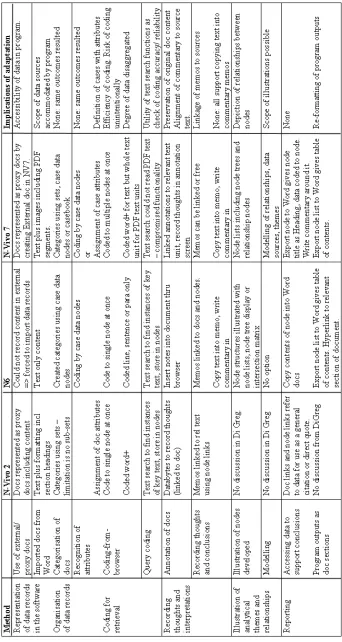
Comparison of the four accounts of analytical method identified the specific areas in which choice of program influenced research-behaviour as a consequence of the software-behaviour facilitated. These findings are detailed in Table 2 and summarised according to the stage of literature review method to which they pertained.
Representation of data records in the software
Choice of program influenced the content of data records accessible through the program, determining the data type represented and therefore the comprehensiveness of the data record. N6 and N-Vivo 7 both read and process text typed into data records created in Word but N-Vivo 7 could also read embedded images such as graphs, pictures and text units copied from PDF documents. Consequently, the creation of data records required adaptation to accommodate these differences; text from PDF documents was copied and pasted into data records for N-Vivo 7 but had to be re-typed into data records for importation into N6.
Organisation of data records
Organisation of data records did not necessitate any adaptation for alternative programs as both programs supported the categorisation of data according to data source characteristics in base data/ descriptive nodes (eg use of major category for year of publication and sub categories for each year). Categorisation of data records using “sets” was possible with N-Vivo 7 but use of case nodes offered superior categorisation possibilities by facilitating creation of major and sub categories.
Coding for retrieval.
Methods for coding-from–browser required some adaptation due to differences identified in the dis-aggregation of data units in each program. While N6 could disaggregate and code a single line of text, N Vivo 7 could dis-aggregate and code single words, thereby facilitating finer-grained dis-aggregation of text and coding. However, N-Vivo 7’ s treatment of PDF text units as embedded images meant that it was not possible to disaggregate PDF-based text to code at a finer level. Consequently, the selection of text unit size during data record creation was found to moderate the impact of program choice in this area. Although both programs supported query coding, the utility of this function was influenced by the use of PDF text images in data records, necessitating adaptations to coding method. As N-Vivo 7 was unable to ‘read’ text in embedded PDF text units, relevant data were not identified when text search queries were used to check accuracy. Consequently, data records had to be manually reviewed to identify instances of relevant text and either code the text from the browser or type the key term into the data record.
Recording thoughts and interpretations
Illustration of analytical themes and relationships
As choice of program determined the range of illustrative options available, adaptations did result as a consequence of alternative program use. Both programs supported the illustration of relationships between major categories and sub-categories through the depiction of the hierarchical tree structures used to link nodes. Both programs also equally supported the generation of node intersection matrices to identify instances of co-occurrence of data in multiple node categories. This facilitated the exploration of associations between categories or instances where associations could be explored in future research. However, the Relationships Nodes and Modeller offered in N Vivo 7 substantially increased the scope for graphically illustrating conceptual relationships by supporting depiction of item-to-item associations. For example, the creation of Relationship Nodes for each type of relationship identified between innovation and networks allowed relationships between concepts and the representations of commonalities or distinctions between different relationship types.
Reporting
Both programs supported reporting of research outcomes through the export of program outputs into word processing software but differences in functionality necessitated method adaptations. For example, both programs enable exporting of node lists to word-processing software but N Vivo 7 only exports those nodes displayed in the node viewer at the time. Consequently, it was necessary to select and display relevant trees before exporting the list. Adaptations were also necessary to the presentation of program outputs as the node lists exported from N Vivo 7 had to be re-formatted in word processing software to present a tabulated list of major and sub categories.
DISCUSSION
The experience of replicating analyses with alternative programs identified several important implications for research practice with and without software support. The first of these was the impact of software on the preparation of data for software-supported analysis. More preparation was required for analysis using N6 due to the necessity of typing relevant text into the data record. This was countered, however, by the need to later re-type material into the data records in which PDF excerpts were embedded for the N-Vivo 7 analyses. More importantly, the experience of preparing data records for both programs engendered a deep appreciation for the value of such preparation in generating familiarity with the data. For example, both authors felt that they were more confident, accurate and insightful in coding summaries they prepared themselves as the relevance of the data at hand to the central themes of the analysis had been determined during the preparation of the data records. Consequently, software-behaviour impacted upon the resarchers’ method-behaviour by influencing exposure to the data in this preparation stage.
The use of alternative programs was also found to influence researcher behaviour when reviewing coded data and developing conclusions as a consequences of the programs distinct capabilities in integrating data from multiple sources. For example, while the external documents created in N6 could be coded to relevant nodes in the same way as the imported summary, the node contained a reference to the document but not the specific content on which the coding decision was taken. This meant that when node contents were reviewed, it was necessary to physically retrieve the original document to identify and review the relevant text. In contrast, the inclusion of content in N-Vivo 7’s external documents meant that all coded content appeared in relevant nodes. Consequently, the program used produced substantive differences in our ability to review all relevant data contained in a node when developing conclusions about the theme in question.
Program features also influenced the efficiency with which analytical outcomes could be generated. For example, the second author’s use of the intersection matrix in N6 to identify tested and untested relationships between innovation and networks necessitated coding of data first to ‘network type’ and ‘innovation type’ nodes, execution of intersection query, review of co-occurring data to identify relationships between network types and innovation types and then re-coding to newly-created nodes for each relationship type. Alternatively, the generation of relationship nodes in N-Vivo 7 as the data was being coded in the first instance meant that re-coding was not necessary. Consequently, we were able to more directly and efficiently identify specific research opportunities using the features in N-Vivo 7. We acknowledge that these differences in efficiency are a consequence of the methods used but noted also that the latter method was developed directly as a consequence of the program’s functionality and promoted, in turn, appreciation of the relative efficiencies of the two programs in this regard.
CONCLUSION
research purpose and technological support are negotiated the study pinpoints the precise interfaces at which researchers determine the extent to which technologically-enacted behaviours influence the research process. Demonstrating the nature and consequences of adaptations made identifies the implications of these decisions for analytical processes and outcome, and therefore the criteria against which researchers should critically evaluate the possibilities offered by technology when making these decisions. In combination, these findings advance discussion of the extent to which technology may advance, hinder or determine research behaviour by demonstrating how and when this may occur and therefore how it can be influenced. Moreover, by demonstrating that analytical conclusions derived from the analysis were maintained irrespective of the software used, the study reinforces the focus and method of the researchers as the primary determinant of the consequences of technological support. As such, the study highlights the importance of further discussion of methods with which researchers can identify, manage and benefit from these consequences.
The study also advances critical evaluation of software in research practice by identifying the form and extent to which software use influences the execution of data analysis. The methodological implications of software selection identified through the study introduce specific decision criteria against which the selection of software support can be taken, particularly where this involves comparative evaluation of alternative programs. Correspondingly, these criteria may also be used to evaluate selection of programs, and therefore contribute to evaluations of rigor in research design.
The empirical design of the study presents three prerogatives for future empirical investigation of the methodological implications of software use. The first of these is the exploration of methodological implications of software in alternative analytic contexts. Future investigation is needed to determine the extent to which methodological impact might differ when applied for purposes of theory development and theory testing rather than topic exploration. The mediating influence of user experience on the methodological impact of software use also requires further exploration. Lee and Fielding’s (1998) research into user interaction with QDAS programs suggests that user characteristics such as level of experience with software, range of programs with which researchers had worked and level of comfort with working in computer-mediated environment may moderate the impact of software on methodological integrity. Thus, additional research is needed to determine the extent to which our experience and competence with the programs applied may have mediated the impact of adaptations made on the outcomes produced. Thirdly, the methodological implications of program design logic should be explored through replication with alternative programs. Future research comparing use of programs designed by alternative developers and for alternative purposes would present greater heterogeneity in software features and functions and therefore present a broader range of adaptations and implications for investigation.
REFERENCES
Agar, M. (1991) “The right brain strikes back” in N. G. Fielding and R. M. Lee (eds.) Using computers in qualitative research. Sage.
Babbie, E. (2002) The basics of social research (2nd ed.). Belmont, CA: Thomson Learning.
Bourdon, S. (2002) The integration of qualitative data analysis software in research strategies: resistance and possibilities. Forum Qualitative Sosialforschung/Forum: Qualitative Social Research, 3 (2). Retrieved June 4, 2004 from http://www.qualitative -research.net/fqs/fqs-eng.htm..
Boyatsis, R. E. (1998) Transforming qualitative information – thematic analysis and code development. Thousand Oaks, CA: Sage Publications.
Bryman, A., and Burgess, R. G. (1994) Reflections of qualitative data analysis. In A. Bryman and R. G. Burgess (eds.) Analysing qualitative data, London: Routledge.
Cresswell, J. W. (1998) Qualitative inquiry and research design: Choosing among five traditions, London, Sage Publications.
Douglas, J. (1976) Investigative social research, London, Sage.
Di Gregorio, S. (2000) Using Nvivo for your literature review, Strategies in qualitative research:
Methodological issues and practices using QSR NVivo and NUD*IST. London: University of London, September. Retrieved [June 4, 2004], from
http://www.sdgassociates.com/downloads/literature_review.pdf
Fielding, N. G. and Lee, R. M. (1998) Computer analysis and qualitative research, London, Sage Publications.
Hart, C. (1998) Doing a literature review, London, Sage Publications.
Layton, E. T. (1974) Technology as knowledge, Technology and Culture, 15, 31-44.
Lee, R. M. and Fielding, N. G. (1991) “Computing for qualitative research: options, problems and potential” in N. G. Fielding and R. M. Lee (eds.) Using computers in qualitative research, London,Sage.
Lonkila, M. (1995) “Grounded-theory as an emerging paradigm for computer-assisted qualitative data analysis” in U. Kelle (ed) Computer-aided qualitative data analysis, London, Sage.
MacKenzie, D and Wajcman, J.(1985) The social shaping of technology, Philadelphia, Open University.
MacLaren, P. and Catterall, M. (2002) Analysing qualitative data: computer software and the market research practitioner, Qualitative Market Research, 5, 28-40.
Mason, J. (1994) “Linking qualitative and quantitative data analysis” in A. Bryman & R. G. Burgess (eds.)
Analysing qualitative data, London, Routledge.
Macmillan, K. and Koenig, T. (2004) The wow factor: preconceptions and expectations for data analysis software in qualitative research, Social Science Computer Review, 22, 179-186.
Miles, M. B. and Huberman, A. M. (1994) Qualitative data analysis - an expanded source book (2nd ed),
Thousand Oaks, Sage.
Miles, M. B. and Weitzman, E. A. (1994) “Choosing computer programs for qualitative data analysis” in M. B Miles and M.A Huberman (eds.) Qualitative data analysis: An expanded sourcebook, London, Sage.
Pfaffenger, B. (1988) Microcomputer applications in qualitative research, London, Sage.
Richards, L. (2004) “Qualitative software and methodological change”, Amsterdam, August.
Richards, T. (2004) “Retrieve vs query – what is the purpose of coding”. Brisbane, Griffith University. November.
Seidel J.(1991) “Method and madness in the application of computer technology to qualitative data analysis” in N.G. Fielding and R. M. Lee (eds.) Using computers in Qualitative Research, Sage.
Seale, C. (1999) Quality in qualitative research, Qualitative Inquiry, 5, 465-478.
Tallerico, M. (1992) Computer technology for qualitative research: hope and humbug, Journal of Educational Administration, 30, 32-40.
Thompson, R. (2002) Reporting the results of a computer-assisted analysis of qualitative research data, Forum Qualitative Sosialforschung/Forum: Qualitative Social Research, 3 (2). Retrieved June 4, 2004 from http://www.qualitative -research.net/fqs/fqs-eng.htm.
Wickham, M. and Woods M. (2005) Reflecting on the Strategic Use of CAQDAS to Manage and Report on the Qualitative Research Process. The Qualitative Report, 10, 687-702.
Table 1: Relationship between innovation and networks: Research opportunities identified through literature analyses
Author 2: Research opportunities Author 1: Research opportunities
Interaction between network members –
challenging the base assumptions
Innovation processes facilitated by networks
Role of space as an antecedent to innovative capacity networks facilitate creation of intellectual
capital
Mechanisms for merging technology across different industries
networks facilitate creation of new knowledge
Similarities and differences between incremental innovation and new-to-world innovations
networks facilitate mutual learning
networks facilitate production efficiency through enactment of rules
Innovation as an outcome of inimitable resources and capabilities
networks prompt recognition of need for innovation, overcome inertia, overcome myopia
Management and leadership of resources and capabilities
Management of knowledge outflows Networks as organisational forms for innovation
deliberate management of internal networks to foster innovation
Innovation and boundary-spanning – challenging the base assumptions
Networks as source of resources for innovation
Non-trad measures of returns from innovation collab with alliance network
Boundary-spanning of knowledge transfer across networks/ industries
Institutional vs social ties as channels for info exchange
networks facilitate info exchange needed for innovation
knowledge characteristics influence innovativeness
knowledge heterogeneity influences opp to benefit social interaction through networks promotes idea generation
network structure influences info exchange networks influence patterns of knowledge diffusion network structure determines ability to benefit from knowledge
network structure determines access to info
network structure influences knowledge heterogeneity centrality in managerial tie network enhances innovation local vs global networks
• global networks provide key info
• informal advice networks
• local networks are key sources of info
• relational structure more important than spatial proximity
Networks influence acceptance or adoption of innovation
can use credibility of social networks to foster acceptance of innovation
networks facilitate creation of new markets or market demand for innovations