1
Title:
Optimal design of cold-formed steel portal frames for
stressed-skin action
using genetic algorithm
Authors: Duoc T. Phana, James B.P. Limb*, Tiku T. Tanyimbohc, A.M. Wrzesienb,c, Wei Shab, R.M. Lawsond
*Corresponding Author: James B.P. Lim
a
Department of Civil Engineering, Faculty of Engineering and Science, Universiti Tunku Abdul Rahman, Kuala Lumpur, 53300, Malaysia (formerly: School of Planning,
Architecture and Civil Engineering, David Keir Building, Queen's University, Belfast, BT9 5AG, UK)
b
School of Planning, Architecture and Civil Engineering, David Keir Building, Queen's University, Belfast, BT9 5AG, UK
c
Department of Civil and Environmental Engineering, University of Strathclyde Glasgow, 107 Rottenrow, Glasgow, G4 0NG, UK
d
Department of Civil Engineering, University of Surrey, Guildford, GU2 7XH, UK
Duoc T. Phan: Department of Civil Engineering, Faculty of Engineering and Science, Universiti Tunku Abdul Rahman, Kuala Lumpur, 53300, Malaysia (formerly: School of Planning, Architecture and Civil Engineering, David Keir Building, Queen's University, Belfast, BT9 5AG, UK)
Email: [email protected]
James B.P. Lim: SPACE, David Keir Building, Queen's University, Belfast, BT9 5AG, U.K.
Email: [email protected]
2
A.M. Wrzesien: Department of Civil Engineering and Environmental Engineering, The University of Strathclyde Glasgow, 107 Rottenrow, Glasgow, G4 0NG, U.K.
Email: [email protected]
Wei Sha: SPACE, David Keir Building, Queen's University, Belfast, BT9 5AG, U.K. Email: [email protected]
R. Mark Lawson: Department of Civil Engineering, University of Surrey, Guildford, GU2 7XH, U.K.
Email: [email protected]
Duoc T. Phan: PhD, Assistant Professor
James B.P. Lim: PhD, Lecturer
Tiku T. Tanyimboh: PhD, Senior Lecturer
Andrzej Wrzesien: PhD student
Wei Sha: PhD, Professor
3
Optimal design of cold-formed steel portal frames for
stressed-skin action using genetic algorithm
This paper describes a stressed-skin diaphragm approach to the optimal design of the internal frame of a cold-formed steel portal framing system, in conjunction with the effect of semi-rigid joints. Both ultimate and serviceability limit states are considered, using deflection limits as recommended by The Steel Construction Institute (SCI). Wind load combinations are included. The designs are optimized using a real-coded niching genetic algorithm, in which both discrete and continuous decision variables are processed. For a building with two internal frames, it is shown that the material cost of the internal frame can be reduced by as much as 53%, compared with a design that ignores stressed-skin action.
Keywords: Cold-formed steel, portal frames, building topology, stressed-skin
4
1. Introduction
In cold-formed steel portal frames, the eaves and apex joints can be formed through mechanical interlock of the steel sections (see Fig. 1(a)). As can be seen in Fig. 1(a), under an applied moment, matching swages in the brackets and channel-sections interlock to form a rigid joint. In laboratory tests described by Kirk [1], it was shown that smaller brackets were required than for the case of joints formed using plain channel-sections (see Fig. 1(b) and (c)). In addition, only four bolts per connection were required as, owing to mechanical interlock, the primary purpose of the bolts is to prevent the brackets and channel-sections from separating.
Recently, Phan et al. [2] have described an ultimate limit state design optimization approach for such a rigid-jointed cold-formed steel portal framing system. In the frame analysis model, the joints were assumed to be rigid and capable of sustaining the full moment capacity of the channel-sections being connected. The objective function was the minimum material cost per square meter on plan (see Fig. 2) of the optimum cold-formed steel channel-sections used for the column and rafter members. Also, the design variables for building topology were the pitch of the frame and the frame spacing (see Fig. 2). As the joints were assumed rigid, the cost of the brackets was not included in the design optimization. In the optimum design of steel portal frames, many researches focused on designing portal frames using hot-rolled rather than cold-formed steel, in which genetic algorithm was successfully adopted as an optimizer [3-5], as well as other method, i.e. nonlinear programming, sequential algorithm [6-8].
5 connection in practice.
As a result, two joint effects on the structural response should be taken into account. Firstly, owing to localised bolt-hole elongation, the joints are semi-rigid. To illustrate this, Fig. 3 shows a bolt-group rotating under moment. As the bolt-holes elongate, the bolt-group rotates around the centre of rotation. The effects of joint flexibility are increased frame deflections, and so serviceability deflections may be more important than for the case of a rigid-jointed frame. Table 1 shows serviceability deflection limits proposed by The Steel Construction Institute (SCI) [9] that will be used as the design criteria for the frame deflections; the frame parameters used for these limits are defined in Fig. 2.
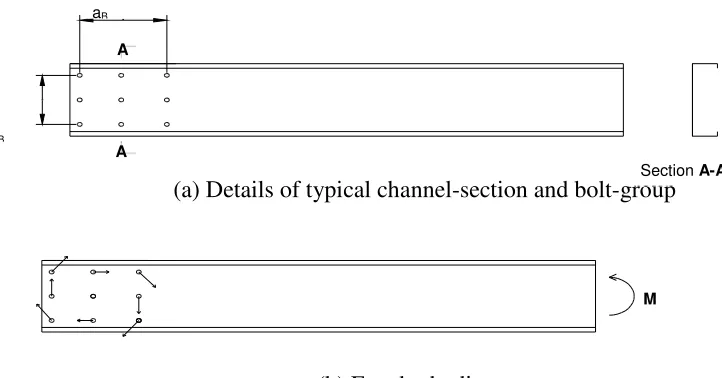
Secondly, unlike rigid joints, moment is resisted by bolt forces developed in the web over the length of the bolt-group (see Fig. 4). As a result of these localized bolt forces, the moment capacity of the joints can be expected to be lower than that of the moment capacity of the channel sections; the strength of the joints can therefore be seen to be influenced by the size of the bolt-group [10-11]. In more general cold-formed steel portal framing systems, larger bolt-group sizes are required in order to increase both the rigidity and strength of the joints.
6
Research has demonstrated that a clad portal frame behaves differently from a bare frame due to the stiffening effect of the roof diaphragm [16]. With the introduction of higher grades of steel, portal frames have become lighter and hence more flexible. In such cases, depending on the ratio of the frame to cladding stiffness, the load is redistributed between adjacent frames and so in some design cases failure can occur in the cladding before first yield of a frame. Some of the authors who have contributed to this research are: Bates et al. [17], Bryan and Moshin [18], Strnad and Pirner [19], Davies et al. [20], and Heldt and Mahendran [21]. It should be noted that the research of these authors focuses on hot-rolled steel portal frames with eaves and apex joints that function as rigid.
However, high-strength, light-gauge, cold-formed steel portal frames with flexible joints are increasingly used for spans up to 20 m. Full-scale tests on cold-formed steel portal frames with semi-rigid bolted moment connections and the inclusion of the stressed-skin effects have been described by Wrzesien et al. [22]. It was shown that cold-formed steel portal frames with semi-rigid joints are sensitive to serviceability deflections, and hence the effects of stressed-skin action should not be ignored as they can lead to a significant reduction on deflections; uncalculated stressed-skin effects can potentially lead to tearing of the fixings [23].
In this paper, the design optimization of a cold-formed steel portal frame is described, in which stressed-skin action and the semi-rigidity of the joints are considered. A parametric study investigating the effect of stressed-skin action is conducted on different numbers of frames and cladding thicknesses. The design optimization uses a real-coded niching genetic algorithm (RC-NGA) to search for the optimum design.
[10-7
11, 22-24], which agree well with the British Standards BS5950 for cold-formed steel. Although BS 5950 is now superseded by the Eurocode 3, it should be noted that the design procedure described are not available in the Eurocodes; however, the research results are of value and independence of any design codes, especially for the study about cold-formed steel structures. Also, the data for characteristic value for cold-formed steel members obtained from industry is tested based on BS 5950. The loading and member checks are therefore performed based on the British Standards BS 5950. In this paper, the buildings are designed to both ultimate and serviceability limit states with all wind load combinations according to BS 6399 [25] considered.
No published research has considered all aspects of cold-formed steel frame and joint designs before. For this reason, this lengthy introduction is given to present the background to this work. Rigid joints in cold-formed steel are expensive to fabricate [1, 10], this paper will show that this is not necessary as a stressed skin design will result in the simpler joints. Applying genetic optimisation and stressed skin action to cold-formed steel portal frame structures is the uniqueness of this research. To limit the scope, consideration of the sizing, shape and lay out optimization, and possible conditions of hazard situation (elevated temperatures, fire), is not included.
2. Structural analysis and design of the cold-formed steel portal
frame
2.1 Details of portal frame building
8
were considered. The gable frames are assumed to be stiff both in- and out-of-plane. The geometrical parameters of the frame shown in Fig. 2 are as follows: span of frame Lf, height to eaves hf, pitch of frame θf, and frame spacing (or bay spacing) bf. It
was assumed that the column bases are pinned. The frames were designed using cold-formed steel profiles available from a UK cold-cold-formed steel supplier (see Fig. 8). Table 2 shows a list of the available channel-sections [26]. It is worth noting that yield strength of cold-formed steel used for members is 390 N/mm2 and elastic modulus is of 205 kN/mm2. Strengths of column and rafter members, namely, moment capacity, axial capacity and shear capacity, are determined based on BS 5950 - Part 5 [27].
The positions of the purlins and side rails are also shown in Fig. 6. The purlins and side rails are assumed to be connected to the webs of the rafter and column members, respectively, thus providing both lateral and torsional restraint. A fixed spacing of 1.2 m and 1.0 m were applied for purlins and side rails, respectively, so that the effect of stressed-skin action can be compared directly between the different building cases, the channel-section C15018 was used for the purlin and side rails for all building cases.
Following consultation with industry, it was assumed that the combined material and fabrication cost of the brackets is £2.0/kg [26], and that each bolt-group should comprises nine bolts.
2.2 Details of the roof and wall sheeting
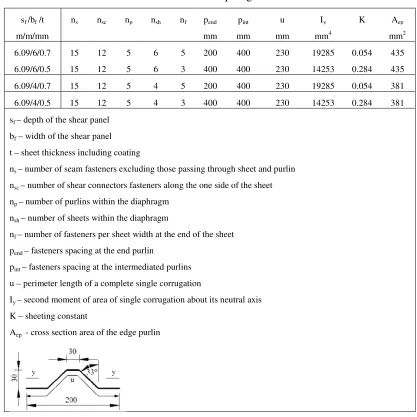
Single skin 30 mm depth roof profile was used for both the roof and wall sheeting, with the yield strength of the sheeting of 390 N/mm2 [28]. In this paper, two roof profiles with thicknesses of 0.5 mm and 0.7 mm were considered. Table 3 shows the parameters used in calculations of the diaphragm roof characteristic.
9
of the typical sheeting panel used in the UK that is fixed at every corrugation at both ends and at alternate corrugations at intermediate purlins. All shear panels are fixed along all four edges of the cladding profile.
For such arrangement of shear roof panel, the transverse shear flexibility, c, of the stressed-skin panel assembly is calculated as follows [29]:
3 3 . 2 2 . 2 1 . 2 2 . 1 1 .
1
c
c
c
c
c
c
c
=
+
+
+
+
+
(1)where
1 . 1
c
is the profile distortion with fasteners at alternate trough of cladding2 . 1
c
is the shear strain of sheeting1 . 2
c
is the deformation of sheet to purlin fasteners2 . 2
c
is the deformation of seam fasteners3 . 2
c
is the fastener deformation of connections to rafters3
c
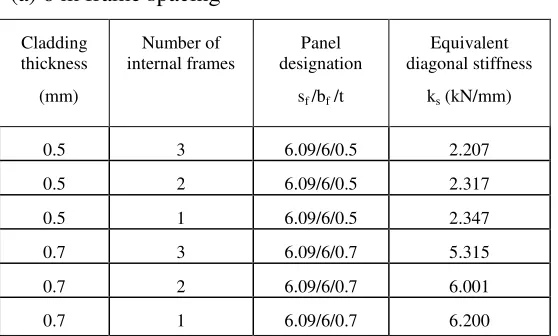
is the axial strain of purlinsIn structural analysis, the transverse shear stiffness is the reciprocal of transverse shear flexibility. In this paper, the shear stiffness, ks (see Table 4), of the panel in the
diagonal direction is calculated from the transverse shear flexibility as follows (Fig. 10): ks =
θ ∆cos2
V (2)
where
V = ∆/c is the shear capacity
∆ is the displacement of other edge of the panel
10
would represent the lower bound of shear strength and stiffness of the roof diaphragm. In this paper, self-drilling and self-tapping screws of 5.5 mm diameter were used for both intermediate and edge purlins with spacings as summarised in Table 3. For the purlin to rafter connections, angle cleats and four M12 bolts were used (Fig. 9); in addition, 6.3 mm screws with washers were used for the seam connection and 5.5 mm screws with washers were used for the sheeting to rafter connections. Table 5 shows the mechanical properties of the screws. All the screws passing through the weather sheets use metal washers with EPDM rubber seal. The diameter of the washers was 16 mm.
The design resistance of screws, Pd, fixed into thin sheeting is given by two formulae, according to BS 5950-5 Annex A:
Pd = 2.1dtpy (3)
Pd = 3.2(t3d)0.5py (4)
where
d is the screw diameter (mm)
t is the thickness of the thinner steel (mm) py is the design strength of the steel (N/mm2)
These formulae include a partial factor of 1.25. For t = 1 mm, d = 5.5 mm and py
= 390 N/mm2, Pd = 4.5 kN to Eq. (3) and 2.9 kN to Eq. (4). It can be seen that Eq. (4) will
generally control for the steel thicknesses used in sheeting.
11
2.3 Frame loadings
2.3.1 Dead and live roof loads
The loads applied to the frame were as follows.
Dead Load (DL): Cladding and service loads on the slope and self-weight of columns, rafters, purlins, and side rails of 0.15 kN/m2.
Live Load (LL): Snow load of 0.6 kN/m2
2.3.2 Wind loads
A dynamic wind pressure (qs) of 1.0 kN/m2 was adopted. Both transverse and
longitudinal wind loads were considered. In accordance with BS 6399 [25], the design wind pressures (p) were calculated as follows.
p = qs
(
Cpe−Cpi)
(5)where Cpe is the external pressure coefficient and Cpi is the internal pressure coefficient.
For buildings of normal permeability, without dominant openings, Cpi has a
minimum value of -0.3 for negative pressure, and a maximum value of +0.2 for positive pressure. Fig. 11 shows the six wind load cases considered (WLC1 to WLC6).
2.3.3 Limit state design
The frame was checked for the following four ultimate limit state load combinations (ULCs) [29].
ULC1 = 1.4DL + 1.6LL (6a)
ULC2 = 1.2DL + 1.2LL + 1.2WLC (6b)
ULC3 = 1.4DL + 1.4WLC (6c)
ULC4 = 1.0DL + 1.4WLC (for wind uplift) (6d)
12
The frame was also checked at the serviceability limit state for the following three serviceability load combinations (SLCs).
SLC1 = 1.0LL (6e)
SLC2 = 1.0WLC (6f)
2.4 Structural analysis and design
Fig. 12 shows details of the beam idealization of a building having two internal frames. As can be seen, the gable-end frames are assumed to be fixed, which is justified as these frames are assumed to be fully clad and therefore stiff in-plane. For the out-of-plane direction, the frames can be constrained together at the position of the purlins and side rails (see Fig. 6). It should be noted that the effective length (buckling length in Eurocode 3) for member buckling check is determined from spacings of purlins and side rails. As shown in Section 2.1, owing to purlins and side rails connecting to columns and rafters through the web, the effective length for buckling check is constant for all loading cases, i.e. gravity loads or wind uplift load. The stressed-skin action is idealized using tension diagonal spring elements; the properties of the spring elements for the different building geometries are as shown in Table 4.
Fig. 13 shows details of the beam idealization of the internal frame. The semi-rigidity of the joints is idealised by a rotational spring at the centre of rotation of the bolt-group. The size of the bolt-groups (and brackets) is shown in Fig. 14. The rotational stiffness at the eaves of the bolt-group connecting the column and rafter to the eaves bracket are kec and ker, respectively. Similarly, the rotational stiffness at the apex of the
bolt-group connecting the rafter to the apex bracket is kar. It is worth noting that the
rotational stiffness of the bolt-group in semi-rigid joints [10,11] is based on the bolt-hole elongation stiffness, kb, as presented in Table 2. Also, the bolt-hole elongation stiffness
13
proposed by Zandanfarrokh and Bryan [30]. The distance from the intersection of the members to the centre of rotation of each bolt-group is referred to the as the effective length of the bolt-group. For the eaves bracket, the effective length of the bolt-group connecting the column and rafter to the eaves bracket are
l
ec' and' er
l
, respectively. Similarly, the effective length of the bolt-group connecting the rafter to the apex bracket isl
ar' . It is worth noting that the influence of imperfections and elongation of bolt holes has the effect on the rotational centre. However, owing to the deflection limits for stressed-skin design being small, the elongation of bolt holes is considered as not remarkable, and so the effect on rotational centre could be neglected.In this paper, the first-order elastic analysis is adopted, which in-plane stability of frame is neglected, owing to the small displacement under the effect of stressed-skin action. However, if these results are required to include second-order effects, the amplified moment method could be adopted and applied to the loadings. The finite element program ANSYS was used for the purposes of the structural analysis. BEAM4 element was used for the columns and rafters; LINK10 was used to idealize the tension bracing that simulates the stressed- skin action. For the semi-rigidity of the joints, a rotational spring element of zero size connected with two coincident nodes at the joint positions (COMBIN40) was used [31]. It is assumed that the Bernoulli beam theory is applied for the member analysis which the effect of cross-section warping under shear stress action is neglected. It should be noted that albeit ANSYS element library provides the BEAM188 element that includes the warping magnitude, there is no option to input the section properties for the lip single-channel or back-to-back channel sections, in which the input for each dimension of cross-section is required.
14
sufficient for the design process. For each load combination, bending moments, shear and axial forces for the frame are determined. The buildings were analysed under all of load combinations.
2.5 Design constraints
2.5.1. Columns and rafters checks
The columns and rafters were checked for axial force and bending moment, lateral-torsional buckling and combined shear and bending [27].
The combined tension and bending moment check for the rafters and columns is
1 M
M P F
cx x t
t + ≤
(7)
where:
Ft is the applied tensile load at the critical section
Pt is the tensile capacity of a member, which is calculated from the effective
net area Ae of the section and steel yield strength py of 390 N/mm2
Mx is the applied bending moment at the critical section
Mcx is the moment capacity in bending Mc about the x axis (see Table 2).
The combined compression and bending moment were checked for local capacity at positions having greatest bending moment and axial compression, as well as for lateral-torsional buckling.
For the local capacity check
1 M
M P
F
cx x cs
c + ≤ (8)
where:
15
Pcs is the short strut capacity subjected to compression, which is calculated
from the effective net area Ae of the section and steel yield strength py of
390 N/mm2
For the lateral-torsional buckling check
1 M M P F b x c
c + ≤ (9)
where:
Pc is the axial buckling resistance in the absence of moment
Mb is the lateral resistance moment about the major axis
For members subjected to both shear and bending moment, the webs of members should be designed to satisfy the following relationship
1 M M P F 2 cx x 2 v v ≤ + (10) where:
Fv is the shear force associated with the bending moment Mx at the same
section
Pv is the shear capacity or shear buckling resistance
2.5.2 Joint checks
In this paper, the partial strength of the joints is taken into account through design checks [27, 32]:
1 P F
w
w ≤ (11)
5 . 1 M M P F 1 . 1 cx x w
w + ≤ (12)
16
Fw is the concentrated web load at the joint
Pw is the concentrated web load resistance
The crushing resistance (Pw) of the web under concentrated load [27] is given by:
Pw =t2C7py
{
8.8+1.1(N/t)1/2}
(13)in which C7 = 1.20 if D/t > 150 and C7 = 1 + (D/t)/750 if D/t ≤ 150
where:
t is thickness of the web
C7 is the experimental constant [27]
py is the design strength of steel
N is the actual length of bearing (or connection length) D is the overall web depth of the cross section
c. Ultimate limit state check for stressed-skin panels
In accordance with BS 5950 - Part 9 [13], the roof diaphragm transfers the horizontal load to stiff gables reducing the level of loading applied to the internal frames. This allows lightening of the internal frames. When the ultimate shear capacity of the roof diaphragm is reached the load is no longer redistributed and the internal frames are subjected to a larger load. The following check must therefore be satisfied if stressed-skin design is to be used safely
, ,
1
d u
d theory
V
V
≤
(14)where:
, d u
V is the applied shear force at the ultimate limit state loading along the
17 ,
d theory
V is the design shear capacity of the diaphragm expressed as a diagonal
force
It should be noted that the design shear capacity (shear strength), Vd theory, , of the shear roof panel is obtained based on the seam capacity and shear connector fastener capacity, as shown in Table 5 [29]. The diagonal force is also determined following the same procedure as shown for the diagonal shear stiffness.
d. Serviceability checks
Cold-formed steel portal frames have flexible members and joints, and so there is often a problem of tearing in the cladding fixings due to differential deflection between adjacent frames [22-24]. Deflection limits in Table 1 are used.
The serviceability of the cladding is checked at serviceability load (Eq. 13) to prevent tearing of cladding [22,23]:
,
,
1 0.6
d s
d theory V
V ≤ (11)
where:
, d s
V is the applied shear force along the diaphragm expressed as a diagonal
force under serviceability load
3. Design Optimization Model
18
cross-section sizes of members, and sizes of eaves and apex bracket, and can be expressed as
C =
+
∑
= br br m 1 i i i f f c w l c b L 1 (16) where:C is the cost of the building per square meter of floor area
ci are the costs per unit length of cold-formed steel sections for frame
members and secondary members
li are the lengths of cold-formed steel frame members
m is the number of structural members in the portal frame cbr is the cost per unit weight of the brackets
wbr is the total weight of the brackets
The decision variables are of two types:
(i) The sizes of the columns and rafters are selected from a list of sections available in the UK (see Table 2)
(ii) The lengths of bolt-groups, namely, aec, aer and aar (see Fig. 4) are continuous
within the range [200 mm, 2000 mm]. It should be noted that the widths of the bolt-groups depend on the depth of the members.
The unit costs per meter length of the channel-sections are also shown in Table 2. As mentioned in Section 2.1, the combined material and fabrication costs for manufacturing the brackets are assumed to be £2.0/kg. The cost objective function is minimized subject to the design constraints in Eqs. (7)-(15).
19
forms of the design constraints or unity-factors, given in Eqs. (7)-(15), are expressed as follows 0 1 M M P F g cx x t t
1= + − ≤ (17a)
0 1 M M P F g cx x cs c
2= + − ≤ (17b)
0 1 M M P F g b x c c
3= + − ≤ (17c)
0 1 M M P F g 2 cx x 2 v v
4 − ≤
+
= (17d)
0 1 P F g w w
5= − ≤ (17e)
0 1 M M P F 1 . 1 5 . 1 1 g cx x w w
6 − ≤
+
= (17f)
, 7 ,
1 0
d u d theoryV
g
V
=
− ≤
(17g)0 1
g u
e e
8 − ≤
δ δ = (17g) 0 1 g u a a
9 − ≤
δ δ = (17h) , 10 , 1 0 0.6 d s d theory V g V
= − ≤ (17i)
where
δe is the horizontal deflection at eaves under the action of serviceability load δa is the vertical deflection at apex under the action of serviceability load
u a
δ and u e
20
4.
Computational Solution
A real-coded genetic algorithm was coded to solve the optimization problem in Eqs. (16) and (13). A characteristic of real-coded GAs is that genetic operators are directly applied to the design variables without coding and decoding as with binary GAs. Solving optimization problems using real-coded GAs is therefore less cumbersome when compared to the binary-coded GAs. The algorithm used in this paper randomly generates a set of solutions known as initial population. From this population, the next generation of solutions is evolved by conducting three genetic operations: binary tournament selection, crossover, and mutation. The tournament selection process is conducted by picking two solutions at random from the current population. The solution with a better fitness value is selected for the next operation. The process of random selection ensures that the best solutions in the population will not dominate the mating pool, as in the proportional selection method. The diversity of the population is thus preserved to increase the exploration component of the algorithm. The best individuals in the population are retained and carried forward unchanged to the next generation. Two individuals are preserved for the next generation in the elitism procedure used here. The rest of the new population is created by the three genetic operators of selection, crossover and mutation applied to the entire current population including elite individuals.
21
diversity of the population throughout the evolutionary process to prevent premature convergence. Niching method aims to increase a competition between solutions in the same neighbourhood during selection for crossover. If the normalised Euclidean distance between two solutions is smaller than an empirical user-defined critical value known as niching radius, that is taken as 0.25 in this paper, these solutions then compete against each other for selection for subsequent crossover. Also, a mating restriction may be imposed to prevent individuals in different neighbourhoods or niches from mating with each other. While niching helps maintain diversity, the mating restriction helps intensify the search within individual niches. This affects multiple parallel searches and increases the probability of achieving a (near) global optimum solution [36]. A flow chart that shows the overall solution approach is shown in Ref. [5].
Penalty functions may be used to address constraints and thus define the relationship between the objective function and constraints. This effectively transforms a constrained problem to an unconstrained one [37] and defines the fitness function used to assess the quality of the solutions the genetic algorithm evolves. The fitness function adopted here has the form:
1
(1
n i)
i
F
C
CVP
=
=
+
∑
(18) where:F is the fitness function
CVPi is the constraint violation penalty for the ith constraint n is the number of design constraints
22
0 0
0 0.1
10 0.1
i
i i i
i i
if g
CVP g if g
g if g
≤
= < ≤
>
(i = 1, ..., n) (19)
The proposed optimization procedure aims to minimize the value of the fitness function F (Eq. 18). This is achieved by simultaneously minimizing the cost C and reducing the penalty CVPi to zero. Low-cost solutions that are feasible or marginally infeasible will yield smaller fitness values, and consequently are selected preferentially by the tournament selection operator. The optimization procedure is summarised in the flow chart in Ref. [5]. Eq. (19) has the advantage that near-feasible cost-effective solutions can survive while highly infeasible solutions are eliminated more quickly. In this way feasible solutions that are not cost-effective will tend to be dominated by marginally infeasible cost-effective solutions. This effectively increases the selection pressure.
5. Results and Discussion
To investigate the effects of stressed-skin action, the frames were first designed without stressed-skin action with the joints either rigid and full-strength or semi-rigid and partial strength. Rigid and full-strength joints were considered as designers in practice often make this assumption on the basis that the beneficial effects of stress-skin action are ignored. Only for the case of the semi-rigid and partial strength joints, were the frames designed with stressed-skin action.
The optimisation was carried out using a laptop computer (2.0 GHz CPU, 2.0 GB RAM). The GA parameters used are as follows: population size = 80; crossover probability pc = 0.9; mutation probability pm = 0.1; niching radius = 0.25; termination
23
was 16000); distribution coefficient for mutation = 1.0; distribution coefficient for crossover = 1.0. The sensitivity analysis carried out showed that the algorithm achieves good results consistently with these parameter values. The optimization algorithm was executed 10 times for each of the cases described below. The initial populations were generated randomly. Satisfactory convergence was achieved as illustrated in Fig. 15. Fig. 15 shows that diversity within the population of solutions is maintained in all the generations in the optimization and helps provide assurance the convergence achieved is not spurious. Additional details and results including the optimized section sizes are available in Ref. [5].
5.1 Frame spacing of 6 m: without stressed-skin action
Table 6(a) summarises the optimal solution of the frame for both the rigid and semi-rigid joint assumptions. As can be seen the constraints reported have been separated into the gravity load design and the wind load design. For the case of the rigid joint assumption, the constraint of combined axial and bending moment governs the design, i.e., g2 = -0.16, under ULC2 with WLC4. The slack (i.e. g2 < 0, the critical g value not
quite near 0) shows that the solution has some redundancy to carry some additional load beyond the design specifications. On the other hand, for the case of the semi-rigid joint assumption, the constraint of the horizontal deflection at the eaves under SLC2 with WLC4 now governs, i.e. g8 = 0. It can be expected that the serviceability governs since
the flexibility of the frame has increased.
24
Nevertheless, ignoring the semi-rigidity of the joints has in this case led to the same section sizes for the members. However, fabricating rigid joints is more complicated (Section 1). Still, the semi rigid joint yields a more costly solution effectively. However, allowing for stressed-skin action in fact reduces the overall cost as explained in the next section.
5.2 Frame spacing of 6 m: with stressed-skin action
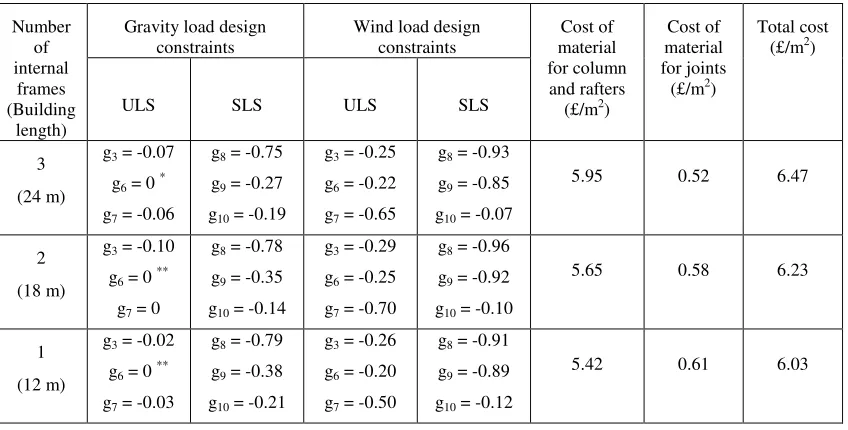
Table 6(b) and (c) summarises the results of the optimization when stressed-skin action is included for cladding thicknesses of 0.5 mm and 0.7 mm, respectively. It should be noted these results are for the semi-rigid joint assumption. Building lengths of 24, 18 and 12m were considered with, respectively, three, two and one internal frames. The main differences between these three design cases are the number of internal frames and the building length.
25
load, as opposed to end bay panels, and so more load is transferred to the considered frame.
As expected, serviceability under the wind load design cases is no longer the critical design constraint; the binding design constraint is combined bending and crushing of the web of the channel-section at the joints under the gravity load design case i.e., g6 =
0. Also, for the cladding thickness of 0.5 mm, these results suggest that the strength of the cladding may be considered critical in practice, i.e. g7 ≅ 0. For the cladding thickness of
0.7 mm the strength of the cladding would appear not to be binding in general.
5.3 Frame spacing of 4 m: without stressed-skin action
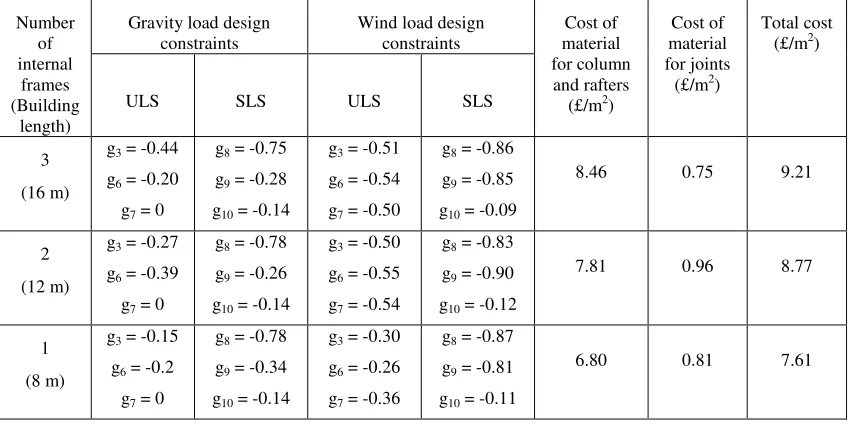
Table 7(a) summarises the results of the design optimization for both rigid and semi-rigid joints. Note that the total cost for the rigid joints is not available, because fabricating rigid cost is more complicated (Section 1) and is not factored into costs. However, Table 7(c) below shows that the optimized stressed-skin design based on a cladding thickness of 0.7mm is more economical by far. As expected, for the semi-rigid joint, the critical constraint of the horizontal deflection at the eaves under SLC2 with WLC4 is binding, i.e. g8 = 0. For the rigid-joint, the constraint of lateral-torsional
buckling controls the design, under the action of wind load (ULC2 with WLC4), i.e., g3 =
-0.02.
5.4 Frame spacing of 4 m: with stressed-skin action
26
strength of the cladding is binding. If section sizes from the rigid-joint design had therefore been adopted, the cladding would have failed. The decrease in the total cost between the building with three internal frames and the building with one internal frame is approximately 17%.
The same trend, as obtained for the frame spacing of 6 m, was observed on the different number of internal frames in cladded building. For the cladding thickness of 0.7 mm, the decrease in the total cost between the building with three internal frames and the building with one internal frame is 36% approximately. This difference (36%) is roughly similar to that of the case of the frame spacing of 6 m (31%). It should also be noted that for the frame spacing of 4m the total costs for three, two and one internal frames are similar to those for the frame spacing of 6m. The ultimate limit state under the gravity load case is critical; the binding constraint is combined bending and crushing of the web of the channel-section at the joints, i.e. g6 = 0.
6. Conclusions
The influence of stressed-skin diaphragm action on the optimal design of the internal frame of a cold-formed steel portal framing system with semi-rigid joints has been investigated. Both ultimate and serviceability limit states were considered, using deflection limits recommended by The Steel Construction Institute (SCI). Wind load combinations were included. The genetic algorithm was adopted for the optimization process which shows the robustness and reliability in searching the most economical design of considered frame. A summary of all the results provided in Fig. 16.
27
shown that the wind load design cases were no longer critical, with the binding constraint being the ultimate limit state under the gravity load case.
It was also shown for a building with three internal frames, that if the combined effect of both stressed-skin action and semi-rigidity of the joints are ignored, and the frame designed on the basis of a rigid joint assumption, that failure of the cladding system could occur before first yield of the frame.
The identified benefits of using stressed-skin action are significant. The potential savings are encouraging, but indicate a need for further studies as to when failure of the roofing could be an issue for designers when the frame is relatively flexible. BS 5950 was used in this research, as opposed to Eurocode 3 which is not yet mature. Future research will be to use Eurocode 3 for a comparison against BS 5950 and assist in the formulation of a transparent criterion for the ease of application in practical design with Eurocode 3. In addition, a study of the influence of joint stiffness on buckling length would be interesting for further research.
Acknowledgement
The financial support from the Queen’s University Belfast is gratefully acknowledged.
References
[1] Kirk P. Design of a cold-formed section portal frame building system. In proceedings of the 8th International Specialty Conference on Cold-formed Steel Structures, 11-12 November 1986 St Louis. Missouri: University of Missouri-Rolla, 295-310.
[2] Phan DT, Lim JBP, Sha W, Siew C, Tanyimboh T, Issa H and Mohammad F. Design optimization of cold-formed steel portal frames taking into account the effect of topography. Engineering Optimization 2013; 45:415–33.
[3] Saka MP. Optimum design of pitched roof steel frames with haunched rafters by genetic algorithm. Computers and Structures 2003, 81, 1967-1978.
28
[5] Phan DT, Lim JBP, Tanyimboh TT, Lawson RM, Martin S and Sha W. Effect of
serviceability limit on optimal design of steel portal frames. Journal of Constructional Steel Research, 2013, 86, 74-84.
[6] Mosquera JC and Gargoum LA. A sequential algorithm for minimum weight design of 2-D steel portal frame using Eurocode 3. International Journal of Steel Structures 2014; 14(1), 141-149.
[7] Hernández S, Fontán A N, Perezzán J.C and Loscos, P. Design optimization of steel portal frames. Advances in Engineering Software 2005, 36, 626-633.
[8] Kravanja S, Turkalj G, Šilih S and Žula T. Optimal design of single-story steel building structures based on parametric MINLP optimization. Journal of Constructional Steel Research 2013, 81, 86-103.
[9] SCI Advisory Desk. AD-090: Deflection limits for pitched roof portal frames (Amended). Ascot: The Steel Construction Institute, 2010.
[10] Lim JBP and Nethercot DA. Stiffness prediction for bolted moment-connections between cold-formed steel members. Journal of Constructional and Steel Research 2004; 60:85-107. [11] Lim JBP and Nethercot DA. Finite element idealization of a cold-formed steel portal frame.
Journal of Structural Engineering, ASCE 2004; 130(1):78-94.
[12] Davies JM. Computer analysis of stressed-skin buildings. Civil Engineering and Public Works Review 1972; 1154-1157.
[13] British Standard. BS 5950: Structural use of steelworks in building. Part 9. Code of practice for stressed-skin design. London: British Standards Institution, 1994.
[14] Davies JM and Bryan ER. Manual of stressed skin diaphragm design. London: Granada, 1982.
[15] Bryan ER. The stressed-skin design of steel buildings. Department of Civil Engineering Report. University of Salford, 1971.
[16] Davies JM. The plastic collapse of framed structures clad with corrugated steel sheeting. ICE Proceedings, 1973; 55:23-42.
[17] Bates W, Bryan ER and El-dakhakhni WM. Full-scale tests on a portal frame shed. The Structural Engineer 1965; 43:199-208.
[18] Bryan ER and Mohsin M E. The design and testing of a steel building taking account of the sheeting. The International Association of Bridge and Structural Engineering, 9th
Congress, Preliminary Report, Amsterdam, 1972; 305-314.
[19] Strnad M and Pirner M. Static and dynamic full-scale tests on a portal frame structure. The Structural Engineer, 1978; 56:45-52.
[20] Davies JM, Engel P, Liu TTC and Morris LJ. Realistic model of steel portal frame behavior. The Structural Engineer, 1990; 68(1):30-35.
[21] Heldt TJ and Mahendran M. Full scale experiments of a steel portal frame building. Journal of the Australian Steel Institute, Steel Construction, 1998; 32:3-21.
[22] Wrzesien AM, Lim JBP, Xu Y, Dundu M, Macleod I and Lawson RM. Stressed skin effects on cold-formed steel portal frames with semi-rigid joints - experimental study. The 6th International Conference on Coupled Instabilities in Metal Structures, Glasgow, 2012. [23] Wrzesien AM, Lim JBP and Nethercot DA. Optimum joint detailed for a general
cold-formed steel portal frame. Advanced Structures Engineering, 2012; 15(9):1635-51. [24] Davies JM and Lawson RM. Stressed skin action of modern steel roof systems. The
29
[25] British Standards. BS 6399: Loading for buildings. London: British Standards Institution, 2002.
[26] CSB. Purlins, rails and eaves beams. Cumbria: Steadmans and Son 2012.
[27] British Standards. BS 5950: Structural use of steelworks in building. Part 5. Code of practice for design of cold-formed thin gauge sections. London: British Standards Institution. London: British Standards Institution, 1998.
[28] CSB. Single skin system. Cumbria: Steadmans and Son 2012.
[29] British Standards. BS 5950: Structural use of steelworks in building. Part 1. Code of practice for design – Rolled and welded sections. London: British Standards Institution, 2001.
[30] Zandanfarrokh F and Bryan ER. Testing and design of bolted connections in cold-formed steel sections. In proceedings of the 11th International Specialty Conference on Cold-formed Steel Structures, 20-21 October 1992 St Louis. Missouri: University of Missouri-Rolla, 625-662.
[31] ANSYS Inc. Programmer’s manual for mechanical APDL. USA: SAS IP, 2009.
[32] Dubina D, Ungureanu V and Landolfo R. Design of cold-formed steel structures. Berlin: Wiley-Blackwell Inc, 2012.
[33] Deb K and Agrawal RB. Simulated binary crossover for continuous space. Complex Systems, 1995; 9(2):115-148.
[34] Deb K and Gulati S. Design of truss-structures for minimum weight using genetic algorithms. Finite Element in Analysis and Design, 2001; 37:447-465.
[35] Deb K. An efficient constraint handling method for genetic algorithms. Computer Methods in Applied Mechanics and Engineering, 2000; 186:311-338.
[36] Deb K. Multi-objective optimization using evolutionary algorithms. Chichester: John Wiley and Sons Inc, 2001.
30
Table captions
Table 1 Deflection limits for steel portal frames recommended by SCI [9]
Table 2 Dimensions and section properties of cold-formed steel channel sections Table 3 Parameters used in calculations of diaphragm roof characteristic
Table 4 Shear properties of panels (a) 6 m frame spacing; (b) 4 m frame spacing Table 5 Mechanical properties of fasteners (after BS 5950-Part 9 Table 5 [13]) Table 6 Optimal solutions for frame spacing of 6 m (a) Stressed-skin action not
considered; (b) Influence of stressed-skin action pertaining to cladding thickness of 0.5 mm; (c) Influence of stressed-skin action pertaining to cladding thickness of 0.7 mm Table 7 Optimal solutions for frame spacing of 4 m (a) Stressed-skin action not
31
Figure captions
Fig. 1 Details of joints for cold-formed steel portal framing system (a) Eaves joint with swages [1]
(b) Eaves joint without swages (c) Apex joint without swages
Fig. 2 Area on floor of building to define unit cost within frame spacing Fig. 3 Details of bolt-group resisting moment
Fig. 4 Free body diagram of channel-section when joint is in pure bending (a) Details of typical channel-section and bolt-group
(b) Free body diagram
Fig. 5 Stressed-skin action in buildings (after BS 5950-Part 9 [13]) (a) Stressed-skin action under horizontal loads
(b) Stressed-skin action under vertical loads
Fig. 6 Geometry of internal frame of building (position of purlins and side rails also shown)
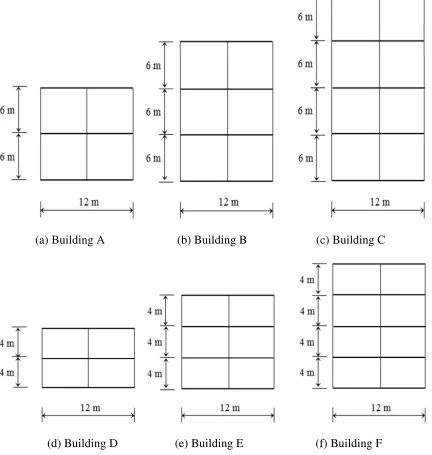
Fig. 7 Plan view of buildings considered to investigate the effect of stressed-skin action (a) Building A; (b) Building B; (c) Building C; (d) Building D; (e) Building E; (f) Building F
Fig. 8 Details of back-to-back cold-formed steel channel-sections
Fig. 9 Fastener arrangement of the roof diaphragm 6.09/6/0.7 for internal frame Fig. 10 Wind load cases (a) WLC1; (b) WLC2; (c) WLC3; (d) WLC4; (e) WLC5; (f) WLC6
Fig. 11 Frame analysis model of building having two internal frames (lateral restraints provided by purlin and side rails not shown)
Fig. 12 Parameters used to define semi-rigid joints of internal frame Fig. 13 Brackets and bolt-group sizes (a) Eaves joint; (b) Apex joint Fig. 14 Flowchart of real-coded niching genetic algorithm (RC-NGA) Fig. 15 Convergence history for a sample optimization run
32
[image:32.595.170.435.155.286.2]TABLES
Table 1 Deflection limits for steel portal frames recommended by SCI [9]
Absolute deflection Differential deflection relative to adjacent frame Lateral deflection at eaves 100 hf ≤ 200 bf ≤ Vertical deflection
at apex - 100
bf
≤
[image:32.595.92.527.367.598.2]and b s2 125 f 2 f +
Table 2 Dimensions and section properties of cold-formed steel channel sections
No Section D (mm)
B (mm)
t (mm)
EA(x102) (kN)
EI(x106)
(kN.mm2) (kNm) Mc (kN/mm) kb* Weight (kg/m) (£/m) Cost 1 C15014 152 64 1.4 858.95 314.47 6.49 4.72 3.29 4.04 2 C15016 152 64 1.6 981.95 356.91 7.91 5.27 3.76 4.23 3 C15018 152 64 1.8 1100.85 398.75 9.24 5.81 4.21 4.74 4 C15020 152 64 2.0 1219.75 439.52 10.48 6.32 4.67 5.19 5 C20015 203 76 1.5 1145.95 733.08 10.29 5.00 4.38 5.02 6 C20016 203 76 1.6 1221.80 780.03 11.44 5.27 4.67 5.31 7 C20018 203 76 1.8 1371.45 872.89 13.74 5.81 5.25 5.98 8 C20020 203 76 2.0 1521.10 964.16 15.93 6.32 5.82 6.56 9 C20025 203 76 2.5 1888.05 1185.31 20.96 7.50 7.23 8.12 10 C25018 254 76 1.8 1555.95 1476.62 17.36 5.81 5.96 7.00 11 C25020 254 76 2.0 1726.10 1632.21 20.26 6.32 6.61 7.95 12 C25025 254 76 2.5 2144.30 2010.85 27.03 7.50 8.21 9.88 13 C25030 254 76 3.0 2556.35 2374.11 33.35 8.57 9.79 11.82 14 C30025 300 95 2.5 2558.40 3400.54 36.42 7.50 9.80 11.18 15 C30030 300 95 3.0 3052.45 4027.64 46.01 8.57 11.69 13.04 16 C40025 400 100 2.5 3122.15 6987.22 50.02 7.50 11.96 17.52 17 C40030 400 100 3.0 3733.05 8296.35 65.09 8.57 14.29 21.74 * Values for kb calculated pertain to a single channel connected to a bracket of 3 mm, in accordance with design expressions provided by Zadanfarrokh and Bryan [30]:
33
Table 3 Parameters used in calculations of diaphragm roof characteristic
sf /bf /t ns nsc np nsh nf pend pint u Iy K Aep
m/m/mm mm mm mm mm4 mm2
6.09/6/0.7 15 12 5 6 5 200 400 230 19285 0.054 435
6.09/6/0.5 15 12 5 6 3 400 400 230 14253 0.284 435
6.09/4/0.7 15 12 5 4 5 200 400 230 19285 0.054 381
6.09/4/0.5 15 12 5 4 3 400 400 230 14253 0.284 381
sf – depth of the shear panel
bf – width of the shear panel
t – sheet thickness including coating
ns – number of seam fasteners excluding those passing through sheet and purlin nsc – number of shear connectors fasteners along the one side of the sheet
np – number of purlins within the diaphragm
nsh – number of sheets within the diaphragm
nf – number of fasteners per sheet width at the end of the sheet
pend – fasteners spacing at the end purlin
pint – fasteners spacing at the intermediated purlins
u – perimeter length of a complete single corrugation
Iy – second moment of area of single corrugation about its neutral axis
K – sheeting constant
34 Table 4 Shear properties of panels
(a) 6 m frame spacing Cladding thickness (mm) Number of internal frames Panel designation
sf /bf /t
Equivalent diagonal stiffness
ks (kN/mm)
0.5 3 6.09/6/0.5 2.207
0.5 2 6.09/6/0.5 2.317
0.5 1 6.09/6/0.5 2.347
0.7 3 6.09/6/0.7 5.315
0.7 2 6.09/6/0.7 6.001
0.7 1 6.09/6/0.7 6.200
(b) 4 m frame spacing Cladding thickness (mm) Number of internal frames Panel designation
sf /bf /t
Equivalent diagonal stiffness
ks (kN/mm)
0.5 3 6.09/4/0.5 2.597
0.5 2 6.09/4/0.5 2.616
0.5 1 6.09/4/0.5 2.537
0.7 3 6.09/4/0.7 7.031
0.7 2 6.09/4/0.7 7.165
[image:34.595.77.358.113.442.2]0.7 1 6.09/4/0.7 6.607
Table 5 Mechanical properties of fasteners (after BS 5950-Part 9 Table 5 [13]) Fastener type Design resistance /
sheet thickness
F
Slip
S (kN/mm) (mm/kN) 5.5 mm diameter screws + neoprene
washer (sheet fasteners) 4.72 0.35 6.3 mm diameter screws + neoprene
washer (seam and shear connector fastener) 5.90 0.35
35 Table 6 Optimal solutions for frame spacing of 6 m (a) Stressed-skin action not considered
Gravity load design
constraints Wind load design constraints material Cost of for column and rafters
(£/m2)
Cost of material for joints
(£/m2)
Total cost (£/m2)
ULS SLS ULS SLS
Rigid joints g2 = -0.24 g8 = -0.87
g9 = -0.62
g2 = -0.16 g8 = -0.21
g9 = -0.66
6.60 -
-Semi-rigid
joints g6 = -0.12 g8 = -0.90 g9 = -0.69
g6 = -0.07 g8 = 0
g9 = -0.89
6.60 0.51 7.11
(b) Influence of stressed-skin action pertaining to cladding thickness of 0.5 mm Number of internal frames (Building length)
Gravity load design
constraints Wind load design constraints material Cost of for column and rafters
(£/m2)
Cost of material for joints
(£/m2)
Total cost (£/m2)
ULS SLS ULS SLS
3 (24 m)
g3 = -0.07 g6 = 0 * g7 = -0.06
g8 = -0.75 g9 = -0.27 g10 = -0.19
g3 = -0.25 g6 = -0.22 g7 = -0.65
g8 = -0.93 g9 = -0.85 g10 = -0.07
5.95 0.52 6.47
2
(18 m)
g3 = -0.10 g6 = 0 **
g7 = 0
g8 = -0.78 g9 = -0.35 g10 = -0.14
g3 = -0.29 g6 = -0.25 g7 = -0.70
g8 = -0.96 g9 = -0.92 g10 = -0.10
5.65 0.58 6.23
1 (12 m)
g3 = -0.02 g6 = 0 ** g7 = -0.03
g8 = -0.79 g9 = -0.38 g10 = -0.21
g3 = -0.26 g6 = -0.20 g7 = -0.50
g8 = -0.91 g9 = -0.89 g10 = -0.12
5.42 0.61 6.03
36
(c) Influence of stressed-skin action pertaining to cladding thickness of 0.7 mm Number of internal frames (Building length)
Gravity load design constraints
Wind load design constraints
Cost of
material for column and rafters
(£/m2)
Cost of material for joints
(£/m2)
Total cost (£/m2)
ULS SLS ULS SLS
3
(24 m)
g3 = -0.10 g6 = 0 * g7 = -0.38
g8 = -0.73 g9 = -0.20 g10 = -0.48
g3 = -0.15 g6 = -0.10 g7 = -0.54
g8 = -0.89 g9 = -0.80 g10 = -0.19
5.75 0.52 6.27
2 (18 m)
g3 = -0.04 g6 = 0 ** g7 = -0.23
g8 = -0.78 g9 = -0.30 g10 = -0.30
g3 = -0.18 g6 = -0.11 g7 = -0.55
g8 = -0.91 g9 = -0.85 g10 = -0.21
4.98 0.55 5.53
1
(12 m)
g3 = -0.08 g6 = 0 ** g7 = -0.26
g8 = -0.78 g9 = -0.30 g10 = -0.30
g3 = -0.30 g6 = -0.05 g7 = -0.55
g8 = -0.87 g9 = -0.81 g10 = -0.22
3.78 0.54 4.32
37 Table 7 Optimal solutions for frame spacing of 4 m (a) Stressed-skin action not considered
Gravity load design
constraints Wind load design constraints material Cost of for column and rafters
(£/m2)
Cost of material for joints
(£/m2)
Total cost (£/m2)
ULS SLS ULS SLS
Rigid joints g3 = -0.12 g8 = -0.75
g9 = -0.26
g3 = -0.02 g8 = -0.08
g9 = -0.60
7.81 - -
Semi-rigid
joints g3 = -0.49 g8 = -0.76 g9 = -0.32
g2 = -0.44 g8 = 0
g9 = -0.89
9.88 0.84 10.72
(b) Influence of stressed-skin action pertaining to cladding thickness of 0.5 mm Number of internal frames (Building length)
Gravity load design
constraints Wind load design constraints material Cost of for column and rafters
(£/m2)
Cost of material for joints
(£/m2)
Total cost (£/m2)
ULS SLS ULS SLS
3 (16 m)
g3 = -0.44 g6 = -0.20 g7 = 0
g8 = -0.75 g9 = -0.28 g10 = -0.14
g3 = -0.51 g6 = -0.54 g7 = -0.50
g8 = -0.86 g9 = -0.85 g10 = -0.09
8.46 0.75 9.21
2
(12 m)
g3 = -0.27 g6 = -0.39 g7 = 0
g8 = -0.78 g9 = -0.26 g10 = -0.14
g3 = -0.50 g6 = -0.55 g7 = -0.54
g8 = -0.83 g9 = -0.90 g10 = -0.12
7.81 0.96 8.77
1 (8 m)
g3 = -0.15 g6 = -0.2
g7 = 0
g8 = -0.78 g9 = -0.34 g10 = -0.14
g3 = -0.30 g6 = -0.26 g7 = -0.36
g8 = -0.87 g9 = -0.81 g10 = -0.11
38
(c) Influence of stressed-skin action pertaining to cladding thickness of 0.7 mm Number of internal frames (Building length)
Gravity load design constraints
Wind load design constraints
Cost of
material for column and rafters
(£/m2)
Cost of material for joints
(£/m2)
Total cost (£/m2)
ULS SLS ULS SLS
3
(16 m)
g3 = -0.04 g6 = 0 * g7 = -0.17
g8 = -0.66 g9 = -0.01 g10 = -0.22
g3 = -0.43 g6 = -0.01 g7 = -0.50
g8 = -0.86 g9 = -0.85 g10 = -0.21
5.78 0.86 6.64
2 (12 m)
g3 = -0.15 g6 = 0 * g7 = -0.02
g8 = -0.70
g9 = -0.07 g10 = -0.05
g3 = -0.45 g6 = 0 g7 = -0.28
g8 = -0.83 g9 = -0.90 g10 = -0.21
4.67 0.54 5.21
1
(8 m)
g3 = -0.04 g6 = 0 * g7 = -0.35
g8 = -0.79 g9 = -0.26 g10 = -0.41
g3 = -0.31 g6 = -0.01 g7 = -0.54
g8 = -0.87 g9 = -0.81 g10 = -0.23
3.85 0.37 4.22
39
FIGURES
(a) Eaves joint with swages [1]
[image:39.595.112.484.82.475.2](b) Eaves joint without swages (c) Apex joint without swages Figure 1: Details of joints for cold-formed steel portal framing system
40
Figure 3: Details of bolt-group resisting moment
(a) Details of typical channel-section and bolt-group
(b) Free body diagram
Figure 4: Free body diagram of channel-section when joint is in pure bending
A
A
Section A-A
aB
bB
[image:40.595.98.459.251.440.2]41
(a) Stressed-skin action under horizontal loads
[image:41.595.170.431.75.209.2](b) Stressed-skin action under vertical loads
[image:41.595.165.438.518.634.2]Figure 5: Stressed-skin action in buildings (after BS 5950-Part 9 [13])
42
(a) Building A (b) Building B (c) Building C
[image:42.595.86.518.80.535.2](d) Building D (e) Building E (f) Building F
43
Figure 8: Details of back-to-back cold-formed steel channel-sections
[image:43.595.151.447.274.638.2]Cross-section A-A
44
45
(a) WL1 (b) WLC2
(c) WLC3 (d) WLC4
[image:45.595.88.696.82.489.2]
46
Figure 12: Beam idealization of building having two internal frames (gables idealised as stiff and rigid in-plane; lateral restraints at purlin and side rail positions not shown)
Figure 13: Parameters used to define semi-rigid joints of internal frame
[image:46.595.98.506.397.550.2]47 (a) Eaves joint
[image:47.595.166.436.67.384.2](b) Apex joint
Figure 14: Brackets and bolt-group sizes
Figure 15: Convergence history for a sample optimization run
0 5 10 15 20 25 30 35 40 45
0 50 100 150 200 250
T
ot
al
uni
t c
os
t (
£/
m
2)
Generations
Best fitness
[image:47.595.137.496.447.670.2]48
![Table 1 Deflection limits for steel portal frames recommended by SCI [9]](https://thumb-us.123doks.com/thumbv2/123dok_us/1607473.113677/32.595.170.435.155.286/table-deflection-limits-steel-portal-frames-recommended-sci.webp)

![Figure 5: Stressed-skin action in buildings (after BS 5950-Part 9 [13])](https://thumb-us.123doks.com/thumbv2/123dok_us/1607473.113677/41.595.170.431.75.209/figure-stressed-skin-action-buildings-bs.webp)