METHOD DEVELOPMENT AND VALIDATION FOR THE SIMULTANEOUS ESTIMATION OF ILAPRAZOLE AND DOMPERIDONE IN CAPSULE DOSAGE
FORM BY UPLC
A DissertationSubmitted to
THE TAMIL NADU Dr. M.G.R. MEDICAL UNIVERSITY CHENNAI - 600032
In partial fulfilment of the requirements for the award of the Degree of
MASTER OF PHARMACY
IN
BRANCH-V-> PHARMACEUTICAL ANALYSIS
Submitted By
RAVI DASGUPTA Reg.No:261430013
Under the Guidance of
Dr. C.N NALINI, M.Pharm., Ph.D Professor and HOD
Department of Pharmaceutical Analysis
C.L. BAID METHA COLLEGE OF PHARMACY
THORAIPAKKAM, CHENNAI – 600097
Dr. C.N NALINI, M. Pharm., Ph.D Professor and HOD
Department of Pharmaceutical Analysis
This is to certify that the project
VALIDATION FOR THE SIMULTANEOUS ESTIMATION OF DOMPERIDONE IN CAPSULE DOSAGE FORM BY UPLC No. 261430013in partial fulfillment
(Pharmaceutical Analysis). LAB, PONDYCHERRY and C.L.
my supervision during the academic year 2014
Date:
Place: Chennai
M. Pharm., Ph.D.
Department of Pharmaceutical Analysis
CERTIFICATE
This is to certify that the project entitled,“METHOD DEVELOPMENT AND
VALIDATION FOR THE SIMULTANEOUS ESTIMATION OF ILAPRAZOLE DOMPERIDONE IN CAPSULE DOSAGE FORM BY UPLC”submitted
fulfillment for the award of degree of Master of Pharmacy
(Pharmaceutical Analysis). The project was carried out at IDEAL ANALYTICAL LAB, PONDYCHERRY and C.L.Baid Metha College of Pharmacy, Chennai
on during the academic year 2014-2016.
Dr. C.N NALINI, M. Pharm., Ph.D Professor and HOD
Department of Pharmaceutical
C.L. Baid Metha college of Pharmacy
Chennai - 600097
METHOD DEVELOPMENT AND ILAPRAZOLE AND submitted by Regd.
Master of Pharmacy carried out at IDEAL ANALYTICAL
ollege of Pharmacy, Chennai-97 under
. Pharm., Ph.D.
artment of Pharmaceutical Analysis
Dr. Grace Rathnam, M.Pharm., Ph.D Principal
This is to certify that the project entitled
VALIDATION FOR THE SIMULTANEOUS ESTIMATION OF DOMPERIDONE IN CAPSULE DOSAGE FORM BY UPLC No. 261430013in partial fulfillment for the award of degree of (Pharmaceutical Analysis).
LAB PONDYCHERRY and C.L.Baid
the guidance of Dr. C.N Nalini
Date:
PLACE: Chennai
Dr. Grace Rathnam, M.Pharm., Ph.D.
CERTIFICATE
This is to certify that the project entitled “METHOD DEVELOPMENT AND VALIDATION FOR THE SIMULTANEOUS ESTIMATION OF ILAPRAZOLE
DOMPERIDONE IN CAPSULE DOSAGE FORM BY UPLC”submitted
in partial fulfillment for the award of degree of Master of Pharmacy
(Pharmaceutical Analysis). The projectwas carried out at IDEAL ANALYTICAL LAB PONDYCHERRY and C.L.Baid Metha college of Pharmacy, Chennai
Dr. C.N Nalini, M. Pharm., Ph.D. during academic year 201
Dr. Grace Rathnam M. Pharm., Ph.D Principal
C.L.Baid Metha College of Pharmacy,
Chennai - 600097
METHOD DEVELOPMENT AND ILAPRAZOLE AND submitted by Regd.
Master of Pharmacy was carried out at IDEAL ANALYTICAL
Metha college of Pharmacy, Chennai-97 under
during academic year 2014-2016
Grace Rathnam M. Pharm., Ph.D.
DECLARATION
I hereby declare that this dissertation entitled, “METHOD DEVELOPMENT AND VALIDATION FOR THE SIMULTANEOUS ESTIMATION OF ILAPRAZOLE AND DOMPERIDONE IN CAPSULE DOSAGE FORM BY UPLC”has been originally carried out by me under the guidance and supervision of Dr. C.N Nalini, M. Pharm.,
Ph.D., Department of Pharmaceutical Analysis, C.L.Baid Metha College of Pharmacy, Chennai – 97 during the academic year 2014-2016. The work embodied
in this thesis is original, and is not submitted in part or full for any other degree of this
or any other University.
Date: [Reg. No: 261430013]
Acknowledgement
“Success is how high you bounce when you hit bottom” “If you can dream it, you can do it”
It affords me an immense pleasure to acknowledge with gratitude the help
and guidance rendered to me by a host of people, whom, I owe a substantial
measure for the completion of the dissertation.
Firstly, I glad to have the blessings of God and my Parents in the
implementation of our thought of doing this project. I thank God for providing me
strength and power to overcome all the hurdles and hindrances that come in the way
of doing the project work.
I take this golden opportunity to express my humble gratitude and respect to
my guide Dr. C.N Nalini, M. Pharm., Ph.D., Professorand HOD, Department of
Pharmaceutical Analysis, C.L.Baid Metha College of Pharmacy, Chennai – 97, for
her inspiring guidance, constant encouragement and intellectual suggestions
throughout the course of the dissertation.
I express our profound sense of gratitude to our honorable PrincipleDr. Grace
Rathnam, M. Pharm., Ph.D. Principal, C.L.Baid Metha College of Pharmacy.
I acknowledge my sincere thanks to Dr. Vijaya Nagarajan, M. Pharm., Ph.D.,
Dr. Amuthalakshmi, M. Pharm., Ph.D., C.L Baid Metha College of Pharmacy, for
their valuable suggestions throughout my thesis work.
I would like to use this opportunity to thank K. Maruthappapandian and R.
Parmaguru, Managing Directors, Ideal Analytical and Research Institution
Pondicherryfor their kind co-operation rendered in fulfilling my work.
I would like to thank Mr. Srinivasa Raghavan, Stores In-Charge, Mrs.
Yogeswari lab assistant Mr. Ganesh Bahadur Security officer for their help to fulfil
I extend my sincere thanks to Librarian M. Rajalakskmi, C.L Baid Metha
College of Pharmacy in helping me to utilize the library facilities for references.
I thank all non-teaching staff members of our college including Mrs. R. Usha,
Mrs. Valli and Mrs. A.P. Kalpakam for their help extended during my project work.
I profusely thank to all my classmates and juniors for their timely help and
good wishes.
And also I thank one and all, who helped me directly or indirectly for the
successful completion of my project work.
Last but not least I am highly grateful and dedicated to my sistersfor their
moral support.
Date: RAVI DASGUPTA
Reg.No: 261430013
i
CONTENTS
CHAPTER
NO.
TITLE
PAGE
NO.
1
INTRODUCTION
1-32
2
DRUG PROFILE
33-38
3
LITERATURE REVIEW
39-44
4
AIM AND PLAN OF WORK
45-47
5
MATERIALS AND EQUIPMENTS
48-50
6
ANALYTICAL METHOD DEVELOPMENT
AND OPTIMIZTION
51-70
7
VALIDATION OF DEVELOPED METHOD
71-103
8
RESULTS AND DISCUSSION
104-108
9
SUMMARY AND CONCLUSION
109-112
ii
LIST OF TABLES
TABLE
NO. TITLE
PAGE NO.
1.1 Comparison between and HPLC and UPLC 18 1.2 Literature from industrial committees and regulatory agencies 27 1.3 Comparison of Validation Parameters Required for HPLC Assay Methods 28 5.1 List of instruments used during validation studies 49 5.2 List of chemicals used during validation studies 50 6.1 Results of System Suitability Domperidone 60 6.2 Results of System Suitability Ilaprazole 61 6.3 Linearity results for Domperidone and Ilaprazole 65 6.4 Tabular column for the assay of Capsule sample 70 7.1 Results of System Suitability Domperidone 78 7.2 Results of System Suitability Ilaprazole 79 7.3 Tabular column for the assay of Capsule sample 82 7.4 Linearity results for Domperidone and Ilaprazole 86 7.5 Tabular Column for Recovery Solution 89 7.6 Accuracy results of Domperidone 94 7.7 Accuracy results of Ilaprazole 95 7.8 Method precision results for Domperidone & Ilaprazole 98
7.9 LOD & LOQ Determination 99
iii
[image:10.595.47.540.69.715.2]LIST OF FIGURES
FIGURE
NO. TITLE
PAGE NO.
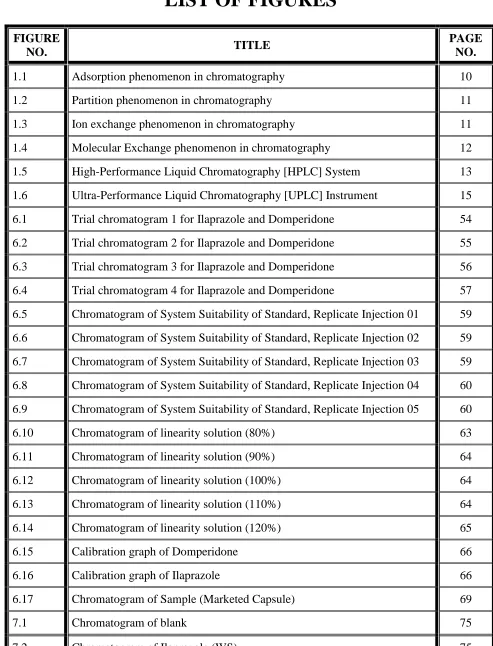
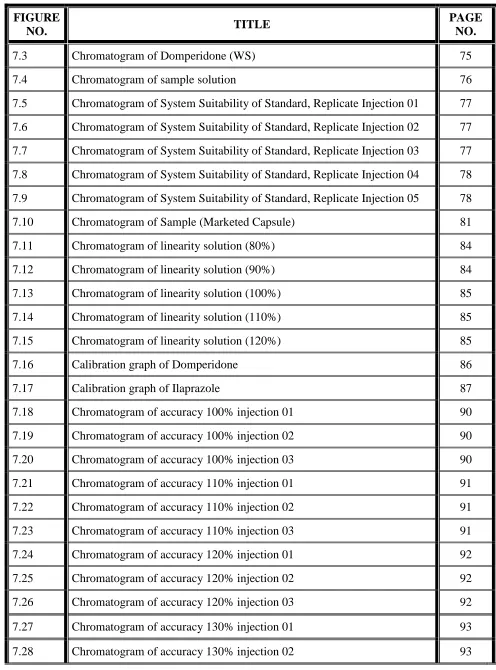
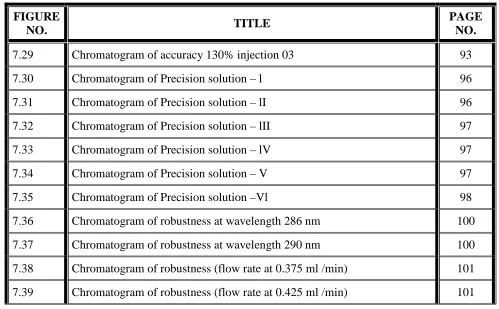
1.1 Adsorption phenomenon in chromatography 10 1.2 Partition phenomenon in chromatography 11 1.3 Ion exchange phenomenon in chromatography 11 1.4 Molecular Exchange phenomenon in chromatography 12 1.5 High-Performance Liquid Chromatography [HPLC] System 13 1.6 Ultra-Performance Liquid Chromatography [UPLC] Instrument 15 6.1 Trial chromatogram 1 for Ilaprazole and Domperidone 54 6.2 Trial chromatogram 2 for Ilaprazole and Domperidone 55 6.3 Trial chromatogram 3 for Ilaprazole and Domperidone 56 6.4 Trial chromatogram 4 for Ilaprazole and Domperidone 57 6.5 Chromatogram of System Suitability of Standard, Replicate Injection 01 59 6.6 Chromatogram of System Suitability of Standard, Replicate Injection 02 59 6.7 Chromatogram of System Suitability of Standard, Replicate Injection 03 59 6.8 Chromatogram of System Suitability of Standard, Replicate Injection 04 60 6.9 Chromatogram of System Suitability of Standard, Replicate Injection 05 60 6.10 Chromatogram of linearity solution (80%) 63 6.11 Chromatogram of linearity solution (90%) 64 6.12 Chromatogram of linearity solution (100%) 64 6.13 Chromatogram of linearity solution (110%) 64 6.14 Chromatogram of linearity solution (120%) 65 6.15 Calibration graph of Domperidone 66 6.16 Calibration graph of Ilaprazole 66 6.17 Chromatogram of Sample (Marketed Capsule) 69
7.1 Chromatogram of blank 75
iv
FIGURE
NO. TITLE
PAGE NO.
v
FIGURE
NO. TITLE
PAGE NO.
LIST OF ABBEREVIATIONS
ACN : Acetonitrile
API : Active Pharmaceutical Ingredient
AR : Analytical Reagent
AU : Absorbance unit
BP : British Pharmacopoeia
DPD : Domperidone
FDA : Food and Drug Administration
gm : Gram
HPLC : High-Performance Liquid Chromatography
ICH : International Conference on Harmonization
ID : Internal diameter
IP : Indian Pharmacopoeia
IPZ : Ilaprazole
LC : Liquid Chromatography
LOD : Limit of Detection
LOQ : Limit of Quantification
mg : Milligram
min : Minute
ml : millilitre
N : Theoretical Plates
NMT : Not More Than
NLT : Not Less Than
nm : Nanometer
QA : Quality Assurance
QC : Quality Control
R2 : Correlation Coefficient
RP-HPLC : Reverse Phase High-Performance Liquid Chromatography
RP-UPLC : Reverse Phase Ultra-Performance Liquid Chromatography
RS : Related Substance
RSD : Relative Standard Deviation
S/N : Signal / Noise
SD : Standard Deviation
UPLC : Ultra- Performance Liquid Chromatography
USP : United States Pharmacopoeia
v/v : Volume / Volume
METHOD DEVELOPMENT AND VALIDATION FOR THE SIMULTANEOUS ESTIMATION OF ILAPRAZOLE AND DOMPERIDONE IN CAPSULE DOSAGE FORM BY UPLC
Department of Pharmaceutical Analysis Page 1
METHOD DEVELOPMENT AND VALIDATION FOR THE SIMULTANEOUS ESTIMATION OF ILAPRAZOLE AND DOMPERIDONE IN CAPSULE DOSAGE FORM BY UPLC
Department of Pharmaceutical Analysis Page 2
1. INTRODUCTION
Pharmaceutical analysis plays a vital role in the Quality Assurance and Quality control of
bulk drugs. Analytical chemistry involves separation, identification, and determining the relative amounts of components in a sample matrix. Pharmaceutical analysis is a specialized branch of analytical chemistry that derives its principles from various branches of sciences like physics, microbiology, nuclear science, and electronics etc. Qualitative analysis is required before a quantitative analysis can be undertaken.
Analytical chemistryis defined asthescience and art of developing sensitive, reliable and accurate method for determining the composition of materials in terms of elements or compounds which they contain. Pharmaceutical analysis comprises those procedures necessary to determine the identity, strength, quality and purity of drug and chemicals Pharmaceutical analysis deals mainly with bulk materials, dosage forms and more recently, biological samples in support of bio-pharmaceutical and pharmacokinetic studies.[1]
Pharmaceutical analysts in research and development (R&D) of pharmaceutical industry plays a very comprehensive role in new drug development and follow up activities toassure that a new drug product meets the established standards, its stability and continued to meet the purported quality throughout its shelf life.
The different activity of R&D includes drug development, (synthesis and manufacture), formulation, clinical trials, evaluations and finally launching i.e. finished products. Closelyassociated with these are regulatory and quality assurance functions.
METHOD DEVELOPMENT AND VALIDATION FOR THE SIMULTANEOUS ESTIMATION OF ILAPRAZOLE AND DOMPERIDONE IN CAPSULE DOSAGE FORM BY UPLC
Department of Pharmaceutical Analysis Page 3
created revolutionary precision and accuracy in quantification of drugs in Formulation and in biological fluids even at low concentration.[2]
Need for pharmaceutical Analysis[3]
New drug development.
Method Validation as for ICH Guidelines Research in Pharmaceutical Sciences Clinical Pharmacokinetic Studies
When promising results are obtained from explorative validation performed during the method development phase, then only full validation should be stared. The process of validating a method cannot be separated from the actual development of method conditions.
A diversity of analytical techniques such as spectroscopy (UV-Visible), gas chromatography (GC), high performance liquid chromatography (HPLC), Ultra performance liquid chromatography (UPLC) supercritical fluid chromatography (SFC), capillary electrophoresis (CE) coupled with selective detectors (diode-array detector (DAD) and mass spectrometry (MS) are normally used to accomplish the above requirements.
METHOD DEVELOPMENT AND VALIDATION FOR THE SIMULTANEOUS ESTIMATION OF ILAPRAZOLE AND DOMPERIDONE IN CAPSULE DOSAGE FORM BY UPLC
Department of Pharmaceutical Analysis Page 4
Correspondingly, HPLC or UPLC methods are profusely used in the field of biomedical analysis, viz. therapeutic drug monitoring, pharmacokinetic and bioequivalence studies. The assay of drugs in blood, plasma and tissues presents analytical challenges. The drug substance is typically present at low concentrations, bound to proteinaceous material and endogenous compounds typically present in the samples can interfere with the analysis. For these reasons, the analytical methods usually be highly sensitive to detect analytes at low concentrations and required a sample pre-treatment procedure such as liquid-liquid extraction (LLE) or solid phase extraction (SPE), to isolate the analyte from the complex biological matrix. Hence, high sensitivity and automation of sample processing tools to deal with large number of samples are strong incentives for the consideration of HPLC or UPLC methods in biomedical analysis.
UPLC comes from HPLC .Ultra Performance Liquid Chromatography (UPLC) is a relatively new technique giving new possibilities in liquid chromatography, especially concerning decrease of time and solvent consumption. This enhanced the demand for UPLC methods for the simultaneous determination of drugs in pharmaceutical mixtures.[4]
1.1 TYPES
Traditionally, analytical chemistry has been split in to two main types, qualitative and quantitative:
1.1.1 Qualitative
• Qualitative inorganic analysis seeks to establish the presence of a given element or inorganic compound in sample.
METHOD DEVELOPMENT AND VALIDATION FOR THE SIMULTANEOUS ESTIMATION OF ILAPRAZOLE AND DOMPERIDONE IN CAPSULE DOSAGE FORM BY UPLC
Department of Pharmaceutical Analysis Page 5
1.1.2Quantitative
•
Quantitative analysis seeks to establish the amount of given element or compound in a sample.Most modern analytical chemistry is categorized by two different approaches such asAnalyticaltargets or analytical methods[5].
By Analytical Targets
• Bio analytical chemistry
• Material analysis
• Chemical analysis
• Environmental analysis
• Forensics
By Analytical Methods
• Spectroscopy
• Mass spectroscopy
• Spectrophotometry and colorimetric
• Chromatography and Electrophoresis
• Crystallography
• Microscopy
• Electrochemistry
Traditional analytical techniques
• Titration
• Gravimetry
• Inorganic qualitative analysis
Instrumental analysis
• Spectroscopy
• Mass spectroscopy
• Crystallography
• Electrochemical Analysis
• Thermal analysis
• Separation
• Hybrid Techniques
• Microscopy
Analytical chemistry research is largely driven by performance (sensitivity, selectivity, robustness, linear range , accuracy, precision, and speed), and cost ( purchase, operation, training, time, and space).
Analytical chemistry has played critical roles In the understanding of basic science to a variety of practical applications, such as biomedical applications, environmental monitoring, quality control of industrial manufacturing, forensic science and so on.
METHOD DEVELOPMENT AND VALIDATION FOR THE SIMULTANEOUS ESTIMATION OF ILAPRAZOLE AND DOMPERIDONE IN CAPSULE DOSAGE FORM BY UPLC
Department of Pharmaceutical Analysis Page 6
in processquality control. Pharmaceutical analysis is the application of principles of analytical chemistry to drug analysis.
The analytical chemistry may be defined as the science of developing sensitive, relative and accurate methods for determining the composition of materials in terms of elements or compounds which they contain.The most importantcomponent aspectanalysis is quantitative chemical analysis. In the presence age, the physical, chemical andbiological analysis, involve computerized techniques to facilitate better result.[6]
1.2. ANALYTICAL TECHNIQUES
[7]SPECTROSCOPY APPLICATIONS
Atomic Absorption and Emission spectroscopy(AAS/AES)
To analyse alkali and alkaline earth metals indilute solution, natural liquids, and extracts at trace levels.
Ultraviolet-visibleSpectroscopy (UV/Vis)
To analyse molecular (organic) and ionic species capable ofabsorbingat UV orVisible wave lengths in dilute solutions. Fourier Transform
infraredSpectroscopy(FT-IR)
To analyse only molecular compounds(Organiccompounds, natural products, polymers, etc.).
Fourier Transform
RamanSpectroscopy (FT-Raman)
To analyse molecular (organic) compounds which are not responding well in the IR region and hence, it is an alternative IR.
Nuclear Magnetic ResonanceSpectroscopy
To identify and characterize the organic and inorganic compounds.
Microwave spectroscopy To analyse simple gaseous molecules in far in region to study their stereo chemistry.
Electron spin resonance Spectroscopy (ESR)
To study the information and lifetime of the free radicals formed in organic reactions and all finds applications in biological works.
Molecular
Fluorescencespectroscopy
METHOD DEVELOPMENT AND VALIDATION FOR THE SIMULTANEOUS ESTIMATION OF ILAPRAZOLE AND DOMPERIDONE IN CAPSULE DOSAGE FORM BY UPLC
Department of Pharmaceutical Analysis Page 7
1.2.1 CHROMATOGRAPHY
1.2.2 THERMAL ANALYSIS
1.2.3 X-RAY TECHNIQUE
X-ray fluorescence(XRF) Spectrometry
To identify the elements and their states present in the surface of the materials.
X-ray Diffractometry(XRD) To study the crystalline properties of solid substances.
1.2.4 MICROSCOPY
Scanning electron microscopy(SEM)
To Study the topography, electronic structure and compositions of metals, ceramics, polymers, composites and biological materials.
Transmission electron microscopy(TEM)
To study the local structures, morphology, and Dispersion of multi-component polymers, cross sections of crystallizations of metallic alloys, semiconductors, microstructure of composites, etc.
Scanning probe microscopy(SPM) To study the hardness and topography of materials like ceramics, polymers, composites, etc. on a nano scale range. High Performance Liquid
chromatography
To separate and analyse complex mixtures or solutions which include liquids and solids and solids of both organic and inorganic origins.
Gas chromatography To separate and analyse mixtures of volatile organic compounds, solvent extracts and gases.
Thermo gravimetric analysis (TGA)
To study the mass charges of materials like polymers, glasses, ceramics, etc., such as evaporation ,decomposition gas absorption, desorption, dehydration etc.,
Thermo mechanical analysis (TMA)
To study the expansion coefficient of composite and laminate materials.
Differential thermal analysis (DTA)
METHOD DEVELOPMENT AND VALIDATION FOR THE SIMULTANEOUS ESTIMATION OF ILAPRAZOLE AND DOMPERIDONE IN CAPSULE DOSAGE FORM BY UPLC
Department of Pharmaceutical Analysis Page 8
1.2.5 ELECTRO-CHEMICAL TECHNIQUES
Polarography To study and determine metals, metal complexes, and organic compounds in trace levels.
Capillary electrophoresis(CE) To study and characterize biologically active compounds like proteins, amino acids and bio- molecules.
1.2.6 MISCELLANEOUS TECHNIQUES
Total organic carbon analyser (TOC)
To monitor pollutants in environmental studies by determining the carbon contents of the trace compounds.
Elemental Analyser(CHN/S)
To estimate percentage compositions of elements like carbon, hydrogen, nitrogen, and sulphur present in newly synthesized organic compounds, pharmaceuticals, etc.
Polarimetry To analyse and quantitative optically active compounds like sugar.
Circular Dichroism(CD) and optical Rotatory Dispersion(ORD)
To get the structural information of optically active compounds like, amino acids, proteins etc.
Vibrational Circular Dichroism(VCD) and Vibrational Linear Dichroism(VLD)
Same as above but in the IR region. VLD measurement is employed to study the molecular orientations of thin polymer films.
Mass spectrometry(MS) To identify the organic compounds. Often used as detectors with HPLC and GC.
Laser Light scattering system(LLIS)
METHOD DEVELOPMENT AND VALIDATION FOR THE SIMULTANEOUS ESTIMATION OF ILAPRAZOLE AND DOMPERIDONE IN CAPSULE DOSAGE FORM BY UPLC
Department of Pharmaceutical Analysis Page 9
1.3 CHROMATOGRAPHY
1.3.1 Introduction to Chromatography
Chromatography is relatively a new technique which was first invented by M. Tswett, a botanist in 1906 in Warsaw. In that year, he was successful in doing the separation of chlorophyll, Xanthophyll and several other coloured substances by percolating vegetable extracts through a column of calcium carbonate. The calcium carbonate column acted as an adsorbent and the different substances got adsorbed to different extent and this gives rise to coloured bands at different positions, ion the column. Tswett termed this system of coloured bands as the chromatogram and the method as chromatography after the Greek words Chroma and graphs meaning “colour” and “writing” respectively. However, in the majority of chromatographic procedures no coloured products are formed and the term is a misnomer.
Chromatography is a non-destructive procedure[8] for resolving a multi-component mixture of trace, minor, or major constituents into its individual fractions. Different variations may be applied to solids, liquids, and gases. While chromatography may be applied both quantitatively, it is primarily a separation tools.
1.3.2 Definition of Chromatograph
Chromatography may be defined as a method of separating a mixture of components into individualcomponents through equilibrium distribution between two phases. Essentially, the technique of chromatography is based on the differences in the rate at which the components of a mixture move through a porous medium (called stationary phase) under the influence of some solvent or gas (called moving phase)[8].
The chromatography method of separation [8], in general, involves the following steps:
1. Adsorption or retention of a substance or separation, in general involves the following steps: 2. Separation of the adsorbed substances by the mobile phase.
3. Recovery of the separated substances by a continuous flow of the mobile phase, the method being called elution.
METHOD DEVELOPMENT AND VALIDATION FOR THE SIMULTANEOUS ESTIMATION OF ILAPRAZOLE AND DOMPERIDONE IN CAPSULE DOSAGE FORM BY UPL
Department of Pharmaceutical Analysis
1.3.3 Classification of Chromatographic Techniques
According to nature
and mobile phase:
Gas Solid chromatography Gas liquid chromatography Solid liquid chromatography Liquid liquid chromatography
1.3.3.1 Adsorption Chromatography:
Adsorption chromatography
around. It utilizes a mobile liquid or gaseous phase that is
a stationary solid phase. The equilibration between the mobile and stationary phase
the separation of different solutes.
Figure 1.1 A
1.3.3.2 Partition Chromatography:
This form of chromatography is based on a thin film formed on the surface of a solid by a liquid stationary phase. Solute equilibrates between the mobile phase and the
METHOD DEVELOPMENT AND VALIDATION FOR THE SIMULTANEOUS ESTIMATION OF ILAPRAZOLE AND DOMPERIDONE IN CAPSULE DOSAGE FORM BY UPL
nalysis
f Chromatographic Techniques
of stationary
chromatography Gas liquid chromatography Solid liquid chromatography Liquid liquid chromatography
According to mechanisms of
separation:
Adsorption chromatography Partition chromatography Ion exchange chromatography Molecular exclusion
chromatography
Affinity chromatography Chiral chromatography
Adsorption Chromatography:
Adsorption chromatography[8]is probably one of the oldest types of chromatography around. It utilizes a mobile liquid or gaseous phase that is adsorbed onto the surface of a stationary solid phase. The equilibration between the mobile and stationary phase
the separation of different solutes.
1.1 Adsorption phenomenon in chromatography
Chromatography:
This form of chromatography is based on a thin film formed on the surface of a solid by a liquid stationary phase. Solute equilibrates between the mobile phase and the
METHOD DEVELOPMENT AND VALIDATION FOR THE SIMULTANEOUS ESTIMATION OF ILAPRAZOLE AND DOMPERIDONE IN CAPSULE DOSAGE FORM BY UPLC
Page 10
According to mechanisms of
Adsorption chromatography Partition chromatography Ion exchange chromatography Molecular exclusion
chromatography
finity chromatography Chiral chromatography
is probably one of the oldest types of chromatography adsorbed onto the surface of a stationary solid phase. The equilibration between the mobile and stationary phaseaccounts for
dsorption phenomenon in chromatography
METHOD DEVELOPMENT AND VALIDATION FOR THE SIMULTANEOUS ESTIMATION OF ILAPRAZOLE AND DOMPERIDONE IN CAPSULE DOSAGE FORM BY UPL
Department of Pharmaceutical Analysis Figure 1.2
1.3.3.3 Ion Exchange Chromatography:
In this type of chromatography, the use of a resin (the stationary solid phase) is used to covalently attach anions or captions onto it. Solute ions of the opposite charge in the
phase are attracted to the resin by electrostatic forces.
Figure 1.3Ion exchange phenomenon in chromatography
1.3.3.4 Molecular Exclusion Chromatography:
Also known as gel permeation or gel filtration Attractive interaction between the
through a porous gel which separates the molecules
M ET H O D DEVE LO PM E NT AND V ALI DAT IO N F O R T H E S IM ULT ANEO US E ST IM AT I O N O F I L AP RAZO LE AND DO M P E RI DO NE I N CAP SUL E DO SAG E F O RM B Y UPL
na l ys i s
1 .2 Pa rtitio n phe no meno n i n chro ma to g ra phy
I on E xcha nge C hr om at og r a phy:
In th is t yp e o f ch ro m ato gr ap h y, the u s e of a res in (th e s tatio nar y s o lid ph as e) is u s ed to
ov alen tl y attach anio n s o r cap ti on s o nt o i t. So lu te io ns of t he o p po s ite ch ar ge in th e
t o th e res in b y el ectr os t at ic fo r c es .
I o n ex cha nge pheno me non i n c hro ma t og rap hy
Mo le cular E x clus io n C hr om a to g ra p hy:
Als o kno w n as gel p e rme atio n or gel filt ratio n[8 ], th is t yp e o f chr o m ato gr aph y la c ks
Attr acti ve i nt eracti on b et ween t h e s tat ion ar y ph as e and s o lu te. T h e l iqu id o r
p oro u s gel wh i ch s epar ates the molecu l es acco rd in g to it s s ize.
M ET H O D DEVE LO PM E NT AND V ALI DAT IO N F O R T H E S IM ULT ANEO US E ST IM AT IO N O F I L AP RAZO LE AND DO M P E RI DO NE I N CAP SUL E DO S AGE F O RM B Y UPL C
P a ge 11
ap hy
In th is t yp e o f ch ro m ato gr ap h y, t he u s e o f a res in ( the s tat ion ar y s oli d p h as e) is u s ed t o
o valen tl y attach anio n s o r cap ti on s o nt o i t. Sol ute io ns o f th e o pp o s ite ch ar ge in th emo bil e liq ui d
I o n ex cha ng e pheno me no n i n c hro ma to g ra p hy
t yp e of ch ro m ato gr ap h y la c ks an
METHOD DEVELOPMENT AND VALIDATION FOR THE SIMULTANEOUS ESTIMATION OF ILAPRAZOLE AND DOMPERIDONE IN CAPSULE DOSAGE FORM BY UPL
Department of Pharmaceutical Analysis
Figure 1.4Molecular Exchange phenomenon in chromatography
The pores are normally small and exclude the larger solute molecules, but allow smaller molecules to enter the gel, causing them to flow through a larger volume. This causes the molecules to pass through the column at a faster rate than the smaller ones.
1.3.3.5 Affinity Chromatography:
Affinity chromatography
phases. This technique is mostly used the field of biotechnology, micro biology, biochemistry etc.
1.3.3.6 Chiral Phase Chromato
Separations of opticalisomer can operate for different types of stationary
used for this type ofchromatography aremostly chemically separation, HPLC and HPTLC methods
because of itssimplicity, precision
1.3.3.7 High Performance Liquid
The acronym HPLC, coined by the late Prf.
originally indicated the fact that high pressure was used to genera chromatography in packed columns
METHOD DEVELOPMENT AND VALIDATION FOR THE SIMULTANEOUS ESTIMATION OF ILAPRAZOLE AND DOMPERIDONE IN CAPSULE DOSAGE FORM BY UPL
nalysis
Molecular Exchange phenomenon in chromatography
normally small and exclude the larger solute molecules, but allow smaller olecules to enter the gel, causing them to flow through a larger volume. This causes the molecules to pass through the column at a faster rate than the smaller ones.
Affinity Chromatography:
Affinity chromatography[8] uses the affinity of the sample with specific stationary phases. This technique is mostly used the field of biotechnology, micro biology, biochemistry
Chiral Phase Chromatography:
of opticalisomer can be done by using stationary phases
of stationary phasesand different samples.The stationary phases type ofchromatography aremostly chemically bonded silica gel
separation, HPLC and HPTLC methods have widely been exploited in , precision, accuracy, andreproducibility of results.
High Performance Liquid Chromatography
nym HPLC, coined by the late Prf. Casaba Horvath for his 1970
originally indicated the fact that high pressure was used to generate the flow required for liquid chromatography in packed columns[9].
METHOD DEVELOPMENT AND VALIDATION FOR THE SIMULTANEOUS ESTIMATION OF ILAPRAZOLE AND DOMPERIDONE IN CAPSULE DOSAGE FORM BY UPLC
Page 12 Molecular Exchange phenomenon in chromatography
normally small and exclude the larger solute molecules, but allow smaller olecules to enter the gel, causing them to flow through a larger volume. This causes thelarger
uses the affinity of the sample with specific stationary phases. This technique is mostly used the field of biotechnology, micro biology, biochemistry
stationary phases different principles The stationary phases are
gel[8]. In chromatographic pharmaceutical analysis
METHOD DEVELOPMENT AND VALIDATION FOR THE SIMULTANEOUS ESTIMATION OF ILAPRAZOLE AND DOMPERIDONE IN CAPSULE DOSAGE FORM BY UPL
Department of Pharmaceutical Analysis
In the beginning, pumps only had a pressure capability of 500 psi. This was called high pressure liquid chromatography, or HPLC
The early 1970s saw a tremendous leap in technology. These new HPLC instruments could develop up to 6,000 psi of pressure, and incorpo
HPLC really began to take hold in the mid
With continued advances in performance during this time (smaller particles, even higher pressure), the acronym HPLC remained the same, but the na
liquid chromatography.
High performance liquid chromatography
[image:27.595.94.504.346.551.2]analytical chemistry. It has the ability to separate, identify, and quantitative the compounds that are present in any sample that can be dissolved in a liquid
Figure 1.5High-Performance Liquid Chromatography [
Today, compounds in trace concentrations as low as parts per trillion may easily be identified. HPLC can be, and has been, applied to just about any s
food, neutraceuticals, cosmetics,
The components of a basic high shown in the simple diagram in Figure
METHOD DEVELOPMENT AND VALIDATION FOR THE SIMULTANEOUS ESTIMATION OF ILAPRAZOLE AND DOMPERIDONE IN CAPSULE DOSAGE FORM BY UPL
nalysis
beginning, pumps only had a pressure capability of 500 psi. This was called high pressure liquid chromatography, or HPLC.
The early 1970s saw a tremendous leap in technology. These new HPLC instruments could develop up to 6,000 psi of pressure, and incorporated improved injectors, detectors, and columns. HPLC really began to take hold in the mid-to late-1970s[9].
With continued advances in performance during this time (smaller particles, even higher pressure), the acronym HPLC remained the same, but the name was changed to high performance
High performance liquid chromatography[9] is now one of the most powerful tools in analytical chemistry. It has the ability to separate, identify, and quantitative the compounds that are present in any sample that can be dissolved in a liquid.
Performance Liquid Chromatography [HPLC] System
Today, compounds in trace concentrations as low as parts per trillion may easily be identified. HPLC can be, and has been, applied to just about any sample, such as pharmaceuticals, smetics, environmental matrices, forensic samples and industrial chemicals. The components of a basic high-performance liquid chromatography (HPLC)
shown in the simple diagram in Figure 1.5.
METHOD DEVELOPMENT AND VALIDATION FOR THE SIMULTANEOUS ESTIMATION OF ILAPRAZOLE AND DOMPERIDONE IN CAPSULE DOSAGE FORM BY UPLC
Page 13
beginning, pumps only had a pressure capability of 500 psi. This was called high
The early 1970s saw a tremendous leap in technology. These new HPLC instruments could rated improved injectors, detectors, and columns.
With continued advances in performance during this time (smaller particles, even higher me was changed to high performance
is now one of the most powerful tools in analytical chemistry. It has the ability to separate, identify, and quantitative the compounds that are
HPLC] System
METHOD DEVELOPMENT AND VALIDATION FOR THE SIMULTANEOUS ESTIMATION OF ILAPRAZOLE AND DOMPERIDONE IN CAPSULE DOSAGE FORM BY UPLC
Department of Pharmaceutical Analysis Page 14
A reservoir (Solvent Delivery) holds the solvent (called the mobile phase, because it moves). A high-pressure pump solvent manager is used to generate and meter a specified flow rate of mobile phase, typically millilitres per minute.
An injector (sample manager or auto sampler) is able to introduce (inject) the sample into the continuously flowing mobile phase stream that carries the sample into the HPLC column.
The column contains the chromatographic packing material needed to effect the separation. This packing material is called the stationary phase because it is held in place by the column hardware. A detector is needed to see the separated compound bands as they elute from the HPLC column (most compounds have no colour, so we cannot see them with our eyes).
The mobile phase exits the detector and can be sent to waste, or collected, as desired. When the mobile phase contains a separated compound band, HPLC provides the ability to collect this fraction of the elute containing that purified compound for further study. This is called preparative chromatography. The high-pressure tubing and fittings are used to interconnect the pump, injector, column, and detector components to form the conduit for the mobile phase, sample, and separated compound bands.
The detector is wired to the computer data station, the HPLC system component that records the electrical signal needed to generate the chromatogram on its display and to identify and quantitative the concentration of the sample constituents. Since sample compound characteristics can be very different, several types of detectors have been developed. For example, if a compound can absorb ultraviolet light, a UV-absorbance detector is used. If the compound fluoresces, a fluorescence detector is used. If the compound does not have either of these characteristics, a more universal type of detector is used, such as an evaporative-light-scattering detector (ELSD). The most powerful approach is the use multiple detectors in series.
METHOD DEVELOPMENT AND VALIDATION FOR THE SIMULTANEOUS ESTIMATION OF ILAPRAZOLE AND DOMPERIDONE IN CAPSULE DOSAGE FORM BY UPL
Department of Pharmaceutical Analysis
1.3.3.8 Ultra Performance Liquid C
In 2004, further advances in instrumentation and column technology were made to achieve very significant increases in resolution
with smaller particles (1.7 micron) and instrumentation with specialized deliver mobile phase at 15,000 psi (1,000 bars) were needed to achieve a A new system had to be holistically created to perform ultra chromatography[10], now known as UPLC technology
Basic research is being conducted today by scientists worki
smaller than 1-micron-diameter particles and instrumentation capable of performing at100,000 psi. This provides a glimpse of what we may expect in the future. U
Performance Liquid Chromatography
speed and sensitivity analysis. It uses fine particles and saves time and reduces solvent consumption. UPLC is comes from HPLC. HPLC has been the evolution of the packing materials used to effect the separation.
Figure
1.6Ultra-METHOD DEVELOPMENT AND VALIDATION FOR THE SIMULTANEOUS ESTIMATION OF ILAPRAZOLE AND DOMPERIDONE IN CAPSULE DOSAGE FORM BY UPL
nalysis
Ultra Performance Liquid Chromatography
In 2004, further advances in instrumentation and column technology were made to achieve in resolution, speed, and sensitivity in liquid chromatography. Columns with smaller particles (1.7 micron) and instrumentation with specialized
deliver mobile phase at 15,000 psi (1,000 bars) were needed to achieve a new levelof new system had to be holistically created to perform ultra
, now known as UPLC technology.
Basic research is being conducted today by scientists working with columns containing even diameter particles and instrumentation capable of performing at100,000 psi. This provides a glimpse of what we may expect in the future. U
Liquid Chromatography[10]. It improves in three areas: chroma
sensitivity analysis. It uses fine particles and saves time and reduces solvent comes from HPLC. HPLC has been the evolution of the packing materials
-Performance Liquid Chromatography [UPLC] Instrument
METHOD DEVELOPMENT AND VALIDATION FOR THE SIMULTANEOUS ESTIMATION OF ILAPRAZOLE AND DOMPERIDONE IN CAPSULE DOSAGE FORM BY UPLC
Page 15
In 2004, further advances in instrumentation and column technology were made to achieve , speed, and sensitivity in liquid chromatography. Columns with smaller particles (1.7 micron) and instrumentation with specialized capabilities designedto new levelof performance. new system had to be holistically created to perform ultra-performance liquid
ng with columns containing even diameter particles and instrumentation capable of performing at100,000 psi. This provides a glimpse of what we may expect in the future. UPLC refers to Ultra
. It improves in three areas: chromatographic resolution, sensitivity analysis. It uses fine particles and saves time and reduces solvent comes from HPLC. HPLC has been the evolution of the packing materials
[image:29.595.142.455.389.679.2]METHOD DEVELOPMENT AND VALIDATION FOR THE SIMULTANEOUS ESTIMATION OF ILAPRAZOLE AND DOMPERIDONE IN CAPSULE DOSAGE FORM BY UPLC
Department of Pharmaceutical Analysis Page 16
An underlying principle of HPLC dictates that as column packing particle size decreases, efficiency and thus resolution also increases. As particle size decreases to less than 2.5µm, there is a significant gain in efficiency and it’s doesn’t diminish at increased linear velocities or flow rates according to the common Van Demeter equation. By using smaller particles, speed and peak capacity (number of peaks resolved per unit time) can be extended to new limits which is known as Ultra Performance.
The classic separation method of HPLC (High Performance Liquid Chromatography)[10] has many advantages like robustness, ease of use, good selectivity and adjustable sensitivity. The main limitation is lack of efficiency compared to gas chromatography or the capillary electrophoresis due to low diffusion coefficients in liquid phase, involving slow diffusion of analytes in the stationary phase. The Van Demeter equation shows that efficiency increases with the use of smaller size particles but this leads to a rapid increase in back pressure, since most of the HPLC system can operate only up to 400 bar. That is why short columns filled with particles of about 2µm are used with these systems, to accelerate the analysis without loss of efficiency.
To improve the efficiency of HPLC separations, the following can be done, (1) Work at higher temperatures
(2) Use of monolithic columns
1.3.3.8.1Principle
The UPLC is based on the principal of use of stationary phase consisting of particles less than2 μm (while HPLC columns are typically filled with particles of 3 to 5 μm). The underlying principles of this evolution are governed by the van Demeter equation, which is an empirical formula that describes the relationship between linear velocity (flow rate) and plate height (HETP or column efficiency).
The Van Demeter curve, governed by an equation with three components shows that the usable flow range for a good efficiency with small diameter particles is much greater than for larger diameters.
H=A+B/v+Cv Where;
A, Band Care constants
METHOD DEVELOPMENT AND VALIDATION FOR THE SIMULTANEOUS ESTIMATION OF ILAPRAZOLE AND DOMPERIDONE IN CAPSULE DOSAGE FORM BY UPLC
Department of Pharmaceutical Analysis Page 17
The A term is independent of velocity and represents "eddy" mixing. It is smallest when the packed column particles are small and uniform.
The B term represents axial diffusion or the natural diffusion tendency of molecules. This effect is diminished at high flow rates and so this term is divided by v.
The C term is due to kinetic resistance to equilibrium in the separation process. The kinetic resistance is the time lag involved in moving from the gas phase to the packing stationary phase and back again. The greater the flow of gas, the more a molecule on the packing tends to lag behind molecules in the mobile phase. Thus this term is proportional to v.
Therefore it is possible to increase throughput, and thus the speed of analysis without affecting the chromatographic performance. The advent of UPLC has demanded the development of a new instrumental system for liquid chromatography, which can take advantage of the separation performance (by reducing dead volumes) and consistentwith the pressures (about 8000 to 15,000 PSI, compared with 2500 to 5000 PSI in HPLC). Efficiency is proportional to column length and inversely proportional to the particle size. Therefore, the column can be shortened by the same factor as the particle size without loss of resolution. The application of UPLC resulted in the detection of additional drug metabolites, superior separation and improved spectral quality.
Advantages
• Drastically decreases the run time compared to HPLC.
• Provides selectivity, sensitivity and dynamic range of LC analysis.
• The time spent on optimizing new methods can also be greatly reduced.
• Expands the scope of Multi residue method
• UPLC’s fast resolving power quickly quantifies related and unrelated compounds.
• Use of very fine particle size of novel separation materials reduces the analysis time.
• Operation cost is reduced and less solvent consumption.
• Increases sample throughput and enables manufacturers to produce more material that consistently meet or exceeds the product specifications, potentially eliminating variability, failed batches, or the need to re-work material.
METHOD DEVELOPMENT AND VALIDATION FOR THE SIMULTANEOUS ESTIMATION OF ILAPRAZOLE AND DOMPERIDONE IN CAPSULE DOSAGE FORM BY UPL
Department of Pharmaceutical Analysis Disadvantages
• One of the major disadvantages in UPLC is the higher back pressures compared to conventional HPLC which in turn may reduce the life of the columns.
• This backpressure can be
• In addition, the phases of less than 2 limited use.
Table 1.1Comparison between and HPLC and UPLC
Characteristics
Particle size
Maximum back pressure Analytical column Column dimensions Column temperature Injection volume
1.3.4Parameters in chromatography
Retention time(Rt)
• Retention time[11] is the time of elution
METHOD DEVELOPMENT AND VALIDATION FOR THE SIMULTANEOUS ESTIMATION OF ILAPRAZOLE AND DOMPERIDONE IN CAPSULE DOSAGE FORM BY UPL
nalysis
One of the major disadvantages in UPLC is the higher back pressures compared to conventional HPLC which in turn may reduce the life of the columns.
This backpressure can be reduced by increasing the column temperature. In addition, the phases of less than 2μm are generally non regenerable
Comparison between and HPLC and UPLC
HPLC
3 to 5m Less than 2m 35-40MPa 103.Mp
Altima C18 Acuity UPLC BEH C
150X3.2mm 150X2.1mm 300C 650c
5µ L(std.In100% Me OH) 2µL(std.In100% ME OH)
chromatography
is the time of elution of peak maximum after injection of compound.
METHOD DEVELOPMENT AND VALIDATION FOR THE SIMULTANEOUS ESTIMATION OF ILAPRAZOLE AND DOMPERIDONE IN CAPSULE DOSAGE FORM BY UPLC
Page 18
One of the major disadvantages in UPLC is the higher back pressures compared to conventional HPLC which in turn may reduce the life of the columns.
reduced by increasing the column temperature.
non regenerable and thus have
UPLC
Less than 2m 103.Mpa
Acuity UPLC BEH C18
150X2.1mm
2µ L(std.In100% ME OH)(7)
METHOD DEVELOPMENT AND VALIDATION FOR THE SIMULTANEOUS ESTIMATION OF ILAPRAZOLE AND DOMPERIDONE IN CAPSULE DOSAGE FORM BY UPLC
Department of Pharmaceutical Analysis Page 19
Retention volume (Vr)
Retention volume[11] is the volume of mobile phase to elute 50% of the compound from the column. It is the product of retention time and flow rate.
Component Retention volume (Vr) could split into two parts:
Reduced retention volume is the volume of the eluent that passed through the column
while the component
Dead volume is the volume of the eluent that passed the column while the component was
moving with the liquid phase.
Separation factor(S):
Separation factor[11] is the ratio of partition coefficient of the two components to be separated.
It can be expressed and determined by using the following equation: S=Kb/Ka=tb-t0/ta-t0
Wheret0 = retention time of unretained substance.
Kb = partition coefficients of b and a
t
b,ta = retention time of substance of band aS = depends in liquid phase, column temperature
If there is more difference in partition coefficient between two compounds, the peaks are far apart and the separation factors are more. If the separation coefficients of two compounds are similar, then the peaks are closer and the separation factor is less.
Capacity factor (k')
It is the measure of how well the sample molecule is retained by the column during an isocratic separation. It is affected by solvent composition, separation and aging and temperature of separation[11].
K' = V1-V0/V0
Where V1 = retention volume at apex of the peak.
METHOD DEVELOPMENT AND VALIDATION FOR THE SIMULTANEOUS ESTIMATION OF ILAPRAZOLE AND DOMPERIDONE IN CAPSULE DOSAGE FORM BY UPLC
Department of Pharmaceutical Analysis Page 20
Selectivity (α)
• The selectivity is a measure of relative retention of two components in a mixture.
• Selectivity[11] is the ratio of the capacity factors of both corresponding peaks.
• It can be calculated by following formula:
Resolution (r):
Resolution expresses the separation of two components in a mixture that determined by the following equation:
Where,
t2and t1 are the retention times of the two components.
w2andw1 are the corresponding widths at the bases of the peaks obtained by
Extrapolating the relatively straight sides of the peaks to the baseline.
Where electronic integrators are used, it may be convenient to determinethe resolution, R, by the following equation:
METHOD DEVELOPMENT AND VALIDATION FOR THE SIMULTANEOUS ESTIMATION OF ILAPRAZOLE AND DOMPERIDONE IN CAPSULE DOSAGE FORM BY UPL
Department of Pharmaceutical Analysis Theoretical plates (N)
The number of theoretical plates following equation:
Where,
T is retention time of the peak W is the
Wh/2 is width at half
• Value of theoretical plates, higher than 4000 is indicating good column performance
Height Equivalent to a Theoretical Plate
A theoretical plate[11] is an ima
solute between stationary phase and mobile phase a functional unit of the column.
A theoretical plate can be HETP is less, the column is more
HETP =length of the column /no. of theore HETP is given by Van Demeter
Where
METHOD DEVELOPMENT AND VALIDATION FOR THE SIMULTANEOUS ESTIMATION OF ILAPRAZOLE AND DOMPERIDONE IN CAPSULE DOSAGE FORM BY UPL
nalysis N):
The number of theoretical plates[11] is a measure of column efficiency. It is
is retention time of the peak the width of the peak.
/2 is width at half-height of the peak.
Value of theoretical plates, higher than 4000 is indicating good column performance
Equivalent to a Theoretical Plate(HETP):
is an imaginary or hypothetical unit of a column where distribution of tionary phase and mobile phase has attained equilibrium.
a functional unit of the column.
can be of any height, which describes the efficiency of column is more efficient. If HETP is more, the column is less efficient.
/no. of theoretical plates is given by Van Demeter equation.
HETP = A+B/u+Cu
METHOD DEVELOPMENT AND VALIDATION FOR THE SIMULTANEOUS ESTIMATION OF ILAPRAZOLE AND DOMPERIDONE IN CAPSULE DOSAGE FORM BY UPLC
Page 21
is a measure of column efficiency. It is expressed by
Value of theoretical plates, higher than 4000 is indicating good column performance.
column where distribution of equilibrium. It can also be called as
METHOD DEVELOPMENT AND VALIDATION FOR THE SIMULTANEOUS ESTIMATION OF ILAPRAZOLE AND DOMPERIDONE IN CAPSULE DOSAGE FORM BY UPL
Department of Pharmaceutical Analysis
A=Eddy diffusion term or multiple path diffusion which arises This can be minimized by uniformity
B = longitudinal diffusion term or molecular diffusion. C = Effect of mass transfer.
U = flow rate
Asymmetry factor:
The asymmetry factor is a measure of peak
of the peak to the back slope divided by the distance from
slope, with all measurements made at 10% of the maximum peak height.
• Fronting:
Fronting[11] is due to the saturation of stationary phase and can be avoided by using less quantity of sample.
METHOD DEVELOPMENT AND VALIDATION FOR THE SIMULTANEOUS ESTIMATION OF ILAPRAZOLE AND DOMPERIDONE IN CAPSULE DOSAGE FORM BY UPL
nalysis
or multiple path diffusion which arises due to the packing of the This can be minimized by uniformity of packing.
longitudinal diffusion term or molecular diffusion. Effect of mass transfer.
low rate or velocity of mobile phase.
is a measure of peak tailing. It is defined as the distance from the center line
of the peak to the back slope divided by the distance from the center line of the peak to the
all measurements made at 10% of the maximum peak height.
is due to the saturation of stationary phase and can be avoided by using
METHOD DEVELOPMENT AND VALIDATION FOR THE SIMULTANEOUS ESTIMATION OF ILAPRAZOLE AND DOMPERIDONE IN CAPSULE DOSAGE FORM BY UPLC
Page 22
the packing of the column.
as the distance from the center line
the center line of the peak to the front
METHOD DEVELOPMENT AND VALIDATION FOR THE SIMULTANEOUS ESTIMATION OF ILAPRAZOLE AND DOMPERIDONE IN CAPSULE DOSAGE FORM BY UPLC
Department of Pharmaceutical Analysis Page 23
•
Tailing:
It is due to the more active adsorption sites can be eliminated by support pretreatment,
more polar mobile phased increasing the amount of liquid phase.
1.3.5 Method Development and Optimization of Chromatographic Conditions
Methods for analysing drugs in multi component dosage forms can be developed if the nature of the sample, namely, its molecular weight, polarity, ionic character and the solubility parameter are in hand. Until and unless considerable trial and error procedures have not performed, an exact recipe for HPLC cannot be provided[12].
The most difficult problem usually is where to start, what type of column is worth trying with what kind of mobile phase. In general one begins with reversed phase chromatography, when the compounds are hydrophilic in nature with many polar groups and are water soluble.
1.3.5.1Selection of stationary phase/ column
:Selection of the column is the initial and the most noteworthy step in method development.
The proper choice of separation column includes three different approaches. 1. Selection of separation system
2. The particle size and the nature of the column packing
3. The physical parameters of the column i.e. the length and the diameter.
Some of the crucial parameters considered while selecting chromatographic Columns. They are length and diameter of the column, packing material, Shape of the particle, Size of the particles, % of Carbon loading, Pore volume, Surface area and End capping. The column is selected depending on the nature of the solute and the information about the analyte, Reversed phase mode of chromatography facilitates information about the analyte.
METHOD DEVELOPMENT AND VALIDATION FOR THE SIMULTANEOUS ESTIMATION OF ILAPRAZOLE AND DOMPERIDONE IN CAPSULE DOSAGE FORM BY UPLC
Department of Pharmaceutical Analysis Page 24
1.3.5.2Selection of mobile phase
:The primary objective in selection and optimization of mobile phase[12] is to achieve optimum separation of all the individual impurities and degrades from one other and from analyte peak. In liquid chromatography, the solute retention is governed by the solute distribution factor, which reflects the different interactions of the solute-stationary phase, solute-mobile phase and the mobile phase-stationary phase.
For a given stationary phase, the retention of the given solute depends directly upon the mobile phase, the nature and the composition of which has to be judiciously selected in order to get appropriate and required solute retention. The mobile phase has to be adapted in terms of elution strength (solute retention) and solvent selectivity (solute separation).
Solvent polarity is the key word in chromatographic separations since a polar mobile phase will give rise to low solute retention in normal phase and high solute retention in reverse phase LC.
The selectivity will be particularly altered if the buffer PH is close to thepKaof the analytes; the solvent strength is a measure of its ability to pull analyte from the column. It is generally controlled by the concentration of the solvent with the highest strength. Buffers, pH of the buffer, mobile phase composition are the parameters, which shall be taken into consideration while selecting and optimizing the mobile phase.
Firstly, Buffer and its strength play an important role in deciding the peak symmetries and separations. Some of the most, commonly employed buffers are Phosphate buffer (Potassium di hydrogen phosphate, Di-potassium hydrogen phosphate, Sodium dihydrogen phosphate, Disodium hydrogen phosphate), Phosphoric acid buffers prepared using O-Phosphoric acid, Acetate buffers (Ammonium acetate, Sodium acetate) and Acetic acid buffers prepared using acetic acid.
The retention time[12] also depends on the molar strengths of the buffer. Molar strength is increasingly proportional to retention times. The strength of the buffer can be increased, if necessary, to achieve the required separations. The solvent strength is a measure of its ability to pull analytes from the column. It is generally controlled by the concentration of the solvent with the highest strength. Secondly, pH plays an important role in achieving the chromatographic separations as it controls the elution properties by controlling the ionization characteristics.
METHOD DEVELOPMENT AND VALIDATION FOR THE SIMULTANEOUS ESTIMATION OF ILAPRAZOLE AND DOMPERIDONE IN CAPSULE DOSAGE FORM BY UPLC
Department of Pharmaceutical Analysis Page 25
withstand the pH which is outside this range. This is due to the fact that the Siloxane linkage area gets cleaved below pH 2.0, while pH valued is above 8.0, silica may dissolve.
Finally, by choosing the optimum mobile phase[12] composition most of the chromatographic separations can be achieved. This is due to the fact that fairly large amount of selectivity can be achieved by choosing the qualitative and quantitative composition of aqueous and organic portions. Most widely used solvents in reverse phase chromatography are methanol and acetonitrile. Experiments were conducted with mobile phases having buffers with different pH and different organic phases to check for the best separations between the impurities. A mobile phase which gives separation of all the impurities and degrades from the analyte peak and which is rugged with variations of both aqueous and organic phase by at least ±0.2% is preferred.
The low solubility of the sample in the mobile phase can also cause bad peak shapes. It is always advisable to use the same solvents for the preparation of sample solution for the preparation of sample solution as the mobile phase to avoid precipitation of the compounds in the column injector.
METHOD DEVELOPMENT AND VALIDATION FOR THE SIMULTANEOUS ESTIMATION OF ILAPRAZOLE AND DOMPERIDONE IN CAPSULE DOSAGE FORM BY UPLC
Department of Pharmaceutical Analysis Page 26
1.3.6Validation
The word “validation”[13] means “Assessment” of validity or action of validity or action of providing effectiveness’.
1.3.6.1 Definitions
FDA defines validation as “establish the documented evidence which provides a high of assurance
that a specific process will consistently produce a product of predetermined specifications and quantity attributes”[14].
WHO action of providing that, any procedure, process, equipment, material, activity, or system
actually leads to the expected results[15].
EUMGP define validation as “action of proving in accordance with the principle of Good
manufacturing practice (GMP), that any material, activity or system actually lead to expected result”[15].
AUSTRALIANGMP defines validation as “the action of proving that any material, process,
activity, procedure, system, equipment or mechanism and intended results”[15].
1.3.6.2 Method Validation Guidelines
Regulatory agencies and European community, Japan and United States published a number of guidelines to assist pharmaceutical companies in validation of analytical methods for drug substances[13-15].
Regulatory agencies such as:
International Conference on Harmonization (ICH) Food and Drug Administration (FDA)
METHOD DEVELOPMENT AND VALIDATION FOR THE SIMULTANEOUS ESTIMATION OF ILAPRAZOLE AND DOMPERIDONE IN CAPSULE DOSAGE FORM BY UPLC
[image:41.595.60.541.146.614.2]Department of Pharmaceutical Analysis Page 27
Table 1.2Literature from industrial committees and regulatory agencies
COMMITTEES AND
REGULATORY AGENCIES GUIDELINES AVAILABLE
ICH
a) Q2R1guidelines are guidelines for new method development and
its validation.
b) Q1R1guidelines are for development and validation of stability indicating analytical methods includes methodology.
USFDA
Two industry guidelines :
a) For the validation of analytical methods. b) For the validation of bio analytical methods
IUPAC “Harmonized guideline for single laboratory validation of methods of
analysis.
EURACHEM
Detailed guide for method validation primarily developed for ISO/IEC accredited.
Laboratories but because of its completeness it is also a good source For (bio) pharmaceutical laboratories.
AOAC Technical document for the verification of analytical methods for the
ISO 17025 accreditation.
Huber Has published a technical document for the verification of analytical
METHOD DEVELOPMENT AND VALIDATION FOR THE SIMULTANEOUS ESTIMATION OF ILAPRAZOLE AND DOMPERIDONE IN CAPSULE DOSAGE FORM BY UPLC
[image:42.595.61.539.152.485.2]Department of Pharmaceutical Analysis Page 28
Table 1.3Comparison of Validation Parameters Required for HPLC Assay Methods
1.3.6.3 Validation Parameters
Accuracy
The accuracy[14] of an analytical procedure expresses the closeness of agreement between the value which is accepted either as a conventional true value or an accepted reference value and the value found.
Accuracy can also be described as the extent to which test results generated by the method
and the true value agree.
The ICH document on validation methodology recommends accuracy to be assessed using a
minimum of nine determinations over a minimum of three concentration levels covering the
specified range (for example, three concentrations with three replicates each). Accuracy should be
reported as percent recovery by the assay of known added amount of standard in the sample or as
the difference between the mean and the accepted true value, together with the confidence Intervals.
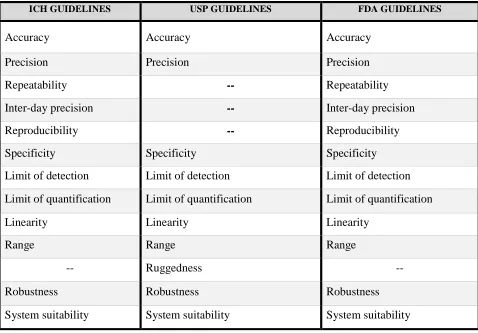
ICH GUIDELINES USP GUIDELINES FDA GUIDELINES
Accuracy Accuracy Accuracy
Precision Precision Precision Repeatability -- Repeatability Inter-day precision -- Inter-day precision Reproducibility -- Reproducibility Specificity Specificity Specificity
Limit of detection Limit of detection Limit of detection Limit of quantification Limit of quantification Limit of quantification Linearity Linearity Linearity
Range Range Range
-- Ruggedness --
METHOD DEVELOPMENT AND VALIDATION FOR THE SIMULTANEOUS ESTIMATION OF ILAPRAZOLE AND DOMPERIDONE IN CAPSULE DOSAGE FORM BY UPLC
Department of Pharmaceutical Analysis Page 29
Thus, accuracy of the method was studied by recovery experiments using standard addition method at three different levels (80%, 100% and 120. Known amounts of Standard solutions containing analyte were added to pre-quantified sample solutions to get 80,100 and 120 %.These samples were analyzed by injecting the sample solution and % recovery was calculated. In the present study %recovery was calculated by the following formula.
Acceptance limit for % recovery is 98-100%
Precision:
The precision[14] of an analytical procedure expresses the closeness of agreement (degree of Scatter) between a series of measurements obtained from multiple sampling of the same homogeneous sample under the prescribed conditions.
Precision may be considered at three levels: repeatability, intermediate precision and reproducibility.
Precision is a measure of the reproducibility of the whole analytical method (including sampling, Sample preparation and analysis) under normal operating circumstances. Precision is determined by using the method to assay a sample for a sufficient number of times to obtain statistically Valid results (i.e. between 6 - 1 0). Therefore for present work sample were assayed six times and the %RSD for obtained assay values was obtained. Precision is then expressed as the Relative Standard Deviation.
Repeatability:
METHOD DEVELOPMENT AND VALIDATION FOR THE SIMULTANEOUS ESTIMATION OF ILAPRAZOLE AND DOMPERIDONE IN CAPSULE DOSAGE FORM BY UPLC
Department of Pharmaceutical Analysis Page 30
Intermediate Precision:
Intermediate precision[14] expresses within-laboratories variations; different days, different analysts, different equipment, etc. The objective of intermediate precision validation is to verify that in the same laboratory the method will provide the same results once the development phases over. The objective is also extent to verify that the method will provide the same results in different laboratories (ruggedness).
Reproducibility:
Reproducibility[14] expresses the precision between laboratories (collaborative studies, usually applied to standardization of methodology).
Specificity:
ICH defines specificity as “the ability to assess unequivocally the analyte in the presence of
components which may be expected to be present. Typically this might
![Figure 1.5High-Performance Liquid Chromatography [Performance Liquid Chromatography [HPLC] System](https://thumb-us.123doks.com/thumbv2/123dok_us/265064.59828/27.595.94.504.346.551/figure-high-performance-liquid-chromatography-performance-liquid-chromatography.webp)
![Figure 1.6Ultra--Performance Liquid Chromatography [UPLC] InstrumentPerformance Liquid Chromatography [UPLC] Instrument](https://thumb-us.123doks.com/thumbv2/123dok_us/265064.59828/29.595.142.455.389.679/figure-performance-liquid-chromatography-instrumentperformance-liquid-chromatography-instrument.webp)