Children’s Performance on and Understanding of the
Balance Scale Problem: The Effects of Adult Support
Sharon Philips
A thesis submitted in accordance with the regulations governing the award of the Degree of Doctor of Philosophy in Psychology
Department of Psychology Submitted October
2007
Acknowledgements
I wish to express my sincere thanks to all those who have helped and supported me throughout the 4 long years of my PhD. I would especially like to thank my
supervisor, Professor Andy Tolmie, who has guided me so dependably, efficiently and patiently through my research and write-up.
I would also like to thank Norrie Sharp and Bill Woodside, Norrie for my research tasks and the many many tapes he transferred over to video for each of my 3 studies, and Bill for all his computer support throughout the years, and for fixing the CRIL printer on the many occasions it broke down!
To Pat Gallagher, thank you for the coffee, biscuits, and chat – you made sitting at my uni computer for hours on end, day after day, very bearable!
To my wonderful mum, dad and Adele, boyfriend Scott, and my friends, for being there with me throughout the good and bad times, for encouraging me not to give up on my PhD when I was completely and utterly sick of it, and for convincing me I would get there eventually!
Contents
Pag e
Abstract 1
Chapter 1 3 1.1. Importance of Vygotskian theory to studying 3 the growth of children’s language and social development 1.1.1. Fundamental components of Vygotskian theory 3 1.1.2. Internalisation of speech 5 1.1.3. Zone of Proximal Development 6 1.2. The Scaffolding Relationship between Child and Parent 8
1.2.1. Early Scaffolding research 8
1.2.1.1. Region of Sensitivity 10
1.2.1.2. Contingency Rules of Intervention 10
1.2.2. Guided Participation 12
1.2.2.1. Cognitive self-regulation 12
1.2.3. Scaffolding Techniques in Relation to Age 15
1.2.4. Parental Support Versus No Parental Support 19
1.2.4.1. Effects of working with a parent compared to working alone 19
1.2.4.2. Effects of working with a parent compared to working with a 20
peer or working alone 1.2.4.3. Pre-interaction competence 21
1.2.5. Assessing the Cognitive Processes that take place in Children 21
during Scaffolding 1.2.5.1. Legitimate peripheral participation 22
1.2.5.2. Exploration of strategies 22 1.2.5.3. Autonomous learning in the presence of the parent 23
1.3. Representational Redescription (RR) Model 24
1.3.1. Definition of RR model 24
1.3.2. The RR process 25
1.3.3. Karmiloff-Smith Versus Vygotsky 25
1.3.4. Representational Redescription in relation to Age and Task 26
1.3.4.1. Different Ages, Different Representations 26
1.3.4.2. Different tasks, different representations 27
1.3.5. Karmiloff-Smith Versus Piaget 27
1.3.6. Criticisms of RR Model 28 1.3.7. Defending the RR Model 28 1.3.8. Is Cognitive Development the result of Innate or 29 Environmental Factors? 1.4. Present Research 30
1.4.1. General outline of studies 30
1.4.2. Balance Scale task 31
Chapter 2 38 STUDY 1
2.1. Introduction 38
2.2 Method 42
2.2.1 Design 42
2.2.2. Participants 43 2.2.3. Materials 43 2.2.4 Procedure 45
2.2.4.1 Scoring 46
2.3 Results 50
2.3.1 Overview of analyses 50
2.3.2 Comparison across assistance condition 50 2.3.3 Detailed analysis of change in the Balance Scale-assisted 52 condition 2.3.3.1 Patterns of parental assistance 52
2.3.3.2. Problem-to-problem changes in children’s performance and 55
level of explanation. 2.3.3.3. Effects of explicit explanation on higher- and lower-performing 61 children. 2.4 Discussion 63
Chapter 3 68 STUDY 2 3.1 Introduction 68
3.2. Method 72
3.2.1. Design 72
3.2.2. Participants 72 3.2.3. Materials 73 3.2.3.1. Balance Beams 73 3.2.3.2. Balance Scale 74
3.2.4. Procedure 74 3.2.4.1. Coding of the classification test 75 3.2.4.2. Scoring 79.
3.3 Results 81
3.3.1. Overview of analyses 81
3.3.2. Profile of Adult Support on the Balance Scale task 81 3.3.3. Profile of children’s performance on the Balance Scale task 84
3.4. Discussion 113
Chapter 4 121
STUDY 3 4.1. Introduction 121
4.2. Method 127
4.2.1. Design 127
4.2.2. Participants 128
4.2.3. Materials 128
4.2.3.1. Balance Beams 128
4.2.3.2. Balance Scale 128
4.2.4.1. Scoring of Balance Scale task 131
4.3. Results 134
4.3.1. Overview of analyses 134
4.3.2. Profile of children’s performance on the Balance Scale task 134
4.3.3. Profile of Adult Input 146
4.3.4. Profile of dialogue used by three pair types 148
4.3.5. Appropriation of adult input to subsequent problems 159
undertaken by dyads 4.3.6. Reverse Appropriation of child codes to subsequent utterances 164
spoken by the adult 4.3.7. Secondary appropriation within Mixed understanding dyads 168
4.4. Discussion 181
Chapter 5 188
GENERAL DISCUSSION 5.1. Summary of theoretical background to present research 188
5.2. Summary of nature of present research 188
5.3. Discussion of findings in relation to previous research 189
5.4. Significance of present findings 195
REFERENCES 199
Appendix 1 – Letter of Approval from local education authority 206
to undertake research in primary schools Appendix 2 – Letter to parents asking for permission to conduct 208
research with their child Appendix 3a – Study 1 transcript: Fully Explicit Input 211
Appendix 3b – Study 1 transcript: Partially Explicit Input 213
Appendix 3c - Study 1 transcript: Minimally Explicit Input 216
Appendix 3d – Study 1 transcript: Implicit Input 220
Appendix 4 – Study 2 transcript: Input involving implicit weight/distance 226
prompts Appendix 5 – Study 3 transcript: Interaction between adult and dyad 230
Philips, S. & Tolmie, A. (2007). Children’s performance on and understanding of the Balance Scale problem: The effects of parental support. Infant and Child Development, 16, 95-117
Tables and Figures
Page
Table 1. Configurations of nuts for Balance Scale problems at Times 45 1, 2 and 3.
Table 2. Levels of scoring for children’s attempts on the Balance Scale 47 task.
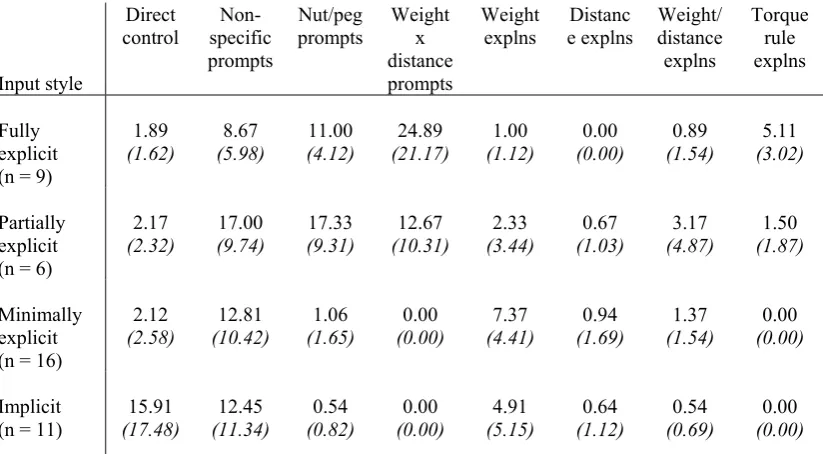
Table 3. Mean frequency of elements of procedural assistance and levels 54 of explanation provided by parents (total across problems), by
input style category.
Table 4. Number of attempts and explanation level for correct solution 57
for each child in the Balance Scale-assisted condition, on Problems 1 to 4 (P1 to P4) at Times 1, 2 and 3, ordered by parental input style.
Table 5. Mean number of attempts and explanation level at Times 1, 2 58 and 3, by parental input style.
Table 6. Coding of children’s explanations on the Classification Test. 75
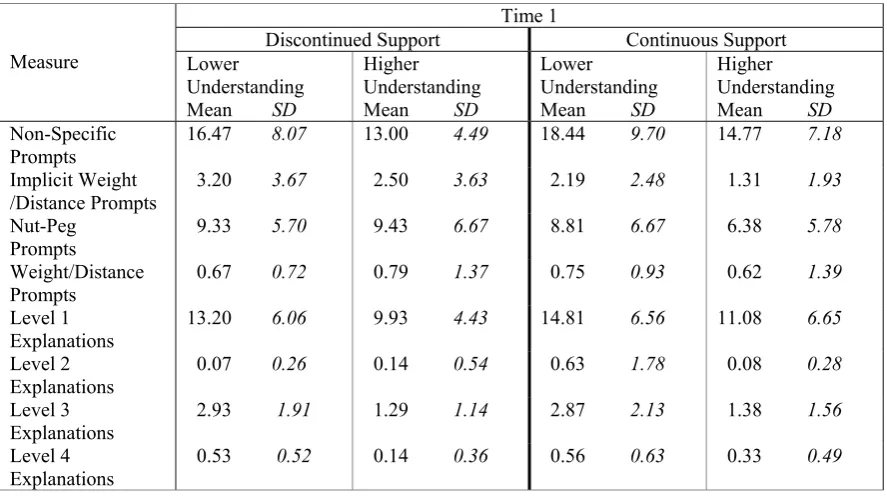
Table 7a. Adult Support Measures at Time 1. 82
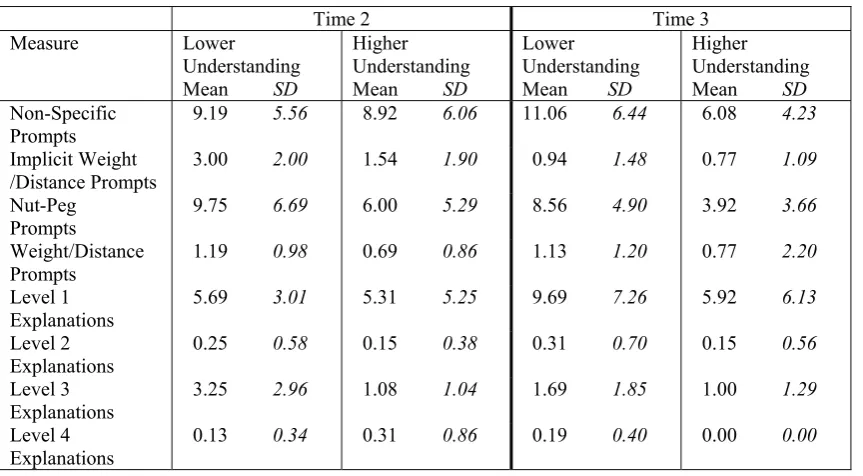
Table 7b. Adult Support Measures at Times 2 and 3. 83
Table 8. Number of attempts and explanation levels for correct solution 85 for each child on the Balance Scale task, on Problems 1 to 4
(P1 to P4) at Times 1, 2 and 3, ordered by conditions of Discontinued Support, Lower Understanding, (DS LU), Discontinued Support, Higher Understanding, (DS HU), Continuous Support, Lower Understanding, (CS LU ) and Continued Support, Higher Understanding, (CS HU).
Table 9. Mean number of attempts and level of explanation in all children, 86
split into their support condition and level of understanding.
Table 10a. Relationship between Time 1 adult input and children’s 97
attempts and explanations.
Table 10b. Relationships between adult input at Time 1 and children’s 98
attempts and explanations at Times 2 and 3.
Table 11a. Relationship between Time 1 adult input and children’s 100
attempts and explanations.
Table 11b. Relationships between adult input at Time 1 and children’s 101
attempts and explanations at Times 2 and 3.
Table 12a. Relationship between Time 1 adult input and children’s 103
attempts and explanations.
Table 12b. Relationship between Time 1 adult input and children’s 105
attempts and explanations.
Table 12c. Relationship between Time 2 adult input and children’s 105
attempts and explanations.
Table 12d. Relationship between Time 2 adult input and children’s 106
attempts and explanations at Time 3.
Table 12e. Relationship between Time 3 adult input and children’s 107
Table 13a. Relationship between Time 1 adult input and children’s 108
attempts and explanations.
Table 13b. Relationship between Time 1 adult input and children’s 109
attempts and explanations.
Table 13c. Relationship between Time 2 adult input and children’s 110
attempts and explanations.
Table 13d. Relationship between Time 2 adult input and children’s 111
attempts and explanations at Time 3.
Table 13e. Relationship between Time 3 adult input and children’s 111
attempts and explanations.
Table 14. Dialogue codes used throughout Balance Scale task by adult 132
and children.
Table 15a. Number of attempts to achieve balance for each supported 135
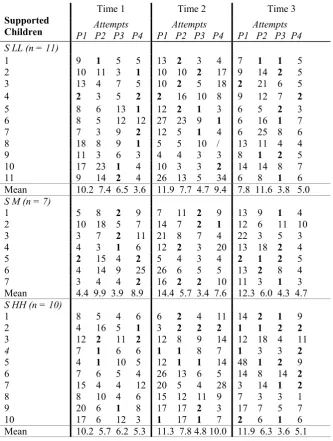
pair of children on the Balance Scale task, on Problems 1 to 4 (P1 to P4) at Times 1, 2 and 3. Table is split into children’s pair type of Support, Low-Low understanding (S LL); Support, High-High Understanding (SHH), and Support, Mixed
Understanding (S M).
Table 15b. Number of attempts to achieve balance for each unsupported 136
pair of children on the Balance Scale task, on Problems 1 to 4 (P1 to P4) at Times 1, 2 and 3. Table is split into children’s pair type No Support, Low-Low understanding (NS LL); No Support, High-High Understanding (NS HH), and No Support, Mixed Understanding (NS M).
Table 16. Mean number of attempts and mean explanation level given by 137
each dyad, split into support condition and pair-type.
Table 17a. Relationship between Attempts and Mean Explanation level 141
across Times 1, 2 and 3 for the supported Low-Low children.
Table 17b. Relationship between Attempts and Mean Explanation level 142
across Times 1, 2 and 3 for the supported Mixed children.
Table 17c. Relationship between Attempts and Mean Explanation level 143
across Times 1, 2 and 3 for the supported High-High children.
Table 18a. Relationship between Attempts and Mean Explanation level 144
across Times 1, 2 and 3 for the unsupported Low-Low children.
Table 18b. Relationship between Attempts and Mean Explanation level 145
across Times 1, 2 and 3 for the unsupported Mixed children.
Table 18c. Relationship between Attempts and Mean Explanation level 146
across Times 1, 2 and 3 for the unsupported High-High children.
Table 19. Mean number of times the adult used each of the 13 interaction 147
codes with supported dyads, split into children’s dyad type at Time 1.
Table 20a. Mean number of times each of the 13 interaction codes were 149
used at Time 1 by Supported and non-supported dyads, split into dyad type and support condition.
Table 20b. Mean number of times each of the 13 interaction codes were 150
into dyad type and support condition.
Table 20c. Mean number of times each of the 13 interaction codes were 151
used at Time 3 by Supported and non-supported dyads, split split into dyad type and support condition.
Table 21a. Relationship between explanation level and use of codes 7 to 153
12 at Time 1.
Table 21b. Relationship between explanation level and use of codes 7 to 153
12 at Time 2.
Table 21c. Relationship between explanation level and use of codes 7 to 153
12 at Time 3.
Table 22a. Relationship between explanation level and use of codes 7 to 154
12 at Time 1.
Table 22b. Relationship between explanation level and use of codes 7 to 154
12 at Time 2.
Table 22c. Relationship between explanation level and use of codes 7 to 154
12 at Time 3.
Table 23a. Relationship between explanation level and use of codes 7 to 155
12 at Time 1.
Table 23b. Relationship between explanation level and use of codes 7 to 155
12 at Time 2.
Table 23c. Relationship between explanation level and use of codes 7 to 155
12 at Time 3.
Table 24a. Relationship between explanation level and use of codes 7 to 156
12 at Time 1.
Table 24b. Relationship between explanation level and use of codes 7 to 156
12 at Time 2 .
Table 24c. Relationship between explanation level and use of codes 7 to 156
12 at Time 3.
Table 25a. Relationship between explanation level and use of codes 7 to 157
12 at Time 1.
Table 25b. Relationship between explanation level and use of codes 7 to 157
12 at Time 2.
Table 25c. Relationship between explanation level and use of codes 7 to 157
12 at Time 3.
Table 26a. Relationship between explanation level and use of codes 7 to 158
12 at Time 1.
Table 26b. Relationship between explanation level and use of codes 7 to 158
Table 26c. Relationship between explanation level and use of codes 7 to 158
12 at Time 3.
Table 27a. Correlations between Codes 0 to 12 used by the adult during 160
Problems 1, 2, 3, and 4 at Time 1, and the corresponding Codes used by Low-Low dyads on subsequent problems.
Table 27b. Correlations between Codes 0 to 12 used by the adult during 162
Problems 1, 2, 3, and 4 at Time 1, and the corresponding Codes
used by High-High dyads on subsequent problems.
Table 27c. Correlations between Codes 0 to 12 used by the adult during 164
Problems 1, 2, 3, and 4 at Time 1, and the corresponding Codes used by Mixed dyads on subsequent problems.
Table 28a. Correlations between Codes 0 to 12 used by Low-Low dyads 166
during Problems 1, 2, 3, and 4 at Time 1, and the corresponding Codes used by the adult on subsequent problems at this time-point.
Table 28b. Correlations between Codes 0 to 12 used by High-High dyads 167
during Problems 1, 2, 3, and 4 at Time 1, and the corresponding Codes used by the adult on subsequent problems at this time-point.
Table 28c. Correlations between Codes 0 to 12 used by Mixed dyads during 168
Problems 1, 2, 3, and 4 at Time 1, and the corresponding Codes used by the adult on subsequent problems at this time-point.
Table 29a. Correlations of Codes 0 to 12 used by the Supported Higher 169
understanding children (High child) during Problems 1, 2, 3, and 4 at Time 1, and the corresponding Codes used by the Supported Lower understanding children (Low child) on subsequent problems.
Table 29b. Correlations of Codes 0 to 12 used by the Supported Higher 170
understanding children (High child) during Problems 1, 2, 3, and 4 at Time 2, and the corresponding Codes used by the Supported Lower understanding children (Low child) on subsequent problems.
Table 29c. Correlations of Codes 0 to 12 used by the Supported Higher 171
understanding children (High child) during Problems 1, 2, 3, and 4 at Time 3, and the corresponding Codes used by the Supported Lower understanding children (Low child) on subsequent problems.
Table 30a. Correlations of Codes 0 to 12 used by the Supported Lower 172
subsequent problems.
Table 30b. Correlations of Codes 0 to 12 used by the Supported Lower 173
understanding children (Low child) during Problems 1, 2, 3, and 4 at Time 2, and the corresponding Codes used by the Supported Higher understanding children (High child) on subsequent problems.
Table 30c. Correlations of Codes 0 to 12 used by the Supported Lower 173
understanding children (Low child) during Problems 1, 2, 3, and 4 at Time 3, and the corresponding Codes used by the Supported Higher understanding children (High child) on subsequent problems.
Table 31a. Correlations of Codes 0 to 12 used by the Unsupported Higher 175
understanding children (High child) during Problems 1, 2, 3, and 4 at Time 1, and the corresponding Codes used by the
Supported Lower understanding children (Low child) on subsequent problems.
Table 31b. Correlations of Codes 0 to 12 used by the Unsupported Higher 176
understanding children (High child) during Problems 1, 2, 3, and 4 at Time 2, and the corresponding Codes used by the Supported Lower understanding children (Low child) on subsequent problems.
Table 31c. Correlations of Codes 0 to 12 used by the Unsupported Higher 177
understanding children (High child) during Problems 1, 2, 3, and 4 at Time 3, and the corresponding Codes used by the Supported Lower understanding children (Low child) on subsequent problems.
Table 32a. Correlations of Codes 0 to 12 used by the Unsupported Lower 178
understanding children (Low child) during Problems 1, 2, 3, and 4 at Time 1, and the corresponding Codes used by the Supported Higher understanding children (High child) on subsequent problems.
Table 32b. Correlations of Codes 0 to 12 used by the Unsupported Lower 179
understanding children (Low child) during Problems 1, 2, 3, and 4 at Time 2, and the corresponding Codes used by the Supported Higher understanding children (High child) on subsequent problems.
Table 32c Correlations of Codes 0 to 12 used by the Unsupported Lower 180
understanding children (Low child) during Problems 1, 2, 3, and 4 at Time 3, and the corresponding Codes used by the Supported Higher understanding children (High child) on subsequent problems.
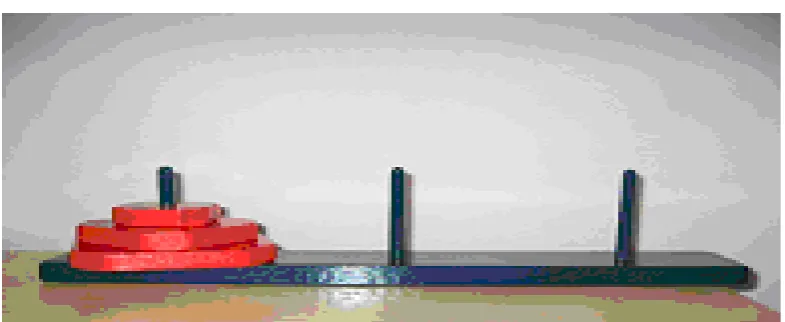
Figure 1. Balance Scale apparatus. 44
Figure 3. Performances across time-points by parental support condition. 51
Figure 4. Symmetrical (a) and asymmetrical (b) beams used in 73 classification test.
Figure 5. % of attempts at each time-point that were single or double 88
attempts only.
Figure 6. % of total attempts at each time-point that were made at levels 90
6and 7.
Figure 7. Children’s mean level of explanation across time-point by level 92
of understanding
Figure 8. Total attempts across time-point by support condition and pair 138
Type.
Figure 9. Mean explanation level across time-point by support condition 139
and pair type.
ABSTRACT
The present thesis investigated the Vygotskian notion that social influences are
necessary for children’s learning to take place, and that the process of conceptual
development via Representational Redescription, described by Karmiloff-Smith
(1992), occurs as a result of contingent scaffolding techniques. The aim of the
research detailed in the thesis was to examine the effects of adult support on
children’s performance on and understanding of a Balance Scale task. Analyses of
support focused on the extent to which language used by the adult could be
appropriated and used subsequently by the child to complete the task and explain their
unknown to the child (Studies 2 and 3). Whereas Studies 1 and 2 focused on the
impact of support on individual children, Study 3 looked at this impact on
collaborating children working in dyads. All children worked on the Balance Scale
task at three separate time-points.
In the first study, which looked at the impact of parental input at Time 1 on their
children’s performance on the Balance Scale task at this and the following two
time-points, compared to children who worked on the task alone at all three sessions, it was
shown that (a) supported children advanced in their explanations in a way not seen by
those who were unsupported; (b) parental input varied considerably, although the
most effective was that which combined explicit operationalisations of strategies to
solve the task and explanations that explicitly stated the principles at work; and (c) as
had been predicted, children benefited from this and other input differently depending
on their initial level of ability on the task, with explicit accounts being readily
appropriated by those with better understanding, whilst those with less understanding
were assisted by more implicit prompts that directed their attention to the
manipulation of weight and distance.
The second study focused on the impact of support depending on children’s initial
level of understanding, and the time-frame of support. Children were categorised as
having lower or higher understanding based on an earlier classification task, and
provided with support at the first time point only, or else for all three sessions. It was
found that children of lower understanding benefited more from continuous support,
which allowed more explicit input to be introduced over time, whereas those of higher
understanding benefited more from support that focused on explicit explanations and
was discontinued after Time 1.
Finally, Study 3 focused on the effects of adult support on children working in
same-sex dyads. Children were identified as being lower or higher understanding based on
an earlier classification test, as was the case in Study 2, and they were placed into
dyads on this basis. There were three pair types used: Low-Low, High-High and
Mixed (one child of lower and the other of higher understanding). Half of the dyads
received support at Time 1 and then worked alone in their dyads for the remainder of
support only made a sustained difference to those in Mixed dyads, the mutual support
available in the High dyads acting as an effective substitute, and the Low dyads
failing to make much gain in understanding whether support was available or not. In
the Mixed dyads, the effect of support was found to be that the dyad member with
higher understanding appropriated more explicit explanations of the problem from the
adult at Time 1 (primary appropriation), and then used these with the lower
understanding member at Time 2, who appropriated them in turn (secondary
appropriation), both converging on their use at Time 3. The net effect of providing
support to Mixed dyads therefore was to combine the process of one-off support for
higher understanding children and continuous support for lower understanding
children noted to produce the best outcomes in Study 2.
Overall, the three studies provided consistent evidence in line with the
Representational Redescription-based tutoring model with regards to: a) supported
children showed changes in explicit representation not seen among children who
worked alone, and the characteristics of effective support differed in predicted fashion
with initial representational level; and b) there is a need to extend the application of
the model to different contexts, and to explore the effects of varying emphases in tutor
input in more detail, given the inconsistencies in outcome, especially as regards the
Chapter 1
THE ORIGINS OF SOCIAL DEVELOPMENT THEORY
Over the past three decades much research has shown that both interpersonal and
environmental influences must be considered when examining the cognitive
development of young children (Conner & Cross, 2003; Freund, 1990; Grolnick &
Slowiaczek, 1994; McNaughton & Leyland, 1990; Vygotsky, 1978; Wertsch,
McNamee, McLane & Budwig, 1980; Wood, Bruner & Ross, 1976). This research
has largely been influenced by the writings of Vygotsky (1962; 1978), who argued
that historical, cultural and social factors are essential in establishing a child’s mental
(psychological) and cognitive growth. Whereas maturation is important to a certain
extent in initially shaping children’s early behaviour and development, it is secondary
to the cultural and social aspects of the child’s environment that are crucial in
determining their transition from using primitive behaviours without proper use of
language, to becoming social creatures who display unique human behaviours, such as
speech (Vygotsky, 1978, p. 20).
1.1. Importance of Vygotskian theory to studying the growth of children’s language and social development
1.1.1. Fundamental components of Vygotskian theory
Vygotsky agreed with theorists such as Buhler (1930) and Kohler (1925) who
suggested that child psychology has much in common with animal psychology. For
example, in both animals and children, basic psychological processes, such as the
practical use of tools, occur independently of speech. But, when those processes in
animals and children are studied together, they allow for and facilitate research into
the biological, or elementary basis of human behaviour. Thus, the root of child
behaviour arises from the connection between primary, or biological processes, and
the social and cultural aspects of their higher psychological functions. Higher
psychological processes, such as speech, have been classed as a continuation of
completely unique to humans. Speech, in the form of signs, is children’s first
experience of social contact with other people, and, with both cognitive and
communicative elements contained within speech establishing the foundation for a
novel but superior path of development and behaviour, this sets children apart from
animals.
Vygotsky’s theories were inspired by Marx’s concept of historical materialism. This
concept postulated that historical changes that occur in society and “material life”
produce changes in the individual’s consciousness and behaviour, that is, their basic
human nature. Vygotsky was also influenced by Engel’s notion that human nature,
along with the cultural environment, is transformed by human labour and tool use.
Vygotsky extended this concept of tool use to include the use of signs also. He
described signs as being the basic components of spoken and written language and
numbers, which have been created and modified by different cultures throughout
human history, changing as society changes. Furthermore, along with Engels,
Vygotsky did not believe that intellectual abilities develop solely from biological or
genetic properties, or are already present in the child and are only waiting to be
manifested in some way. On the contrary, he argued that those intellectual abilities
develop from the cultural and social experiences the child encounters with other
people. In essence, the fundamental components of human development and change
are embedded within society and culture, with the most important aspects of cultural
behaviour, this being the use of tools and human speech, arising during infancy
(Vygotsky, 1978).
The functions of sign and tool use differ in a number of ways, the most significant
being the way in which they shape behaviour. Whereas the use of tools is externally
regulated, as it controls how individuals influence and change the outlook of objects,
signs are internally regulated, as they are concerned with facilitating the individual’s
control over their surroundings.
According to Vygotsky, tool use, in the form of practical abilities, and sign use, in the
form of speech, develops simultaneously in children. This was one of the few areas in
which he and Piaget agreed, as Piaget (1955) argued that this dialectic between
their speech inwardly). Therefore, although practical skills (tool use) and speech
(sign use) can function separately to one another in young children, together they
form the essence of adult human behaviour. This process of distinguishing human
intellect from that of animals, in terms of establishing the unique human capacity to
think practically and theoretically, arises when speech and practical skills, initially
two simultaneous but separate paths of development, join together.
This unity of practical and theoretical thinking begins when children, before acquiring
control over their own behaviour, start to manage their surroundings through speech.
This process is the basis for the development of their intellect and use of tools. As
children work through a problem-solving task, they use speech to facilitate their
progression towards the task goal. The speech occurs naturally and carries on over
the course of the task. As the task increases in difficulty, the speech becomes more
copious. In fact, the function of speech is vital to children in their attempts to achieve
their goal, and the more complex the task is, the more important speech is to the
procedure. This theory was supported in research by Fernyhough & Fradley (2005),
who found that children’s egocentric (or ‘private’) speech was much more likely to
occur during the most difficult tasks as opposed to simpler activities.
Furthermore, as children progress through tasks, achieving a number of clear and
logical subgoals, they may then encounter difficulty with a certain aspect of their task,
and so turn to the adult for help. In this case, Vygotsky believed that they already
have a plan visualised to solve the task, but just cannot perform all of the necessary
procedures without this social influence to assist them. As a result of the combined
elements of using private speech and the scaffolding process, the child performs
successfully on the task when working on it subsequently alone (Winsler, Diaz &
Montero, 1997). In essence, private speech is developmentally a half-way point
between social and inner speech (Fernyhough & Fradley, 2005).
1.1.2. Internalisation of speech
Along with language, children use other functions to progress through
problem-solving tasks, such as perception (using their eyes), sensory-motor actions (using their
internalisation of the child’s visual field. Following this, their speech which has
initially been “socialised”, that is, used solely for communication with adults during
the problem-solving process, then becomes internalised, so that the child is now using
it to guide their own actions, as opposed to letting their actions be guided by an adult.
Vygotsky referred to this process as, “the internalisation of social speech” (Vygotsky,
1978, p. 27), with the term “internalisation” referring to the transformation of an
external action into one that occurs within the child. This internalisation alters the
entire cognitive process and allows the child to exert control over his or her actions.
Ultimately, the whole basis of human psychology revolves around the internalisation
of socially embedded, and historically evolved behaviours.
This internalisation procedure, therefore, suggests that higher psychological processes
are actually dialogic in their nature (Fernyhough, 1996, Wertsch, 1990).
Vygotsky generally believed that any psychological procedure, whether instinctive or
voluntary, changes as it is being observed, and this can occur over the course of a few
seconds or fractions of seconds. Therefore, to successfully study the
moment-by-moment (microgenetic) changes involved in development, those being generated from
the problem-solving behaviours of children whilst completing a task, it is necessary to
present difficulties into the activity that interrupts the child’s constructive
problem-solving procedures. Thus, by observing how children of different ages and working
within different levels of task complexity, adapt to those difficulties Vygotsky tried to
map out the changes in their intellectual processes occurring throughout their
development. To be precise, Vygotsky studied performance as it was happening, as
opposed to only focussing on the end result. His main question was not, “What has
the child done?” but “What is the child doing?”
He believed that children have already begun their learning by the time they start
school, and whatever learning they experience always has a prior history. In fact,
Vygotsky argued that children’s learning and development are interrelated from the
day they are born.
The course of development, accordingto Vygotsky, occurs at two levels. The first
level is comprised of what the child is able to do at that present time, that is, their
‘actual developmental level’. He argued that researchers make the mistake of
believing that it is only what the child can do independently that determines their
overall mental abilities, and pay no attention to what might be achieved with help
from other sources. In support of this, Vygotsky found that if leading questions were
offered to the child, or a demonstration was given of the correct way in which to solve
the task, the child was able to successfully complete it. This showed Vygotsky that
even children of the same chronological age may not work at the same age mentally.
In other words, they are at different stages in their mental abilities. Thus, what one
child is capable of doing at seven years old, another child of the same age may not.
Most cognitive developmental researchers (for example, Conner & Cross, 2003;
Kermani & Brenner, 2000; Rogoff, 1990; Wertsch, McNamee, McLane & Budwig,
1980; Wood and Middleton, 1975; Wood, 1986) have been very influenced by
Vygotsky’s theory of the zone of proximal development, which he defined as, ‘the
distance between the actual developmental level as determined by independent
problem-solving and the level of potential development as determined through
problem solving under adult guidance or in collaboration with more capable peers’
(Vygotsky, 1978, p. 86). In other words, the ‘zone’ is the phase between what the
child is capable of achieving independently, and what they are as yet unable to
achieve without guidance and support from an adult or more capable peer. The role
of the ‘tutor’ is, thus, to effectively induct the child into the use of sign operations (i.e.
speech), to control their actions explicitly. The adult achieves this by working with
the child on two levels, the interpersonal and then the intrapersonal. At this first level (interpersonal), the adult uses speech to control the children’s actions, as this
allows the child to appropriate this sign usage, firstly in the form of private speech,
and then by internalising it. When internalisation occurs, the child is now functioning
on the intrapersonal level. With this close guidance and appropriation of sign usage,
children are able to successfully complete certain aspects of the given task which they
could previously not accomplish (Pratt, Kerig, Cowan and Cowan, 1988). Therefore,
“the actual developmental level characterises mental development retrospectively,
while the zone of proximal development characterises mental development
Using this theory allows researchers to study the child’s cognitive development in a
deeper, more complex form than is possible from the abilities they are showing at that
present time. That is, it enables them to examine the child’s potential development
achievable through interaction, collaboration and support from the environment, such
as teachers, parents or peers. However, Vygotsky believed that children would only
benefit from collaborative problem-solving activities when the activity was focused
towards advancing their present state of development. For example, although
imitation as a method of teaching children within the zone of proximal development
may be an effective means of advancing their learning, it only does so when the child
is imitating that which is already within his or her current level of development.
Vygotsky gave the example of a child having difficulty with an arithmetic puzzle,
which he or she overcomes through imitation of the teacher’s solution on the
blackboard. However, if the teacher were to demonstrate the solution to a higher
mathematical puzzle on the board, such as algebra, the child may never understand the
answer, even after many imitations of what is on the board.
Vygotsky’s zone of proximal development theory was in complete contrast to that of
Piaget, who postulated that children’s development relies on biological processes to
ensure their transition through set, universal stages. Although Piaget recognised that
imitation was a factor in children’s development, he argued that it only led to
mechanistic learning where the child did not actually learn or understand what they
were doing. In other words, Piaget believed that any attempts to teach children skills
that they were not yet able to do, led to frustration and the learning of ‘empty
procedures’ (in Wood, 1998).
It can be concluded from Vygotsky’s theories therefore, that the fundamental
component of learning is that it generates the zone of proximal development. In other
words, learning stimulates many internal developmental procedures that can function
only during interactions that occur between children and their environment, this being
made up of parents, teachers and other peers. When those procedures become
internalised, they can then be recognised as contributing to the child’s autonomous
1.2. The Scaffolding Relationship between Child and Parent
1.2.1. Early Scaffolding research
Wood and colleagues (Wood & Middleton, 1975; Wood, Bruner & Ross, 1976) later
developed the concept of ‘scaffolding’, which is the process in which ‘tutors’ and
children work together within the child’s Zone of Proximal Development, to increase
the child’s understanding and development of skills on the particular activity.
However, it is not only the adult who determines their level of involvement on the
task but the child also who, along with the adult, establishes the degree to which help
is required (Bjorkland, 2000). For example, if the child is less able to progress
through the task, they will request more support from the adult, with the opposite
being true for more able children. (Plumert & Nichols-Whitehead, 1996). On the
other hand, children who are highly skilled on one task may be less able in another,
and so the level of support needed and given to the child also depends on the specific
task being undertaken (Bjorkland, 2000). Therefore, the complexity of the task does
not independently affect the child’s ability to complete it. Essentially, the difficulty of
a task is dependent on the child’s perception of its difficulty, the degree of support
given by the tutor, along with the child’s present capabilities (McNaughton &
Leyland, 1990).
From observing the scaffolding behaviours executed by mothers in their study, Wood
and Middleton (1975) found that mothers differed quite considerably in the way in
which they interacted with their childrenon a task in which they had to help them
assemble a wooden pyramid structure. They devised a series of levels of control
measures to highlight those behaviours. Level 1 – General Verbal Instruction,
involved the least amount of intervention from the mother. It was concerned with the
parent trying to encourage her child to reach a specific goal or subgoal, but without
specifying how the child should progress, for example, “Well done, now can you
make another part like that?” Level 2 – Specific Verbal Instruction, involved the
mother offering a specific hint as to how to progress to meet a goal or subgoal, for
example, “Now you have to find a block with a hole in the middle.” If the mother not
only drew her child’s attention to a specific part of the task but also showed him or
at Level 3 – Mother Indicates Materials. An example of this Level may be, “You
need to use that block there” (points to block). If the mother not only indicated the
materials to be used but also selected the appropriate items and prepared them for
construction she would be working at Level 4 – Mother Provides Material and
Prepares it for Assembly. The final and highest Level of Intervention was Level 5 –
Mother Demonstrates an Operation. At this level the mother took full control of the
task by both selecting and constructing the materials whilst the child only looked on.
Thus, as the Levels increased, so did the mothers’ control of the task and situation.
Assessing the amount of difficulty that the child was having initially with the task,
and structuring the scaffolding relationship accordingly, led to the most effective use
of those Levels. That is, if the child was having much difficulty with the task, it was
more beneficial to work at a higher level with them until they were more aware of the
task goals and how to achieve them. For example, it was found by Wood, Bruner &
Ross (1976) that when children who found a pyramid-building task difficult were only
asked to carry out a certain action they tended to ignore the researcher’s requests,
even if the outcome of their potential actions were achievable. In contrast, when
those children were shown the materials (i.e., the blocks) they were required to use for
specific parts of the task, they often did manage to complete the action.
1.2.1.1. Region of Sensitivity
Within the concept of scaffolding, Wood and Middleton (1975) found that the most
effective adult interventions were structured in the ‘region of sensitivity’ (pp. 182).
This was achieved when the adult (referred to by Wood as the ‘tutor’) was aware of
the parts of the task the child could complete independently, what elements they
understood but could not complete without help, and what components of the task
they could not perform at all without support. Once this region was established the
tutor would help the child to complete a part of the task in which they understood the
components but could not proceed alone. The child would then internalise this part of
the task and thus be able to progress to the next stage or sub-goal. This would
continue until the child had successfully internalised the task components, and
therefore was able to reach their ultimate goal.
In addition, Wood (1986) found that successful interactions between mothers and
their children, as measured by children’s success on subsequent independent trials,
resulted fromthe mother following two ‘contingency rules’ of interventions. One of
the two rules was concerned with her taking a higher level of control over the parts of
the tasks in which the child failed to accomplish. Thus she may have shifted from
using Level 2 – Specific Verbal Instructions, to Level 3 – Indicating Materials. The
other rule stated that when the child successfully completed an instruction or sub-goal
of the task, the mother should decrease her level of intervention, for example, shifting
from Level 3 back to Level 2. This allows the child to develop their skills
independently and leaves space for further success (along with errors). This has been
supported by later studies measuring both intervention behaviours within the region of
sensitivity and use of contingency rules (Conner & Cross, 2003; Conner, Knight &
Cross, 1997; McNaughton & Leyland, 1990; Pratt et al., 1988).
Conner & Cross (2003), for example, conducted a longitudinal study in which they
tested children from the age of 16 months to 54 months. Their problems involved
parents and children building a tower using two sets of blocks in a specific sequence.
Familiar objects were used, and no explicit instructions were given to the parents or
children about how they should attempt to reach the overall goal. They used the
scoring system developed by Wood & Middleton (1975) and modified by Pratt et al.
(1988). Pratt et al’s Levels of Intervention commenced at Level 0 - No Parental Intervention. Level 1 comprised of a General Verbal Start, such as, “You move a
block”. Level 2 consisted of Verbal Hints, such as, “It’s too small”. Specific Verbal
Instructions, such as, “You should use another smaller block”, comprised Level 3.
Level 4 consisted of Identifies Material or Placement, for example, pointing to a
block, and telling the child, “That block will fit”. Parents who Specified both
Material and Placement, such as telling the child to retrieve a block and put it in a
specific place, worked at Level 5. Finally, Parents who only Demonstrated how to
build the tower worked at Level 6.
They found that parental support began at the highest Level of Intervention when the
children were very young (16 months), and gradually decreased as the children
complexity of their behaviours during problem-solving activities at consecutive ages.
For example, when the children were very young, mothers tended to be more
physically involved, and gave more information about the task (Levels 4 to 6).
However, as children’s ages increased, mothers shifted support towards being more
verbally mediated, and giving less information about the task (Levels 0 to 3). This
pattern of adults varying the nature of their interaction during joint problem-solving
activities depending on the age of the child has also been found in other studies, with
adults being more directive, giving more guidance, and offering more specific
information to younger children (Kontos, 1983; Rogoff, Ellis & Gardner, 1984; Saxe,
Guberman & Gearhart, 1987; Wertsch et al., 1980).
1.2.2. Guided Participation
The general concept of scaffolding was extended by Rogoff (1990), who believed that
both the child and adult (or more capable peer) work together through ‘Guided
Participation’ in their quest to develop and regulate the child’s independent learning.
This concept allows researchers to observe the numerous ways in which children learn
as they take part in and are guided by their society (Rogoff, 2003). Furthermore, the
actual process of ‘guidance’ and ‘participation’ between child and adult increases the
child’s present understanding and abilities by coordinating and constructing the level
of participation by the young learner in different activities. Rogoff (1990) along with
Garton & Pratt (2001) believed that the most important element of Guided
Participation (Rogoff) and an important factor within Vygotsky’s Zone of Proximal
Development (Garton & Pratt) was the process of intersubjectivity. Intersubjectivity
occurs when the parent and child both realise the nature of the task, and share the
same idea about how to reach the goal. In other words, they share a “meeting of
minds” (Garton & Pratt, 2001, pp. 308), which facilitates the cognitive learning
process in the child and allows him or her to complete the activity independently.
This approach differed to that of Wood (Wood & Middleton, 1975; Wood, 1986), as
despite guided participation being based on a more qualitative analyses of dialogue
between teacher and ‘apprentice’, Rogoff did not make clear exactly how
appropriation is finally achieved. In other words, she did not detail the type of
linguistic exchange that takes place between tutor and learner to facilitate learning and
focused on the step-by-step changes occurring throughout the problem-solving
process between parent and child. His detailed account of the type of dialogue uttered
by the parent made it very clear to see how this linguistic exchange led to the child
appropriating the necessary strategies and understanding of the task to enable them to
undertake it subsequently alone.
1.2.2.1. Cognitive self-regulation
In spite of the different approaches to the study of children’s cognitive learning, the
underlying premise remains consistent. That is, as children undertake tasks over a
period of time they shift from being a passive learner, that is, allowing the
problem-solving process to be adult-regulated (by which the adult takes control of the task
demands) to being cognitively regulated. This concept of ‘cognitive
self-regulation’, highlighted by Baker & Brown (1984) and Wertsch (1977), refers to the
child’s use of control processes that are vital for successful accomplishment of a task.
Those processes may involve planning task activities, observing success or failure of
actions, staying aware of task goals, and orchestrating strategies to achieve those
goals (Baker & Brown, 1984; Wertsch, 1977).
This change from adult-regulation to self-regulation of problem-solving strategies has
been studied using microgenetic methods (Chen & Siegler, 2000; Siegler & Svetina,
2002; Wertsch & Hickman, 1987; Wertsch, McNamee, McLane & Budwig, 1980;
Winsler, Diaz & Montero, 1997). This method involves recording change processes
as they occur during problem-solving activities, as opposed to only observing the
products of this change. In other words, microgenetic approaches to studying
development focus on “real-time” or “moment-by-moment” (Lavelli, Pantoja, Hsu,
Messinger & Fogel, 2005) change as it happens during interactions or independent
performance on a cognitive activity. For example, Wertsch & Hickmann (1987)
investigated children’s changing development and use of strategies on
problem-solving tasks as they were acquired during the problem-problem-solving process, and found
that the shift from adult-regulation to child-regulation occurred “as the joint
Cognitive self-regulation is also thought to be a component of metacognition, a concept incorporating two separate forms of cognition. Those are, firstly, knowledge
about an individual’s own cognitive processes, and secondly, being in control of those
processes (Baker & Brown, 1984). Hartup (1985) proposed that metacognitive skills,
such as planning strategies on a task, are facilitated by the process of social
interaction. In addition, Gearhart (1979) suggested that when planning strategies,
children may learn about their own and each other’s cognitive activities, the term
‘planning’ referring to the process of formulating and coordinating actions aimed at
accomplishing a goal, and of assessing the effectiveness of the actions for reaching
the goal as the plans are implemented (Gauvain & Rogoff, 1989).
It has been suggested that cognitive self-regulation develops through early social
interactions between young children and more competent individuals such as parents
(Vygotsky, 1978). During parent-child activities, the parents largely control the
child’s behavioural responses, such as guiding their attention to specific areas,
reminding them where they are in the task and what the goals are, and evaluating the
child’s success or failure in terms of their actions. When those scaffolding techniques
are employed contingently by an adult, this leads to successful self-regulation on the
part of the child.
Radziszewska and Rogoff (1988) found, for example that when children worked on a
route planning task with a parent who employed contingent scaffolding techniques
they performed more sophisticated planning strategies when working on the task
subsequently alone than those who had worked originally with a peer. One parent
who encouraged the child to verbalise their thoughts throughout the task by constantly
asking questions about how to plan the next move, worked towards short-term
sub-goals and justified ideas, resulted in the child internalising those strategies and using
them in the subsequent post-test. Thus, at post-test, the child demonstrated
exploration of all the strategies available to successfully complete the task, and made
sophisticated decisions regarding planning moves that would not have been possible
without his parent’s guidance.
Children who had originally worked with a peer on the route planning task did not
in a step-by-step process, only planning their next move from the location they had
just arrived at. This less sophisticated strategy led to a poor performance at post-test,
especially compared to those who were supported by a parent.
Therefore, the cognitive self-regulatory processes the child must acquire to solve
problems independently are triggered by parental input, and those processes are
similar to the regulatory acts previously set by the parent during joint activities
(Vygotsky, 1978). Cognitive development continues when those regulatory acts set
by the parent become internalised by the child to the extent that he or she is able to
regulate their own cognitive processes independently. As mentioned earlier in
discussion of Vygotsky’s (1978) theory of the zone of proximal development, this
process of internalisation is made easier by three actions undertaken by the adult
during joint problem solving with a child. Firstly, the adult takes responsibility for
the parts of the task that are outside the child’s capabilities. Secondly, they limit their
control of the child’s behaviour, for example, guiding the child’s attention to the parts
of the task that are just beyond their ability level. The third and final action
undertaken by the adult to facilitate internalisation, is noting the areas of the task in
which the child has successfully mastered and transferring responsibilities to the child
in that part of the task (Kermani & Brenner, 2000). The adult’s understanding of the
‘zone’ between what the child can do with assistance and what the child has mastered
is a primary factor within Vygotsky’s theory of cognitive development (Conner &
Cross, 2003; Freund, 1990).
This does, however, take for granted the notion that parents will scaffold their child’s
problem-solving contingently. As found by Hess & McDevitt (1984) and Wood &
Middleton (1975), those mothers who did not employ contingent support techniques,
for example, constantly using Level 5 intervention strategies of showing the child how
to do the task and then asking them to replicate their methods (c.f. Wood &
Middleton), did not facilitate their child’s learning on the task at all, resulting in those
children performing very poorly when having to re-do the task subsequently alone.
Therefore, for successful self-regulation to take place, it is crucial that parents are
sensitive to what their child is able to do presently and what is just outside of their
Hess & McDevitt (1984) suggested that as a child becomes able to successfully
complete problem-solving tasks independently, and thus becomes self-regulated, they
also develop a sense of pride, self-confidence and the belief that they can consistently
succeed in tasks.
Therefore, it can be suggested that understanding how a parent interacts with the child
during joint problem-solving activities will provide insight into not only how the child
will perform later while problem solving on his or her own, but also of their own
expectations and self-appraisal of their later performances.
1.2.3. Scaffolding Techniques in Relation to Age
There is much evidence to support the notion that parents structure their scaffolding
style according to their child’s age. That is not to say they do not use the same type of
contingent scaffolding techniques highlighted by Wood & Middleton (1975) but
contingency takes place at a different level. That is, the parents use broader strategic
decisions in relation to their child’s ability, rather than the moment-by-moment
approach used by Wood & Middleton (1975). Thus, mothers of younger children give
more help than those assisting children who are older (Baker, Sonnenschein & Gilat,
1996; Freund, 1990; Gauvain & Rogoff, 1989; Rogoff, Ellis & Gardner, 1984; Wood,
Bruner & Ross, 1976), even if the younger ones do not actually need the assistance
(Baker et al. 1996). Furthermore, many studies have found that the way in which parents structure their scaffolding may depend on their own perception of the task in
terms of its difficulty, and the role that they should adopt in working with their
children to progress through the interactive session (Freund, 1990; Gauvain & Rogoff,
1989; Renshaw & Gardner, 1990; Rogoff, Ellis & Gardner, 1984).
Rogoff, Ellis & Gardner (1984) studied mother-child interaction with children aged 6
years and 8 years. They argued that children at those ages are at a critical period in
terms of their familiarity with formal schooling. That is, younger children have only
just started school, whereas the older children have very much settled into their school
lives. They predicted that adults would respond more to how practiced the younger
and older children were in different tasks, than to the children’s ages and nature of the
where they had to place grocery items on shelves in a mock kitchen. The other task
was a school activity, which involved sorting photographs of common objects into a
divided tray. Both of the tasks were conducted in a room made up to resemble a
kitchen, consisting of appliances and cupboards, kitchen curtains, and decorations.
The mother’s job was to teach her child the location of a number of items. Rogoff,
Ellis and Gardner found that the younger children in the school task received more
instruction than either the younger or older children in the home task. In addition, the
amount of directives, open-ended questions, nonverbal instruction, child’s
involvement in the task, and time spent reviewing was greater for the younger
children in the school task than for the younger children in the home task or for the
older children in either task. However, the amount of time spent organising items did
not significantly follow this pattern. In other words, there was more regulated
instruction in terms of directives given, open-ended questions, nonverbal instruction,
reviewing time and child involvement for 6-year olds in the school task then for any
other condition.
It was found that more instruction was given in the school task than the home activity
as parents expected the school task to be more difficult, although it was arranged to be
similar in difficulty to the home task. Parents were found to generally expect tasks
conducted at school to be more difficult than those undertaken at home. Due to this
belief, dyads adopted a more formal stance toward the school task.
Freund (1990) studied children’s abilities to sort 36 pieces of household furniture and
appliances, found in a typical home, into two to six rooms in a one-level, doll
house-like structure. For example, a towel rack, bath, sink and toilet would be placed in a
room that would then be labelled the bathroom. There were also six same-scale
distracter items that are not found in typical houses, such as a deer and a boat. There
was a difficult and easy version of the task. The difficult version encompassed a
six-room doll-house with 35 furniture items and six distracter items. However, although
the 5-year old children could adequately cope with this configuration, 3-year olds
found the task too difficult, and could not complete it. Thus, for the 3-year olds the
six-room house was reduced to four rooms with 24 pieces of household furniture and
four distracter items. The easy version of the task comprised cutting in half the
Phase one consisted of the children undertaking the difficult version of the task
independently. Phase two comprised of two conditions. One condition involved
children and their mothers working together on the easy and difficult versions of the
task. In the other condition, control (corrective feedback) groups completed both
versions independently. The third and final phase consisted of all children completing
the difficult version of the task, again independently.
Freund (1990) found that children who interacted with their mothers performed more
effectively on the task than children in the corrective feedback condition. In fact,
parental support greatly improved both 3- and 5-year olds’ sorting performance.
Furthermore, when working independently the second time, children who belonged to
the interaction group performed more effectively than those who worked alone at
Phase 2. However, there was no relationship found between children’s initial
independent performance and the level of control taken by mothers for the item-and
room-selection components in the interaction condition. There was also no evidence
that mothers of children belonging to one age-group spoke more than the other
mothers, even though 5-year olds had more items to sort than the 3-year olds.
This finding supports that by Baker, Sonnenschein & Gilat (1996), but contradicts
Kontos (1983) and Kontos & Nicholas (1986), who found that children did not
perform any better individually after initially working with their mothers on a task
than those who had previously worked alone. This may be due to the fact that the
puzzles used in the two latter studies were highly challenging, unique, and certain to
be unfamiliar to the child. Thus, although the categorisation task in Freund’s (1990)
study and the matching concepts used by Baker et al. (1996) were also challenging, the items were familiar to the children and were contained within a context that was
familiar to both the child and mother. In addition, Baker et al. (1996) suggested that this contradiction in findings could have been due to the fact that puzzle tasks such as
those used by Kontos (1983) may be learned independently through practice and
repeated performance, for example, if a certain puzzle piece does not fit into a certain
hole, that pairing will not be re-attempted. However, in other tasks that require
specific knowledge that is only acquired through instruction, for example, the
activities used in Baker et al’s (1996) study along with that of Freund (1990), adult support is very important. Therefore, it has been suggested by Rogoff (1987) that the
situation and type of task being undertaken, and if the circumstances are not
appropriate then the social relationship will not facilitate the child’s cognitive
development. In other words, the task has to involve a shared perspective of thinking
between the parent and child (Freund, 1990).
Freund also found that mothers took more responsibility and controlled their
children’s performance during the difficult version of the task, but only for the most
important component, that being room selection. Furthermore, they gave less general
verbal instruction during the difficult version of the task than the easy. Mothers of
3-year olds also controlled the main task component (room selection) to a higher extent
than mothers of 5-year olds along with using more planning, goal directing, and
monitoring verbalisations. Freund argued that her study provided support for
Vygotsky’s social interaction theory of cognitive development, and suggested that it is
important to evaluate both child and adult activity during joint problem-solving tasks
to fully characterise the child’s cognitive development. This suggestion mirrored that
of Hoogsteder, Maier & Elbers (1996), who believed that as both child and adult
(parent) bring their own experiences of similar or comparable situations, motivation
towards the task, and relationship history to their interaction on the task, it is
important to analyse the behaviour, performance and understanding of each dyadic
member.
1.2.4. Parental Support Versus No Parental Support
1.2.4.1. Effects of working with a parent compared to working alone
Research undertaken by Baker, Sonnenschein & Gilat (1996) focused on the effects of
mother-child interaction on a perception task where the children had to match
opposite concepts. Children aged 3- and 5- years of age underwent 3 trials, each of
which contained a different series of both easy and difficult levels of matching
pictures. They were firstly given a pre-test where they all worked alone on the task,
which incorporated easy and difficult matching concepts. Half then worked with a
parent whilst the other half continued to work alone. Finally, all children again