City, University of London Institutional Repository
Citation:
Albuquerque, R. & Schroth, E. (2015). The Value of Control and the Costs ofIlliquidity. Journal of Finance, 70(4), pp. 1405-1455. doi: 10.1111/jofi.12207
This is the accepted version of the paper.
This version of the publication may differ from the final published
version.
Permanent repository link:
http://openaccess.city.ac.uk/14003/Link to published version:
http://dx.doi.org/10.1111/jofi.12207Copyright and reuse: City Research Online aims to make research
outputs of City, University of London available to a wider audience.
Copyright and Moral Rights remain with the author(s) and/or copyright
holders. URLs from City Research Online may be freely distributed and
linked to.
City Research Online: http://openaccess.city.ac.uk/ [email protected]
The Value of Control and the Costs of Illiquidity
Rui Albuquerque and Enrique Schroth
Forthcoming,Journal of Finance
ABSTRACT
We develop a search model of block trades that values the illiquidity of control-ling stakes. The model considers several dimensions of illiquidity. First, following a liquidity shock, the controlling blockholder is forced to sell, possibly to a less e¢ cient acquirer. Second, this sale may occur at a …re sale price. Third, absent a liquidity shock, a trade occurs only if a potential buyer arrives. Using a structural estima-tion approach and U.S. data on trades of controlling blocks of public corporaestima-tions, we estimate the value of control, the blockholders’ marketability discount and the dispersed shareholders’illiquidity-spillover discount.
High ownership concentration is a predominant phenomenon in the corporate world. In many
countries, including the United States, evidence suggests that high ownership concentration is
pervasive in public corporations.1 By de…nition, ownership concentration is also an integral
part of privately held corporations.2 In this paper, we study the value of controlling blocks
of shares in public corporations, contributing to the understanding of the costs and bene…ts
of concentrated ownership. An inherent di¢ culty in valuing controlling blocks of shares is the
illiquidity of the market. Theoretically, illiquidity in the market for controlling blocks is a cost
that a¤ects the block value, possibly in a nonlinear way. Empirically, illiquidity reduces the
number of observations available to the econometrician and constrains the empirical strategy
of estimating the block value. We provide a model of the trading and pricing of controlling
blocks in an illiquid market with search frictions. We argue that block-trading events convey
information that identi…es the model parameters and allows the estimation of the value of
control.
The model’s main premise is that a controlling blockholder of a public corporation a¤ects
the value of the …rm’s assets (Holderness and Sheehan (1988); Barclay and Holderness (1989);
and more recently Pérez-González (2004)). Therefore, given the choice, the controlling
block-holder will only sell to a bidder who can increase asset value. In addition, we assume that the
controlling blockholder is forced to sell if hit by a liquidity shock, in which case he may sell to
a party that creates less asset value and be paid a …re sale price. The potential absence of a
bidder at any given time further increases the illiquidity of the block. These frictions give rise
to amarketability discount on the value of the block. Additionally, the possibility that the new
blockholder may decrease asset value introduces a discount on the dispersed shares traded in
the stock market. We name this novel e¤ect the illiquidity-spillover discount.
The estimation of the marketability and the illiquidity-spillover discounts is notoriously
dif-…cult because they require a counter-factual analysis: what should the price be absent search
frictions? The structural estimation adopted in the paper uses the model’s pricing equations
suc-cessfully identify the parameters of these pricing equations. In particular, since the pricing will
di¤er depending on whether or not the trade was caused by liquidity shocks, the model must
identify ex post the reasons for trading. These reasons are unobservable to the econometrician.
One contribution of this paper is to show that it is possible to identify the model’s
parame-ters by using the valuations of two di¤erent types of shareholders during a block trade: the
blockholders’ valuation implicit in the negotiated block price and the dispersed shareholders’
valuation revealed in the exchange share price.
In the model, a liquidity shock is the realization of a random variable with a Bernoulli
distribution that forces blockholder turnover. Following a liquidity shock, the block is sold at a
…re sale price equal to a fraction of the buyer’s valuation. In contrast, the dispersed shareholders
only care about the discounted value of future cash ‡ows under the new blockholder and not
the …re sale price. This price di¤erence allows us to identify …re sale discounts.
In the absence of a liquidity shock, the block changes hands only if a potential new
block-holder arrives and can generate more cash ‡ow. In this case, block and share prices di¤er partly
because liquidity shocks penalize blockholders more than dispersed shareholders, who are
un-a¤ected by the lower expected …re sale price in a future sale. In short, our model is able to
fully exploit the data by identifying liquidity shock probabilities not only out of the frequency
of trades with negative price reactions, but also the block vs. share price di¤erences that exist
whether or not liquidity shocks have occurred.
We estimate an average probability of getting a liquidity shock within one year of 20%, and,
conditional on a liquidity shock, an average …re sale discount of 8% of the block value.3 The
estimated probability of meeting a potential buyer within one year is 43%. We …nd that the
marketability discount, which is a non-linear function of these three estimates, is on average
13% of the block value, with a standard deviation of 22%. The spillover e¤ect of the block’s
illiquidity on the dispersed shares is on average 2.1% of the share price.4
A selection bias in our estimates may arise if not all liquidity shocks lead to a …re sale. That
a …re sale, for example, using the block as collateral for a loan. We argue that this selection
bias leads to downward-biased estimates of the probability of a liquidity shock. In addition, our
reduced form approach to …re sale prices may lead to upward-biased estimates of the …re sale
price. That is, what we call a …re sale price is likely to be the maximum payout among many
alternative ways of reacting to the liquidity shock, which include, for example, the arrival of a
private equity …rm supplying liquidity. Because the marketability and the illiquidity-spillover
discounts are decreasing in the …re sale price and increasing in the probability of a liquidity
shock, these biases lead to the underestimation of the discounts. Our approach, therefore, gives
a conservative estimate of the discounts we study.
We allow the probability of a liquidity shock and the …re sale price to vary across deals
as a function of economy-wide and deal-speci…c determinants of liquidity in order to match
the observed variation in the block and exchange share prices. Economy-wide determinants
of liquidity appear to capture unobserved variation in the probability of a liquidity shock,
whereas …rm and industry characteristics appear to capture unobserved variation in …re sale
values. We …nd that the probability of a liquidity shock is increasing in the Fontaine and Garcia
(2012) measure of aggregate funding illiquidity, and decreasing in GDP growth and the stock
market return. However, the probability of a liquidity shock is high when GDP growth and
market returns are high and the yield curve is steep. Our interpretation is that macroeconomic
expansions increase block holder liquidity via their balance sheet e¤ects but may also trigger a
preference for cash if they bring good investment opportunities when outside funding is costly.
The block’s …re sale value decreases with the degree of asset speci…city of the target …rm’s
industry and with the target …rm’s leverage relative to that of its industry. The evidence
that the state of the aggregate economy determines …rm-speci…c liquidity complements the
work of Chordia, Roll, and Subrahmanyam (2000) and Bao, Pan, and Wang (2011), who …nd
commonalities in asset-speci…c liquidity measures.
We discuss the robustness of our results to other possible motives for trading. Trading could
to increase share value, the resulting drop in the dispersed shareholders’ valuation could be
misinterpreted as a the consequence of a liquidity trade. We show that the use of data on the
blockholders’valuation, together with data on the dispersed shareholders’valuation, allows us
to distinguish these two types of trades. Intuitively, liquidity trades are bad events for the block
sellers whereas private bene…ts trades are good events. Therefore, the two trading reasons have
opposite e¤ects on the blockholder’s valuation.
The literature has considered alternative ways of measuring the value of control. One
ap-proach is to look at the voting premium, measured directly as the price di¤erence of shares with
di¤erent voting rights (e.g., Masulis, Wang, and Xie (2009)), or indirectly as deviations from
put-call parity (Kalay, Karakas, and Pant (2012)) and equity-loan values (Christo¤ersen et al.
(2007)). By studying per share prices, these approaches measure the marginal value of control.
Because in our data we have the total price of a block, we are able to comment on the total
value of control. Moreover, our structural approach allows us to isolate the cost of illiquidity
from the total e¤ect of control, which also includes the increase in security bene…ts.
The paper that is closest to ours is Albuquerque and Schroth (2010). They estimate private
bene…ts of control that result from diverting cash ‡ow, whereas we are the …rst to estimate the
costs of illiquidity embedded in the value of control. Albuquerque and Schroth (2010) focus on
smaller controlling blocks as they expect that private bene…ts of control are more likely to have
a …rst order e¤ect on valuations and trading decisions in these blocks. Illiquidity has no role in
their model. In contrast, our main premise is the opposite: for larger blocks, illiquidity is more
likely to have a …rst order e¤ect whereas incentive alignment between controlling and dispersed
shareholders should imply zero private bene…ts of control derived from the …rm’s cash ‡ows.
The literature started by Barclay and Holderness (1989) also looks at the total value of control.
These papers do not consider the costs of illiquidity associated with large blocks.
There is a vast literature on the pricing of illiquid assets (see Amihud, Mendelson, and
Pedersen (2005) for a comprehensive survey). Longsta¤ (1995) measures the marketability
as opposed to trading restrictions and allows the owner of the shares to have an in‡uence over
the cash ‡ows of the …rm. Du¢ e, Garleanu, and Pedersen (2005, 2007) present search models
of over-the-counter markets with atomistic investors. In these papers there is no controlling
shareholder that can a¤ect the value of assets and discounts result from a pure search cost. In
our paper, liquidity costs also arise from the possibility of having to sell the block at …re sale
prices and to a less e¢ cient buyer.
Related theoretical work shows that concentrated ownership induces illiquidity in the …rm’s
exchange traded shares (see Demsetz (1968), Holmstrom and Tirole (1993), and Bolton and von
Thadden (1998)).5 This literature focuses on the price implications of a reduced ‡oat. Instead,
by studying block-trading events where the ‡oat is unchanged, we are able to focus on the pricing
implications of liquidity shocks to large blockholders. Kahn and Winton (1998) and Maug
(1998) argue that, if blockholders obtain value-relevant information from their monitoring, then
the resulting adverse selection problem when blockholders trade their shares lowers liquidity
(see also Edmans and Manso (2011)). We believe that the size of the controlling blocks studied
in this paper and the fact that blocks are not partitioned suggest that this cause for illiquidity
is of second order in our exercise and should not a¤ect our results.
Vayanos and Wang (2007) and Weill (2008) study illiquidity spillovers in search models with
multiple securities. They …nd that search frictions can lead to higher prices in more liquid
assets (i.e., with lower search times) despite the fact that the assets have identical cash ‡ows.
Chordia, Sarkar, and Subrahmanyam (2011) …nd evidence of liquidity spillovers across size
portfolios by inspecting lead-lag cross-correlation patterns. Aragon and Strahan (2009) use the
Lehman Brothers bankruptcy to show that stocks traded by hedge funds connected to Lehman
experienced greater declines in market liquidity. The illiquidity spillover studied in this paper
instead looks at how the liquidity shocks to the controlling blockholder spill over to the value
of the shares held by dispersed investors of the same …rm.
The paper proceeds as follows. SectionI presents preliminary evidence on controlling block
II presents the search model that we use to price controlling blocks and dispersed shares.
Section III describes the empirical strategy. SectionIV summarizes the data used and Section
V presents the main results. SectionVI discusses additional tests and SectionVII concludes.
I. Preliminary Evidence on Controlling Block Trades
In a block trade, the incumbent holder of a block of shares on a target …rm sells the entire
block to a rival blockholder. Simultaneously, dispersed shareholders of the same target …rm
react to the news of the trade leading to a change in the price of the exchange-traded shares.
This information is summarized respectively in the block premium (BP) paid by the acquirer
of the block and in the cumulative abnormal (announcement) return (CAR) on the
exchange-traded shares.
Our data comprise 114 U.S. disclosed-value acquisitions of blocks of more than 35% but less
than 90% of the shares of a company between January 1, 1990, and December 31, 2010. These
data are described in detail in SectionIV. We measureBP as the ratio of the unit block price
to the exchange-traded share price 21 trading days before the block trade announcement. We
measure CAR as the ratio of the exchange-traded share price 2 trading days after the block
trade announcement to the exchange-traded share price 21 trading days before the
announce-ment. This choice of event window follows Barclay and Holderness (1989) and others, and is
meant to capture the full e¤ect of market expectations about the unfolding block trade and the
corresponding e¤ect of the change of control on security bene…ts.
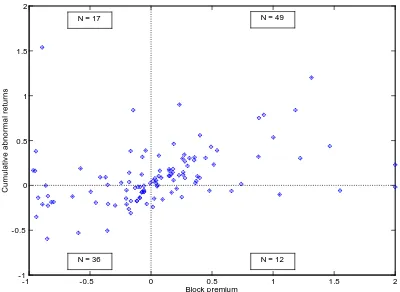
Figure1shows the scatter plot ofBP andCARin our sample. There are several noteworthy
features. First, the average BP in our sample is 6:8% and the average CAR is 9:6%. Despite
these positive means, 47% of deals have negative BP and 42% of deals have negative CAR.
Second, BP and CAR are positively correlated, with a correlation coe¢ cient of 0:37. This
strong association captures the fact that most trades are concentrated in two regions of the
scatter plot, with 74% of the trades with positiveCAR exhibiting a block premium and75% of
that, for most majority-block trades, dispersed shareholders and blockholders either gain or
lose simultaneously.
<INSERT FIGURE 1ABOUT HERE>
How are these data informative of liquidity shock probabilities? Consider the subsample of
trades where dispersed shareholders respond negatively to the announcement (i.e., CAR <0).
For these deals, a decline in the shared security bene…ts may have been caused by either a
liquidity shock that forced the incumbent blockholder to sell, implying also losses to the
block-holder (i.e., BP <0) or a gain in private bene…ts at the expense of the dispersed shareholders,
so that BP >0.
Based on this distinction, one approach to identify the probability of liquidity shocks would
be to treat all deals with CAR < 0 and BP < 0 as having been caused by such shocks and
then specify a reduced-form probabilistic regression model to explain the event that CAR <0
and BP < 0. However, this approach introduces biases by neglecting the fact that deals with
CAR >0can also be informative of liquidity shocks. First, the incumbent blockholder may have
been hit by a liquidity shock but found a white knight that provided liquidity while increasing
shared security bene…ts. Second, forward-looking block and share prices must incorporate the
possibility of liquidity shocks in the future, even for deals that were not caused by liquidity
shocks. Indeed, 30% of our sample contains deals where blockholders gain more than
share-holders (BP > CAR >0). While these deals were most likely caused by an increase in security
bene…ts, the transaction prices embedded inBP andCAR are likely to also re‡ect information
about liquidity shocks.
We extract two conclusions from this discussion. First, because block trades by and large
imply either simultaneous gains or losses to blockholders and dispersed shareholders, the main
reasons for trading in our data must be increase in security bene…ts or sales forced by liquidity
shocks. Second, a successful approach to identify the probability of liquidity shocks must
or negativeCAR. Moreover, due to their forward-looking nature, the prices in di¤erent scenarios
will incorporate information about the same parameters. Essentially, any deal in the data can
potentially be informative of liquidity shocks if structurally modeled.
The di¢ culties in identifying illiquidity-driven trades carry over to estimating the value of
control. Because the block premium in deals with positive CAR incorporates both shared
se-curity bene…ts and illiquidity costs, estimation of illiquidity costs requires a way to disentangle
these two opposing e¤ects. The model developed in this paper proposes an economic
mech-anism whereby illiquidity costs have di¤erent e¤ects on blockholder valuations and dispersed
shareholder valuations. The structural estimation infers these illiquidity costs by matching the
data on BP and CARto the model’s predictions of these prices.
II. A search theory of block trades
This section presents an estimable model of the valuation of a controlling block that includes
a proportion <1of the shares of a …rm, and the valuation of the 1 remaining shares held
by dispersed shareholders. Time is discrete and investors have discount factor <1.
A. Blockholder’s value
The current block owner is called the incumbent and is denoted byI. The …rm’s cash ‡ow
is a discrete random variable that takes values on a gridf 1; :::; Ng:Without loss of generality,
we assume that m > l for any m > l. Let Il denote the …rm’s cash ‡ow in state l when
I is in control. It evolves stochastically according to the conditional probability distribution
Pr [ 0 = mj = l] =qlm with qlm >0 and PNm=1qlm = 1 for every l = 1:::; N, where the prime
denotes next period values. We assume that the transition matrix induced by the conditional
probabilities qlm is monotone.
Denote byv I
l the incumbent’s per share value of the block at Il. This value includes the
shared security bene…ts and illiquidity costs to the blockholder. The blockholder also obtains
but rather from social prestige and network building in the case of an individual blockholder
or from valuable synergies in the case of a corporate blockholder. We assume per share private
bene…ts are constant across incumbent and rival and equal to B.
At the beginning of every period, I may face a liquidity shock with probability . If a
liquidity shock occurs, then I is forced to sell at a …re sale price to a rival blockholder denoted
by R. The …rm’s cash ‡ow under the rival is denoted by R
m and is drawn from the same
transition matrix induced by qlm given the current state l. We do not model how the block
trades following a liquidity shock. Instead, we specify the …re sale price in reduced form as
v Rm . The parameter summarizes the owner’s liquidity and the parameter summarizes
the asset’s liquidity. Therefore, the ex ante block price upon a liquidity shock is
Lvl = N
X
k=1
qlkv( k): (1)
If a liquidity shock does not occur, the incumbent is matched with a potential buyer with
probability . The parameter is a measure of market thinness. We assume trading is the result
of Nash bargaining, where the seller’s relative bargaining power is 2 [0;1]. If bargaining is
successful, R pays the prices Ik; Rm and getsv Rm plus the private bene…ts.
The value of the block to the incumbent, v, is the sum of the current cash ‡ow, I l, the
continuation value in the absence of a liquidity shock, ~v, and the liquidation value, Lvl, that is,
v Il = Il +
"
(1 ) N
X
k=1
qlkv~l Ik + Lvl
#
: (2)
The continuation value absent a liquidity shock plus private bene…ts equal
~
vl Ik +B = N
X
m=1
qlmmax s Ik; Rm ; v kI +B + (1 ) v Ik +B : (3)
The incumbent has an option to sell the block for s Ik; Rm to a higher valued blockholder.
Under Nash bargaining,s Ik; Rm solves
max
s s v I
k +B v Rm +B s 1
:
When a there are gains from trade v I
k < v Rm , the solution is
Otherwise, no trade occurs and I remains the blockholder with valuationv Ik +B. From (4),
the block price must compensate I for the value attained by not selling plus I’s fraction of the
added surplus that results from R taking over.
The next proposition characterizes the functionv( ). The proof is provided in the appendix.
Proposition 1 The value function v exists, is unique, and is strictly increasing in .
The property that v is strictly increasing implies that it is optimal to sell the block if and
only if I
k< Rm. Therefore, we can simplify ~v as
~
vl Ik =v Ik + X m>k
qlm v Rm v Ik : (5)
The last term on the right hand side of equation (5) is the value of the option to sell. The
fraction of the option to sell accrues toI but can only be captured if a rival appears, which
occurs with probability . Note that it is worth selling to an incrementally better rival because
all future increases in value that result from a sale by the rival are already properly valued in
v and there are no …xed costs of selling.
The model’s property that the block is sold if and only if I
k < Rm (rather than if and only if
v Ik < v Rm ) is extremely useful. As we show in Appendix B, this property implies that we
can solve the …xed point problem de…ning v (equations (2) and (5)) via a perfectly identi…ed
system of linear equations that only requires inverting a matrix. Proposition 1 guarantees
that this matrix inverse exists. This property follows from the assumption that R and I are
heterogeneous only with respect to the cash ‡ow they generate. Any two blockholders generating
the same cash ‡ow have equal security bene…ts, v( ): Without this property, we would have
to solve the value function …xed point problem simultaneously with the decision rule that
v Ik < v Rm (see Afonso and Lagos (2012) for a similar result).
B. Dispersed shareholders’value
The model assumes complete information by all investors. Therefore, dispersed shareholders
stock market at the share price p such that
p Il = Il +
"
(1 ) N
X
k=1
qlkp~l Ik + L p l
#
: (6)
Dispersed shareholders know that with probability 1 there is no liquidity shock and the
block is sold if and only if a rival is present and generates higher cash ‡ows. The share price
absent a liquidity shock, p;~ is given by
~
pl Ik =p Ik + N
X
m=1
qlmmax p Rm p Ik ;0 : (7)
Dispersed shareholders also bene…t from I’s option to sell. Further, we will show that p( ) is
increasing in , which implies that I’s decision rule to sell is e¢ cient. This result is appealing
because it is consistent with the correlation between the block premium and announcement
return documented in Section I. The last component of the share price is the expected share
price if a liquidity shock occurs,
Lpl = N
X
k=1
qlkp( k): (8)
Dispersed shareholders di¤er from blockholders in three ways. First, they do not receive
any private bene…ts from holding the stock. Second, dispersed shareholders are able to extract
all the value from the option to sell because they act in a competitive market. Indeed, they do
not bargain over the gains from trade. Third, dispersed shareholders are not hit with liquidity
shocks and are not forced to sell at a …re sale price. However, they lose if, upon a liquidity
shock, the incumbent sells to a rival that generates lower cash ‡ows. These di¤erences are
critical for the model to identify the illiquidity cost parameters.
The next proposition characterizes the function p( ).
Proposition 2 The value function p exists, is unique, and is strictly increasing in . Also,
p( )> v( ) for any whenever >0 and <1, or >0 and <1.
As in Bolton and von Thadden (1998), dispersed shareholders value security bene…ts more
blockholders that have less impact on dispersed shareholders. Speci…cally, when the probability
of a liquidity shock is strictly positive, …re sale discounts a¤ect blockholders more than they do
dispersed shareholders if <1. Likewise, when >0, selling to a more e¢ cient rival bene…ts
the dispersed shareholders more because <1. The model therefore relies on private bene…ts to
explain why blockholders may value shares of the target …rm more than dispersed shareholders.
C. The block premium and the price reaction to the trade
Conditional on a trade, the block price is v Rm if a liquidity shock occurs, and s Ik; Rm
otherwise. The block premium is de…ned as the ratio of the share block price to the
per-share pre-trade price:
BP Ik; Rm
8 > < > :
v( R m)
p( I k)
1; if a liquidity shock occurs,
s( I k; Rm)
p( I k)
1; else.
(9)
The price reaction to the block trade announcement is de…ned by:
CAR Ik; Rm p R m p I
k
1: (10)
Note that CAR < 0 signals liquidity shocks: it only occurs if the block is traded after a
liquidity shock and the new block owner generates lower cash ‡ow. However, the converse is
not true: CAR >0 occurs following a liquidity shock if the randomly matched rival produces a
higher cash ‡ow. The next section discusses how the probability of a liquidity shock is identi…ed
despite this di¢ culty.
III. Empirical strategy
The unit of observation in our data is a block trade indexed byi. The dependent variables
areCARi and BPi. Our model allows us to construct theoretical counterparts to these for each
deal as a function of the parameters of interest: the owner’s liquidity shock probability, , the
asset’s liquidity parameter, , market thinness, , the blockholder’s private bene…ts,B, and the
model identi…es these parameters from the data. These parameters are constant in the model
for each trade and we will treat them as such in the empirical estimation. However, there is no
model-imposed restriction on how these parameters vary across trades. We then discuss how
we specify variation across trades for some of these parameters. Finally, the section describes
the estimation method.
A. Identi…cation
We develop a novel identi…cation strategy to estimate a search model that uses the di¤erences
in the valuation of blockholders, BP, and of dispersed shareholders, CAR, at the time of the
block trade. Traditional identi…cation strategies in search models require either information on
the time between two trades of the same block or contemporaneous trades of di¤erent blocks
on the same stock (Feldhütter (2012)). Neither alternative is feasible to us.
A.1. Identi…cation of
The model de…nes three main regions in the (CAR; BP) space that can be used to
iden-tify liquidity shocks. First, the model infers that trades exhibiting a negative price reaction
(CAR <0)must have been caused by a liquidity shock.
Second, the model infers that a liquidity shock cannot have occurred if the trade resulted
in a block premium that surpassed the increase in dispersed shareholders’s valuation, BP
CAR >0:To see this note that v R v R < p R , for any R, so that any trade caused
by a liquidity shock must have
BP = v R
p( I) 1< p R
p( I) 1 =CAR:
Hence, deals in Figure 1 with BP CAR > 0 are voluntary trades where shared bene…ts
increased.
Third, for the remaining deals in the sample with CAR > 0 and CAR > BP, the model
assigns an ex-post probability that a liquidity shock occurred that is equal to
Pr [ 0 > lj = l]
The numerator describes the probability that a trade results from a liquidity shock to the
incumbent that nonetheless yields an increase in shared bene…ts. The denominator describes
the probability that a trade occurs and there is an increase in shared bene…ts.
Interestingly, the model allows us to extract information about even for those deals that
it predicts were not caused by a liquidity shock, that is, in the region where BP CAR > 0.
To see this, consider panel (a) of Figure 2, which plots the simulated mean valuation spread
BP CAR conditional on BP CAR > 0; against . The parameter values are close to the
actual estimates given below, but the plot has an identical shape for a wide range of values.
The valuation spread is decreasing in . Intuitively, this spread re‡ects the fact that these
shocks penalize blockholders more than dispersed shareholders because blockholders have a
lower expected …re sale price. Interestingly, the valuation spread is informative (i.e., steeper)
when liquidity shocks did not occur ex post (i.e., BP > CAR >0) and were unlikely ex ante
(i.e., low ).
<INSERT FIGURE 2 HERE>
A.2. Identi…cation of and
Estimation of relies on the fact that …re sale prices a¤ect only the blockholders’value,v,
but not the share price, p. Therefore, when a liquidity shock has occurred, the model primarily
assigns the variation in block prices that is not associated with variation in the price reaction
to variation in . In addition, it is possible to infer variation in even in deals that the model
predicts that there was no liquidity shock. Panel (b) of Figure 2 indicates that the valuation
spread increases with conditional on BP CAR > 0. The intuition is that, in this region,
the block premium incorporates the likelihood of a future …re sale and therefore is increasing
in , whereas the announcement return is una¤ected by .
Market thinness, , a¤ects directly the value of the option to sell to a high-valued rival. Like
; BP and CAR increase with . However, as depicted in panel (c) of Figure 2, BP CAR
relies on the fact that, unlike , it cannot explain the occurrence of negative price reactions.
A.3. Identi…cation of B and
The size of private bene…tsB has an important role in capturing variation in the data where
CAR > 0. The choice of B faces the following trade-o¤: too low and the estimation may fail
to match the average block premium in deals where BP CAR > 0; too high and it may
misclassify trades with low BP and CAR > 0 as due to liquidity shocks. For this reason, we
add some ‡exibility to the functional form of B, allowing private bene…ts to vary across deals
but, to remain consistent with the model, not across blockholders in the same deal.
To identify the bargaining parameter, , the model relies on the fact that a¤ects the block
price but notCAR. While these facts are also true for the asset liquidity parameter, , there is
one important di¤erence between and : has a …rst order e¤ect on the block price absent
a liquidity shock through the value of the option to sell, whereas has a …rst order e¤ect on
the block price in the presence of a liquidity shock.
B. Modeling liquidity
In our estimation, as well as in the model, and are constant for each deal but allowed to
vary across deals. We model the cross-sectional variation in and using parametric logistic
functions:
(xi; ) = exp (x 0 i ) 1 + exp (x0
i )
; (12)
(zi; ) = exp (z 0 i )
1 + exp (z0i ): (13)
By construction, the logistic function guarantees that and are bounded between 0 and 1. In
these functions,xi and zi are vectors of exogenous determinants of liquidity shocks and …re sale
prices, respectively, whereas and are vectors of …xed sensitivities to be estimated. As we
describe in detail in Section IV, xi includes variables that describe the state of liquidity, such
in zi capture variation in the traded blocks’ …re sale value, including proxies for industry
redeployability and asset speci…city. Variation in xi and zi across deals allows us to estimate
and through the variation they produce on BP and CAR.
While varies with xi and varies with zi, the model and the estimation constrain and
to be constant over time for each deal i. This assumption is equivalent to assuming that
blockholders and dispersed shareholders display a myopic attitude towards changes in these
quantities. The ability of the model to reasonably …t the data suggests that our assumption
may not be too restrictive and the reason may be that the variables we include in xi and zi are
quite persistent. Ideally, the model and estimation would allow forxiandzito be state variables
in the investors’problems and for investors to change their valuations as their forecasts of and
changed. We do not pursue this approach because it is highly computationally demanding,
but allowing for time variation in and is a goal for future research.
C. Estimation
C.1. Algorithm
For each deal, we estimate the conditional probabilities qlm using annual cash ‡ow data at
the target …rm’s 3-digit SIC level. We obtain an industry cash ‡ow grid and its associated
Markov transition matrix from the discretization of the estimated AR(1) process of the
log-detrended cash ‡ow time series. We construct a …rm-level grid from the industry grid assuming
constant price to cash ‡ow ratios. The use of industry data for the regressions guarantees, with
its longer time series, more precise estimates. More details can be found in Appendix C.
We set the discount factor to 1=1:1. This choice of a 10% discount rate includes a
risk-free rate, a market premium and an additional premium for the lack of diversi…cation. Lower
discount factors tend to generate higher variation inCARbecause the changes inCARapproach
the changes in one-period cash ‡ows when the future matters less. Section VI shows that this
additional variation inCAR comes at the cost of limiting the e¤ect of the liquidity frictions on
Private bene…ts are identical across incumbent and rival for each deal, but as with the
liquidity parameters, we allow private bene…ts to vary across deals. We specify Bi as
Bi =b0+b1E(v( i)) +b2E(p( i)) (1 i)= i;
which allows for a higher utility from running a more valuable block, through E(v); and a
“glow”e¤ect, throughE(p) (1 ), that the blockholder gets from running a …rm with a large
capitalization of the dispersed shares. The parameters to estimate, b0; b1, andb2;are constant
across deals.
We estimate the model’s parameters, =f ; ; b0; b1; b2; ; g; using the simulated method
of moments (SMM). This estimator minimizes the norm function,
J = [m(fBPi; CARigi; ) M]0 W [m(fBPi; CARigi; ) M];
where m(fBPi; CARigi; ) is a vector of model-predicted moments of the joint distribution
of the two observed endogenous variables, the block premium and the price reaction to the
announcement, and M is the vector of the same moments in the sample. W is a matrix of
weights. The procedure to search for the SMM estimator is explained in AppendixC, including
the care we take in the choice of initial conditions.
C.2. Moment conditions
The number of parameters to estimate is equal to the number of parameters in and
plus 5. We identify these parameters through an over-identifying set of 3 (# ( ) + # ( )) + 7
moment conditions. First, m includes moments that condition on deals the model predicts
were caused by liquidity shocks, that is, where CAR < 0 and BP < 0. We include the …rst
and second moments of BP and CAR: E(BPjCAR <0; BP < 0), V ar(BPjCAR < 0; BP <0),
V ar(CARjCAR < 0; BP <0), and E(BP CARjCAR < 0; BP <0). In this subsample, BP is
directly related to via the …re sale price equation. Therefore, we impose the restriction that
the model match the co-movement between the estimated and the determinants of the asset’s
Second, and also motivated by the identi…cation arguments above,mincludes moments that
the model predicts were not caused by liquidity shocks, where we have BP CAR >0. In this
region, the value spread is highly informative of . Hence, we include the …rst and second order
conditional moments of BP CAR: E[BP CARjBP CAR > 0], V ar(BPjBP CAR >0),
V ar(CARjBP CAR >0), V ar(BP CARjBP CAR >0), and E[BP CARjBP CAR >
0]. Similarly, we include the momentsE[(BP CAR) xjBP CAR >0]to constrain that our
estimates of match the co-movement between the valuation spread and the determinants of
the owner’s liquidity, x.
Third,mincludes the …rst-order unconditional momentsE(BP x),E(CAR x),E(BP z),
and E(CAR z).6 These moments provide additional information on all parameters, because
they are weighted averages of the conditional moments above (and of moments not included)
where the weights are the corresponding conditional probabilities, which are themselves
infor-mative about ; and :
IV. Data
Our data set combines Thomson One Banker’s Mergers and Acquisitions data, CRSP and
Compustat. We complement these with characteristics of the aggregate economy, which are
obtained from the Board of Governors of the U.S. Federal Reserve. Table I describes in detail
the variables constructed from these sources.
<INSERT TABLE I ABOUT HERE>
A. Sample selection
We consider all U.S. disclosed-value acquisitions of a block of more than 35% but less than
90% of the stock between January 1, 1990, and December 31, 2010 in Thomson One Banker’s
M&A. The lower bound on block size is imposed so that the blockholder has e¤ective control
over the …rm. Arguably, control can be e¤ectively achieved with less than 35% of the stock (e.g.,
We use the conservative value of 35% because smaller blocks are subject to di¤erent economics:
(i) with smaller blocks, a raider may acquire control without buying the existing block (see
Burkart, Gromb, and Panunzi (2000)), complicating the pricing mechanism with the e¤ect of
alternative buying strategies; (ii) the incentive alignment e¤ect strengthens with block size,
minimizing the chances that a trade for larger controlling blocks is motivated by heterogeneity
in private bene…ts; and (iii) larger blocks are more likely to be subject to liquidity shocks as
they represent a larger fraction of the owner’s wealth, all else equal. The Internet Appendix
presents results of estimating the model using a lower bound of 10%. This larger sample appears
to have more trades due to private bene…ts, producing weaker estimation results.
We exclude deals such as block trades between parent companies and subsidiaries, spin-o¤s,
equity carve-outs, recapitalizations, repurchases and others that either fail to have a price for
the target before the trade or do not otherwise …t the structure of the model of two independent
blockholders trading an existing block. Our sample starts with 1;751deals. Of these, only395
deals involve publicly traded targets. From these 395deals, we drop146 deals because the deal
synopses or one of at least two news articles about each deal report either (i) a di¤erent deal type
than in the Thomson One Banker data (e.g., spin-o¤s or parent-subsidiary deals that should
have been eliminated previously), or (ii) changes in the block size simultaneous or subsequent
to the trade (in 51 deals the block is made of newly issued shares, in 22 deals the trade was
shortly followed by an acquisition of the remaining interest and in 14 deals it was followed by
a tender o¤er). Indeed, the latter events are inconsistent with the model, where the block size
remains constant after the trade. We match each deal to the target …rm’s Compustat record
on the last December preceding the trade announcement. The …nal sample of 114deals (45:7%
of 249) excludes deals where the target is not covered by CRSP or Compustat after the trade.
Details of the sample selection are included in Appendix D.
TableIIsummarizes the main characteristics of the block trades: the mean block size is 59.7%
with a standard deviation of 15.1%, and the average deal value is $193 million with a standard
liquidity beta from a regression of daily returns on the contemporaneous value-weighted CRSP
portfolio return and the innovations in the Pástor-Stambaugh (2003) market liquidity index
using all available prices from 252 days to 21 days before the announcement. The estimated
parameters are used to adjustCAR andBP for changes in systematic risk and liquidity risk in
line with the assumption of risk-neutral shareholders in the model.
<INSERT TABLEII ABOUT HERE>
B. Determinants of the owner’s liquidity
We interpret as shock to the blockholder’s preference for, or access to cash, which forces the
sale of the block. We expect this shock to occur in times of tighter aggregate funding liquidity.
Our proxy for funding liquidity is the bond liquidity premium index in Fontaine and Garcia
(2012) (Fontaine-Garcia). Fontaine and Garcia (2012) identify a monthly latent liquidity factor
from the yield spread between US Treasury bills with the same cash ‡ows but di¤erent ages.
They interpret the higher yields on otherwise identical older Treasury bills as a premium on
the liquidity of on-the-run bonds. We hypothesize that their index is positively associated with
: We discuss other measures of liquidity in Section VI.
We include also the growth of U.S. GDP per capita (GDP growth). The inclusion of a
busi-ness cycle variable is meant to capture two opposing e¤ects: during expansions, (i) investors
have stronger balance sheets and are less likely to face liquidity shocks, and, (ii) better
alter-native investment opportunities may generate a preference for cash. We try to separate these
hypotheses by interacting the business cycle variable with variables that describe aggregate
funding costs. We argue that having a better alternative investment opportunity would only
force the blockholder to sell if at the same time the cost of borrowing is high. The proxy for
the cost of funding used is the slope of the yield curve, measured by the di¤erence in interest
rates on the 10-year and the 3-month Treasury bills (Yield curve slope). We expect high GDP
growth to have a negative direct e¤ect on ; but a positive e¤ect via its interaction with the
We also include in the determinants of the average daily return on the equally-weighted
portfolio of all NYSE, AMEX, and NASDAQ stocks (Market Return) and the standard
de-viation of the returns on the same portfolio (Market Volatility). Gromb and Vayanos (2002)
and Brunnermeier and Pedersen (2009) show that liquidity providers face tighter funding
con-straints when market returns are low and volatility is high and thereby diminish their role as
liquidity providers (see also Chordia, Roll, and Subrahmanyam (2002)). We therefore predict
to decrease with Market Return and to increase with Market Volatility. Because stock returns
may also capture investment opportunities, we also include the interaction between the Yield
curve slope and Market Return.
C. Determinants of the asset’s liquidity
We think of as describing the liquidity of controlling blocks. The empirical literature on
the liquidity of productive assets largely follows Williamson (1988) and speci…es liquidation
values as a function of the asset’s physical redeployability.7 We adopt this idea and specify the
block’s liquidity as a function of its …nancial redeployability. Given that measuring the block’s
…nancial redeployability requires unavailable data on incumbent and potential blockholders,
we borrow proxies for the asset’s redeployability. Indeed, we expect the physical capital to
be correlated with the human capital needed to make good use of it (e.g., the more ‘speci…c’
the asset, the more scarce the required human capital). The cost of this choice is the risk of
introducing noise in the estimation. Only more data in the future can help capture these e¤ects
better.
The industry’s asset speci…city captures the human capital needed to make good use of the
assets. Therefore, we view it as a proxy for the amount of industry-speci…c knowledge required
by the controlling blockholder, and expect more potential buyers of controlling stakes in …rms
that use generic productive assets. We hypothesize that higher speci…city causes a steeper
…re sale discount of the block. We follow Stromberg (2000) and measure Industry Speci…city
industry (non-industry speci…c assets include land, commercial real estate and cash). Shleifer
and Vishny (1992) add that, because assets of distressed …rms tend to be best sold within the
same industry, redeployability is a function of the industry’s capacity to absorb them. As an
additional measure of the block’s redeployability, we use the ratio of the block value to the
total market capitalization of all …rms in the same 2-digit SIC group (Block-to-Industry Size).
Table II shows that, while the trades in our sample are small relative to their industries’total
equity (mean of 0.008), there is large variation in this measure. Based on this interpretation,
we expect the liquidation parameter, ;to decrease with the relative size of the block. However,
if blockholders have a preference for relatively larger blocks in order to, say, exert control over
industry policies, then would vary positively withBlock-to-Industry Size.
We let the block’s …re sale parameter vary with the target’s leverage relative to its industry’s
median leverage. We de…ne Target minus Industry Leverage as the di¤erence between the
target’s proportion of long-term debt to assets and the median proportion of long-term debt
to assets of all …rms in the same 3-digit SIC code. We expect blockholders to price a bigger
discount for …rms with more long term debt as they are more constrained in borrowing to fund
any restructuring activities.
We include the total dollar volume of M&A activity involving targets in the same 2-digit SIC
group during the last quarter before the deal. HighIndustry’s M&A Activity could be the result
of an increased supply of industry-speci…c assets, which would depress the liquidation value of
the block. High Industry’s M&A Activity could also re‡ect high liquidity for industry-speci…c
assets as in Schlingemann, Stulz, and Walkling (2002) and Ortiz-Molina and Phillips (2012)
and, therefore, increase the block’s liquidation value. To control for the time-series variation
in investment opportunities in the same industry, we include the median ratio of the
market-to-book value of assets of all …rms in the same 3-digit SIC code. Finally, we control for the
V. Results
We present results for a baseline speci…cation and for an extension of the baseline
spec-i…cation that tries to distinguish between liquidity shocks due to an increase in investment
opportunities or a shortage of funding.
A. Model …t
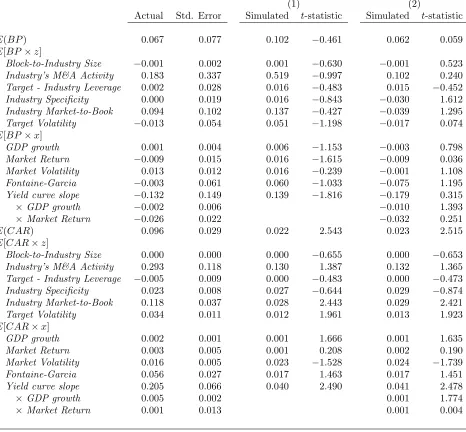
Panel A of Table III evaluates the quality of the model’s …t to the data. In the baseline
speci…cation (speci…cation (1)), the model estimates the average block premium to be 9.6%,
which is larger than the sample mean of 6.7%. In the extended speci…cation (speci…cation (2)),
the model gets closer, predicting an average block premium of 6.2%. Speci…cation (2) is better
at matching the fraction of discounts, but it underestimates the standard deviation of the block
premium. The model produces a correlation between actual and predicted block premiums of
about 0.11.
The two speci…cations predict similarCARmoments. Under both speci…cations, the model
underpredicts the mean and standard deviation of CAR, but gets close to matching the
frac-tion of negative CAR in the data. Despite underpredicting CAR, the model generates a
cor-relation between actual and predicted CAR of almost 0.4. The model can …t BP better than
CARbecause: (i) unlike share prices, block prices are also directly a¤ected by private bene…ts
of control, …re sale discounts and the bargaining power parameter; and, (ii) the variation in the
cash ‡ow distribution, which we estimate to be quite high, is smoothed out signi…cantly in p
by the fact that share prices are forward looking, therefore constraining the maximum possible
predicted CAR. A detailed discussion of point (ii) is provided in the Internet Appendix.
Recall from Section I that 74% of the trades with positive CAR exhibit a block premium
and that 75% of the trades with a negative CAR exhibit a block discount. In the baseline
speci…cation the corresponding numbers are 61% and 55% whereas in the extended speci…cation
the corresponding numbers are 77% and 67%. Note that speci…cation (2) performs well in
For both speci…cations, we reject the hypothesis that all of the model’s parameters are
zero (p-value of 0:00). Further, with 95% con…dence, we cannot reject the joint hypotheses
that the model is correctly speci…ed and that the moment conditions over-identify the model’s
parameters. We investigate the model …t also by inspecting the model’s ability to match the
moment conditions in the SMM estimation. TableIV reports a moment-by-moment match for
both speci…cations.
The model does a good job matching the moments that are most informative of and
: the unconditional mean of BP; the mean of BP CAR conditional on BP > CAR > 0;
the correlation of the valuation spread BP CAR with some of the proposed determinants of
liquidity conditional on BP > CAR >0; and, many of the correlations of BP and CAR with
some of the proposed determinants of liquidity shocks (the yield curve slope and its interactions
with GDP growth or market returns) and of …re sale values (target leverage relative to its
industry median, target industry’s asset speci…city). The ability to match the correlations of
BP andCARwith determinants of liquidity is consistent with the relatively low standard errors
for the associated coe¢ cients.
The model does poorly in matching the second order moments and speci…cally moments
that are related to CAR. One possible reason for this failure is the risk neutrality assumption
that eliminates all variation in risk premia. Future models should consider risk aversion and
variation in risk premia to better match the moments associated withCAR. Another possibility
for this failure is that that SMM gives these moments smaller optimal weights, as the estimation
procedure trades o¤ the matching error with the precision of the moments’measurement.
As an additional test to the …t of the model, we count the number of trades that satisfy
the condition that trading following a liquidity shock is ine¢ cient, that is, v( I) +B > v( R).
This condition is veri…ed in each speci…cation for all trades in the sample.
<INSERT TABLE III ABOUT HERE>
B. Parameter estimates
Panel B of TableIIIpresents the parameter estimates. We estimate the parameter associated
with market thinness, , to be 0:59 in speci…cation (1) and 0:43 in speci…cation (2). These
estimates are statistically signi…cant at the 1% level. Their magnitude suggests that a seller is
expected to meet a potential buyer absent a liquidity shock roughly once every two years.
In both speci…cations, the estimated incumbent’s bargaining power in the absence of a
liquidity shock is close 0.5. These point estimates are statistically signi…cantly di¤erent from
0, but not from 0.5. We take this result as additional empirical support for our model given
that there is no reason to expect buyers to have a bargaining advantage over sellers in times of
normal liquidity.
At the bottom of panel B of Table III, we present the estimates of the private bene…ts
function parameters. The estimated average private bene…ts per share in the block are 17.6%
in speci…cation (1) and 7.9% in speci…cation (2). Neither is statistically signi…cant at normal
signi…cance levels.
B.1. Cross-sectional determinants of owner’s liquidity
GDP growth has a negative and signi…cant e¤ect on . In terms of economic signi…cance,
and in both speci…cations, a one standard deviation increase inGDP growth is associated with a
decrease in of0:03. The sign of the point estimate supports the hypothesis that in expansions
agents have stronger balance sheets and are less likely to face liquidity shocks.
The coe¢ cient on Market Return is negative and has the strongest e¤ect on in terms of
economic signi…cance: one sample standard deviation increase in Market Return is associated
with a large decrease in of 0.11 in speci…cation (1) and of 0.31 in speci…cation (2). This
result is in line with that of GDP growth and suggests that periods of high market returns in
the sample are periods of increased liquidity. The e¤ect of Market Volatility is unexpectedly
negative, although not always signi…cant at the 5% level.
a statistically and economically signi…cant positive e¤ect on : The cost of funding as proxied
by theYield curve slope has positive e¤ect on , which is especially strong in speci…cation (2).
Speci…cation (2) adds the interactions between GDP growth and Market Return with the
Yield curve slope. The estimated coe¢ cients of these variables are positive and strongly
sta-tistically and economically signi…cant. These results support the hypothesis that blockholder
liquidity shocks are more likely to occur with the arrival of better alternative investment
op-portunities in expansions, together with high cost of borrowing.
B.2. Cross-sectional determinants of asset’s liquidity
The e¤ects of Target minus Industry Leverage and of Industry Speci…city on are negative
as expected, statistically signi…cant in both speci…cations in Table III, and in further tests
discussed later. In speci…cation (2), a one sample standard deviation increase in Target minus
Industry Leverage leads to a reduction in the …re sale parameter of 4 percentage points, and
one sample standard deviation increase in the speci…city of the industry’s assets is associated
with a decrease in the …re sale parameter of 2 percentage points.
While not statistically signi…cant, the Industry’s M&A Activity has a strong positive
ef-fect on …re sale prices. The sign of this estimate is consistent with the interpretation that a
large volume of M&A activity within an industry re‡ects enhanced liquidity for acquisitions
(Schlingemann, Stulz, and Walkling (2002)), although its lack of precision suggests the proxy
may be contaminated by supply e¤ects, which have the opposite sign.
Industry Market-to-Book has a positive e¤ect on …re sale prices, if not always statistically
signi…cant, implying that a given controlling block is worth more when there are more growth
options available in the industry. Finally, beyond these controls, we …nd insigni…cant e¤ects of
theTarget Volatility, or of the size of the block relative to its industry, Block-to-Industry Size.
C. In-sample distributions of and
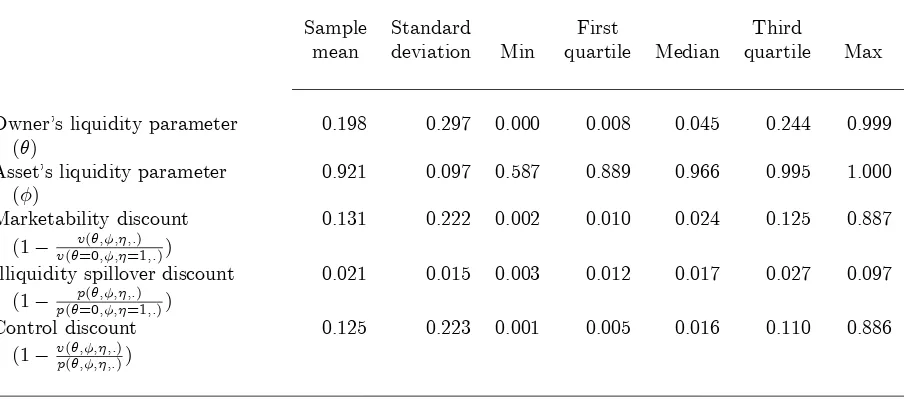
estimated average is 0.2, with a standard deviation of 0.3. This estimate suggests that on
average a blockholder is hit by a liquidity shock that forces a sale once every …ve years.8 The
table also shows that approximately 25% of the trades have an estimated of at least 24%. The
frequency of deals with extremely large may appear low relative to the42%of deals in the data
with negativeCAR. This discrepancy is explained by the following reasons. First, is an ex ante
measure of liquidity shocks computed using ex post data from each deal. A liquidity shock may
have occurred despite the low ex ante probability. Second, and more mechanically, the estimate
of is not equal to the proportion of deals with negative CAR but is a nonlinear function of
this statistic and also deal dependent. We further discuss in Section V.E the interpretation of
the size of the estimates of and of in the context of our model.
<INSERT TABLEV ABOUT HERE>
<INSERT FIGURE 3ABOUT HERE>
TableV shows that, conditional on a liquidity shock, the estimated block’s …re sale price is
on average 92% of the buyer’s block valuation, with 25% of the targets with an estimated of
less than 89%. The implied …re sale discounts are similar to estimates for other markets, that
is, to the aircraft liquidation values reported in Pulvino (1998) and to the gains from trading
on price pressure sales reported in Coval and Sta¤ord (2007). Panel (b) of Figure 3 shows the
predicted histogram of .
D. Illiquidity discounts
D.1. Marketability discount
We de…ne themarketability discount of a controlling block with respect to security bene…ts,
dM;as
dM( ) 1 v( ; ; ; :) v(0;1;1; :):
The formula makes explicit the dependence of v on , , and . It is easy to show that dM( )
dM( ) quanti…es the value of the shares in the block relative to the counterfactual scenario
where it is possible to trade at any time ( = 1) and voluntarily ( = 0). This measure of the
marketability discount di¤ers from the one in Longsta¤ (1995) because in dM it is presumed
that the blockholder remains in control, whereas in Longsta¤’s measure there is no presumption
of control.
Table V shows that the estimated average marketability discount is 13%, reaching a
max-imum of 89%. The predicted marketability discount varies with the predicted . Panel (a) of
Figure4plots the marketability discount function for every 2[0;1]. We see that, for the …rms
in the lower quartile of ;the marketability discount increases quickly, reaching 40% for just
below 20%. The estimated marketability discount is also large for blocks with intermediate …re
sale prices. However, for blocks with the highest …re sale parameter estimates, the marketability
discount is under 5% for any . Panel (b) plots the predicted distribution of the marketability
discount.
<INSERT FIGURE 4ABOUT HERE>
D.2. Illiquidity-spillover discount
We de…ne the illiquidity-spillover discount, dIS;as
dIS( ) 1 p( ; ; :) p(0;1; :):
We have that p(0; :) > p( ; :) for any >0 and that dIS >0. The illiquidity-spillover discount
quanti…es the price of dispersed shares that would prevail in the absence of search costs. It is a
spillover e¤ect in that the dispersed shareholders are not hit by a liquidity shock nor experience
market thinness directly but rather through the blockholder. However, p incorporates the
possibility that control may change hands and that the value of assets will change as a result.
TableVshows that the cost of forced block turnover is important to dispersed shareholders:
we estimate an average illiquidity-spillover discount of2:1%on dispersed shares (maximum close
to 10%). This e¤ect is …ve times as large as the average quoted bid-ask spread (Bollen, Smith,
Panel (a) of Figure 5 plots the illiquidity-spillover discount against ; conditional on the
…rm’s cash ‡ow state before the trade. As the …gure shows, this discount is higher for …rms
with high cash ‡ow because these …rms have more to lose if, due to a liquidity shock, the
incumbent blockholder is forced to sell to a less e¢ cient rival. Panel (b) plots the predicted
distribution of the illiquidity-spillover discount.
<INSERT FIGURE 5ABOUT HERE>
D.3. Control discount
We de…ne the control discount from security bene…ts,dC, as
dC( ) 1 v( ; ; ; :) p( ; ; :) :
Given that v < p for any > 0, then dC > 0. The control discount measures the
di¤er-ence in valuations of security bene…ts between the controlling blockholder and the dispersed
shareholders. This estimate of the control discount ignores the private bene…ts a¤orded to the
controlling shareholder. Given thatdIS is much smaller thandM, the estimated control discount
shares similar properties with the marketability discount, as displayed in TableV. As with the
marketability discount, Panel (a) of Figure 6 shows that the control discount displays high
sensitivity to the probability of a liquidity shock when the …re sale parameter is lowest (solid
line). Panel (b) of Figure 6 shows that the sample distribution of control discount is highly
skewed with many trades displaying negligible discounts.
<INSERT FIGURE 6ABOUT HERE>
The estimates of the control discount on blocks of shares in public corporations can be
applied to block valuations in the case of privately held corporations. Valuing blocks of shares
in privately held corporations is di¢ cult, as illustrated in Mandelbaum et al. v. Commissioner
of Internal Revenue (1995). As the court indicated, these di¢ culties arise from the limited
estimates of the control discount can be applied to a paired sample of comparable publicly traded
…rms with controlling blockholders to determine the block value. Using …rms with controlling
blockholders guarantees that the pricing by dispersed shareholders already incorporates the
added value of the blockholder and the illiquidity-spillover costs.
E. Interpreting discount estimates
Our modeling of search frictions has potential biases in the estimation of the parameters
and and hence potential biases in the measurement of the various discounts. Consider the
following two possible extreme alternatives. First, suppose that is a pure liquidity shock,
that is, one that does not necessarily force a sale. Then does not represent a pure …re sale
price but rather represents the blockholder’s reservation value. This reservation value is the
best outcome out of all possible ways of dealing with the liquidity shock, including when the
incumbent keeps the block but borrows against it as collateral; sells to a white knight, such
as a private-equity …rm supplying the needed liquidity; sells only a fraction of the block while
retaining control (though this is rare according to Barclay and Holderness, 1989); or, sells at a
…re sale price. While these possibilities are out of the model, we note that, since the …re sale is
the chosen alternative in our sample, then is an upper bound to the …re sale price.
Second, suppose that captures a more restrictive event: the event of a liquidity shock and
having failed to deal with it in any other way other than selling. By de…nition, this more
restrictive type of shock leads to a …re sale and then represents a pure …re sale price. In this
case, is a lower bound on a pure liquidity shock.
Consider now the impact of these two alternative interpretations of and on the
mar-ketability discount, dM. BecausedM is decreasing in , an upper bound on the …re sale price as
implied by the …rst scenario leads to a lower bound ondM. As for the second alternative, a lower
bound on also leads to a lower bound on the marketability discount becausedM is increasing
in . In conclusion, while we may not be measuring and exactly as pure search costs, the
discount that is always a lower bound to the true marketability discount.
The illiquidity-spillover discount, dIS, is invariant to and increasing in . Hence the
esti-mation also produces a lower bound for the illiquidity-spillover discount. Finally, the control
discount dC is decreasing in , but monotonicity with respect to cannot be determined
ana-lytically. Numerically, we showed above that dC is increasing in , so that the estimated dC is
also a lower bound to the true control discount.
F. Illiquidity discounts by industry
To illustrate the cross-sectional di¤erences in the illiquidity discounts, TableVIpresents the
highest and lowest values of the discounts by 2-digit SIC code group of the target …rm. The
analysis excludes the 2-digit SIC groups with fewer than 3 observations.
Firms in the Air Transportation industry (code 45) have the highest average marketability
and control discounts. This result may be surprising given that aircraft would appear to be
assets of very low speci…city. However, Pulvino (1998) and Benmelech and Bergman (2008)
provide strong evidence that aircraft …re sales do exist, and that their liquidation values can
vary signi…cantly across airlines. The high discount estimates for this industry, which are the
result of a combination of relatively high estimates of (0.46) and relatively low estimates of
(0.81), are largely explained by high values of the high yield curve slope contemporaneous
to these trades, and the fact that the traded …rms were highly levered with respect to their
industry.
Firms in Business Services (code 73) and Electronic and Other Electrical Equipment (code
36) rank among the industries with the lowest for marketability discount. Their ranking is
explained by the fact that these industries have relatively high estimates of average , but also
high estimates of average . For Business Services, is relatively high due to a combination of a
steep yield curve and high values of theFontaine-Garcia index contemporaneous to the trades,
while is high due to low target leverage and low asset speci…city. In the case of Electronic
industry-speci…c M&A.
Industries 73 and 36 are interesting because, despite having some of the lowest marketability
discounts, they have the fourth and …fth highest illiquidity-spillover discounts, respectively.
The reason for their high illiquidity-spillover discount is the high variance of cash ‡ows in the
industry: they rank second and …fth in terms of cash ‡ow volatility, respectively. The high
cash ‡ow volatility yields a high option value associated with …nding a better blockholder to
run the …rm, but market thinness reduces the contribution of this option to share prices. For
the same reason, the …rms in Engineering, Accounting and Management Services (code 87) and
Building Contractors (code 15) rank …rst and second in terms of illiquidity-spillover discounts.
These industries have the highest and third highest estimated cash ‡ow volatilities, respectively,
among the industries in the sample.
<INSERT TABLEVI ABOUT HERE>
VI. Additional Tests
This section considers several extensions to our model. Unless noted, the results are
tabu-lated in an Internet Appendix.
A. Trading due to private bene…ts
In our model, blocks are traded due to liquidity shocks or e¢ ciency gains. In practice,
block trades may also occur due to di¤erences in private bene…ts of control, as in Burkart,
Gromb, and Panunzi (2000) or Dyck and Zingales (2004). Therefore, one important question
is whether our identi…cation of the modelled motives for trading is a¤ected by the omission of
the private bene…ts motive. For example, trades in our sample may have occurred because the
new blockholders enjoyed signi…cantly more private bene…ts than the incumbent while being
detrimental to dispersed shareholders, that is, R < I. Given that those trades would also
result in CAR < 0; we could potentially identify them incorrectly as liquidity shock-driven,