City, University of London Institutional Repository
Citation
:
Asad, M. and Slabaugh, G. G. (2014). Hand Orientation Regression Using
Random Forest for Augmented Reality. In: DePaolis, L.T. and Mongelli, A. (Eds.), Augmented
and Virtual Reality. AVR 2014. Lecture Notes in Computer Science, 8853. (pp. 159-174).
Berlin, Germany: Springer Verlag. ISBN 978-3-319-13968-5
This is the accepted version of the paper.
This version of the publication may differ from the final published
version.
Permanent repository link:
http://openaccess.city.ac.uk/17193/
Link to published version
:
http://dx.doi.org/10.1007/978-3-319-13969-2_13
Copyright and reuse:
City Research Online aims to make research
outputs of City, University of London available to a wider audience.
Copyright and Moral Rights remain with the author(s) and/or copyright
holders. URLs from City Research Online may be freely distributed and
linked to.
City Research Online:
http://openaccess.city.ac.uk/
[email protected]
Forest for Augmented Reality
Muhammad Asad and Greg Slabaugh
City University London, EC1V 0HB, London, United Kingdom
{Muhammad.Asad.2, Gregory.Slabaugh.1}@city.ac.uk
Abstract. We present a regression method for the estimation of hand orientation using an uncalibrated camera. For training the system, we use a depth camera to capture a large dataset of hand color images and orientation angles. Each color image is segmented producing a silhouette image from which contour distance features are extracted. The orienta-tion angles are captured by robustly fitting a plane to the depth image of the hand, providing a surface normal encoding the hand orientation in 3D space. We then train multiple Random Forest regressors to learn the non-linear mapping from the space of silhouette images to orienta-tion angles. For online testing of the system, we only require a standard 2D image to infer the 3D hand orientation. Experimental results show the approach is computationally efficient, does not require any camera calibration, and is robust to inter-person shape variation.
Keywords: orientation estimation, Random Forest regression, silhou-ette image, hand
1
Introduction
Technological advancements over the recent years have made computing devices powerful, portable and inexpensive. This has given the possibility to rethink how devices are designed to work with us. One of the major hurdles faced by existing technology is the requirement for humans to adapt and learn to use it. This is particularly true for the existing tangible human-computer interaction interfaces, such as keyboard and mouse, which have not seen significant change since their first introduction. Researchers and manufacturers are trying to think of ways technology can adapt to our lifestyle so it does not get in the way but works with us [1].
extract the orientation of hand for augmented reality [7] [8] [9] [10]. Our work is closely related to [7], which uses a calibrated camera and recovers a single person’s hand geometry in addition to the camera pose. However our approach differs in that it does not require camera calibration, rendering it suitable for a much wider array of applications. In addition, by training the system on data from multiple people, it naturally handles person-to-person hand variations. Our method does not recover the camera pose, instead we focus on acquiring the orientation of the hand itself, which can be used to render an augmented object. Our method utilizes silhouette images to extract relevant features for re-gression. Silhouette images have been previously used to extract features for regressing 3D human pose [11] [12]. Multi-view silhouette images have also been used for 3D modelling [13]. Albert et al.[14] used multi-view silhouette images to estimate hand pose. Our approach differs from these methods as in our case, we only regress the 3D orientation using hand silhouette images.
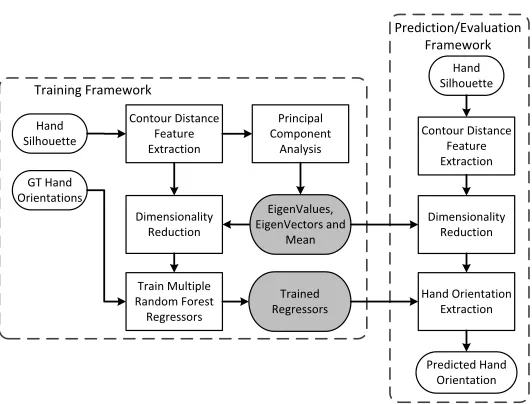
We propose a method to regress hand orientation from a dataset of hand images. This method first extracts contour distance features from the hand sil-houette images and then uses these features along with the ground truth (GT) orientation angles to train a set of Random Forest regressors. The hand orienta-tion dataset is captured using a commodity depth sensor, where for each hand orientation we have a pair of color image andGT orientation angles. These an-gles are generated by fitting a plane on the depth image. The dimensionality of contour distance features is then reduced using Principal Component Analysis (PCA). Offline training of a set of Random Forest regressors is performed using the dimensionally reduced features and GT orientation angles. Online testing involves using only dimensionally reduced contour distance features from silhou-ette images (as shown in Fig. 1) to predict orientation angles. The proposed method is evaluated using single fold and leave-one-out cross-validation.
The rest of the paper is organised in subsequent sections. Section 2 provides the details of the proposed method, while section 3 details the experimental evaluation. Discussion of the evaluation results is presented in section 4. An augmented reality based application of the proposed method is illustrated in section 5. The paper concludes with section 6.
1.1 Our Contribution
Contour Distance Feature Extraction Hand Orientation Extraction Dimensionality Reduction Hand Silhouette Predicted Hand Orientation Prediction/Evaluation Framework Contour Distance Feature Extraction Principal Component Analysis Hand Silhouette Dimensionality Reduction Train Multiple Random Forest Regressors Training Framework GT Hand Orientations EigenValues, EigenVectors and Mean Trained Regressors
Fig. 1.Flowchart for training and evaluation of the proposed hand orientation method.
We also contribute a method for extractingGT hand orientation angles from a depth image. We note this GT orientation is only used for training of the regression model.
2
Method
Given a set of color images and GT orientation angles of hands, we are in-terested in finding the mapping between segmented silhouette images and the corresponding orientation angles. The framework is designed to work with uncal-ibrated cameras and across a range of different shapes, size and style variations of hand.
(a) (b)
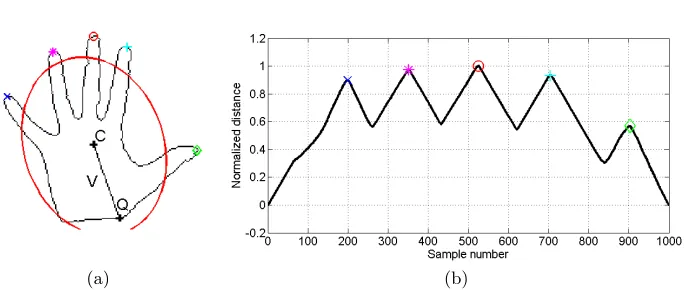
Fig. 2.Contour distance feature extraction from hand contour showing (a) the method for extraction of prevalent pointQon the wrist using a fitted ellipse, centroidC and a rayV and (b) the corresponding contour distance features.
2.1 Feature Extraction
Our method utilizes the contour distance features which are extracted from hand silhouette images. Contour distance features have been previously used for hand shape based gesture recognition [16]. While the main aim of our proposed method is not gesture recognition, contour distance features provide sufficient hand shape variations that can directly correspond to changes in orientation of the hand. Additionally we also employ a method for aligning and normalizing these features. Details on these feature extraction techniques are depicted in the following subsections.
Contour Distance Features: Let Sn ={Sk} K
k=1 be a set of hand silhouette
images for the nth person. We propose a method to compute a corresponding
distance feature setDn=D¯k K k=1.
The contour extracted from each silhouette image consists of points Pk =
{Pki}Ii=1. The Euclidean distance of each of these contour pointsPki={Pkix, P y ki} to a prevalent point on the wristQ={Qx, Qy}is determined as:
Dki=
q
(Qx−Px ki)
2
+ (Qy−Py ki)
2
, (1)
whereDk={Dki} I
i=1 is the contour distance feature vector for a set of contour
pointsPi. This method is illustrated in Fig. 2. The extracted features have dif-ferent number of samples and magnitude depending on the scale changes and inter-person hand shape variations. To deal with this we normalize a given fea-ture vector as:
¯
Dk =
Dk
PI
i=1Dki
(a) (b)
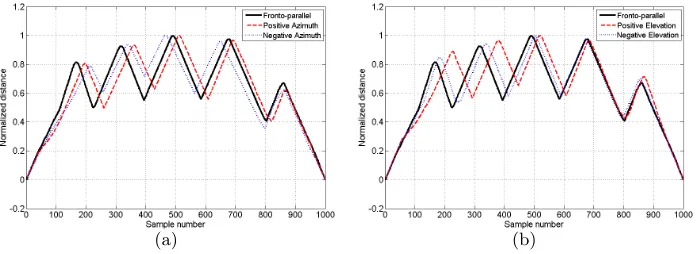
Fig. 3.Variation in the contour distance features with varying orientation in (a) Az-imuth (φ) axis and (b) Elevation (ψ) axis only.
All extracted feature vectors are resampled to a specified number of samplesρ, in order to use PCA and train Random Forest regressors. For our experimental evaluation we empirically chooseρ= 1000.
Extraction of a prevalent point on the wrist: To align the values in the distance feature vectors, we propose a method to extract a prevalent point on the wrist. Given an orientationθbetween x-axis and the major axis of an ellipse that fits the hand contour and centroidC, an equation of a ray emanating from
C can be defined by:
V =ξλˆv+C, (3)
where ˆv is the unit vector encoding the direction,
ˆ
v=
1 tanθ
√
12+ tan2θ, (4)
ξis a scalar for correcting the direction of ˆv,
ξ=
(
+1 ifθ <90◦
−1 ifθ≥90◦, (5)
andλis a parameter that changes the length of the ray. The direction scalar ξ
is calculated using Eq. 5 based on the assumption that the in-plane orientation
θof hand will always be within a predefined range of an upright hand pose with
θ = 90◦. We define this range to be 0◦ < θ <180◦. This corrects the direction of the rayV so that it is always propagating towards the wrist.
(a)
(b) (c) (d)
[image:7.612.138.484.111.374.2](e)
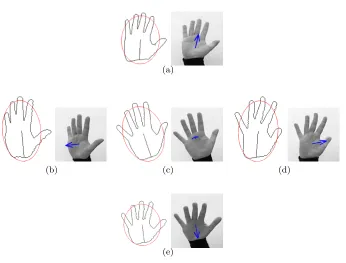
Fig. 4.Variation in the contour corresponding to contour distance features in Fig. 3 along with the normal vector encoding theGTAzimuth (φg) and Elevation (ψg)
orien-tation angles. From Fig. 3 each plot corresponds to the contours in the following man-ner: (a) Negative Elevation:φg = +12.60◦ andψg =−38.96◦, (b) Negative Azimuth:
φg =−36.67◦ and ψg = +8.59◦, (c) Fronto-parallel: φg = +2.29◦ and ψg =−0.57◦,
(d) Positive Azimuth: φg = +47.56◦ and ψg = +2.29◦ and (e) Positive Elevation:
φg = +10.31◦andψg= +41.83◦.
for distance feature calculation. θ represents the in-plane rotation of the hand, and is used along with the other predicted angles to define a complete hand orientation.
Azimuth rotation axis
Azimuth rotation axis
Elevation rotation axis
[image:8.612.223.391.130.318.2]Elevation rotation axis
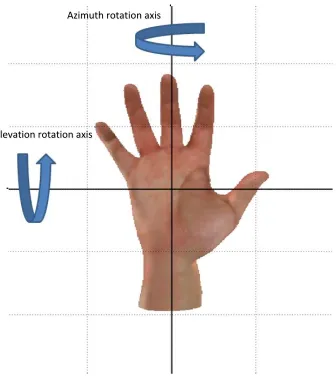
Fig. 5.Rotations axis about which Azimuth (φ) and Elevation (ψ) angles vary in the dataset. Image rendered using libhand [18].
2.2 Dimensionality Reduction
The contour distance features extracted from the hand silhouettes have a large number of dimensions. To extract the prominent variations in the dataset, we use PCA for projecting the feature vectors onto a reduced feature space.
We first extract the eigenvectors and eigenvalues of the corresponding feature vectors in the training data. The dimensions of these feature vectors are then reduced by selecting a set of eigenvectorsE, that result in 90% energy for cor-responding eigenvalues, and projecting the feature vectors onto a reduced space defined by:
ˇ
Dn=ET(Dn−µ), (6)
whereµis the mean of all the samples andDˇn is a set of dimensionally reduced feature vectors [17].
2.3 Ground Truth (GT) Data Generation using Depth Maps
The dataset contains color images andGT orientation angles. TheseGT orien-tation angles are only used during training phase and are extracted from aligned depth images by fitting an equation of a plane. For our dataset collection we use an outstretched hand pose which is roughly planar.
We use RANSAC to fit an equation of a plane defined by:
ThisN is used to calculate the corresponding orientation angles:
φg= cos−1nx, ψg= cos−1ny, (9)
whereφgandψgareGT azimuth and elevation angles respectively, as shown in Fig. 4 and Fig. 5.
2.4 Training using Random Forest
Random Forest has been previously used for fast and robust pose estimation for both the full-body and hand [19] [20] from depth images. The motivation to use Random Forest came from its performance with large datasets and that it can be easily implemented on a GPU [21] [15]. It has been proven to handle large variations in body shape, size and pose [19]. However, in this paper we are interested in regressing from the space of hand silhouette images to that of orientation angles.
The dimensionally-reduced features and GT orientations extracted in the previous steps are used to train two Random Forest regressors, one for each orientation angle. In our experimental evaluation we use Random Forest with 1000 trees and 2 features are sampled for splitting at each node.
We generate a dataset which contains 1624 color images and GT orienta-tion from a total of 13 participants. The choice of hand orientaorienta-tion variaorienta-tions used to record the dataset holds significance in depicting the contribution of the proposed method. To generate this dataset we asked our participants to use an outstretched open hand pose throughout the data capture process. They were asked to rotate the hand back and forth, first along the azimuthal axis and then along the elevational axis only (as shown in Fig. 5). Color images and GT
hand orientations were recorded while the participants performed these manip-ulations. As a result of different participants, the dataset contains significant variations in hand size, shape and style of rotations. This current dataset only contains data from participants’ right hand, however taking the advantage of mirror symmetry the same dataset can be reflected to generate images for left hand. The GT orientation angles are only used for the training step and are not part of the final prediction method, where only hand silhouettes from color images are used. In the dataset bothφg andψgare limited from−45◦to +45◦.
3
Experimental Evaluation
(a) (b)
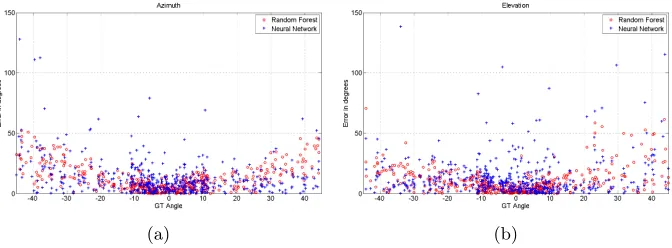
Fig. 6. Absolute prediction error (in degrees) illustrating error (a)φe and (b) ψe in
single fold validation using Random Forest and Neural Network regression techniques.
Table 1.Average error in degrees for experimental evaluation in section 3.
Evaluation method
Regressor
Used Azimuth (φa) Elevation (ψa)
Single Fold Random Forest 11.44◦ 9.57◦ Neural Network 15.31◦ 14.19◦ Leave-one-out Random Forest 12.93◦ 12.61◦ Neural Network 20.14◦ 18.85◦
the system, and tested the resulting system on the left out participant. This latter technique demonstrates how the system performs on unseen individuals. For comparison all experiments are also repeated using Neural Network regressor with 1 hidden state containing 1000 neurons. In our experiments, we varied the number of trees in Random Forest and neurons in Neural Network regressors. However changing these parameters did not significantly affect the output of our method. Therefore we empirically fixed the number of trees and neurons to be 1000 for all the experiments. The results are presented below which are then compared and discussed in Section 4.
3.1 Single fold validation
To evaluate the overall performance of the proposed method, we randomly di-vide the dataset into training and testing sets. The system is then trained and evaluated using the corresponding sets of data.
The absolute predicted errors for this validation are presented against GT
[image:10.612.153.458.314.383.2](a)
[image:11.612.139.475.111.378.2](b)
Fig. 7.GT vs Predicted Angle plots showing the accuracy of different regressors for predicted angles φp and ψp in single fold validation. The predicted angles are
illus-trated using (a) Random Forest regressors with number of trees = 1000 and (b) Neural Network regressor with 1 hidden state containing 1000 neurons.
3.2 Leave-one-out cross-validation
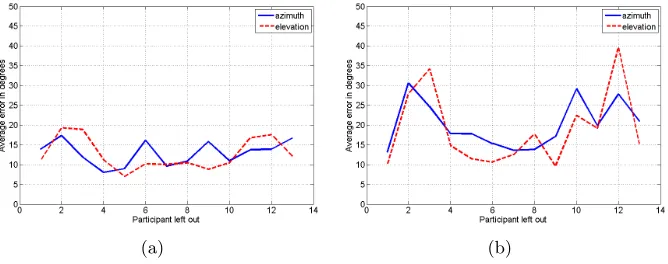
We further evaluate our method against a scenario where in each trial, we leave one participant’s data out from the training dataset. This left out data is then used for testing. This is a scenario where an unseen hand is used with our method. It is also able to evaluate the ability of the method to handle variations in hand shape, size and orientation without the need for an additional calibration step. The average prediction error for each participant using Random Forest and Neu-ral Network are presented in Fig. 8 (a) and (b) respectively, while Table 1 shows the results for average prediction error for all participants’ cross-validation.
4
Discussion
(a) (b)
Fig. 8.Absolute prediction error in degrees for leave-one-out cross-validation of each participants’ data using (a) Random Forest and (b) Neural Network regression tech-niques.
to 10◦ for both φ and ψ angles (as shown in Table 1). The average execution time of the proposed method for the given set of input silhouette images is found to be 16.93 ms per frame in Matlab implementation on 3.2 GHz Core-i5 CPU.
Fig. 6 shows the absolute prediction errors againstGT orientation angles for both Random Forest and Neural Network regressors. It can be seen from this figure that Random Forest is able to model the underlying data well, with signif-icantly less number of outliers as compared to Neural Network. Looking at the range−10◦to +10◦Random Forest is able to predict with exceptional accuracy,
while Neural Network regressor has significant number of outliers falling within the same range.
In Fig. 7 we establish the relationship betweenGT and predicted orientation angles to illustrate the performance of different regressors in single fold valida-tion. The diagonal line represents the region with optimum results, where we have correct predictions. The closer the predicted data is packed around this diagonal, the better the performance of the regressor is. It can be seen from this figure that for bothφandψ, Random Forest is able to perform better with fewer outliers.
(a) (b) (c) (d)
(e) (f) (g) (h)
[image:13.612.137.478.102.380.2] [image:13.612.188.424.478.572.2](i) (j) (k) (l)
Fig. 9. Success cases for our proposed method. The GT normal vectors are super-imposed on each image to depict the orientation. Error for each case is presented separately in Table 2.
Table 2.Absolute prediction error in degrees for success cases shown in Fig. 9.
Abolute Error Abolute Error Fig. 9 φe ψe Fig. 9 φe ψe
(a) 0.89◦ 3.61◦ (g) 5.17◦ 1.35◦ (b) 4.33◦ 0.39◦ (h) 9.08◦ 0.04◦ (c) 1.18◦ 0.52◦ (i) 7.83◦ 1.31◦ (d) 0.81◦ 8.69◦ (j) 7.12◦ 0.20◦ (e) 1.17◦ 0.34◦ (k) 1.07◦ 0.86◦ (f) 3.18◦ 0.88◦ (l) 7.18◦ 1.22◦
(a) (b) (c) (d)
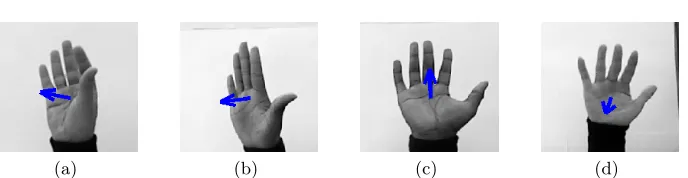
Fig. 10. Failure cases for our proposed method. The GT normal vectors are super-imposed on each image to depict the orientation. Error for each case is presented separately in Table 3.
Table 3.Absolute prediction error in degrees for failure cases shown in Fig. 10.
Predicted Ground Truth Abolute Error Fig. 10 φp ψp φg ψg φe ψe
(a) 2.96◦ −7.90◦ −43.46◦ −7.26◦ 46.42◦ 0.64◦ (b) −0.54◦ 2.29◦ −43.29◦ 5.85◦ 42.75◦ 3.56◦ (c) −3.86◦ −11.16◦ −1.15◦ −41.17◦ 2.71◦ 30.01◦ (d) −4.88◦ −17.85◦ −7.00◦ 20.97◦ 2.12◦ 38.82◦
While our method works well for most of the cases, it does produce errors. Fig. 10 shows some of the cases where our method fails, while Table 3 presents the corresponding error. These failure cases can easily be identified as outliers in the dataset as they do not have outstretched hand pose. In Fig. 10 (a), (c) and (d) the hand does not follow the planar surface assumption which directly affects the calculation of GT orientation angles, whereas in Fig. 10 (b) the fingers are placed too close together making it impossible to extract a contour distance feature that corresponds to the ones in the training dataset. Furthermore by analysing the absolute prediction errors for each failure case in Table 3 it can be seen that our method only fails for the orientation where these assumptions fail. Since our method is regressing both orientation angles independently therefore, even in these failure cases, the unaffected angle is predicted with good accuracy.
5
Application to Augmented Reality
The proposed method can be applied to a number of different application sce-narios. In our work, we present an augmented reality based application for visual inspection of virtual objects (shown in Fig. 11). In this application the digital content is overlaid on an augmented layer. Orientation changes from the hand movements are captured using our method and the corresponding orientation transformations are applied to the augmented object.
(a) (b) (c) (d)
(e) (f) (g) (h)
(i) (j) (k) (l)
(m) (n) (o) (p)
[image:15.612.136.481.105.611.2](q) (r) (s) (t)
be able to inspect it from different angles in 3D, so as to get the real impression of how the object looks like.
6
Conclusion
A hand orientation regression approach was proposed. This method used a dataset of hand silhouettes only to predict the orientation of the hand in az-imuthal and elevational axes. Contour distance features were extracted from hand silhouettes and used along with theGT orientation from depth images to train two Random Forest regressors, one for each angle. The online testing of the system required only a standard 2D image to infer the 3D hand orientation. Comparison of Random Forest with Neural Network based regression shows that the Random Forest is better suited for generalizing the variations in the dataset The system performs well with an average error of 10◦with single fold evaluation
and 12◦for leave-one-out cross-validation. The proposed method has an average
execution time of 16.93 ms per frame in a matlab implementation.
Our future aim is to extend this approach with hand in a number of different poses across different orientations. While contour distance features are able to encode variation related to orientation changes, we endeavour to explore other features as well which might further improve the overall performance of the proposed method. A major challenge for this will be to extractGT orientation. Our existingGT orientation data generation approach can be extended for such scenarios by introducing a palm extraction method. This way, assuming that the palm is rigid, we can again extract theGT orientation of hand. We also envision to use temporal correlation methods such as Kalman filtering to further increase the performance of the proposed method.
References
1. Sara Allison, “Wearable tech - the future, or just a fad?,” February 2014, [Online; posted 13-February-2014].
2. Maj Isabelle Olsson, Matthew Wyatt Martin, Joseph John Hebenstreit, and Pe-ter Michael Cazalet, “Wearable device with input and output structures,” Sept. 26 2013, US Patent App. 14/037,788.
3. Ali Erol, George Bebis, Mircea Nicolescu, Richard D Boyle, and Xander Twombly, “Vision-based hand pose estimation: A review,” Computer Vision and Image Un-derstanding, vol. 108, no. 1, pp. 52–73, 2007.
4. Ying Wu and Thomas S Huang, “Capturing articulated human hand motion: A divide-and-conquer approach,” in The Proceedings of the Seventh IEEE Interna-tional Conference on Computer Vision (ICCV). IEEE, 1999, vol. 1, pp. 606–611. 5. Romer Rosales, Vassilis Athitsos, Leonid Sigal, and Stan Sclaroff, “3d hand pose
for markerless augmented reality,” inIEEE Virtual Reality Conference, (VR’08). IEEE, 2008, pp. 145–152.
9. Taehee Lee and T Hollerer, “Multithreaded hybrid feature tracking for markerless augmented reality,” IEEE Transactions on Visualization and Computer Graphics, vol. 15, no. 3, pp. 355–368, 2009.
10. Haruhisa Kato and Tsuneo Kato, “A marker-less augmented reality based on fast fingertip detection for smart phones,” inIEEE International Conference on Consumer Electronics (ICCE). IEEE, 2011, pp. 127–128.
11. Ankur Agarwal and Bill Triggs, “Recovering 3d human pose from monocular images,” IEEE Transactions on Pattern Analysis and Machine Intelligence, vol. 28, no. 1, pp. 44–58, 2006.
12. Ahmed Elgammal and Chan-Su Lee, “Inferring 3d body pose from silhouettes using activity manifold learning,” in Proceedings of the 2004 IEEE Computer Society Conference on Computer Vision and Pattern Recognition (CVPR). IEEE, 2004, vol. 2, pp. II–681.
13. Jean-Sebastien Franco and Edmond Boyer, “Fusion of multiview silhouette cues using a space occupancy grid,” inTenth IEEE International Conference on Com-puter Vision (ICCV). IEEE, 2005, vol. 2, pp. 1747–1753.
14. Albert Causo, Etsuko Ueda, Yuichi Kurita, Yoshio Matsumoto, and Tsukasa Oga-sawara, “Model-based hand pose estimation using multiple viewpoint silhouette images and unscented kalman filter,” in The 17th IEEE International Sympo-sium on Robot and Human Interactive Communication, RO-MAN. IEEE, 2008, pp. 291–296.
15. Leo Breiman, “Random forests,” Machine learning, vol. 45, no. 1, pp. 5–32, 2001. 16. Erdem Yoruk, Ender Konukoglu, B¨ulent Sankur, and J´erˆome Darbon, “Shape-based hand recognition,” IEEE Transactions on Image Processing, vol. 15, no. 7, pp. 1803–1815, 2006.
17. Michael E Leventon, W Eric L Grimson, and Olivier Faugeras, “Statistical shape influence in geodesic active contours,” in Proceedings of IEEE Conference on Computer Vision and Pattern Recognition (CVPR). IEEE, 2000, vol. 1, pp. 316– 323.
18. Marin ˇSari´c, “Libhand: A library for hand articulation,” 2011, Version 0.9. 19. Jamie Shotton, Ross Girshick, Andrew Fitzgibbon, Toby Sharp, Mat Cook, Mark
Finocchio, Richard Moore, Pushmeet Kohli, Antonio Criminisi, Alex Kipman, et al., “Efficient human pose estimation from single depth images,”IEEE Transac-tions on Pattern Analysis and Machine Intelligence, vol. 35, no. 12, pp. 2821–2840, 2013.
20. Cem Keskin, Furkan Kıra¸c, Yunus Emre Kara, and Lale Akarun, “Real time hand pose estimation using depth sensors,” inConsumer Depth Cameras for Computer Vision, pp. 119–137. Springer, 2013.