City, University of London Institutional Repository
Citation
:
Rahulamathavan, Y., Veluru, S., Han, J., Li, F., Rajarajan, M. & Lu, R. (2016).
User Collusion Avoidance Scheme for Privacy-Preserving Decentralized Key-Policy
Attribute-Based Encryption. IEEE Transactions on Computers, 65(9), pp. 2939-2946. doi:
10.1109/TC.2015.2510646
This is the accepted version of the paper.
This version of the publication may differ from the final published
version.
Permanent repository link:
http://openaccess.city.ac.uk/15497/
Link to published version
:
http://dx.doi.org/10.1109/TC.2015.2510646
Copyright and reuse:
City Research Online aims to make research
outputs of City, University of London available to a wider audience.
Copyright and Moral Rights remain with the author(s) and/or copyright
holders. URLs from City Research Online may be freely distributed and
linked to.
City Research Online:
http://openaccess.city.ac.uk/
[email protected]
User Collusion Avoidance Scheme for Privacy-Preserving
Decentralized Key-Policy Attribute-Based Encryption
Yogachandran Rahulamathavan, Suresh Veluru, Jinguang Han, Fei Li, Muttukrishnan Rajarajan, and Rongxing LuAbstract—Decentralized attribute-based encryption (ABE) is a
variant of multi-authority based ABE whereby any attribute authority (AA) can independently join and leave the system without collaborat-ing with the existcollaborat-ing AAs. In this paper, we propose a user collusion avoidance scheme which preserves the user’s privacy when they interact with multiple authorities to obtain decryption credentials. The proposed scheme mitigates the well-known user collusion security vulnerability found in previous schemes. We show that our scheme relies on the standard complexity assumption (decisional bilienar Deffie-Hellman assumption). This is contrast to previous schemes which relies on non-standard assumption (q-decisional Diffie-Hellman inversion).
Index Terms—Attribute-based encryption, user collusion.
I. INTRODUCTION
Attribute-based encryption (ABE) supports both confidentiality and access control with a single encryption and has been identified as a potential technology for data sharing in distributed environ-ment such as cloud [1], [2], [5]. Four parties namely data owner, users, attribute authority (AA) and storage server (i.e., cloud) involved in ABE. Users identities can be defined as a set of attributes (i.e., name, age, gender, location, passed driving test, purchased premium TV channels, etc). AA maintains encryption and decryption credentials for the users attributes. Data owner chooses a set of attributes based on the type of data and uses the corresponding encryption credentials for those attributes to encrypt the data. Then the encrypted data will be uploaded onto the cloud by the data owner. At the same time users obtain the decryption credentials for a set of attributes by proving to the AA that they are legitimate users for those attributes. If the users want to access the encrypted data, then they will first download the encrypted data from the cloud and will compare whether they satisfy the set of attributes defined by the data owner during the encryption.
The first ABE scheme was developed using single AA [2]. Later multiple AAs based ABE (MA-ABE) was proposed in [12], since single AA ABE scheme allowed too much information at single entity. In the MA-ABE scheme, there are multiple AAs responsible for disjoint sets of attributes. In conventional MA-ABE scheme, users interact with multiple AAs to obtain decryption credentials for their attributes. If there is no privacy protection for users then all AAs can share (collude) the particular user’s information (attributes) to reveal the user’s identity. Hence
This work was supported by the Engineering and Physical Sciences Research Council of the U.K. under EPSRC Grant EP/K03345X/1 and National Natural Science Foundation of China under Grant 61300213.
Y. Rahulamathavan, F. Li, and M. Rajarajan are with the School of Engineering and Mathematical Science, City University Lon-don, LonLon-don, U.K. (e-mail: {Yogachandran.Rahulamathavan.1, fei.li.1, r.muttukrishnan}@city.ac.uk).
S. Veluru is with the United Technologies Research Centre, Ireland. (e-mail: [email protected]). Part of this work done while the author was with City University London.
J. Han is with the Jiangsu Provincial Key Laboratory of E-Business, Nanjing University of Finance and Economics, Nanjing, Jiangsu 210003, China (e-mail: [email protected]).
R. Lu is with the Division of Communication Engineering, School of Electrical and Electronics Engineering, Nanyang Technological University, Singapore (e-mail: [email protected]).
the focus of this paper is on achieving user privacy during the interaction with AAs (interesting readers can refer [1]–[5] for more details about ABE schemes). Let us provide concrete example applications for the proposed algorithm.
The first potential application is healthcare where ABE has been considered to provide fine-grain access control. The users of healthcare application could be staffs at hospital and patients i.e., they upload and retrieve sensitive data on daily basis [17]. Lets consider a scenario where diabetic patient wants to access his medical data which is in fact encrypted using ABE and one of the attributes is “Name of the Hospital". Unfortunately this hospital is known for diabetic clinic and obtaining a relevant key from AA (who may be a third party) responsible for “Name of the Hospital" attribute will jeopardize the patient’s privacy straightaway. However, the proposed technique allow patients to access relevant information related to their condition without revealing their attributes (i.e., type of disease, hospital, gender, age) to the AAs.
The second potential application is smart grid where smart gridŠs control center can use ABE to broadcast a single encrypted message to a specific group of users (smart meters) [18]. Each user in the targeted group can individually decrypt the message based on their attributes. The attributes could be sensitive and reveal users day-to-day electricity usage e.g., attributes such as location, type of electrical equipment, subscription package can be passively leak user’s private information. Because the same user might have different homes and businesses at different locations however some attributes such name, date of birth will be same for all properties. If that is the case then, with some side information and information resides at AAs, the user’s spatial-temporal profile can be revealed by AAs. This vulnerability can be mitigated by the proposed scheme.
Within this context first known privacy-preserving (PP) de-centralized ABE scheme was proposed in [6]. The scheme in [6] enables users to interact with AAs to obtain credentials for attributes via anonymous protocol. However, the solution in [6] is vulnerable to collusion attack [7] i.e., two users (colluding users) who have obtained credential for an attributeo from an AAO
can generate credential for a third user for owithout involving
O. This is a serious security issue since that third user in fact may not satisfyoas part of his identity. Hence in this paper, we propose a scheme which mitigates the above user collusion attack using anonymous key issuing protocol. The main achievement of this work is on tieing secret known for AA and secret known for user in a non-linear fashion. This non-linear coupling withstands the colluding users to generate new keys for unauthorized users via algebraic operations.
Related Works: There are two main types of ABE namely
must submit their global identities (GIDs) to each AA to obtain the decryption credentials. This will breach the user privacy since a set of corrupted AAs can pool together all the attributes belong to the particular GID.
In order to mitigate this privacy vulnerability, Chase and Chow proposed an anonymous key issuing protocol in [12], whereby a user can obtain the decryption keys from AAs without revealing her GID. Even though the scheme proposed by Chase and Chow eliminates the central AA, all the AAs must be online and collaborate with each other to set up the ABE system hence it is not fully decentralized. Similarly, various protocols have been proposed to decentralize the ABE scheme [9]–[12], however, each scheme has its own merits and demerits.
The first known fully decentralized (i.e., without central AA) MA-ABE scheme was proposed in [9]. In [9], any party can become an AA and there is no requirement for any global coordination other than the creation of an initial set of common reference parameters. Crucially [9] overcome the collusion vulner-ability without any coordination between AAs by proposing novel techniques to tie key components together and prevent collusion attacks between users with different global identifiers. However, the scheme in [9] does not preserve the user privacy i.e., attributes of users can be collected by AAs by tracing users’ GIDs. The scheme in [12] considers privacy but not fully decentralized. For the first time, Han et al. proposed a PP decentralized scheme for KP-ABE in [6]. In contrast to the existing decentralized ABE schemes, the scheme in [6] preserves the user privacy and relies only on decisional bilinear Diffie-Hellman (DBDH) standard complexity assumption.
In [6], the GID of the user is used to tie all the decryption keys together, where blind key generation protocol has been used to issue the decryption keys. Hence, corrupted AAs cannot pool the users’ attributes by tracing the GIDs’ of the users from the decryption keys. Unfortunately, the scheme in [6] cannot prevent user collusion, hence, two users can pool their decryption keys to generate decryption keys for an unauthorized user [7]. This is due to weak bind between users’ GID and the decryption keys.
In this paper, contrasting to all the works in literature, we propose a PP decentralized KP-ABE scheme in order to mitigate the known user collusion security vulnerability [7]. We exploit the anonymous key issuing protocol in [12] to strengthen the bind between decryption keys and GID as well as to preserve the user privacy. In order to incorporate the anonymous key issuing protocol, we modify the PP decentralized KP-ABE scheme in [6]. We prove this by contradiction that the proposed scheme is secure i.e., we reduce the DBDH standard complexity assumption to show that an adversary who can break the proposed scheme can be exploited to break the DBDH assumption. We also proved that the anonymous key issuing protocol is free from leak, selective-failure and avoid user collusion.
II. DECENTRALIZEDKEY-POLICYATTRIBUTE-BASED
ENCRYPTION
The following notations are used throughout this paper: we use x ←−−R−X to denote that x is randomly selected fromX. Suppose Zp is a finite field with prime order p, by Zp[x], we denote the polynomial ring on Zp. We used the following well-known techniques as building blocks for our scheme: Lagrange Interpolation, bilinear groups, decisional bilinear Diffie-Hellman complexity assumption, commitment scheme, proof-of-knowledge and access tree (refer [2], [6] for more details).
In a decentralized scheme, any AA can join and/or leave the system at any time without rebooting the system. First of all, we will explain sub-algorithms and security game, original scheme
Global Setup (GS)− For a given security parameter λ, GS generates the bilinear groupsG1 and G2 with prime order pas follows: {G1,G2} ← GS(1λ). Let e : G
1×G1 −→ G2 be a
bilinear map and g, h and h1 be the generators of G1. There
are N number of authorities {A1, . . . , AN}: Ak monitors nk
attributes i.e.A˜k={ak,1. . . , ak,nk},∀k.
AAs Setup (AS)− Security parameters of Ak:
SKk = αk, βk, and[tk,1, . . . , tk,nk] ←−−R−Zp,∀k. Public
parameters of Ak:P Kk = {Yk = e(g, g)αk, Zk = gβk, and
[Tk,1=gtk,1, . . . , Tk,nk =g
tk,nk]},∀k. EachA
kspecifies an
(kk, nk)threshold access structure wherekk≤nk.
Key Generation (KG)− Collision-Resistant Hash Function H : {0,1}∗ → Z
p to generate u from the user global
identity. Attribute set of user isA˜u:A˜u∩A˜k = ˜Aku ∀k.Ak
generatesrk,u ∈R Zp and dk =kk−1 degree polynomialqk
where kk – threshold value of that node. withqk(0) = rk,u.
Now decryption keys for the user u is generated as follows:
D=Dk,u=gαkhrk,uhuβ1 k, Dk,j=h
qk(ak,j)
tk,j ,∀ak,j∈A˜k
u.
Encryption (E)− Attribute set for the message m is A˜m:
˜
Am∩A˜k = ˜Akm,∀k, i.e. A˜m ={A˜1m, . . . ,A˜km, . . . ,A˜Nm}.Data
owner of messagemrandomly choosess∈RZp, and output the
ciphertext as follows:
C = C1 = m. Q
k∈IC
e(g, g)αks, C2 = gs, C3 =
Q
k∈IC
gβksand
n
Ck,j=Tk,js
o
∀k∈IC,ak,j∈A˜jm
where Ic denotes
the index set of the authorities.
Decryption (D)−In order to decrypt C, the useru, computes X, Y and Sk as follows: X = Q
k∈IC
e C2, Dk,u, Y =
e C3, hu1
and Sk = Q
ak,j∈Akm
e Ck,j, Dk,j
∆
ak,j ,A˜jm(0). User
then decrypts the messagemas follows:m=
C1Y Q
k∈IC
Sk
[image:3.595.304.539.221.478.2]X .
Fig. 1. The original decentralized key-policy attribute-based encryption scheme [6].
in [6] followed by our PP decentralized KP-ABE. In Section III, we incorporate the anonymous key issuing protocol to strengthen the bind between user GID and decryption keys.
A. Sub-algorithms
In general decentralized schemes contain the following five sub-algorithms:
Global Setup: This algorithm takes a security parameter as input
and output system parameters. These system parameters can be used by AAs who join the system.
AA Setup: Each AA uses the system parameters obtained from
the global setup to generate public and private keys for the attributes it maintains.
Key Issuing: User and AA interact via anonymous key issuing
protocol (see Section III) in order to determine attributes belong to the user. Then AA generates decryption credentials for those attributes and send them to the user.
Encryption: The encryption algorithm takes a set of attributes
maintained by AA and the data as input. Then it outputs the ciphertext of the data.
Decryption: The decryption algorithm takes the decryption
B. Security Game
In order to avoid the security vulnerabilities, ABE schemes should be proven to be secure against the selective identity (ID) model [1]. In the selective ID model, the adversary should provide the identities of the AAs (challenge identities) he wishes to challenge the challenger with. Then challenger (i.e., the system) will generate necessary parameters corresponding to the challenge identities and send them to the adversary. Then the adversary is allowed to make secret queries about the challenge identities. If the adversary cannot decrypt the encrypted message at the end with non-negligible advantage then the proposed scheme is secure against the selective ID model. Formally, this is represented by the following game between the adversary and the challenger:
Setup- Adversary sends a list of attribute sets and AAs including
corrupted AAs to the challenger. Now the challenger generates public and private keys corresponding to the attributes and AAs provided by the adversary. Challenger provides public and private keys corresponding to the corrupted AAs to the adversary while only public keys corresponding to the remaining AAs to the adversary.
Secret Key Queries- The adversary is allowed to make any
number of secret key queries as he wants against the AAs. However, the only requirement is that for each user, there must be at least one non corrupted attribute AA from which the adversary can get insufficient number of secret keys.
Challenge- The adversary sends two messagesm0andm1to the
challenger in plain domain. Now the challenger randomly chooses one of the messages and encrypt it and send the ciphertext to the adversary.
More Secret Key Queries- The adversary is allowed to make
more secret key queries as long as he satisfies the requirement given earlier.
Guess- Now the adversary guesses which message was encrypted
by the challenger. The adversary is said to be successful if he guesses the correct message with probability 12 +ǫwherebyǫis a non-negligible function.
C. Construction of our new algorithm
Let us consider N number of AAs and denote them as
A1, . . . , AN. The attribute set managed by the AAAkis denoted
as Akf ={ak,1, . . . , ak,nk} ∀k. Let us first describe the original
algorithm in [6] in Fig. 1. Then in Fig. 2 we show how our algorithm differ from [6]. Let us explain the important steps involved in Fig. 1 and how our algorithm in Fig. 2 differs from [6].
Initially, for a given security parameter λ, global setup al-gorithm (GS) generates the bilinear groups G1 and G2 with prime order p i.e., {G1,G2} ← GS(1λ). The AA setup
al-gorithm (AS) is executed by each AA to randomly gen-erate public keys (P K) and the corresponding secret keys (SK). The public-secret key pairs for Ak is given as
{(Yk, Zk,[Tk,1, . . . , Tk,nk]),(αk, βk,[tk,1, . . . , tk,nk])}.
Let us denote the attribute set belongs to user u as Auf and the common attribute set between user u and AAk as Afk
ui.e.,
f
Ak
u=AufT fAk. Key generation (KG) algorithm will be used to
issue decryption keys to the useruwith a set of attributesAuf. The algorithm outputs a key that enables the user to decrypt a message encrypted under a set of attributesAfk
ubased on threshold policy
i.e., if users satisfy more attributes than AA’s defined threshold then the user can successfully generate decryption credential. Since threshold policy is very basic, we use access tree based access structure in our scheme.
Let us briefly explain the access tree. First choose a polynomial
qx for each node x(including the leaves) in the tree T. These
Global Setup(GS)−Same as the original.
AAs Setup(AS)−The initial setup is same as the original. We consider more generic tree access structure. Hence we replace the threshold access structure requirement into tree based as follows: Ak specify mk as minimum number of attributes required to
satisfy the access structure (mk≤nk).
Key Generation (KG)− Attribute set of user is A˜u:
˜
Au ∩ A˜k = A˜ku ∀ k. Ak generates rk,u ∈R Zp and
polynomial qx for each node x (including the leaves) T.
For each node x, the degree dx of the polynomial qx is
dx = kx − 1 where kx – threshold value of that node.
Now, for the root node r, set qr(0) = rk,u. For any
other node x, set qx(0) = qparent(x)(index(x)). Now
decryption keys for the user u is generated as follows:
D=Dk,u =g−αkh
βk rk,u+uh
rk,u βk+u
1 , Dk,u1 =h 1
rk,u+u, Dj
k,u =
h
qak,j(0) (βk+u)tk,j
1 ,∀ak,j∈A˜ku.
Encryption(E)−This exactly same as the original scheme. Decryption (D)−In order to decrypt C, the useru, computes X, Y and Sk as follows: X = Q
k∈IC
e C2, Dk,u, Y =
eC3, D1k,u
and Sk = Q
ak,j∈Akm
eCk,j, Djk,u
∆
ak,j ,A˜jm(0).
User then decrypts the messagemas follows:m= C1X
Y Q
k∈IC
[image:4.595.304.539.154.369.2]Sk.
Fig. 2. The proposed decentralized KP-ABE scheme. This shows the difference between the original and the proposed algorithm.
polynomials are chosen in the following way in a top-down manner, starting from the root node r. For each node x in the tree, set the degreedx of the polynomialqx to be one less than the threshold valuekx of that node, that is,dx =kx−1. Now, for the root noder, setqr(0) =rk,u anddr other points of the polynomial qr randomly to define it completely. For any other node x, set qx(0) = qparent(x)(index(x))and choose dx other
points randomly to completely define qx. Once the polynomials have been decided, for each leaf nodex, we give the secret value
Dk,u, D1k,u and Djk,u, ∀ak,j ∈ Afku as shown in Fig. 2 to the
user. Hence user can decryption keys if and only ifT(Afk u) = 1.
Let us denote the set of attributes used to encrypt messagem
asAmgand the common attribute set between messagemand the AA k as gAk
m i.e., gAm ={Ag1m, . . . ,gAkm, . . . ,AgNm}. Let us also
denote the index set of AAs involved in the ciphertext of message
m as Ic. The encryption algorithm (E) in Fig. 2 encrypts the messagem∈G2using an attribute setgAm. In order to encrypt the message, the message owner randomly generatessand computes ciphertext C=hC1, C2, C3, Ck,j,∀ak,j∈gAkm
i
. If the user has decryption keys for the attributes of messagemthen he can obtain the messagemfrom the ciphertext using the following four steps by executing the decryption algorithm (D). First, user can use decryption keyDk,u andC2 to computeX as
X=Y
k∈IC
e(C2, Dk,u) = Y
k∈IC
e
gs, g−αkhrk,uβk+uh rk,u βk+u
1
,
=Y
k∈IC
e(g, g)−sαk Y
k∈IC
e(g, h)
sβk rk,u+u Y
k∈IC
e(g, h1)
srk,u βk+u,
then user uses decryption keyDk,u1 andC3 to computeY as
Y=e C3, D1k,u
=e
Y
k∈IC
gβks, h
1
rk,u+u
=Y
k∈IC
e(g, h)
and usesDjk,u,Ck,j, ∀ak,j ∈Agjmand polynomial interpolation
to get rk,u as
Sk = Y
ak,j∈Agkm
eCk,j, Djk,u
∆
ak,j∈Am ,g Agjm
(0)
,
= Y
ak,j∈Agkm
e(g, h1)
s
(βk+u)qak,j(0)∆
ak,j∈Am ,g Agjm
(0)
,
where qak,j(0) = qparent(ak,j)(index(ak,j)). Hence, Sk =
e(g, h1)
srk,u
(βk+u). Now user can get the messagemusing C
1 and
pre-computed values X, Y, Sk, ∀kas follows:
C1X
Y Q
k∈IC
Sk =
m. Q
k∈IC
e(g, g)αks
Q
k∈IC
e(g, h)sβk,urk+u
×
Q
k∈IC
e(g, g)−sαkQ
k∈IC
e(g, h)rk,usβk+uQ
k∈IC
e(g, h1)
srk,u βk+u
Q
k∈IC
e(g, h1)
srk,u βk+u
=m.
D. Security Analysis
Theorem 1. The proposed scheme is semantically secure against chosen plain text attack (CPA) in the selective ID model, if there exist negligible function υ such that, any adversary will succeed the security game explained earlier with probability at most12+υ.
Proof. Suppose if there is a probabilistic polynomial time
adver-sary who can break our algorithm then there will be a challenger who can break the DBDH assumption by exploiting the adversary. Lets assume that the challenger is provided with [ga, gb, gc, Z]
and if the challenger wants to break the DBDH assumption then he needs to determine whetherZ = ˆe(g, g)abcor not with at least
1
2 +υ probability.
Let us assume that there is an adversary who can break the proposed algorithm. In this section, we will show that the chal-lenger can use such an adversary to break the DBDH assumption. In order to exploit such an adversary, the challenger needs to incorporate the given [ga, gb, gc, Z] within the proposed algorithm (i.e., Fig. 2). First of all, let us explain how the challenger incor-porates [ga, gb, gc, Z] within the global setup, AA setup, and key generation sub-algorithms. We stress here that this incorporation is indistinguishable from the steps provided in Fig. 2.
Initially, as explained in the security game, the adversary must submit a set of attributes and a set of AAs he wants to challenge. Let us denote the set of attributes provided by the adversary as
f
AC={Af1
C, . . . ,AfkC, . . . ,AgNC}whereAfkC=ACf T fAkand a list
of corrupted AAs asCA. One of the conditions as given in security game is that at least there will be one honest AA for each user whereby the adversary can get insufficient number of decryption credentials [11]. Let us denote GID of a particular user asωand the corresponding honest AA as κ, and it’s access structureTκ
hence Tκ(Afκ
C∩Afκω) = 0. Hence, we can divide the AAs who
maintain attributes AC into three: corrupted AAs, AAs who are not corrupted and not κ, andκ.
Firstly, challenger generates two random values γ, η ←−−−R Zp and sets h=gagγ andh
1 =ga
η
=gaη. For the corrupted AAs Ak ∈ CA: The challenger generates vk, βk, wk,j ←−−−R Zp and sets Yk = e(g, g)vk, Zk = gβk and {Tk,j = gwk,j}
ak,j∈gAk.
Hence, the public-secret key pairs for Ak ∈ CA is given as
{(vk, βk,[wk,1, . . . , wk,nk]),(Yk, Zk,[Tk,1, . . . , Tk,nk])}.
Chal-lenger provides the secret-public key pairs of the corrupted AAs to the adversary. Hence, the adversary can computeDk,ω, D1k,ω,
andDj
k,ω,∀ak,j∈Afkωhimself for userωwithout interacting with
the challenger.
For the AAs who are not corrupted and not κ (i.e., Ak ∈/ CA ∪κ): Challenger generates vk, βk, wk,j ←−−R−Zp and sets
Yk=e(gb, gvk) =e(g, g)bvk, andZk =gβk. For the attributes
ak,j ∈ACf ∩Akf, the challenger sets Tk,j = gwk,j. Other
at-tributes i.e.,ak,j∈Akf−Afk
C, the challenger setsTk,j=h
wk,j
1 =
gaηwk,j. Hence, the public-secret key pairs forAk∈/CA∪κis
given as{(bvk, βk, wk,1, . . . , wk,nk),(Yk, Zk, Tk,1, . . . , Tk,nk)}.
Challenger sends public keys (Yk, Zk, Tk,1,[Tk,1, . . . , Tk,nk])
to the adversary. Now AA Ak assigns a polynomial qx with degree dx for every node in it’s access tree Tk. It first sets
up a polynomial qx of degree dx for the root node x. It sets qx(0) = rk,ω and then sets rest of the points randomly to completely fix qx. Now it sets polynomials for each child node x′
of x as follows: qx′(0) = qx(index(x′)). Then
computes Dk,ω = g−bvkg
(a+γ)βk
rk,ω+ωgaηrk,ωβk+ω , D1
k,ω = g
a+γ rk,ω+ω,
and Djk,ω = g
aηqparent(ak,j)(index(ak,j))
(βk+ω)wk,j ,∀ak,j∈ACf ∩Akf
or
Dk,ωj =g
qparent(ak,j) (index(ak,j)))
(βk+ω)wk,j ,∀ak,j∈Akf−Afk C
If Ak = κ: Challenger generates βκ, wκ,j ←−−R−Zp.
Challenger sets Yκ = e(ga, gb) Qn
j=1,j6=κ
Y−1
j =
e(g, g)
ab− P
Ak /∈CA∪κ
bvk− P
Ak∈CA
vk
, Zκ = gβκ. For the
attributes aκ,j ∈ACf ∩Aκf, the challenger sets Tκ,j = gwκ,j.
Other attributes i.e., aκ,j∈Aκf−Afκ
C, the challenger sets Tκ,j = hwκ,j
1 = g(aη)wκ,j. Hence, the public-secret key
pairs for Ak = κ is given as [(ab − P
Ak∈C/ A∪κ
bvk −
P
Ak∈CA
vk), βk, wk,1, ..., wk,nk,(Yκ, Zκ, Tκ,1, ...)]. Challenger
sends public keys(Yκ, Zκ, Tκ,1, ...) to the adversary.
SinceTκ(Afκ
C∩Afκω) = 0, it should be stressed that maximum dx−1number of children of node xcould be satisfied. It first defines a polynomial qx of degree dx for the root node xsuch that qx(0) =r′
. For each satisfied child x′
ofx, the procedure chooses a random pointex′ and sets qx(index(x′)) =ex′. We
will show later in this section that it is possible to implicitly define remaining children nodes using polynomial interpolation. Now it recursively defines polynomials for the rest of the nodes in the tree as follows. For each child node x′
of x,
qx′(0) =qx(index(x′)). Computes
Dκ,ω=g
−ab+ P
Ak /∈CA∪k∗
bvk+ P
Ak∈CA
vk
g(a(+r+γ)ωβκ) g
aηr′ βκ+ω, D1
κ,ω=
g (a+γ)
(r+ω),and Dj
κ,ω=h
qparentaκ,j(index(aκ,j))
wκ,j
1 ∀aκ,j∈AC∩Akf
or Dj
κ,ω = g
r′
∆0,S(aκ,j)+dκ
−1 P
i=1ei
∆i,S(aκ,j)
wκ,j ,∀aκ,j ∈Akf−Afk C
wherer′=r+b(βκ+ω)
η .
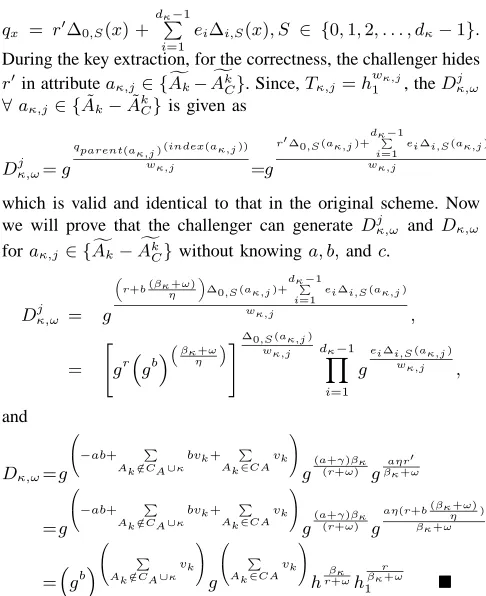
The following lemma provesDκ,ω and Dj
κ,ω are correct and
the challenger can generate these without knowing a, b, cfrom
ga, gb, gc.
Lemma 1.Dκ,ωandDκ,ωj are correct and they can be generated by challenger without knowinga, b, cfromga, gb, gc.
Proof. In the beginning of the access structure we chosene1,e2,
. . .,edκ−1 random values for children nodes of root node and we
setqx(0) =r′=r+b(βκ+ω)
η . Hence, using the polynomial
qx = r′∆
0,S(x) +
dκP−1
i=1
ei∆i,S(x), S ∈ {0,1,2, . . . , dκ−1}.
During the key extraction, for the correctness, the challenger hides
r′
in attributeaκ,j∈ {Akf−Afk
C}. Since,Tκ,j=h
wκ,j
1 , theDjκ,ω
∀aκ,j ∈ {Ak˜ −A˜kC}is given as
Djκ,ω=g
qparent(aκ,j) (index(aκ,j))
wκ,j =g r′
∆0,S(aκ,j)+dκ
−1 P
i=1 ei
∆i,S(aκ,j)
wκ,j ,
which is valid and identical to that in the original scheme. Now we will prove that the challenger can generate Dj
κ,ω and Dκ,ω
foraκ,j ∈ {Akf−Afk
C}without knowinga, b,andc.
Dκ,ωj = g
r+b(βκη+ω)
∆0,S(aκ,j)+ dκP−1
i=1 ei
∆i,S(aκ,j)
wκ,j ,
= "
grgb
βκ+ω η
#∆0,S(aκ,j) wκ,j dYκ−1
i=1
g
ei∆i,S(aκ,j)
wκ,j ,
and
Dκ,ω=g
−ab+ P
Ak /∈CA∪κ
bvk+ P
Ak∈CA
vk
g (a+γ)βκ
(r+ω) g
aηr′ βκ+ω
=g
−ab+ P
Ak /∈CA∪κ
bvk+ P
Ak∈CA
vk
g (a+γ)βκ
(r+ω) g
aη(r+b(βκη+ω))
βκ+ω
=gb
P
Ak /∈CA∪κ
vk
g
P
Ak∈CA
vk
hrβκ+ωh r βκ+ω
1
Once adversary received all the credential from the challenger, he will send two messages,m0 andm1 to the challenger. Now the
challenger randomly chooses one of the messages and encrypts it and sends the encrypted message back to the adversary. Let us denote the message chosen by the challenger asmbwhereb= 0 or 1 and the encrypted message as C = {C1 = mb.Z, C2 =
gc, C
3 = Q
k∈AC
(gc)βkand{Ck,j= (gc)wk,j}
∀k∈IC,ak,j∈A˜jm}.
We stress here that C is a valid encryption of the message mb
if Z = e(g, g)abc. Hence, the adversary should have his usual
non-negligible advantage υ of correctly identifying the message
mb. However, when Z 6= e(g, g)abc, then C is just random
value, hence, the adversary can have no more than 12 probability of guessing correctly. Hence, if the adversary guesses correctly then challenger guesses that Z = e(g, g)abc and if adversary
is wrong then challenger guesses that Z 6= e(g, g)abc, hence, the challenger has an advantage of υ2 in distinguishing whether
Z = e(g, g)abc. Hence, an adversary who breaks our scheme
with advantage υ implies an algorithm for breaking DBDH assumption with non-negligible advantage υ2. We can conclude that the proposed scheme is selective ID secure.
III. ANONYMOUSKEYISSUINGPROTOCOL
In order to issue keys to the users, Han et. al. [6] used key extraction protocol. The key extraction protocol joins secrets known to the user and AA via simple operation which let the users to collude successfully. To avoid the user collusion, we have to use schemes which support non-linear coupling of secrets, hence we are considering anonymous key issuing protocol based on anonymous credential system (See Section III-C for more details). In an anonymous credential system [14], the users can obtain and prove the possession of credentials while remaining anonymous. In such work it is assumed that each user has a unique secret key i.e., GIDs. Then the user can interact with each AA under a different pseudonym (generated using GID) in such a manner that it is impossible to link multiple pseudonyms belonging to the same user. In the proposed work, we exploited the anonymous
credentials to allow users to obtain decryption keys from the AAs without revealing their GIDs.
In particular, in the proposed key issuing protocol, we coupled the properties of anonymous credential system with ABE. Hence, the user can obtain a set of decryption keys for his secret GID without revealing any information about that GID to the AA (pre-serve the privacy). At the same time, the AA is guaranteed that the agreed upon decryption-keys are the only information that the user learns from the transaction (i.e., provide security by mitigating user collusion). This is derived from blind IBE schemes [15]. We define this algorithm as[U(params, P Kk, u, GID, decom)⇆
Ak(params, P Kk, SKk)] → DecryptionKeysf orU ser. In this algorithms, the user runs Commit and sends the com to AA and keeps the decom [6]. Then the user and AA interact with each other to generate decryption keys. The decryption keys for the user will be generated only if the output of Decommit is1. From [15], the anonymous key extraction protocol should be leak-free and selective-failure blindness. Definition and security games for leak-free and selective-failure blindness can be found in [6], hence we jump straight into the formulation.
A. Construction of anonymous key issuing protocol
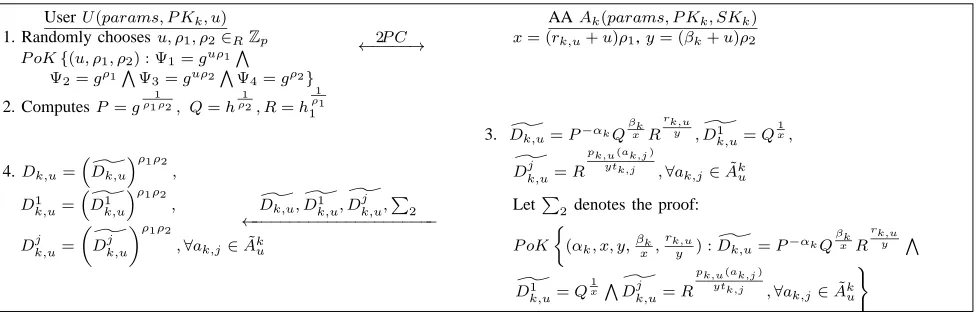
Fig. 3 shows the anonymous key issuing protocol where user with private value u ∈ Zp and Ak with private values
rk,u, βk and αk ∈ Zp jointly computing decryption keys for the user. The decryption keys for u are Dk,u, Dk,u1 and Djk,u
∀ak,j ∈ Afk
u. In order to obtain these keys, first user and Ak
interact with each other using two-party protocol (2PC). The 2PC protocol can be done via a general 2PC protocol for a simple arithmetic computation. Alternatively, we can do this more efficiently using the construction in [8]. The 2PC protocol takes (u, ρ1, ρ2) ∈Zpfrom user and (rk,u, βk) ∈Zpfrom Ak and
returnsx= (u+βk)ρ1mod pandy= (u+rk,u)ρ2mod ptoAk.
Since, ρ1 and ρ2 were randomly generated by user, the AAAk
cannot extract the user identityufromxandy. After executing the 2PC protocol, the user now computesP =gρ11ρ2, Q=h
1
ρ2
and R=h 1
ρ1
1 and send those values toAk. Now Ak computes ]
Dk,u,D]1
k,uand
]
Dk,uj ∀ak,j ∈ Afk
u(i.e., randomized decryption
credentials) usingP, Q, R, xand yand send them back to the user. Now the user exponentiates the obtained values byρ1ρ2 to
get the decryption keys. Note that, sinceucoupled non-linearly within the decryption keys. We show in Section III-C that this approach avoid user collusion.
B. Security Analysis
To obtain the decryption credential blindly fromAk∀k, the user needs to prove that he holds the identifieruin zero knowledge. As shown in Fig. 3, the user randomly generatesρ1, ρ2∈RZp
and computesΨ1=guρ1,Ψ2=gρ1,Ψ3=guρ2,andΨ4 =gρ2
as commitments. At the end of the 2PC protocol, the AA obtains
x = (rk,u+u)ρ1 mod p, y = (βk+u)ρ2 mod p. Then AA
verifies gx =? ABrk,u and gy =? CDrk,u. If they are correctly
verified then the AA continues otherwise it aborts. Now AA needs to proof that he knows(αk,βk
x ,
rk,u
y )in zero
knowledge to the user. This will be done using the following steps:
1. Ak randomly generatesb1, b2, b3∈RZp, computes
] ]
Dk,u=
P−b1Qb2Rb3 and sendsDk,u]], andDk,u] to the user
2. User generatesc1 ∈RZpand sends it to the AA
3. AA computesb′
1 =b1−c1αk, b′2 =b2−c1βxk, b′3 =b3−
c1rk,uy and sendsb′1, b′2, b′3 to the user
[image:6.595.48.291.85.383.2]UserU(params, P Kk, u) AAAk(params, P Kk, SKk)
1. Randomly choosesu, ρ1, ρ2∈RZp ←−2P C−−−→ x= (rk,u+u)ρ1,y= (βk+u)ρ2 P oK{(u, ρ1, ρ2) : Ψ1=guρ1V
Ψ2=gρ1VΨ3=guρ2VΨ4=gρ2}
2. ComputesP=g
1
ρ1ρ2, Q=hρ12, R=h
1
ρ1
1
3. D]k,u=P−αkQ
βk x R
rk,u y ,D]1
k,u=Q
1
x,
4.Dk,u=
]
Dk,u
ρ1ρ2
, D]jk,u=R
pk,u(ak,j)
ytk,j ,∀ak,j∈A˜k u
D1
k,u=
]
D1
k,u
ρ1ρ2
, D]k,u,D]1k,u,
] Djk,u,P2 ←−−−−−−−−−−−−−−−−−−−−
LetP2 denotes the proof:
Djk,u=
] Djk,u
ρ1ρ2
,∀ak,j∈A˜ku P oK
(αk, x, y,βxk,
rk,u
y ) :D]k,u=P−αkQ
βk xR
rk,u y V
] D1
k,u=Q
1
xVD]k,uj =R
pk,u(ak,j)
ytk,j ,∀ak,j∈A˜k u
[image:7.595.54.543.87.243.2])
Fig. 3. Anonymous key issuing protocol for decentralized KP-ABE
We ignored the zero-knowledge proofs for 1x and 1y for brevity since they are similar to the above proof.
Theorem 3. The proposed anonymous key issuing protocol is both leak-free and selective-failure blind.
Proof. Leak freeness. Suppose there exists an adversary U in the real experiment (where Uis interacting with an honest AA
Akrunning the anonymous key issuing protocol) and a simulator ˜
U in the ideal experiment (where U˜ can access the trusted AA
running the key issuing protocol without privacy preservation) such that no efficient distinguisher D can distinguish the real experiment from the ideal experiment. The simulatorU˜simulates the communication between the distinguisherDand the adversary Uby passing the input ofDtoUand the output ofUtoD. The simulatorU˜works as follows:
1. U˜ sends the adversaryUthe public-keyP Kk ofAk
2. The adversary U must proof the possession of u in zero-knowledge to U˜. If proof is successful then U˜ obtains (u, ρ1, ρ2)using rewind technique
3. U˜sendsuto the trusted party. The trusted party runs KeyGen to generates (Dk,u,D1
k,u,Djk,u) and responds toU˜
4. Now U˜ computes
Dk,uρ11ρ2, Dk,u1 1
ρ1ρ2, Dj
k,u 1
ρ1ρ2
and
sends them toU
If (Dk,u, D1k,u, Dk,uj ) are correct keys from the trusted AA in
the ideal experiment, then
Dk,uρ11ρ2, D1k,u 1
ρ1ρ2, Dj
k,u 1
ρ1ρ2
are the correct keys from Ak in the real experiment. Hence,
(Dk,u,D1
k,u,Dk,uj ) and
Dk,uρ11ρ2, D1k,u 1
ρ1ρ2, Dj k,u
1
ρ1ρ2
are
correctly distributed and no efficient distinguisher can distinguish the real experiment with the ideal experiment.
Proof. Selective-failure blindness. The adversarial AAAk sub-mits the public key P Kk, and two GIDs u0 and u1. Then, a
bit b ∈ {0,1} is randomly selected. Ak can have a black box access to u0’s and u1’s parameters i.e., U(params, P Kk, ub)
and U(params, P Kk, ub−1). Then,U executes the anonymous
key issuing protocol withAkand outputs secret keys forub and
u1−b i.e.,SKub andSKu1−b.
1. If SKub 6=⊥ and SKu1−b 6=⊥then Ak is given (SKub,
SKu1−b)
2. IfSKub6=⊥andSKu1−b=⊥thenAkis given (ǫ,⊥)
3. IfSKub=⊥andSKu1−b6=⊥thenAkis given (⊥,ǫ)
4. IfSKub=⊥andSKu1−b=⊥thenAkis given (⊥,⊥)
At the endAk submits his prediction onb.
In the anonymous key issuing protocol, U sends four random parametersΨ1 =gubρ1 ∈G1,Ψ2 =gρ1 ∈G1,Ψ3 =gubρ2 ∈ G1,and Ψ4 =gρ2 ∈G
1 to the adversarial AA Ak and proves
P oK(ub, ρ1, ρ2). Now it isAk’s turn to respond. So far,Aks
view on the two black boxes is computationally undistinguishable. Otherwise, the hiding property of the commitment scheme and the witness undistinguishable property of the zero-knowledge proof will be broken. Suppose that Ak uses any computing strategy to output secret keys {Dk,ub, D
1
k,ub, D
j
k,ub∀ak,j∈
˜
Ak
ub} for the
first black box. In the following, we will show thatAkcan predict
SKub ofU without interacting with the two black boxes:
1. Akchecks
P oK
(αk,βk
x ,
rk,u
y ) :
]
Dk,u=P−αkQβkx R rk,u
y V
]
D1
k,u=Q
1
xVD]j
k,u=R
pk,u(ak,j)
ytk,j ,∀ak,j∈A˜k u
)
If proof fails,Ak setsSK0=⊥
2. Ak generates different secret keys {Dk,ub, D1
k,ub, D
j
k,ub∀ak,j ∈
˜
Ak
ub} for the second
black box and a proof of knowledge:
P oK
(αk,βk
x ,
rk,u
y ) :
]
Dk,u=P−αkQβkx R rk,u
y V
]
D1
k,u=Q
1
xVD]j
k,u=R
pk,u(ak,j)
ytk,j ,∀ak,j∈A˜k u
)
If proof fails,Ak setsSK1=⊥
3. Finally Ak outputs his prediction on (u0,u1) with (SKub,
SKu1−b) if SKub 6=⊥ and SKu1−b 6=⊥; (ǫ, ⊥) if
SKub 6=⊥ and SKu1−b =⊥; (⊥, ǫ) if SKub =⊥ and
SKu1−b6=⊥; (⊥,⊥) ifSKub=⊥andSKu1−b=⊥.
The predication on (u0, u1) is correct, and has the identical
distribution with the black box. BecauseAk performs the same check as the honest U, it outputs the valid keys as U obtains from anonymous key issuing protocol. Hence, ifAk can predict the final outputs of the two black boxes, the advantage ofAkin distinguishing the two black boxes is the same without the final outputs. Therefore, the advantage ofAk should come from the received Ψ1,Ψ2,Ψ3,Ψ4 ∈ G1 and P oK(u, ρ1, ρ2). From the
hiding property of the commitment scheme and witness undis-tinguishable property of the zero-knowledge proof, Ak cannot distinguish one from the other with nonnegligible advantage. Hence our anonymous key issuing protocol is secure against selective-failure.
C. User collusion
1 2 3 4 5 6 7 8 9 10 0
10 20 30 40 50 60 70 80
Total Setup Cost for AAs
No. of Attributes per AA
Computational Complexity (in ms)
Our Scheme Han et al [6] Chase [11] Chase et. al. [12]
1 2 3 4 5 6 7 8 9 10 0
200 400 600 800 1000 1200
Total Key Generation Cost for AAs
No. of Attributes per AA
Computational Complexity (in ms)
Our Scheme Han et al [6] Chase [11] Chase et. al. [12]
1 2 3 4 5 6 7 8 9 10 10
20 30 40 50 60 70 80
Total Encryption Cost for Data Owner
No. of Attributes per AA
Computational Complexity (in ms)
Our Scheme Han et al [6] Chase [11] Chase et. al. [12]
1 2 3 4 5 6 7 8 9 10 50
100 150 200 250 300 350 400 450
Total Decryption Cost for Users
No. of Attributes per AA
Computational Complexity (in ms)
Our Scheme Han et al [6] Chase [11] Chase et. al. [12]
[image:8.595.47.290.477.568.2](a) (b) (c) (d)
Fig. 4. Comparison of computational costs of four different schemes against four different steps.
that the proposed scheme is free from the identified vulnerability and discuss the reason. Lets consider a scenario with two AAs
A1 and A2. Let A1 monitors attribute {a1,1} and A2 monitors
{a2,1}. Hence according to the original scheme presented in Fig.
1, the public keys and secret keys of Ak are P Kk = {Yk =
e(g, g)αk, Zk =gβk, Tk,j =gtk,1} and SKk ={αk, βk, tk,
1}
for k ={1,2}. Suppose the encryption algorithm specifies the attribute set for message m is Am˜ = {a1, a2}while the users
U1 and U2 with identifiers u1 andu2 only have the decryption
credential for the attribute {a1} and the userU3 with identifier
u3 only has the credential for attribute {a2}. Note that none of
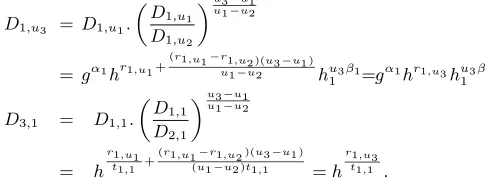
these three users can decrypt the ciphertext alone. However, due to the vulnerability in [6], these users can collude together and generate decryption credentials to decrypt the ciphertext encrypted by attribute set Am˜ ={a1, a2}as follows: according to Fig. 1,
credential issued toU1 andU2 are
D1,u1 = g
α1hr1,u1hu1β1
1 , D1,1=h
r1,u1
t1,1 , D1,u2 = g
α1hr1,u2hu2β1
1 , D2,1=h
r1,u2
t1,1 ,
U1 andU2 can collude to compute the secret key corresponding
to the userU3 as follows:
D1,u3 =D1,u1.
D1,u1 D1,u2
u3−u1
u1−u2
=gα1hr1,u1+ (r1,u
1−r1,u2 )(u3−u1 )
u1−u2 hu13β1=gα1hr1,u3hu3β1
1 ,
D3,1 = D1,1.
D1,1
D2,1 u3−u1
u1−u2
= h
r1,u1
t1,1 +
(r1,u1−r1,u2)(u3−u1 ) (u1−u2 )t1,1 =h
r1,u3 t1,1 .
Note that D1,u3 and D3,1 are valid credentials for U3 for
attribute a1,1 since the power of h1 (i.e., u3β1) and power of
h1(i.e., random valuer1,u1+
(r1,u1−r1,u2)(u3−u1)
u1−u2 ) are correctly
produced in the credentialsD1,u3 andD3,1due to the collusion.
Let us analyse the reason behind this successful collusion. If we look at the variables (i.e.,β1, andu3) in the power ofh1inD1,u3, β1 is known to AA andu3 are known to the user. However, the
power,β1u3 is just a multiplication (it is very naive) of both the
variables. Hence the users can removeu1andu2while keepingβ1
using the above simple algebraic operations to produce decryption credential for U3.
In the proposed scheme, if we compute D1,u1.
D
1,u1
D1,u2
γ
then the power of the generator h becomes
β1
r1,u1+u1+γ
β1
r1,u1+u1 −
β1
r1,u2+u2
, and the power of generator
h1 becomes
r1,u1
β1+u1 +γ
r
1,u1
β1+u1 −
r1,u2
β1+u2
where γ could be any scalar (i.e., u3−u1
u1−u2). It is obvious from both the powers,
even though users know u1 andu2, they cannot remove theu1
and u2 since they are coupled non-linearly withr1,u1,r1,u2 and β1 which are known only to the AA (i.e., r1,u1
1+u1,
1
β1+u1).
Hence,u1 and u2 cannot be replaced withu3 without knowing
β1,r1,u1 andr1,u2 . Hence our method withstands the collusion
found in [6]. In general, since the variable known to user and the variables known to the AA are non-linearly coupled in our scheme, it is impossible for two users to generate decryption credential for third user without involving AA.
IV. COMPLEXITYCOMPARISON
In this section, we compare the computational complexity of our scheme against the following KP-ABE schemes: Han et. al decentralized KP-ABE scheme [6], Chase MA-ABE KP-ABE scheme with central AA [11], and Chase et.al MA-ABE KP-ABE scheme without central AA [12]. Let us assume there are
N number of AAs and each AA monitorsnnumber of attributes. In order to compare the complexity at worst case scenario, let us assume that the ciphertext encrypted using all the attributes in the system (i.e.,nN) and user has decryption credentials for all the attributes. Let us denote the computational time (in ms) for one multiplication, one exponentiation, and one pairing as Cm, Ce, andCp, respectively.
In order to simulate, we use the benchmark time values given in the popular pairing-based cryptography library namely jPBC in [16]. Table I shows the time values (in ms) forCm, Ce, and
Cpfor two different testbeds: testbed 1 uses Intel(R) Core(TM) 2 Quad CPU Q6600 with 2.40GHz and 3 GB memory running on Ubuntu 10.04 and testbed 2 uses HTC Desire HD A9191 smart phone running on Android 2.2. The time values given in Table I are for a symmetric elliptic curve calleda-curve, where the base field size is512-bit and the embedding degree is2. Thea-curve has a160-bit group order.
We consider the healthcare scenario described in Section I as an example to simulate the comparison of four different schemes. Without loss of generality lets assumeN= 2andnvaries from1 to10. As shown in Figures 1 and 2, each algorithm consists of four sub algorithms. Fig. 4 compares the performance of four schemes across four sub algorithms. In Fig. 4(a), the time complexity for setting up the ABE system for all four algorithms increase linearly with same order against the number of attributes per AA. Setup cost for [11] is better than other schemes. It is due to a simplest problem formulation without privacy consideration (i.e., central AA knows secret keys of all AAs).
In Fig. 4(b), the key generation time complexity for [12] increases quadratically with number of attributes due to the interaction between pair of AAs to agree on a shared secret per
TABLE I
TIME COMPLEXITY MEASURES FOR TWO DIFFERENT TESTBEDS.
Testbed 1 (ms) Testbed 2 (ms)
Cp 14.6 491.2
Ce 2.8 34.1
attribute. However, complexity of other schemes increase linearly with almost same order. Complexity of the proposed scheme is high when n = 1 due to generation of other independent credential Dk,u. Han et. al. scheme performs better than the proposed scheme due the difference in number of credentials generated in both the schemes.
In Fig. 4(c), the time complexity for encryption increases linearly with same order for all schemes similar to the setup. Han et. al’s scheme and the proposed scheme show equal performance while other two schemes also show equal performance. This clearly shows that there is no significant difference in Encryption sub algorithm and new schemes are built on top of the previous schemes.
Finally the time complexity of decryption shown in Fig. 4(d) is slightly different compared to other three sub algorithms. Even though the time complexity of all four algorithms increase linearly, the orders are different for all four algorithms. In fact Han et. al perform better than [12] after n= 10. The proposed algorithm takes longer (roughly 10mslonger for10attributes) to decrypt messages than other algorithms. This is solely due to the additional operations involved for the privacy protection. In overall, Chase’s scheme [11] performs better than other three schemes due to it’s simplicity. However, the algorithms in [11], [12] need a central AA and/or interaction among AAs; hence [11], [12] are vulnerable for single point of failure. The proposed scheme and Han et. al’s scheme are performing equally well as each other. However, the proposed algorithm mitigates the user collusion vulnerability compared to [6]. Due to page limitation, we restricted toN= 2 case, however we observed the similar trend forN >2cases.
Let us now compare the ciphertext length and performance of the proposed scheme on mobile platform. Fig. 5(a) shows cipher-text length for all schemes against the number of attributes. The ciphertext length is increasing linearly with number of attributes at same order for all schemes. This is one of the drawbacks of these schemes; hence, developing a novel scheme which ensures the user’s privacy with constant size ciphertext could be a potential future work. Recent trend of Internet of Things replaces PCs with smart devices and it is anticipated that decryption part of the proposed scheme could be done on mobile device i.e., users want to download and read data on their smartphones. To compare the performance on smartphones against PC, we simulate the time complexity of decryption sub algorithm on both the test beds given in Table I. As expected, Fig. 5(b) shows that the decryption process on smartphone is much slower than PC. More importantly, even though the time complexity on both the test beds are increasing linearly, the complexity on test bed 2 increases with higher order than PC. The main reason behind this is that the mobile device used in test bed 2 is equipped with one processor. This led the non-linear relationship ofCp between both the test beds (in test bed 1,Cp∼= 5Cm but in test bed 2Cp∼= 14Cm).
1 2 3 4 5 6 7 8 9 10 500
1000 1500 2000 2500 3000
Ciphertext Length
No. of Attributes per AA
Ciphertext Length (in bits)
Our Scheme Han et al [6] Chase [11] Chase et. al. [12]
1 2 3 4 5 6 7 8 9 10 0
2000 4000 6000 8000 10000 12000 14000
Decryption Complexity
No. of Attributes per AA
Computational Complexity (in ms)
Test Bed 1 Test Bed 2
[image:9.595.39.290.655.766.2](a) (b)
Fig. 5. (a) Ciphertext length of four different schemes, (b) decryption complexity of the proposed scheme is two different test beds.
V. CONCLUSIONS
In this paper, we proposed a PP KP-ABE scheme for a dis-tributed data sharing environment. The proposed scheme enables users to download and decrypt the data from online such as cloud without revealing their attributes to the third-parties. The novelty of the work is to mitigate the user collusion attack in the existing scheme. We used anonymous key issuing protocol to strengthen the bind between user identity and decryption keys; hence, two or more users cannot pool their keys to generate decryption keys for an unauthorized user. We validated the security of the proposed scheme using the decisional bilinear Diffie-Hellman standard complexity assumption.
REFERENCES
[1] A. Sahai, and B. Waters, Fuzzy Identity-Based Encryption. Advances in Cryptology EUROCRYPT, vol. 3494, pp. 557, 2005.
[2] V. Goyal, O. Pandey, A. Sahai, and B. Waters. Attribute-based Encryption for Fine-Grained Access Control of Encrypted Data. In Proc. 13th ACM conf. Comp. and Commun. security (CCS ’06), New York, USA, pp. 89-98 2006.
[3] F. Li, Y. Rahulamathavan, M. Rajarajan, R. C.-W Phan. Low complex-ity multi-authorcomplex-ity attribute based encryption scheme for mobile cloud computing. In Proc. IEEE 7th Int’l Symp. Service Oriented System Engineering (SOSE), San Francisco, USA, pp. 573–577, Mar. 2013. [4] F. Li, Y. Rahulamathavan, M. Rajarajan, R. C.-W Phan. LSD-ABAC:
Lightweight Static and Dynamic Attributes Based Access Control Scheme for Secure Data Access in Mobile Environment. In Proc. IEEE Local Computer Networks (LCN), Edmonton, Canada, Sept. 2014.
[5] J. Bethencourt, A. Sahai, B. Waters. Ciphertext-Policy Attribute-Based Encryption. In IEEE Symposium on Security and Privacy, SP 07, pp. 321–334, May 2007.
[6] J. Han, W. Susilo, Y. Mu, and J. Yan: Privacy-Preserving Decentralized Key-Policy Attribute-Based Encryption. In IEEE Trans. Parallel and Distributed Systems, vol. 23, no. 11, pp. 2150–2162, Nov. 2012. [7] A. Ge, J. Zhang, R. Zhang, C. Ma, and Z. Zhang: Security Analysis
of a Privacy-Preserving Decentralized Key-Policy Attribute-Based Encryption Scheme. In IEEE Trans. Parallel and Distributed Systems, vol. 24, no. 11, pp. 2319–2321, 2013.
[8] M. Belenkiy, J. Camenisch, M. Chase, M. Kohlweiss, A. Lysyanskaya, and H.Shacham. Randomizable Proofs and Delegatable Anonymous Credentials. In Advances in Cryptology-CRYPTO 2009, pp. 108–125. Springer Berlin Heidelberg, 2009.
[9] A. B. Lewko and B. Waters. Decentralizing attribute-based encryption. In EUROCRYPT, ser. Lecture Notes in Computer Science, K. G. Paterson, Ed., vol. 6632. Springer, 2011, pp. 568-588.
[10] B. Waters. Ciphertext-Policy Attribute-Based Encryption: An Ex-pressive, Efficient, and Provably Secure Realization. In Proc. 14th Intl Conf. Practice and Theory in Public Key Cryptography Conf. Public Key Cryptography (PKC 11), D. Catalano, N. Fazio, R. Gennaro, and A. Nicolosi, eds., pp. 53-70, Mar. 6-9 2011.
[11] M. Chase, Multi-authority Attribute Based Encryption, In LNCS, Berlin Heidelberg, pp. 515–534, vol. 4392, 2007.
[12] M. Chase and Sherman S.M. Chow. Improving privacy and security in multi-authority attribute-based encryption. In Proc. 16th ACM conf. Comp. and Commun. Security (CCS ’09), New York, USA, pp. 121-130, 2009.
[13] Stefan Brands. Rethinking Public Key Infrastructure and Digital Certificates  Building in Privacy. PhD thesis, Eindhoven Inst. of Tech. 1999.
[14] J. Camenisch and A. Lysyanskaya. Efficient Non-transferable Anony-mous Multi-show Credential System with Optional Anonymity Re-vocation. In EUROCRYPT 2001, vol. 2045 of LNCS, pp. 93–118. Springer Verlag, 2001.
[15] J. Camenisch, M. Kohlweiss, A. Rial, and C. Sheedy. Blind and anonymous identity-based encryption and authorised private searches on public key encrypted data. In Proc: PKC09, volume 5443 of LNCS, pp. 196–214. Springer, 2009.
[16] The Java Pairing-Based Cryptography Library (JPBC), http://tinyurl. com/ll2p39t
[17] A. Abbas, S. U. Khan. A Review on the State-of-the-Art Privacy-Preserving Approaches in the e-Health Clouds. IEEE Journala of Biomedical and Health, vol.18, no.4, pp.1431-1441, July 2014. [18] Z. M. Fadlullah, N. Kato, R. Lu, X. Shen, and Y. Nozaki, "Towards
![Fig. 1.The original decentralized key-policy attribute-based encryptionscheme [6].](https://thumb-us.123doks.com/thumbv2/123dok_us/1457213.98417/3.595.304.539.221.478/fig-the-original-decentralized-policy-attribute-based-encryptionscheme.webp)