Precise Modelling of Compensating Business Transactions
and its Application to BPEL
Michael Butler
School of Electronics and Computer Science, University of Southampton Highfield, Southampton SO17 1BJ, United Kingdom
Carla Ferreira
Department of Computer Science, Technical University of Lisbon Av. Rovisco Pais, 1049-001 Lisbon, Portugal
Muan Yong Ng
School of Electronics and Computer Science, University of Southampton Highfield, Southampton SO17 1BJ, United Kingdom
Abstract: We describe the StAC language which can be used to specify the orchestra-tion of activities in long running business transacorchestra-tions. Long running business transac-tions use compensation to cope with exceptransac-tions. StAC supports sequential and parallel behaviour as well as exception and compensation handling. We also show how the B notation may be combined with StAC to specify the data aspects of transactions. The combination of StAC and B provides a rich formal notation which allows for succinct and precise specification of business transactions. BPEL is an industry standard lan-guage for specifying business transactions and includes compensation constructs. We show how a substantial subset of BPEL can be mapped to StAC thus demonstrating the expressiveness of StAC and providing a formal semantics for BPEL.
Key Words: Long-running transactions, compensation, language semantics, formal specification, B Method.
Category: D.3.1, F.3.2, H.m
1
Introduction
because parts of a transaction (e.g., communications with external agents) are inherently impossible to undo. In such cases compensation can be used as a way of dealing with faults.
In the context of business transactions, Gray [16] defines a compensation as the action taken to recover from error or cope with a change of plan. Consider the following example: a client buys some books in an on-line bookstore and the bookstore debits the client’s account as the payment for the book order. The bookstore later realises that one of the books in the client’s order is out of print. To compensate the client for this problem, the bookstore can credit the account with the amount wrongfully debited and send a letter apologising for their mis-take. This example shows that compensation is more general than traditional rollback in database transactions. Compensation is important when a system cannot control everything, such as when interaction with humans is involved. Garcia-Molina and Salem [15] used compensation to define the concept ofsagas. A saga partitions a long running transaction into a sequence of several smaller subtransactions, where each of the subtransactions has an associated compen-sation. If one of the subtransactions in the sequence aborts, the compensation associated with those committed subtransactions is executed in reverse order.
In terms of the range of techniques used for system dependability [2], our approach to compensation may be viewed as a forward error recovery mechanism. For example, when a bookstore realises that a book that has been ordered by a customer is out of print so is unable to deliver it (the error state), it recovers from this error by performing various actions (offering a refund and sending an apology). It does not recover by rolling back to some previous state. The saga approach [15] requires that compensations represent a semantic undo of the forward action in the usual database sense and so their approach may be regarded as a form of backwards error recovery. Although our approach does not require that compensations perform a semantic undo, it is fair to say that the coordination of compensations has been influenced by the requirement for semantic undo, i.e., in the case that compensations perform a semantic undo, then invocation of compensations can be regarded as a backward error recovery mechanism.
gives a precise interpretation to the mechanics of compensation, including the combination of compensation with parallel execution, hierarchy and exceptions. To facilitate modelling of data dependency and manipulation, a StAC pro-cess has global data state associated with it and this state is changed by atomic actions. Typically the data state of a StAC process is represented using state variables and the effect of atomic activities on data is represented using assign-ment to variables. Rather than inventing our own notation for specifying data variables and operations for manipulating them, we have chosen to use the B notation of Abrial’s B Method [1]. B provides a state based formal notation for writing precise abstract specifications of data and data manipulation and makes strong use of set theory and predicate logic. In our approach a business transac-tion specificatransac-tion has two components: the StAC specificatransac-tion that describes the orchestration of activities, including ordering of compensation activities, and a B specification that describes an abstract model of the data of the transaction along with atomic actions for manipulating the data.
The combination of StAC and B provides a clear and succinct notation for writing precise specifications of long running business transactions. The notation has a formal semantics ensuring specifications are unambiguous and amenable to formal analysis. When business transactions are provided in the open web ser-vices environment [3], we believe that the ability to write precise specifications is particularly important. As well as providing the basis for rigorous implemen-tation of business transactions, precise specifications can act as contracts for business services. Such contracts may be shared with partners to provide them with sufficient detail to be able to interact sensibly with a service, without having access to all implementation details.
StAC was originally inspired by the BPBeans development framework [11] that allows an application to be built by a nested hierarchy of business pro-cesses. BPBeans supports orchestration of activities through parallel and se-quential composition, as well as exception and compensation handling. Similar orchestration mechanisms are also found in the BizTalk [19] and BPEL4WS [12] languages. BPEL4WS (Business Process Execution Language for Web Services), or BPEL for short, is a web services composition language that is jointly devel-oped by Microsoft, IBM and others. It provides an XML syntax for writing abstract and/or executable specifications of business processes which may be provided as web services and may involve the invocation of other web services.
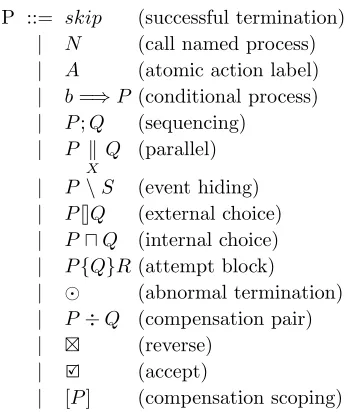
P ::= skip (successful termination)
| N (call named process)
| A (atomic action label)
| b=⇒P (conditional process)
| P;Q (sequencing)
| P k X
Q (parallel)
| P \S (event hiding)
| P[]Q (external choice)
| P⊓Q (internal choice)
| P{Q}R (attempt block)
| ⊙ (abnormal termination)
| P÷Q (compensation pair)
| ⊠ (reverse)
|
2
X (accept) [image:4.595.221.396.107.313.2]| [P] (compensation scoping)
Table 1:StAC Syntax
accessible through a succinct but precise formal definition.
Section 2 introduces the StAC language and illustrates its expressiveness through an example. Section 3 describes how StAC may be combined with the B notation. Section 4 shows how StAC may be used to give a semantics to BPEL activity constructs. Section 4 only supports a certain form of BPEL compensa-tion. In Section 5 the StAC language is extended in a way that allows BPEL compensation to be modelled more fully.
2
The StAC Language
The StAC language provides standard combinators for modelling sequential and parallel processes, along with specific combinators to deal with compensation. The syntax of StAC processes is presented in Table 1.
A process is specified by a set of equations of the form Ni = Pi, where
each Ni is a process name and Pi is a StAC process expression. The process
skipdoes nothing and immediately terminates successfully. For process nameN, the processN calls the process named N returning if and when N terminates successfully. Mutually recursive calls are possible.
Σ. In Section 3 we will show how B provides a rich notation for specifying data states and atomic actions on data states. In this section we focus on the StAC operators that provide the orchestration mechanisms for long running business transactions.
In the conditional operator, a processP is guarded by a boolean expression b. This expression function can consult the state,i.e., b:Σ→BOOL. Process b =⇒ P behaves asP ifbevaluates to true in the current state. Conversely, if b is false, the conditional process will block.
The sequential construct combines two processes,P;Q. In process P;Q, P is executed first, and only when P terminates successfully canQbe executed.
In parallel processP k X
Q, the execution of the activities ofP andQis
syn-chronised over the activities inX, while the execution of the remaining activities ofP andQis interleaved. Synchronisation can introduce deadlock,e.g., process P may be waiting to synchronise with Q over an activity A and that activity will never occur in Q. If set X is empty (no synchronisation) we will represent the parallel process as PkQ.
With hiding one can make the execution of activities invisible to the envi-ronment:P \Crepresents the processP with all the events in the setChidden from the environment.
The external choice P[]Q selects whichever ofP or Qis enabled (i.e., not blocked). If both P andQare enabled, the choice is made by the environment and it is resolved at the first activity. The environment could be a user selecting one of the options in a menu, for example. Notice that the [] operator causes nondeterminism in some cases. Consider the following example:
(A;B) [] (A;C).
When activity A occurs it is not possible to determine which one of the two behavioursA;BorA;Cwill be chosen. In this case, the choice is made internally by the system rather than by the environment. Internal nondeterminism may be specified directly using the internal choice operator (⊓).
The parallel and choice operators may be extended to generalised versions over (possibly infinite) sets of indexed processes. For example, a process that allows a user to choose a book could be described in StAC as:
[]b ∈ BOOK • ChooseBook(b)
Details of the generalised versions of the operators may be found in [13]
2.1 Attempt Block and Early Termination
occurs or a customer decides to abandon a transaction. It might also arise in the case of speculative parallelism, where several tasks, representing alternative ways of achieving a goal, are commenced in parallel and when one completes, the remaining tasks may be abandoned. We have included in StAC what we call an attempt block. An attempt blockP{Q}R first executesQ, and if Qterminates successfully it then continues with P. If an early termination operation (⊙) is executed withinQ, the block continues withR. For example, the process
C{A;⊙;B}D
will first executeA, then the early termination will cause B to be skipped over and D to be executed. Any behaviour sequentially following the execution of early termination within an attempt block will be skipped. So an attempt block P{Q}Rcan be viewed as an exception construct, with early termination repre-senting the raising of an exception andRrepresenting the exception handler.
The effect of the early termination is limited to the attempt block so in the following process, the early termination in the attempt block has no effect on the processS running in parallel with the block:
{(P;⊙;Q)} kS
(We write{Q} as short forskip{Q}skip.)
In the case of parallel processes within an attempt block, a termination in-struction within one of the parallel process also affects the other processes. For example, in the process
{(P;⊙;Q)kR}
the early termination afterP allows R to terminate early. Our use of the term ‘allows’ is deliberate here. R is not required to terminate immediately. It may continue for several more steps before terminating early, it may continue to completion or it may execute forever if it is a non-terminating process. In any case, if and when the main body of an attempt block terminates and at least one of its constituent process has executed an early termination, then the whole of the main body is deemed to have terminated early.
2.2 Compensation Operators
The next few StAC operators are related to compensation. In thecompensation pair P÷Q,P is the primary process andQis the compensation process. When a compensation pair runs, it runs the primary process, and once the primary process has successfully completed, the compensation process is remembered (installed) for possible later invocation.
can be forgotten. We refer to this as acceptance. The reverse operation (⊠) causes the currently installed compensation handlers to be invoked. For example (A÷A′);
⊠will execute A, installA′ and then the reverse operation will cause
A′ to be executed. The overall behaviour isA;A′.
The accept operation (
2
X) indicates that currently installed compensations should be cleared, meaning that after an accept the compensation task is set to skip. The process (A÷A′);2
X;⊠executesAand when the ⊠operation is called the compensation taskA′ has already been cleared by the2
Xoperator soA′ willnot be executed.
In the case of activities composed using sequential composition, the com-pensation process is constructed in the reverse order to the primary process execution. Consider the process (A÷A′); (B÷B′).This process behaves asA;B
and has the compensation task B′;A′. A sequential compensation task can be
viewed as a stack where compensation processes are pushed on to the top of the stack. The process (A÷A′); (B÷B′);
⊠behaves as A;B, and then the ⊠ operator causes the compensation task to be executed, so the overall behaviour is (A;B); (B′;A′) (which we write asA;B;B′;A′).
In the case of parallel processes, execution of compensations is also performed in parallel. The parallel process (A÷A′) k (B÷B′) executesAandB
concur-rently and the resulting compensation process isA′ kB′.
Next we will consider the combination of compensation with choice. The process (A÷A′) [] (B÷B′) behaves either asAor asBwith the choice between
A and B being made by the environment. The compensation task in the case that Ais chosen isA′ and in the other case isB′.
If the primary process terminates early, the compensation process will not be installed. For example, in the process (A;⊙;B)÷C, compensation C will not be installed because of the early termination in the primary process.
In the case that a compensation pair is running in parallel with a process that executes an early termination, this early termination cannot affect the com-pensation pair while the comcom-pensation pair is executing. So the comcom-pensation pair will either not get executed at all or will be expected to execute to com-pletion, including installation of the compensation handler. For example, the process{(A÷B)k ⊙ }will either behave asskipor as (A÷B).
2.3 Scoping of Compensation
since the start of the scope. In the process
(A÷A′); [ (B÷B′);
⊠],
the overall process would behave as A;B;B′. Compensation A′ is not invoked
because it is outside the scope of the reversal instruction. An acceptance instruc-tion within a scope will only clear the compensainstruc-tion activities that have been recorded since the start of the scope. For example, the process:
(A÷A′
); [ (B÷B′
);
2
X]; (C÷C′)afterA,B andC have been executed, hasC′;A′ as compensation. Since the
ac-ceptance instruction is within the compensation scope, it just clears the compen-sation processB′ that is within the brackets. Another feature of compensation
scoping is that compensation is available beyond a scope if a reversal instruction is not performed, as in the example:
(A÷A′); [ (B÷B′) ]; (C÷C′).
Here, after executing A;B;C the compensation process isC′;B′;A′, which
in-cludes the compensation process B′ of the inner scope. B′ is retained because
there is no acceptance instruction within the brackets.
2.4 Example: Order Fulfillment
To illustrate the use of StAC we present the order fulfillment example described in [9] and [10]. ACME Ltd distributes goods which have a relatively high value to its customers. When the company receives an order from a customer, the first step is to verify whether the stock is available. If not available the customer is informed that his/her order can not be accepted. Otherwise, the warehouse starts preparing the order for shipment, and a courier is booked to deliver the goods to the customer. Simultaneously with the warehouse preparing the order, the company does a credit check on the customer to verify that the customer can pay for the order. The credit check is performed in parallel because it normally succeeds, and in this normal case the company does not wish to delay the order unnecessarily. If the credit check fails the preparation of the order is stopped. Here we present a very simple representation of the order acceptance and focus on the order fulfillment part in more detail.
Before presenting the ACME process, we introduce the following syntactic sugar:
TRY P THEN QELSE R = Q{P}R
At the top level the application is defined as a sequence as follows:
ACME =AcceptOrder÷RestockOrder; TRY FulfillOrder THEN
2
XELSE ⊠The first step in the ACME process is a compensation pair. The primary ac-tion of this pair is to accept the order and deduct the order quantity from the inventory database. The compensation action simply adds the order quan-tity back to the total in the inventory database. Following the compensation pair, the FulfillOrder process is invoked. If the order has been fulfilled cor-rectly (FulfillOrder terminates sucessfully), the order is accepted, otherwise (FulfillOrder terminates early) the order is reversed.
The bold font, e.g.,AcceptOrder, indicates an atomic action. In Section 3 the effect of these and other actions on a data state will be specified using the B notation.
The order is fulfilled by packaging the order at the warehouse while con-currently doing a credit check on the customer. If the credit check fails, the FulfillOrder process is terminated early:
FulfillOrder =WarehousePackaging
k (CreditCheck;IF ¬okCreditCheckTHEN ⊙ELSE skip)
HereokCreditCheckis a boolean expression that will be specified in terms of a data state in Section 3. BecauseWarehousePackaging is within the scope of the early termination, a failed credit check allowsWarehousePackagingto terminate early, possible before all the items in the order have been packed.
TheWarehousePackaging process consists of a compensation pair in parallel with thePackOrder process:
WarehousePackaging= (BookCourier÷CancelCourier)kPackOrder
This compensation pair books the courier, with the compensation action being to cancel the courier booking.CancelCouriermight result in a second message being sent to the courier. The PackOrder process packs each of the items in the order in parallel. Each PackItem activity is reversed by a corresponding UnpackItem:
PackOrder =ki ∈ order • (PackItem(i)÷UnpackItem(i))
2.5 Overview of StAC Formal Semantics
We do not present the formal semantics of StAC here since they already appear in [7, 13]. Instead we briefly provide an overview of the nature of the formal semantics. [7, 13] use a so-called Plotkin style of operational semantics [22] to define StAC where a set of transition rules are used to define transitions between configurations. For the operational semantics of StAC, a configuration is a tuple:
(P, C, σ) ∈ P rocess×(I→P rocess)×Σ
In the above tuple,Cis a function that returns the compensation processC(i), for each compensation indexi. Scoping of compensation is modelled using com-pensation indices, with each scope having its own index. Σrepresents the data state andΣ is included in our model of StAC processes since we want to model the ability of a basic activity to change the data state. In Section 5 we will show how compensation indices may be introduced explicitly into the language to provide a multiple compensation facility.
A process gives rise to a labelled transition system with configurations being the nodes of the system and activity labels being the transition labels. The labelled transition
(P, C, σ)−→A (P′, C′, σ′) (1)
denotes that the execution of a basic activityAmay cause a configuration tran-sition from (P, C, σ) to (P′, C′, σ′).
A set of transition rules define the conditions under which labelled transitions may occur. An atomic action is a relation from Σ to Σ, and we write σ→A σ′
whenσis related toσ′by→A. The following transition rule shows that execution
of an atomic action leads to successful termination (skip) with a new data state σ′ and an unchanged compensation function:
σ→A σ′
(A, C, σ) −→A (skip, C, σ′)
This rule should be read as: ifσis related toσ′by→A, then there is anA-labelled
transition from process configuration (A, C, σ) to configuration (skip, C, σ′).
The next rule shows the execution of activities within the first process of a sequential composition:
(P, C, σ) −→A (P′, C′, σ′)
(P ;Q, C, σ) −→A (P′ ;Q, C′, σ′)
If the first process in the sequence has terminated successfully, then the second process can be executed immediately:
The label τ is a special label that represents an operation not visible to the external environment.
As mentioned above, each compensation scope is given an explicit compen-sation index. To define the semantics of compencompen-sation, each occurrence of a compensation operator in a term is decorated with the index corresponding to the scope in which it appears. The following rule for the compensation pair op-erator adds the compensation process Qto the compensation functionC when the primary process has terminated sucessfully:
(skip÷iQ, C, σ) −→τ (skip, C[i:= (Q;C(i)) ], σ)
C[i:= (Q;C(i)) ] denotes that compensation taskiis set toQin sequence with the previous compensation for taski. In this manner, the compensation process is built in the reverse order of the execution of the primary processes.
In the next rule, the operator⊠i causes the compensation taski to be
exe-cuted, and also resets that compensation task toskip:
(⊠i, C, σ) τ
−→ (C(i), C[i:=skip], σ)
The full set of transition rules for StAC may be found in [7].
3
Describing State and Activities in B
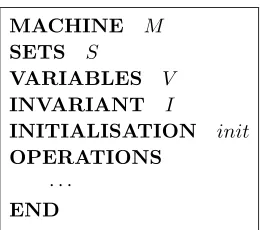
The B notation is a state based formal notation that is part of the B method developed by Abrial [1]. In the B method, a system is defined as an abstract machine consisting of some state and some operations acting on the state. An abstract machine has the structure presented in Figure 1. The abstract machine M consists of some variablesV, an invariantI and some atomic actions on the variables. Operations act on the variables while preserving the invariant and can have input and output parameters. The given sets S declare some basic types that may be used to type the variables. The type constructors of B are standard constructors of set theory such as powersets, relations and functions. These set theoretic constructors allow for models of the states of a system that abstract from implementation detail.
Initialisation and operations are written in the generalised substitution no-tation of B, which includes constructs such as assignment, guarded statements, and choice. In the assignment statement x := E, xis a variable and E is an expression that may use any of the available variables. Simultaneous assignment x := Eky := F is equivalent tox, y := E, F. In the guarded statement
MACHINE M
SETS S
VARIABLES V
INVARIANT I
INITIALISATION init
OPERATIONS
· · ·
[image:12.595.243.373.116.231.2]END
Figure 1:B abstract machine
the guardGis a condition on the state variables and S is a generalised substitu-tion. This statement will be enabled only when Gholds. The nondeterministic choice between two statements is written
CHOICE S OR T END
The choice is enabled when either S orT is enabled. The unbounded choice
ANY x WHERE P THEN S END
nondeterministically chooses some valuexsatisfyingP and then behaves likeS. TheAN Y statement has an implicit guard: it is only enabled if there is somex satisfyingP.
A business transaction may be specified as a combination of a B machine and a StAC process. The B machine defines a data state and atomic actions on that state. The StAC part orchestrates the order in which actions are executed and has access to the data state in defining conditional behaviour. Guarded atomic actions can further constrain the orchestration. For example, ifA is an atomic event of the formG=⇒S, then the StAC process A;P will only be enabled if Gholds.
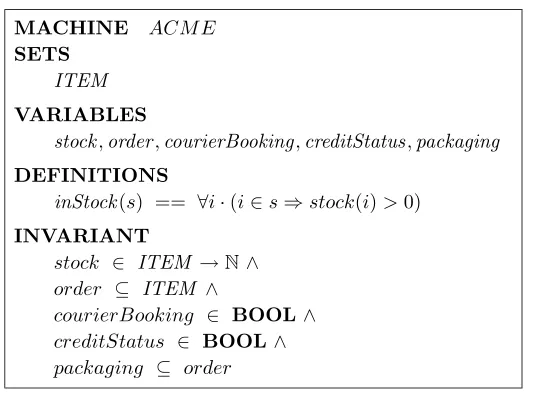
MACHINE ACM E
SETS ITEM
VARIABLES
stock,order,courierBooking,creditStatus,packaging
DEFINITIONS
inStock(s) == ∀i·(i∈s⇒stock(i)>0)
INVARIANT
stock ∈ ITEM →N∧ order ⊆ ITEM ∧
courierBooking ∈ BOOL∧
creditStatus ∈ BOOL∧
[image:13.595.176.443.115.313.2]packaging ⊆ order
Figure 2:ACME machine state
3.1 Order fulfillment example
The abstract machine for the ACM E transaction is shown in Figure 2. This has a single setITEM that represents all items available to the customers. The VARIABLES clause declares the variables of the abstract machine such asstock, order, courierBooking, okCreditCheck, and packaging. In the INVARIANT we specify the types of the variables introduced in the previous clause. Variable stock is a total function abstractly modelling the stock inventory. The stock variable maps each item identifier to the remaining quantity of that item. Vari-ableorder represents the items chosen by the client, and is defined as a subset of ITEM. The variablescourierBooking andokCreditCheck are boolean variables: courierBooking says whether or not the courier was booked;okCreditCheck rep-resents the outcome of the credit check. The last variable,packaging, is a subset of order that contains those items in the order already packed. In the DEF-INITIONS clause we have defined the boolean expression inStock that checks whether all the items ordered by the client are available.
is decreased by one; the set items is assigned to the customer order; and the packaging of the items in the customer order is initialised to the empty set:
AcceptOrder=ˆ
ANY itemsWHEREitems⊆IT EM ∧ inStock(items)THEN
stock := stock−λ(item).(item∈items|stock(item)−1) k
order := items k
packaging :={}
END
The expressionf −λ(x).(x∈X|h(x)) describes a multiple update of a function
f such that eachx∈X is mapped to a new valueh(x).
In theRestockOrderaction, provided the packaging is empty, the stock for all items in the customer order is increased by one, making those items available to other customers. Simultaneously with the stock update, the customer order is emptied:
RestockOrder=ˆ packaging={} =⇒
stock := stock−λ(item).(item∈order|stock(item) + 1) k
order:={}
TheCreditCheckaction sets the variableokCreditCheck. This is used by theFulfillOrder process to trigger an early termination when the client’s credit card is rejected:
CreditCheck =ˆ BEGIN
CHOICE
okCreditCheck := true OR
okCreditCheck := false END
END
TheCreditCheck action is described as a choice between assigning the value trueorfalse to the variableokCreditCheckdepending on the credit card being accepted or rejected. This a simple abstraction of the real processing which may involve getting authorisation from a credit card company.
The BookCourier action represents the booking of the courier, which is done by setting the variablecourierBookingtotrue. TheCancelCourieraction is similar except that it setscourierBooking tofalse:
BookCourier=ˆ
CancelCourier=ˆ
courierBooking := false
ThePackItemaction adds an item to the setpackagingand removes it from the order, whileUnpackItemreverses this:
PackItem(i) ˆ= i∈order =⇒
packaging := packaging ∪ {i} k
order:=order \ {i}
UnPackItem(i) ˆ= i∈packaging =⇒
order := order ∪ {i} k
packaging:=packaging \ {i}
4
Formalising BPEL process behaviour
4.1 Overview of BPEL
A BPEL process performs hierarchically orchestrated activities including receiv-ing messages from other services and sendreceiv-ing messages to other services. The other services which interact with a BPEL process are referred to as partners and the process communicates messages with its partners through ports. The BPEL language provides constructs for declaring message types, port types, partner types, and process variables for storing messages. It also provides constructs for defining basic activities and structured activities. Examples of basic activities include message receipt and sending, variable assignment, and throwing an ex-ception. Examples of structured activities include sequencing, parallel flows and conditional branching.
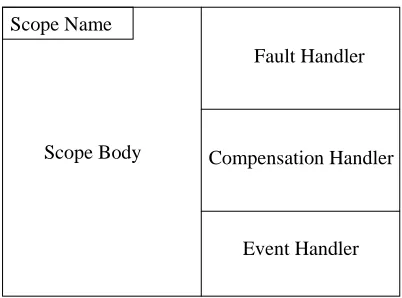
The main activity structuring mechanism for declaring hierarchical units of work is the BPEL scope. A BPEL scope is partitioned into four sections (Fig-ure 3):
1. Themain bodywhich contains the description of the normal behaviour. The main body can consist of any basic or structured activities (including scopes).
2. The event handlers which will are invoked when certain events occur. An event might be the receipt of a particular type of message from a partner or a timeout.
Scope Name
Fault Handler
Scope Body Compensation Handler
[image:16.595.205.406.105.254.2]Event Handler
Figure 3:BPEL Scope.
4. Thefault handlers catch faults that are thrown by the main body or by one of the event handlers.
Previously installed compensation handlers are invoked through the BPEL compensateactivity. The compensate activity can only appear in a fault handler or a compensation handler, that is, a fault or compensation handler for a scope S may invoke compensations on scopes directly within the main body ofS. The compensate activity comes in two forms. In the first form (the named form), a scope name is provided which means that the installed compensation handler for the scope identified by the argument should be invoked. In the second form (the name-freeform), no scope argument is provided and the default compensation is applied. Default compensation means that the installed compensation handlers for all the direct inner scopes will the invoked. In this section we will only model the name-free form of compensation invocation. In section 5 we will describe an extension to StAC and we will show how this allows us to model the named form of explicit compensation.
In this paper we focus on formalising the basic and structured activity con-structs of BPEL. We will not be concerned with formalising BPEL message, partner nor variable types. We will see that all the significant activity constructs of BPEL can be mapped easily to StAC. Before we present the mapping from BPEL activities to StAC, we describe a modest extension to StAC which sup-ports throwing and handling of different types of exception. This extension is necessary to model BPEL fault handling.
4.2 Extending StAC with Parameterised Throw
dis-cusses how StAC could be extended to deal with parameterised throw and catch of exceptions so that early termination attempt and attempt block constructs can distinguish the type of exception raised and execute an exception handler tailored for each exception. Constructs that deal with exception handling are parameterised by the exception identifier:
P ::=· · ·
| ⊙f (early termination of attempt)
|P{Q}( []e∈E· e=⇒Re) (attempt block) | · · ·
whereEis a set of exception identifiers andf is an exception identifier. Further-more, the attempt block now provides a choice of exception handlers instead of a single handler.
An extended attempt blockP{Q}( []e∈E· e=⇒Re) first executesQ, and if
Qterminates successfully it continues withP. Otherwise, if an early termination
⊙f occurs within Q, there are two possible outcomes. Either the exceptionf has an exception handlerRf(withf ∈E), in which case the block continues withRf,
orf does not have an exception handler (f /∈E), in which case the exception⊙f
is thrown again to the surrounding block. Appendix A shows how the semantic rules for StAC in [7] may be extended to deal with parameterised throw.
4.3 Mapping BPEL to StAC
To define a mapping from BPEL to StAC, we have defined an abstract syntax for a simplified subset of the activity description language of BPEL. This abstract syntax for BPEL activities is shown in Table 2. We have assumed some basic sets such as P artner, representing a set of identifiers for partners, and Operation, representing a set of operation identifiers. In the remainder of this section we will go through each syntactic construct in Table 2 and explain how it is mapped to StAC. We introduce a functionTthat maps each syntactic construct of BPEL to an appropriate corresponding StAC construction. For simplicity we are not modelling BPEL process variables nor assignment to variables in this paper since we want to focus on formalising the orchestration of activities in BPEL. Another important feature of BPEL that we do model in this paper is the creation of process instances. In BPEL a receive activity can be defined so that receipt of a message creates a new process instance. Correlation rules can be defined which correlate messages with the appropriate instance of a process. We do not treat correlation sets or time related features in our formalisation of BPEL.
Act::=receive(P artner, Operation) (receive a message)
| reply(P artner, Operation) (reply to a message)
| invokeS(P artner, Operation) (synchronous operation invoke)
| invokeA(P artner, Operation) (asynchronous operation invoke)
| sequence(Act1, . . . , Actn) (sequence) | while(Cond, Act) (conditional loop)
| switch(CAct1, . . . , CActn, Act) (choice of conditional activities) | pick(GAct1, . . . , GActn) (choice of guarded activities) | f low(Act1, . . . , Actn) (parallel flow)
| linkedActivity(Linksin, Act, Linksout) (activity with incoming
and outgoing links)
| scope(ScopeN ame, Act, EH, F H, CH) (scope)
| throw(F aultN ame) (throw a fault)
| compensate(ScopeN ame) (compensate a scope)
CAct::=conditionalActivity(Cond, Act)
GAct::=guardedActivity(receive(P artner, Operation, V arin), Act)
EH ::=eventHandler(GAct1, . . . , GActn)
F H ::=f aultHandler(catch(F aultN ame1, Act1), . . . ,
catch(F aultN amen, Actn) )
CH ::=compensationHandler(Act)
Table 2:Abstract syntax for BPEL subset
is modelled simply as an atomic event in StAC, thus the results of translating a receive is defined simply as follows:
T(receive(p, op) ) = receive.p.op
Areplyspecifies a partner and an operation with which the reply is concerned:
T(reply(p, op) ) = reply.p.op
Invocation is used by one BPEL process to request an operation on another BPEL process. Invocation comes in two forms, asynchronous, in which the re-quester does not wait for a reply, and synchronous, in which the rere-quester does wait for a reply. In the asynchronous case, the invoked process replies to the original request by invoking the original requestor. A synchronousinvokeS ac-tivity consists of two StAC activities, sending a request to a partner followed by getting a response from the partner:
Although not defined in this paper, our assumption is that arequest.p2.opevent initiated by partnerp1 would result in a correspondingreceive.p1.op event oc-curring in partner p2. Similarly for reply.p1.op and response.p2.op. These as-sumptions represent the way in which we intend BPEL processes to interact. An asynchronous invokeAactivity simply involves sending a request to a partner:
T(invokeA(p, op) ) = request.p.op
Given a group of activitiesA1, . . . , An, the structured activitysequence(A1,
. . . , An) represents the execution of these activities in sequential order.
Sequen-tial composition of activities is defined in terms of the sequenSequen-tial composition operator of StAC:
T(sequence(A1, . . . , An) ) = T(A1) ; · · · ; T(An)
Looping behaviour is defined in BPEL using thewhileconstruct. This has the usual semantics for while: while(C, A) continues to execute A while condition C holds. For simplicity we assume that conditions are expressed in the same language as StAC boolean conditions. Thewhileconstruct is defined in terms of a recursive StAC definition:
T(while(C, A) ) = W where
W = C=⇒(T(A) ;W) [] ¬C=⇒skip
Here process W will execute T(A) and then continue as W provided condition C holds, otherwise it terminates immediately.
The BPEL switch selects one of a group of activities for execution. Each activity has an associated selection condition. Conditions are evaluated in order of appearance and the first branch whose condition is true is evaluated. If no activity satisfies its selection condition, the default activity is executed. The switchis translated to StAC as follows:
T(switch(conditionalActivity(C1, A1), . . . , conditionalActivity(Cn, An), A) ) = C1 =⇒ T(A1) []
¬C1∧C2 =⇒ T(A1) []
· · ·
¬C1∧ · · · ∧ ¬Cn−1∧Cn =⇒ T(An) [] ¬C1∧ · · · ∧ ¬Cn−1∧ ¬Cn =⇒ T(A)
A1
A2
A3
A5 A4
l1 l3
[image:20.595.218.395.104.189.2]l2 l4
Figure 4:Example BPEL flow with links.
corresponds to the StAC choice, where each branch is guarded by an event, and is translated to StAC as follows:
T(pick(guardedActivity(R1, A1), . . . , guardedActivity(Rn, An)) ) = T(R1);T(A1) [] · · · [] T(Rn);T(An)
The BPEL syntax allows multiple simultaneous receives on the same message type from the same partner though the meaning of such behaviour is said to be undefined in [12]. StAC supports multiple simultaneous receives though it can lead to nondeterministic choice of behaviour.
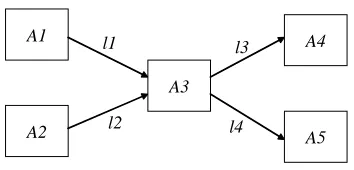
The BPEL f low construct is used to specify a group of activities running in parallel. Synchronisation dependencies between activities may be specified in BPEL flows using dependency links. Each link has exactly one source and one target. For example, consider the dependent flow illustrated in Figure 4. This flow contains five parallel activities. The arrows represent synchronisation depen-dencies. The arrow fromA1 toA3 indicates that activityA3 cannot commence until A1 has completed. When an activity has multiple incoming links, then it must wait until all the source activities of its incoming links have completed. For example,A3 in Figure 4 must wait until bothA1 and A2 complete. In our abstract syntax for BPEL we can attach incoming and outgoing links to an ac-tivity using the linkedActivity construct. If L1 andL2 are sets of links, then linkedActivity(L1, A, L2) represents an activity A with incoming links L1 and outgoing linksL2. The example of Figure 4 would be represented in our BPEL syntax as:
f low(
linkedActivity({}, A1,{l1}), linkedActivity({}, A2,{l2}), linkedActivity({l1, l2}, A3,{l3, l4}), linkedActivity({l3}, A4,{}), linkedActivity({l4}, A5,{}) )
We model synchronisation links in StAC by using synchronisation variables shared between processes. Each link has a boolean variable associated with it. Initially the variable is assumed to bef alse. When the activity at the source of a link completes, it sets the link variable to true. A linked activity must wait until all its incoming links aretrue before proceeding. An atomic action which sets a set of links totrueis defined in B as follows1:
Set(L) = (kl∈L·l:=true)
Waiting for all incoming links to becometrueis modelled using a guarded atomic action defined in B as follows:
W ait(L) = (∀l∈L·l=true) =⇒ skip
Thus, for example, the linked activity containingA3 in our example is translated to StAC as:
W ait({l1, l2}) ; T(A3) ; Set({l3, l4})
When this process is run in parallel with the appropriate translations of the other linked activities of our example, A3 cannot occur untilA1 and A2 have completed and have setl1 andl2 totrue.
A flow is translated into a parallel composition in StAC:
T(f low(A1, . . . , An) ) = (kl∈L·l:=f alse) ; (T(A1) k · · · k T(An) )
Here the links used in the flow are initialised to false. Although not defined formally here, the set L represents the set of link identifiers contained in the flow excluding those contained in nested flows or loops.
To achieve the desired link dependency, the translation rule for linked activ-ities uses theW aitandSetactions as follows:
T(linkedActivity(L1, A, L2) ) = W ait(L1) ; T(A) ; Set(L2)
BPEL link sources may have transition conditions and linked activities may have join conditions which are expressions of the incoming transition conditions. We do not model link conditions in this paper which represents a big simplification of the BPEL link semantics.
We now consider how to model the BPEL scope construct. Recall that as well as a main body, a BPEL scope has an event handler, a fault handler and a compensation handler. We model compensation handling using the StAC com-pensation pair operator and fault handling using the StAC attempt block. We
1 Here we are taking some syntactic libertes with the B notation. A valid B
model the event handler as a process that runs in parallel with the main body. A scope of the form
scope(S, A, EH, F H, CH)
will be modelled with the following StAC construction:
[ skip{(AkEH)÷CH }F H ]
This is a compensation scope containing an attempt block. The main body of the attempt block consists of the scope bodyAin parallel with the event handler EH. IfAkEH terminates normally, the compensation handlerCH is installed and the whole scope terminates. A fault may be thrown byAor byEH in which case control is passed to the fault handlerF H andCH is not installed.
Each event handler is guarded by a receive event and can be executed multiple times. An event handler is disabled when the main body terminates (normally or through a fault). We model this in StAC using a looping construct that on each iteration is either willing to terminate immediately or to execute process P. This is defined as follows:
LOOP(P) = X
where
X = skip[] (P;X)
A scope may contain a group of event handlers for different messages and these should be available in parallel:
eventHandler(guardedActivity(R1, A1), . . . , guardedActivity(Rn, An))
Here eachRi is a receive activity which is bocked until an appropriate message
is received in which case the corresponding Ai activity is executed. The event
handlers are modelled in StAC by looping over the handlers in parallel:
LOOP(R1;A1) k · · · k LOOP(Rn;An)
As well as message receipt, BPEL also allows event handlers to be guarded by timeout alarms. We have not modelled alarms here.
A BPEL fault handler is of the form2
f aultHandler(catch(f1, F1), . . . , catch(fn, Fn))
Here fi is a fault type andAi is the corresponding handler forfi. This will be
modelled in StAC using the parameterised exception operators introduced in Section 4.2.
When the compensation handler for a BPEL scope is installed it overrides any compensation handlers installed by nested inner scopes. We use theStAC
2
X operator to clear inner compensations when installing the outer compensation. [P;2
X]÷Qwill clear any compensations installed byP before installingQ. IfP throws an exception, then the compensations installed byP will remain available andQ will not be installed. We believe this corresponds to the informal BPEL semantics defined in [12] in the case that the name-free form of compensation is used.The rule for translating a BPEL scope is as follows:
T(scope(S, A, EH, F H, CH) ) = [ skip{[ (A′kEH′);
2
X]÷CH′ }F H′ ]where
A′ = T(A)
EH = eventHandler(guardedActivity(R1, A1), . . . ,
guardedActivity(Rn, An) )
EH′ = LOOP(T(R
1);T(A1)) k · · · k LOOP(T(Rn);T(An))
F H = f aultHandler(catch(f1, F1), . . . , catch(fn, Fn))
F H′=f
1=⇒T(F1) [] . . . [] fn=⇒T(Fn)
CH = compensationHandler(C) CH′ = T(C)
The compensation handler is optional in StAC. In the case that a compen-sation handler is not present, the default compencompen-sation for a scope is to run the compensations of the enclosed scopes. To model this in StAC, inner compensa-tions are not cleared and no compensation handler is installed:
T(scope(S, A, EH, F H, ) ) = [ skip{A′kEH′}F H′ ]
where A′,EH′ andF H′ are as defined above.
The fault handler is also optional in BPEL. If it is not present, the default is to invoke the default compensation for the scope and throw the exception to the outer level. If the fault handler is not present, the above definition ofF H′
should be replaced by the following:
F H′
= []e∈ E · e =⇒ ⊠;⊙e
Here E represents the set of all possible exceptions types. The above construc-tion defines a handler for every excepconstruc-tion type, the effect of which is to invoke compensation and then re-throw that exception.
The event handler is also optional in BPEL. When it is absent,EH′is simply
skip.
A BPEL throw activity may appear anywhere in a scope. The BPEL throw activity is modelled in StAC as follows:
The BPEL compensate activity can only appear in a compensation handler or a fault handler. As mentioned at the beginning of the section, for the moment we provide a translation for the name-free compensate activity. The name-free compensate activity causes all the immediately enclosed scopes to be compen-sated, similar to the default case where no handler is present. The name-free compensate is translated as follows:
T(compensate) =⊠
The BPEL standard [12] says that when the default compensation is applied to a scope, the compensation handlers should be be run in reverse order of completion of the scopes to which they are attached. Because of the semantics of StAC, we give a less constrained semantics to default compensation, that is, compensations for sequentially composed scopes are executed in reverse order while compensations for scopes composed in parallel can be run in parallel. Though our interpretation allows for more parallelism when compensating, it may not be appropriate in the presence of link dependencies in flows.
In the next section we introduce a modified form of the StAC language that supports multiple compensation threads. This will allow us to model the named compensate activity.
5
Multiple Compensation in StAC
In this section we present some extensions to the StAC language. The most important of these extensions is that a process can have several simultaneous compensation tasks associated with it. A process decides which task to attach the compensation activities to, and each individual compensation task can be reversed or accepted. This contrasts with the language presented in Section 2, where scoping of compensation is hierarchical and each scope has a single implicit compensation task. To distinguish different compensation tasks, the operators that deal with compensation, i.e., compensation pair, acceptance and reversal, are indexed by the compensation task index to which they apply. The syntax of StACi is presented in Table 3.
The original motivation for extending the StAC language was that StACi
had a clear semantics for compensation and made it easier to describe parallel compensation. It is easier to define the operational semantics of multiple com-pensation tasks, than a hierarchy of comcom-pensation scopes, because with multiple compensation it is possible to refer directly to a compensation task by its index, while with nested compensations this is not possible. Later, when applying StAC to some case studies it emerged that some features that were difficult to model in StAC could be easily modeled in StACi using multiple compensation tasks.
P,Q ::= · · ·
| P÷iQ(indexed compensation pair)
| ⊠i (indexed reverse) |
2
Xi (indexed accept) | Ji (merge)
Table 3: StACi Syntax
5.1 Extended Compensation Operators
Most of the StACi operators are retained from StAC without any alterations.
The new operators deal with compensation (Table 3) and reflect the modifica-tions to the StAC language. These replace the compensation operators of StAC presented in Section 2. In the extended language, process P÷iQ hasP as its primary process and, whenP completes, compensationQis installed on compen-sation taski, whereiis an index. Note that compensation indices are constants and not expressions that can be evaluated. The instruction to accept compen-sation taskiis given by
2
Xi while the instruction to reverse compensation taski
is given by⊠i. To help illustrate indexed compensation, consider the process:
(A÷1A′); (B÷2B′);⊠1; (C÷2C′);⊠2.
This process will start by invokingA, followed byBand then the reversal causes compensation A′ to be invoked. Compensation B′ will not be invoked at this
stage as it is on compensation task 2 and only compensation task 1 is invoked by the first reversal operator. After the first reversal, activity C is performed. Reversal is then invoked on compensation task 2 which causesC′followed byB′
to be executed.
The compensation information of a process is maintained by a compensation function that for each compensation task index, returns the associated com-pensation process. When the primary task of a comcom-pensation pair concludes its execution, the compensation task is composed in sequence with the original compensation process for that task.
An important operator in StACiis the merge operator. The expressionJi,
whereJ is a set of indices, merges all compensation tasks belonging toJ into the compensation taski. When merging compensation tasks, those tasks are merged in parallel. In the process
(A÷1A′); (B÷
2B′);{1,2}3
the merge operator will compose compensation task 1 (A′) and compensation
task 2 (B′) in parallel and add the result (A′kB′) to the front of compensation
The StAC process
(A÷A′); [(B÷B′);
⊠; (C÷C′)]
can be represented in StACi as
(A÷1A′); (B÷
2B′);⊠2; (C÷2C′);{2}1
Here the inner compensation scope is represented as a ‘new’ compensation task. When the reversal instruction is invoked on compensation task 2 it will only execute B′. Compensation process A′ that in StAC was outside the braces, in
StACi is in a different compensation task, and does not get invoked. The merge
is used to preserve any compensations not reversed within the scoping brackets. Utilising the facility of multiple interleaved compensation tasks, [10] intro-duced theselective compensation andalternative compensation. With selective compensation, the reversal selects some activities to be compensated, while pre-serving the compensations for other activities. With alternative compensation, several alternative compensation tasks may be attached to an activity and the reversal selects one of these alternatives for invocation. These two multiple com-pensation mechanisms are discussed in detail in [10] where selective compensa-tion is used in a travel agency business process to compensate those parts of a client itinerary that fail to get reserved.
5.2 Modelling Named Compensation in BPEL
The multiple compensation provided by StACi allows us to model named
com-pensation in BPEL. We write named comcom-pensation in BPEL ascompensate(S), where S is the name of the scope to be compensated. The meaning of the compensate(S) activity is to run any compensation handler installed for scope S. To deal with this, we associate a compensation task with each scope, iden-tified using the name of the scope. Now a compensation handler for scopeS is installed on a compensation task labelled bySand that compensation can later be invoked by compensating task S. Consider the nested scopes illustrated in Figure 5 with an outer scopeS1 and inner scopesS2 andS3. This will give rise to three compensation tasks, S1,S2 and S3. WhenA2, the body of scopeS2, completes successfully, then compensation handlerCH2 will be installed in com-pensation task S2. Similarly for S3 and S1. Fault and compensation handlers F H1 andCH1 may contain compensate(S2) orcompensate(S3) activities and these will be translated into the corresponding compensate operations in StACi.
A2
S2 FH2
CH2
EH2 A2
S2 FH2
CH2
EH2
A3
S3 FH3
CH3
EH3 A3
S3 FH3
CH3
EH3 S1
FH1
CH1
[image:27.595.201.411.105.288.2]EH1
Figure 5:Example nested BPEL scopes.
model name-free compensation, as well as installingCH2 on compensation task S2, we will also introduce a compensation taskS1′ to model default
compensa-tion forS1 (S1′is a distinct identifier fromS1 and all other scope identifiers and
is used to identify the default compensation task for scopeS1). In the example of Figure 5, both CH2 and CH3 would be installed on S1′. Now a name-free
compensate activity in F H1 or CH1 is translated into compensation of task S1′.
The installation ofCH2 andCH3 on compensation taskS1′ also deals with
default compensation. Recall that default compensation arises when a scope has no defined compensation handler or when the compensation handler is not in-stalled because of an exception. With our proposed scheme, ifCH1 is not present or does not get installed because of an exception, then the default compensation task will be used if S1 needs to be compensated.
To recap, given a scopeS2 which is directly contained within scopeS1, when the body ofS2 completes successfully, thenCH2, the compensation handler for S2, is installed on two compensation tasks,S1′ andS2. This double installation
in modelled in StACi as follows:
((A2kEH2)÷S2CH2)÷S1′CH2
compensate activities, are modified so that they simply pass this argument on to recursive calls ofT, e.g.,
T(sequence(A1, . . . , An), S) = T(A1, S) ; · · · ; T(An, S)
We replace the translation rules for BPEL scopes given in Section 4.3 by the following rule. On successful completion of the scope, the compensation handler is installed in two places as discussed above:
T(scope(S2, A, EH, F H, CH), S1 ) = skip{((A′kEH′)÷S
2CH′)÷S1′CH′}F H′
where
A′ = T(A, S2)
EH = eventHandler(guardedActivity(R1, A1), . . . , guardedActivity(Rn, An) )
EH′ = LOOP(T(R
1, S2);T(A1, S2)) k · · · k
LOOP(T(Rn, S2);T(An, S2))
F H = f aultHandler(catch(f1, F1), . . . , catch(fn, Fn))
F H′ =dCH; (f
1=⇒T(F1, S2) [] . . . [] fn=⇒T(Fn, S2) )
dCH′ = skip÷S
2(⊠S2′)
CH = compensationHandler(C) CH′ = T(C, S2)
Notice that the first step (dCH) of the fault handler F H′ is to install an
in-vocation of the default compensation handler on compensation taskS2. This is because in the case of a fault, the given compensation handlerCH will not be installed and the default compensation will apply instead.
If the fault handler is not present, the above definition of F H′ should be
replaced by the following:
F H′
= []e∈ E · e =⇒ (⊠S2′ ; ⊙e)
If the compensation handler is not present, the above definition ofCH′should
be replaced by the following:
CH′
= ⊠S2′
A named BPEL compensate activity is translated to a StAC compensate operator indexed by the named scope, while a name-free compensate is indexed by the default handler for the containing scope:
T(compensate(S2), S1) = ⊠S2 T(compensate, S1) = ⊠S1′
in this new scheme is not quite the same as in the scheme defined in Section 4.3. With the previous scheme, default compensation was based on the StAC ap-proach which is that compensations for sequentially composed scopes are exe-cuted in reverse order while compensations for scopes composed in parallel can be run in parallel. In the new scheme, the compensation handlers will be run in reverse order of their installation. This is exactly the definition for default compensation order in BPEL [12].
6
Conclusions
The combination of explicit and implicit compensation supported by BPEL is quite complicated and it is unclear to what extent this complexity is required for application to business transactions. A downside of the complexity is that it may hinder reasoning, both formal and informal, about BPEL designs. [8] describes a trace semantics for a simplified version of the StAC language. In that work, the simplified language does not contain⊠or
2
X. Instead the invocation of installed compensations for a transaction block is automatic in the case of an exception in the block while installed compensations are discarded in the case of successful termination of a transaction block. While this is more restrictive than StAC and BPEL, it does lead to a cleaner compositional semantics and a language that appears to be more amenable to modular verification than StAC or BPEL.Bruni et al [4] have developed an operational semantics for a language with similar operators to StAC, including compensation pairs and transaction blocks (or sagas as they call them). Like the work of [8], and unlike StAC, the invocation of compensation in a saga is automatic depending on failure or success which leads to a neater operational semantics.
Other researchers have worked on formalising notions of compensation. In [18], a compensation is formalised in terms of the properties it has to guarantee. However, [18] does not provide a modelling language as StAC does, rather it pro-vides a characterisation of properties of compensation. ConTracts [23] attempt to provide a structured approach to compensation. In ConTracts the invocation of a particular compensation has to be made explicitly within a conditional in-struction (if the outcome of a step is false, then a specific task is executed to compensate for this). ConTracts do not have the notion of installing a compen-sation handler nor acceptance nor reversal found in StAC.
implemented using speculative parallelism whereby multiple possible ways of achieving a service are attempted in parallel. The link between compensation and speculative parallelism has been investigated in [8] where it show that com-pensation can be used to ‘tidy-up’ those speculative branches that fail or are not availed of.
We believe that the combination of a process oriented notation such as StAC with a state oriented notation such as B, provide a very rich way of describing both the orchestration and the data aspects of long running business transac-tions. Compensation is an important feature of long running transactions and we believe that StAC was the first process oriented language to introduce com-pensation operators. Because of the closeness of StAC to BPEL we were able to define a straightforward mapping from BPEL to StAC. We believe this mapping makes the semantics of BPEL activities more accessible as well as giving them a formal semantics. This suggests that combinations such as StAC and B pro-vide a good basis for specification of contracts and formal analysis of business transactions.
Acknowlegdements
We are grateful to the anonymous reviewers for very valuable feedback which has lead to improvements in the paper.
References
1. J.R. Abrial. The B-Book: Assigning Programs to Meanings. Cambridge University Press, 1996.
2. A. Avizienis, J.-C. Laprie, B. Randell, and C.E. Landwehr. Basic concepts and taxonomy of dependable and secure computing. IEEE Trans. Dependable Sec. Comput., 1(1):11–33, 2004.
3. D. Booth, H. Haas, F. McCabe, E. Newcomer, M. Champion, C. Ferris, and D. Orchard. Web services architecture. www.w3.org/TR/ws-arch/, 2004. W3C Working Group, Note 11.
4. R. Bruni, H. Melgratti, and U. Montanari. Theoretical foundations for compensa-tions in flow composition languages. InPOPL 2005, 2005.
5. M. Butler. csp2B: A practical approach to combining CSP and B. Formal Aspects of Computing, 12:182–198, 2000.
6. M. Butler and C. Ferreira. A process compensation language. InIntegrated Formal Methods(IFM’2000), volume 1945 ofLNCS, pages 61 – 76. Springer-Verlag, 2000. 7. M. Butler and C. Ferreira. An operational semantics for stac, a language for mod-elling long-running business transactions. InCoordination 2004, volume 2949 of LNCS. Springer-Verlag, 2004.
8. M. Butler, C. Ferreira, and C.A.R. Hoare. A trace semantics for long running transactions. In25 Years of CSP, 2004.
10. M. Chessell, D. Vines, C. Griffin, M. Butler, C. Ferreira, and P. Henderson. Ex-tending the concept of transaction compensation. IBM Systems Journal, 41(4):743–758, 2002.
11. M. Chessell, D. Vines, C. Griffin, V. Green, and K. Warr. Business process beans: System design and architecture document. Technical report, Transaction Pro-cessing Design and New Technology Development Group, IBM UK Laboratories, January 2001.
12. F. Curbera, Y. Goland, J. Klein, F. Leymann, D. Roller, S. Thatte, and S. Weerawarana. Business process execution language for web services, version
1.1. http://www-106.ibm.com/developerworks/library/ws-bpel/, 2003.
13. C. Ferreira. Precise Modelling of Business Processes with Compensation. PhD thesis, University of Southampton, 2002.
14. C. Ferreira and M. Butler. Using B Refinement to Analyse Compensating Business Processes. InThird International ZB Conference (ZB’2003), volume 2651 ofLNCS. Springer-Verlag, 2003.
15. H. Garcia-Molina and K. Salem. Sagas. In Proceedings of ACM SIGMOD, pages 249–259, 1987.
16. J. Gray and A. Reuter. Transaction Processing: Concepts and Techniques. Morgan Kaufmann Publishers, 1993.
17. C.A.R Hoare. Communicating Sequential Processes. Prentice-Hall, 1985.
18. H. Korth, E. Levy, and A. Silberschatz. A formal approach to recovery by com-pensating transactions. In16th VLDB Conference, Brisbane, Australia, 1990. 19. B. Metha, M. Levy, G. Meredith, T. Andrews, B. Beckman, J. Klein, and
A. Mital. BizTalk Server 2000 Business Process Orchestration. IEEE Data Engi-neering Bulletin, 24(1):35–39, 2001.
20. R. Milner. Communication and Concurrency. Prentice-Hall, 1989.
21. J. Misra. Computation orchestration – a basis for wide-area computing. In 2004 NATO Summer School, Marktoberdorf, 2004.
22. G. Plotkin. A structural approach to operational semantics. Technical Report DAIMI FN-19, Aarhus University, Computer Science Department, September 1981. 23. H. Wachter and A. Reuter. The ConTract model. In A. Elmagarmid, editor, Database Transaction Models for Advanced Applications. Morgan Kaufmann Pub-lishers, 1992.
A
Semantics of Parameterised Throw
The transition rules dealing with early termination are easily extended to deal with parameterised throw. For most rules, one just has to add the exception identifier to⊙andearlyoperators. For example, consider the non-parameterised rule below:
(⊙, C, σ) −→⊙ (early, C, σ)
This rule is extended by adding the exception identifier f to operators ⊙ and early stating that exceptionf has occurred:
(⊙f, C, σ)
⊙f
The only rule that cannot be extended by parametrisation of the exception operators is the rule below:
(P{early}R, C, σ) −→τ (R, C, σ)
In this case the rule has to be replaced by two new rules. The rule on the left-hand side states that, if an attempt block terminates prematurely by the occurrence of exceptionf and there is a handler (Rf) for that exception, then the exception
handlerRf will be executed. While the rule on the right-hand side, models the
situation where no handler exists for exception f causing that same exception to be thrown again.
f ∈E
(P{earlyf}( []e∈E· e=⇒Re), C, σ) τ
−→ (Rf, C, σ)
f /∈E
(P{earlyf}( []e∈E· e=⇒Re), C, σ) τ