Provenance-based Validation of E-Science Experiments
Sylvia C. Wong, Simon Miles, Weijian Fang, Paul Groth and Luc Moreau
School of Electronics and Computer Science, University of Southampton, UK
{sw2,sm,wf,pg03r,l.moreau} at ecs.soton.ac.uk
Abstract. E-Science experiments typically involve many distributed services main-tained by different organisations. After an experiment has been executed, it is use-ful for a scientist to verify that the execution was performed correctly or is com-patible with some existing experimental criteria or standards. Scientists may also want to review and verify experiments performed by their colleagues. There are no exsiting frameworks for validating such experiments in today’s e-Science sys-tems. Users therefore have to rely on error checking performed by the services, or adopt other ad hoc methods. This paper introduces a platform-independent frame-work for validating frame-workflow executions. The validation relies on reasoning over the documentedprovenanceof experiment results andsemantic descriptionsof services advertised in a registry. This validation process ensures experiments are performed correctly, and thus results generated are meaningful. The framework is tested in a bioinformatics application that performs protein compressibility anal-ysis.
1
Introduction
Very large scale computations are now becoming routinely used as a methodology to un-dertake scientific research: success stories abound in many domains, including physics (griphyn.org), bioinformatics (mygrid.org.uk), engineering (geodise.org) and geographical sciences (earthsystemgrid.org). These large scale computa-tions, which underpin a scientific process usually referred to as e-Science, are ideal candidates for use of Grid technology [1].
E-Science experiments are typically formed by invoking multiple services, whose compositions are modelled as workflows [2]. Thus, experimental results are obtained by executing workflows. As part of the scientific process, it is important for scientists to be able to verify the correctness of their own experiments, or to review the correct-ness of their peers’ work. Validation ensures results generated from experiments are meaningful.
Such validation methods suffer from limitations in the context of large e-Science experiments, potentially carried out in open environments. First, programs (or work-flows) may not be expressed in languages that analysis tools operate on, or may not be directly available because they are exposed as services, hereby preventing static anal-ysis. Second, in general, in open environments, we cannot make the assumption that services always check that their inputs or outputs match their interface specifications (if available at all); furthermore, such interfaces may be under-specified (for instance, many bioinformatics services tend to process and return strings encoding specific bio-logical sequence data); as a result, no guarantee exists that types will be checked dy-namically. Third, studies of user practice have shown that rapid development cycles are being adopted by e-Scientists, in which workflows are frequently modified and tuned and scientific models are evolved accordingly. As a result, it is important for scientists to be able to verify that previous experimental results are compatible with recent crite-ria and requirements. Since these models did not necessarily exist at experiment design or execution time, it is a necessity to perform such validationafterthe experiment has been completed.
Theprovenance of a piece of data denotes the process by which it is produced. Provenance-aware applications are applications that record documentation of their ex-ecution so that the provenance of the data they produce can be obtained and reasoned over. In this paper, our thesis is that provenance-based validation of experiments allows us to verify the validity after experiments have been conducted. Specifically, our contri-butions are: (a) a provenance-based architecture to undertake validation of experiments; (b) the use of semantic reasoning in undertaking validation of experiments; (c) an im-plementation of the architecture and its deployment in a bioinformatics application in order to support a set of use cases. Our experimentation with the system shows that our approach is tractable and performs efficiently.
The structure of the paper is as follows. Section 2 describes some use cases we have identified that require experiment validation. Section 3 briefly discusses current approaches to e-Science experiment validation and explains why it is necessary to per-form validation after an experiment was executed. Section 4 introduces the proposed framework for validation of workflow execution. Section 5 then describes how the ar-chitecture can be applied to the use cases introduced in Section 2. In Section 6, we discuss how semantic reasoning is essential in properly establishing the validity of ex-periments. Section 7 then presents results from an implementation of the validation framework with an e-science application (specifically, the protein compressibility anal-ysis experiment). The paper finishes with discussion in Section 8 and conclusions in Section 9.
2
Use Cases
Use Case 1 (Interaction validity, interface level) A biologist, B, performs an experi-ment on a protein sequence. One stage of this experiexperi-ment involves generating a pre-specified number of permutations of that sequence. Later, another biologist, R, judges the experiment results and considers them to be suspicious. R determines that the num-ber of permutations specified was an invalid value, e.g. it was negative.2
In this example, we consider that the service provider could have specified a re-striction for the number of permutations to non-negative integers in the service schema, since the parameter only makes sense for non-negative integers. However, this does not guarantee that the service will validate the data against the schema at run-time. In general, whether validation is carried out at run-time is service specific.
In Use Case 1, B could have entered a negative value for the number of permuta-tions. In this case, the value is incorrect because it does not conform to the restrictions and requirements as specified by the interface document of the service. By validating the experiment using its provenance, R can determine that B entered an invalid value for the number of permutations, and thus the results generated by the experiment were not meaningful.
Use Case 2 (Interaction validity, domain level) A bioinformatician, B, downloads a file containing sequence data from a remote database. B then processes the sequence using an analysis service. Later, a reviewer, R, suspects that the sequence may have been a nucleotide sequence but processed by a service that can only analyse meaningfully amino acid sequences. R determines whether this was the case.2
Nucleotides and amino acids are two separate classes of biological sequences, but the symbols used in the syntax of nucleotides are a subset of those used for amino acids. Therefore, it is not always possible to detect which type of sequence is used by superficially examining the data. The service used in Use Case 2 could require an amino acid sequence as its input. If a nucleotide sequence was accidentally used rather than an amino acid sequence, the problem would not be detected at run-time, and the experiment results would not be meaningful.
Given that many bioinformatics services operate on strings, the biological interpre-tation of a piece of data is information not directly available from interface specification, and cannot be easily derived from the data itself. Typically, such additional description that is useful or of interest to the user has to be made explicit elsewhere. Thus, the in-teraction in an experiment can be correct according to service interface specifications, but incorrect according to the domain level understanding of the problem.
Use Case 3 (Ontology revision) A bioinformatician, B, performs an experiment on a sequence downloaded from a remote database. Later, another bioinformatician, D, up-dates the ontology that classifies sequences stored in the database to correct an error in the previous version. B checks if the experiment is compatible with the new version of the ontology.2
Ontology [3]. If a service advertises that it accepts nucleotide sequences, we can infer that the service can also meaningfully process DNA and RNA sequences.
Similar to Use Case 2, the bioinformatician B in Use Case 3 wants to validate the interactions in the experiment according to their domain-level characterisation (specifi-cally, biological sequence types). However, in this use case, the ontology describing the gene sequences is revised after the experiment has been conducted. Therefore, to ensure results of the experiment are not affected by this error in the ontology, B validates the execution against the revised ontology.
Use Case 4 (Conformance to plan) A biologist, B, creates a plan for an experiment by defining the type of analysis to perform at each stage of the experiment. B then performs an experiment that is intended to follow the plan. Later another biologist, R, determines whether each operation performed in the experiment fulfilled an intended operation in the plan.2
In Use Case 4, the plan defined by B is abstract in nature. To verify whether the experiment conformed to the original plan, R examines thetasksthe services perform. In other words, R is interested in verifying the properties of the services, not the inter-actions between the services. This is in contrast to the previous use cases, where the validation is performed on the types of the data provided and accepted by the services.
Use Case 5 (Patentability of results) A biologist, B, performs an experiment. Later, B wishes to patent the results. A reviewer, R, checks that no service used in the experiment has legal restrictions such that the results could not be patented.2
In Use Case 5, R is interested in attributes such as condition of use, legal constraints and patents. These conditions are (probably) unforeseen by biologist B when he de-signed and performed the experiment.
3
Current Validation Approaches
Web Services are described by a WSDL interface [4] that specifies the operations they support, the inputs they expect, and the outputs they produce. The inputs and outputs of an operation are part of a message and their structure, referred to as interface type, is commonly specified using XML Schema [5]. In other words, it is the type expected by the transport layer (i.e., SOAP [6]). It is generally (but not always) the role of the service provider to publish interface type definitions.
the resources they rely upon. Such information may be provided by the service provider, or by a third party, and published in a registry such as the myGrid/Grimoires registry [9].
In the introduction, we discussed two commonly used forms of validation: static and dynamic. Static validationoperates on workflow source code. The vast array of static analyses devised by the programming language community is also applicable to workflows, such as type inference, escape analysis, etc. Some analysis were conceived to address problems that are specific to workflows. Examples of these include work-flow concurrency analysis [10], graph-based partitioning of workwork-flows [11], and model checking of activity graphs [12]. Yang et al. [13] devise a static analysis to infer work-flow quality of service. However, the workwork-flow script may not always be available, or it may be expressed in a language for which we do not have access to a static analyser.
Hence, validation may be performed at run-time. In its simplest form, validation is service-based. In Web Services, a validating XML parser verifies all XML docu-ments sent to a service conform to its specified schema. Thus, if all the services used in a workflow employ validating parsers, the workflow execution is guaranteed to sat-isfy syntactic types required by services. We note however that many XML parsers are non-validating by default, such as Apache Axis (ws.apache.org/axis) and JAXB (java.sun.com/xml/jaxb), because validation is an expensive operation that affects the performance of web services. Therefore, most XML parsers used by web services simply check if XML documents are well-formed, and if they can be un-marshalled into compiled classes.
Other forms of validation and analysis can take place at run-time. The Pegasus planner is capable of analysing a workflow and re-planning its execution at run-time so as to make use of existing available resources [14]. Policy languages such as KAoS are used to perform semantic reasoning and decide if access can be granted to services as they are being invoked [15].
Service-based validation can only be performed at run-time. However, it is some-times necessary to validate an experiment after it has been executed. This has been identified in Use Cases 3 and 5. Third parties, such as reviewers and other scientists, may want to verify that the results obtained were computed correctly according to some criteria. These criteria may not be known when the experiment was designed. This is because as science progresses, criteria evolve. Thus, it is important that previously com-puted results can be verified according to revised sets of criteria.
4
Provenance-based Validation Architecture
We propose a provenance-based approach to workflow validation. The provenance of an experiment contains a record of all service invocations such that the information is sufficient to reproduce the exact experiment. A provenance-based approach lends itself easily to third party validation as scientists can share provenance data with other scientists. Also, as validation criteria evolve, the validation process can be repeated without re-executing the experiment.
wish to support multi-level descriptions beyond interface types, possibly provided by third parties, the registry provides support for semantic annotations [9]. An interface for metadata publication allows for metadata annotations to services, individual opera-tions (within a service), their inputs and outputs; likewise, a query interface caters for metadata-based discovery.
provenance store semantic
registry annotation
semantic validator workflow enactment engine
provide
advertise invoke
get advertisements query service providers
get p−assertions document execution
[image:6.612.170.439.200.366.2]document execution services
Fig. 1.Provenance-based validation architecture.
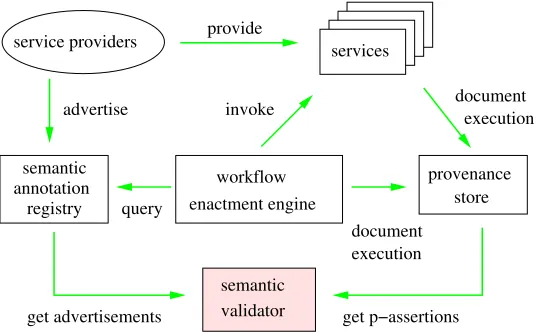
Users construct workflows for their experiments. The workflow enactment engine queries the registry for services that provide the tasks requested in the workflow and calls the appropriate services in the correct order. The services and the workflow enact-ment engine docuenact-ment the execution of the experienact-ment using a provenance store. We refer to the provenance of some experimental result as the documentation of the process that led to that result. Each client and service (collectively,actors) in an experiment can assert facts about that experiment, calledp-assertions(assertions, by an actor, pertain-ing to provenance). A p-assertion may state either the content of a message sent by one actor to another, aninteraction p-assertion, or the state of an actor when an interaction took place, anactor state p-assertion. Examples of actor state p-assertions range from the workflow that is being executed, to the amount of disk and CPU a service used in a computation [16].
isV alid←true for allactivitiesado
(R, A)←Compute(a)
isV alid←isV alid∧(AsatisfiesR)
[image:7.612.132.491.113.177.2]end for
Fig. 2.Algorithm for provenance-based validation. RequirementRand actual valueAare calcu-lated using theComputefunction shown in Figure 3
Figure 3 explains how requirementRand actual valueAare calculated for a given activitya. First, the validator obtains provenance p-assertions forafrom the provenance store. Using this provenance information, the validator fetches services’ advertisements and semantic annotations from the registry. The user supplies extra information needed for validation, such as the bioinformatics ontology in Use Case 3 and the legal descrip-tions in Use Case 5.
Function: Compute requirementRand actual valueA Require: activitya
Retrieve p-assertions from provenance store Get advertisements from registry
[image:7.612.135.488.322.407.2]Get user supplied information R←Compute requirements A←Compute trace
Fig. 3.Algorithm to compute requirementRand actual valueA.
The type of information to obtain from the provenance store, the registry and the user depends on the actual validation to be performed. Similarly, the semantic reason-ing needed to compare requirementRand actual valueAalso depends on the type of validation. The next section explains how the semantic validator implements the various types of validations identified by the use cases using the algorithms introduced in this section. Section 6 then discusses the semantic reasoning performed.
5
Validation Algorithms for the Use Cases
Figure 3 presented a generic algorithm for computing requirementRand actual value Aof an activity by querying the provenance store and the registry. In this section, we apply the algorithm in Figure 3 to the use cases in Section 2.
5.1 Interface level interaction validity
validator validates input XML documents (actual value A) against the schemas (re-quirementR). For each activitya,RandAare computed according to Figure 4. The validator queries the provenance store for the service and operation names of activitya. These names are used to obtain the WSDL document for the activity from the registry. The provenance store also provides the validator with a copy of the data passed to the activity in the experiment.
Retrieve service/operation names ofafrom provenance store R←Get WSDL document forafrom registry
A←Retrieve input toafrom provenance store
Fig. 4.Interface-level interaction validation: computing requirementRand actual valueAfor activitya.
5.2 Domain level interaction validity
To support Use Cases 2 and 3, we validate all interactions in a workflow execution using domain-level knowledge. For each activitya, we wish to compare the domain-level types of the data expected by the activity (R) with the actual data used (A). The domain-level type of the actual data passed to activityais derived from the output of preceding operationp. (By preceding, we refer to the service that precedes activityain terms of data flow, not time). In the simplest case, an interaction is considered domain-level valid ifAis either the same type or a subtype ofR. Figure 5 summarises how the two valuesRandAare computed. First, the validator queries the provenance store to obtain the service and operation names of activityaand preceding activityp. With the service and operation names, the validator retrieves the metadata attached to the WSDL message parts from the registry. Specifically, the validator is interested in the metadata for the output message part of operationp, and the metadata for the input message parts of the current operationa. The last piece of information the validator requires is the ontology. This is supplied by the user.
Retrieve service/operation names ofafrom p-assertions
Retrieve service/operation names of preceding activitypfrom p-assertions R←Get input domain-level type ofafrom registry
A←Get output domain-level type ofpfrom registry Get ontology from user
5.3 Activity validity
To support Use Cases 4 and 5, we verify that the metadata associated with services conforms to certain criteria. We use the myGrid profile [17] to identify the tasks services perform. (The myGrid profile is an extension of the OWL-S profile [7]). Likewise, the profile also specifies databases usage restrictions. Thus, the process of verifying the activity validity of an experiment involves checking that each activity’s profile satisfies the requirements specified for it. The requirement can be different for each activity, as in Use Case 4. In other situations, the requirement can be the same for every activity in the workflow, such as in Use Case 5.
An activity is considered to fulfil requirementRif the metadata annotation for the operation (A) is of the same class or is a subclass ofR. Figure 6 shows the algorithm used for computing the valuesR andAfor activitya. The validator first obtains the names of the service and operation for activity afrom the provenance store. It then retrieves the semantic annotations of operationafrom the registry. The user supplies the requirementRfor the activity. In Use Case 4,Ris the original plan of the experiment. In Use Case 5,Ris the set of legal requirements devised according to patenting needs. Any required ontology is also supplied by the user.
Retrieve service and operation names ofafrom p-assertions A←Get semantic annotation ofafrom registry
R←Get requirements from user Get ontology from user
Fig. 6.Activity validation: computing requirementRand actual valueAfor activitya.
After the validator computed the valuesRandA, it can verify whetherAsatisfies R, as shown in Figure 2. For Use Case 1, verification of satisfaction is performed using a validating XML parser. For the other use cases, semantic reasoning is required. This will be explained in the next section.
6
Semantic Reasoning for Validation
6.1 Validation by Generalisation
The simplest and most commonly required form of reasoning is to compare two types where one is a super-class of the other.
For example, databaseDmay advertise its download operation as returningRNA se-quences. Analysis serviceAadvertises its analysis operation taking as inputnucleotide sequences. The ontology specifies that bothDNAandRNA sequencesare subclasses ofNucleotide sequences. Therefore, the interaction between the download operationD and analysis serviceAis valid as the input type ofAis a superclass of the output type ofD.
Similarly, in Use Case 4, a plan is defined using high-level concepts to describe the operations to be performed at each stage of the experiment. For example, in the experiment plan for our sample bioinformatics application, one of the steps requires aCompression algorithm. The provenance records that aPPMZ algorithm was used in the experiment and, in the ontology,PPMZ algorithm is defined as a sub-class of Compressionalgorithm. Therefore, the semantic validator can verify that this operation conforms to the one in the original plan.
6.2 Validation of Inter-Parameter Constraints
The same experiment provides cases for more novel forms of semantic description and reasoning in validation. One service,gcode, in our bioinformatics workflow takes two parameters: a sequence and a grouping alphabet. The sequence, which may represent either an amino acid sequence or a nucleotide sequence, is encoded as a sequence of symbols. The grouping alphabet specifies a set of non-overlapping groups of symbols, each group having a symbolic name. Servicegcodereplaces each symbol in the input sequence with the name of the group to which it belongs, so that the output of the service is a sequence of group names of the same length as the original sequence.
In order for the workflow to be semantically valid, the symbols used in the input se-quence ofgcodemust have the same meaning as those making up groups in the group-ing alphabet. That is, if the groupgroup-ing alphabet specifies groups of nucleotides (A, G, C and T/U) then the input sequence should be a nucleotide sequence, and if the alphabet specifies groups of amino acids (A, B, C, D, E...) then the input sequence should be an amino acid sequence.
another concept’s property (Y) without giving the type of those values. This mechanism has also been used to specify configuration policies of registries [20].
The input sequence and the grouping alphabet are provided togcodeby two other actors, and these interactions are recorded in a provenance store. From the provenance data, the element type of the input sequence and the letter type of the grouping alphabet in a particular experiment can be determined.
7
Evaluation
In this section, we present our evaluation of validation framework in satisfying two of the use cases (Use Case 2 and Use Case 4) in a sample bioinformatics experiment.
For completeness, we briefly explain the intent of the experiment used in evaluating our architecture. A more detailed description of this experiment and its workflow can be found in [21]. The experiment, developed by Klaus-Peter Zauner and Stefan Artmann, studies the structure of protein sequences by analysing their compressibility. Proteins are amino acid chains that fold into unique 3D structures. This 3D shape of the protein determines its function. The structure of protein sequences is of considerable interest for predicting which sections of the DNA encode for proteins and for predicting and designing the 3D-shape of proteins. For comparative studies of the structure present in an amino acid, it is useful to determine their compressibility. This is because com-pression exploits context-dependent correlations within a sequence. The fraction of its original length to which a sequence can be losslessly compressed is an indication of the structure present in the sequence.
For the evaluation, we ran the workflow multiple times and recorded the executions in the provenance store. Both the provenance store and the registry were implemented as Web Services (available for download atpasoa.organdgrimoires.org re-spectively). The semantic validation component was implemented in Java and used Jena 2.1 for reasoning over the ontology. The ontology itself was specified in OWL and based on the ontology developed by the bioinformatics Grid project, myGrid. Af-ter a set of workflow runs, each analysing one sample, the provenance store contains records of interactions between services. Each interaction record contains the invoca-tion message that occurred in the workflow, which specifies the operainvoca-tion invoked and data exchanged as arguments. In addition to the message itself, the services record data links that specify when the output of one service has been used as the input of another service. Collectively, the data links describe the data flow throughout the experiment. The full provenance data for one workflow run was approximately 1 MB in size. For the evaluation, we deployed the registry on a Windows XP PC with Pentium 4 CPU, 3 GHz, 2 GB RAM, and the provenance store and semantic validator on another Windows XP PC with Pentium 4 CPU, 1.5 GHz, 2 GB RAM. The PCs were connected by a 100Mb local ethernet. The results of each experiment is described in further detail below.
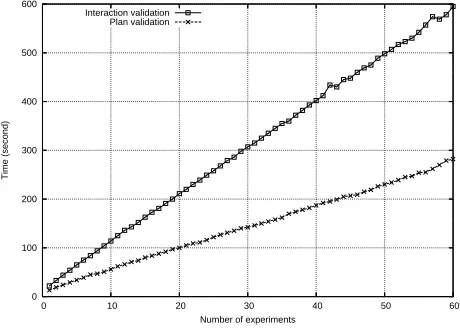
of experiments. Figure 7 shows the performance of the semantic validation architecture as the number of experiments for which provenance documentation is recorded and are to be validated increases.
0 100 200 300 400 500 600
0 10 20 30 40 50 60
Time (second)
Number of experiments Interaction validation
[image:12.612.188.418.192.357.2]Plan validation
Fig. 7.Evaluation of interaction validity and conformance to plan for an increasing number of experiments.
7.1 Interaction validity, domain level
In the interaction validity experiment, the type of each output message part in the exper-iment was compared with the type of the input message part of the succeeding invoca-tions in which it was used. We obtained the names of the input and output message parts from the provenance store. We then use these names to obtain their domain level types from the registry. The domain level types are ontology terms. The comparison is done by checking if the output type is the same class or a subclass of the input type. Specifi-cally, we use the member functionshasSuperClassandequalsof theOntClass interface in Jena. As can be seen in Figure 7, the time required for validation increases linearly with respect to the number of experiments. In total, one test included a total of452N+ 1Web Service calls to either the provenance store and registry plus48N occurrences of reasoning using the ontology, where N is the number of experiments.
7.2 Conformance to plan
low-level concepts specifying the exact algorithm used by that operation. The validator checked that every data link in the provenance store corresponded to one in the plan. This is achieved by checking that the performed action is the same class or a subclass of the planned action. As can be seen in Figure 7, the time required for validation increases linearly with respect to the number of experiments. In total, one test included a total of260N+ 1Web Service calls to either the provenance store and registry plus48N occurrences of reasoning using the ontology, where N is the number of experiments.
8
Discussion
The myGrid and CombeChem (combechem.org) projects have also worked on the problems of provenance recording and service description, and adopted RDF-based approaches, making ontology-based reasoning a possibility. However, neither iden-tify the architectural elements required for validation nor provide a generic, domain-independent way to satisfy use cases such as those presented in this paper.
As our design is dictated by pragmatic considerations, we have adopted a hybrid ap-proach to information representation. Provenance information is made available by the provenance store as XML documents. Inside the data structure representing provenance, we may find assertions, made by some actors. These assertions may be expressed using semantic web technologies. For instance, the function performed by a service or a de-scription of its internal state expressed using OWL. In the registry, annotations provided by third parties may be encoded in the formalism of their choice. We have explicitly ex-perimented with OWL and RDFS. Therefore, semantic reasoning (based either on OWL or RDFS technology) only operates on a subset of the provenance representation and some descriptions published in the registry.
This hybrid approach to representation suits the intensive data processing require-ments of Grid applications. For roughly 10 days of computation over 100 nodes, we ex-pect our provenance store to accumulate approximately10×100×24×60×60×20 = 1,728,000,000invocations to be described for the provenance of a data set. Selectively identifying the elements to reason over is therefore essential. All our use cases operate using the same reasoning pattern, which consists of identifying the provenance of some data and iterating on all its records. More advanced use cases will result in new pat-terns of processing. As all possible patpat-terns cannot be anticipated, we allow users to use declarative specifications of what they expect from computations. Policy languages such as KAoS [20] are strong contenders for this problem. KAoS positive and nega-tive obligations allow us to encode what has to occur, or what should not occur. For example, we can introduce a policy for a transactional system that requires every action to be committed or rolled back by the end of an experiment. The challenge will be to integrate the KAoS reasoner (also OWL based) with the potentially large size of the provenance store.
9
Conclusions
exper-iments grows, determining whether results produced are meaningful becomes an in-creasingly difficult task. In this paper, we studied the problem of validation on such experiments. Traditionally, program validation is carried out either statically or at run-time. However, the usefulness of either approach is limited for large scale e-Science experiments. Static analyses rely on the availability of workflow scripts. These scripts may not be expressed in languages that analysis tools operate on, or may not be avail-able because they are exposed as web services. Run-time service-based error checking is service dependent and users may not have control over its configuration.
We propose an alternative, provenance-based approach to experiment validation. The provenance of an experiment documents the complete process that led to the results. As a result, validation is not reliant on the availability of workflow scripts or service configurations. Moreover, as science progresses, criteria for validation evolve. Using a provenance-based approach, the validation process can be repeated without re-running the experiment. By employing technologies for provenance recording, annotation of service descriptions and semantic reasoning, we have produced an effective solution to the validation problem. Algorithms working over the automatically recorded documen-tation of experiments and utilising the semantic descriptions of experimental services in registries can test the validity of results to satisfy various domain-independent and domain-specific use cases.
To demonstrate the viability of our semantic validation architecture, we have dis-cussed how it can be used with various algorithms and forms of semantic reasoning to satisfy five use cases. We have also implemented two of the use cases. Performance tests show our algorithms scale linearly as the amount of provenance documentation recorded increases.
10
Acknowledgements
This research is funded in part by the Grimoires (EPSRC Grant GR/S90843/01), my-Grid (EPSRC Grant GR/R67743/01) and PASOA (EPSRC Grant GR/S67623/01) projects. The authors would also like to thank Klaus-Peter Zauner and Stefan Artmann for pro-viding us with the bioinformatics experiment.
References
1. Foster, I., Kesselman, C., Tuecke, S.: The anatomy of the grid: Enabling scalable virtual organizations. International Journal of High Performance Computing Applications15(2001) 200–222
2. Gil, Y., Deelman, E., Blythe, J., Kesselman, Tangmunarunkit, H.: Artificial intelligence and grids: workflow planning and beyond. IEEE Intelligent Systems19(2004) 26–33
3. Consortium, T.G.O.: The Gene Ontology (GO) database and informatics resource. Nucleic Acids Research32(2004) 258–261
4. Christensen, E., Curbera, F., Meredith, G., Weerawarana, S.: Web services description lan-guage (WSDL) 1.1. Technical report, W3C Note, http://www.w3.org/TR/wsdl
(2001)
6. Mitra, N.: SOAP version 1.2 part 0: Primer. Technical report, W3C Recommendation,
http://www.w3.org/TR/soap12-part0(2004)
7. Martin, D., Burstein, M., Hobbs, J., Lassila, O., McDermott, D., McIlraith, S., Narayanan, S., Paolucci, M., Parsia, B., Payne, T., Sirin, E., Srinivasan, N., Sycara, K.: OWL-S: Semantic markup for web services. Technical report, W3C Member Submission,http://www.w3. org/Submission/OWL-S(2004)
8. Wroe, C., Goble, C., Greenwood, M., Lord, P., Miles, S., Papay, J., Payne, T., Moreau, L.: Automating experiments using semantic data on a bioinformatics grid. IEEE Intelligent Systems19(2004) 48–55
9. Miles, S., Papay, J., Luck, M., Moreau, L.: Towards a protocol for the attachment of metadata to grid service descriptions and its use in semantic discovery. Scientific Programming12 (2004) 201–211
10. Lee, M., Han, D., Shim, J.: Set-based access conflicts analysis of concurrent workflow defi-nition. In: Proceedings of Third International Symposium on Cooperative Database Systems and Applications, Beijing, China (2001) 189–196
11. Baresi, L., Maurino, A., Modafferi, S.: Workflow partitioning in mobile information systems. In: Proceedings of IFIP TC8 Working Conference on Mobile Information Systems (MOBIS 2004), Oslo, Norway, Springer (2004) 93–106
12. Eshuis, R., Wieringa, R.: Verification support for workflow design with uml activity graphs. In: Proceedings of the 24th International Conference on Software Engineering. (2002) 166– 176
13. Yang, L., Bundy, A., Berry, D., Huczynska, S.: Inferring quality of service properties for grid applications. In: CS poster, EPSRC e-Science Meeting, Edinburgh, UK, NeSC (2004) static analysis of workflows.
14. Blythe, J., Deelman, E., Gil, Y.: Planning for workflow construction and maintenance on the grid. In: ICAPS 2003 workshop on planning for web services. (2003)
15. Uszok, A., Bradshaw, J.M., Jeffers, R.: KAOS: A policy and domain services framework for grid computing and semantic web services. In Jensen, C., Poslad, S., Dimitrakos, T., eds.: Trust Management: Second International Conference (iTrust 2004) Proceedings. Vol-ume 2995 of Lecture Notes in Computer Science., Oxford, UK, Springer (2004) 16–26 16. Miles, S., Groth, P., Branco, M., , Moreau, L.: The requirements of recording and using
provenance in e-science experiments. Technical report, Electronics and Computer Science, University of Southampton (2005)
17. Wroe, C., Stevens, R., Goble, C., Roberts, A., Greenwood, M.: A suite of DAML+OIL ontologies to describe bioinformatics web services and data. nternational Journal of Coop-erative Information Systems12(2003) 197–224
18. Horrocks, I., Patel-Schneider, P.F., Boley, H., Tabet, S., Grosof, B., Dean, M.: SWRL: A semantic web rule language combining OWL and RULEML. Technical report, DARPA Agent Markup Language (DAML) Program,http://www.daml.org/2003/ 11/swrl/(2003)
19. Schmidt-Schauss, M.: Subsumption in KL-ONE is undecidable. In Brachman, R.J., Levesque, H.J., Reiter, R., eds.: Proceedings of the 1st International Conference on the Prin-ciples of Knowledge Representation and Reasoning (KR89), Morgan Kaufmann (1989) 421– 431
20. Moreau, L., Bradshaw, J., Breedy, M., Bunch, L., Johnson, M., Kulkarni, S., Lott, J., Suri, N., Uszok, A.: Behavioural specification of grid services with the KAOS policy language. In: Proceedings of Cluster Computing and Grid (CCGrid), Cardiff, UK (2005)