Generic object recognition by combining distinct features in
machine learning
Hongying Meng, David R. Hardoon, John Shawe-Taylor and Sandor Szedmak
School of Electronics and Computer Science, University of Southampton, Southampton, UK
ABSTRACT
In a generic image object recognition or categorization system, the relevant features or descriptors from a characteristic point, patch or region of an image are often obtained by different approaches. These features are often separately selected and learned by machine learning methods. In this paper, the relation between distinct features obtained by different feature extraction approaches from the same original images was studied by Kernel Canonical Correlation Analysis (KCCA). We apply a Support Vector Machine (SVM) classifier in the learnt semantic space of the combined features and compare against SVM on the raw data and previously published state-of-the-art results. Experiment show that significant improvement is achieved with the SVM in the semantic space in comparison with direct SVM classification on the raw data.
Keywords: Machine learning, Image recognition, KCCA, SVM, Data fusion
1. INTRODUCTION
The capacity to categorize objects plays a crucial role for a cognitive and autonomous visual system in order to compartmentalize the huge numbers of objects it has to handle into manageable categories. Generic object detection and recognition has recently gained a lot of attention in computer vision (e.g.1–4). For a generic object
recognition system, there are three main stages. At first, features like points or regions have to be detected. These features should be flexible enough to accommodate a wide variety of object categories. Secondly, these features should be normalized or represented to be compared or learnt. Finally, a suitable classifier or recognition algorithm should be provided. In most of these systems, distinct features were handled separately into the classification.
The increase of multimedia data during the past years has raised the issue of having efficient methods to analyze the data. In Ref. 5, it has been shown that the combination of different types of data is able to give a more accurate result than each component separately. In previous work,6 we follow this motive using KCCA where we
combine image and text extracted from the web for a webpage classification task. KCCA has been successfully applied in information retrieval application such as of cross-lingual7 and content-based image retrieval6, 8 where
one of two views is used to retrieve the other. In this paper, we follow the idea of combining different components for a generic object classification task, where KCCA was used to learn the semantic feature space between interest point and key point features from the same image and produce a new kernel function for SVM.
In the Sect. 2, the related research are summarized. In Sect. 3, our system is introduced including feature extraction and integration. In Sect. 4, KCCA method is introduced and kernel mapping is designed. In Sect. 5, experimental results are shown for two datasets. The final section gives conclusions and future directions.
Further author information: (Send correspondence to H.M.)
H.M.: E-mail: [email protected], Telephone:+44 23 8059 7697,Image Speech and Intelligent Systems group, SO17 1BJ D.R.H.: E-mail: [email protected], Telephone: +44 23 8059 7697
2. RELATED WORK
Agarwal and Roth1used sparse network of Winnows as the learning algorithm for the recognition of cars from side
views. For this purpose images were represented as binary feature vectors which included a sparse, part-based representation of objects and spatial relations between them. These features were obtained by moving a window in the whole image and sensitive for the image with wide variety in scale. Complexity of the learning algorithm grows linearly with the number of relevant features and logarithmically with the total number of features.
A different approach to object class recognition was presented by Fergus, Perona, and Zisserman.3 They
present a method of learning and recognizing object class models from unlabeled and unsegmented cluttered scenes in a scale invariant manner. Objects are modeled as flexible constellations of parts. A probabilistic model was used for the representation of the object within the image. Using an EM-type learning algorithm they achieved very good recognition performance.
The two previously described methods are based on the model of the object in the image. For image datasets that have a wide variation in scale, views and highly textured background, we find that the models used in Ref. 1, 3 are difficult to estimate accurately.
Recently, Opelt A. et al.4 provided a new framework for a generic object recognition system that is a
model-free approach to allow flexibility. In this system, the characteristic regions were detected by interest point and key point detectors. These are two successful methods used to detect the low-level features of an image. For one interest point, different local descriptors were calculated as the feature vectors. Finally, Boosting algorithm was used in combining several weak classifiers based on arbitrary and inhomogeneous sets of image features into a final strong classifier. This method can provide very good performance on relatively difficult datasets.
The original idea for interest points detector cames from Harris corner detector.9 It was originally used to
capture the characteristic corner and edge points in an image. Later, it has been extended to several improved versions. Based on the evaluation of interest points by Schmid et al.,10 the improved Harris detector get
better results. In application, the scale invariant Harris-Laplace detector11and the affine invariant interest point
detector12 both proposed by Mikolajczyk and Schmid are most common ones. Another one proposed by Lowe13
is also very common.
For each image, there are a different number of points and for each point there are a set of feature vectors. Although in the standard Adaboost algorithm, the feature vectors of all samples should be of the same length. In Ref. 4, all the distance between every feature and every image were calculated in the preprocessing and the best weak learner among them is found as a weak hypothesis in every step of Adaboost algorithm. It is quite a huge computing burden during training.
In this paper, we proposed a modified generic object recognition system with light computing burden and very good performance in comparison with the one in Ref. 4 .
3. GENERIC OBJECT RECOGNITION SYSTEM
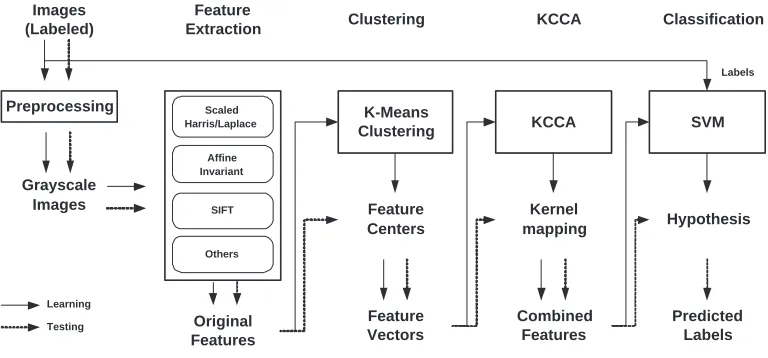
Our whole system is showed in Fig.1. There are three main differences in comparison with the one in Ref. 4. The first difference is that we use clustering in order to reduce the number of features. The second is that we apply KCCA to study the relationship between two distinct features and obtain a new kernel mapping function that can be regarded as a new kernel function and be easily implemented in SVM. Finally, we use SVM instead of Adaboost algorithm for the classification.
3.1. Feature Extraction
Our feature extraction is similar to the one used in Ref. 4. For all the images, the characteristic patches are detected by Harris corner detector and key point detector. For each image Ii, there are Ni detected patches,
this can range from hundreds to thousands. For each patchl, feature vectorsfi,lare constructed by some local
descriptors such as invariant moment12∗ and Scale Invariant Feature Transform (SIFT)13†.
∗The program is available at http://lear.inrialpes.fr/people/Mikolajczyk/. †The program is available at http://www.cs.ubc.ca/
Labels
Original Features Preprocessing
Images (Labeled)
Grayscale Images
Feature
Extraction Clustering KCCA
Scaled Harris/Laplace
Affine Invariant
SIFT
Others
Feature Centers K-Means Clustering
Feature Vectors
Kernel mapping
KCCA
Combined Features
Classification
Hypothesis SVM
Predicted Labels
[image:3.595.102.486.109.288.2]Learning Testing
Figure 1. This is our generic object recognition system. Different original feature vectors are constructed from the neighbor of extracted characteristic points in the grayscales images. The uniform feature vectors are created based on clustering on the training set. KCCA are used to build combined feature from distinct features. Finally, SVM is used as the classifier.
3.2. Clustering
In order to obtain a simple feature vector for each image, K-means method was used to cluster the features into a uniform frame. In the training process, all the characteristic patch features were clustered by the K-means methods. The training patches were clustered into K classes and their centers are in the set O =
{ok, k = 1,· · ·, K}, where each centerok is a vector that has the same length with the original feature vector
obtained from one patch. Then the uniform feature vector xi = {xi,k, k= 1,· · ·, K} of an image Ii is the
minimum distance betweenok and all featuresfi,lin Ii. It can be represented in the following way:
xi,k= min l=1,···,Ni
d(fi,l,ok), k= 1,· · ·, K (1)
whered(., .) is the Euclidean distance.
3.3. Classifier
We use SVM for the classification in our system. This is due to SVM being a outstanding classifier, that has shown very good performance on many real-world classification problems. Using arbitrary positive definite kernels provides a possibility to extend SVM capability to handle high or even infinite dimensional feature space. If the binary labels are denoted as yi, the norm-2 soft-margin SVM can be represented as a constrained
optimization
min
w,b,ξ
1 2||w||
2+CX
i
ξi (2)
s.t.
hxi,wi+b≥1−ξi, yi= 1, hxi,wi+b≤ −1 +ξi, yi=−1,
whereCis a penalty parameter andξiare slack variables. It can be converted by applying Langrange multipliers
into its Wolfe dual problem
max
αi
LD≡
X
i
αi−
1 2
X
i,j
αiαjyiyjhxi,xji (3)
s.t.
0≤αi≤C,
P
iαiyi= 0.
The primal optimum solution for w can be represented as a linear combination of the support vectors for whichαi >0,
w=X
i
αiyixi. (4)
The dual of the optimization problem can be solved by quadratic programming methods. The final hypothesis is:
hw,b(x) =sign(hw,xi+b). (5)
It should be mentioned here that only dot products of feature vectors appear in the dual of the optimization problem. Based on it, SVM can be generalized to the case where the decision function is not a linear function of the data. Now suppose we first mapped the data to some other (possibly infinite dimensional) Euclidean space S, using a mapping which we call Φ:
Φ :Rd7→S. (6)
Then of course the training algorithm would only depend on the data through dot products inS, i.e. on functions of the formhΦ(xi),Φ(xj)i. If we define the kernel as
K(xi,xj) =hΦ(xi),Φ(xj)i, (7)
we only need to useK(xi, xj) in the training algorithm and never need to explicitly even know what Φ is.
Then the dual problem can be represented by
maxαi LD≡
P
iαi−12Pi,jαiαjyiyjK(xi,xj),
0≤αi≤C,
P
iαiyi= 0.
(8)
4. KERNEL CANONICAL CORRELATION ANALYSIS
4.1. Brief Introduction of CCA
Canonical Correlation Analysis (CCA) is a method of correlating linear relationships between two multidimen-sional variables. Proposed by H. Hotelling in 1936,14 CCA can be viewed as the problem of finding basis vectors
for two (or more) sets of variables such that the correlation between the projections of the variables on to these basis sets are mutually maximised. The advantage of canonical correlation over correlation is that it is invariant to affine transformations. Consider linear combination s = a′uu and t = a′vv, where a′ is the transpose of a matrix or vector a. u,v are two random variables from a multi-normal distribution, with zero mean. The correlation betweensandtis given by the following
max
au,av
ρ= p E[st] E[s2]E[t2] =
a′uCuvav p
(a′
uCuuau)(a′vCvvav)
. (9)
4.2. Kernel CCA
It may be the case that due to the linearity of CCA, useful descriptors may not be extracted from the data. In Ref. 15, 16, a complete kernel representation of CCA is presented. Kernel CCA offers an alternative solution by first projecting into a higher dimensional feature space prior to performing the CCA. The KCCA mapping is represented by equation (6) and the kernel function byK(Φ(u),Φ(v)). Due to the curse of dimensionality, the flexibility of the feature projection causes overfitting of the data. Therefore to avoid finding spurious correlations we introduce a regularisation parameterκto control the flexibility of the feature projection, for brevity we refer the reader to Ref. 16.
The principle of KCCA is
maxgu,gvg
′
uKuKvgv (10)
s.t.
¡
gu′K2
ugu+κg′uKugu¢= 1, ¡
g′vK2
vgv+κg′vKvgv ¢
= 1,
whereKuandKv are kernel matrices defined based on the samples. For the linear case, they can be defined as
Ku=UU′,Kv =VV′, whereU= (u1,u2,· · ·,uN) ′
,V= (v1,v2,· · ·,vN) ′
, au=U′guandav=V′gv.
Solving equation (10) as an eigenvalue problem, as shown in Ref. 16, 17. Partial Gram-Schmidt orthogonal-ization (PGSO) was applied on the kernel matrices to reduce their dimensionality, please see Ref. 16 for details. We can obtain several solutions forρand correspondinggus and gvs. In practice, we only use a subset of the
solutions based on all sample feature vectors learnt in equation (10) denoted as Gu= ¡
g1
u,g2u,· · ·,gNu1 ¢′
and Gv=¡g1v,gv2,· · ·,gN
1
v ¢′
.
4.3. Kernel Mapping
We choose two feature vectors ˆx1
i andˆx2i from one imageIiin the training set. If there areM1training samples,
we can define the linear kernel matrices as Kˆ1=Xˆ1Xˆ1′ and Kˆ2=Xˆ2Xˆ2′ where Xˆ1=¡ˆx11,xˆ12,· · ·,ˆx1M1
¢′
and ˆ
X2=¡xˆ21,xˆ22,· · ·,xˆ2M1
¢′
. Kernels other than the linear kernel can be selected as well.
For any image Ii, we also have two feature vectors x1i and x2i. Based on the KCCA analysis on training
samples, we can define the kernel mappings in the following way:
φ1¡x1i ¢
=GuXˆ1x1i,
φ2 ¡
x2i¢
=GvXˆ2x2i.
The combined new feature vectors will be a linear combination of the two mappings:
ˆ
φ(xi) =δφ1¡x1i ¢
+ (1−δ)φ2¡x2i ¢
,
where δ is a combination factor satisfying δ ∈ [0,1]. These feature vectors can be used in the SVM classifier. Of course, based on the combined features, further kernels such as Gaussian kernel or polynomial kernel can be defined and used in the SVM classifier.
5. EXPERIMENT RESULTS
5.1. Dataset
Two datasets were used in our experiment. The first one is a very difficult dataset‡ used by Opelt et. al.4
These images contain the objects at arbitrary scales and poses with highly textured background. There are two categories of objects, persons (P) and bikes (B), and images containing none of these objects (N). We tested the images containing the object (e.g. categories B and P) against non-object images from the database (e.g. category N). The performance was measured with the receiver-operating characteristic (ROC) corresponding
‡Available at http://www.emt.tugraz.at/
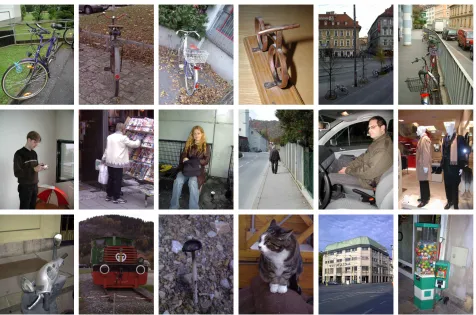
Figure 2.These are some samples of the original images in dataset 1. The first two rows came from two object categories Bikes (B) and persons (P) respectively. The third rows came from background No-Person-No-Bike category (N).
error rate3.4 The training set contains 100 positive and 100 negative images. The tests are carried out on 100
new images, half belonging to the learnt class and half not. For this dataset, there are several results published. In our experiment, the selected training and testing dataset are same with Ref. 4. Fig.2 is some examples of the images.
The second data set is a common one§ in the field of generic object recognition of images used by Opelt et
al.,4 Fergus et al.3 and other papers. Motorbikes, airplane and faces are three object datasets and there is also
a background dataset.
5.2. Experiment Setup
For one image, two types of features were extracted by two different methods. One is from affine invariant interest point detector where moment invariant descriptor was calculated for each interest point. Another is the SIFT feature obtained from key point detector. These features were used in paper Ref. 4 as well. For any image in the two datasets, about from 10 to 3000 characteristic points were detected based on complexity of the images. AndK= 400 was used as the number of centers for feature vectors in the clustering. So finally, for one image there are two uniform feature vectors with same length 400.
KCCA algorithm¶ was used to produce the combined feature vectors. The selection method for regularization
parameter κis the same as in Ref. 16. Half number of the solutions of KCCA were used in our experiment and §Available at http://www.robots.ox.ac.uk/
∼vgg/data/
¶Available at http://www.ecs.soton.ac.uk/
another parameterδ= 0.5. SVM was then used to classify the object categories against the no-object categories. The programSV Mlight(Version 5.0)k was used in the experiment.
The results were compared to the one in which individual features are classified by SVM. It is also compared with SVM on the mixed features in which two feature vectors were concatenated into one high dimensional vector. These results were also compared with the state-of-art performance obtained by other methods.
5.3. Performance
5.3.1. Results on dataset 1
The state-of-art performance of the dataset 1 by using complex Adaboost algorithm was listed in the Tab. 1. The experiments results of our generic object recognition system based on the same two features was listed in the Tab.2. Experiment results showed that significant improvement was achieved by the new combined feature in comparison with classifications by using SVM on both individual features and mixed features. It is also a competitive result in comparison with the state-of-art performance on this dataset.
Table 1.Classification accuracy based on Adaboost algorithm4according to ROC Equal Error Rate on dataset 1.
Dataset Moment SIFT Bikes 76.5 86.5 Persons 68.7 80.8
Table 2. Classification accuracy based on proposed generic object recognition system according to ROC Equal Error Rate on dataset 1.
Dataset Individual features Mixed KCCA Moment SIFT
Bikes 74.10 76.01 75.94 84.86 Persons 75.84 72.83 73.91 81.30
5.3.2. Results on dataset 2
The experiments results of our proposed generic object recognition system based on the same two features on dataset 2 was listed in the Tab.2. Experiment results show that very good performance is achieved by our generic object recognition system. There is a significant improvement in comparison with the state-of-art performance from previous papers.
Table 3. Classification accuracy based on proposed generic object recognition system according to ROC Equal Error Rate on dataset 2 in comparison with the state-of-art performance from previous papers.
Dataset Individual features Mixed KCCA Fergus et al.3 Opelt et al.4
Moment SIFT
Motorbikes 95.32 94.96 95.09 96.71 92.5 92.2 Airplanes 92.39 97 97.25 97.37 90.2 88.9 Faces 97.95 96.47 98.51 98.47 96.4 93.5
6. CONCLUSIONS AND FUTURE WORK
From experiments results in the Tab.2 and Tab.3, it is clear that combining SIFT with moment invariant feature can produce better results. Most of the results are even better than the state-of-the-art performances. The new kernel mapping can efficiently combine two distinctive features into a semantic feature space where significant improvement can be achieved in the SVM classification.
Due to the good results of the image generic object recognition by combining the interest points and key point features, it can be regarded that this methodology can be applied to a much wider generic field rather than just generic object recognition. It should be regarded as a general data fusion method of combining two or more sources for increasing the classification accuracy provided by only a single source.
Future work will include the study on how to choose a-priori the best subset of the KCCA solution for the projection into the semantic space. We would like to look into existing and new problems of multimedia application and data, where data fusion and multi-source handling is needed.
ACKNOWLEDGMENTS
This work is supported by the European project LAVA Num. IST-2001-34405.
REFERENCES
1. S. Agarwal and D. Roth, “Learning a sparse representation for object detection,” inProceedings of the 7th European Conference on Computer Vision, Copenhagen, Denmark,4, pp. 113–130, 2002.
2. E. Borenstein and S. Ullman, “Class specific top down-segmentation,” inProceedings of the 7th European Conference on Computer Vision, Copenhagen, Denmark,2, pp. 109–124, 2002.
3. R. Fergus, P. Perona, and A. Zisserman, “Object class recognition by unsupervised scale-invariant learning,” inProceedings of the IEEE Conference on Computer Vision and Pattern Recognition, 2003.
4. A. Opelt, M.Fussenegger, A. Pinz, and P. Auer, “Weak hypotheses and boosting for generic object detection and recognition,” inProceedings of the 2004 European Conference on Computer vision, pp. 71–84, 2004. 5. T. Kolenda, L. K. Hansen, J. Larsen, and O. Winther, “Independent component analysis for understanding
multimedia content,” in Proceedings of IEEE Workshop on Neural Networks for Signal Processing XII, H. Bourlard, T. Adali, S. Bengio, J. Larsen, and S. Douglas, eds., pp. 757–766, IEEE Press, (Piscataway, New Jersey), 2002. Martigny, Valais, Switzerland, Sept. 4-6, 2002.
6. A. Vinokourov, D. R. Hardoon, and J. Shawe-Taylor, “Learning the semantics of multimedia content with application to web image retrieval and classification,” inProceedings of Fourth International Symposium on Independent Component Analysis and Blind Source Separation, (Nara, Japan), 2003.
7. A. Vinokourov, J. Shawe-Taylor, and N. Cristianini, “Inferring a semantic representation of text via cross-language correlation analysis,” inAdvances of Neural Information Processing Systems 15, 2002.
8. D. R. Hardoon and J. Shawe-Taylor, “KCCA for different level precision in content-based image retrieval,” in Proceedings of Third International Workshop on Content-Based Multimedia Indexing, (IRISA, Rennes, France), 2003.
9. C. Harris and M. Stephens, “A combined corner and edge detector,” inAlvey Vision Conference, pp. 147– 151, 1988.
10. C. Schmid, R. Mohr, and C. Bauckhage, “Evaluation of interest point detectors,” International Journal of computer vision, pp. 151–172, 2000.
11. K. Mikolajczyk and C. Schmid, “Indexing based on scale invariant interest points,” in Proceedings of the 2001 IEEE Computer Society Conference on Computer Vision and Pattern Recognition, pp. 525–531, 2001. 12. K. Mikolajczyk and C. Schmid, “An affine invariant interest point detector,” in Proceedings of the 2002
European Conference on Computer vision, pp. 128–142, 2002.
13. D. Lowe, “Object recognition from local scale-invariant features,” in Proceedings of the 7th IEEE Interna-tional Conference on Computer vision, pp. 1150–1157, 1999.
15. D. R. Hardoon, S. Szedmak, and J. Shawe-Taylor, “Canonical correlation analysis: an overview with appli-cation to learning methods,” in Technical Report, CSD-TR-03-02, Royal Holloway University of London, 2003.
16. D. R. Hardoon, S. Szedmak, and J. Shawe-Taylor, “Canonical correlation analysis: an overview with appli-cation to learning methods,”Neural Computation16, pp. 2639–2664, 2004.