Near-Optimum Nonlinear Soft Detection for Multiple-Antenna Assisted OFDM
M. Jiang, J. Akhtman and L. Hanzo
1School of ECS, Univ. of Southampton, SO17 1BJ, UK.
Tel: +44-703-593 125, Fax: +44-703-593 045
Email:
1[email protected], http://www-mobile.ecs.soton.ac.uk
Abstract– In this contribution, a nonlinear hybrid de-tection scheme based on a novel soft-information assisted Genetic Algorithm (GA) is proposed for a Turbo Convolu-tional (TC) coded Space Division Multiplexing (SDM) aided Orthogonal Frequency Division Multiplexing (OFDM) sys-tem. Our numerical results show that the performance of the currently known GA-assisted system can be improved by about 2dB with the aid of the GA’s population-based soft solution, approaching the optimum performance of the soft-information assisted Maximum Likelihood (ML) de-tection, while exhibiting a lower complexity, especially in high-throughput scenarios. Furthermore, the proposed tech-nique is capable of achieving a good performance even in the so-called overloaded systems, where the number of trans-mit antennas is higher than the number of receiver anten-nas.
1. INTRODUCTION
Recently, Genetic Algorithm (GA) [1] assisted Multi-User De-tection (MUD) techniques have been proposed for both multi-user Code Division Multiple Access (CDMA) [2–5] as well as Space Division Multiple Access (SDMA) type uplink Or-thogonal Frequency Division Multiplexing (OFDM) [6] sys-tems. However, to the best of our knowledge all GA-based detection schemes found in the open literature at the time of writing are only capable of providing a hard-decision output for the channel decoder, which inevitably limits the system’s achievable performance. Against this background, we propose the novel concept of a GA-aided detection scheme benefitting from population-based soft solutions and quantify its perfor-mance gain in a Turbo Convolutional (TC) coded Multiple-Input-Multiple-Output (MIMO) OFDM architecture, which is referred to here as Space Division Multiplexing (SDM)
as-sisted OFDM.We will demonstrate that the proposed Bell
Labs Layered Space-Time (BLAST) [7] type SDM-OFDM system exploiting the GA’s soft outputs is capable of
out-Acknowledgements: The work reported in this paper has formed part of the Wireless Enablers 2.2 of the Core 3 Research Programme of the Vir-tual Centre of Excellence in Mobile and Personal Communications, Mobile VCE, www.mobilevce.com, whose funding support, including that of EPSRC, is gratefully acknowledged. Fully detailed technical reports on this research are available to Industrial Members of Mobile VCE.
performing its counterpart based on hard-decision outputs, while achieving a similar performance to that attained by soft-decision assisted optimum Maximum Likelihood (ML) detection. Furthermore, the proposed scheme is capable of achieving a good performance even in the so-called over-loadedscenarios, where the number of transmit antennas is higher than the number of receiver antennas. Finally, the computational complexity of the proposed scheme is significantly lower than that of the optimum ML system, especially in high-throughput scenarios.
The structure of this paper is as follows. The SDM-OFDM system model is introduced in Section 2, followed by a brief review of the conventional-GA assisted detection technique in Section 3. The proposed GA detection with population-based soft outputs is detailed in Section 4. Our numerical results are presented in Section 5, while Section 6 concludes our findings.
2. SDM-OFDM ARCHITECTURE
DeMUX MUX
SDM Encoder
SDM Decoder
IF
FT
IF
FT
IF
FT
Effective Base-band MIMO Channel
… …
Data In
FF
T
FF
T
FF
T
…
SDM Detector
… …
Data Out
S
D
M
-O
F
D
M
T
ra
n
smitte
r
S
D
M
-O
F
D
M
R
ece
iv
er
1
x
x
2x
mt1
ˆ
x
x
ˆ
2ˆ
t
m
x
1
y
y
2r
[image:1.595.319.566.415.655.2]n
y
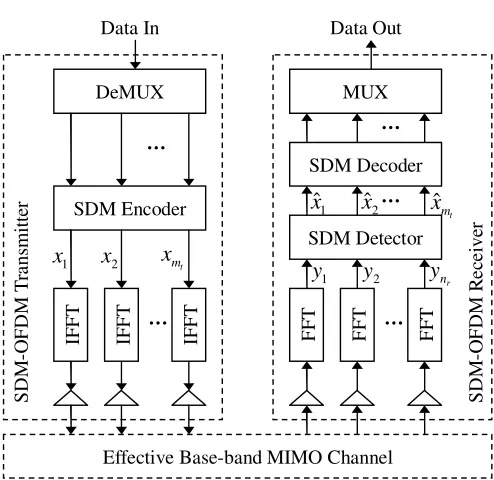
Figure 1:Schematic of a SDM-OFDM BLAST-type transceiver.
differ-entiating it from the conventional BLAST scheme [7], which usually refers to the point-to-point single-carrier MIMO archi-tecture. The discrete-time model of the SDM-OFDM MIMO system is illustrated in Figure 1, which can be characterized by:
yi[n, k] = mt
j=1
Hij[n, k]xj[n, k] +wi[n, k], (1)
wheren= 0,1, . . . ,andk= 0, . . . , K−1are the OFDM sym-bol and subcarrier indices, respectively, whileyi[n, k],xj[n, k] andwi[n, k]denote the symbol received at theith(i= 1, . . . , nr) receive antenna, the symbol transmitted from the jth (j = 1, . . . , mt) transmit antenna and the Gaussian noise sample encountered at theithreceive antenna, respectively. Further-more,Hij[n, k]represents the complex-valued Channel Trans-fer Function (CHTF) associated with the propagation link con-necting thejthtransmit and theithreceive antennas at thekth OFDM subcarrier and time instancen. For the sake of mathe-matical convenience, Equation 1 can be expressed in the form of vectors and matrices, as:
y[n, k] = H[n, k]x[n, k] +w[n, k], (2)
where we introduce the space-division related vectorsy,xand
w, as well as the (nr×mt)-dimensional CHTF matrixH, as follows:
y = (y1, y2, . . . , ynr)T, (3) x = (x1, x2, . . . , xmt)T, (4) w = (w1, w2, . . . , wnr)T, (5)
H =
H11 H12 · · · H1mt H21 H22 · · · H2mt
..
. ... . .. ...
Hnr1 Hnr2 · · · Hnrmt
. (6)
Note that in Equations 3 to 6 the notation of[n, k] has been omitted for brevity, but the above equations refer to any of the
Ksubcarriers in thenthOFDM symbol.
3. GA-BASED SDM DETECTION
It is well known that the optimum ML detection [8] uses an ex-haustive search for finding the most likely transmitted signals. For the SDM-OFDM system employingmttransmit antennas, the ML detection requires a total ofM = (2mB)mt metric evaluations, wheremBdenotes the number of bits per symbol (BPS), in order to detect the symbol vectorˆxML that consists of the most likely transmitted(2mB)-ary symbols of the mt
transmit antennas at a specific subcarrier. Explicitly, the ML complexity increases exponentially with both the number of BPS and the number of transmit antennasmt. By contrast, the GA-based detection schemes [2–5] confine their search to a small fraction of the ML detector’s search space by evaluating
a system-dependentObjective Function (OF)at a substantially
reduced number of up toX ·Y M times, whereX is the
GA’s population size andY is the number of GA generations. In the context of the SDM-OFDM system, the OF can be for-mulated according to the ML decision metric as:
Ω (ˇx) =||y−Hˇx||2
2, (7)
where ˇxis a trial-vector in the setMmt, which has a size of M and is defined by:
Mmt =
ˇx= (ˇx1,xˇ2, . . . ,xˇmt)T
xˇ1,xˇ2, . . . ,xˇmt ∈ Mc
,
(8) andMc denotes the set containing the2mB number of legiti-mate complex constellation points associated with the specific modulation scheme employed. Based on Equation 7, the solu-tion vector found by the GA is given by:
ˆxGA= arg
min ˇ
x∈Mmt
Ω (ˇx), (9)
which is theindividualhaving the lowestobjective score(i.e. the OF’s output) in terms of GA terminology. With the aid of the GA’s natural evolution-like search mechanism, the GA-based detection technique is capable of achieving near-optimum performance at a significantly lower complexity than that im-posed by the full-search based ML detection. For more details on GA-based detection, the interested readers are referred to references [2, 3, 6]. Here we point out that the GA-aided de-tection schemes found in the open literature [2–6] can only pro-vide a GA-individual based hard-decoded solution, which in-evitably limits the GA-aided system’s attainable performance. Furthermore, none of these previous schemes considered the so-called overloaded scenarios, where the number of transmit antennas is higher than the number of receiver antennas. In Section 4, the proposed GA with the ability to provide soft out-puts will be introduced, which is capable of performing well even in overloaded systems.
4. GAS USING POPULATION-BASED SOFT OUTPUT
In this section we derive an algorithm that enables the GA to output soft information. The soft-bit value or Log-Likelihood Ratio (LLR) associated with themthbit position at thejth(j= 1, . . . , mt)transmit antenna can be formulated as [9]:
Lj,m= lnPP((bbj,m= 1|y,H)
j,m= 0|y,H), (10)
b ∈ {0,1}, is given by the sum of all the probabilities of the symbol combinations which assume that bj,m = b. Hence, Equation 10 can be equivalently rewritten as:
Lj,m= ln
ˇ
x∈Mmtj,m,1P(ˇx|y,H)
ˇ
x∈Mmt
j,m,0P(ˇx|y,H)
, (11)
whereMmt
j,m,bdenotes the specific subset associated with the
jth transmit antenna, which is constituted by those specific trial vectors, whose jth element’s mth bit has a value of b, which is expressed as:
Mmt
j,m,b=
ˇx= (ˇx1,xˇ2, . . . ,ˇxmt)T
{xˇ1,xˇ2, . . . ,xˇmt ∈ Mc} ∧ {bj,m=b}
.
(12) With the aid of Bayes’ theorem [9], we have:
P(ˇx|y,H) =P(y|ˇx,H)P(ˇx)
P(y). (13)
Upon substituting Equation 13 into Equation 11, we arrive at:
Lj,m= ln
ˇ
x∈Mmtj,m,1P(y|ˇx,H)
ˇ
x∈Mmt
j,m,0P(y|ˇx,H)
. (14)
Note that here we have assumed that the different(2mB)-ary
symbol combination vectorsˇxhave the same probability, namely thatP(ˇx),ˇx∈ Mcis a constant. On the other hand, it can be observed from Equation 2 thaty is a random sample of the
mt-dimensional multi-variate complex Gaussian distribution, where the mean vector isHx, while the(nr×nr)-dimensional covariance matrixRnis given by [8]:
Rn=E{nnH}=σn2I, (15)
where σ2n is the noise variance and Iis the identity matrix, while the noise encountered at thenrnumber of receiver anten-nas is assumed to be uncorrelated. Hence, the above-mentioned multi-variate complex Gaussian distribution can be described by [10]:
f(y|x,H) = 1
πnr|Rn|exp
−(y−Hx)HR−1
n (y−Hx)
.
(16) When substituting Equation 15 into Equation 16, we have [8]:
f(y|x,H) = 1 (πσ2
n)nr
exp−σ12
n||y−Hx|| 2 2
. (17)
Note thatf(y|x,H) = P(y|x,H)is thea prioriprobability that the vectoryhas been received under the condition that the vector xwas transmitted over the MIMO channel character-ized by the CHTF matrixH. Thus, Equation 14 can be further
developed with the aid of Equation 17, yielding:
Lj,m= ln
ˇ x∈Mmtj,m,1
1 (πσ2
n)nrexp
− 1 σ2
n||y−Hˇx||
2 2
ˇ x∈Mmtj,m,0
1 (πσ2
n)nrexp
− 1 σ2
n||y−Hˇx||
2 2
.
(18) In order to avoid the exponential computation imposed by Equa-tion 18, the maximum-approximaEqua-tion [8] can be applied, yield-ing:
Lj,m≈ −σ12 n
||y−Hˇxj,m,1||22− ||y−Hˇxj,m,0||22
, (19)
where
ˇxj,m,b= arg
min ˇ x∈Mmtj,m,b
||y−Hˇx||2 2
, b={0,1}.
(20) Furthermore, with the aid of Equation 7, Equation 19 can be represented as:
Lj,m≈ −σ12 n
Ωj,m,1−Ωj,m,0, (21)
where
Ωj,m,b= minΩ (ˇxj,m,b), ω, b={0,1}, (22)
andω=mtnris a normalization factor. Equation 21 suggests that the LLRs can be obtained by evaluating the GA’s OF. More explicitly, in order to calculate the LLR of themthbit of the
jth(j= 1, . . . , m
t)transmit antenna at the specific subcarrier considered, theXnumber of individuals in the GA’s final gen-eration are divided into two groups, where the first (or second) group is constituted by those individuals that have a value of one (or zero) at themthbit of thejthtransmit antenna. The re-sultant lowest OF score calculated in each of the two groups is then compared toω, and the smaller of the two will be used in Equation 21 for calculating the corresponding LLR, which can therefore assist the channel decoder in improving the SDM-OFDM system’s performance.
It is worth pointing out that the proposed population-based GA only imposes a modest complexity increase in compari-son to the conventional hard-decision aided individual-based GAs [2–6]. This is because the only additional operation re-quired by the proposed scheme is to compareωto the objective scores, which are already available, since the results of the OF evaluation carried out by the conventional GAs can be readily used.
5. SIMULATION RESULTS
CDMA (WDMA) Universal Mobile Telecommunications Sys-tem’s (UMTS) turbo code interleaver of [12]. The octally rep-resented RSC generator polynomial of(7 5)was used. The 8-path dispersive fading channel model of [13] was employed and the channel estimation was assumed to be perfect. The Minimum Mean Square Error (MMSE) algorithm was used for creating the GA’s initial population and the BiasedQ-function based Mutation (BQM) scheme of [14] was employed. For the reader’s convenience, the simulation parameters are summa-rized in Table 1. For more details on the GA’s configuration, the interested reader is referred to [2, 6, 14].
Modem QPSK
Code rate 1/2
TC code Compnent codes RSC
parameters Constraint length 3
Octal generator polynomial (7 5)
Turbo interleaver length 124 bits
Population initialization MMSE
Mating pool strategy Pareto-Optimality [15]
Selection method Fitness-Proportionate
Cross-over Uniform cross-over
GA Mutation BQM [14]
parameters Elitism Enabled
Incest prevention Enabled
Population size 500
Generations 5
Mutation probability 0.1
CIRs BUG [13]
Paths 8
Channel Maximum path delay 40µs
parameters Symbol duration 160µs
Subcarriers 128
[image:4.595.322.567.57.273.2]Channel interleaver length 248 bits
Table 1:Basic simulation parameters used in Section 5.
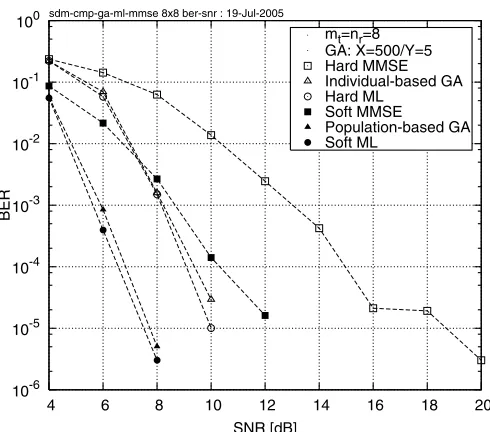
Figure 2 provides the Bit Error Rate (BER) performance of the TC-aided GA-SDM-OFDM system employing both the conventional individual-based hard-decoded GA solution [2, 4–6, 14] and the proposed GA using population-based soft information, respectively. For the sake of benchmarking, the BER performances of the systems using hard-decoded and/or soft-information aided MMSE and/or ML detection are also shown in Figure 2, where we hadmt=nr= 8for all schemes, implying an effective throughput of(2·8·12) = 8BPS. It can be seen in Figure 2 that the GA-aided system was capable of achieving a similar BER performance to that attained by the optimum ML-aided arrangement, while outperforming the lin-ear MMSE detected system. Furthermore, anEb/N0gain of
10-6 10-5 10-4 10-3 10-2 10-1 100
4 6 8 10 12 14 16 18 20
BER
SNR [dB] sdm-cmp-ga-ml-mmse 8x8 ber-snr : 19-Jul-2005
mt=nr=8 GA: X=500/Y=5 Hard MMSE Individual-based GA Hard ML
Soft MMSE
Population-based GA Soft ML
Figure 2: BER performance comparison of the 8-receiver TC-SDM-OFDM system using the individual-based hard-decoded and population-based soft-output GA detection, while employing a QPSK scheme having an effective throughput of 8 BPS.
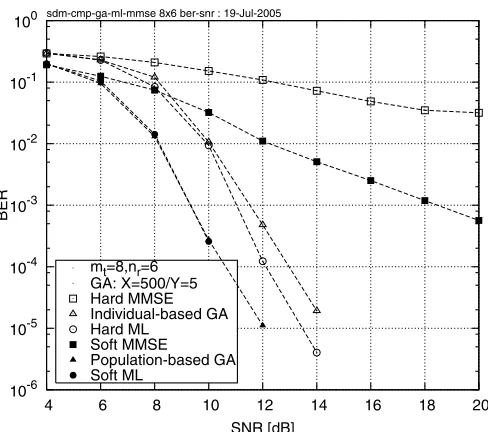
about 2dB was achieved by the GA using population-based soft outputs over its counterpart using the individual-based hard-decoded outputs. In Figure 3 we provide the BER performance recorded in the overloaded scenario, where mt = 8 trans-mit antennas andnr = 6 receiver antennas were employed. In overloaded scenarios, the weight matrix calculated by the MMSE algorithm becomes a singular matrix, which will lead to a theoretically unresolvable detection problem and thus re-sulting in a dramatic performance degradation, as shown in Figure 3. By contrast, the system aided by the GA providing soft-outputs was capable of attaining an undistinguishable per-formance from that of the optimum soft-ML detected arrange-ment in the overloaded scenario of Figure 3. Again, a 2dB
Eb/N0gain was observed, when comparing the proposed GA to the GAs found in the literature [2, 4–6]. Furthermore, the as-sociated complexity of the proposed GA-aided detection is sig-nificantly lower than that of the ML detection. The complexity is quantified here in terms of the maximal number of OF eval-uations required by the ML or GA detection, where the OF is given by Equation 7. In the overloaded scenario associated with Figure 3, for example, the corresponding complexity of the ML detection isM = 22·8= 65536OF evaluations, while that of the GA-aided detection is only(X·Y) = 500·5 = 2500 OF evaluations.
6. CONCLUSIONS
[image:4.595.66.298.191.512.2]10-6 10-5 10-4 10-3 10-2 10-1 100
4 6 8 10 12 14 16 18 20
BER
SNR [dB] sdm-cmp-ga-ml-mmse 8x6 ber-snr : 19-Jul-2005
mt=8,nr=6 GA: X=500/Y=5 Hard MMSE Individual-based GA Hard ML
Soft MMSE
[image:5.595.61.305.57.273.2]Population-based GA Soft ML
Figure 3: BER performance comparison of the 6-receiver TC-SDM-OFDM system using the individual-based hard-decoded and population-based soft-output GA detection, while employing a QPSK scheme having an effective throughput of 8 BPS.
improved by about 2dB, when the proposed population-based soft-output GA is employed. Furthermore, the GA-detected TC-SDM-OFDM system is capable of achieving an undistin-guishable performance to that of the optimum soft-ML de-tected arrangement, while reducing the ML complexity by a factor of65536/2500≈26formt= 8. When a higher num-ber of transmit antennas is used, the achievable complexity re-duction becomes even more significant.
7. REFERENCES
[1] J. Holland,Adaptation in Natural and Artificial Systems. Ann Arbor, Michigan: University of Michigan Press, 1975.
[2] L. Hanzo, L.-L. Yang, E.-L. Kuan, and K. Yen, Single-and Multi-Carrier DS-CDMA: Multi-User Detection, Space-Time Spreading, Synchronisation and Standards. IEEE Press - John Wiley & Sons Ltd., 2003.
[3] C. Erg¨un and K. Hacioglu, “Multiuser Detection Using a Genetic Algorithm in CDMA Communications Sys-tems,”IEEE Transactions on Communications, vol. 48, pp. 1374–1383, August 2000.
[4] K. Yen and L. Hanzo, “Antenna-diversity-assisted genetic-algorithm-based multiuser detection schemes for
synchronous CDMA systems,” IEEE Transactions on
Communications, vol. 51, pp. 366–370, March 2003.
[5] K. Yen and L. Hanzo, “Genetic-algorithm-assisted mul-tiuser detection in asynchronous CDMA communica-tions,” IEEE Transactions on Vehicular Technology, vol. 53, pp. 1413–1422, September 2004.
[6] M. Jiang and L. Hanzo, “Genetically Enhanced TTCM Assisted MMSE Multi-User Detection for SDMA-OFDM,” inProceedings of the IEEE 60th Vehicular Tech-nology Conference, 2004 (VTC 2004 Fall), vol. 3, (Los Angeles, USA), pp. 1954–1958, 26-29 September 2004.
[7] G. J. Foschini, “Layered Space-Time Architecture for Wireless Communication in a Fading Environment When
Using Multi-Element Antennas,” Bell Labs Technical
Journal, vol. Autumn, pp. 41–59, 1996.
[8] L. Hanzo, M. M¨unster, B. J. Choi, and T. Keller,OFDM and MC-CDMA for Broadband Multi-user Communica-tions, WLANs and Broadcasting. IEEE Press - John Wi-ley & Sons Ltd., 2003.
[9] T. K. Moon and W. C. Stirling, Mathematical Methods and Algorithms for Signal Processing. Prentice Hall, 2002.
[10] S. Kay, Fundamentals of Statistical Signal Processing, Estimation Theory. New Jersey, USA: Prentice Hall, 1993.
[11] L. Hanzo, T. H. Liew, and B. L. Yeap, Turbo Coding, Turbo Equalisation and Space-Time Coding for Trans-mission Over Fading Channels. New York, USA: IEEE Press - John Wiley & Sons Ltd., 2002.
[12] H. Holma and A. Toskala,WCDMA for UMTS: Radio
Ac-cess for Third Generation Mobile Communications. John Wiley & Sons, Ltd, third ed., July 2004.
[13] S. Bug, C. Wengerter, I. Gaspard, and R. Jakoby, “Chan-nel modeling based on comprehensive measurements for DVB-T mobile applications,” in Proceedings of the 18th IEEE Instrumentation and Measurement Technol-ogy Conference, 2001 (IMTC 2001), vol. 1, (Budapest, Hungary), pp. 544–548, 21-23 May 2001.
[14] M. Jiang, S. X. Ng, and L. Hanzo, “Hybrid Iterative Multi-User Detection for Channel Coded Space
Divi-sion Multiple Access OFDM Systems,” accepted by
IEEE Transactions on Vehicular Technology, July 2005. Available at http://www.ecs.soton.ac.uk/˜mj02r/t/tvt-iga-sdma.pdf.