FIRE PERFORMANCE OF BASALT FIBRE COMPOSITES UNDER
TENSILE LOADING
S. Feiha*, T. Bhata,b, A. Ab Rahmana,b, V. Chevalia,b, X. Liub,c, A.P. Mouritza
a
School of Aerospace, Mechanical and Manufacturing Engineering, RMIT University, Melbourne, VIC 3001, Australia
b
Cooperative Research Centre for Advanced Composite Structures Ltd (CRC-ACS), Melbourne, VIC 3027, Australia
c
Advanced Composite Structures Australia Pty Ltd, Melbourne, VIC 3027, Australia *[email protected]
Keywords: Basalt fibre composites, fire exposure, tensile loading
Abstract
In this paper, the fire structural resistance of a basalt fibre composite is determined experimentally and analytically. The basalt fibre composite is compared against an equivalent laminate reinforced with E-glass fibres. The fire structural survivability of the basalt fibre composite was inferior to the glass fibre laminate when exposed to the same radiant heat flux. The materials were weakened by thermal softening and decomposition of the polymer matrix and tensile softening of the fibre reinforcement, and these events occurred at similar temperature ranges and property loss rates. It was determined that the inferior fire resistance of the basalt fibre composite is due mainly to the material’s lower emissivity which causes higher temperatures within the material for the same radiant heat flux.
1. Introduction
There is growing interest in reinforcing polymer composites with mineral basalt fibres because of their moderate cost, high stiffness and strength, excellent corrosion and oxidation resistance, and high heat resistance and thermal stability. Basalt is the generic term for solidified volcanic lava, and it can be melt extruded into continuous filaments using process technology similar to the production of glass fibres. Several types of basalt fibres are commercially available, with different properties depending on the chemical composition of the basalt rock and the process conditions used to extrude the molten basalt into fibres. Depending on the type of basalt fibre, it has stiffness and strength properties which are similar or higher than E-glass fibres, which is the most commonly used reinforcement in polymer matrix composite materials [1]. Polymer composites reinforced with continuous basalt fibres have mechanical properties (elastic modulus, ultimate strength, interlaminar shear strength, impact resistance) which are equivalent or superior to E-glass reinforced composites [2]. Basalt fibres are resistant to most chemicals, and are less prone to damage from alkali solutions and water than E-glass fibres [3]. For these reasons, there is emerging interest in substituting glass fibres with basalt fibres in selected applications for composites.
temperatures than E-glass fibres [5], although their creep onset temperature [5] and high temperature tensile strength [6] are lower and similar to glass fibres, respectively. Basalt is also an excellent thermal insulator and non-flammable, and is being used for heat insulation and passive fire protection.
It is not known whether the high heat resistance of basalt fibres translates into superior fire resistance when used as the reinforcement to polymer composite materials. In this paper, the structural response and failure of basalt fibre composites under combined loading and one-sided heating by fire will be investigated and compared to E-glass fibre composites.
2. Materials and Experimental Methods
2.1 Composite Materials
Basalt fibre composites were produced for high temperature and fire structural testing using woven basalt fabric and vinyl ester resin. The basalt fabric was plain woven by the supplier (Zhejiang GBF Fiber Co. Ltd.) using 300 tex tows to an areal density of 350 g/m2. The basalt fibres had an average diameter of 13 µm. The basalt fabric was stacked in a cross-ply pattern of [0/90]s and then infused with vinyl ester resin (SPV 1349 Nuplex composites) at room
temperature using the vacuum bag resin infusion (VBRI) process. Following infusion, the composite was gelled and partially cured under ambient conditions (20ºC, 55% RH) and then post-cured at 80ºC for two hours. The fibre volume content of the basalt composite was 53%.
The fire resistant properties of the basalt composite were compared against a near-equivalent glass fibre composite. The composite was reinforced with plain woven E-glass fabric (800 g/m2), and was made with the same vinyl ester resin and using the same VBRI process and cured under the same conditions as the basalt composite. The fibre stacking sequence of the glass fibre laminate was also cross-ply and the fibre volume content was 55%. The only significant difference between the basalt and glass composites was the type of reinforcement.
2.2 High Temperature Testing of Fibre Tows and Composites
The tensile properties of basalt and E-glass fibre tows were measured at high temperature to determine the fibre softening rate and strength loss. The tows were heated to temperatures between 150 and 650°C for different times up to two hours. The tensile failure load was measured by loading a basalt tow with a gauge section of 150 mm at an extension rate of 2 mm/min to failure using a 10 kN load capacity Instron machine (Model: 4501). Five tows were tested under identical temperature and heating time conditions to determine the scatter in the failure load.
2.3 Fire Structural Testing of Composites
Small-scale fire structural tests were performed on the basalt and glass fibre composites to assess their fire resistance. The test involves subjecting both composites to combined tensile loading and one-sided unsteady-state radiant heating. This test is designed to replicate the condition of a tensile-loaded plate exposed to one-sided heat radiated by fire. The rectangular test specimens were 600 mm long, 50 mm wide and 9 mm thick. The basalt and glass fibre composites contained 42 and 15 plies, respectively, to have the same thickness of 9 mm. The fibre contents of both materials were very similar.
The fire structural test involved loading the composites along their 0° fibre (or warp) direction at a constant tensile stress between 20% and 80% of the failure stress at room temperature. The room temperature failure stress was 460 MPa for the basalt composite and 470 MPa for the glass fibre composite. While under constant tensile stress, a 100 mm long section of the composite specimen was exposed to constant heat flux of 25 or 50 kW/m2. The specimen was held under constant stress and one-sided radiant heating until failure, and the stress rupture time was used to define the fire structural resistance. A full description of the fire structural test procedure and apparatus is given by Feih et al [7].
3. Results and Discussion
3.1 Thermal Response of Basalt Composite to Fire
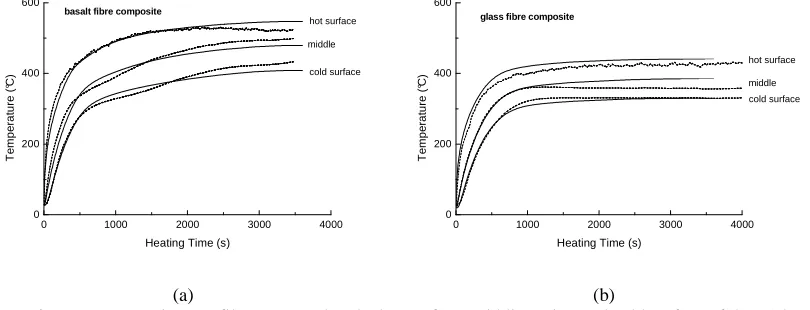
The temperature rise to the basalt and glass composites when exposed to the heat fluxes of 25 and 50 kW/m2 is compared in figures 1 and 2. The data points show temperatures measured using thermocouples attached to the hot (heat-exposed) and cold (back) surfaces of the composites. Thermocouples were also located at the mid-thickness point of the composites to record the internal temperature. Exposing the composites to the lower heat flux of 25 kW/m2 caused an unsteady-state rise in temperature until eventually near-thermal equilibrium was reached. At the higher heat flux of 50 kW/m2, the heated surface temperature of the basalt fibre composite spiked due to ignition of the front face at around 675°C. At the same heat flux, however, the glass fibre laminate did not ignite, even after long-term heat exposure.
The solid curves in figures 1 and 2 shows the calculated temperature rise at the surfaces and middle of the composites. The temperatures were calculated using the thermal model formulated by Henderson et al [8]. To date, this model has only been used to calculate the temperature in glass fibre laminates [7] and sandwich composites with glass fibre laminate skins [9] exposed to fire. It has not been used to predict the temperature of other types of fibre-polymer composites, including basalt reinforced materials. The one-dimensional governing equation for the temperature (T) rise with increasing heating time (t) in the through-thickness direction of a fibre-polymer composite when exposed to one-sided heating at constant heat flux is expressed as [8]:
(
Q h h)
(
k.C( )
T)
t h x m x T ) T ( k x t T
p s
, g s
, g
g
− + ∂
ρ ∂ − ∂
∂ −
∂ ∂ ∂
∂ = ∂
∂ ⋅
[1]
absence of air) have a cooling effect, and therefore they are negative terms in equation 1. The parameters are defined as follows: ρ is density, Cp is specific heat capacity (which is temperature dependent); x is distance below the heated composite surface in the
through-thickness direction; k is thermal conductivity (which is temperature dependent); g .
m is mass flux of volatiles; hg is enthalpy of the decomposition gas (volatiles); h is enthalpy of the solid phase; and Q is endothermic activation energy for the decomposition reaction of the matrix phase.
The curves in figures 1 and 2 show that the calculated temperatures were in good agreement with the measured temperatures for the basalt composite except for when the material ignites when the computed temperature values are too low. Agreement between the calculated and measured temperatures for the glass laminate is also good.
0 1000 2000 3000 4000
0 200 400 600 middle cold surface hot surface T e m p e ra tu re ( °C )
Heating Time (s)
basalt fibre composite
0 1000 2000 3000 4000
0 200 400 600 cold surface middle hot surface T e m p e ra tu re ( °C )
Heating Time (s)
glass fibre composite
[image:4.612.105.510.259.414.2](a) (b)
Figure 1. Temperature-time profiles measured at the hot surface, middle region and cold surface of the (a) basalt
composite and (b) glass composite when exposed to the heat flux of 25 kW/m2. The dashed and solid curves are the measured and calculated profiles, respectively.
0 1000 2000 3000 4000
0 200 400 600 800 cold surface middle ignition point
basalt fibre composite
hot surface T e m p e ra tu re ( °C )
Heating Time (s)
0 1000 2000 3000 4000
0 200 400 600 800 cold surface middle hot surface T e m p e ra tu re ( °C )
Heating Time (s)
glass fibre composite
(a) (b)
Figure 2. Temperature-time profiles measured at the hot surface, middle region and cold surface of the (a) basalt
composite and (b) glass composite when exposed to the heat flux of 50 kW/m2. The dashed and solid curves are the measured and calculated profiles, respectively.
[image:4.612.102.509.465.620.2]higher than the respective temperatures of ~430 and 640oC reached by the glass composite. The basalt composite became hotter because the emissivity of basalt fibre (ε = 0.72) is lower than for E-glass fibre (ε = 0.93). Basalt fibres radiate less thermal energy causing the composite to heat up more rapidly and reach higher temperatures. This finding highlights a problem with basalt composites when used in high fire risk applications. (This may be alleviated by surface treating the basalt composite with a high emissivity coating, although this was not investigated as part of this study). The lower emissivity caused the basalt composite to reach a sufficiently high temperature and decomposition rate that it ignited and burnt at the heat flux of 50 kW/m2. This did not occur with the glass laminate exposed to the same heat flux because it was cooler.
Figures 1 and 2 show the middle and back-face temperatures of the basalt composite also increased at a faster rate than the glass fibre laminate. However, the temperature differential between front face and cold back face remains similar for the two composites. This is because the thermal conductivity (k) and specific heat capacity (Cp) values for basalt fibres (k = 0.031-0.038 W/m.K; Cp = 840 J/kg.K) and E-glass fibres (k = 0.034-0.04 W/m.K; Cp = 800 J/kg.K) are very similar. The higher internal and back surface temperatures of the basalt fibre composite are therefore not due to faster heat transfer through the material. Instead, the faster heat-up rate within the basalt composite is attributed mostly to its higher temperature at the hot surface resulting from its lower emissivity.
3.2 Softening Mechanisms of Composite in Fire
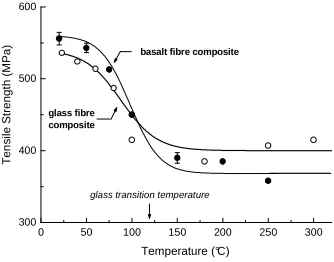
The thermal softening behaviour of the basalt and glass composites due to the glass transition of the vinyl ester matrix is shown in figure 3. The tensile strengths of the composites were determined under iso-thermal conditions between 20°C and 300°C. The high temperature is just below the decomposition temperature of the vinyl ester matrix. Figure 3 shows that the tensile strength of both composites fell by 30-40% over a similar temperature range (between 80-150°C) due to the glass transition of the vinyl ester matrix. The tensile strengths were reduced by the loss in stress transfer efficiency between the load-bearing basalt or glass fibres when the matrix had softened. The softening behaviour occurred over the same temperature range for both composites due to the same resin being used, although the basalt laminate experienced a greater loss in strength. This is attributed to the differences of fibre waviness within the two woven fabric materials.
0 50 100 150 200 250 300 300
400 500 600
glass fibre composite
basalt fibre composite
glass transition temperature
T
e
n
s
ile
S
tr
e
n
g
th
(
M
P
a
)
[image:5.612.223.390.531.662.2]Temperature (°C)
The effects of temperature and heating time on the tensile failure load of the basalt and glass reinforcements used in the composites are compared in Figure 4. The tensile values were determined for continuous fibre tows of the basalt and glass using the tow strength test. The values are expressed as a percentage of the average tow failure load measured at 20oC, which was 85 N for the 300 tex basalt tows and 125 N for the 280 tex glass tows. It should be noted that this difference in room temperature tow strength is generally due to the sizing and related friction effects between fibres during testing rather than the single fibre strength. The failure load of both the basalt and glass tows began to decrease when heated above ~250°C. The failure load of both tow types decreased with increasing heating time, and this defines the thermal softening rate of the fibre reinforcement, before reaching a minimum steady-state residual strength at each temperature. The results show there are no significant differences between the softening rates and strength losses for the basalt and glass.
0 1000 2000 3000 4000 0 20 40 60 80 100 650°C 550°C 450°C 350°C 250°C 150°C R e s id u a l B a s a lt T o w S tr e n g th ( % )
Heating Time (s)
0 500 1000 1500 2000 2500 3000 0 20 40 60 80 100 650°C 550°C 450°C 350°C 250°C 150°C R e s id u a l G la s s T o w S tr e n g th ( % )
Heating Time (s)
(a) (b)
Figure 4. Effects of temperature and heating time on the percentage tensile failure loads of the (a) basalt tows
and (b) glass tows.
3.3 Mechanical Response of Composites to Fire
One-sided radiant heating caused both the basalt and glass fibre composites to progressively soften and then catastrophically fail under tensile loading.Figure 5 shows the effect of applied tensile stress on the rupture times of both composites when exposed to the heat fluxes of 25 and 50 kW/m2. The rupture time is the duration that the composite can carry the applied tensile stress before breaking when exposed to the heat flux, and is often used to define the structural survivability of materials in fire [7]. The data points show the experimentally measured failure times and, as expected, for both materials these increased with decreasing applied stress and heat flux.
The curves in figure 5 were calculated using the thermal-mechanical model developed by Feih et al. [7]. This model considers the effects of matrix softening, matrix decomposition and fibre weakening on the tensile strength loss of continuous fibre reinforced laminates exposed to fire. The model was developed specifically to predict the tensile softening of glass fibre laminates in fire, although the good agreement between the calculated and measured failure times for the basalt composites shows it also works well with this material.
occur, with the most important being fibre strength loss. The fibre strength loss is similar for both fibre types as shown previously in figure 4. This indicates that the tensile response of the basalt and glass composites in fire should also be similar. Based on this information, it is concluded that the inferior fire resistance at a given radiant heat flux of the basalt composite is not experienced because it softens and weakens at a greater rate than the glass composite. Instead, the basalt composite is inferior simply because it heats up more rapidly and reaches higher temperatures due to the lower emissivity of the basalt fibres.
0 2000 4000 6000 8000 0
100 200 300 400 500
matrix softening effect
glass fibre composite
basalt fibre composite
A
p
p
lie
d
T
e
n
s
ile
S
tr
e
s
s
(
M
P
a
)
Rupture Time (s)
0 2000 4000 6000 8000 0
100 200 300 400 500
matrix softening effect
glass fibre composite
basalt fibre composite
A
p
p
lie
d
T
e
n
s
ile
S
tr
e
s
s
(
M
P
a
)
Rupture Time (s)
(a) (b)
Figure 5. Effect of constant tensile stress on the rupture times of the basalt and glass composites when exposed
to heat fluxes of (a) 25 and (b) 50 kW/m2.
4. Conclusion
There is growing interest in the use of basalt fibre as a fire resistant material because of its low thermal conductivity, high oxidation resistance, and high softening and melting temperatures. This study has shown, however, that basalt fibre composites have lower tensile fire resistance than equivalent E-glass laminates when exposed to the same heat flux radiated by fire. Basalt and E-glass fibre composites soften and decompose at similar rates at elevated temperature. However, the lower emissivity of basalt fibre causes the composite to heat-up faster and reach higher temperatures. This causes basalt composites to undergo softening and decomposition of the polymer matrix and weakening of the load-bearing tows at a faster rate, resulting in inferior fire resistance compared to glass composites under the same combined tensile loading and one-sided radiant heating. Protecting basalt fibre composites with a high emissivity coating may extend their structural survivability in fire, although this concept still needs to be proven.
Acknowledgements
References
[1] S. Carmignato, I. M. De Rosa, F. Sarasini, and M. Valente. Characterisation of basalt fibre reinforced vinyl-polyester composite: an overview, International conference on innovative natural fibre composites for industrial applications, Rome, 2009.
[2] V. Lopresto, C. Leone and L. De Lorio. Mechanical characterisation of basalt fibre reinforced plastics. Composites: Part B, 42: 717-723, 2011.
[3] B. Wei, H. Cao and S. Song. Environmental resistance and mechanical performance of basalt and glass fibers. Materials Science and Engineering A, 527: 4708-4715, 2010. [4] L. Gabriele, R. Francesco, N. Cristiano and Z. Severino. Design and testing innovative
materials for passive fire protection. Fire Safety Journal, 44: 1103-1109, 2009.
[5] M. Cerný, P. Glogar, V. Goliáš, J. Hruška, P. Jakeš, Z. Sucharda and I. Vávrová. Comparison of mechanical properties and structural changes of continuous basalt and glass fibres at elevated temperatures, Ceramics – Silikáty, 51: 82-88, 2006.
[6] K. Van de Velde, P. Kiekens and L. Van Langenhove. Basalt Fibres as reinforcement for composites: Department of Textiles, Ghent University, Technologirpark 907, B-9052, Belgium.
[7] S. Feih, A. P. Mouritz, Z. Mathys and A. G. Gibson. Tensile strength modelling of glass fiber-polymer composites in fire, Journal of Composite Materials, 41:2387-2410, 2007. [8] J. B. Henderson, J. A. Wiebelt and M. R. Tant. A model for the thermal response of
polymer composite materials with experimental verification. Journal of composite
materials, 17: 579-595, 1985.