COMMISSION OF THE EUROPEAN COMMUNITIES
Brussels, 23.07.1997
COM(97) 399 finalInterim Report
on the Implementation of the Programme
Leonardo da Vinci
TABLE OF CONTENT
I. INTI{()I>UCTION ... 3
2. TIU!:NDS ANI> DEVELOI'MI<:NTS REGAIWING VOCATIONAL TI{AINING SYSTEMS ...•••...•... 3
2.1 MAIN TRENDS ... , ... 3
2.2 SPECIFIC TRENDS ... 3
2.2.1 Trend1· regarding .1ystems of initial vocational training ... 3
2.2.2 Trends regarding .1ystems l?lcontinuing vocational training ... 5
2.2.3 Trend1· concerning the links between school-training-employment ... 6
2. 2. 4 Trend1· regarding disadvantaged target-groups ... 7
2.1 CONCI.USIONS ... 8
3. IMI,LEMENTATION AND IMPACT OF THE LEONARDO DA VINCI I,I{()(;RAMME .; ... 9
1.1 DESCRIPTION OF THE STRUCTURES AND THE IMPLEMENTATION PROCESS OF THE LEONARDO DA VINCI PROGRAMME ... , ... 9
3.1: I The process at Community level ... 9
3 .1.1.1 Organisation of European structures ... 9
3.1.1.2 Activities of the European structures ... : ... lO 3.1.2 The process at the level ofparticipating countries ... 10
3.1.2.1 Organisation of national structures ... l 0 3.1.2.2 Activities of national structures ... II 3.2 BUDGETARY DATA ... II :U FIRST RESULTS OF THE LEONARDO DA VINCI PROGRAMME ... II 3.4 IMPACT OF THE LEONARDO DA VINCI PROGRAMME ... \3
. 3.4. I Impact and the evolution ofsystem.\' ... 14
3.4.2 Impact and innovution ... .-... 14
3.4.3 Impact on .\ystems and impact on practice.\' ... 14
.1. 4.4 Impact and the structure of' the programme ... : ... /5
3. 4.5 Impact and mohility ... 16
3.4.6 fmJUicf, glohal approach and new training methods ... 16
3.4. 7 Real and the perceived impact ... 17
4. LINKS WITII FORMI<:R J>IU>GRAMMI~S AND COMPLEMENTARITY WITH OTHF.R PROGRAMMES AND INITIATIVES OF THE EUROPEAN C<>MMUNITY .•... ; ... 18
5. C<>NCLUSIONS ... : ... 20
I.
Introduction
By its Decision of 6.12.1994, the Council established the Leonardo da Vinci programme for the development of a vocational training policy at Community level ( 1995-1999). This programme followed on from the former programmes - Petra (social and professional insertion of young people), Force (continuing training), Comett (University-Enterprise Co-operation in the field of training in technologies) and Lingua (promotion of training in linguistic skills). It was adopted at the same time as the Socrates programme in the field of education. It
is open to the Member States of the European Union, as well as to countries from the European Economic_ Area (Iceland, Norwc~v. Lieclrtenstein). The participation of associated countries from Ea<>tern and Central Europe, as well as for Cyprus, is foreseen.
The Council Decision referred to above provides for a regular evaluation of the programme, based on reports submitted by the Member States and the participating countries and on an external evaluation. This document represents the first interim evaluation report. It covers the period 1995-96. It consists of two parts: firstly "a short presentation and an analysis l~{ the evolution and trend~ in systems and provisions regarding vocational training in Member States and participating countries (?fthe Leonardo da Vinci programme"; secondly, as requested by the
Council, an analysis of "the implementation and l?{ the impact (!llhe programme".
2.
Trends and developments
regarding vocational training
systems·
A cross-analysis of the reports of Member Stales and participating countrie.s has enabled
a
number of common trends and developments to be identified. What follows is just a summary of those.2.1 Main trends
Vocational training systems of Member States and participating countries are rather complex and diverse. However, they all face similar challenges. Thus, it is quite clear that the concern for employment and employability is becoming more and morre pronounced in vocational training policies. This overwhelming trend takes different
3
torms and it is implemented in diverse ways, whether it applies to specific programmes for combating exclusion or to actions seeking to strengthen the links between schools and enterprises or to actions regarding the recognition of skills, etc. A common feature of all these is the increasing blurring of the distinction between education and lifelong learning and the diminuition in the division between initial and continuing vocational training.
Reforms undertaken in the Member States and in the participating countries over the last few years have aimed, mainly, at validating vocational training and guaranteeing its quality especially through by increasing flexibility and modernization.
Overall at the level of evolution of systems a dual trend is apparent which relates to the structure of the various national systems. This trend either takes the form of wide-ranging and in-depth changes in the programmes as it has been the case in Luxembourg
and Liechtenstein; or the trend is towards the
strengthening of existing prov1s1ons, often accompanied by a simplification of procedures and structures - as has been the case in France for
example. Pragmatism and efficiency, flexibility and a concern for rapid reaction in the provision of training seem to be common features of all systems.
If there are noticeable differences in the involvement and participation of various actors (social partners, local and regional actors) in Member States and participating countries, there is however, a clear trend towards a stronger active involvement of all the actors which is part of an overall trend towards rcgionalisation, decentralisation and the individualisation ofvocational training.
One of the main differences between national approaches lies in the will to legislate or not in this field. Situations in different Member States vary greatly from those where there is an obvious and strong will to legislate (as in France) to those where
the will to avoid legislation is equally strong (as in the United Kingdom and in Germany).
2.2
Specific trends2.2.1. Trends regarding systems of initial vocational training
The report from Germany identifies the main current
aptitudes and skills, modernization of existing professional profiles, a need for new training content and pedagogical methods, the needs to address the issue of parity of esteem between general education and vocational training as well as the opening up of the apprenticeship system to higher education level, especially technical education.
Two main trends can be identified in the area cif initial vocational training: the will to reinforce the validation and recognition of initial vocational training and a closer relationship between schools and enterprises.
It is in this context that efforts made in favour of apprenticeship training should be noted. Existing systems are being strengthened and lil)ked work-and-training approaches are being developed beyond the traditional apprenticeship model towards new types . oftraining and new target groups. Linked work-and-training, under its various forms (including apprenticeship) is to be found at all levels of initial vocational training, including at University level. In parallel, it is of some note that specialisation too early, is being rejected. As is underlined in the case of Greece, preference is being given to the
development of a combination of technical and behavioural skills in the perspective of life-long learning. Linked work-and-training schemes are being recognised more for their capacity to promote transversal skills than for the preparation for particular professions. Similarly, Italy underlines the
fact that new developments affecting its initial vocational training system are geared towards improving the level of its basic training, and the promotion of multi-skills so as to facilitate the adjustment to new professional and organisational profiles.
The development of linked work-and-training schemes is also quite clear in most provisions regarding the socio-professional entry for young people or for people excluded from the labour market. In this context, Germany stresses that
updating the contents and the development of new pedagogical approaches, supported by a number of model experiments, is also a priority for the actors of the initial vocational training system. In the United Kingdom, for example, Modern Apprenticeships in
England and Wales offer young people a work-based route to skills at craft, technician and junior management levels, which combine apprenticeships traditions with modern qualifications and learning methods.
4
School systems are tending to open up to links with various training paths. In any case, it is too early to speak of integration · of general and professional training paths. The will to set up bridges is nevertheless obvious.
After compulsory schooling- in Portugal, the three
routes of long duration technical and vocational training (3 years) lead to a certificate of vocational qualification and a secondary school diploma which allows for the immediate vocational insertion and access to higher learning on the same terms as those for other general routes.
In this area, one should also include projects which aim to ensure a double qualification, i.e. general and professional qualifications which will enable students to organise their school career either directly towards a profession or towards higher education studies.
Ireland's intention to bring about a radical
transformation of its system of vocational training should be mentioned. The new model, based on modules, became operational for all handicraft professions in 1995. It is based on common standards with seven phases of alternating training on- and off-the-job.
Germany, for example, is modernising some 90
professions and, currently, social partners are currently examining the opportunity of introducing 30 new professions from 1997 onwards. Spain has
just produced a compendium of vocational diplomas bringing together . more than 135 professional profiles.
While a general trend towards the differentiation of professional profiles is evident, there are instances of the emerging necessity for an extended and more common knowledge base. The . the orientation is to enable, on the basis of differentiated methods, a maximum number of young persons to acquire a diploma or a professional certificate according to their cognitive abilities and their personal interest. Another case here is Austria: which is developing a
policy for improving the attractiveness of vocational training by introducing flexible and differentiated structural approaches (periods of schooling and linked work-and-training placements on a weekly or yearly period) according to the participants' abilities. More explicit links with other forms of teaching are thus established mainly at higher education level so as to secure the maximum number of graduates.
Denmark underlines the importance of widely
people - an approach that has resulted in programmes such as "Education for all" and "Programme for
individualised training for young people".
Furthermore, Finland has signalled its desire ·to develop a system for validating qualifications through diplomaS and certificates, especially of a vocational nature - a trend that is present under various forms in most Member states and participating countries.
Germany, notably, mentions the necessity of training
young people with a European dimension in mind; this should be achieved by an intensification of trans-European mobility, a better knowledge of languages and by integrating the placements undertaken in other countries into vocational qualifications.
Finally, the necessity, at the level of initial vocational training, to set up the basis for the development of a more generalised participation in continuing training is being emphasised.
2.2.2 Trends regarding systems of
continuing vocational training
The first thing to be noted is that reports from the Member States and participating countries emphasis that the number of persons undergoing training measures has increased regularly over the last few years.
Three trends can be identified in continuing vocational training: decentralisation, a search for quality and a search for a tailored and flexible training offers.
Enterprises are looking more and more for a direct link between training measures and the work place. This follows a decentralisation of training measures. Enterprises are also increasingly considering the economic value of these measures - thus looking for quality training which offers a return on investment. Consequently, local and regional actors, as well as social partners are becoming more actively involved. Decentralisation of continuing vocational training often takes the form of regionalisation. Thus, in many Member States and participating countries, the region becomes more and more the natural locus for the development of training policies - thus, also, the importance of implementing accompanying measures at regional level. For example, Belgium, which has witnessed extensive changes over the last few years now relies on a set of national and regional measures in the area of vocational training. A similar trend is apparent in Spain where some autonomous regions
5
have . a large margin for manoeuvre in the organisation of their education and training system. In Italy, new functions have also been allocated to regions which, in addition to initial training for young people, are starting to offer training to qualified personnel and for adults; regions are entirely responsible for the planning and the implementation of their training activities - with the underlying aim of bringing vocational training as close as possible to the dynamics of the labour market. In Sweden and in Norway, local and regional actors also play an important role in adult education by developing approaches strongly geared towards the labour market.
The economic dimension of training plays a major role in most cases. This has resulted in a drive towards ensuring quality in terms of supply and a concern for the return on investment.
The overriding demand is for very flexible solutions, · with recourse to modular approaches and to new technologies. Thus, a very clear trend towards distance training and adult education outside the working hours aimed at obtaining school-based qualification is apparent - as in Finland for example. A broadening, a professionalisation and a diversification in the supply of training - both at the level of the actors and at the level of supply can also be noted. There is also a trend towards individualisation and tailored approaches leading, preferably, to new and accessible qualifications for a wide range of target groups. The issue of controlling the quality (of the supply) is a real concern.
Training supply is obviously broadening and diversifying. Public organisations are increasingly becoming real training suppliers. Luxembourg maintains that, all things considered, it is the State, with all its institutions attached to ministerial departments, which should be the most important supplier of training measures.
Thus, in quite a number of participating countries Governments have set up Agencies for supporting vocational training, so becoming, themselves, training suppliers.
Another trend arises from the increasing role played . by universities in the supply of training. Thus, in
Sweden, the legislative authorities have explicitly
have always been oriented towards vocational pathways
Different organisations arc increasingly becoming involved' in the trai·ning market - of which there arc many micro-enterprises specialised in very specific areas. This also implies the necessity for greater transparency in the training market.
It should also be noted that some countries arc in the process or radically reforming their system or continuing training and arc establishing specific legislation by means or framework laws - as is the case now in Lll.n!mlwurf: or in Liechten.\·tein -or as in .\jmin where a plan for transforming vocational lr<ll111ng has been in the process of being implemented since I I.J93. These new orientations of the institutions arc simultaneously oriented towards several different objectives: guaranteeing vocational training' capable or responding to the economic and industrial changes relating to the introduction of new technologies at all levels of the production process and to new forms or work organisation; enabling workers to adapt their skills and qualifications to the levels required by the new occupational profiles; validating, certifcating and recognising experiences and vocational training acquired throughout working lik; and, finally, regulating vocational training markets taking account of the need to improve the quality of supply. Similarly, since I I.JI.J7, Portu~:al has just begun to implement a pol icy aimed at re-directing vocational trammg towards greater efficiency and individualised flexible solutions of a high qualitative level - a move that should benefit mainly SMEs.
In general, as stated in the United Kin~:dom's report, strategies arc being designed with the objective or developing coherent vocational training systems, capable or responding to current changes. These systems arc hased on pitrtnerships between
govcrnm~nt, social partners, training suppliers and individunls. The overall objective is to encourage employers nnd individuals to invest efliciently in the llevelopment of new skills as well as to prepare disadvantaged persons for the labour market. The aim is to enable young people to acquire the necessary technical, technological and behavioural skills needed f()r their entry into the labour market. l)oth the amount of training and the strategies through which they are being delivered have been assisted in the objective I to 6 regions by the contributions of the European Social Fund (ESF). There is thus a need to make sure that training is adapted and directly connected with the needs of the
·working environment; that it is delivered within reasonable cost limits, while not forgetting to account for the need to demonstrate return to the investment.
2.2.3 Trends regarding the links between school, training and employment
The divisions between initial and continuing vocational training arc getting blurred. Through training numerous projects help young people in their transition between leaving vocational or higher education establishments and their entry into the professional world or into an enterprise.
The clearest example is given by Sweden where the distinction between vocational and general education is almost imperceptible. The basic idea is to reduce the gap between these two types of training as much as possible. Thus, specialisation does not start before the higher phase of secondary education.
In the __ Netherlands an experimental route is developed to give students in higher vocational education the opportunity to follow some linked work and training schemes (HBO-MKB route). In the · United Kin~:dom, national framework of qualifications provides effective and flexible routes from general education to occupational standards. Three types of qualifications, i.e. academic GCSEs/GCEs, broad vocational qualifications (Qeneral National Vocational Qualifications) and occupation'ally-based vocational qualifications (National Vocational Qualifications) - can lead to employment and training or to further and higher education. Other Member States and participating countries are also seeking ways in which to bridge the gaps between previously separated training areas. Such concerns form the backdrop to the approach _ advocated by the decision establishing the Leonardo da Vinci programme in which the continuum of "lifelong learning" help provide an overall broadening of offers for training. The exploration of additional modalities for the recognition of qualifications compared with more traditional certificates or diplomas also reflects such developments.
to integrating education qualifications with professional experience.
In the perspective of lite-long learning and of bringing education and training doser to the world or work, since I<JX<) in Portu,;al a new route to vocational training, the vocational schools, which involve local authorities, enterprises and other organisations in the world of work have been developed.
This move results in the search f()r new alternative :tpproachcs to diplomas, to identify bridges between the two systems, to implement a double qualification (general and vocational) so as to ensure the broadest possible range of studies, and of validating professional experience.
In this context, it is possible to include informal knowledge, so that school diplomas on their own arc not enough. As underlined in the rcpor1 prepared by
France, the trend is towards the development of tools enabling professional experience to be analysed and validated for their equal consideration with school qualifications. In the same context, the case of
Nonvt~V is noteworthy: a system of competence validat,ion which leads to certificates independent of the way they have been acquired has been implemented.
For example, in Germanv, a discussion has been launched regarding the development of regulations enabling those having the title of Meister to have access to higher technical education without being obliged to possess a diploma certifying that they have completed secondary vocational education.
In general, the role of Universities is also changing. Not only do they seck active co-operation with enterprises in the area of research, but they arc becoming increasingly involved in vocational training which, next to research and purely academic teaching, is becoming their third nu~jor area of activity. One should note that most of the Member States ami participating countries arc giving higher autonomy to their universities. For example, in
Au.\·tria, a specialised university has been created fi.)r the vocational training of those having an academic · diploma. In Finland, like most Member States and participating countries, Ministries of Education arc in the process of broadening· their networks of non-university higher vocation education.
2.2.4 Developmen~ covering dis-advantaged target groups
7
All Member States and participating countries express an additional concern to implement actions and programmes which have been designed for the specific needs of different target groups, such as unskilled young people, the young and, the long-term unemployed, the disabled and migrants.
In the drive to make qualifications accessible tc all, emphasis is placed on the fight against school failure and, thus, against exclusion from the world of work. Professional entry, the improvement. of employability and the stabilisation of employmen( arc major concerns. One has to go beyond the shan-term objectives of qualification (especially for continuing vocational training, for adapting the job place) towards a broader adaptation of individuals to evolving systems of production and work organisation. One aspect of this issue concerns the types of regulations of training schemes requiring effective consultation between the State and social partners, the actors of the economic world and those in the world of training.
The objective is to give those in charge of training the reference points to enable them to orientate their own training programmes and pathways.
In 1996 the Netherlands established a new system which put in place qualification standards at the level of secondary vocational education. These standards arc determined jointly by the world of education and the world of work, and are organised by sectors. This system of qualification standards was realised with the implementation of the WEB (Adult and Vocational Education Act). The United Kingdom
introduced a framework of national occupational standards, on which it bases its National Vocational Qualifications (NVQs) and SVQs in Scotland. The assessment and cenification process for these qualifications is independent of the training process itself.
entry of these target groups. The financing of these measures is provided by public authorities or by t 'ommunity jm>grammes or initiatives.
2.3 Conclusions
The organisation of training systems is undergoing a major evolution, within which contextual debates between public authorities and social partners continue to be important. This becomes quite clear when considering the aim of training or its financing. The reports attach great importance to the role played by enterprises regarding policies developed in the field of vocational training. This role finds specific expression in rarticular systems which have varying li.>rms of access to training. Thus, it is impossible to consider the cases of Bet~:ium (Funds collected for high-risk groups), France (with its general obligation to contrihutc lin;mcially to training), Ireland (tax-grant in some professional sectors) or the Ncllterlmul\· (<) & 0 fondscn "' Training and Development Funds, which arc funds earmarked l(>r the linancing of training measttres) as similar systems.
The particiration of enterprises, and, moreover, of professional organisations in the definition of objectives and contents of training rcmitin a central issue in many Member States and participating countries.
/\1 a transcuropcan level, the export of national experiences or legislation to other countries remain I im ited. For example, the '.'ioh rotation" scheme is known in Nordic countries through /Jenmarh's
experience, but it remains specilic, while in other countries it takes other li.mns within individual projects. This can also be noticed li>r the National Vocational <)Lialilications (l!nilcd Ki111:dom), whose implementation in other I·:U countries has yet to succeed. Reasons lor these difficulties arc numerous. One of these is certainly the lltct that most of these programmes have been launched in very specific national cultmcs and contexts - thus making their transposition in other cnvironmetits rather delicate. Conversely, two types of convergence should be noted. The first one concerns the tick! of vocational training itself; the second, its link with the socio-economic environment.
Regarding the first set of convergencies, one should note that the issue of pedagogy (and of its improvement) is a concern common to the different systems. The development of modular approaches and the establishment of individualised training
pathways, e.g. Denmark with its training courses in open workshops - illustrate this point. This trend rctlects the massive integration of new information and c(nnmunication technologies as training tools. Equally in this context, the transition from qualification to that of skills, as well as a trend towards the valorisation and the recognition of professional experience raises additional issues. This' appears to be a decisive point in relation to access as entry to many vocational training courses themselves are determined by school and academic prerequisites. The trend is towards the implementation of skill evaluation systems which are independent from the way the skills have been acquired. Apart from the
United Kin~:dom NVQ, the case of Ireland is of note as it has established a national structure for certification which covers all the non-university types of higher education as well as continuing training. In '1991 France set up the "bilan de compctences" (skills balance) as an instrument for helping enterprises and workers - the latter having the possibility to get financial support for achieving this "skill balance" outside working time.
Specific importance is also given to self-training and lifelong training schemes, confirming the acceptance that the learner is the central locus of the training process. This trend is reinforced by the establishment of accompanying structures: reception, information, guidance and advice. In the United Kingdom, careers services are provided under contract to the Government through a network of public and private organisations. They provide comprehensive information and guidance at a local level, geared to individual needs.
The second point of convergence concerns the link hctwecn the field of vocational training and the socio-economic contexts- such as the world of work and employment policies. It does indeed appear, in a reading of the reports of participating countries that training measures and initiatives are increasingly geared towards maintaining jobs and improving the emrloyability of the individual. If account is taken of certain target-groups, especially the disadvantaged ones, trammg becomes a component of an employment policy, possibly of a social policy. Training supply is being extended to include new target groups and new contents. The report from
In lta~v, th<.: agr<.:<.:m<.:nt sign<.:tl bl!lw<.:en th<.: gov<.:rnm<.:nt and till! social partn<.:rs in 1996 intl<.:ed has the obj<.:ctive or <.:stabJishing cJos<.:r Jinks bl!lwe<.:n
train~ng and the labour market by way of consultative action.
Anotlwr point is cl<.:arly appar<.:nt. Th<.: number or those having bendit<.:d from training measures has r<.:gularly increased ovm the last few years. This is true both for initial training and fix continuing training. From the reports of the participating Member States, it is quite clear that public authorities do intend to strengthen these developments even further - i.e. to increase the number of young people leaving training systems with a certificate.
Furthermore, it is interesting to compare the role of the various actors in relation to the target groups for whom the measures have been developed. In most Member States, public authorities- albeit in different ways - play a role in the process of professional qualification. The State contributes in the planning, the organisation and in the control of vocational training, especially in regards to quality. Most ollen, it determines the general framework within which the vocational training market may develop. However, public authorities do remain the main training provider f(lr groups at risk. It se<.:ms, however, that the relevance of pub! ic authorities is tending to diminish: this may result from regionalisation or vocational training and from the growing implication of the social partners in the entire decision-making process.
In all cases, the evolution in the role of the State has to be considered in parallel with the implication of the social partners and that of the local and regional actors. llowever, in relation to the publics concerned, and to the .role allocated to the social partners, the role of the State is more or less crucial in the process or vocational qualification.
llowever, it remains extremely difficult to classify the vocational training systems of the Member States and participating countries according to common categories. Rather than designing complex tools fi.lr such a classification, it would be more useful to develop evaluation tools for enabling training systems to position themselves each vis-a-vis other systems as well as vis-a-vis the main developments which are taking place.
3.
Implementation and impact of
the Leonardo da Vinci programme
3.1 Description of the structures implementation process of Leonardo da Vinci programme
Within the Leonardo da Vinci programmes planned measures are divided into strands and instruments. The overall orientations of the programme are specified within a common framework of objectives and by those actual priorities for the calls for tender which are set annually.
These overarching priorities - which come within the context of article 127 to the Treaty establi~·hing the European Community -aim at making sure that the Leonardo da Vinci programme is an instrument for the implementation of a vocational training policy of the European Community, particularly in the context of the conclusions drawn at Essen by the European Council (1994), of the Confidence Pact for Employment in Europe ( 1996), as well as by the guidelines laid out by the Commission in its White Paper "Growth, Competitiveness and Employment"
(1994) and in "Teaching ~nd Learning: towards the Learning Society" ( 1995).
These priorities are established in close consultation with the Leonardo da Vinci Committee. In 1997, as in 1996, these priorities were: encouraging the acquisition of new skills, strengthening co-operation between school and enterprise, combating exclusion, treating investment in training and capital on an equal basis, extending access to knowledge with the tools of the informatio·n society. The horizontal dimensions of the programme are equality of opportunity, social dialogue, regional development and industrial change. '
3.1.1. The process at Community level
3.1.1.1 Organisation of European structures
proposals and, l(>r .final selection or the proposals which merit financial support.
In the execution of these dirlcrent tasks, the Commission is assisted by a committee consisting of representatives of Member States and couritries in the European l~conomic Area and, in certain cases, the observers of the Social Partncrs,all of whose limctions arc specified in the Council Decision. In keeping with this Decision, sub-committees have . also been established on initial vocational training, on continuing training and on university-enterprise co-operation. These have met regularly to discuss issues notably the delinition or the priorities and the analyses of the results of the calls for proposals.
3.1.1.2 Activities ofthe European structures
Within the framework of its responsibilities, and with the support of its . Leonardo da Vinci Technical Assistance Oflice, the Commission ensures the preparation and the management of the calls lor proposals, the implementation of the evaluation process for the proposed projects and the activities for operationalising and monitoring the funded projects and disseminating their outcomes. As a result, there is a pcn11anent link with the National Co-ordination Units.
In practice, and by producing analyses and inl(mnation documents on the various invitations I(H· proposals, these activities comprise helping promoters designing projects, organising thematic· and dissemination seminars and establishing a link with Eastern and Central European Countries ( I'ECO) nnd Cyprus to ensure their integration in the programme.
Furthermore, the Commission and its Technical Assistance Office, produce a number of regular publications, such as the compendia which describe the projects and calls li>r proposals or promoters, analytical brochures on the results or the calls li>r proposals and general infonnatfon brochures. A data bank comprising products of previous programmes· has also been set up and is available l(>r consultation at the Multimedia centre at the Technical Assistance (>nice.
3.1.2· The process at the level of participating countries
For their part Member States and partiCipating countries have set up information, animation and
10
monitoring structures: National Co-ordination Units (NCUs).
3.1.2.1 Organisation of national structures
Initial and/or continuing vocation training do not come under the responsibility of the same ministerial departments or, even, solely within the remit of the public authorities. In some participating countries, for example, initial vocational training is mainly the responsibility of the Ministry of Education, as in
Germany or in the Netherlands. In other Member States and participating countries this responsibility is shared between several ministerial departments -mainly Education and Labour - as in France. As a result the management and the animation of the Leonardo da Vinci programme at the level of the Member States and participating countries mirrors the diverse arrangements in Member States and participating countries.
Furthermore, most Member States have set up tripartite consultative and national management committees which assist in the definition of national priorities and ensure a link with the key players in vocational training. These committees, together with the National Co-ordination Units, . participate, normally, in the definition of national priorities for Strand I, and in projects evaluation and pre-selection processes at national level.
The main function of the National Co-ordination Units, which are financially supported by the Commission and the Member State, is to provide assistance to the national authorities, the Commission and to potential project promoters and contractors. NCLJs play an important role in this respect: they ·assist in ensuring that the programme impacts on national policies and structures; they organise promotion, technical assistance and dissemination seminars for project contractors; they help the development of thematic, sectoral, national or transnational networks.
various tar)!,cl groups or to the programme measures -as in France, in Luxemhmu'l:, or iti (iermany. 3.1.2.2 Activities of national structures
The main activities of NCUs for which, they' receive an operating grant from the Commission, based on a statement of accounts, .arc to organise and launch conferences; to frame a national operational and dissemination plan; to ensure the publication of calls f(ll· proposals; to organise national - or even, transnational - contact seminars; to evaluate the project submissions and to organise animation and monitoring seminars with the projects which arc limdcd. •,'
'·
Xhc purpose of these acttvtttcs is to monitor, in partnership with the Commission, the development
nf project activities and outcomes and to contribute tt·l solving problems which a project may encounter during its implementation. Moreover, NClJs contribute to operationalising the thematic, national or transnational aspects of the programme.
N( :1 Js arc furthermore responsible for the thanagcmcnt of transnational exchange and
p!ac~.;,mcnt programmes under Strand I. To that end, and having first submitted an operational plan, they receive a global grant for the different target groups toncctncd.
N_<
'l,Js also r}ublish compendia or national projccls, liif!mt'wtion hrm:hurcs and ncwshccts.~-' .~~ .
.
3:.,z;<~:~
·Budgetary data~\'\·: ·~·.""-· ' ' .
-:;",·:.. .. ' . '
:fth~ d~mncil
.~ -~· Decision estimated that the financial ' .. :rcso~~~s which arc required
6y
the. (ommunity lor 'iho .jtnplcmcntation of the I .c~lhardo da Vinci-~~Qgr'ammc
would be 620 MEC'lf for the period·:w9A-99 ·
·
·
·'
~~: ~
.
{~~i: ·~'
.
·f(i1c.'tii~liihntio;1
of the sumsalloc<it~d
to the various..
~l~~l)~~~
a'tid, measures is decidedby
the C'omm ission.!t~il~,w.lr}g,
the o(Jinior1 of theL~~mardo
da VinciqltiHl,littec.
One should note that there arc maximum and
·~nlllii11Lll11 limits to the hudgctary distribution between the different measures of the different strands. " minimal threshold or 35% of the total budget is allocated to pilot projects, as against 30% for placenll:nts and exchanges. 1\ nu:ximum ceiling of'20% is set for other measures, especially surveys and analyses, exchange programmes, comparable
11
statistics as well for National Co-ordination Units under Strand IV.I
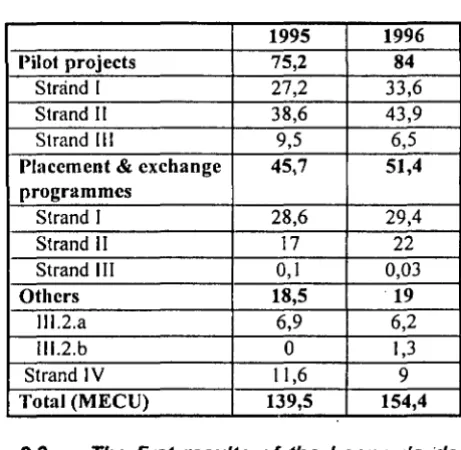
For the first two years of the programme, the budget authority has allocated an envelope amounting to 139.5 MECU in 1995 and 154.4 in 1996. ·
The following table sums up the budget distribution · of the programme for the first two years:
Table l
Distribution of the Leonardo da Vinci budget for 1995 and 1996
1995 1996
Pilot projects 75,2 84
Strand I 27,2 33,6
Strand II 38,6 43,9
Strand Ill 9,5 6,5
Placement & exchange 45,7 51,4 programmes
Strand I 28,6 29,4
Strand II 17 22
Strand III 0,1 0,03
Others 18,5 19
111.2.a 6,9 6,2
111.2.b 0 1,3
Strand IV II ,6 9
Total (MECU) 139,5 154,4
3.3. The first results of the Leonardo 'da Vinci programme
[image:11.565.289.520.216.441.2]-,
Tablu
l{csults of the first two c:tlls for proposnls (1995 and 1996)
1')95 1996
Number of Projects 749 793
selected
procedure I 319 299
procedure II 430 494
Pilot Projects 581 582
Placement and
Exchange 121 170
Programmes (Strands II and III)
Surveys and Analyses 47 41
Number of Partners 13212 10267
procedure I 2210 2131
procedure II 11002 8136
This data shows that the programme has reached signilicant proportions in respect of the numbers of projects, transnational partners, and of the vocational training professionals involved.
J\ nalysis of the lirst two years of the Leonardo da Vinci programme illustrates that the programme has evolved towards taking better account of the real challenges fltcing vocational training in Europe. To ensure the consolidation and improvement · of systems, arrangements and ·practices of vocational training however, there is a need li.>r the 1542 projects which have been funded to ur1dergo a qualitative evaluation with respect to their capacity to meet their goals and deliver concrete results which arc transferable to all 18 participating countries. The time has come lor a follow up, animation, and reconsideration of the contents and methods which make it more possible for the Leonardo da Vinci programme to be a real "European laboratory .fhr innovation".
Funded projects can be grouped into three main categories: those which focus on forecasting of training and guidance needs
in relation to a specilic environment, those which concern the design of innovative training methods and measures by means of developing training products, .often based on multimedia systems, and those directly relating to the enterprises and the training organisations. The active participation of the social partners in the programmes, as well as the setting up of transnational training networks (sectoral
12
or regional networks), is also ·noteworthy. These two factors should have a significant effect on the promotion and the dissemination of new knowledge and kriow-how.
A more in-depth analysis leads to the conclusion that the majority of the projects tend to fall under the three categories. Increasingly, projects explicitly seek to develop solutions through 'a consideration of the processes - beginning with the identification of a specific need and leading, via the implementation of more wide-ranging educational methodologies, to the design and the implementation of focused solutions targeted for specific contexts.
In the projects assisted in 1995 there were 13212 partners participating in 749 projects, as against I 0267 partners for the 793 projects selected in 1996. The participation - even after the first calls for proposals - of SMEs in the programme is admittedly weak, especially if we consider that it is mainly small and medium enterprises which create jobs. In the light of this insufficiency of participation, all those responsible for the Leon'ardo da Vinci programme will need to be more actively encouraged to make the additional investment required to ensure a. bigger participation of SMEs in the partnerships, not least in. the simplification of procedures.
Nevertheless, it is also necessary to nuance the assessment. If it is true that for the three categories combined, the offers to train appear greater than the demand for them, then it should not be forgotten that the measure best suited for the participation of enterprise (including SMEs) is Strand II "improvement in actions of vocational training", particularly measures 11.1.1 a "innovation in vocational training" an.d II.l.l.c "Transfer of technological innovations". Similar conclusions apply for ·transnational exchange and placement programmes of Strand II.
'.n'1obh:J
Naamhcr or ilii"O~II"lOmmcs :nBD<ll hencfndnrnes of ftlll:ncemends :nnntll exellumf.!:es foreseen ni!D D995 :nmD
119')6
!'humber of Number of programmes beneficnaries D995
I
D996 t99s 1 1996n.n.2.a- Placements for young people undergoing initial vocational training
short-term placements
6041
I
*
9943 \10063 1.1.2.a - Placements for young people undergoing .initial vocational training·long-term placements '
9(,
I
*
982. 1 1009 1.1.2,b - Placements for young workers293
I
*
4704I
5333 ·1.1.2.c - Exchanges for instructors293
I
*
2242 1 2379 11.1.2.a - Placements for people undergoing university training and for graduates102
I
144 5t75 1 7731ll.l.2.b- Exchanges between enterprises and universities and/or training bodies
11
I
11 121I
146 tl'. L:t:c - Exchanges of people in charge of training11
I
12 47I
231*.data not yet <!Vall able
Jt
cath be noted that the Leonardo da Vinci.
"
programme has in 8995 and 1996 enabled more tllnn .-50,000 people - of whom 22,000 young · ~~of)l~ :iQ nniti:tl truining, 10,000 young workers . a~d. :(3,000 higher cducntion students or
grad-uates.~ ,hi benefit from a l!l:uropean mobility grant
~·r J~uid~mce
and training periods throughout'Mcni'bcr
St:ntes and participating 'countries.~·:. .. ' .:,.
... ;
1
f;'drHi~_tm~rc,
the Leonardo progrm'nme ti.Jresees the · il;ipleil)entation of a programme in the field of . sfatistics under Strand 11.2.b as well. as of a
Pi:t)gri!lrij~~
<'>f study visits ma-nt;gcd by Cedcfi.Jp iihdcr Strand ·111.3 b..
;. l ·. ~ ' •Tl~e ~C(JUnCil Decision of 6 December 1994 makes it possible for the Commission to propose a work programme concerning an "1Eul!ua1!11g~ olT
<eomranrllllb~~ dbnt~n" under Strand 111.2. Following a proposal by the Commission, a 10-point progrmnme has been adopted by the Leonardo da Vine! Committee, the implementation of which is ensured by a Working Party "Statistics in the field of education and training" comprising r~pr!!!SI!:T.la!l!tiweg oft" dlln~ Ml\l!mlber §~ates and of the Commission. llHll
13
D 1)95, 111 canllll 1for acmDu lleaUI to dl!un~e pJrojects,
hcgauHll iHll Y 996, ":n saurvey of inndi~nl tranDllnillg", "~n
survey olT coDlldnH1launll1lg dll"lllnHllnHllg" :mdl "trlmsntnoHll to workill1lg life". A jpJrOject OBll "compall"mbDe cllassifBcmtnoi!D" was mmJrDagedl lby ClEIO>lEIFOP.In 1996, three themes were included in a specific call for tenders, namely, "the supply of training", "the learning of languages", "comparable classifications" aBlld "Kitell"acy foil' mdlults". The amounts committed for this first phase total 1.3 MECU; it is intended to broaden the size and the field of investigations· in 1996 and 1997 up to an additional amount totalling
2.1 MECU. .
The Community programme (measure 111.3.b) for study visits for vocational training specialists within the European Union is co-ordinated by Cedefop. In co-operation with a network of national liaison officers, this programme foresees the organisation of study visits, lasting from 3 to 5 days, focusing on themes such as youth training, adult education or the impact of new technologies on vocational tram mg. I ,225 vocational training specialists, distributed in 116 groups have benefited from such a study visit; on average, the individual grant amounted to 1350 ECU in 1995 and 1996. The total budget allocated for the study visits for the same period amounted 2.3 MECU.
3.4
Impact of the Leonardo da Vinci programmeAs indicated at the beginning of this interim report, the analysis undertaken concerns the first two years · of the implementation of the programme. Given the tact that the firsts projects did not become operational until early 1996 and that, on the other hand, their average duration is 2 years, the views expressed below cannot be considered as definitive.
Another element should be underlined: as a
"European laboratory for innovation", the programme intends supporting actions aiming at improving vocational training systems and arrangements or vocational training actors in Member States. Obviously, such an impact requires some time to materialise.
Conversely, it is already possible to identify, through the external evaluation report and reports of Member States and participating countries, the ter:hnical and administrative weaknesses of t:1e programme implementation. In this respeci, it should be no~d
Results thus obtained are more concerned with the difficulties encountered when ·implementing the projects than the impact of the programme.
This being said, it is possible to identify some key elements regarding the impact of the programme.
3.4.1. Impact and the evolution of the systems
From the analysis of the reports, it appears quite clearly that the pilot projects arc part of the development of v9cational training systems and arrangements in Member States - especially in relation to the general trends identified at the beginning of this report. The programme does illustrate the evolution of the . entire vocational training field - its aim being to enable a maximum number of institutions and individuals to benefit from this evolution.
Furthermore, and this is especially true for Strand I projects, activities developed oy promoters are wholly integrated in the vocational training national provisions; it is thus normal that these projects are in time with the main trends of vocational training systems.
This posJtJvc correlation docs not mean that the funded pilot projects are just an extension or a copy of national operations. Both as· regards the objectives, the content and the methods, tr~nsnational projects -aim at developing innovative approaches. This. being said, their diversity does not run against priorities of common interest in a context requiring very rapid adjustments and evaluations.
By proposing innovative answers concerning new qualifications, new professional profiles, new means ofaccess, new modalities for bring schools and enterprises closer, new routes for professional insertion and "stabilisation" - especially through apprenticeship and linked work-and-training, transnational projects give a definite impulse to the real daily life operations of vocational training.
It is equally significant that the programme attracts the main vocational training actors who are clear that training represents a priority for investment.
3.4.2 Impact and innovation
The Leonardo da Vinci programme is defined as the
"laboratory of European innovation" in the field of vocational training. An examination of the national
14
and evaluation reports suggest that it is at this level that the more significant impact of the programme can be s~en. A number of new approaches which address key objectives like new qualifications, new professional profiles, better access to training. notably new forms of entry and recognition of qualifications find support in the Leonardo da Vinci programme. In evidence are the development of new content, products, methods and services, with regard to a large range of target groups and the issue of equal opportunities as well as the marked orientation on projects with regional dimensions.
In all Member States the innovation of the Leonardo da Vinci programme and, as a consequence, its impact is more developed at the early stage of the creation of projects which permit the integration and joint utilisation of the methods and tools which are targeted fo specific groups. Nowadays the development and utilisation of the CD-ROM is not more innovatory in its own right, but its combination with long distance learning for addressing those who· are some way from the large centres of training provision does constitute an innovatory factor. The Leonardo da Vinci programme provided evidc11<;c
or
the specificityor
innovation in the substantive aspects of prolcssional training. On the . one hand, it is relative : what was innovative in a certain context was already in place in another. On the other hand, it is evolving. In spite of any counter effects of previous Leonardo da Vinci programmes. we consider that there is a truly qualitative improvement in the operations of new programme. Furthermore, observation of the years spent under the Leonardo da Vinci programme opens up a dynamic which can'only be realised in the medium term.3.4.3 Impact on systems and practices
The majority of the projects constitute responses or preliminary reactions to real situations requiring new solutions concerning the integration of young people without qualifications, vocational training in SMEs etc.
Certain countries, like Luxembourg and
Liechtenstein, which arc already in the process of
reforming their vocational training systems, noted that the past and present Leonardo da Vinci programmes did not affect their considerations in the implementation of new legislation on vocational training systems and decisions concerning the new directions are taken elsewhere.
In the short term, the real impact is always felt on the ground. Two dimensions of the projects merit particular attention. Certain projects focus essentially on testing new models, either the models themselves or concepts imported from abroad, applying a new idea or passing on good experiences, etc. Other projects mainly seek the real innovatory solutions at the risk of failure. Thus surveys and analyses are often undertaken to analyse the conditions for effective implementation of the previous pilot projects.
The advantage oftransnationality is that it deals more easily with the territorial constraints which all national systems recognise. It is also significant that many projects come under a logical process (without necessarily using the concept) or are supported by the original partners.
3.4.4 Impact and programme
structure of the
The French experience suggests that the majority of promoters saw the Leonardo da Vinci programme as an opportunity to develop and amplify an existing project.
This comment was self evident in those national reports which only advanced projects for the first call for proposals. Nevertheless, certain basic observations inform us of the way in which the structure of the Leonardo da Vinci programme
favours projects having an impact or not.
Even if respecting objectives constitutes a criterion for eligibility, a reading of the national reports makes apparent their coherence with the common framework of objectives. In the same way and more generally, they reflect the fundamental commitment to professional entry, new qualifications and employability.
Two other aspects were also made evident: transnation:uiity and the multiactor character of the partnerships.
15
If the reports failed to underline the difficulty of transnationality for the management of the projects, they nevertheless always provided evidence of their richness.
Thus the European dimension of the projects can be shown as follows:
I. To achieve the goals of entry, employability, access, etc., the promoters and partners deliberately chose the transnationality route to try new approaches which facilitate the provision of responses to ongoing changes. 2. The creation of the tools and reference
material or joint modules for training is seen to be essential. Given the problems they often but not always encounter at national level, the response was fundamentally transnational. 3. The European dimension is sought more as an
enrichment at the centre of the projects than as just a question of joint construction.
4. Finally, the European dimension is reaffinned and further assisted through mobility by the exchanges and the ways in which the exchanges are facilitated.
Another major achievement arises from the complementarity of the players who worked on these projects. The multiactor character of the partnerships encourage higher objectives for the projects.
One thus sees new structures of partnerships emerging and by implication different institutions, training organisations, professional associations, local authorities or enterprises. In terms of impact these new forms are themselves a consequence of the operation of the programme.
In this respect, the programme allows close collaboration between universities and enterprises; one side brings meth9dology and the other side knowledge and know-how. This benefits the enterprises in systematising the methodological approaches of universities as well as individuals from universities thus reducing the gap which 1:u· too often separates higher education and the world of work in certain Member States and participating countries.
the subject of local development .and creation of new jobs.
In general. growth in training actions in fnvour of new targeted groups, inaccessible to by vocational training actions, can be noted, such as ethnic
111 inorities, people in disadvantaged areas and handicapped people. It is, however, regrettable that good quality proposals with equal opportunities arc too limited in number. Moreover, it appears that the speci fie references to university-enterprise associations f{lr training in the measures which can · benefit from Community support have created some ambiguity with the "AUEF" supported by the old COMET'I' programme. Nevertheless, the broad, open structure of the programme, which has space filr all <ictors in the field of training, is without doubt a positive factor for both those offering as well as those demanding training.
3.4.5 Impact and mobility
A certain impact of the programme lies in the development of transnational mobility. European mobilitY is :1 concern for those young people in
tr:tining, whatever the status, apprentice or school, youth workers, students and ,young graduates, to impnive and keep their own employnhility so as to g:tin easier :tccess to work and m:tintain employment stability. Experiments of new models linking work-and-training arc particularly interesting.
The integration of youth is thus improved by mobility, generating an increase of -know-how in terms of competence, from a linguistic point of view, as well as from a point of view of professional experience. In particular mobility adds more in terms of personal experience and to the curriculum vitae.
Enterprises gain from mobility through the llexibility of modular approaches and new forms of linked work-and-training which notably is aimed at an already qualified or well-qualified public. Two types of activity emerge : on the one hand, the construction and consolidation ·of. networks, both resource and reception centres, directly responding to the objectives of promoting mobility and to entry of trainees in to working life. On the other hand, making available information tools and management aimed at apprentices, could act as a channel for professional entry.
. 16,
In this context, the innovative character of projects is largely due to partnership structures. Mobility projects show limited innovation when they arc simply projects from previous programmes: this is the case of certain projects supported by recurrent structures (same issues, same partnership). On the other hand, where mobility is placed in a broader context to respond to specific ·problems, by setting up appropriate frameworks and associating social partners, it has a considerable potential impact.
This impact is notably ensured when placement and exchange programmes are integrated in the conceptual framework for which the pilot project has been established. The programme of placements and exchanges therefore supports the pi lot project. In operational ising the transnational character of the project, the pilot project can be integrated into a network. Moreover, foreign partners could benefit from national experiments.
3.4.6 Impact, global approach and new training methods
It is shown that the impact is all the more important if the project is able to develop real training strategies by the creation of a clear link between several clements: analysis of changes of knowledge and know-how, understanding of professions, linking jobs, tasks and know-how, establishment of a methodological framework aimed at the analysis of future training, thinking, forecast and prospective of future professions. The process of establishing the projects is increasingly the logical development of a global methodology of work which consists of defining the reference points of employment, analysis of posts, the definition of the know-how necessary for employees occupying these posts, analysis of the needs of firms in terms of knowledge, development of training material, use of new learning tools and methods of disseminating the results, all based on new technologies.
The impact should be particularly noticeable during !he development of a pilot project, a multiplier project, from surveys and analyses.
jobs and ·the corrcspmHiin~ lrainin~ m:cds arc . idcnli lied · li1r each partner. During this phase exchanges bel ween partners on the vanous concepts used. as well as the methodology to be developed is rich and numerous. It is a question of capitalising the results of the analysis subsequently and establishing a common synthesis from the national conclusions.
The impact of global approaches, concrete and targeted, depends on real strategies to provide a solution to a specific problem, if it concerns professional integration, access to training for SME employees or others. Pedagogical thinking, dralling of course material, creation of products ·(for example a CD-ROM) arc all clements of a huge
ingenuity of vocational training.
3.4.7 Real and perceived impact
The I ,conardo da Vinci programme and more globally vocational training arc subject to a . discrepancy between the established ambitions and
the achievements in the field.
With this in mind, the broad perspective and the general aims of the programme have probably yet to be met. This has allowed a wealth of initiatives, but also their exposure. If the complexity and the diversity, among others, of the field of vocational training is taken into consideration, it is easy to understand that actual impact is not ncces'sarily the perceived impact.
It nevertheless appears, in the light of vanous reports. that co-operation which has been initiated :nul pi:Jtforms which have hecn opened n·spmul to changes which arc undt•rway and :uc pmmising. This is witnessed by the abundance of llllllaiJvcs in new qualifications. professional integration. linked work-and-training, access and employability whose convergence is now perceptible.
Similarly, the dissemination of good practices at a European level, such as can be observed at the moment, leave a growing bank of experiments to be carried out and multiplied. Observation of these innovations is extremely important.
Generally the analysis highlights that the impact of the projects from the Leonardo da Vinci programme depend on several factors :
o the extent of openness of the project by its
transnationality and its transvcrsality;
1 '/
• the ability of projects to integrate various target groups (unqualified youths. workers in SMEs . etc.) to which they arc addressed;
• the extent of involvement of the social partners, especially, but not exclusively, at the level of implementation, carrying out and dissemination ofthe project;
• the extent of involvement of partners ·contributing directly to the definition of training
systems;
• the relevance of the subject and the quality of the project;
• the management quality of the project;
• the dissemination strategy of the results and the commercialisation of products, such as distancing learning products or software support .
. At the time of the drafting this interim report and more specifically at the time of drafting the national and evaluation reports, the . question of the relationship between innovation, impact and change was premature due to the fact that the majority of projects were at the beginning of their work.
In addition, it is important to note a development in the programme in relation to the different calls for tender. Schematically one /may note a tendency towards the reduction in the number of proposals profiting from better quality and better coherence of the programme. It is apparent that the projects submitted under the first call for tenders often repeated the logic of the earlier programmes.
This factor is not abnormal as some continuity of the logic has to exist. The field of vocational training docs not operate with sudd~n changes. However, we arc already able to notice that Leonardo da Vinci programme has strongly contributed to coherence in the field of vocational training. We have now gone beyond the stage of reinventing the wheel and this notably thanks to the structure of the programme which encourages actors to work together. In this sense, ihe obligation to co-operate constitutes a guarantee for investments and the possibility to do something other than the conventional.