This is a repository copy of Mixed methods, materialism and the micropolitics of the research-assemblage.
White Rose Research Online URL for this paper: http://eprints.whiterose.ac.uk/119188/
Version: Accepted Version
Article:
Fox, N.J. orcid.org/0000-0003-2037-2664 and Alldred, P. (2017) Mixed methods, materialism and the micropolitics of the research-assemblage. International Journal of Social Research Methodology. pp. 1-14. ISSN 1364-5579
https://doi.org/10.1080/13645579.2017.1350015
[email protected] https://eprints.whiterose.ac.uk/
Reuse
Items deposited in White Rose Research Online are protected by copyright, with all rights reserved unless indicated otherwise. They may be downloaded and/or printed for private study, or other acts as permitted by national copyright laws. The publisher or other rights holders may allow further reproduction and re-use of the full text version. This is indicated by the licence information on the White Rose Research Online record for the item.
Takedown
If you consider content in White Rose Research Online to be in breach of UK law, please notify us by
Mixed methods, materialism and the micropolitics of the
research-assemblage
Nick J Fox
Pam Alldred
Correspondence to: Nick Fox, ScHARR, University of Sheffield, 30 Regent St, Sheffield S1 4DA, UK. E-mail: [email protected]
To cite: Fox, N.J. and Alldred, P. (2017): Mixed methods, materialism and the micropolitics of the research-assemblage, International Journal of Social Research Methodology, DOI: 10.1080/13645579.2017.1350015
Biographical Note:
Nick J Fox is honorary professor of sociology at the University of Sheffield School of Health and Related Research.
Mixed methods, materialism and the micropolitics of the research-assemblage
Abstract
We assess the potential for mixing social research methods, based upon a materialist and micropolitical analysis of the research-assemblage and of what individual research techniques and methods do in practice. Applying a DeleuzoGuattarian toolkit of assemblages, affects and capacities, we document what happens when research methods and techniques interact with the events they wish to study. Micropolitically, many of these techniques and methods have unintended effects of specifying and aggregating events, with the consequently that the knowledge produced by social inquiry is invested with these specifications and aggregations. We argue that rather than abandoning these social research tools, we may use the
micropolitical analysis to assess precisely how each method affects knowledge production, and engineer the research designs we use accordingly. This forms the justification for mixing methods that are highly aggregative or specifying with those that are less so, effectively rehabilitating methods that have often been rejected by social researchers, including surveys and experiments.
Introduction
We argue in this paper that when considering mixing methods within a research study, the question that needs to be asked when evaluating a method for inclusion is not what that method is but what it can do. We do not seek, however, to justify this proposition by
recourse to ‘what works’ pragmatist arguments (Biddle and Schafft, 2015: 323; Johnson and Onwuegbuzie, 2004: 17; Onwuegbuzie and Leech, 2005), based upon retrospective evidence or judgements of the utility or efficacy of a method. Instead we ground our argument within a meticulous, materialist analysis of the capacities of different research methods, tools and techniques.
Importantly, these capacities are both explicit (in terms of an aim to answer a particular research question) but also implicit – contingent upon what that method or technique does
micropolitically within the research process, in other words, which possibilities for action it
ask why and how it works, and evaluate what it does micropolitically in a particular context – for instance, how it affects a research substrate or what knowledge biases it produces. In other words, issues of a method’s ontology and epistemology are to be explored via
‘ethological’ assessment of its contextual capacities: what it actually does.1 From this, it will follow that ‘mixing’ methods or research techniques within a research study should be guided not by estimations of their ‘compatibility’ (Howe, 1988) or ‘commensurabilty’ (Morgan: 2007: 62) in terms of ontological foundations or a researcher’s epistemological commitments. Rather, the methods and techniques selected need to be interrogated to assess what specific (positive and negative) capacities each may supply to a research study.
We will argue that by applying such a detailed, micropolitical analysis we can establish the foundation for a critical, materialist approach to mixing methods. We undertake this micropolitical assessment for a range of methods and techniques, to supply a nuanced and highly critical assessment of the effects of methods (singly and in combination) for
knowledge production. We offer arguments in support of mixing approaches as a means to overcome the implicit micropolitical biases in many methods. Our objective is thereby to empower social scientists to make informed choices over their choice of methods to address pressing research questions.
Mixing methods: beyond pragmatism
There is a substantive literature concerning the philosophical justification of mixing methods from different ontological or epistemological traditions (see, for example, Greene, 2008; Johnson and Onwuegbuzie, 2004; Yanchar and Williams, 2006). Doubts over the validity of mixing quantitative and qualitative research methods rest upon the incommensurability of their underpinning epistemological paradigms (Morgan, 2007), with the former linked to positivism or sometimes realism, and the latter with post-positivism, interpretivism or constructionism (Feilzer, 2010: 6). Various resolutions of this incompatibility have been suggested, often drawing upon pragmatism – both as a distinct philosophical position deriving from the work of Dewey and others, and as a ‘small p’ pragmatism that emphasises the utility of research methods rather than theoretical concerns (for a review of these
about ontological or epistemological incommensurability, and consequently can be side-stepped to focus instead upon the pragmatic needs of researchers for appropriate methods to answer a particular research question (see also Onwuegbuzie and Leech, 2005). Feilzer (2010) suggested that mixed method pragmatism is itself a research paradigm that can supersede the positivist/post-positivist divide to produce ‘socially useful knowledge’ (ibid: 6). However, the allure of such pragmatic ‘what works’ resolutions has been questioned by others, as over-simplifying the philosophical underpinning of scientific inquiry (Biddle and Schafft, 2014; Hathcoat and Meixner, 2015: 6; Yanchar and Williams, 2006: 3).
Our intention here is not to revisit these arguments for or against a pragmatist basis for mixing methods. Instead we aim to address the practical challenges associated with mixed method research from an entirely different approach, by exploring the micropolitics of specific research practices. We approach this task by means of a new materialist (Coole and Frost, 2010) approach that de-centres attention away from the human researcher and her/his epistemological concerns with how to know the world, focusing instead upon the ‘research assemblage’ (Fox and Alldred, 2014) of human and non-human relations within research designs. A materialist analysis of the research-assemblage (which we will define in the following section) will assess qualitative and quantitative methods and techniques not in terms of philosophical (in)compatibilities, but by examining what particular methods or techniques actually do during research. By understanding these micropolitics, we may
establish a foundation for decisions about precisely which methods might be combined within studies, what consequences derive from using a mix of particular methods, and what such combinations mean for scientific inquiry.
essentialist or absolute (Coole and Frost, 2010: 29), supplying social theory with a means for to re-immerse itself in a materiality of life and struggle that is plural and complex, uneven and contingent, relational and emergent.2
New materialists consider that the world and history are produced by a range of material forces that extend from the physical and the biological to the psychological, social and cultural (Barad, 1996: 181; Braidotti, 2013: 3). By challenging any distinction between the materiality of the physical world and the social constructs of human thoughts and desires, it opens up the possibility to explore how each affects the other, and how things other than humans (for instance, a tool, a technology or a building) can be social ‘agents’, making things happen. New materialism’s post-anthropocentrism shifts humans from the central focus of attention, not only emancipating the affective capacities of the non-human but also
establishing an ethics that can engage productively not only with human culture but also with other living things, and with the wider environment of inanimate matter (Braidotti, 2013: 60).
This distinctive ontology has been described as ‘flat’ or ‘monist’ (rather than ‘dualist’), rejecting differences not only between historical materialism’s economic ‘base’ and cultural ‘superstructure’ (Marx, 1971) but also between ‘natural’ and ‘cultural’ realms, human and non-human, and – perhaps most significantly – between mind and matter (van der Tuin and Dolphijn, 2010). A flat ontology also marks a re-focusing of attention upon ‘events’: the endless cascade of material interactions of both nature and culture that together produce the world and human history, rather than upon structural or systemic ‘explanations’ of how societies and cultures work (Latour, 2005: 130). Exploring the relational character of events and their physical, biological and expressive composition becomes the sole means for sociology to explain the continuities, fluxes and ‘becomings’ that produce the world around us. In the context of research practice, this requires a focus upon the specific inter-actions between events and research acts (events in their own right).
(1994) and Thrift (2004), and in empirical social science by Duff, 2010, Fox and Alldred (2013, 2014), Renold and Ringrose (2011), Youdell and Armstrong (2011) and others. This DeleuzoGuattarian approach is predicated upon three propositions, concerning relationality, agency and micropolitical capacities.
First, new materialism asserts the fundamental relationality of all matter: bodies, things and social formations gain their apparent ‘is-ness’ only through their relationship to other similarly contingent and ephemeral bodies, things and ideas (Deleuze 1988: 123; Haraway, 1991: 201). Actions and events are assemblages (Deleuze and Guattari 1988: 88) of these
relations that develop ‘in a kind of chaotic network of habitual and non-habitual connections,
always in flux, always reassembling in different ways’ (Potts, 2004: 19). For instance a ‘sexuality-assemblage’ accrues around an event such as an erotic kiss, which comprises not just relations between pairs of lips but also physiological processes, personal and cultural contexts, aspects of the setting, memories and experiences, sexual codes and norms of
conduct, and potentially many other relations particular to that event (Fox and Alldred, 2013). The relations within assemblages may be identified from sources including empirical data, research literature and our knowledge and understanding of the social and natural world.
Second, a conventional conception of (human) agency is replaced with the Spinozist notion of affect (Deleuze, 1988: 101), meaning simply a capacity to affect or be affected. All matter has an ‘agential’ capacity to affect, rather than being inert clay moulded by human agency, consciousness and imagination (Barad, 1996: 181; Coole and Frost, 2010: 2): this assessment de-privileges human agency as the means by which the social world is produced and
reproduced. An affect is a ‘becoming’ (Deleuze and Guattari, 1988: 256) that represents a physical, psychological, emotional or social change of state or capacities of an entity (Massumi, 1988: xvi). Affects produce further affective capacities within assemblages (Deleuze and Guattari, 1988: 400), and because one affect can produce more than one
capacity, social production is a branching, coalescing and rupturing (rather than linear) flow. Clough (2004: 15) describes this flow as an ‘affect economy’.
Affects within assemblages act on bodies, things and social formations to alter their
capacities – what they can do (Duff, 2010: 625). Following Deleuze and Guattari, we analyse the micropolitical movements that occur in assemblages in terms of two processes:
specification/generalisation and aggregation/dis-aggregation, founded upon the
DeleuzoGuattarian concepts of territorialisation/de-territorialisation (Deleuze and Guattari, 1988: 88-89) and molar/molecular (Deleuze and Guattari, 1984: 286–8) respectively. An affect may specify the capacities of a body, object or social formation: for example, a tooling affect may specify a piece of metal as a screwdriver with specific capacities. Conversely, another affect may generalise a body or a thing, opening up new possibilities for what it can do or how it may interact. For instance, the previously-specified ‘screwdriver’ can be re-purposed through expediency to serve as chisel, lever or even as weapon. At the same time, while some affects are ‘singular’, affecting a single relation in a unique way, other affects aggregate relations together. So, for example, naming a new pet kitten Daisy is a singular affect, while categorising it as tabby or tortoiseshell is aggregative. Aggregative forces, which include systems of thought or discourses, orthodoxies, evaluative categorisations, codifications, cultural norms and so forth (Fox and Alldred, 2013: 776; Potts, 2004: 20) can affect a relation’s capacities radically, closing down possibilities for action or interaction.
Research as Assemblage
With this framework for a new materialist approach established (henceforth, for conciseness, we drop the ‘new’ qualifier), we are now in a position to apply this ontology to the research process. Our materialist approach will consider research within a ‘web of forces, intensities and encounters’ (Braidotti, 2006: 41) between human and non-human elements that produce multiple specifying and aggregating effects, but also, importantly, continual challenges, fragmentations and resistances to these specifications and aggregations. This analysis shifts attention away from human bodies and individuals, on to the intra-actions (Barad, 1996: 179) within material assemblages of bodies, things, ideas and social institutions, and focuses upon the micropolitics of research and the capacities these assemblages produce (Fox and Alldred, 2015).
terms of the multiplicity of affective relations in the research process, including the ‘events’ to be researched (these can be any instance of bodies, things, settings or social formations, or of assemblages of these); research tools such as questionnaires, interview schedules or other apparatus; recording and analysis technologies, computer software and hardware; theoretical frameworks and hypotheses; research literatures and findings from earlier studies; the ‘data’ generated by these methods and techniques; and of course, researchers. To this list may be added the physical spaces and establishments where research takes place; the frameworks and cultures of scientific research; ethical principles and committees; research assessment
exercises; and the stuff of research outputs: libraries, journals, editors, reviewers and readers.
While this long list of elements in the research-assemblage is of interest, more importantly, we need to seek out the affects that bind a research-assemblage together. Deleuze and
Guattari’s (1988: 4) described assemblages as ‘machines’ that link affects together to produce or do something; Jackson and Mazzei (2013) talk of ‘plugging in’ elements of the research process to achieve specific methodological objectives. We can develop this notion to analyse the research process as if it were a series of interconnected machines that do specified tasks such as data collection, data analysis and so forth, via the affective flows they establish between event, instruments and researchers. A ‘data collection machine’ would take aspects of an event as its raw materials, and by the means specific to its design, generate ‘data’. An analysis machine processes data according to rules specific to an approach (for instance, statistics or thematic analysis) to produce ‘findings’ in the form of generalities or summaries, and so forth. We can similarly treat research ‘techniques’ such as sampling, ethical approval or data validation as machines that are plugged into the research-assemblage, enabling particular research capacities.
Unpacking the research-assemblage into its constituent machines simplifies efforts to
understand the micropolitics of the research processes of data collection, data analysis and so forth. Analysed together, these can reveal the micropolitical movements that occur when events are turned into ‘data’ or ‘findings’, and who gains and who loses in the process. Later in the paper we will explore research machines in detail, but to give an example: in a
‘real-world’ settings, empowering the research-assemblage to model the ‘uncontaminated’ affect of one variable upon another. By contrast, use of naturalistic research machines in qualitative studies enhances the affectivity of respondents’ accounts, but paradoxically also enhances the affective capacities of the research-assemblage to interpret these accounts. The differing micropolitics of these research designs is due entirely to the specific affect economies within their constituent machines, and the capacities these together produce.
This micropolitical assessment is the means to assess more explicitly from within the materialist perspective what happens when an event is subject to social inquiry, and in due course to assess the impact of ‘mixing methods’. Consider an event such as a sexualities education class, as described by students in Alldred and David’s (2007) mixed method study of sex and relationship education (SRE) in secondary schools. This event can be treated as an assemblage ‘E’ comprising a set of relations ‘ABC’ – in this example, the students, teachers, the SRE curriculum, experiences of sexuality, perhaps props such as contraceptive devices, and so forth – linked by affects such as peer group dynamics that make this event do
whatever it does (which might either be a successful SRE lesson or a heteronormative display of macho behaviour by pupils). The aim of a research study into this event would be to apply methods that can somehow identify the ABC relations within the E assemblage, explore the affects between these relations, and from this offer an explanation of what E does within its particular social context.
From such a perspective, a research study also needs to be acknowledged as an event in its own right, a research-assemblage R. R will have its own set of relations ‘XYZ’, which includes all the elements listed earlier, as deployed within a particular research study. These XYZ relations are purposively assembled in order to engineer specific affective flows within the research-assemblage, with the objective of taking the event-assemblage E or other similar events, and producing a textual or other knowledge’ output. Crucially, if R is to document, analyse and eventually turn E into knowledge, the research-assemblage must be capable of
being affected by the event affects.
links relations A, B, C, X, Y and Z. The affective flow in R/E is distinct from those in either
E or R, and it is this hybridised affect economy that will produce the outputs of research, in
other words, ‘knowledge’ of the E assemblage. However, this R/E affect economy may also have unintended consequences for E, for instance, by altering the quality or quantity of interactions between participants during the research study (a ‘Hawthorne’ effect), or even causing permanent changes to these interactions as a result of attention from outsiders.
These interactions produce the materialist micropolitics of social inquiry, as may be
apprehended by considering two opposing ‘hazards’ often discussed in research. The first of these will occur if the ‘research’ relations XYZ dominate the flow within the R/E assemblage, asserting a powerful effect upon event-assemblage relations ABC. This may happen in various ways: for example, by a sampling strategy that excludes key aspects of E; by
controlling out naturalistic contexts; by imposing a theoretical framework on data; by use of statistics to summarise data. These affects all tend to have the consequence of radically
re-specifying and aggregating the affective flow between ABC relations. The outcome of such
specification and aggregation will be that the ‘knowledge’ produced by R/E no longer reflects the flow within E, generating a biased representation in research outputs. Taken to extremes, this is the situation highlighted by radical social constructionists, who have argued that modernist research constructed rather than described its objects (as in Foucault’s (1981) and Kitzinger’s (1987) studies of sexuality, for example).
out to describe specific events; or in ‘Delphi’ methodologies where the aim is to gain consensus among experts with little analytical or theoretical framing by a researcher. 3
However in the majority of research situations, neither ABC nor XYZ affects establish overwhelming control over the affective flow in the R/E assemblage. Within this mid-range, the affective flows of E and R will still be in dynamic tension, influencing the capacities of a research study to produce ‘knowledge’ of the world it is researching.4 This materialist analysis of research micropolitics neither assents to realist optimism that meticulous methodology and theory-building can reveal an objective reality independent of observer perspectives, nor the pessimism of radical constructionism that considers all research findings merely as reflections of the social contexts of the researchers. Instead, a materialist analysis in terms of E and R assemblages supplies a means to reveal a far more nuanced micropolitics of the research process, in which a hybrid R/E assemblage will inevitably incorporate affects from both the event and from the research process. Each and every research method and technique can be assessed micropolitically – both prospectively when designing a study and retrospectively when data has been collected – to reveal the affective flows between event and research machine. Methods can in this way be evaluated in terms of the aggregations and specifications they produce in the hybrid R/E assemblage, and decisions made about their inclusion in a design, or indeed how a method or technique might be modified to reduce its aggregative or specifying capacities. This understanding of the research process cuts across simplistic notions of objectivity and subjectivity, but poses new challenges for social inquiry; challenges we will suggest later that astute and cautious methods mixing can in part address.
The micropolitics of research methods, techniques and designs
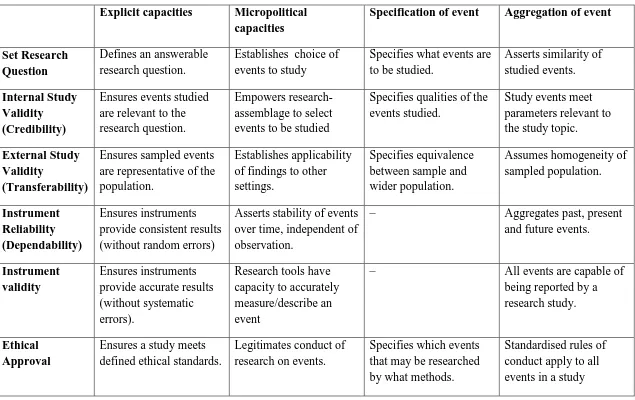
Table 1 sets out the micropolitical capacities produced by a wide range of research techniques (for instance, a sampling technique or ethics procedures), methods and designs, and the impact of the research affects on the hybrid research/event assemblage in terms of specification and aggregation. We explore the affect economies of a small selection of research methods and techniques in more detail below, to illustrate the micropolitical capacities that these generate during research, and the specifications and aggregations involved. The insights from these analyses allow us to unpack the micropolitics of two research-assemblages (‘research designs’) frequently applied in social research – and
frequently the objects of debates around mixing methodologies: the survey and the qualitative interview.
(Insert Table 1 about here)
Micropolitics of specific research methods and techniques
The first of the social research methods that we will analyse micropolitically is the approach known as participant observation (PO) – a data collection method used in ethnographic research studies (McCall, 2006: 4). Observational methods have the explicit aim of enabling a research-assemblage to gain more or less extensive first-hand experience of an event or events. As a data collection method, the direct involvement of a researcher in an event purportedly supplies the capacity to generate data on that event and use this to make an assessment of what happened, why it happened and what socio-cultural significance it may have. There is an unacknowledged affect economy at work here that micropolitically denotes and legitimates a researcher as a data collection instrument, ascribing a capacity to engage with and make sense of the event, conceivably at the expense of the perspectives of other actors within the event. This specifying affect will be significant as the research-assemblage hybridises with the affects in the event to produce an ethnographic account of the event.
Documentary analysis is a data analytic tool applied in both historical and social research to
explicate what happened in an event distant in time or space. Once again, there is an
acknowledged affect economy at work in this machine, which ascribes this capacity to make sense of and indeed draw conclusions about such a distant event. Micropolitically, the effect is to accord the documentary analytic machine with skills to sift, judge and evaluate
documents without recourse to the broader (non-documentary) range of affects in the event studied. This introduces a powerful research affect economy into the hybrid event/research assemblage that specifies which documents are included in the analysis, and (as in all analytical research-machines) aggregates documents to draw out findings about the event studied by the documentary analysis.
Turning to specific techniques used in social research, sampling is a means to select specific elements (respondents, institutions, occurrences) for inclusion within or exclusion from a study. In the case of the ‘representative sample’, a tool such as a random-number programme is used to systematically select some and exclude other members of a population, in order to create the study-material to be studied. While the explicit aim of this technique is to ensure data generated is representative, micropolitically the sampling machine empowers a research-assemblage to achieve the logistically impossible – to study an entire population. This is achieved by applying specific, researcher-defined affects that assert the equivalence of sample and population, in order to determine which event affects are subjected to research-assemblage affects, and which are not. Though (in a representative sample) every member of a population has an equal chance of inclusion, this technique amounts to an absolute
specification of the study sample.
Ethics approval is another machine that forms part of most social research-assemblages. Its
framework) the basis within which event-assemblage and research-assemblage may hybridise.
Micropolitics of specific research designs
We turn now to two of the most often used research designs in contemporary social inquiry the survey and the qualitative (in-depth) interview. The survey is a social research design assemblage that uses a series of research-machines to produces a quantitative summary of specific aspects of an event or events (as defined by a research question). Affects in the survey’s sampling machine allocate events to the sample; those in the questionnaire machine select aspects of an event to be studied and categorise findings; affects in the statistical analysis machine aggregate and manipulate the data mathematically to supply summaries such as means or ranges, and estimates of confidence to generalise from sample to population; the result-writing machine presents these aggregated and de-contextualised findings to answer the study’s research questions. Micropolitically, all these machines are highly aggregative, restricting which affects from the event can become part of the R/E assemblage; effacing complexities and divergences in the events, and simplifying and thereby reducing the granularity of the event-affects represented in the research outputs.
The qualitative interview is a research methodology that uses sampling, data collection and analytical machines to produce ‘rich descriptions’ of an event or events from accounts elicited from humans in the event assemblage. Affects in the purposive sampling machine select subjects, often seeking diversity rather than representativeness. An interview schedule is a simple affect that determines which elements of the subjects’ affective engagements with the topic can be reported; the qualitative analysis machine organises, aggregates and reduces the textual materials within ‘themes’; writing produces a second-order account of the events being studied, as interpreted first by interviewees and then by the researcher.
interviewees’ accounts may be used selectively to justify the study’s answer to the research question.
These descriptions of two research designs reveal the micropolitics inherent between events and the research process, analysed in terms of the affects within the various machines that comprise a research methodology, and the capacities these affect economies produce. Other designs may be similarly evaluated. In the next section we consider what this analysis and the previous assessment of research methods and techniques means for mixing methods in social research.
A rationale for mixing methods
Scrutiny of these examples of the techniques, methods and designs and of the broader range of research machines in Table 1 suggest that most of the machines used in social inquiry specify and/or aggregate affects in the research/event assemblage in one way or another, tending to produce simplicity where there was complexity, definition in place of
indeterminacy, and evenness rather than variability. It is clear from this analysis that research is in no way a ‘transparent’ process that simply allows events to be translated into
‘knowledge’. The specifications and aggregations of events inevitably have consequences upon the products of social inquiry produces, and potentially upon the impact of the research process upon the events they study.
One response to this assessment of the micropolitics of research could be to reject wholesale the ways in which social inquiry has been conducted – as fatally flawed by these
reflection (McCormack, 2005: 122), with the aim not of representing the world but of generating ‘difference, divergence, and creation’ (Thrift and Dewsbury, 2000: 416).
A second response to the aggregative and specifying effects of research is a well-established approach among post-positivist qualitative researchers: to acknowledge that the effects of the research process limit potential for generalisation beyond the specific contexts of the research setting (Guba and Lincoln, 1982: 246-247). This acknowledgement gained further
momentum in post-structuralist theory, which revealed that knowledge was not so much disclosed by research as constructed from the cultural and discursive resources available (Rose, 1998: 55), compromising any notion of the ‘objectivity’ of research knowledge (Rosenau, 1992: 96-97). The ‘diffractive’ methodologies inspired by the work of materialist and posthuman theorists Barad (2007: 71) and Haraway (1997: 268) recognise that the processes of observation and analysis (the research-assemblage affects) become part of the event. Events ‘are understood differently by differently positioned subjects, through different lenses and in this sense are always multiple’ (Uprichard and Dawney, 2016: 10). Different methods and methodologies ‘cut’ data in multiple ways (ibid: 9) as does intra-action with researchers’ own theories, insights or reflections (Juelskjaer, 2013: 757). In response, diffractive researchers apply and specify a particular contextual cut in their data (for instance by focusing on something in the data that has a specific resonance or significance for the researcher), to offer insight rather than truth about an event (see, for example, Renold and Ivinson, 2014: 365; Taguchi and Palmer, 2013).
We would suggest that the detailed analysis of research method micropolitics that we have undertaken and set out in this paper enables us to build upon minor science and diffractive approaches, to offer a nuanced response to the challenges of research micropolitics. It discloses the complex affective flows between the many elements involved in research, and the specifications and aggregations of events, researchers and audiences that occur as
First, awareness and understanding of the affective flows and micropolitics in a particular machine or entire research-assemblage (design) open up the possibility to re-engineer a research assemblage or research machine to avoid specific affects. For example, an
aggregation of data by pre-coding a questionnaire can be removed by replacing closed with open-ended questions; directive interview schedules can be substituted by walking tours of a location or setting directed by research participants rather than researchers (Renold and Ivinson, 2014: 365).
Second, where affects cannot be designed out (for instance, if statistical analysis of data is essential), specifications and aggregations can be acknowledged and their effects on the research process critically assessed, evaluated and discussed as shortcomings to a study.
Third, and of most relevance for the objective of this paper, specifications and aggregations in a research machine can by countered by intentional generalisations and disaggregations elsewhere in the research process. Researchers, particularly in the post-positivist tradition, have developed many techniques including involvement of participants in research design, data analysis and dissemination: the materialist analysis offered here provides a more formal basis for these kinds of initiatives. However, we would suggest that this effort to ‘balance out’ specifications and aggregations can also be powerfully effected by a more strategic mixing of methods (research machines), some highly aggregative but analytically powerful, others less analytical but intentionally non- or even dis-aggregative.
For instance, a study might combine a (minimally-aggregative) descriptive case study that produces a rich picture of the concerns and values of research participants in a setting with an intervention (highly aggregative) that attempts to alter aspects of the setting to address these concerns and values. A subsequent evaluation might combine aggregative quantitative measures with opportunities for participants to offer their own unmediated assessments of any improvements, and use the research outputs to challenge policy or improve their living environment. Mixing methods and methodologies in this way does not mean that the
can be accurately predicted and acknowledged when reporting findings and drawing conclusions.
Discussion
We have offered here an argument in favour of mixed methods research not underpinned or undermined by philosophy of science debates about the epistemological bases of different methodological approaches. Instead, we have developed a bottom-up analysis of the material and micropolitical processes that are involved in actually doing research. This analysis has enabled a sophisticated understanding of the impacts of different research techniques and methods upon knowledge production.
This micropolitical analysis does not make easy reading for any who aspire to undertake social research not only to understand the social world but also to change it for the better in policy or practice. The research methods, techniques and designs analysed in Table 1 have been designed to produce particular specifications and aggregations. These micropolitical effects alter the apprehension of the events and interactions that social inquiry sets out to describe, analyse and interpret (though how these actually deploy in practice cannot be known in advance of their application in a research study). Almost every aspect of the research process is implicated in these unintended reproductions. If one had the hope that post-positivism or reflective research practices might ameliorate the impact of research on what it seeks to study, those hopes are dashed by this materialist assessment.
One resolution is to shift from any efforts to represent the world, and we have noted earlier the arguments by non-representational theorists and diffractive methodologists to move entirely beyond any effort at representational science. Those approaches can indeed open up new ways to become much more engaged with the social world, shifting away from the notion of a dispassionate researcher offering insights from above. But we would note Deleuze and Guattari’s assertion (1988: 372) that ‘following’ is not better than
So we would suggest that we need not yet dispense with the entirety of the social research apparatus at our disposal. A materialist understanding of research allows us to peer inside the research-assemblage, and more significantly, to tinker with it. To that end, we can find ways to offset some of the impacts of particular research techniques and tools, and that supplies the justification for judicious and strategic mixing of methods. Importantly however, this does not amount to a carte blanche for mixed methods research. It is not a case of ‘what works’; rather it a matter of selecting methods than can be used in concert to achieve specific micropolitical effects in the research process, and consequently specific kinds of research output.
However, the most exciting possibility that this materialist analysis of the
research-assemblage offers is not to supply a new argument for the supremacy of qualitative, person-centred, reflexive, participatory approaches, but the opposite: a means to rehabilitate some of the approaches such as surveys and even experiments that have been rejected by social scientists as positivistic and directive. Our analysis sustains such criticisms of their
specifying and aggregating tendencies, but at the same time suggests that mixed cautiously with other methods, they can contribute to the panoply of methods available to the social researcher. Nor does such an integration of disparate methods depend upon philosophical justifications of their ‘compatibility’. The only necessary justification is now at the
micropolitical level of what these methods actually do in practice. This, we would suggest in conclusion, opens up possibilities for novel methodologies that apply methods for their strengths, while acknowledging that every method has micropolitical weaknesses too.
Notes
1. Deleuze (1988, 1992) used the term ‘ethology’ to define the study of capacities to affect and be affected. The Spinozist/Nietzschean provenance of this focus upon affective
capacities differentiates Deleuzian thought substantively from that of the Dewey/James pragmatist tradition (Malecki and Schleusener, 2014: 216-219).
influenced significantly by feminist scholarship – have produced a range of post-qualitative (Lather, 2013; Lather and St Pierre, 2013) ontologies and methodologies, including non-representational theory (Thrift, 2007), posthumanism and the posthumanities (Braidotti, 2013), affect theories (Clough, 2008; Massumi, 1996) and diffractive methodologies (Barad, 2007; Haraway 1997: 268), as well as the approaches informed by DeleuzoGuattarian theory discussed in this paper. These developments shift the focus of concern in social inquiry from epistemology to ontology, and draw the material and the semiotic into a single realm, posing a foundational challenge to the humanism underpinning qualitative research methods such as interviews and observation. This ontological move undermines the central conceit of
modernist social research that it can adequately represent its object (Lather and St Pierre, 2013: 630), offering in its place an ‘affirmative, experimental ontology of becoming’ (St Pierre, 2013: 652).
3. The non-analytical approach has also been advocated by non-representational theorists as a means to move beyond representation as the means of gaining knowledge of the world (see note 6).
4. This Deleuze-inspired analysis of the research process is cognate with, but distinct from, the onto-epistemological framework outlined by Karen Barad (2007), that draws on the work of quantum theorist Niels Bohr to suggest that observation is always part of the context of research, and hence that all knowledge is necessarily affected by the research methods used to produce it. We do however draw different conclusions, based on the differing conceptual framing of our Deleuzian analysis.
5. Partial versions of such a response have of course been advocated in the past by those who have sought to abandon positivism, quantitative methodologies or a research enterprise implicated in patriarchal or racist systems of thought.
6. Non-representational theory is an approach developed by social geographer Nigel Thrift that explores the affective flows of everyday life, often drawing on the work of Deleuze and Guattari. It addresses everyday practices from an anti-biographical, pre-individual and affective rather than cognitive perspective, and as parts of a flowing or rhizomic movement rather than independent events.
Alldred, P. and David, M. (2007) Get Real about Sex. The Politics and Practice of Sex
Education. Maidenhead: Open University Press.
Barad, K. (1996). Meeting the universe halfway: realism and social constructivism without contradiction. In: Nelson, L.H. and Nelson, J. (eds.) Feminism, Science and the Philosophy
of Science. Dordrecht: Kluwer, pp. 161-194.
Barad, K. (2007). Meeting the Universe Halfway. Quantum Physics and the Entanglement of
Matter and Meaning. Durham, NC: Duke University Press.
Biddle, C. and Schafft, K.A. (2015). Axiology and anomaly in the practice of mixed methods work: pragmatism, valuation, and the transformative paradigm. Journal of Mixed Methods
Research, 9(4), 320-334.
Biesta, G. (2010). Pragmatism and the philosophical foundations of mixed methods research. In: Tashakkori, A. and Teddlie, C. (eds.) Sage Handbook of Mixed Methods in Social &
Behavioral Research. London: Sage.
Braidotti, R. (2006). Transpositions. Cambridge: Polity.
Braidotti, R. (2011). Nomadic Theory. New York: Columbia University Press.
Braidotti, R. (2013). The Posthuman. Cambridge: Polity.
Clough, P.T. (2004). Future matters: technoscience, global politics, and cultural criticism.
Social Text, 22(3): 1-23.
Clough, P.T. (2008). The affective turn: political economy, biomedia and bodies. Theory,
Culture and Society, 25(1): 1–22.
Coole, D.H. and Frost, S. (2010). Introducing the new materialisms. In Coole, D.H. and Frost, S. (eds.) New Materialisms. Ontology, Agency, and Politics. London: Duke University Press, pp. 1-43.
DeLanda, M. (2006). A New Philosophy of Society. London: Continuum.
Deleuze, G. (1988). Spinoza: Practical Philosophy. San Francisco: City Lights.
Deleuze, D. (1992). Ethology: Spinoza and us. In Crary, J. and Kwinter, S. (eds.)
Incorporations. New York: Zone Books, pp. 625‐633.
Deleuze, G. and Guattari, F. (1988). A Thousand Plateaus. London: Athlone.
Dewsbury, J. D. (2003). Witnessing space:‘knowledge without contemplation’. Environment
and Planning A, 35(11): 1907-1932.
Duff, C. (2010). Towards a developmental ethology: exploring Deleuze’s contribution to the study of health and human development. Health, 14(6): 619-34.
Feilzer, M.Y. (2010). Doing mixed methods research pragmatically: implications for the rediscovery of pragmatism as a research paradigm. Journal of Mixed Methods Research, 4(1): 6-16.
Foucault, M. (1981). The History of Sexuality Vol.1: The Will to Knowledge. Harmondsworth: Pelican.
Fox, N.J. and Alldred, P. (2013) The sexuality-assemblage: desire, affect, anti-humanism.
Sociological Review, 61(6): 769–789.
Fox, N.J. and Alldred, P. (2014) New materialist social inquiry: designs, methods and the research-assemblage. International Journal of Social Research Methodology, 18(4): 399-414.
Fox, N.J. and Alldred, P. (2015) Inside the research-assemblage: new materialism and the micropolitics of social inquiry. Sociological Research Online, 20(2): 6.
http://www.socresonline.org.uk/20/2/6.html
Greene, J.C. (2008). Is mixed methods social inquiry a distinctive methodology? Journal of
Mixed Methods Research, 2(1), 7-22.
Grosz, E. (1994). Volatile Bodies. Bloomington: Indiana University Press.
Hathcoat, J.D. and Meixner, C. (2015). Pragmatism, factor analysis, and the conditional incompatibility thesis in mixed methods research. Journal of Mixed Methods Research. EPub ahead of print: http://journals.sagepub.com/doi/full/10.1177/1558689815622114
Haraway, D. (1991). Cyborgs, Simians And Women. London: Free Association Books.
Haraway, D. (1997). Modest_Witness@Second_Millennium.
Howe, K.R. (1988). Against the quantitative-qualitative incompatibility thesis or dogmas die hard. Educational Researcher, 17(8): 10-16.
Jackson, A.Y. and Mazzei, L.A. (2013). Plugging one text into another: thinking with theory in qualitative research. Qualitative Inquiry, 19(4): 261-271.
Johnson, R. B., & Onwuegbuzie, A. J. (2004). Mixed methods research: A research paradigm whose time has come. Educational Researcher, 33(7), 14-26.
Juelskjaer, M. (2013). Gendered subjectivities of spacetimematter. Gender and Education,
25(6), 754-768.
Lather, P. (2013), Methodology-21: what do we do in the afterward? International Journal of
Qualitative Studies in Education, 634-645
Lather, P. and St. Pierre, E.A. (2013). Post-qualitative research. International Journal of
Qualitative Studies in Education, 26(6), 629-633.
Latour, B. (2005). Reassembling the Social. An Introduction to Actor Network Theory. Oxford: Oxford University Press.
Lemke, T. (2015). New materialisms: Foucault and the ‘government of things’. Theory,
Culture & Society, 32(4): 3–25.
Kitzinger, C. (1987). The Social Construction of Lesbianism. London: Sage.
Malecki, W. and Schleusener, S. (2014). ‘What affects are you capable of?’ On Deleuze and somaesthetics. In: Bignall, S., Bowden, S. and Patton, P. (eds.) Deleuze and Pragmatism. London: Routledge.
Marx, K. (1971). A Contribution to the Critique of Political Economy. London: Lawrence & Wishart.
Masny, D. (2013). Rhizoanalytic pathways in qualitative research. Qualitative Inquiry,
19(5): 339-348.
Massumi, B. (1988). Translators’s foreword. In Deleuze, G. and Guattari, F. A Thousand
Plateaus. London: Athlone, pp. ix-xix.
Massumi, B. (1996). The autonomy of affect. In Patton, P. (ed.) Deleuze: a Critical Reader. Oxford: Blackwell, pp. 217-239.
Handbook of Fieldwork. London: Sage.
McCormack, D.P. (2005). Diagramming practice and performance. Environment and
Planning D: Society and Space, 23(1), 119-147.
McCulloch, G. (2004). Documentary Research in Education, History and the Social Sciences. London: Routledge Falmer.
Morgan, D. L. (2007). Paradigms lost and pragmatism regained: methodological implications of combining qualitative and quantitative methods. Journal of Mixed Methods Research,
1(1), 48-76.
Onwuegbuzie, A.J. and Leech, N.L. (2005). On becoming a pragmatic researcher: the importance of combining quantitative and qualitative research methodologies. International
Journal of Social Research Methodology, 8(5): 375-387.
Pillow, W.S. (2015). Policy temporality and marked bodies: feminist praxis amongst the ruins. Critical Studies in Education, 56(1), 55-70.
Potts, A. (2004). Deleuze on Viagra (Or, what can a Viagra-body do?) Body & Society,
10(1): 17–36.
Renold, E. and Ivinson, G. (2014). Horse-girl assemblages: towards a post-human
cartography of girls’ desire in an ex-mining valleys community. Discourse: Studies in the
Cultural Politics of Education, 35(3): 361-376.
Renold, E. and Ringrose, J. (2011). Schizoid subjectivities? Re-theorizing teen girlsʼ sexual cultures in an era of ‘sexualization’. Journal of Sociology, 47(4): 389-409.
St. Pierre, E.A. (2013). The posts continue: becoming. International Journal of Qualitative
Studies in Education, 26(6), 646-657.
St Pierre, E.A. (2014). A brief and personal history of post qualitative research: Toward ‘post inquiry’. Journal of Curriculum Theorizing, 30(2): 2-19.
St Pierre, E. and Pillow, W. (2000) Introduction: Inquiry among the ruins. In St Pierre, E. and Pillow, W. (eds.) Working the Ruins: Feminist Poststructural Theory and Methods in
Education. London: Routledge, pp. 1-24.
Education, 25(6): 671-687.
Thrift, N. (2004). Intensities of feeling: towards a spatial politics of affect. Geografiska
Annaler Series B Human Geography, 86(1): 57-78.
Thrift, N. (2007). Non-representational Theory: Space, Politics, Affect. London: Routledge.
Thrift, N. and Dewsbury, J.D. (2000). Dead geographies—and how to make them live.
Environment and Planning D: Society and Space, 18: 411-432.
Uprichard, E. and Dawney, L. (2016). Data diffraction. Journal of Mixed Methods Research. ePub ahead of print: DOI: 10.1177/1558689816674650.
van der Tuin, I. and Dolphijn, R. (2010). The transversality of new materialism. Women: A
Cultural Review, 21(2): 153-171.
Yanchar, S.C. and Williams, D.D. (2006). Reconsidering the compatibility thesis and eclecticism: five proposed guidelines for method use. Educational Researcher, 35(9): 3-12.
Youdell, D. and Armstrong, F. (2011). A politics beyond subjects: the affective
Table 1. The micropolitics of social research methods and techniques
A. Techniques
Explicit capacities Micropolitical capacities
Specification of event Aggregation of event
Set Research Question
Defines an answerable research question.
Establishes choice of events to study
Specifies what events are to be studied.
Asserts similarity of studied events.
Internal Study Validity (Credibility)
Ensures events studied are relevant to the research question.
Empowers research-assemblage to select events to be studied
Specifies qualities of the events studied.
Study events meet parameters relevant to the study topic.
External Study Validity
(Transferability)
Ensures sampled events are representative of the population.
Establishes applicability of findings to other settings.
Specifies equivalence between sample and wider population.
Assumes homogeneity of sampled population.
Instrument Reliability (Dependability)
Ensures instruments provide consistent results (without random errors)
Asserts stability of events over time, independent of observation.
– Aggregates past, present and future events.
Instrument validity
Ensures instruments provide accurate results (without systematic errors).
Research tools have capacity to accurately measure/describe an event
– All events are capable of being reported by a research study.
Ethical Approval
Ensures a study meets defined ethical standards.
Legitimates conduct of research on events.
Specifies which events that may be researched by what methods.
Sampling Systematic selection of events from a population.
Findings can be generalised to a wider population.
Events in sample are representative of a wider group.
Sample events are equivalent to those in wider population.
B. Data Collection Methods
Interview Gathers data on events from human subjects.
Research gathers accounts relevant to the research question.
Accounts filtered to
answer research question.
All respondents/events treated as equivalent.
Participant Observation
Descriptions of events by a researcher.
Legitimates researcher as principal data collection instrument.
Events filtered through research-assemblage.
Research-assemblage aggregates events to form a coherent picture.
Questionnaire Assesses respondents on multiple pre-selected measures.
Instrument selects which data is to be collected as relevant to question.
Data on specific, pre-selected aspects of events gathered.
Same questions asked of all respondents/events.
Experiment Effect of a defined independent variable on an event.
Research-assemblage controls context of event.
All aspects of an event specified.
All respondents/events treated as equivalent.
C. Analytical Methods
Statistical Analysis
Summarises event data numerically.
Imposes statistical models of populations on
Event attributes transformed into
data. numbers.
Thematic Analysis
Summarise data into pre-defined themes.
Events explained by pre-existing conceptual or theoretical framework.
Events described in terms of specific features.
Data aggregated
according to similarities of attributes.
Grounded Theory
Inductively-generated theory to explain an event
Applies coherent internal structure or processes to data.
Data are coded and categorised to disclose underlying structure.
Progressive aggregation of data into categories and super-categories.
Documentary Analysis
Evaluate an event from documentary sources.
Research-assemblage can select relevant materials to evaluate an event at a distance.
Event is specified using materials accessed by the research study.
Aggregates documentary evidence to develop an interpretation of an event.
D. Study Presentation
Writing up Report events studied. Uses data from study to answer the research question.
Events summarised in terms of the research topic.
Events aggregated into report sub-topics.
Dissemination Share findings with scientific community.
Events become materials that justify study
findings.
Events specified in relation to research findings.
Events aggregated in terms of similarities across a population.
Policy application
Affect policy or practice. Research findings (rather than events) are evidence for policy or practice.
Events specified as part of research evidence.