promoting access to White Rose research papers
White Rose Research Online [email protected]
Universities of Leeds, Sheffield and York
http://eprints.whiterose.ac.uk/
This is an author produced version of a paper published in Discourse and Society.
White Rose Research Online URL for this paper:
Published paper
Edwards, Geraint. O. (2012) A comparative discourse analysis of the
construction of in-groups in the 2005 and 2010 Manifestos of the British National Party, Discourse and Society, 23 (3), pp. 245-258
A comparative discourse analysis of the construction of “in-groups” in the 2005
and 2010 Manifestos of the British National Party
By Geraint O. Edwards
N.B. This is the pre-review draft of this article. For the final draft, which
includes numerous corrections and improvements, please download from
2
Since Nick Griffin’s appointment as chairman of the far-right British National Party (BNP) in 1999, the party has undergone a drastic makeover in terms of the language it employs in the public domain, adopting a moderate discourse of unobjectionable “motherhood and apple pie” concepts, whilst privately maintaining its core ideology of racial prejudice. This paper continues the work previously done examining BNP literature in order to ascertain what discursive techniques the BNP is adopting and how their language is changing to appeal to a wider electoral base. Using Corpus Analysis as a base, and drawing upon techniques of Discourse Analysis (DA) and Critical Discourse Analysis (CDA), this study compares the 2005 and 2010 BNP manifestos. Its focus is the way in which “in-group” categories such as nationhood are invoked to imply inclusivity yet on closer inspection are racially defined. The project of disguising BNP racism in seemingly moderate discourse is continuing apace.
3
List of tables/figures 4
Table of contents
1. – Introduction 5
2. – Review of the literature 6
3. – Research design and method 7
4. - A corpus analysis of “in-groups” in the 2005 and 2010 BNP manifestos 8
4.1 Pronouns and “BNP” 8
4.2 Detailed study – “our” 10
4.3 Britain and the British 13
4.4 “Natives” vs. “Indigenous peoples” 15
4.5 White people 16
4.6 Humans 19
5 – Conclusions 21
6 – References 22
7 – Appendices 26
Appendix i - BNP General Election results 1983-2010 26
4
List of tables/figures
Fig. 4.1 – Self-references in 2005 & 2010 manifestos 8
Fig. 4.2 – Referents of “our” in 2005 manifesto 12
5
In 1998, BNP leader Nick Griffin was found guilty of inciting racial hatred and handed a two-year suspended sentence for producing the anti-Semitic booklet “Who are the Mindbenders?” (Camus, 2005), citing an international Jewish conspiracy. However, on becoming party leader in 1999, he soon made it clear to the party that his intention was to adopt a less direct discursive approach. In an article in the Spring 1999 issue of the BNP magazine Patriot, Griffin stated “Nothing is easier for a group of isolated true believers than to create a fundamentalist programme of ideological perfection which positively petrifies ordinary voters” (Copsey 2004, p.175). He added: “Of course, we must teach the truth to the hardcore [but] when it comes to influencing the public, forget about racial differences, genetics, Zionism, historical revisionism and so on” (Copsey 2007, p.68). In their place, Griffin suggested four “idealistic, unobjectionable, motherhood and apple pie concepts” such as “freedom”, “democracy”, “security” and “identity” – a concept lifted from Jean-Marie Le Pen’s Front National (ibid.). This was the beginning of the transformation which saw the BNP’s public discourse altered dramatically, in a process which is ongoing. However, undercover journalists continued to expose the true racist character of private BNP discourse in programmes such as the BBC’s “The Secret Agent”, aired 15th July 2004, attracting four million viewers and resulting in the arrest of Griffin and 11 others on charges of inciting racial hatred (Copsey, 2007, p.72).
1. Introduction
6
has thus both voluntarily shifted its discourse in order to attract a wider section of the electorate and avoid alienating voters, and also been forced to adapt its language for legal reasons. The purpose of this paper, therefore, is to examine how the language of the BNP has altered between the two manifestos in order to judge how it is communicating the same message of racial prejudice in more electorally palatable discourse. This is especially pertinent due to the “latent support” factor uncovered by John & Margetts (2009), who suggest that results showing only electoral victories fail to reveal the “dulling” of negative feelings towards the BNP. Their research showed dramatic falls in the number of people reporting that they “could never” vote BNP, and rises in the “might vote” and ambivalent “don’t know” categories. For this reason it is currently of huge importance to monitor the manner in which the BNP is adapting its discourse to appeal to a wider demographic.
General accounts of the BNP’s rise and the quest for legitimacy do not come any more comprehensive than Copsey’s “Contemporary British Fascism” (2004), complemented by his analysis of the party’s ideological makeover, “Changing course or changing clothes?” (2007). Chilton (2004) gives an excellent overview of techniques employed in political discourse, especially in the construction of “foreigners” with reference to Enoch Powell’s “Rivers of Blood” speech and the use of legitimising and delegitimising strategies, appropriation of victimhood, agency, entailment, presupposition, presumption, frames and metaphors. The tactic of reversing the accusation of racism is investigated by Van Dijk (1993, 1998), Renton (2003, 2005), Pitcher (2006) and Kundnani (2007). Charteris-Black (2005) builds on this pool of resources with his investigation of personification and depersonification and Critical Metaphor Analysis. The use of metaphor in political discourse has grown from Lakoff & Johnson’s (1980) and Van Teeffelen’s (1994) work on metaphor and racism, to become a popular area of examination in recent years in CDA with
7
Fairclough’s “Language and Power” (2001) setting the foundations for works such as Charteris-Black’s (2006) analysis of the immigration metaphors “natural disaster” and “container” in the 2005 campaign, Hart’s (2007) CDA and metaphor work with the 2005 BNP manifesto and Polson & Kahle’s (2010) study of the metaphorical construction of “the Other”. Richardson and Wodak’s (2009) examination of BNP leaflets, Richardson’s work on of the use of “Britishness” (2008), Atton’s (2006) analysis of online materials, Wood and Finlay’s (2008) investigation of BNP depictions of Muslims following the London bombings and Woodbridge’s (2010) work on the appropriation of Christian credentials are all incisive and revealing studies of current BNP discourse. Finally, Rhodes’ study of legitimisation, “The Banal National Party”, Holmes’ “Integral Europe” (2000) and John & Margetts’ inquiry into the phenomenon of “latent” BNP support underline the manner in which discourse plays a central role in normalisation of extreme groups.
To date, BNP materials have mainly been analysed either from the perspective of Discourse Analysis (DA) or within a particular framework of Critical Discourse Analysis (CDA). Metaphor analysis has received much attention, and so will not be addressed here. As we are concerned with how the discourse has changed between the two texts, the most appropriate method would seem to be Corpus Analysis. Wordlists and concordances alone, of course, are insufficient to reveal the subtleties of usage needed to gain an accurate understanding of the trends involved. Corpus Analysis, therefore, forms the basis for the investigation of variation, following which, an analysis incorporating techniques and concepts from both DA and CDA will be employed to interpret and explain those tendencies identified. The paper is based on a Corpus Analysis using Mike Scott’s Wordsmith Tools, forming wordlists and concordances, and applying principles of DA and CDA to identify
8
trends and the reasoning behind them. The analysis focuses on the construction of “in-groups” identified by references of pronouns and key lexical items.
4. - A corpus analysis of “in-groups” in the 2005 and 2010 BNP manifestos 4.1 Pronouns and “BNP”
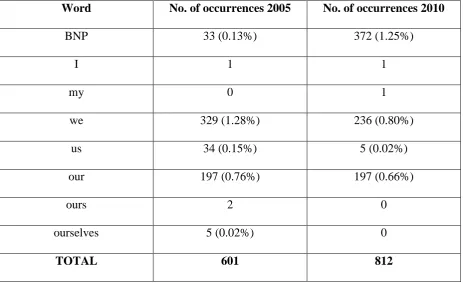
[image:9.595.67.531.374.657.2]Fig. 4.1 shows the instances of self-references in the two manifestos and their total number of occurrences. Percentages of the relevant text are provided in order to account for the difference in word count between the two manifestos (25,664 words in 2005 and 29,790 in 2010).
Fig. 4.1 – Self-references in 2005 & 2010 manifestos
Word No. of occurrences 2005 No. of occurrences 2010
BNP 33 (0.13%) 372 (1.25%)
I 1 1
my 0 1
we 329 (1.28%) 236 (0.80%)
us 34 (0.15%) 5 (0.02%)
our 197 (0.76%) 197 (0.66%)
ours 2 0
ourselves 5 (0.02%) 0
TOTAL 601 812
9
in 2010. Closer inspection reveals that “BNP” replaced “we” to a large extent in the subject position and “us” in the object position. The result of this is that the pronouns, which may be interpreted in numerous ways, such as representing humankind, “ethnically British” people, “civically British” people, the BNP, the BNP leadership or the British nation state have been replaced by a single representative organ. Whereas in 2005, policies would be expressed by the use of the inclusive but potentially vague pronoun: “We will enact laws that will ensure that the dictatorship of the media over free debate in our society is dismantled” (BNP, 2005, p.9), 2010’s manifesto declares: “The BNP will enact legislation which will hold journalists and their media outlets criminally liable for knowingly publishing falsehoods” (BNP, 2010, p.43).
10
The increase in the use of the name not only demonstrates the growth in confidence and perceived legitimacy within the party, but is also an act of legitimisation in itself. Chilton (2004) outlines the dual methods of epistemic and deontic legitimisation exercised in political discourse. Whereas the latter employs methods which appeal to the emotional and moral sense of the audience, the former is grounded in rational and objective “facts” which are given credibility through the authority of the speaker. In the field of party politics, the party name is an essential badge of identity which aids the construction of this authoritativeness.
4.2 Detailed study – “our”
11
in the interpretation of discourse items to carefully consider what associations, relevance and significance a word may have.
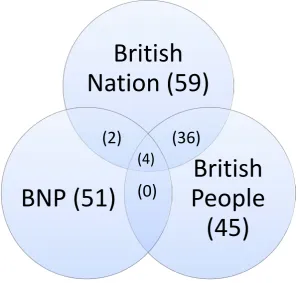
Figures 4.2 (2005) and 4.3 (2010) show the usage of “our” and the version of the in-group to which it relates, whether the British nation state, the British people or the BNP. As there must exist a certain amount of subjectivity in the interpretation of the in-group to which they refer, they are presented as a Venn diagram in order to preserve the overlap of referents which it is possible to have. Taking the first instance of “our” in the 2005 manifesto: “’Rebuilding British Democracy’ is the title of our general election manifesto for a very good reason” (p.3), the use of “our” clearly refers to the BNP only. On the other hand, the following sentence is taken from the 2010 manifesto, and may be interpreted as encompassing all three referents: “There is far too much emphasis on collective security, embracing nations that are not always well disposed to our viewpoint” (p.13). In this manner, each possible combination is accounted for.
12
Fig. 4.2 – Referents of “our” in 2005 manifesto
Fig. 4.3 – Referents of “our” in 2010 manifesto
British
Nation (59)
British
People
(45)
BNP (51)
British
Nation (92)
British
People
(34)
BNP (36)
(36)
(0)
(2)
(4)
(24)
(4)
(1)
[image:13.595.160.456.447.731.2]13
What, then, is the significance of such a change? This may, once more, be seen as another step in the process of legitimisation, and as symbolic of the growing self-assurance of the BNP leadership. Its relevance lies in the shift from articulating the desires of the party and attempting to speak for the “British” people, to the much wider assertion of authority to speak for the country and presuming the power to influence the nation state. Such a bold authority claim of the type discussed above speaks of a party whose self-image has altered significantly, or is attempting to portray significantly loftier intentions. The claim constitutes a speech act which asserts itself on a higher political plain as yet unoccupied by the BNP.
Regarding the use of the object pronoun “us”, the 2005 text shows a total of 34 widely distributed references: 10 uses relate to British people, 5 to the British nation, and 10 could be seen as referring to both people and nation; 3 represent the BNP, 4 uses relate to humankind, the British and Irish combined and the English have a single mention each. In 2010, only 5 instances occur, and the plurality of the in-group has disappeared. Gone are the references to the English, the Irish and humankind. In 2010, every remaining usage refers to Britain as a nation in the context of international relations. This is a further indication that, in terms of its manifesto at least, the party has abandoned the discourse of the little man riling against the powers that be, and has elected to adopt a more statesmanlike approach by invoking the authority of nationhood. This change in direction may also be seen in terms of what Condor (cited in Richardson, 2008) has named “banal nationalism”; this is an example of legitimisation by presupposition (Chilton, 2004).
4.3 Britain and the British
14
an outlook which embraces the nation and all within it, as opposed to one favoured group. However, this distinction is rather more pertinent when we remind ourselves of what is meant when the BNP uses the word “British”. Prior to the Equality and Human Rights Commission winning the case on opening up membership to non-whites, the BNP’s racial composition was entirely white. Despite the change, there have understandably been few applicants from other ethnic backgrounds, and the EHRC has since had a subsequent ruling upheld that the revised constitution remains indirectly racially discriminatory as it requires members to oppose mixed-race relationships and support the repatriation of non-whites (EHRC, 2010). Therefore, when the BNP refers to itself, there can be little doubt that we are dealing with a group composed entirely of whites. Moving on to the next group, that of British people, one might expect to be discussing people from a variety of ethnic backgrounds. Whilst this group constitutes a far wider section of the community, we would be mistaken to assume it includes any non-white members. The 2005 version of the BNP Guide to Language Discipline (cited by Richardson and Wodak, 2009, p.261) included the following instruction to its members:
Rule #15. BNP activists and writers should never refer to ‘black Britons’ or ‘Asian Britons’ etc, for the simple reason that such persons do not exist. These people are ‘black residents’ of the UK etc, and are no more British than an Englishman living in Hong Kong is Chinese.
15
equally exclusive of any group which is not white. Perhaps more disturbingly still, this is a discourse which disguises its racism in the language of inclusivity, representing as it does, a nation run by and for a single racial group, to the exclusion of all others. With this in mind, an analysis of the occurrence of words connected with nationhood yields interesting results. From 2005 to 2010, the instances of “British” increase from 108 (0.42%) to 191 (0.64%), a rise in actual occurrences of 76.85%; “Britain” grows from 117 (0.45%) to 171 (0.58), or 46.15% overall, and “UK” shoots from 14 (0.05%) to 50 (0.17%) constituting a quantitative increase of 257.14%. Clearly, this shift in self-representation in terms of nationhood is not limited to pronoun use.
4.4 “Natives” vs. “Indigenous peoples”
16
The reason for this is twofold. Firstly, the abandonment of the word “native” may be as a result of the imagery conjured by a word which, for a party so preoccupied with British history and the British empire, evokes the Victorian discourse of spear-throwing savages subject to civilised Imperial rule. As Smith (2006), who discusses the use of the two words and their associations, reports: “How often do we read in the newspaper about the death or murder of a Native man, and in the same paper about the victimisation of a female Native, as though we were a species of sub-human animal life?” (p.9). This is hardly a role to which the BNP would aspire. On the other hand, the word “indigenous” does not carry the strong associations, as suggested above by Smith, with being “primitive”. It is a word more associated with efforts at a governmental level to preserve ancient and threatened cultures. It is a word more commonly used to describe noble civilisations which have suffered injustice at the hands of complacent or complicit authority, and which require nurture and protection to redress the balance. It is also a word which, in the simplest terms, drops the “sub-human” and boosts the “victimisation”. This is another method of legitimisation, whereby the oppressor appropriates the language of the oppressed. As Back (cited in Atton, 2006) states, “the language of hate is increasingly being articulated through invocations of love” (p.576). This new approach of the evocation of victimhood by the BNP is specifically designed to suggest that “the implicit racism of the BNP is born out of suffering and repression, not hatred” (Atton, 2006, p.580).
4.5 White people
17
and that only 3 of those refer to race. The first talks of “the ‘positive discrimination’ schemes that have made white Britons second-class citizens” (p.14); the second bemoans “a quasi-Marxist cultural war against all things white, European and male” (p.22); and the final example, somewhat out of left field, criticises the BBC for its depiction of “the white working class - in the most negative and unattractive light possible” (p.22). All three examples paint the white majority as victims, in line with the appropriation outlined above, and the white identity evoked is both male and working-class. The fact that only three uses appear is a clear example of how far the party had already come, under Griffin’s stewardship, in disguising its ethnocentric ideology under its various euphemisms. Furthermore, the evocation of victimhood was a far cry from Griffin’s declaration in the BNP magazine The Rune in 1995, that the defence of “rights for whites” would only be achieved by “well-directed boots and fists” (Atton, 2006, p.576).
18
“vital technical skills” (p.69), and is an indication of the party’s attempts to attract more middle class support. The white working class appears twice in 2010, once again in its negative portrayal by the media, and also as a victim of abandonment by “Labour’s globalist ideals” (p.22), but there is no mention of males.
The discourse of victimhood is taken up a level in 2010, with the language of racial abuse appropriated and reversed. We are informed that “whites are overwhelmingly the victims of racially motivated crime” (p.18) and are presented with statistics from the “well known researcher Tony Shell” (who, according to the anti-fascist group Searchlight, is the BNP’s Plymouth organiser [Gable, 2008]) that “white victims of racist murders are over-represented” (ibid.). In contrast to the 2005 text, we see children presented in terms of race and are told that “Asian pupils outnumber white children” in primary schools (p.17) and that in 2005, “36 percent of all births in England and Wales were not “white British” (ibid.). However, of the twelve references to “white” in the 2010 manifesto, the largest number relate to girls and females. In a new approach employing the racialisation of crime (p.33), we hear of the “grooming of white girls for sex” and the “growing concern at the attitudes of some Asian men towards white girls”; that “white girls as young as 12 are being targeted for sex”, and “young white females are lured in sex abuse traps by Muslim males”.
19
men, replaced with girls, children and babies as the vulnerable victims. Perhaps the ultimate in “apple pie” concepts, with which no-one could argue, the protection of the most defenceless in society is guaranteed to elicit an emotive response. As expressed by Atton (2006), “the BNP is anti-multicultural, anti-equality and anti-freedom, yet its discourse uses the tropes of multiculturalism, equality and freedom to maintain an ideological space where racism and repression may appear natural and commonsensical” (p.586). Thus, the BNP has reintroduced the word “white” into its discourse by distancing itself from a male identity and widening its socioeconomic focus beyond the working class whilst simultaneously stepping up its discourse of victimhood by switching the victim status from working class white men to white girls, children and babies, which has been achieved by a process of the racialisation of crime.
4.6 Humans
20
Though the previous sentence may seem to be a rather obvious statement, its relevance becomes pertinent as we examine the most recent text. In 2010, references to “human” drop to 11, with one use of “humane”. However, it is not only the quantitative evaluation which demonstrates a discursive shift. A qualitative analysis of usage in context yields one reference to the need for a “just and humane” welfare system, mirroring the meaning of “fairness” mentioned earlier. One use of “human” employs the word to support its “celebration of difference” approach: “Group identity, belonging, loyalty and allegiance, in other words, are not products of ‘false consciousness’, economics, imperialism or sociological processes; they are an essential part of elementary human nature” (p.22). However, the overwhelming majority of the uses of the word are capitalised. The reason for this is that they all form the titles of organisations or laws designed to protect human rights, and in every case, they are opposed. In all 3 references to the “Equalities and Human Rights Commission” (the body which judged the BNP constitution to be discriminatory), it is prefixed with the verb “repeal”. The same is true of the “Human Rights Act”, which appears on 4 occasions, again in the context of its dissolution. The remaining 3 uses refer to the “European Convention on Human Rights”, in each case accompanied by the intention to “withdraw from” it. In 2005, we also see 14 uses of “rights”, all of which are positive. By 2010, this figure increases to 29, half of which are negative. Between the texts, rights have moved from being something positive to be protected, to something pernicious to be feared. In what seems a conscious decision to cease highlighting the shared humanity of our species, and instead speak of humans only in opposition to organisations which support the concept of equality between people of all races, the BNP has rather subtly taken the most drastic step in the delegitimisation of “the other”. As Chilton (2004) stresses:
21
some individual or group, attacking the communicative cooperation of the other, attacking the rationality and sanity of the other. The extreme is to deny the humanness of the other. (p.47)
Taken as a whole, the total number of the most overt self-reference words (personal pronouns, the explicit acronym “BNP”, Britain/British/UK, native/indigenous and white/whites) sees an overall rise from 861 (3.34%) to 1254 (4.22%) as a proportion within their respective texts, and representing a rise in actual occurrences of 45.64%. This is clearly a significant change in perspective, as policies and ideas are now articulated much more in terms of the in-group.
The BNP’s discursive makeover is clearly ongoing, and the research conducted yields a number of patterns of note. The corpus analysis showed a party gaining in confidence, no longer being coy in the use of the name “BNP”, indicative of their faith that the name no longer conjures such negative imagery. The study of “our” and “British” shows the increased disguising of the racially constructed in-group behind the ostensibly inclusive discourse of nationhood. We have also seen a rise in the appropriation of the discourse of victimhood and the racialisation of crime exercised through the use of “indigenous” and “white”, and the abandonment of the ultimate inclusive term “human” except for derision and attack.
5 – Conclusions
22
Atton, C. (2006). Far-right on the internet: culture, discourse and power. New Media & Society, 8, 573.
6 – References
BBC. (2004). The Secret Agent – BNP edition [Television series episode]. Aired 15 July 2004. London: BBC.
BBC. (2009). Question Time [Television broadcast]. Aired October 22, 2009. London: BBC.
BBC. (2010, May 8) General Election Results. BBC News. Retrieved May 8, 2010, from
BNP faces legal action over membership and constitution. (2009, July 29). The Daily Telegraph. Retrieved May 11, 2010, from
Camus, J. (2005, March 1). The use of racist, antisemitic and xenophobic arguments in political discourse. ECRI. Retrieved June 9, 2010, from
Carter, E. (2005). The extreme right in Western Europe: Success or Failure? Manchester: Manchester University Press.
Charteris-Black, J. (2005). Politicians and Rhetoric. Basingstoke: Palgrave Macmillan.
Charteris-Black, J. (2006). Britain as a container: immigration metaphors in the 2005 election campaign. Discourse and Society, 17, 563-581.
23
Copsey, N. (2004). Contemporary British Fascism. New York: Palgrave Macmillan.
Copsey, N. (2007). Changing course or changing clothes? Reflections on the ideological evolution of the British National Party 1999-2006. Patterns of Prejudice, 41(1), 61-82.
EHRC - Amended BNP constitution ruled indirectly discriminatory [Report] (2010, March 12). EHRC - Home. Retrieved June 5, 2010, from
Fairclough, N. (1995). Critical Discourse Analysis: The critical study of language. Harlow: Longman.
Fairclough, N. (2001). Language and Power (2nd ed.). Harlow: Longman.
Gable, S. (2008, November 1). BNP targets young people in "Racism Cuts Both Ways" hate drive. Searchlight Magazine. Retrieved June 6, 2010, from
Gee, J. P. (2005). An Introduction to Discourse Analysis: Theory and Method (2nd ed.). Abingdon: Routledge.
Hart, C. (2007). Critical Discourse Analysis and Metaphor: Toward a Theoretical Framework. Critical Discourse Studies, July, 1-22.
Hodge, M. (2010, May 28). How to beat the BNP and make sure they don't come back. The Daily Telegraph. Retrieved May 30, 2010, from
24
John, P., & Margetts, H. (2009). The latent support for the extreme right in British politics.
West European Politics, 32(3), 496-513.
Kundnani, A. (2007). Integrationism: the politics of anti-Muslim racism. Race & Class, 48, 24.
Lakoff, G., & Johnson, M. (1980). Metaphors we live by. Chicago : Chicago University Press.
Pitcher, B. (2006). "Are you thinking what we're thinking?" Immigration, Multiculturalism and the Disavowal of Racism in the run-up to the 2005 British General Election. Social Semiotics, 16(4), 535-551.
Polson, E., & Kahle, S. (2010). Limits of national discourse on a transnational phenomenon: A case study of immigration framing in the BBC online. International Communication Gazette, 72, 251.
Renton, D. (2003). Examining the success of the British National Party, 1999-2003. Race & Class, 45, 75.
Renton, D. (2005). 'A Day to make history'? The 2004 elections and the British National Party. Patterns of Prejudice, 39(1), 25-45.
Rhodes, J. (2009). The Banal National Party: the routine nature of legitimacy. Patterns of Prejudice, 43(2), 142-160.
25
Richardson, J. E. (2008). “Our England”: discourses of race and class in party election leaflets. Social Semiotics, 18(3), 321-335.
Smith, L. T. (2006). Decolonizing methodologies: research and indigenous peoples. New York: Palgrave.
Summers, D. (2009, January 30). Brown stands by British jobs for British workers remark.
The Guardian. Retrieved July 2, 2010, from
Teeffelen, T. V. (1994). Racism and Metaphor: The Palestinian-Israeli Conflict in Popular Literature. Discourse and Society, 5, 381-405.
van Dijk, T. (1993). Elite Discourse. Newbury Park, CA: Sage.
van Dijk, T. (1998). Ideology: A Multidisciplinary Approach. Newbury Park, CA: Sage.
Wood, C., & Finlay, W. M. (2008). British National Party representations of Muslims in the month after the London bombings: Homogeneity, threat, and the conspiracy tradition. British Journal of Social Psychology, 47, 707-726.
26
7 - Appendices Appendix i
Year
- BNP General Election results 1983-2010 (adapted from Ford & Goodwin, 2010)
Votes Constituencies contested
Average in seats
contested (%)
Highest vote (%)
Deposits retained
1983 14,621 54 0.6 1.3 0
1987 553 2 0.5 0.6 0
1992 7,005 13 1.2 3.6 0
1997 35,832 56 1.4 7.5 3
2001 47,129 33 3.9 16.4 7
2005 192,746 119 4.9 16.9 34
2010 564,331* 339* N/A 14.6* 72†
* Source: BBC (http://news.bbc.co.uk/1/shared/election2010/results)
27
Geraint Edwards is an English Tutor at the English Language Teaching Centre at the
University of Sheffield. He has been teaching for ten years at various institutions in the UK, the Czech Republic, Japan and Spain. He has recently finished his Master’s Degree in Applied Linguistics from the University of Sheffield, where he focussed on Discourse Analysis. This article is adapted from his dissertation, which also deals with the discursive construction of “out-groups” and the role of agency in the BNP’s manifestos. ADDRESS: English Language Teaching Centre, University of Sheffield, 78 Hoyle Street, Sheffield, S3 7LG, UK. [email: [email protected]]