Seboni, L and Tutesigensi, A (2014) Allocating project managers to projects in a multi-project
IN A MULTI-PROJECT ENVIRONMENT
Lone Seboni1and Apollo Tutesigensi
Institute for Resilient Infrastructure, School of Civil Engineering, University of Leeds, Woodhouse Lane, Leeds, LS2 9JT, UK
A recent empirical study demonstrated that the process of allocating project managers to projects (PM2P) in multi-project environments of Botswana was not effective. This inspired the authors to seek to understand the structure of the PM2P process with a view of proposing improvements to increase effectiveness. A conceptual model was developed and used in this study, which focusses on using the developed model as a theoretical lens to study the process in a large company, using the case study method. Via an enumeration, qualitative and quantitative data were collected from four project directors and eleven senior level executives through in-depth semi-structured
interviews. The analysis of the quantitative data (using univariate descriptive analysis) and qualitative data (using content and thematic analysis) revealed weaknesses in the existing PM2P process demonstrated in five ways namely: (1) absence of documented and specific competencies required of project managers in various roles, (2) lack of management tools and techniques to match project managers to projects, (3) prevalence of ad-hoc projects, (4) lack of consideration of a comprehensive list of inputs and (5) lack of accountability for outputs. The strengths in existing PM2P process were demonstrated in two ways namely: (1) use of management tools and techniques at strategic level to forecast project implementation costs for projects in
the pipeline, and (2) criteria to be
considered in the PM2P process. The findings provide a strong basis upon which a decision support system can be developed to facilitate a more effective approach to allocating project managers to projects in the multi-project environment of the case study in question. Other companies that undertake business in a multi-project context may benefit from this work.
Keywords: allocation, decision making, project manager, multi-project environment.
INTRODUCTION
Seboniet al(2013) identified the problem of lack of effective PM2P allocation
performance. The outcome of that previous empirical study was that the PM2P processes were informal, not objective, not comprehensive and lacked a good match between project managers and projects. The link between these practices to certain performance variables (e.g., project manager performance, project success, project manager rewards) was also established in terms of positive and statistically significant correlations. These findings pertain to 12 out of 15 eligible project based companies in Botswana, which included the Case study in question as regards the current study. The term 'effective' is used in the context of improving the quality of the PM2P allocation process, leading to improved company performance (Jugdev and Muller 2005). The
basis of the research problem was the author's anecdotal observation regarding a lack of effective PM2P approaches in a specific company based in Botswana. This was strengthened by a critical appraisal of the limited literature specific to PM2P
allocations in multi-project settings, majority of which were predominantly focussed in USA high-tech industry and specific to new product development projects
(Patanakul 2004, Patanakulet al2004). The empirical study conducted in Botswana (Seboniet al2013) also confirmed the author's anecdotal observation. This currently underexplored area was broadened by drawing from well-supported management and organizational theories. For example, the universal theory of resource management (Owusuet al2007), which encapsulates other theories such as resource planning, scheduling and allocation (PMI 2008).
A conceptual model for understanding the PM2P allocation process was developed (Seboni and Tutesigensi 2014) by modifying existing models, incorporating broader reviews of cognate fields of inquiry to address gaps in existing PM2P allocation models e.g., inclusion of some significant additions in terms of criteria to be
considered and feedback loops between the model components. The model was used in this study to examine the PMP2 allocation process of a large company in the context of Botswana, as part of building on existing framework to include a different contextual perspective as regards a different country, industry and project types.
Given that research must be done within a certain context that suits the research problem, justification for using Botswana as the contextual basis for this study are: (1) strong empirical evidence from a previous study (Seboniet al2013) that validated the existence of the research problem across 12 out of 15 eligible private and public companies, (2) the need to extend existing framework to other countries, (3) the author's familiarity with Botswana as regards reducing the challenges of data collection, (4) the need to give back to Botswana, since the research funding comes entirely from Botswana. Empirical studies on PM2P allocation models, applicable to multi-project environments (the principal focus of this study), are currently limited and focussed predominantly on one country and industry (Patanakul 2004). For example, six empirical studies that directly propose PM2P allocation models were conducted in USA high-tech industry alone, published between 2003 and 2009. The closest to these six studies are four studies conducted in Israel (Hadadet al2013), Iran (Sebtet al2010), Thailand (Ogunlanaet al2002) and Egypt (El-Sabaa 2001), in the context of the construction industry, but not explicit to multi-project environments.
Notwithstanding this currently underexplored area, this is an important topic because of the significant impact of the PM2P allocation decisions on company strategic value, particularly in view of the link between projects and strategy (Olsson 2008), directly visible in a multi-project environment
importance of this study, which is among the first to empirically examine the PM2P allocation practices of a large multi-project company in Botswana, is even more crucial because of the significant contribution of the chosen company's project types to national Gross Domestic Product (GDP)
project budgets and annual revenue generated by the company's projects, relative to global value of mineral resources. Revenue from these projects contributes
approximately 30% to national GDP, in the context of the economy of Botswana (DeBeers 2012). It therefore, becomes critical that the right project managers are allocated to the right projects.
Conceptual model for understanding the PM2P allocation process
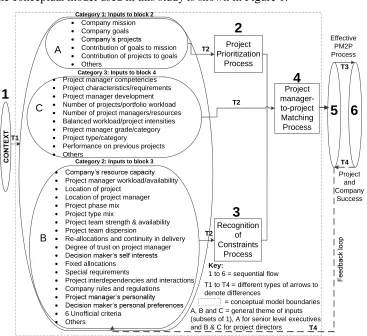
The conceptual model used in this study is shown in Figure 1.
Company mission Company goals
Contribution of goals to mission Contribution of projects to goals Others
Project manager workload/availability Location of project
Location of project manager Project phase mix Project type mix
Project team strength & availability Project team dispersion
Re-allocations and continuity in delivery Degree of trust on project manager
Fixed allocations Special requirements
Project interdependencies and interactions Company rules and regulations
6 Unofficial criteria Others Project Prioritization Process Project manager-to-project Matching Process Recognition of Constraints Process B A C
1
Effective PM2P Process Project and Company Success2
3
6
5
4
T1 T2 T2 T2 T3 T4 T4 Key:1 to 6 = sequential flow
T1 to T4 = different types of arrows to denote differences
= conceptual model boundaries A, B and C = general theme of inputs (subsets of 1), A for senior level executives and B & C for project directors
Project manager competencies Project characteristics/requirements Project manager development Number of projects/portfolio workload Number of project managers/resources Balanced workload/project intensities Project manager grade/category Project type/category
Performance on previous projects Others
Category 1: Inputs to block 2
[image:3.595.117.484.231.567.2]Category 2: Inputs to block 3 Category 3: Inputs to block 4
Figure 1 Conceptual model for PM2P process - Source: Seboni and Tutesigensi (2014)
This conceptual model was developed from: (1) critical appraisal of specific literature concerning PM2P allocation models (which included empirical studies as secondary data) and broader theories surrounding the PM2P allocation process, (2) industry expert reviews from USA, UK and Botswana, in relation to validating the generic nature of the model structure and content, as part of complimenting the evidence from literature with industry practice. The model was developed for use by project
are used in processes labelled 2, 3 and 4, leading to performance related outcomes labelled 5 and 6. The six unofficial criteria in block B are: project manager's age, gender, religious beliefs, marital status, health condition and nationality. Details of how the contents of this conceptual model were translated into a research instrument for this study are discussed under research method.
Research aim and questions
The aim of this study was to use the developed conceptual model (Seboni and
Tutesigensi 2014) to empirically examine the PM2P allocation practices of a specific company, with a view to obtain a complete understanding of the participating
company's PM2P approach in relation to strengths and weaknesses. Two research questions were constructed to focus on different aspects of this process. These research questions were: (1) to what extent do managers consider the list of thirty-seven criteria in the conceptual model in their PM2P allocation practices? and (2) what are the strengths and weaknesses of their current practices on the basis of the conceptual model? The developed conceptual model, described briefly in terms of its contents and not its development and verification (which is outside the scope of this study) was used as a lens through which gaps and strengths could be identified, from complementary analysis of each data type (such that new insights could be uncovered from equal treatment of each data type). The work is classified as quantitative
research, on the basis of building on existing theory by using a developed conceptual model that has been validated from both literature and industry.
RESEARCH METHOD
A case study of the chosen company (major unit of analysis) was considered
appropriate to address the research aim for two reasons. Firstly, the need to obtain in-depth descriptions of the PM2P allocation process and not generalizations, and secondly, the complexity of the unit of analysis in terms of the large number of
variables involved, including the different qualitative aspects of the issues surrounding the PM2P process to be studied through an in-depth semi-structured interview survey of two groups of informants (embedded unit of analysis) in different organizational levels. The participating company was selected on the basis of its eagerness to be used as a case for the current study, including commitment and timely participation and cooperation demonstrated in a previous study involving 12 companies (Seboniet al 2013) aimed at validating the existence and nature of the research problem. The chosen company views the outcome of the entire study (which includes the current study) as critical in the pursuit of improved performance. Whilst there was consistent evidence of a lack of effective PM2P practices for the specific context of Botswana's public and private sector, the case in question stood out since it had a project
management office in three locations, compared to the other 11 companies, which had one or two project management offices and fewer relevant informants.
new mining plant or increasing the capacity of an existing plant. Typical small projects include resource evaluation to sustain existing mine business and give confidence to the investment community regarding the types of mineral resources being mined in terms of changes in volumes and grades as depth of mining increases.
Senior level executives were required to provide detailed information about five criteria pertaining to the company's project prioritization process, while project directors were required to provide detailed information about thirty-two criteria that pertain to the PM2P matching process. Both qualitative and quantitative data were required from different informants within the hierarchy of the unit of analysis (including company documents as additional data sources) in a complementary
manner that treats both data types equally, to uncover a complete understanding of the PM2P allocation process of the entire case. A relevant population of 15 informants was identified on the basis of eligibility to provide the required data relating to the PM2P process. This population was enumerated (no sampling), given its manageable size in terms of the required time and resources to conduct interviews. All 15
informants, who represent the entire population in the context of the participating company, were interviewed. The issue of data quality was addressed by careful selection (Fellows and Liu 2008) of company documents, which were reviewed to complement interviews as regards substantiating the constructs being studied.
Using the case study method, the contents of the conceptual model were translated into an in-depth semi-structured interview protocol (research instrument), containing both quantitative and qualitative questions about different aspects of the PM2P
allocation process. The questions were structured into four main themes. Theme 1 was concerned with measuring the importance score for each of the thirty-seven criterion contained in the conceptual model using a 1 to 9 Likert scale (1 = not important, 5 = average importance, and 9 = very important). Theme 2 focussed on a reflection of the given importance scores to determine how each criterion was taken into account in the actual (real-life context) PM2P decision making process (Yin 1984). Theme 3
explored the outputs to the decision making process (Figure 1). Theme 4 examined how the output to each process was used in reality. These four themes represent different aspects of the issues surrounding the PM2P allocation process. The research questions warrant a mixture of quantitative and qualitative questions, informed by a pragmatist philosophical perspective, which was adopted on the basis that it is suited to this type of design (Cresswell and Clark 2011). The importance of this approach lies in the need to fully address the research questions, with a view to provide a complete understanding of how managers make PM2P allocation decisions.
DATA COLLECTION AND ANALYSIS
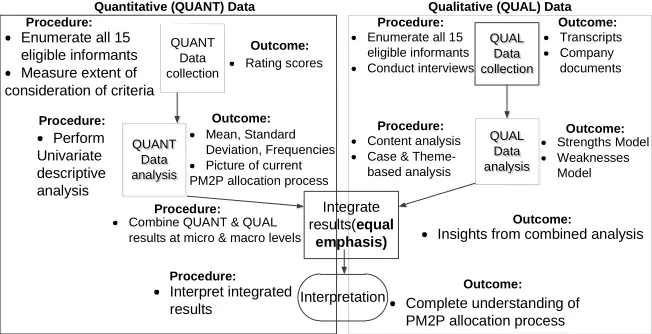
theory suggests to be important in effective PM2P processes, was used to identify strengths and gaps. The qualitative data involved thematic (Ritchie and Lewis 2003) and content analysis (Krippendorf 2004) of the open ended responses, representing another layer of analysis to uncover words and phrases that are indicative of strengths and weaknesses (Figure 2).
QUANT Data collection QUAL Data collection QUAL Data collection QUANT Data analysis QUANT Data analysis QUAL Data analysis QUAL Data analysis Procedure: Outcome: Procedure: Outcome: Procedure: Procedure: Outcome: Outcome: Outcome: Outcome: Procedure:
Enumerate all 15 eligible informants Measure extent of consideration of criteria
Perform Univariate descriptive analysis Rating scores Mean, Standard Deviation, Frequencies Picture of current PM2P allocation process
Combine QUANT & QUAL results at micro & macro levels
Procedure: Interpret integrated results
Enumerate all 15 eligible informants Conduct interviews Transcripts Company documents Content analysis Case & Theme-based analysis
Strengths Model Weaknesses Model
Insights from combined analysis
Complete understanding of PM2P allocation process Integrate
results(equal emphasis)
Interpretation
[image:6.595.74.400.152.319.2]Quantitative (QUANT) Data Qualitative (QUAL) Data
Figure 2 Approach for data collection and analysis
SPSS version 21 was used for analysis of quantitative data in relation to measures of central tendencies (e.g., mean). NVivo version 10 was used to facilitate management and analysis of the qualitative data (Bazeley and Jackson 2013), in relation to
exploring different themes associated with the PM2P allocation process. The two strands were analysed independently, as a starting point to reduce bias. The findings from quantitative data analysis were intellectualized to examine the extent to which the managers consider the list of thirty-seven criteria. The findings from qualitative data analysis were intellectualized using models built from both case and theme-based analysis of the whole data, to demonstrate the strengths and gaps of PM2P allocation practices of the case study in question.
Following a review of several analytic strategies for integrating the two strands during analysis rather than when making conclusions, the appropriate analytic strategy, proposed by Brewer and Hunter (2006) and supported by Green (2007), Cresswell and Clark (2011), was adopted for further integration of the outcomes of each analysis (Figure 2). This integration, concerned with combining different aspects of the issues surrounding the PM2P allocation process, rather than data comparisons appropriate for similar aspects to determine concordances and discordances, was chosen because it is consistent with the purpose of this study. The integration was performed at micro-level (each individual criterion in the conceptual model) and macro-micro-level (summaries of the findings).This integration, performed during analysis rather than conclusions (Brewer and Hunter 2006), revealed new insights discussed in the next section.
RESULTS AND DISCUSSION
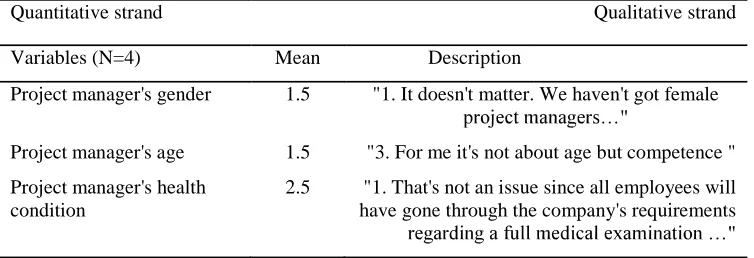
Table 1: Typical result from project director's data set for integration at micro-level
Quantitative strand Qualitative strand
Variables (N=4) Mean Description
Project manager's gender 1.5 "1. It doesn't matter. We haven't got female
Project manager's age 1.5 "3. For me it's not about age but competence " Project manager's health
condition
2.5 "1. That's not an issue since all employees will have gone through the company's requirements
The integrated results from both strands revealed no additions to the developed conceptual model (another evidence for model validation) but new insights regarding three categories of criteria as follows:
Category 1: four criteria (gender, age, health condition and marital status) were not considered important on the basis of context. For example, project
was not applicable to the conditions of the case being studied (see Table 1). Whilst the absence of female project managers was attributed to a"hostile mining environment", the interpretation from the findings, in relation to these four criteria, is that context (country, industry, company and nature of projects) plays a role in determining important criteria to be considered in the PM2P approach, as supported by a similar study of the important factors to be considered in matching project managers to construction projects in Thailand (Ogunlanaet al2002).
Category 2: eleven criteria were not given sufficient attention by the managers, in terms of extent of consideration, despite their importance. These criteria were: contribution of projects to goals, location of project, location of project manager, team dispersion, self interests of decision maker and project
manager, nationality of project manager, organization's rules and regulations, contribution of each limitation, number of project managers and projects. This is despite evidence from literature (Patanakulet al2007, Hadadet al2013) which suggests that these issues are important contributors to effective PM2P allocation decisions.
Category 3: five criteria were rated highly (quantitative measures) but their importance were not reflected in the qualitative descriptions of the issues surrounding those criteria. These criteria were: project manager competencies, organizational goals, organization's projects, contribution of projects to goals and contribution of goals to organization's mission.
Items 2 and 3 were used as a basis for identification of weaknesses in the current PM2P allocation process. The next section is a summary of the strengths and weaknesses that emerged from integrated analysis of both strands.
Strengths and weaknesses
The strengths in PM2P practices were demonstrated in two main ways. Firstly, the use of management tools at strategic level to forecast project implementation costs.
The weaknesses in existing PM2P allocation processes were found to be as follows: Absence of documented and specific competencies required of project managers in various roles the results reveal that the job profiles for all project management related roles contain a total of 8 identified competencies, which are generic and not specific to each role.
Lack of management tools and techniques to match project managers to projects the managers rely on intuition and do not have objective tools, as part of a structured approach to aid decision making. This may explain evidence of mismatches in PM2P allocations. This finding concurs with empirical studies conducted in USA (Patanakulet al2007), in relation to reliance on managerial intuition, considered ineffectiveness when majority of the decision making variables are known (Shapiro and Spence 1997).
The results indicate the presence of ad hoc projects and the ad hoc manner in which these projects are introduced, as a result of changes in business
dynamics, caused by changing business priorities due to unanticipated events in the global mining industry.
Lack of consideration of a comprehensive list of criteria that theory suggests should be considered as inputs to effective PM2P allocation processes. Lack of accountability for outputs the managers could not account for
differences in given scores to certain criteria in their qualitative descriptions of the issues surrounding those criteria, from analysis of both data types.
Implications
The results provide a strong basis upon which a decision support system (DSS) can be developed to facilitate a more effective PM2P approach, applicable to the multi-project environment of the case study company. A DSS will help to provide decision makers with readily available information required to make objective and systematic resource allocations (which include resource planning and scheduling) while saving time (particularly for large project based companies with teams of project managers), as well as the need to occasionally reshuffle the PM2P allocations due to incoming projects (Patanakulet al2007). A critical discussion of the theme of a DSS is beyond the scope of the current study.
The implications of these findings highlight potential cost savings that could be made by implementing a DSS to optimize the PM2P allocation process, linked directly to the participating company's strategic intent of moving towards better performance. Other companies that undertake business in a multi-project context may benefit from this study, in the context of two potential benefits namely: (1) improved PM2P allocation processes in terms of objective consideration of a comprehensive list of criteria contained in the developed conceptual model (whose deployment verified the model content since it did not result in significant structural modifications), including use of formalized tools such as a DSS (to complement managerial intuition in terms of effective decision making) to promote increased levels of match between project managers and projects, leading to increased project manager motivation and
performance, and (2) reduction in human resource expenditure - a number of authors assert that the increasing global market competitiveness facing companies that compete for the same pool of human resources leads to a steep increase in human resource expenditure, which calls for these companies to manage their human
CONCLUSIONS AND FUTURE RESEARCH
The aim of this study was to use a conceptual model to empirically study how managers make PM2P allocation decisions, using a specific case in Botswana. This led to identification of strengths and gaps in PM2P processes, demonstrated in several ways as outlined under 'results and discussion'. The following conclusions can be drawn: (1) analysis of both quantitative and qualitative data revealed gaps in the PM2P process of the case study in question, on the basis of five criteria that were rated highly by the informants but not accounted for in the relevant qualitative descriptions, (2) eleven criteria contained in the conceptual model were not given sufficient attention by the informants, despite their importance in the PM2P process, (3) it is evident that there are areas for improvement in view of an effective PM2P approach, which presents an opportunity to address identified gaps.
Next steps
The next step is to develop a DSS with a view to facilitate a more effective approach to the PM2P decision making problem, applicable to the multi-project environment of the case study in question.
Acknowledgements
The authors would like to acknowledge the University of Botswana for sponsoring the research, Government of Botswana for awarding research permits and the
participating company for official permission to be used as a case study. The authors are indebted to Mr Krisen Moodley, Jadzia Terlecka and ARCOM reviewers for their valuable comments.
REFERENCES
Bazeley, P (2012) Integrative Analysis Strategies for Mixed Data Sources. ,56, 814-828.
Bazeley, P and Jackson, K (2013) . 2ed. London:
Sage.
Blaikie, N (2003) . London: Sage.
Brewer, J and Hunter, A (2006) .
2ed. California: Sage.
Brown, S L and Eisenhardt, K M (1995) Product Development: Past research, present
findings, and future directions. ,20, 343-378.
Cresswell, J W and Clark, V L P (2011) . 2ed. London: Sage.
DeBeers. (2012) Contributing to economies. Retrieved 2 November 2013. Available from:
http://www.debeersgroup.com/Sustainability/Economics/Contributing-to-economies.
El-Sabaa, S (2001) The skills and career path of an effective project manager. nternational
,19, 1-7.
Fellows, R and Liu, A (2008)"Research Methods for Construction". 3 ed. Chichester: John
Wiley & Sons.
Greene, J C (2007) . San Francisco: Jossey-Bass.
Hadad, Y, Keren, B and Laslo, Z (2013) A decision-making support system module for project manager selection according to past performance.
Jugdev, K and Muller, R (2005) A Retrospective Look at Our Evolving Understanding Of
Project Success. ,36, 19-31.
Kabli, M R (2009)"A Multi-attribute decision making methodology for selecting new R & D
projects portfolio with a case study of Saudi oil refining industry", Unpublished PhD Thesis, School of Mechanical, Materials and Manufacturing Engineering, University of Nottingham.
Krippendorff, K (2004) . 2ed.
London: Sage.
Ogunlana, S, Siddiqui, Z, Yisa, S and Olomolaiye, P (2002) Factors and procedures used in matching project managers to construction projects in Bangkok.
,20, 385-400.
Olsson, R (2008) Risk management in a multi-project environment: An approach to manage
portfolio risks. ,25,
60-71.
Owusu, G, Voudouris, C, Dorne, R, Ladde, C, Anim-Ansah, G and Gasson, K (2007) ARMS Application of Al and OR methods to resource management.
,25, 249-253.
Patanakul, P (2004)"A Decision Support Model for Project Assignments", PhD Thesis,
Department of Engineering and Technology Management, Portland State University.
Patanakul, P (2013) Key Drivers of Effectiveness in Managing a Group of Multiple Projects. ,60, 4-17.
Patanakul, P, Milosevic, D and Anderson, T R (2007) A Decision Support Model for Project
Manager Assignments. ,54,
548-564.
Pinto, J K and Slevin, D P (1988) Critical success factors across the project life cycle. ,19, 67-74.
PMI (2008), . Newtown Square,
PA: Project Management Institute.
Ritchie, J and Lewis, J (2003)
. London: Sage.
Seboni, L, Tutesigensi, A and Bower, D (2013) Managerial decision making regarding the allocation of project manager resources to projects: The case of Botswana. In:
Kocaoglu, D F (Ed.), , 29 July to 5 August 2013, San
Hose, California. Technology Management in the IT-Driven Services, 487-510.
Seboni, L and Tutesigensi, A (2014) Development and verification of a conceptual framework for Project Manager-to-Project (PM2P) allocations in Multi-Project Environments,
, 27 to 31 July, Kanazawa, Japan. Infrastructure and Service Integration, In press.
Sebt, M H, Shahhosseini, V and Rezaei, M (2010) Competency Based Assignment of Project Managers to Projects. In: 2010 UkSim (Ed.),
, 24-26 March 2010, Cambridge, UK, 311-316.
Shapiro, S and Spence, M T (1997) Managerial intuition: A conceptual and operational
Framework. ,40, 63-68.
Srour, I, Haas, C and Borcherding, J (2006) What Does the Construction Industry Value in its
Workers? ,132,
1053-1058.