promoting access to White Rose research papers
White Rose Research Online
[email protected]
Universities of Leeds, Sheffield and York
http://eprints.whiterose.ac.uk/
This is the author’s version of an article published in
Astrophysical Journal
Letters
White Rose Research Online URL for this paper:
http://eprints.whiterose.ac.uk/id/eprint/75567
Published article:
Wareing, CJ (2012)
Reconciling the emission mechanism discrepancy in Mira's
tail and its evolution in an interface with shear.
Astrophysical Journal Letters, 748
(2). ISSN 2041-8205
C
2012. The American Astronomical Society. All rights reserved. Printed in the U.S.A.
RECONCILING THE EMISSION MECHANISM DISCREPANCY IN MIRA’S TAIL
AND ITS EVOLUTION IN AN INTERFACE WITH SHEAR
C. J. Wareing
School of Mathematics, University of Leeds, Leeds LS2 9JT, UK;[email protected]
Received 2011 October 15; accepted 2012 February 23; published 2012 March 7
ABSTRACT
Galaxy Evolution Explorerobservations of the Mira AB binary system revealed a surrounding structure that has been successfully hydrodynamically interpreted as a bow shock and tail of ram-pressure-stripped material. Even the narrow tail, initially difficult to model, has been understood to be the effect of the passage of Mira from a warm neutral medium into a hot, low-density medium, postulated to be the Local Bubble. However, no model to date has explained the observed kink and associated general curvature of the tail. We test the hypothesis that before entering the Local Bubble, Mira was traveling through a shear flow with approximately 1/3 Mira’s own velocity at an angle of 30◦ to Mira’s proper motion. The hypothesis reproduces the kinked nature of Mira’s tail and predicts recompression and reheating of the tail material to the same or greater levels of density and temperature predicted in the shock. This provides a heat source for the FUV emission, allowing for an extended lifetime of the FUV emission in line with other estimates of the age of the tail. The uniqueness of Mira’s situation implies that the chances of observing other FUV tails behind asymptotic giant branch stars are highly unlikely.
Key words: circumstellar matter – hydrodynamics – ISM: bubbles – stars: AGB and post-AGB – stars: individual (Mira) – stars: mass-loss
Online-only material:color figures
1. INTRODUCTION
In the Mira binary system, Mira A is an evolved star that is undergoing a period of enhanced mass loss as it moves along the asymptotic giant branch (AGB) on route to becoming a white dwarf. The companion star, previously classified as a white dwarf, now has a less clear classification (Karovska et al.
2005; Ireland et al.2007) but is less luminous and any stellar outflow is comparably insignificant to Mira A in terms of mass flux and energetics. Observations of the Mira system (Martin et al.2007, hereafter referred to as M07) revealed a comet-like tail in the far-ultraviolet (FUV) extending 2◦away to the north and an arc-like structure in the south, reproduced in Figure1. Based on recent dust observations of the AGB star R Hya (Ueta et al.2006) and associated simulations of that star (Wareing et al.
2006b), M07 postulated that the features around Mira are caused by motion through the interstellar medium (ISM) producing a bow shock and ram-pressure-stripped tail. Their postulation is consistent with the direction of Mira’s proper motion (Turon et al. 1993) of 225.8 mas yr−1 in the direction 187◦.1 east of
north (corrected for solar motion). Further, they noted that at the revised Hipparcos-based distance (Knapp et al. 2003) of 107 pc, the large space velocity of 130 km s−1, calculated from the proper motion and the radial velocity (Evans1967) of 63 km s−1, is further consistent with the bow shock structure.
M07 concluded that the FUV emission is excited collisionally by the interaction of molecular hydrogen in the cool, wind wake with hot electrons in the post-shock gas resulting from the bow shock that also entrains and decelerates the wind. Based on the time taken to travel the observed length of the tail and assuming instantaneous deceleration of bow shock material, they predicted that the tail is 30,000 years old, consistent with maintaining the temperature of material in the tail for FUV emission.
Wareing et al. (2007c) tested this hypothesis with hydro-dynamical modeling. The authors were able to reproduce the position and width of the bow shock and the length of the tail—4 pc at D = 107 pc—although they were not able to
reproduce the narrow tail and speculated that Mira could have recently entered the Local Bubble, a tenuous high-temperature low-density region (Lallement et al.2003). Mira would have had a small bow shock while traveling through the warm neu-tral medium, which then expanded to its current size after the star entered the lower density Local Bubble. From the simu-lations, the time taken to generate a 4 pc tail was found to be (2–3)×105years—8×to 10×longer than M07’s estimate.
Un-like M07, Wareing et al. predicted a much slower deceleration of material along the tail, meaning a far longer time was required to generate a tail of the observed length. Further, since the sim-ulated temperatures dropped rapidly along the tail, the driving mechanism for the FUV emission was no longer present. Radio observations (Matthews et al.2008) measured the velocity of the tail material and confirmed Wareing et al.’s theory, predicting an age of the tail around 120,000 years in this scenario. Esquivel et al. (2010) explored the Local Bubble idea, first in an analyti-cal solution and then in two-dimensional numerianalyti-cal simulations including adaptive mesh refinement. With this model, they were able to reproduce the narrow tail structure, while also reproduc-ing the wide bow shock around the cometary head. However, their tail structure is very turbulent (see also Raga & Cant´o
2008), unlike the collimated appearance of the tail. This turbu-lence is postulated to reheat the tail material and drive the FUV emission.
The Astrophysical Journal Letters, 748:L19 (5pp), 2012 April 1 Wareing
Figure 1.Mosaicked UV images of the Mira AB bow shock and tail system. This figure is an adaptation of Figure 1(a) from Martin et al. (2007). The two lines indicate the change of alignment in the tail. The bright star close to the termination point of the tail is HR 691.
(A color version of this figure is available in the online journal.)
2. MODEL
The same two-wind model as previously (Wareing et al.
2007c) has been used, consisting of a slow, dense AGB wind ejected from the position of the mass-losing star and a second
wind representing the motion through surrounding medium. The model has also been used to successfully model the circumstellar structures around the evolved star R Hya (Wareing et al.2006b), the planetary nebula Sh2-188 (Wareing et al.2006a) and develop an evolutionary timeline for the interaction of AGB stars and planetary nebulae with the ISM (Wareing et al.2007b).
CO line observations (Ryde et al.2000) define an AGB wind mass-loss rate of 3×10⁻⁷M
yr−1and a velocity of 5 km s−1.
An unphysical temperature of 104K was used as the cooling
curves extend no further but this does not affect the overall result (Wareing et al. 2006b). In the direction of motion, the inner rim of the bow shock has been remeasured at 5 arcmin south of the binary system. Recent revisions of Mira’s parallax have resulted in a new value of 10.91±1.22 mas (van Leeuwen2007), placing the binary system at a distance of 92 pc±10.3 pc. At this distance, Mira’s space velocity is reduced from the original estimates to 116.9%±8% km s−1. The angle of inclination of Mira’s proper motion vector to the plane of the sky is now at 32◦.6 and the bow shock is at the stand-off distance of 0.134 pc± 0.015 pc. A ram pressure balance between the AGB wind and the Local Bubble implies a Local Bubble density of nH =
0.019%±25% cm−3. This density depends directly on AGB
wind mass-loss rate and velocity. The physical length of Mira’s tail is approximately 3.8 pc. The Local Bubble temperature has been set at 106K (Lallement et al.2003).
Our previous model considered Mira moving through a smooth warm neutral medium with a low density inferred from the ram pressure balance above. We now postulate that at some point during the AGB phase, Mira passed into the low-density Local Bubble from a typical warm neutral medium with a den-sity 25 times higher than that of the Local Bubble. While pass-ing through the ISM, the bow shock would have been five times closer to the star. We calculate this ISM to have a temperatures of 104K and a density ofn
H=0.475%±25%/23% cm−3
con-sistent with warm neutral medium conditions typical of Mira’s galactic disk location.
We evolve the simulation for enough physical time to form the long narrow tail while Mira is in the ISM and then linearly ramp the density and temperature to the Local Bubble conditions over a period of 10,000 years as well as linearly changing the angle of the oncoming ISM from 30◦back to 0◦with respect to thex-axis of the simulation domain. This angle has been directly estimated from the observation in Figure1. A 10,000 year timescale aids smooth running of the simulations and is more realistic since the boundary between regions is unlikely to be an instantaneous change.
3. SIMULATIONS
We have employed an improved version of thecubempicode used previously. We took a numerical domain of 500×300×300 cells with the central star placed at cell coordinates (x,y,z)= (50, 150, 150). Each cell is a regular cube 0.01 pc on a side, giving a physical domain of 5 pc×3 pc×3 pc. The numerical scheme is second order accurate and based on a conservative upwind Godunov-type shock-capturing method developed by Falle (1991) using a Riemann solver due to van Leer (1979). The homogeneous stellar wind, ISM, and Local Bubble are treated as ideal gases. The method also includes the effect of radiative cooling above 104K via parameterized cooling curves
time step in a volume-weighted spherical region of radius 534 cells centered on the position of the central star. The initial grid is otherwise entirely filled with ISM conditions and ISM inflow is affected by an inflow boundary condition atx = 0. The change to Local Bubble conditions is achieved by linear alteration of these inflow boundary conditions. We ran a number of simulations exploring the parameters discussed above, in particular the extremes of the parallax error. We also investigated a number of angles (10◦, 20◦, 30◦, and 40◦) between the proper motion of Mira and the oncoming ISM flow. The results of this sensitivity study are consistent and the data presented in the next section represent the best fit to the observations.
4. RESULTS
The simulations begin at the onset of AGB mass loss and are performed in the frame of reference of the star. The wind from the star forms into a bow shock upstream, positioned at a stand-off distance which can be understood in terms of a ram pressure balance between the stellar wind and the ISM. Simulated temperatures at the head of the bow shock are in agreement with strong shock theory:T∼(3/16)mv2/k.
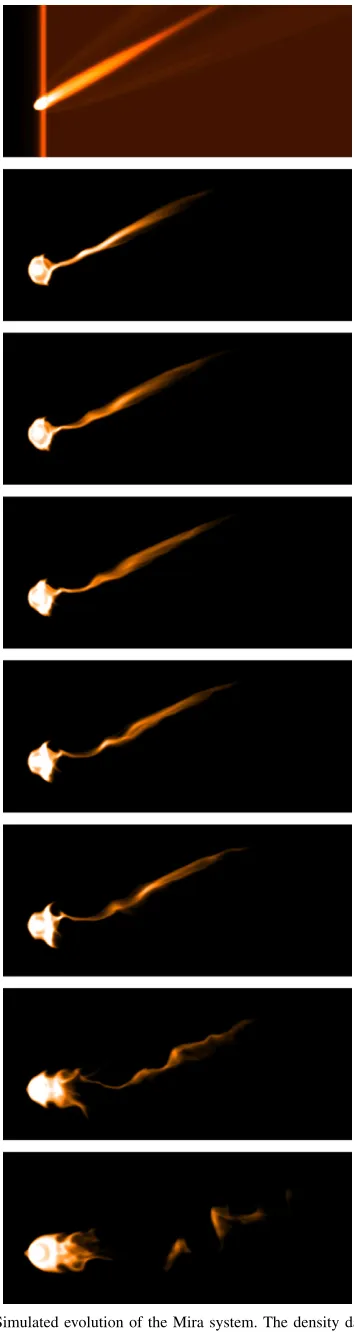
Ram-pressure-stripped material from the head of the bow shock forms a tail behind the nebula at an angle of 30◦to thex-axis. After 250,000 years, the tail is narrow and remains collimated to the edge of the simulated domain—a distance down the tail of 4 pc. We show this instance in time in the top panel of Figure 2, where the passage of the Local Bubble is clear. We then show the collapsed density datacube at 75,000, 87,500, 100,000, 112,500, 125,000, 175,000, and 225,000 years after crossing the boundary. As the Local Bubble conditions sweep past the location of Mira, the bow shock expands to the new stand-off distance five times further away from the star after 50,000 years. Given that the ambient medium temperature has increased by a factor of 100, and the density decreased by only a factor of 25, the relative thermal pressure in the Local Bubble region is four times higher than that in the ISM. This higher pressure has begun to compress the tail, increasing density and temperature (panel 2, 75,000 years after Mira entered the Local Bubble). 100,000 years after Mira has entered the Local Bubble, the simulated structure compares very well to the observed one. The bow shock has the correct position and width. The tail has been narrowed by the pressure of oncoming material. While the simulation does not reproduce the gap in the tail, the observed position and angle of the kink in the tail is best fit by the simulation at this time. The simulation predicts Mira entered the Local Bubble 100,000±25,000 years ago. After this time, shown further down Figure2, the position of the kink moves down the tail, going out of agreement with the observation. After 175,000 years the pressure driving the initial compression and reheating has now begun to destroy the tail. Material from the bow shock is now forming a wide, cool turbulent wake and no longer resembles a collimated tail.
5. DISCUSSION
5.1. Pressure Balance?
[image:4.612.355.532.54.721.2]Setting to one side the question of whether the Local Bubble exists, it is thought to be an ancient supernova-driven bubble approximately 100 pc across and 1–10 million years old. The outward driving pressure is likely to be very low, hence our choice of a factor four pressure increase. The Local Bubble in the simulations of Esquivel et al. (2010) is at a pressure of
The Astrophysical Journal Letters, 748:L19 (5pp), 2012 April 1 Wareing
50 times greater than their warm neutral medium, high for an ancient and broad structure. This unrealistically large pressure difference is likely to drive the strong ram pressure stripping and turbulent tail conditions seen in their model. It is of interest to consider what would happen if the warm neutral medium and the Local Bubble had reached thermal pressure equilibrium. To maintain the temperature ratio of 100, the density ratio for thermal equilibrium must be 0.01. With the density in the Local Bubble fixed by the position of the bow shock, the warm neutral medium density must then benH=1.9 cm−3. The results of a
simulation with these conditions show similar, but more rapid, evolution to the one presented in Figure2. The tail material is swept more rapidly behind the star and after 75–100,000 years the kink has all but disappeared. Temperature also reduces drastically down the length of the tail and more quickly as the material is entrained behind Mira. After 150,000 years, it is 10 times cooler than the bow shock. These results would suggest that the Local Bubble is not yet in pressure equilibrium with its surroundings.
5.2. The Origins of the Flow in the ISM
This work suggests a flow in the ISM at 30◦to Mira’s proper motion vector is responsible for the kink in the tail. The passage into the Local Bubble leads to compression and reheating of the tail material via an overpressure compared to the surrounding warm neutral medium. Practically no implications of a flow in the ISM exist in the literature; Ueta et al. (2010) imply a bow shock around the AGB star R Cas has been compressed on one side by a flow in the ISM, but such one-sided emission can be more easily understood in terms of instabilities seen in AGB star bow shocks, evidence for which has been detected in several objects, specifically Sh 2-188 (Wareing et al.2006a), in Mira itself, launched from the bow shock leading to the observed ring in the tail and also clearly in the instability-dominated bow shocks recently revealed around X Her and TX Psc (Jorissen et al.2011). While it is possible that Mira’s tail is entirely instability driven, in the context of our previous simulations of AGB star tails and associated instabilities and vortices (Wareing et al.2007a,2007b) it has been impossible to reproduce the distinct directional change of the tail. The 30◦angle implies the flow speed is around 1/3 of Mira’s own velocity, or approximately 40 km s−1. The sound speed of the warm neutral medium at 104 K is approximately 15 km s−1,
implying this is a Mach 2–3 flow. A possible origin then, supported by the indications above that the Local Bubble is probably still pressure driven, is that the shell of ISM material swept up by the expanding supernova remnant is causing the flow.
5.3. Emission
One central issue is the source of the long-lived FUV tail emission. M07 modeled several options with CLOUDY, and following a comparison to Galaxy Evolution Explorer
(GALEX) grism mode observations, only H2emission and (only
marginally) isothermal 105K plasma emission were consistent with the lack of NUV and Hαemission. M07 thus concluded that the FUV emission is excited collisionally by the interaction of H2in the cool wind wake with hot electrons in the post-shock gas
[image:5.612.355.532.49.711.2]as discussed previously. However, since then, both simulations and further observations have found the tail to be 4–10 times older. This raises the difficulty of maintaining sufficient thermal energy over the extended lifetime and length of the tail in order
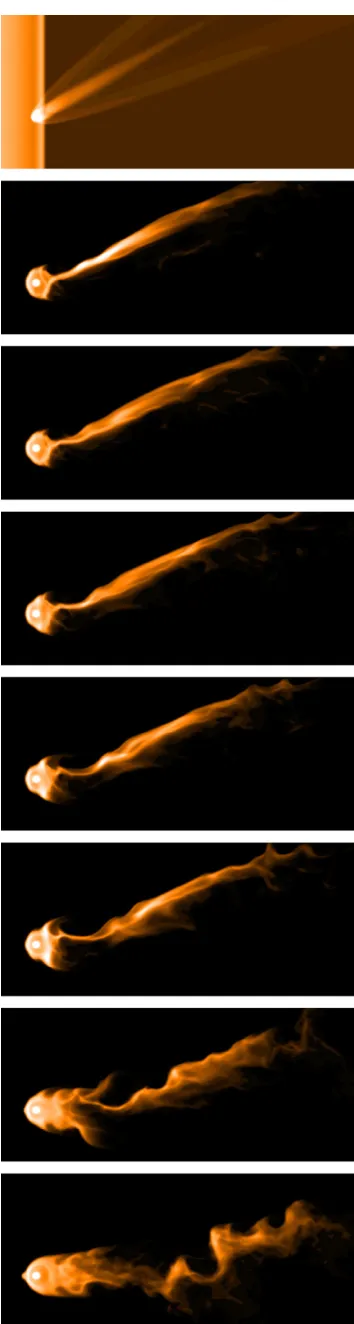
Figure 3.Simulated logarithmically scaled emission from the Mira system. The top panel shows Mira just entering the Local Bubble. Descending rows are then at the same times as Figure2. Each panel is 2.25 pc×5 pc.
to power the FUV emission. Esquivel et al. implied turbulent shock heating may lead to the UV emission, but the high level of turbulence is likely to be caused by the unrealistically high pressure difference between neutral medium and Local Bubble conditions. The power source of the FUV emission has remained unclear.
In previous simulations without a shear, we have found that the temperature drops along the tail far too quickly to support the existence of hot electrons—see the first panel of Figure3. However, in the shear model, with the hot Local Bubble, the kinked tail is exposed to hot oncoming Local Bubble material, compressing and reheating the tail material. We calculate naive emission from the tail based on free-bound hydrogen emission,
E ∝ nenpkTe, assumingne = np =ρ andTe = T. Figure3
thus shows ρ2T at equivalent times to the density plots. We
suggest that the FUV emission is thermally driven by the compression effect of the Local Bubble material, rather than bow shock heating. Consequently, when the tail is eventually swept behind the star—250,000 years after entering the Local Bubble in our simulations—the recompression effect ceases and the FUV emission will switch off. It should be noted though that this proposed reconciliation of the source of emission on a timescale that agrees with the age estimates of Matthews et al. is achieved primarily through choice of Local Bubble conditions and shear flow angle and can be adjusted as such. Radiative transfer modeling, beyond the scope of this work, is required to examine this in any further detail.
5.4. Still One of a Kind
Observationally, the tail of Mira still remains unique. How-ever, all evolved AGB stars show similaror strongerwinds to Mira and several bow shocks have now been observed around similar stars. The question still remains then as to whether Mira is a prototype or an exception, regarding its tail. There are now two main differences between Mira and typical similar stars. Specifically, the high space velocity and the transit from a warm neutral ISM with a shear flow into the Local Bubble. These conditions combine to make Mira’s tail observable only briefly and also imply that tails in more common ISM conditions are unlikely to generate sufficient recompression and heating to produce FUV emission from their tails.
Tails behind AGB stars may therefore be common and in most cases considerably wider. However, the particular set of conditions that we find have combined to make Mira’s tail collimated over a great length and observable, are unlikely to be commonly observed in the FUV. Shorter, wider, turbulent wakes are much more likely to be observed.
6. CONCLUSION
We have shown in this Letter that the kinked nature of Mira’s tail can be reproduced by modeling the star’s passage through a warm neutral medium with a flow at an angle of
30◦ to the proper motion vector. Mira then enters a hot low-density environment, thought to be the Local Bubble, where the bow shock expands to its current position and the tail is compressed and reheated, driving collisionally excited FUV emission in agreement with the GALEX observations (Martin et al.2007). These simulations predict Mira entered the Local Bubble 100,000±25,000 years ago, in agreement with the radio observation estimate of Matthews et al. (2008). The discrepancy between the source of energy driving the FUV emission and the age of the tail has therefore been resolved.
Mira’s tail is a transient structure—only visible for the 100,000 years or so between the beginning of the compression and reheating following entry into the Local Bubble and the destruction of the tail by the formation of a turbulent wake. Without the high temperatures of the Local Bubble, FUV emission would be unlikely making us lucky indeed to be able to observe wonderful Mira at this spectacular and unique time in its evolution.
The author acknowledges useful discussions with Albert Zijlstra and Sam Falle and also constructive remarks from an anonymous referee that led to many improvements to the original manuscript. The numerical computations were carried out using the STFC-supported UKMHD computing facility at the University of Leeds.
REFERENCES
Esquivel, A., Raga, A. C., Cant´o, J., et al. 2010,ApJ,725, 1466
Evans, D. S. 1967, in IAU Symp. 30, Determination of Radial Velocities and Their Applications, ed. A. H. Batten & J. F. Heard (London: Academic),57 Falle, S. A. E. G. 1991, MNRAS,250, 581
Ireland, M. J., Monnier, J. D., Tuthill, P. G., et al. 2007,ApJ,662, 651 Jorissen, A., Mayer, A., Van Eck, S., et al. 2011,A&A,532, A135
Karovska, M., Schlegel, E., Hack, W., Raymond, J. C., & Wood, B. E. 2005,ApJ, 623, L137
Knapp, G. R., Pourbaix, D., Platais, I., & Jorissen, A. 2003,A&A,403, 993 Lallement, R., Welsh, B. Y., Vergely, J. L., Crifo, F., & Sfeir, D. 2003,A&A,
411, 447
Martin, D. C., Seibert, M., Neill, J. D., et al. 2007,Nature,448, 780
Matthews, L. D., Libert, Y., Gerard, E., Le Bertre, T., & Reid, M. J. 2008,ApJ, 684, 603
Raga, A. C., & Cant´o, J. 2008,ApJ,685, L141
Raymond, J. C., Cox, D. P., & Smith, B. W. 1976,ApJ,204, 290
Ryde, N., Gustafsson, B., Eriksson, K., & Hinkle, K. H. 2000, ApJ, 545, 945
Turon, C., Creze, M., Egret, D., et al. 1993, Bull. Inf. Cent. Donnees Stellaires, 43, 5
Ueta, T., Speck, A. K., Stencel, R. E., et al. 2006,ApJ,648, L39 Ueta, T., Stencel, R. E., Yamamura, I., et al. 2010,A&A,514, A16 van Leer, B. 1979,J. Comput. Phys.,32, 101
van Leeuwen, F. 2007, Hipparcos, the New Reduction of the Raw Data (Astrophys. Space Sci. Lib 350; Berlin: Springer)
Wareing, C. J., O’Brien, T. J., Zijlstra, A. A., et al. 2006a,MNRAS,366, 387 Wareing, C. J., Zijlstra, A. A., & O’Brien, T. J. 2007a,ApJ,660, L129 Wareing, C. J., Zijlstra, A. A., & O’Brien, T. J. 2007b,MNRAS,382, 1233 Wareing, C. J., Zijlstra, A. A., O’Brien, T. J., & Seibert, M. 2007c,ApJ,670,
L125