This is a repository copy of
Green challenges and solutions for sustainable development
of China’s electronic information industry
.
White Rose Research Online URL for this paper:
http://eprints.whiterose.ac.uk/78990/
Version: Accepted Version
Proceedings Paper:
Peng, G.C. (2011) Green challenges and solutions for sustainable development of China’s
electronic information industry. In: Proceedings of the International Conference on
Industrial Policy and Development in China. International Conference on Industrial Policy
and Development in China, 29th - 30th July 2011, Singapore. , pp. 1-11.
Reuse
Unless indicated otherwise, fulltext items are protected by copyright with all rights reserved. The copyright
exception in section 29 of the Copyright, Designs and Patents Act 1988 allows the making of a single copy
solely for the purpose of non-commercial research or private study within the limits of fair dealing. The
publisher or other rights-holder may allow further reproduction and re-use of this version - refer to the White
Rose Research Online record for this item. Where records identify the publisher as the copyright holder,
users can verify any specific terms of use on the publisher’s website.
Takedown
If you consider content in White Rose Research Online to be in breach of UK law, please notify us by
promoting access to White Rose research papers
White Rose Research Online
Universities of Leeds, Sheffield and York
http://eprints.whiterose.ac.uk/
This is an author produced version of a paper published in Proceedings of the
International Conference on Industrial Policy and Development in China.
White Rose Research Online URL for this paper:
http://eprints.whiterose.ac.uk/78990
Published paper
Peng, G.C. (2011) Green challenges and solutions for sustainable development
of China’s electronic information industry. In: Proceedings of the International
Conference on Industrial Policy and Development in China. International
SUSTAINABLE DEVELOPMENT OF CHINA’S
ELECTRONIC INFORMATION INDUSTRY: GREEN
CHALLENGES AND SOLUTIONS
Guo Chao Peng
Information School, University of Sheffield, UK
ABSTRACT
Under the national strategy of “let informatisation drive industrialisation, and let industrialisation promote informatisation”, China’s electronic information industry has achieved continuous and dramatic development during the last three decades. It has now become one of the most essential pillar industries for China’s national economy. However, severe pollution issues and environmental challenges emerge at different stages throughout the lifecycle of Information and Communication Technology (ICT) products, from their design, development, and manufacturing to use and to disposal. Evidence shows that much effort has been put to increase industrial profit margin, improve indigenous innovation, and overcome the negative effects of the 2008 financial crisis on China’s electronic information industry. Nevertheless, environmental issues have traditionally received less attention from industrial manufacturers and users of ICT products (e.g. CEOs, managers and employees of companies, and individual citizens). China is still in its infant stage in building up a green electronic information industry. This paper discusses and highlights the importance and impacts of current environmental challenges faced by the electronic information industry, as well as to propose the implementation of Green ICT as a key strategy to ensure environmental-friendly use of ICT equipments and thus maintain sustainable development of this industry in the long term.
1. INTRODUCTION
Ever since China’s reform and opening up started in the late 1970s, Information Technology (IT) or more specifically Information and Communication Technology (ICT), has been perceived by the Central Government as “an important driving force for the economic and social development” in the country1. Moreover, in the Sixteenth Central Committee of the Chinese Communist Party (CCP) in 2002, the government launched the national strategy of “let informatisation drive industrialisation, and let industrialisation promote informatisation”2
The electronic information industry primarily consists of two fundamental sectors, namely the manufacturing industry for designing and producing ICT products and accessories (e.g. PCs, laptops, DVD-ROM drives, monitors, printers, scanners, mobile phones, and TVs), and the software industry that includes the design, development, implementation and maintenance of computer software and information systems. As the backbone for the development of informatisation and building an information society in China, the electronic information industry is considered by the State Council as “a strategic, fundamental and pioneering pillar industry of the national economy”1.
. This national strategy reinforces the importance and critical role of IT towards achieving industrialisation and modernisation in China.
With substantial political and financial support from the government, China’s electronic information industry has achieved rapid and continuous development during the last 30 years. Especially since entering the 21st century, its manufacturing output value increased from RMB 755 billion in 2000 to RMB 4456 billion in 2009, which accounts for more than 8% of the total of the national manufacturing industry3
1
“Planning on Adjusting and Revitalising the Electronic Information Industry”, General Office of the State Council, available at:
. On the
http://www.lawinfochina.com/law/displayModeTwo.asp?id=7420&keyword.
2
“China’s Informatisation Development During the 10thFive Year Plan”, General Office of the State Council, available
at:http://www.china.com.cn/chinese/PI-c/1254081.htm
3
other hand, sales of the software industry has also increased dramatically, from RMB 76 billion in 2001 to RMB 1336.4 billion in 2010, which represents an average annual growth of 38%4
However, this apparent success of the industry and the increasing use of ICT-related products in the society raised significant environmental issues that can threaten long-term development of the electronic information industry. In particular, the production of ICT products are in fact very energy intensive (e.g. it is estimated that producing a desktop computer with a 17-inch CRT monitor will consume 6400 megajoules of total energy and 260kg of fossil fuels)
.
5
. On the other hand, the use of many ICT products will not just consume electricity but more importantly will also emit carbon dioxide (CO2) – every PC can emit 0.1 tonne
of CO2in a year6
When much attention has been paid to increase industrial profit margin, improve indigenous innovation, and mitigate the negative effects of the 2008 financial crisis on China’s electronic information industry, the above environmental issues have not received sufficient considerations from industrial manufacturers and users of ICT products (e.g. CEOs, managers and employees of companies, and individual citizens). This paper thus provides an analysis and discussion on current environmental challenges faced by China’s electronic information industry. It aims to make Chinese policy makers, industrial manufacturers, and commercial and home users become more aware of crucial environmental problems emerged as a result of the production and increasing use of ICT products in the Information Age
. Considering that China manufactures thousands of millions of ICT-related products each year, the associated environmental impacts and pollution problems are particularly striking. Moreover, when this enormous amount of ICT products come to the end of their lifecycle, the disposal of these products leads to further environmental challenges.
7
The paper is structured as follows. The next section provides a brief history on the development of informatisation in China, followed by an overview of the status quo of China’s electronic information industry as well as a discussion of the government’s current development plan for the industry. Subsequently, the paper discusses a set of environmental issues raised during the manufacturing, use and disposal of ICT products. Finally, the paper proposes the use of Green ICT as a possible solution and strategy to handle these environmental challenges and thus maintain sustainable development of China’s electronic information industry in the long term.
.
2. DEVELOPMENT OF INFORMATIZATION IN CHINA
The history of China’s informatisation development can be traced back to the 1970s, when the country called for using computers in supporting government administrative activities8. In 1980s, a number of information systems development projects were launched and completed in twelve key sectors of the national economy, such as civil aviation, banking, electricity supply, national postal service, and railway8. The building of China’s national information highway was started in 1993, when the government launched the Golden Bridge Project. This national project aims to form a nationwide network, which links together all discrete and diverse networks across the country and thus serves as the backbone of China’s national information infrastructure. As a result of the Golden Bridge Project, China built up a modern information network that covers more than 2000 cities in the country and links to all major international networks in the world by the early 2000s9
4
“Status Quo of China’s Software Industry in 2010”, Ministry of Information Industry, available at:
.
http://www.cobsq.
com/Html/xxjs/201104/1325.html
5
Williams, E. (2004). “Energy Intensity of Computer Manufacturing: Hybird Assessment Combin9ing Process and Economic Input-Output Methods”. Environmental Science & Technology, 38, 6166-6174. Available at:http://www. scribd.com/doc/4183/Energy-Intensity-of-Computer-Manufacturing
6
“What is Green Computing”, RK Incoporation, available at:http://kanthinc.com/green/gtech2.html
7
The Information Age (or also commonly known as the Information Era or Digital Age), refers to the phenomenon that with the use of IT, individuals in the 21stcentury can transfer information more easily and freely, and can get instant
access to knowledge that would have been difficult or even impossible to locate before.
8
Chen, X. (2007). “The Ideas and Practices of Promoting E-government in China”, Presentation on “Asia E-government Forum 2007”, available at:http://unpan1.un.org/intradoc/groups/public/documents/apcity/unpan039695.pdf
9
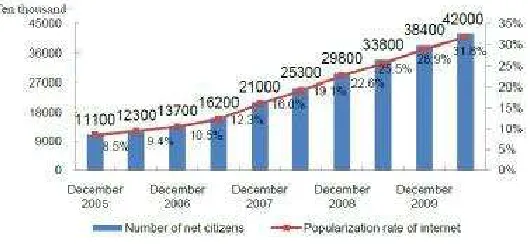
Associated with the development of this national information network, the number of Net Citizens (i.e. users of the Internet) in China has grown up year by year (Figure 1). According to the official data provided by the China Internet Network Information Center10
[image:5.595.176.441.246.370.2], in October 1997, China only had 0.62 million of Net Citizens, and only 0.3 million of PCs could be used to get access to the Internet. However, by the end of 2005, the number of Net Citizens and the number of PCs with Internet access grew to 111 million and 49.5 million respectively. By July 2010, the number of Net Citizens reached 420 million, which accounted for 31.8% of the Chinese population. In addition, Chinese Net Citizens are no longer just using traditional desktop PCs to get access to the Internet. A larger number of them are in fact also using their wireless laptops (36.8%) and mobile phones (65.9%) to browse the Web. With this popularisation rate of Internet usage, China has now become the largest Internet-using country in the world – well ahead of the US.
Fig. 1. Net citizen scale and popularisation rate in China
Source: China Internet Network Information Center, 2010
Apart from the above achievements, the results of informatisation development in Chinese companies are also very remarkable. In particular, all Chinese large-size firms nowadays have computer facilities and company websites. For small and medium-sized enterprises (SMEs), 94.8% of them have been equipped with PCs, and 43% have built their own company webpages, by the end of 2010. Moreover, and according to CCW Research11, IT investments of China’s manufacturing sector reached RMB 24.5 billion in 2004, of which 61% were put on hardware and IT infrastructure building and 39% were spent on information systems development and IT services outsourcing. A more recent survey report of CCW Research12
Overall, such rapid development of informatisation in China results in a very high national demand for ICT products in both organisational and individual levels. This in turn provides the prerequisite for the dramatic and continuous development of China’s electronic information industry.
shows that IT investments of the manufacturing sector increased to RMB 52.9 billion in 2010.
3. THE STATUS QUO OF CHINA’S ELECTRONIC INFORMATION
INDUSTRY
As introduced earlier, China’s electronic information industry contains two essential components, namely the manufacturing sector of ICT products and the software industry.
In fact, China has been the world’s leading manufacturer of a wide range of ICT products. In 2009, the manufacturing sector of the electronic information industry produced 182.2 million units of PCs, 619 million units of mobile phones, 99 million units of TVs, and 41.4 billion units of integrated circuits, which
10
“Statistical Reports on the Internet Development in China”, China Internet Network Information Center, available at:
http://www.cnnic.net.cn/en/index/0O/02/index.htm
11
Zuo, W. (2005). “Informatisation of Manufacturing Sector Became Increasingly Prevalent in 2005” (in Chinese), available at:http://www.people.com.cn/GB/paper 53/13867/1238567.html
12
“IT Investments of the Manufacturing Sector Reached RMB 52.9 billion in 2010 ”, CCW Research, available at:
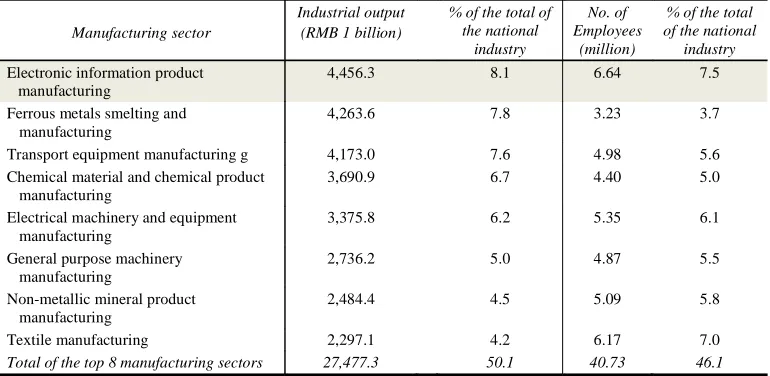
respectively accounted for 60.9%, 49.9%, 48.3% and 12.9% of the total of the world13. Exports of electronic information products grew from US$ 55.1 billion in 2000 to US$ 591.2 billion in 2010, accounting for 37.5% of China’s total exports. A number of domestic electronic manufacturing companies, led by Huawei, Konka, TCL and ZTE, have become increasingly well known in the international market. Furthermore, the industrial output value of this manufacturing sector increased rapidly from RMB 583.1 billion in 1999 to RMB 4456.3 billion in 2009, which represents an average annual growth rate of 22.5% (Figure 2). In 2009, the electronic information manufacturing sector contributed to 8.1% of the total industrial output of the national industry. As clearly shown in Table 1, this represents the highest contribution to the national industrial output value, comparing with the other pillar manufacturing sectors in China in the same year. Moreover, the rapid development of the electronic information manufacturing sector has also created a significant number of jobs in China. For instance, the number of employees of this sector reached 6.64 million in 2009, which accounted for 7.5% of the total of the national industry (Table 1).
Fig. 2. 1999~2009 industrial output value for the manufacturing sector of electronic information products
Source: China Statistical Yearbook in various years
Table1. Comparison of the top 8 manufacturing sectors in China in 2009
Manufacturing sector
Industrial output (RMB 1 billion)
% of the total of the national
industry
No. of Employees
(million)
% of the total of the national
industry Electronic information product
manufacturing
4,456.3 8.1 6.64 7.5
Ferrous metals smelting and manufacturing
4,263.6 7.8 3.23 3.7
Transport equipment manufacturing g 4,173.0 7.6 4.98 5.6 Chemical material and chemical product
manufacturing
3,690.9 6.7 4.40 5.0
Electrical machinery and equipment manufacturing
3,375.8 6.2 5.35 6.1
General purpose machinery manufacturing
2,736.2 5.0 4.87 5.5
Non-metallic mineral product manufacturing
2,484.4 4.5 5.09 5.8
Textile manufacturing 2,297.1 4.2 6.17 7.0 Total of the top 8 manufacturing sectors 27,477.3 50.1 40.73 46.1 Source: China Statistical Yearbook, 2009
13“Bluebook of Informatisation: Analysis and Forecast on China’s Informatisation”, available at:http://www.gov.cn/jrz
g/2010-08/19/content_1683939.htm
583.1 899
1584
2699.4
3922.4
4456.3
0 1000 2000 3000 4000 5000
1999 2001 2003 2005 2007 2009
On the other hand, the software industry as an emerging sector has also been playing an increasingly important and strategic role to the national economy. Sales of China’s software industry increased dramatically from RMB 59.3 billion in 2000 to RMB 583.4 billion in 2007, which showed an annual growth rate of over 30%. This sales figure also accounted for 8.7% of the world’s total in 2007, and made China become the fourth largest IT market in the world14. In 2010, the sales revenue of the software industry reached RMB 1330 billion, which represented 18% of the total sales of China’s electronic information industry. The number of employees engaged in the software industry also increased significantly from 300,000 in 2000 to 2 million in 201015
In sum, the two core sectors of China’s electronic information industry have enjoyed a very high-speed growth during the last 10 years. Given its high contribution to the national industrial output and exports, the electronic information industry is widely perceived as the No. 1 pillar industry for the national economy
.
16
4. GOVERNMENT SUPPORT TO THE ELECTRONIC INFORMATION
INDUSTRY
. In fact, all these remarkable developments and achievements of the electronic information industry would not have been possible without substantial and continuous support from the Chinese government, as discussed further in the next section.
Ever since the 1980s, the government has formulated and implemented a wide range of industrial programs and policies in supporting and promoting the development of the electronic information industry, although only a few can be named here. As one of the significant examples, the National High-Tech Research and Development Program (also known as the 863 Program)17, which was launched in March 1986, specifically highlighted the electronic information industry as one of China’s prioritised development sectors. Moreover, in various Five-Year Plans for National Economic and Social Development18
Most of these policies/programs call for special government funds to be assigned and used to support indigenous research and development (R&D) of core technologies and products in the electronic information industry
, China has continuously placed the electronics and information industry at the top of the national development agenda. A detailed list of some of the recent development programs for the electronic information industry is given in Appendix 1.
19
. In particular, a major fund operated by the Chinese government in this sector is the ‘Development Fund for the Electronics and Information Industry’ (or also known as the IT Fund), which was established in 1986. From 1986 to 2010, the IT Fund supported a total of 3,909 R&D projects with RMB 8.02 billion20
Moreover, in relation to the above government development programs, there is a list of tax benefits and incentives available to China’s electronics information companies, including income tax exemption and
.
14
“China’s Software Industry Reached RMB 583.4 billion”, Ministry of Industry and Information Technology, available at:http://www.ce.cn/cysc/tech/07ityj/guonei/200806/12/t20080612_15807641.shtml
15
“China’s Software Industry Strives to Reach RMB 3000 billion in Sales by 2015”, Xinhua News, available at:
http://www.xinhua08.com/news/cyjj/201103/t20110322_404359.html
16
Gou, Z. (2006). “Innovation in China’s Electronic Information Industry”, China Communications, available at:
http://unpan1.un.org/intradoc/groups/public/documents/APCITY/UNPAN027039.pdf
17
“China’s National High-Tech Research and Development Program, also known as the 863 Program, emerged in 1986 as a response to the growing technological and innovation gap between China and the West […] The main objectives of the 863 Program are to fund technological research and innovation in areas of strategic importance to the nation’s economic and social development”, quoted from Thornley, B., Wood, D., Grace, K. and Sullivant, S. (2011). “Impact Investing: A Framework for Policy Design and Analysis”, available at:http://www.pacificcommunityventures.org/ insight/impactinvesting/report/13-High_Tech_R&D_Program.pdf.
18
China’s Five-Year Plans are a series of economic development indicators. Each plan sets the blueprint, strategies and targets for national economic development for a period of 5 years. China is currently implementing its 12thFive-Year
Plan for 2011-2015.
19
Stewart, T.P. (2007). “China’s Industrial Subsidies Study: High Technology”, available at:http://www.uscc.gov/ researchpapers/2008/TLAG%20Study%20-%20China's%20Industrial%20Subsidies%20High%20 Technology.pdf
20
“The IT Fund led to Remarkable Results in Developing the Electronic Information Industry During the 11thFive-Year
reduction, VAT rebate and exemption, and preferential tariff treatment. For example, China’s software companies can enjoy a full income tax exemption for the first two years after they start to make profits, followed by a 50% tax reduction for the next three years. It is clear that all these tax incentives can help to increase profit margin of electronic information companies in China.
In 2008, the global economic crisis hit hard on the international market and China’s national economy. As a result of this financial crisis, in the second half of 2008, China’s export growth rate of electronic information products slowed down considerably. Sales income of many subsectors in the electronic information industry showed a significant decrease and even a negative growth rate. Many leading domestic companies in the sector also reported operational and financial difficulties. In response to these severe challenges, in April 2009, the State Council released a new Revitalising Plan for the Electronic Information Industry 2009-2011. This revitalising plan provides a set of development guidelines in seven key areas, namely increasing national demand of electronic information products, increasing state investment and policy support, improving investment environment, supporting mergers and acquisitions, exploring further the international market, and enhancing indigenous innovation21
Overall, by reviewing these major government plans and policies available to the electronic information industry, it became clear that China has made very substantial effort to improve indigenous innovation and increase profit margin of domestic electronic information companies, as well as to overcome the negative effects of the global economic crisis on this sector. However, none of these development programs have specifically addressed environmental and pollution issues associated with the production, use and disposal of ICT products. In fact, these environmental problems have existed for a long time and are actually unavoidable with increasing use of ICT products in the information society. Although the central government are aware of these problems and are attempting to deal with them, the results are still to be seen. Moreover, given the size and the fluid situation of the country, these environmental challenges are actually very difficult to handle.
.
5. GREEN CHALLENGES OF THE ELECTRONIC INFORMATION
INDUSTRY
Owing to the rapid industrialisation and modernisation, pollution issues in China have become increasingly apparent. In particular, according to official statistics provided by the Netherlands Environmental Assessment Agency, China’s CO2emissions were still 2% lower than the emissions of the US
in 2005. However, in 2006 the CO2emissions of China have surpassed those of the US by 8%. China has
thus become the world’s largest CO2emitting country22. Since then, China’s CO2emissions have kept going
up rapidly. As shown in Figure 3, the CO2emissions of China reached 7,711 million tonnes in 2009, which
were larger than the total of US, India and Canada, and were up by 171% since the year 200023
Gartner (a very well-known international consulting firm) estimates that the global electronic information industry is responsible for 2% of global CO2emissions – a figure equivalent to the aviation industry
.
24. In
China, it was estimated that the CO2emissions of China’s electronic information industry accounted for 2.4%
of the total of the country in 2007. It is also estimated that by 2020, this industry will produce 415 million tones of CO2emissions, which represent 3.0%-3.3% of the country’s total25.
21“Planning on Adjusting and Revitalising the Electronic Information Industry”, General Office of the State Council,
available at:http://www.lawinfochina.com/law/displayModeTwo.asp?id=7420&keyword.
22“China now no.1 in CO
2emissions, USA in second position”, Netherlands Environmental Assessment Agency, 2007,
available at:http://www.pbl.nl/en/dossiers/Climatechange/moreinfo/Chinanowno1inCO2emissionsUSAinsecondposition
23
“World carbon dioxide emissions data by country: China speeds ahead of the rest”, Guardian, available at:
http://www.guardian.co.uk/news/datablog/2011/jan/31/world-carbon-dioxide-emissions-country-data-co2#
24
Gartner (2007). “Gartner Estimates ICT Industry Accounts for 2 Percent of Global CO2Emissions”, Gartner Press
Release, available at:http://www.gartner.com/it/page.jsp?id=503867
25
Fig. 3. A world map of CO2emissions (adapted from Guardian23, 2011)
The increasing amount of CO2emissions of electronic information industry in the world in general, and in
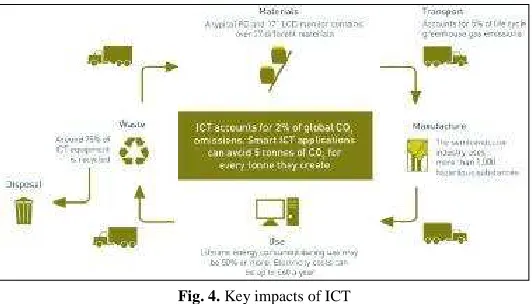
China in particular, is attributed to a wide range of pollution issues that can occur when manufacturing, transporting, using and disposing ICT products, as illustrated in Figure 4.
Fig. 4. Key impacts of ICT
Source: James and Hopkinson, 200926
As also discussed earlier, the production of many ICT products and related components are very resource-and energy-intensive. For example, a study of the United Nations University found that the manufacturing process of a desktop PC with 17 inch monitor requires the use of 1.8 tons of total materials and natural resources, including 240 kilograms of fossil fuels, 22 kilograms of chemicals, and 1,500 kilograms of water (this amount of resources is equivalent to those required to produce a mid-size vehicle)27. Moreover, a report from the European Commission identified that the average power consumption of a laptop is about 97.34kWh per year28
26
James, P. and Hopkinson, L. (2009). “Sustainable ICT in Further and Higher Education”,: A Report for the Joint Information Services Committee (JISC)”, available at:
. This amount of power consumption can result in 38.94kg of CO2emissions23. The
http://www.jisc.ac.uk/media/documents/publications/ rptgreenictv1.pdf
27
Hoang, A., Tseng, W., Viswanathan, S. and Evans, H. (2009). “Life Cycle Assessment of a Laptop Computer and its Contribution to Greenhouse Gas Emissions”. In Proceedings of the 8thWorld Congress of Chemical Engineering, Quebec,
Canada, 23-27 August, available at:http://archivos.labcontrol.cl/wcce8/offline/techsched/manuscripts%5Ceipzav.pdf
28
[image:9.595.172.438.363.515.2]total CO2emission of a desktop PC with a 17-inch monitor was even estimated to be 0.1 tonne per year29
Furthermore, with increasing consumer demands for new functionality, the lifecycle of ICT products has nowadays become much shorter. When these ICT products come to the end of their lifecycle, their disposal and recycle are also fraught with problems and difficulties. In particular, the recycling process of million units of ICT products will inevitably emit CO2.More importantly, ICT products always contain harmful and
toxic substances (such as lead and mercury) and therefore should never be thrown out conveniently. Unfortunately, rather than being properly collected and recycled, many ICT products may very often just be dumped in landfills, e.g. 92% of obsolete laptops ended up in landfills and only 8% got recycled in the US
. Given the fact that China manufactured 182.2 million units of desktop PCs and 150 million units of laptops in 2009, the amount of CO2emissions during production and use of these ICT products would be enormous.
30
. Worse of all, most discarded and toxic electronic waste (e-waste) from developed countries has been shipped overseas to Asian developing countries, e.g. China and India. It is estimated that 70% of e-waste in the world has been illegally imported to China every year31. Plus 2.3 million tonnes of e-waste generated domestically32
6. GREEN ICT: A STRATEGY FOR SUSTAINABLE USE OF ICT
, China has been facing very significant environmental threats.
Due to the complicated and multifaceted nature of the above environmental challenges, it is clear that no single endeavor would be sufficient in making a substantial effect towards improving them. In order to enable more environmental-friendly use of ICT products, a combined effort is required, including government instructions, inter-disciplinary academic research, industry-wide collaboration, and extensive social awareness33
6.1 What is Green ICT?
. Consequently, ‘Green ICT’ emerges in recent years as a holistic strategy that can involve stakeholders from different areas to work together to achieve green and sustainable use of ICT.
Green ICT is a strategy that can be implemented across the entire lifecycle of ICT products, from design and development, to use, and to disposal of ICT equipments. It aims to achieve green and sustainable use of ICT in the information society, as well as to help reduce the 2% of global CO2emissions generated by the
global electronic information industry. In addition, efficient and sustainable use of ICT can also in turn contribute to the reduction of the remainder 98% of CO2emissions for the whole global economy.
As a fairly new concept emerged in the West, it is hard to find a universally accepted definition of Green ICT. In order to capture the rich meaning and all essential aspects of this term, by considering the definition given by Murugesan34and Elliot35, this paper defines Green ICT as:
The strategy, study and practice for designing, producing, using and disposing ICT products and related components and accessories, in an efficient and environmental-friendly manner, to minimise harmful effects and achieve sustainable use of ICT in the long term.
http://extra.ivf.se/ecocomputer/downloads/EuP%20Lot%203%20Task%201-7,%20draft%20report.pdf.
29“What is Green Computing”, RK Incoporation, available at:http://kanthinc.com/green/gtech2.html
30
Matthews, S.H. and Matthews, D.H. (2003). “Information Technology Products and the Environment”. In: Kuehr, R. and Williams, E. (eds.). Computers and the Environment: Understanding and Managing their Impacts, Kluwer Academic Publishers: Dordrecht, Netherlands.
31
“70% of Electronic Waste in the World has been dumped in China”, Xinhua News, available at:http://news.xinhuanet. com/fortune/2006-12/04/content_5429353.htm
32
“UNEP: China will be the Main Source of E-waste”, ChinaTechNews, available at:http://www.chinatechnews.com/ 2010/02/25/11623-unep-china-will-be-the-main-source-of-e-waste-this-year
33
Yousif, M. (2009). “Keynote: Towards Green ICT”, European Research Consortium for Informatics and Mathematics (ERCIM) News, 79, pp. 3, available at:http://perso.ens-lyon.fr/laurent.lefevre/Documents/ERCIM_79.pdf
34
Murugesan, S. (2008). “Harnessing Green IT: Principles and Practices”, IEEE IT Professional, 10 (1), pp 24-33.
35
Elliot, S. (2007). “Environmentally Sustainable ICT: A Critical Topic for IS Research?”, In Proceedings of the 11th
When coming into actual practice and implementation, Green ICT is in fact a very big ‘umbrella’ that covers a wide range of collaborative activities, of which a few are given below:
In the design and production stage, ICT technologists, developers and manufacturers should attempt to reduce the use of harmful substances by investigating new alternative materials or solutions. Further research can also be carried out to explore innovative designs and technologies for maximising energy efficiency during the product's lifetime. Current production and transportation models of manufacturers should be reviewed, evaluated and improved in order to reduce power consumption and carbon footprint during these processes.
In the use stage, modern ICT-intensive organizations (especially large and medium-sized companies across all industries, banks, universities, government institutions, and hospitals) should develop and implement a set of internal policies and initiatives to enable energy-saving and environmental-friendly use of ICT. Some basic Green ICT activities being adopted by leading global companies (e.g. Microsoft, Google, HP, GE, Toyota and Fujitsu) include:
o setting double-sided printing as the default for all office printers (to save unnecessary paper waste);
o encouraging video conferencing meetings across geographical locations (to reduce travel cost and related carbon footprint);
o purchasing ‘Energy Star’ qualifying PCs36
o switching off building (and thus PC) power after office hour (to reduce power consumption); (to reduce energy cost);
o outsourcing databases, servers, and IT applications to third-party IT firms in a cloud computing
environment37
In fact, many of these practices (e.g. using double-sided printing, switching PC off when it is not in use) can also be implemented by individual consumers at home.
(to reduce the number of servers required and simplify the IT infrastructure).
In the disposal stage, obsolete ICT products need to be properly collected and recycled. Manufacturers and distributors of ICT products can establish certain reward schemes (e.g. offering cashback or giving discount for the next purchase) to encourage consumers to trade in any unused ICT equipments.
It is evident that all these collaborative Green ICT activities would be difficult or impossible to implement without appropriate support, encouragement and even control of the government. However, more detailed and comprehensive government guidelines and plans are still to be seen, in the world in general and in China in particular, to facilitate the implementation of Green ICT strategies across different stages of the entire lifecycle of ICT products.
6.2 Implementing Green ICT in China
As one of the most prevalent discussion topics in the world, Green ICT has attracted increasing attention of the Chinese government in recent years. However, implementing Green ICT in China is not an easy task owing to at least three main reasons.
First, as an emerging concept, Green ICT has not been widely known by the Chinese society. According to a survey conducted by CIO Insight China in 200838
36
The Energy Star program was released by the United States Environmental Protection Agency (EPA) in 1992 and was then revised in 2006. According to the EPA, Energy Star qualifying PCs will be 65 percent more efficient than conventional ones.
, 65% of Chinese Chief Information Officers (CIOs) have not heard about Green ICT. Among the remainder 35% of Chinese CIOs, 25% stated that their organisations have not yet planned for any Green ICT projects. Interestingly, the survey also found that 48% of these Chinese CIOs have not received any information about Green ICT from their IT system and service
37
Cloud computing refers to an emerging and innovative model for enabling convenient and on-demand access to a pool of shared computing resources (e.g., databases, servers, IT applications and services) through the Internet.
38
providers. This finding clearly indicates a need for IT vendors to put more substantial effort in advertising and promoting Green ICT to Chinese companies.
Second, under the increasingly competitive market conditions in China, some Chinese companies may very often be driven by short-term and immediate economic results. Also due to a lack of awareness, some Chinese CEOs, managers and employees may not be interested in cooperating with the government on environment protection. This can present significant barriers and resistance in implementing Green ICT projects in Chinese firms.
Third, it is widely acknowledged that China’s industrialisation and economic development has significant inequality between different cities and regions. Citizens in some less developed and rural areas may have less awareness of environment protection. In light of this, China’s western regions have become the base of a large amount of toxic electronic waste. Given the current economic development status, the situation in these regions is more difficult to control and manage.
In sum, although Green ICT has the potential to significantly reduce ICT carbon footprint, its implementation in China is still fraught with challenges and difficulties. More should be done to promote the concept of Green ICT to the Chinese society, as well as to put it into actual practices.
7. CONCLUDING REMARKS
APPENDIX 1
No Programs Issuing Agency Issuing Date
1 The 11th Five-Year Plan & 2020 Mid- to Long-Term Plan for the Science and Technological Development of the Information Industry
Ministry of Information Industry (MII)
August 2006
2 The 11th Five-Year Plan of Foreign Trade in the Electronics and Information Industry
MII 2006
3 Opinions on Accelerating the ‘Giant Company’ Strategy in the Electronics and Information Industry
MII 2004
4 Development Policies on the National Electronics and Information Industry Bases and Industrial Parks
MII August 2006
5 Provisional Measures for the Administration of the Development Fund for the Electronics and Information Industry
Ministry of Finance (MIF), MII
July 2001
6 Cooperation Agreement on Development Financing to Support the Development of Information Industry and Application of Information Technologies
MII, China Development Bank (CDB)
December 2005
7 Several Policies for Encouraging the Development of the Software and Integrated Circuits Industry
The State Council June 2000
8 Tax Policies on Further Encouraging the Development of the Software and Integrated Circuits Industry
MII, State Administration of Taxation (SAT)
October 2002
9 Action Plans on Promoting the Software Industry (2002-2005)
The State Council July 2002
10 Provisional Measures for the Administration of the Specific Project Funds for Research and Development of the Integrated Circuits Industry
MIF, MII, State Development and Reform Commission (SDRC)
March 2005
11 Preferential Tax Policies to Support the Development of the TFT-LCD Industry
MIF, STA February 2005
Source: Stewart, T.P. (2007). “China’s Industrial Subsidies Study: High Technology”. Available
at: