rl
I
a
ooo
o
O
OO
ooooaoo
o
o
\
o
o
o
ooo
ooo
rY]
\
/
ti
t)
rr
r\
I]
Contenls
Note
of the Editor
Contact
with
USERS
Users
Group
Sutistics
on computer
utilization,
May
utilization
by obiectives and accounts, May
Table
of
Equivalent
Time, summary per month
and cumulative
ftoject
COST
11
-
European
lnformatics
Network
Implementation Architecture
Note
to the
Users2
3
3
8
9
10
11
lrlote
of the
EditorThe present Newsletter is
published monthly oxoept for August
and December.
The Nervsletter includer:
.
Oer,elopmont3, changE, wes of initallations.
Announce[EnB, news and abtract3 on initiativB and accomplbhmenG.The Editor thanks in advmce tho6e uvho
urant to
cmtribut
to the N€vslefaerby rnding articles in Englirh or French
to one of the folloring percons of the Editorial Board.
Editorial
Board/
Comit6 de R6dactionH. de Wolde, D.G. lspra
C. Pigni, C.C. lspra
J. Pire, C.C. lspra
@nsulant: S.R. Gabbai, D.G. lspra
Note de !a R6daction
Le pr6sent Bulletin ert publid nunruelle.
rnent exoeptd durant lee mois d'aoot et
d6cembre.
[c
Bulletin traite der:o
DdveloppemenB, changemens etemploi des
d6
in3tallationso
Avis, nouralla et r6urtdr oonoemantlen initlatitos et les r€alisatiqrs.
ll
R6daction renrrcie d'avance ceuxqui veulent Uen contribuer au Bulletin
en envoyant
dc
articles en anglair oufrangais il l'un des rnember du Comitd de Rddaction.
Computing Centre Ref erences
fubnager
Adioined @mpu@r Room
Adjoined
Peripherals System Group
Adioined
lnfontutia
Supporto General lnformation
o Program lnfornntion Service
Adioined
o Graphics and Support to Users
Adroined
Application Packages
Programming Languages
Room
T6l.J.
Pire
1816
732G.
Gaggero
18?4
787P.
Tomba
1857
797A.
Binda
1857
797G.
Nocera
1825
767D.
Koenig
1839
742P.A.
Moinil
1841
7O4G.
Gaggero
1874
787G.
Hudry
1873
787G.
Gaggero
1874
787S. Leo
Menardi
1884
721H.l. de
Wolde
1890
753A.
Pollicini
1882
743A.
lnzaghi
1887
755C. van den
Muyzenberg
l8zt8
781Editor : Sylvie R. Gabbai
Layout : Paul De Hoe
Contact
with
USERS
Hans Jdrgen Helms
As
I
had occasionto
emphasizein
a previousarticle
in
this
Newsletter, aclose and constructive contact between the Computing Centre and its users is essential
for
obtainingthe
maximumbenefit from
the ressourcesavaila-ble, and
to
allow the computing oentreto
provide the bestposible
service.The
Nerysletteris one instrument
which
allows such contacts,but
other initiatives are also neoessary.ln
this spirit,
a
USERS GROUPcould
developinto
aforum
for
a properexchange
of
vievvson the
service providedat
present, and plannedfor
the future.Moreover,
the
USERS GROUPwill
provide the computing centrewith
aforum where the background
to
ir
decisions can be explainedfor
the usersin a more detailed way than is possible in
written form.
It
isin this
contextthat
I
considerall
initiativeswhich
can leadto
better contact between the oomputing centre and its users as most welcome.Users
Group
(U.G.l
J.P.
Halleux
(Provisional Secretary)For
morethan
oneyear now,
you
reoeivethe
Computing CentreNews-letter.
lt
representsone
of
the efforts
done
by the
Computing
Centre(C.C.) tormrOs an
optimum
communicationwith
the
users.An article
byMesrs.
De Wolde, Pigni andPollicini ("Support to
Computing",C.C.Neua-letter
No.11)
describedthe Division lnformatique
as composedby
three services, oneof
them,
the
lnformatics' Support,
being useroriented.
A
zubgroup
of
this
service,the
Supportto
Computing has been plannedfor
the regular
contact
with
the
users.This
unit
is busywith
helping the userof
computing facilities
for
all
informatic
problems he encounters whenvrorking
with
thesefacilities.
Moregererally it
also helpsto
f ind adequate methodsfor
solving the problems.It
is
moreor
les
a
"how to
use" and thuscertainly
is indispensablefor
ensuring the eff iciencyof
computer use. As conf usion should be avoided,it
might be useful
to
repeatthat the unit
Support
to
Computing is notintended
for
doing theiob of
the users!
.Of
course,not
only
practical, daily problemsare encounteredby
theuser-Often
problems are involvedin
the fundamental aspectsof
the
computerinstallation;
it
is
clearthat
the politics
of
developmentof
the
C.C. has adefinite
impact
on the
performanceof
the
machinesin
the
frarneof
thework
askedto
them. Also, when defining
a
developmentpolicy
of
theC.C.,
the
managementof
the C.C. triesto
integratethe
users' needs. Andright
here thedifficulty
begins. Howto
know the
users'nee&?
There isno
user organization providingfor
efficient interlocutors.
The C.C. hasto
ask
the
userindividually,
or uke
indirect information or
guessthe
needsfrom
theextrapolation
of
presentworks,
or use the disparateinformation
received
by
the Supportto
Computing and so on.This
representsa
lot of
work
and
it
cannot
be expectedthat the
C.C. spendstoo
muchtime
and competenceon
it,
insteadof
doing
its current job.Furthermore
when
the
C.C. wantsto
discuss a general problemwith
theusers
or to
transferinformation
to
them, they
cannot find
any ready and recognized representativesof
the
users. So,in
November 1976, Mr-Helmsraised
the
ideaof
creating such a users'representation (called users'group) and asked afew
interested users to prepare a proposition accordingto
thefollowing
general guidel ines:-
The Users' group should providefor
aforum
whereall
maior problems related to computers can be discussed.-
lt
should be composedby
representatives chosen amongst the users ofcomputing facilities.
The
memberswould
be designatedby their re
spect ive directions or departments.
-
Peopleworking
for
the
computer centre, thoughnot
membersof
theUsers'group,
would
be invited to attend the meetingsto
bring scientif icsupport and
to
propose their solutionsto
the problems raised.- lt
is
proposedto
limit the
numberof
participantsto
ensure theeffi-ciency
of
the group.Unfortunately and
surprisingly,an
unexpecteddifficulty
arised: mostof
the users showed a great indifference.
Claims are available, but constructive critics are desperately missing!
Newrtheles
it
wasposible
to set up a preliminary users' group and a hardwork
began,of
coursenot from
the
point of
viewof
actual realizations,because - due
to
the provisionalaspect of the group -it
was notposible
andwould
not
have beenfair to
take decisions;it
was hardin
theattempt
to
show
that
it
is indeed possibleto
create an enhanced and prof itable stateof relations between C.C. and users.
As a result
it
can be noticed:-
the
developmentof
a
naturalflux of
information from
the C.C. to the preliminary users'group on allwhat
is going on in the C.C.,-
the existenceof
good climatefor
discussionwith
the C.C..-
a
collaboration continuously offered
by the
C.C.to
the
preliminary users'group during the last months.It
is hopedthat
this
will
convinceall
usersto join
the
action and providefor what is mising until now: the final
flux
from
and towardsthe
user himself .It
is
clearthat
for
the
user there is no advantagein the
present situationbecause the
wall
between C.C. and usersstill
exists:
it
haslust moved. To getit
removed is nowa matter that
depends exclusively upon the user!
.So
if
you
area
userand
if
you are now actively interested in the idea of ausers'group,
join
the next meeting organized by the preliminary group and brringyour
opinions
and your critics
to
animate
a
discusion
which
ishoped
to
be positive and creative.lf
the hopesare goingto
be turnedinto
reality
depends asalready
stated,definitely only
uponyou
:
there can be no eff icient users'groupwithout
users!
.The Newsletter is available
at:
Mrs.
A.
CambonSupport
to
Computing Blds. 36 -Tel.
730Des exemplaires du Bulletin sont disponibles chez:
Mme
A.
CambonSupport
to
ComputingBat. 36 -
Tel.
730Propositim
for
the
Statut of a Permanent Urers' Group(U.G.l
ConcerningGomputirg
Facilities at JRC lrpra(Elaborated by a Preliminary Group
of
Users*)Part 1: ObietiYcr
The U.G. is intended
to
providefor
a forum whereall
maior foblems related to@mputers can be discussed. lts f irst aim is to ensure an optimal computing srvice by
promoting the exchange of id€asbetween the computer centre (C.C.l and the users of
computing facilities.
The U.G. is nota group of specialists in informatics,
it
is the retural emanation of theraers' community.
lt
is thus composed W repres€ntatives exclusively chosen amongstthe users of comprting facilities, only the personnel of the C.C. being excluded.
A
very simple organigramme visualizing the link betureen the C.C. ard the U.G. isproposed:
CFEATION OF
WOBKING GROUPS
CONSULTATION
Part 2: Tasks
ln connection with the principal aim of the U.G. (i.e. inforrrntion and consultation
with the C,C.l some def inite tasks should be given to the U.G. in order to ensure his
usefulness:
1. Collectron, elaboration and definition
of
the Users'needs (with e\,entualpriori-ties).
2
Checking of the eff iciency of computer use.3. Action on the daily manageinent of the C.C.
4.
Elaborationof
propositionsfor
the de\reloprnentof
computing Iacilities withinPart 3: Rules
1. The U.G. is composed by a maximum
of
15 representatives chosen exclusivelyamongst the users of computing facilities (called "users").
2. The nominati\re list of the users and the appointing procedure aredefined by the
Directorate on proposition of the U.G.
3. The obiectives and tasks
of
the U.G. are definedin
Parts1
and 2of
the U.G. Statut.4.
The U.G. designates 4of
its members to form a steering committee (1 secretaryand 3 substitutes). Only the secretary or his substitutes can speak and acr in name
of the users' community.
5.
The U.G. itself decides on its internal organization.6.
At
least 6 times ayar
lt.i..
January, February, March, May, June, September,October and November), ihe U.G. organizes its meeting with the Computer Centre
(C.C.). Both the C.C. and the U.G. decide
on
the "Ordre du Jour"of
these meetings.7.
The U.G. may propose to change its Statut. The rmdif ications becorne effective only if and when approved by the Directorate.8.
Transient disposition: the first U.G. is composed by the rnembers of thePrelimi-nary U.G. (see list of participating persons below*) , Ne\
/
rnembers for this firstU.G. are welcomed any time.
'
@mpsition of the $eliminary group:Mrs. Actis Dato Direction du Site Mr. Haenen Dept, A
Mr. Biggio Dept. B
Mr.Capobianchi Dept, A
Mr. Dorpema Dept. A
Mr. Eder Dept. B
Mr. Fangmeyer Oept. A
Mr. Halleux Dept. B
Mr. Kn5ppel Oept. C
Mr. Kolar Dept. B
Mr. Riesch Oept, B
Mr, Town Dept. C
Statistics
of
computing installation utilization
Report
of
computing installationexploitation
for
the month of MayNumber of norking days
Work hours from 8.00 to 24.00for Duration of scheduled rnaintenance
Duration of unexpected meintenance
Total maintenance time Total exploitation time
CPU time in problem mode
Convestbnal SYtemr
CPU time
l/O number
Equivalent time
Elapsed time
Batch processing:
Number of iobc
Number of cards read
Number of cards punched
Number of lines printed
Number of pager printed
YEAR 1977
18d
16.00 h
21.@ h
G).76 h
90.84 h
199.16 h
104.64 h
2.65 499,0q) 6.15 211
6,$7
1,8@,mO 140,m0 20,3D3,m0 454,(x)OYEAR 1976
20d
14.00 h
23.45 h
2.75h 26.20h 274.80h 120.62h 1.9) 581,m0 5.37 157.50 8,3C2 2,853,000 153,m0 23,351,(nO 524,ofl) BATCH PROCESSING DISTRIBUTION BY BEOUEST€O COBE MEMOBY SIZE
loo
2Oo 3oO
4OO
600
8OO 1O0Ot4O0
rordNumber of iobc
1612
2fi7
1220
696
131 58 13 6237E3apred
tirle
(hrslG' 194
135135
52 17 2.5 575CPU time (hrsl
23323
22 15 0.6 102Equivalent time
(hrsl 12 59
44 52 21 0.9 197Turn around tim6
(hml
0.9 2.4
3,1 3.7 4.8 7.1 2.6 2.4 PERCENTAGE OF JOBS FINISHED IN LESS THANt5' 30' th 2h
4h gh 1D2D
3D 5D %Vear 197642.2
@.1
75.s
88.O
96.2 98.9 99.3
100%vear
1977
29.4
46.1
62.8 77.6
87.9
94.2
97.3 99.4 99.5
1OOTIME
tltilization of
@mputercerter
by theobiediu$
andappropriatbn
ac@untrfor the
lmnth of
MayrBM $101165 equiualort tamo an hour3
1.2O.2
General Services - Administration-lspra 24.521.20.3
General&rvices
- Technical-lspra 1.761.30.4
L.M.A. o.o21.90.0
ESSOR 9.451.92.0
Supportto
the Commission 5.132.10.1
Reactor Safety84.43
2.10.2
Plutonium Fuel andActinide
Researcft 4.182.10.3
Nuclear Materials 2.622.20.1
Solar Energy 0.592.2O.2
Hydrogen 0.012.20.4
Design Studies on Thermonudear Fusion o.442.30.0
Environment and Resources 13.852.4O.O
METRE 3.052.50.1
Data Processing 29.982.5O.3
Safeguardso.v
TOTAL
180.S'
1.94.0
Servicesto
External Users 13.27TOTAL
193.64EOUIVALENT TIME TABLE FOR ALL JOBS OF THE GENERAL SERVICES - Monthly
.rd
Grmulative StarisricrJanuary February March April May June July
August
Septe.mber'October
November Dec6mb€r59
36
46712
748
79484
a4
61
653
101
77
57
il
73
54267
344
40r
465
538
59282 166 Year 1976
sccumulation
Year 1977
accumulation
44
44
118
74
195
78
228
32
25426EOUIVALENT TIME TABLE FOR THE JOBS OF ALL THE OBJECTTVES AND GENERAL SERVICES - Monthly and Cumulativa Statistica
January February March
April
May
June
JulyAugust
September
October
November Decembar Year 1976accumulation
Year 1977 accumulation 241 954 270 713 206 206 237 443 229
1 183
248 1431 249 1680 223 1903 233 2136 2380 150 2539 1689 t35
135 353 665 8s8 r038
EOUIVALENT TtME TABLE FOR THE JOBS OF THE EXTERNAL USERS - Monthly and Cumulative Statistics
January February March April May June July
August
September
October
November December31
29
12221
250 26228
16
25
32
14
11
2765
81
106
138
152
163
190rJ
37
t8
18
Year 1976
accumulation
Year 1977
accumulation
13 74
18
1645
6r14
27
13 13
EOUIVALENT TIME TABLE FOR ALL JOBS OF ALL USERS - Monthly and Cumutative Statistics
January February March April May July
August
September
October November DecemberYear 1976
accumulation
Year 1977 accumulation
233
271233
504313
817
280
1 097
277 1374
260
1915
245
21 60
273 2433 287 2720 206 1926 172 3098 314 713 158 158 202 1157 399 95s June
hoject
COST
11
-
European
lnformatics
Network
I
mplementatbn Ardritecture
K. Weaving
This
isthe
secondarticle
in a series describingthe work
beingperforned
on
the project, andwill
describethe
software system andtools
q.rrrentlyused and developped on
the
IBM 370 particularlyfor
ElN.System Environmem
The EIN
softwares/stem
runs ina
userpartition in
the 370under
HASPand currently ocatpies
300K
of
memory.
Thernaiority
of
the
system is'written
in
PL/l
usingthe
multitasking facilities wftichallow
Inany tasksto
be
executd
assynchronously.ln
orderto
reduce the amountof
rnemoryused,
the werlay
facilities
of
the linkap editor
are
used,whicfr
causesprocedures
to
bekept
on disk andonly
broughtinto
core whenthoy
needto
be executed. This obviously incurs sorne additional owrhead dueto
thetime taken
in
bringingthe
procedurefrom
disc, so the
mostfrequently
used procedur€xi are permanently resident
in
core.This
isonly
necessary becausethe
EIN
systemruns
in
realtime
where certain actions must bepeformed within
a certaininterral
of real tirne (i.e. "elapsedtime").
Softmre
Ardrhecture
The
design approachis
to
implement eachprotocol
as avirtual
machinerunning
in
a software environment whichprwides
thefollowing
facilities:-
intermachine communication-
synchronisation and exclusion-
timeout
handling-
store management.A
data
base system producedlocally forms the
basisof
the
softwareen-vironment,
additional
code having beenwritten to
give a setof
primitir,eswhich can be
usedbv any virtual
machinewithout
knowing
they
are dealingwith
a data base system.The external atributes
of
avirtual
machine are simply an input queue andan
event.
A
virtual
nncfrine can be defined
asa
processwftich
has noexternal rariables, and is therefore completely self
sufficient.
lt
reactsto
commands
which
it
takesfrom
its
input
queue performing aet
of
pred+fined
actionsfor
each command depending on its current state. The virtualmachines communicate
only by
the
exchangeof
commands usingther
input
queues. Where large blocksof
data areto
be exchanged, the data isstored
in
the dat+base, andonly
the addresof
thedau
is included in thecommand.
The
event
is
usually associatedwith the input
queue,so
that
when
itsinput
queue
is empty, the
machinewill
wait on the
event.Any
othermachine
putting
a commandinto the
input
queuewill
cause the eventto
be set. The dormant
machinewill
then be
woken
up
to
process thecommand.
To communi€te
with a
machine,all
that
need be knownabout
it
is its command set and replies(if
any).Vartusl Macfiines
Three types
of virtual
rnachine have been identif iedwithin
our design.The
first,
and simplest is theprotocol
machine (usuallya protocol
imple-mentation) which
hasits
queueas
itsonly
sourceof
input, and
its onlyoutput
are commandsto
theinput
queuesof
other machines.The second
type
is theoutput
machine, which has a queue as itsinput,
but itsoutput
goesto
an external ressource (e.g. aprinter).
Thethird
type
isthe
input
machinewhich
takesits input from
an external ressource (e.g. akeybmrd)
and itsoutput
isto
queuesof
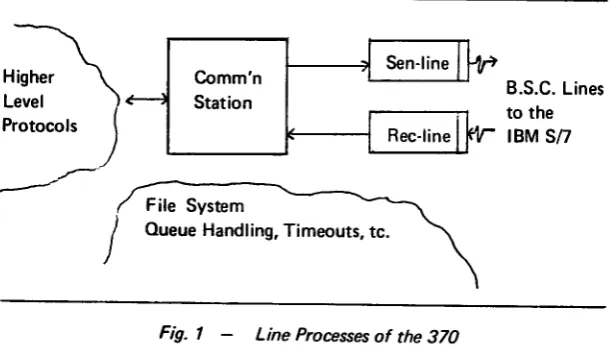
other machines.Tlp
line control
section
of
the
Network
Control
programis shown
inFig. 1. As can be seen. this section contains three machines, one of each
of
fie
types described above.B.S.C. Lines
to
theIBM SI7
File
SystemI
Oueue Handling, Timeouts,
tc.
[image:14.413.57.364.355.531.2]The
machine REC-LINE receivesthe
messagesfrom
the System/7, storesthe
messagetext
in
the
data-basethen
queuesa
RECEIVE-PACKET commandto
the
CommunicationStation.
lt
waitscontinually
on the line and hence has no needfor
an input queue, being aninput
machine.The machine SEN-LINE pro@sses
its input
queue which canonly
containNvo types
of
command,TERMINATE
and SEND-PACKET.ln
the case of SEND-PACKET,it
constructsthe
packetfrom
the
data whose addressesare given
in
the comnunds and sendsit
down the line. This isan exampleof
anoutput
machine.The remaining
virtual
machinetype isexamplified
by the CommunicationStation.
This
isthe
implementationin
the370
of
the HDLC protocol of
the subnetwork node.
Timeouts
No real time
system ctrn runwithout
usingtimeouis. tn the EIN
Systemrnlre
have
implementeda
timer
processin
PL/l
asa virtual
nnchine,
al-though
it
is considered as partof
the software environrnent.When requesting
a
timeout,
a
machine specifiesthe time
to
elapse, thecommand
to
be generated whenthis
time has elapsed, and the rnachineto
which
the
command isto
be queued (this is usually itself, but thepossibi-lity
existsfor
it
to
be anothermachine)
Timeouts cannot be cancelled assuch,
but the
command generatedwhen the timeout
has elapsed can beignored. For example,
a timeout
is usually setto
protect a
machinefrom
sitting indefinitely
in a particular state.lf
the machine changes state beforethe timeout
elapses then theaction
prescribedfor
thetimeout
in the new stateis "drop
it!
".
Praaical Conclusions
This type
of
implementation has allowed usto
develop software which iseasily modifiable.
This
arisesfrom the fact that
each
machine has norelations
with
the
others exceptthe
commands which are passed betvr,eenthem. The interface
between machinesis therefore limited
to
the
setof
commands.
For this
reasonalso,
the
systemis
easilyextended
by
theintroduction
of
new
machines havingonly a few
fundamental rulesto
respect.
Noto
to
tfre UsersDue
to
reasons beyondthe control
of
the
involved people aninformation
meeting on the time-sharing system TSO which was scheduleci
for
June 20,1977
could
not
take
place.This
meeting
is now
planned
fot
tues&y
September
27,
O9.OOh
in
the amphitheatreof
the
CETIS.All
users wttointend
to
useTSO
in
the future
are invitedto
come.All
users'presentlyrsing the
PSO/FlLED|
system are recommendedto
come.D.
K6nigThe Editorial board invites you
to
answer
the questions
appearing
in the
form on
page23
of the
No. 11
issue.Les
personnes int6ress6es
et
d6sireuses
de recevoir
r6gulidre-rrEnt
"Computing
Oentre Newsletter" sont
pri6es
de
remplir
le
bulletin
suivant et de l'envoyer
dMme
A.
CambonSupport
to
ComPutangBet.36,
Tel. 7fl1
Nom
.Tel.
The
persons
interested
in
receiving regularly the
"Computing
Centre
Nencletter"
are requested
to
fill
out
the
following form
and
tosend
it to:
Mrs.
A.
CambonSupport
to
ComF ting
Building
36,
Tel. 730Nom
.
...
.
Address