This is a repository copy of Structural reforms in the railways: Incentive misalignment and
cost implications.
White Rose Research Online URL for this paper:
http://eprints.whiterose.ac.uk/82988/
Version: Accepted Version
Article:
Nash, CA, Smith, ASJ, van de Velde, D et al. (2 more authors) (2014) Structural reforms in
the railways: Incentive misalignment and cost implications. Research in Transportation
Economics, 48. 16 - 23. ISSN 1875-7979
https://doi.org/10.1016/j.retrec.2014.09.027
[email protected] https://eprints.whiterose.ac.uk/ Reuse
Unless indicated otherwise, fulltext items are protected by copyright with all rights reserved. The copyright exception in section 29 of the Copyright, Designs and Patents Act 1988 allows the making of a single copy solely for the purpose of non-commercial research or private study within the limits of fair dealing. The publisher or other rights-holder may allow further reproduction and re-use of this version - refer to the White Rose Research Online record for this item. Where records identify the publisher as the copyright holder, users can verify any specific terms of use on the publisher’s website.
Takedown
If you consider content in White Rose Research Online to be in breach of UK law, please notify us by
Structural reforms in the railways: incentive misalignment and cost
implications
Chris A. Nash a*, Andrew S. J. Smith b, Didier van de Velde c, Fumitoshi Mizutani d and Shuji Uranishi e
a Institute for Transport Studies, University of Leeds, UK
b Institute for Transport Studies, University of Leeds and Leeds University Business School, UK
c Faculty of Technology, Policy and Management, Delft University of Technology, The Netherlands and inno-V (consultancy), Amsterdam, the Netherlands
d Graduate School of Business Administration, Kobe University, Japan e Graduate School of Economics, Osaka City University, Japan
* Corresponding author: Institute for Transport Studies, University of Leeds, United Kingdom, LS2 9JT Tel: +44 (0)113 3435337
Email: [email protected]
JEL Codes D23, L22, L24, L92
Keywords: Structure, railways, incentives, cost, transactions
ABSTRACT
In Europe, many countries have completely separated their railways into totally separate infrastructure managers and railway undertakings (train operators) and the European Commission has sought to make such complete vertical separation a legal requirement. This study used both quantitative and qualitative methods to investigate the impact on costs of vertical separation. We find the impact to vary with circumstances, but for more densely used railways and those with a higher proportion of freight traffic, vertical separation raises costs. It appears that the main reason for this is the misalignment of incentives, leading each player to seek to optimise their own costs rather than those of the system as a whole.
Various approaches are used to try to overcome this misalignment, through track access charges, performance regimes and various forms of partnership, but none is fully successful. We also find no evidence that complete vertical separation leads to more competition, or indeed that such an increase in competition reduces costs, though we consider that further work is needed to better measure the extent of competition in different markets. From a policy perspective our findings suggest that alternative railway structures will suit different railways with different patterns of usage and therefore a policy that seeks to impose complete vertical separation on all EU members would increase costs
1. Introduction
For such competition to work, it is necessary to ensure that new entrants are not
discriminated against in terms of charges for and allocation of capacity on the infrastructure. Thus legislation already requires that these functions must be undertaken by a body which is independent of any train operator. Moreover, the infrastructure manager must publish
separate accounts and legislation requires there to be a regulator to whom appeals can be made if discrimination is suspected. However, these requirements have not prevented some European countries (notably Germany, Austria and Italy) from maintaining a structure in which infrastructure and train operations remain separate subsidiaries of the same holding company.
In its original proposals in the 4th railway package, the Commission proposed making the holding company model illegal, and requiring complete separation of infrastructure and operations into totally different companies. In the face of opposition from some member states, it has now revised the proposal to accept the holding company model with even stricter conditions to prevent discrimination.
It remains the case that, outside Europe, the most common structure of the rail industry is for it to comprise one or more vertically integrated railways. It is argued that vertical integration enables optimisation for the system as a whole, and that this is difficult to achieve in a vertically separated railway (Pittman, 2007). Firstly, there are transactions costs involved in negotiating and enforcing the contracts necessary for a vertically separated system to operate. The only study to try to quantify these to date (Merkert et al, 2012), found them not to be large, with the holding company model reducing them by around 1% of total systems costs compared with a completely vertically separated system (Of course they might be reduced further by complete vertical integration). But more importantly, there are issues of misalignment of incentives, as each player tries to optimise their own part of the system regardless of the impact elsewhere. These were emphasised by the McNulty Report in the UK (McNulty, 2011).
Past studies on this issue are inconclusive. Some studies (e.g. Growitsch and Wetzel, 2009) have found increased costs as a result of vertical separation and others either no impact (Asmild et al, 2009; Cantos et al, 2011) or the reverse (Cantos et al, 2010). Most
interestingly, one of the most recent studies (Mizutani and Uranishi, 2013) brought together data for Europe with that for Japan and South Korea, and found that the most cost effective structure depended on the density of traffic, with densely used railways benefitting from integration but less densely trafficked railways benefitting from vertical separation.
This paper seeks to summarise the policy implications of the research undertaken for that report (available on: http://www.cer.be/publications/studies/) and as set out in the associated technical academic paper (Mizutani et. al. (2014)).
The structure of the paper is as follows. Following the introduction, in section 2 we describe and summarise the results of the econometric model comparing the cost of vertical
separation with vertical integration and the holding company model. Section 3 examines the qualitative evidence on misalignment of incentives. Finally, section 4 brings together the theory and evidence contained in sections 2 and 3, and concludes.
2. Econometric cost model
The main purpose of this section is to draw conclusions on the impact of vertical and horizontal separation (as well as intermediate forms) on rail costs. It is divided into four sub-sections. In section 2.1 we position the paper within the previous literature and explain the methodological and data innovations undertaken. In section 2.2 we outline the model and dataset. Section 2.3 contains the core results. Finally section 2.4 explains the policy implications of the work. The focus here is on results and the policy conclusions and we therefore do not describe the details of the alternative models tested and all the diagnostic tests undertaken. For further details of these see van de Velde et al (2012) and Mizutani et. al. (2014). In section 4 of the paper the results and policy implications of section 2 are combined with those from section 3 and wider conclusions drawn.
2.1 Contribution to the literature
We note that the literature mainly contains studies based on physical input measures that may not properly capture the inputs used by railways (e.g. using track-km or route-km as a measure of capital). As another example, physical measures of the staff input (staff numbers) can be highly misleading, given the very different degrees of subcontracting found in different railway companies. A cost based study, which produces an overall measure of a railway companies inputs, and which is not affected by sub-contracting, thus has a number of advantages and that is the approach used in the model reported here (though we recognise that further data improvements are still required; see section 2.4). Specifically the model used builds on the previous paper by Mizutani and Uranishi (2013), updating and enhancing the data and methodology in a number of important ways. For a detailed literature review of past studies in this area see Nash (2013).
First, from a data perspective, Britain is added to the sample. Most previous studies have excluded Britain due to lack of data (we were able to assemble data for Britain with help from the rail industry). The addition of Britain is important given the very radical approach taken to rail reforms and the ensuing cost increases that occurred. The dataset has also been
updated beyond 2007, up to 2010 (where possible). Further improvements to the data, for example in pinpointing the exact dates of key reforms, were made by asking Community of European Railways and Infrastructure Companies (CER) members to check and improve our dataset.
competition effects are modelled (reflecting actual, rather than potential entry, and taking into account the degree of passenger entry).
Finally the approach to modelling the relationship between industry structure and train density, set out in Mizutani and Uranishi (2013), is developed to reflect the fact that railways with a high proportion of freight traffic could be considered different to those with a lower proportion in respect of the impact of railway structure on costs.
The above developments to data and method mean that the approach addresses a number of limitations in the previous literature. In particular, and relevant to European rail policy, it enables policy conclusions to be drawn on the cost implications of the holding structure as well as of vertical separation and full integration (see van de Velde (2012) and Mizutani et. al., 2014 for further detail). Importantly we combine the quantitative results of the
econometric model with qualitative analysis in reaching our overall findings.
2.2 The model and dataset
Here we set out the main features of the data and the model. Further details can be found in Mizutani and Uranishi (2013), van de Velde et al (2012) and Mizutani et. al. (2014).The dataset, which comes predominantly from the International Union of Railways (UIC), includes three extra countries compared to the original Mizutani and Uranishi (2013) study; these being Britain, Bulgaria and Latvia. As noted above, the dataset was updated in time to 2010 (where possible) and CER members also helped with some checking of the data.
In respect of the dependent variable, the aim is to measure total rail system costs which is defined here as the total cost of the main infrastructure company plus the total costs of all operators (passenger and freight) operating on that system. We do not include small vertically integrated systems. However, the Mizutani and Uranishi (2013) study is based on company-level, not country-level data; so it does not in general include small train operators. To address this we essentially scale up costs to allow for the proportion of train kilometres accounted for by missing operators. Further discussion of this point is set out in van de Velde et al (2012) and Mizutani at. al. (2014).
As noted above, the purpose of the analysis is to explore the impact of industry structure and competition on rail industry costs. The model includes a set of variables that reflect genuine differences between railways (see the list of control variables in Table 1; these are in line with the literature). These control variables allow, inter alia, the model to take account of any economies of scale and/or density, and then to estimate the impact of competition and industry structure (the test variables) after having taken account of those important features of rail production. In simple terms the model can therefore be written in equation form as:
Total Rail Industry Cost = Function (Control Variables; Test Variables)
the dummy variables) and estimate a translog model. Further details of the model and the alternative specifications adopted are provided in Mizutani et al (2014).
TABLE 1:CONTROL AND TEST VARIABLES
Control variables (variable name in brackets) Test variables (variable name in brackets)
Passenger output (passenger-km; QP) in millions of passenger-km
Freight output (freight tonne-km; QF) in millions of ton-km
Route length (route-km; N) in km
Technology index (percentage of electrified lines) in percentage
Wage rate (labour cost per employee; WL) in euros per employee
Energy price (energy price per 1000 TOE; WE) in euros per 1000 TOE
Materials price (Material costs per rolling stock; WM) in euros per rolling stock
Capital price (capital costsper route-km; WK) in euros per route-km
Vertical separation dummy variable (DVS) Vertical separation dummy variable times train
density (V.DVS)
Vertical separation dummy variable times freight revenue as a proportion of total revenue (R.DVS) Holding company dummy variable (DHC)
Holding company dummy variable times train density (V.DHC)
Holding company dummy variable times freight revenue as a proportion of total revenue (R.DHC) Horizontal separation dummy variable (DHS) Passenger competition measure (CMP) Freight competition dummy variable (DCF)
Further description of the test variables is set out below:
DVS is a dummy variable taking the value unity when full vertical separation has taken
place; zero otherwise.
DHC is a dummy variable taking the value unity when a holding company structure is in
place; zero otherwise.
V is the natural logarithm of train density (total train-km divided by route-km), normalised to the sample mean. This is multiplied by the vertical separation and holding company dummies. This interaction variable is included because increased traffic on a fixed network in a separated environment is likely to lead to increased transaction and other costs since capacity constraints will be more of an issue than when the network is used less intensively (see Mizutani and Uranishi (2013)). R is the natural logarithm of the proportion of revenue made up by freight (revenue
freight proportion), normalised to the sample mean. This is multiplied by the vertical separation and holding company dummies. The task of timetabling and of real time traffic control are more complex when the network is intensively used, and possibly for freight traffic, which is less likely to follow exactly the same timetable every day than passenger. Thus increased freight is likely to lead to higher costs in a separated environment.
DHS is a dummy variable taking the value unity when horizontal separation has taken
place; zero otherwise. By horizontal separation we mean that passenger operations and freight operations are carried out by institutionally separate companies.
CMP is our measure of passenger competition which captures not just whether
competition has occurred, but the differing degrees of competition in different countries. See Mizutani et al (2013) for further details of its construction.
DCF is a dummy variable taking the value unity when actual freight entry has occurred;
2.3 Key Findings and Policy Conclusions
A full exposition of the results and the different models considered is contained in Van de Velde et al (2012) and Mizutani et. al. (2014). Here we report the key policy findings, which are as follows.
First, the effect of vertical separation on costs at the sample mean is not significantly different from zero (note that this cost effect is relative to a model of vertical integration). However, we find that the effect of vertical separation varies with train density (this finding being
statistically significant). For low levels of train density therefore, vertical separation reduces costs, but at average levels there is little effect; above average levels vertical separation starts to increase costs. This finding is attributed to the idea that the challenges associated with coordination in the vertically separated case are likely to be increased when there is more intense usage of the network, and possibly capacity problems. It is much less intuitive as to why vertical separation reduces costs for less intensely used systems. The latter is possibly explained by the increased transparency and focus on costs brought about by separation, or the general cost pressure induced by reforms, though we have no clear evidence of this.
Second, the holding company model does not appear to have much effect on costs, with a small (5%) cost reduction at the sample mean (relative to vertical integration; this effect is statistically insignificant at the 5% level, though significant at the 10% level). There is also no evidence that this effect varies with traffic density or with the freight proportion of revenue, which therefore differs from the vertical separation case in that regard. The explanation for this reduction (though small and on the margins of statistical significance) is that even internal separation within a holding structure should bring about increased transparency, whilst any loss of coordination benefits is minimised. That said, there are several versions of the holding company model in practice, though it has not been possible to model this
heterogeneity
The third conclusion is that the higher the proportion of freight running on the network the smaller any cost reduction effect from vertical separation (or the larger any cost increase). As noted earlier, it might be expected that freight traffic, which is not subject to a fixed timetable, and may involve multiple operators on the same route, could result in increased coordination problems and costs (or simply that mixed traffic is more difficult to handle).
.
Fourthly, we find that horizontal separation reduces costs considerably (24%). Whilst horizontal effects are not the focus of this paper, it may be that this finding has more to do with transfer of ownership than to horizontal separation per se. Finally we find that
Taking the above conclusions together, Table 2 shows the cost of imposing vertical
separation on those EU countries which have not yet separated (so are either still vertically integrated or adopting the holding company model) at around 6 billion Euros at 2010 traffic density levels. Noting the European Commission’s targets for future traffic growth, we would also expect the future cost to increase as density levels rise, given that the model has an increasing relationship between the cost of vertical separation and traffic density. As shown in Table 2, the costs could rise by as much as 15 billion Euros annually. Thus it does not seem appropriate to adopt a policy of requiring all railways to be vertically separated as this will increase costs, based on our model. Of course the numbers quoted in Table 2 are based on an extrapolation from an econometric model and should be viewed as indicative rather than a precise finding.
TABLE 2:COST CHANGES RELATIVE TO THE STATUS QUO OF IMPOSING VERTICAL SEPARATION ON ALL
EU-RAILWAYS (BILLIONS OF EUROS AT 2005 CONSTANT PRICES)
Current density levels + 0% + 50%*
Yearly cost of imposing vertical separation across EU (for those countries not already separated)
5.8 14.5
It is important to note some caveats to the above conclusions. First, our sample comprises main line railway companies with a mean output of 147 million train-km p.a. and a range from 2 million to 954 million. We do not believe our results to be applicable to small local railways. Second we are modelling relationships at an aggregate level and so further analysis would be needed to draw conclusions about the cost implications of different organisational structures on individual parts of the network. Finally, whilst we made data improvements as part of this research, inevitably some data issues remain with regard to, for example, differences in depreciation policies and in financial charges between countries. We still consider that cost based approaches have advantages over methods using physical
measures, though we recognise that cost studies also face data issues. For further details on data issues and wider methodological issues see van de Velde et al (2012) and Mizutani et. al. (2014). Continuing to enhance the quality and international comparability of cost and other data in railways in future studies with further strengthen the confidence policy makers have in the findings.
3. Qualitative analysis of misalignment of incentives
misalignment of incentives in the case of vertical separation and potential for discrimination in alternative structural options. Various options for overcoming those problems are also presented.
3.1 Review of the literature
Various reports attempt to address the issue of incentive misalignment in alternative railway structures. Although most qualitative studies attempt to list the positive and negative
consequences of various unbundling options, few studies do – to our regret – attempt to quantify precisely the consequences of unbundling, perhaps also underscoring the difficulty linked to the gathering of facts and the construction of useful counterfactual scenarios in this sector.
The most interesting and extensive study on the consequences of unbundling is undoubtedly the official British McNulty (2011) study. That study views the current market organisation with its high level of fragmentation as an important reason for inefficiencies, characterising the system as ineffective and misaligned and the industry's legal and contractual framework as complex, leading to adverse effects and additional costs. It states that there are few effective incentives across the wheel/rail interface, despite the complex track access charging system and performance regime in place. The study recommends changes to structures and interfaces, and a closer alignment of incentives between Infrastructure Manager (IM) and Railway Undertaking (RU) at the route level, by cost and revenue sharing (and joint targets), by joint ventures or by alliances. In some circumstances it even
recommends full vertical integration through a combined concession for infrastructure
management and train operations. The study recommends a stronger focus on co-operation, partnership, whole-system and whole-life approaches, and more consideration for trade-offs between infrastructure, rolling stock and operations. It concludes that "one size will not fit all" in different regions of Great Britain, with different solutions being seen as optimal in areas where a single franchisee dominates train operations compared to where this is not the case. Studies realised in the context of the McNulty study seemed to confirm that the reduction of transaction costs would be modest, instead the principal benefits of vertical integration were seen to come from better alignment of incentives that could lead to savings from 2 to 20% of infrastructure costs.
Unfortunately, studies produced in other countries do not investigate the issue with the same depth. All question the optimality of full vertical separation even though they do not all come
to identical conclusions, except perhaps for the finding that there does not seem to be a ‘one -size-fits-all’ solution in term of unbundling. One study, directly aimed at calculating the
financial consequences of separating infrastructure from transport, finds a net negative effect from separation for the German case. The main report (van de Velde et al., 2012) includes further references to studies carried out in Great Britain, Germany, the Netherlands or France.
From this review, what appears to be determining elements for the debate includes
discussions on fragmentation versus leadership, short-termism versus the need for long-term planning, sub-optimization and misalignment versus whole-systems approach and incentive re-alignment, and transaction costs versus induced system costs.
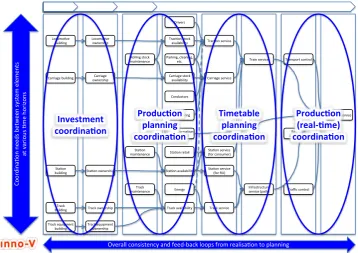
The literature review and the quantitative analysis point to the importance of the analysis not only of transaction costs in unbundled regimes, but more importantly at the relatively larger misalignment costs that may result from an inadequate institutional setup. To study this, we have used a generic ‘rail sector model’ (van de Velde, 2009; 2012), taking the shape of a generic chart, and laying down the conceptual framework needed for an analysis of potential misalignments. This approach, which is inspired by the Transaction Cost Economics theory (Williamson, 1975; 2000), decomposes the railway value-chain into the main production processes and elementary transactions implicitly present in the railway sector irrespective of the institutional configuration chosen. It allows superimposing various institutional
configurations to illustrate and better understand the localisation of and boundaries between the actors created by various unbundling options. This clarifies the differences between various institutional configurations by illustrating for each of them which elementary
transactions and sections of the value-chain are combined within the scope of each resulting actor. This also helps to understand where specific coordination mechanisms may be
needed to ensure a proper functioning of the sector, distinguishing between the short, the medium and the longer term, and it helps understanding whether and why the needs in the railway sector might be different from what can be observed in other sectors. This
decomposition also allows for a better understanding of related transaction costs,
coordination needs and regulatory needs. The various existing or potential structural options for the rail sector represent different institutional configurations of this decomposed value chain, where different actors combine different elements of the value chain within one or several organisations. Operate Maintain Own Build Carriage building Locomo ve building Sta on building Track building Energy Track equipment building Carriage ownership Locomo ve ownership Rolling stock maintenance Track maintenance Sta on maintenance
Sta on ownership
Track ownership Track availability Sta on availability Trac on stock
availability Drivers
Conductors Carriage stock
availability
Trac on service
Carriage service Track service Traffic control Infrastructure service (path) Train service
Sta on retail
Transport service Real- me Informa on Track equipment ownership Train catering Transport control Parking, cleaning, etc.
Sales, informa on and support
Sta on service (for consumer)
Sta on service (for RU) Produc on planning coordina on Timetable planning coordina on Investment coordina on Produc on (real- me) coordina on C o o rd in a o n n e e d s b e tw e e n sy st e m e le m e n ts a t v a ri o u s m e h o ri zo n s
[image:10.595.122.481.401.654.2]Overall consistency and feed-back loops from realisa on to planning
Figure 1 Rail sector model: Coordination (Source: van de Velde, 2009; 2012) The approach distinguishes between four main planning terms and coordination circles (Figure 1):
fixed assets. Their configuration largely determines the general service concepts that will be feasible for the years to come (speed, comfort, connectivity, capacity).
Secondly, medium term service planning is concerned with the development of concrete service concepts and staffing (incl. training).
Thirdly, the rail sector is characterised by a timetable cycle, usually one year,
representing the shorter term, often complemented by even shorter term planning (not represented here for the sake of clarity).
Finally, real-time adjustments to the plans are often needed at the realisation phase to cope for unforeseen events, e.g. disruptions.
3.3 Analysis of alignment of incentives between infrastructure managers and railway undertakings
We have attempted to list potential misalignments between infrastructure manager and railway undertakings on the basis of the four planning terms (or circles) described in the generic rail sector model. This approach was led by a consideration of the target functions that could guide the actions of the IM and RU in different institutional settings.
In a vertically integrated regime, all decisions pertaining to both the infrastructure and the operations of trains can be taken within one company by one line of command and a business-case is developed for each ‘new idea’ and each is evaluated in terms of its total contribution. This approach is at the centre of the management decisions of the many privatised Japanese vertically integrated railway companies and it results in a tailor-made infrastructure that meets infrastructural needs while maximising passenger revenues. These for-profit companies are long-term profit-maximizers, subject to strong intermodal
competition, sometimes network competition, and to various regulatory constraints such as yardstick competition with their peers to prevent excessive customer prices. Importantly, most of these railways have also extensively developed real estate, retail and public
transport services around their lines to ensure a long-term passenger orientation towards the railways. This regime results in a powerful competitive and regulatory mix generating various strong competitive incentives on various time horizons.
The European railway sector, on the contrary, is submitted to an obligation of accounting separation between infrastructure management and train operations. One major re-alignment mechanism is required by law to replace the internal trade-offs made by vertically integrated companies: the track access-charging regime. The idea is that this should – ideally – send optimal investment and utilisation signals to the infrastructure manager and the railway operators, leading to system-wide optimisation. However, as experience shows, and besides further optimisation problems linked to asset specificity and to the fact that European IMs are publicly owned and partly funded by the state, it appears impossible to design a track access charging system that simultaneously provides for non-discrimination, appropriate incentives for efficient development of the network and appropriate incentives for its use (see van de Velde et al, 2012 for more detail).
misalignments that can appear in relation to the quality of the resources used and the
resulting system reliability. It also includes the fundamental issue of ‘small scale’ investments
that can prove to be determinant in their evolutionary impact on total system performance. For timetable coordination, this includes misalignments related to path allocation between maintenance and transport, but also issues related to timetable robustness. For real-time production coordination, this includes issues related to disruption handling and also the important feedback loops from measured problems at the realisation phase back to timetabling, resource planning, system reconfigurations and major investments. These findings, which have been informed by a number of concrete examples drawn from research, interviews with railways undertakings and the author’s expertise, are presented and analysed at greater length in van de Velde et al (2012).
TABLE 3:EXAMPLES OF MISALIGNMENT ISSUES ACROSS THE COORDINATION CIRCLES
Investment coordination
Production planning coordination
Timetable planning coordination
Production (real-time) coordination
Extension / decommissioning Upgrading /
downgrading
Quality of resources and reliability Small/medium scale
investments
Maintenance/renewal versus operations Timetable robustness
Disruption handling Feed-back loops
Source: van de Velde et al (2012)
The examples that we could gather show that the potential consequences of misalignments appear to be varied and include: held-up investment opportunities in various technical assets, networks not developed in line with market requirements and sub-optimal
combinations of assets (rolling stock, track and personnel), etc. These lead to excessive costs of production, externalities in the sense of efficiency savings from one party’s actions coming at the disadvantage of the other party's cost and performance and negative impacts on daily operations. The misalignment issues have important technical components and the pivotal point with all these issues is that costs and benefits of various actions can fall apart and that one actor bears the costs whilst the other one gains all or at least a noteworthy share of the benefits. Unfortunately, European railways and governments have not spent much time attempting to identify and quantify the potential misalignments resulting from unbundling. As a result, the quantitative evidence available to assess the concrete cost consequences of misalignment is very limited.
Our review has shown that re-alignment mechanisms have been developed in various contexts within each of the four circles, besides the track access charging system, which itself proves to be insufficient to solve all misalignment issues created by unbundling. The mechanisms put in place appear to be hybrid, combining market and hierarchy: long term contracts, strategic partnerships and joint ventures, for example, or the establishment of joint control centres. These solutions are scalable in scope, size and depth, and come with transaction costs to design, contract and manage. Here too, there is a lack of thorough benchmarking of relevant production processes, and of calculation of the exact beneficial consequences of the re-alignment mechanisms that have already been put in place, preventing us from estimating to what extent the re-alignment mechanisms were able to counter the negative cost effects of unbundling.
Whereas vertical separation may have shortcomings in terms of induced costs, vertical integration or the holding company model are sometimes seen as presenting shortcomings in terms of non-discriminatory access to the infrastructure, thereby hampering the proper
functioning of regimes where several railway undertakings may get access to the same network.
A number of mechanisms may be used to ensure non-discrimination in dealing with entrants in the rail industry regardless of overall industry structure. One important condition is the presence of a rail regulator, independent from the Ministry and with adequate resources to enforce its decisions. The arrangements reviewed and concrete examples presented covered vertical separation, the separation of the so-called ‘essential functions’ into an institutionally separate organisation, the enforcement of enhanced compliance and regulatory mechanisms within the holding company model, and the option of additional independence requirements between RU and IM. We have no clear evidence on the cost and relative effectiveness of these different measures, although clearly the independent bodies
undertaking the essential functions in Switzerland and Hungary are lean organisations which do not cost much to operate1.
We calculated the market shares of new entrants under various regimes in order to evaluate the relative merits of various institutional configurations. Our findings from empirical data is that it is clear that substantial entry can occur under any of the reviewed institutional structures, and that no single structure seems more favourable than the others in terms of promoting market entry.
We compared the market share of entrants2 in the freight transport sector between vertically separated regimes and vertically integrated or holding company regimes. On the basis of the most recent Rail Market Monitoring Survey (European Commission, 2012) it appeared that the average shares of new entrants for these two subsets of countries does not differ significantly, suggesting that market entry and intra-modal competition can exist under various institutional options. Nor is there any clear pattern that countries with separated essential functions or enhanced compliance mechanisms have a different level of
competition than other vertically integrated or holding company countries, although obviously the sample is very small for this to emerge. Furthermore atomistic market shares (numerous small operators without any single larger operator) do not either seem to be typical for these markets. Looking at the change in market concentration over time by taking the market share of all but the largest operator, we find that neither full separation nor full separation of
capacity allocation lead to stronger growth in the market share of operators other than the largest operator. Having separation, in other words, does not seem to support rail freight
1
The Hungarian body responsible for capacity allocation and charging (VPE) had a total staff of 35 in 2013, out of which 17 worked in the timetabling and One-Stop-Shop (ad-hoc path requests) department and 8 in the regulation and charging department. The Swiss body responsible for capacity allocation (Trasse Schweiz) had a total staff of only 10 people in 2013; while being in charge of handling and allocating path requests, it mandates SBB to elaborate the draft timetable.
2
market entry more than not having separation, as measured by the market shares of the smaller players and by the range (min. – max.) of market shares in the respective set of countries.
Entry in the passenger market in the period of our data comprises almost entirely the outcome of competitive tendering. Competitive tendering is not used in many countries and occurs both under vertical separation and holding company models. Its outcome does not appear to depend on the degree of separation. Open access in passenger transport is currently very limited, and took off essentially in the last one or two years. For this reason we have not yet been able to review its impact. We should mention, though, that recent national experiences (e.g. Italy, Austria and Czech Republic) will be interesting to follow.
In sum, this suggests that a number of mechanisms may be used to ensure non-discrimination in dealing with entrants in the rail industry regardless of overall industry structure.
3.5 Conclusions from qualitative analysis
There does not seem to be a single simple recipe for success. Unbundling is a potential source of detrimental misalignments. Complex track-access charging regimes and
performance regimes are contractual market mechanisms that can play a role but that do not appear to be adequate to solve all misalignment issues.
Additional re-alignment mechanisms are being developed in various countries (e.g. Britain and the Netherlands), and it is noteworthy to mention that these tend to move towards hybrid, cooperative arrangements, rather than simple contractual market mechanisms. Whether the resulting set of mechanisms will lead to a similar level of performance to what in principle can be achieved in bundled regimes (see, e.g., Japan) is doubtful. The lack of thorough benchmarking of relevant production processes, and of calculation of the exact beneficial consequences of the re-alignment mechanisms put in place, prevented us from estimating whether these were able to counter the negative cost effects of unbundling. One should also remember that bundled regimes, as an alternative to unbundling, are not in themselves a guarantee for optimal performance, as the European railway history showed. Additional performance incentives may be needed here too and various options do exist, as exemplified in Japan and the US, but also in Europe.
Ultimately the choice of the most appropriate re-alignment mechanisms to put in place in the absence of vertical (re-)integration will have to depend upon the characteristics of the
elements of the value chain at stake, the economic circumstances (economic development, economic perspectives, market conditions, characteristics of the networks and demand, etc.) and the institutional environment of the country or region. It is therefore also important to realise that the various elements of the value chain and boundaries between actors may require the implementation of different coordination mechanisms throughout the chain, all depending upon the varying characteristics of the transactions at stake.
4. Conclusion
analysis finds that vertical separation works best for lower density railways, but that a holding company model or complete vertical integration is best at high densities and where there is a high proportion of freight traffic. Horizontal separation of freight and passenger services seems to be accompanied by a large reduction in costs. We suspect that the cost savings from vertical or horizontal separation come about because of the way in which the reforms increased transparency and in turn focus on where money and subsidy was being spent, particularly where freight operations are being prepared for privatisation. There is no
evidence that such restructuring leads to more competition, or indeed that more competition leads to reductions in cost, though we recognise that our measure of competition are not perfect.
It appears that the main factor leading to higher costs in vertically separated railways is not increased transactions cost but the effect of misalignment of incentives; players have an incentive to optimise their own costs rather than the costs of the system as a whole. Whilst track access charges and performance regimes can play a part in overcoming this problem, it does not appear that they can wholly do so. A range of other approaches is therefore being developed in different countries, all of which involve closer partnerships between the infrastructure manager and railway undertakings..
We conclude therefore that there is no case for seeking to impose complete vertical separation on all EU members. Whatever the structure of the railway, the need for
coordination mechanisms must be recognised. Feed-back loops and knowledge exchange between infrastructure manager and railway undertakings benefit the sector. Dense networks need particularly close co-ordination and the importance of dense networks will increase if the goals of European transport policy in increasing the usage of rail are realised.
References
Asmild, M., T. Holvad, J.L., Hougaard, D. Kronborg, D. (2009), ‘Railway reforms: Do they influence operating efficiency?’, Transportation, 36 (5), 617-638.
Cantos P., J.M. Pastor and L. Serrano (2010), ‘Vertical and horizontal separation in the European railway sector and its effects on productivity’, Journal of Transport Economics and Policy, 44 (2) 139-160.
Cantos P., J.M. Pastor and L. Serrano (2011), ‘Evaluating European railway deregulation using different approaches’, Paper given at the workshop on Competition and Regulation in Railways, FEDEA, Madrid, March 12.
Growitsch, C. and H. Wetzel (2009), ‘Testing for economies of scope in European Railways:
an efficiency analysis’, Journal of Transport Economics and Policy, 43 (1), 1-24. European Commission (2012), "Commission staff working document accompanying the
document 2012 Report from the Commission to the Council and the European Parliament on monitoring development of the rail market", SWD(2012) 246 final, European Commission, Brussels.
McNulty, Sir R. (2011), ‘Realising the Potential of GB Rail: Final Independent Report of the
Rail Value for Money Study’, London: Department for Transport and Office of Rail Regulation.
Merkert, R, A. Smith and C.A. Nash (2012), ‘The measurement of transaction costs –
Mizutani, F. and S. Uranishi (2013): Does vertical separation reduce cost? An empirical analysis of the rail industry in European and east Asian OECD countries, Journal of Regulatory Economics, 43 (1), 31-59.
Mizutani, F. Smith, A.S.J., Nash, C.A. and Uranishi, S. (2014). Comparing the Costs of Vertical Separation, Integration, and Intermediate Organisational Structures in European and East Asian OECD Railways, mimeo (available from the authors on request).
Nash, C. A. (2010): ‘European rail reform and passenger services —the next steps’, Research in Transportation Economics, 29(1), 204–11.
Nash, C.A. (2013), ‘Rail Transport’, in Finger, M. and Holvad, T., eds., Regulating Transport
in Europe, Edward Elgar, Cheltenham, UK • Northampton, MA, USA.
Pittman, R (2007) Options for Restructuring the State-owned Monopoly Railway. Research in Transportation Economics, 20(1), 179-198.
van de Velde, D.M. (2009), "Economics of the transport markets", In: EPA1231 Economics of Infrastructures, Syllabus, Delft University of Technology, Delft.
van de Velde, D.M. (2012), "A transaction-based Transport Sector Model: Application to the railway sector to discuss unbundling and incentive misalignment", mimeo, Delft University of Technology, Delft.
van de Velde, D., C. Nash, A. Smith, F. Mizutani, S. Uranishi, M. Lijesen and F. Zschoche (2012), "EVES-Rail - Economic effects of Vertical Separation in the railway sector", Report for CER - Community of European Railway and Infrastructure Companies, by inno-V (Amsterdam) in cooperation with University of Leeds – ITS, Kobe University, VU Amsterdam University and civity management consultants, Amsterdam/Brussels, 188 pp.
Williamson, O.E. (1975), Markets and hierarchies, analysis and antitrust implications: a study in the economics of internal organization, Free Press, New York.