City, University of London Institutional Repository
Citation:
Harrison, G. (2018). Sonographer Workforce Developments. Synergy News, August, pp. 12-13.This is the accepted version of the paper.
This version of the publication may differ from the final published
version.
Permanent repository link:
http://openaccess.city.ac.uk/20221/Link to published version:
Copyright and reuse: City Research Online aims to make research
outputs of City, University of London available to a wider audience.
Copyright and Moral Rights remain with the author(s) and/or copyright
holders. URLs from City Research Online may be freely distributed and
linked to.
Sonographer workforce developments
Ultrasound education is undergoing innovative changes. During this process the Society and College of Radiographers (SCoR) continues to be a key stakeholder in national work, establishing a career
framework for the ‘profession’, ensuring that all levels of ultrasound practice can be supported to
provide safe, effective services and career development pathways. The SCoR are mindful of the challenges faced during this work and the priority is to support those in existing ultrasound roles throughout these developments. This is in addition to ensuring that any new professional pathways are clearly defined to ensure safe, competent, well-supported sonographers enter the workforce. Effective career pathways should benefit the current sonography workforce to develop skills and competencies to progress within the career framework. Patient protection and safe working practice for future developments is paramount. All proposed developments are reviewed by the SCoR UK council.
The shortage of sonographers and the increasing demand on the ultrasound workforce have been highlighted in many documents, such as the 2017 Centre for Workforce Intelligence (CfWI) report.1
In 2014, the Society and College of Radiographers (SCoR)2 reported that a third of sonographers
were over the age of 50, in a sample of 59 departments who employ sonographers. Similar findings were reported in the CfWI report in 2017,1 although some regions were more affected than others,
with, for example, Wessex predicting that 20% of the sonographer workforce were expected to retire in five years.1 In 2016 the first direct entry BSc (Hons) programme in ultrasound was launched
in the UK3, with sonographers from this programme due to qualify in summer 2019. Additionally
there is an apprenticeship standard being written for medical ultrasound4, this is due to be offered
at academic level 6 [BSc (Hons)]. The challenge of Sonography not being recognised as a profession has been highlighted in surveys,5,6,7 as a concern when considering new models of education.
In a survey this year by the SCoR7, 72 departments responded and suggested that there was an
average of 2.65 sonographer vacancies within the Trusts. The mean predicted shortfall of
sonographers needed to provide the service in 5 years was 4.6, with some departments suggesting they would need an additional 20 sonographers to meet the increasing demands. New career pathways have been discussed for some time8,9 and Health Education England (HEE) are working
with stakeholders to look at possible ways to increase the sonographer workforce to meet the demands. At the 2017 Society of Radiographers (SoR) Annual Delegates Conference10 a motion was
carried to ‘ensure that there is an appropriate career progression route in ultrasound … without reducing the quality of service, job satisfaction or dumbing down of the role’. The SCoR are actively involved in all the various work streams with other professional groups, such as the British Medical Ultrasound Society (BMUS), the Royal College of Radiologists (RCR), the Consortium for the
Accreditation of Sonographic Education (CASE), Society for Vascular Technology of Great Britain and Ireland (SVT) and the Chartered Society of Physiotherapy (CSP). These stakeholders are focussing on developing a career progression framework to meet current demands and changes within
sonography education. Initiatives from HEE include commissioning education to train 200 health care professionals to undertake third trimester pregnancy scans11 and statutory registration for
The HEE documentation when it is published will refer to various ‘levels’, including career levels and
academic levels. It will not however refer to Agenda for Change (AfC) pay bands, as this is not part of
HEE’s remit. AfC is a system which“allocates posts to set pay bands, using the Job Evaluation
Scheme”12which is separate to the career and academic levels referred to by HEE. Also involved with
HEE’s work are Skills for Health (SfH), who are the Sector Skills Council for Health in the UK and publish National Occupational Standards for ultrasound practice,13 which are linked to the
Knowledge and Skills Frameworks (KSF) for different professional activities for anyone working in that area of practice. The SfH use ‘career framework levels’, these relate to levels of autonomous practice, responsibility and decision making within the role14. Any reference to career level relates to
the SfH definitions of career level, for example the newly qualified radiographer will be career level 5, moving to career level 6 as they develop more autonomous practice and increase the level of responsibility and decision making13. Academic levels relate to the Quality Assurance Agency
academic levels in England,14 which include level 6, BSc (Hons); level 7, Master’s level qualifications
[image:3.595.73.519.300.764.2]and level 8, doctoral level.15
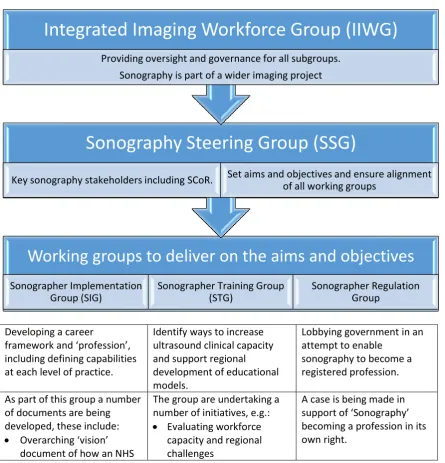
Figure 1: The current work stream to develop a Sonographer Career Framework
Developing a career
framework and ‘profession’,
including defining capabilities at each level of practice.
Identify ways to increase ultrasound clinical capacity and support regional development of educational models.
Lobbying government in an attempt to enable
sonography to become a registered profession.
As part of this group a number of documents are being developed, these include: • Overarching ‘vision’
document of how an NHS
The group are undertaking a number of initiatives, e.g.: • Evaluating workforce
capacity and regional challenges
A case is being made in
support of ‘Sonography’
becoming a profession in its own right.
Working groups to deliver on the aims and objectives
Sonographer Implementation Group (SIG)
Sonographer Training Group (STG)
Sonographer Regulation Group
Sonography Steering Group (SSG)
Key sonography stakeholders including SCoR. Set aims and objectives and ensure alignment of all working groups
Integrated Imaging Workforce Group (IIWG)
ultrasound service should be delivered16
• Learning outcomes and educational standards for CASE accreditation of programmes of education17
• Updating the CASE handbook
• Preceptorship standards
• Investigating innovative methods of clinical ultrasound education • Developing case studies to
showcase some of the different educational models that might be used.
In conclusion, the SCoR are working with other stakeholder, on behalf of members and service users, to ensure that current developments support all levels of sonographic practice and provide a clear framework for advancement of sonographers, whilst maintaining a safe and effective ultrasound service.
References:
1. Centre for Workforce Intelligence, ‘Securing the Future Workforce Supply – Sonography Workforce Review’, March 2017. [Online]. Available:
https://www.gov.uk/government/uploads/system/uploads/attachment_data/file/597697/S onography_workforce_review.pdf
2. The Society and College of Radiographers, ‘Sonographer Workforce Survey Analysis’. 2014. [Online]. Available:
https://www.sor.org/learning/document-library/sonographer-workforce-survey-analysis
3. Birmingham City University, ‘Medical Ultrasound – BSc (Hons)’, 2018. [Online]. Available: https://www.bcu.ac.uk/courses/medical-ultrasound-bsc-hons-2019-20
4. White, H. ‘Apprenticeships are here’. Radiography, 23 (S1), pp.S5 - S6
5. Parker, P. C. & Harrison, G. ‘Educating the future sonographic workforce: Membership survey report from the British Medical Ultrasound Society’. Ultrasound 2015; 23(4); 231–
241. [Online]. Available:
https://www.ncbi.nlm.nih.gov/pmc/articles/PMC4760598/
6. Waring, L. Miller, P. and Sloane, C. ‘The future of sonographic education’, 2015. Health
Education North West. [Online]. Available:
http://insight.cumbria.ac.uk/id/eprint/2949/1/Waring,%20Miller%20&%20Sloane%20(2015) %20-%20Ultrasound%20Futures.pdf
7. The Society and College of Radiographers, ‘Sonographer Clinical Teaching Capacity Survey’,
2018. [Unpublished].
8. The Society and College of Radiographers, ‘Developing and Growing the Sonographer workforce: Education and Training needs’, 2009. [Online]. Available:
9. The Society and College of Radiographers, ‘Direct Entry Undergraduate Ultrasound
Programmes (with competency to practise): a briefing from the Society and College of
Radiographers’, 2009. [Online]. Available: https://www.sor.org/learning/document- library/direct-entry-undergraduate-ultrasound-programmes-competency-practise-briefing-society-and-college
10. Motion 62. ‘Sonography career progression,’ 2017. [Online]. Available:
https://www.sor.org/trade-union-support/annual-delegates-conference/adc-2017-motions
11. The Department of Health and Social Care mandate to Health Education England April 2017 to March 2018. 2018. [Online]. Available:
https://assets.publishing.service.gov.uk/government/uploads/system/uploads/attachment_ data/file/674419/HEE_mandate_2017-2018.pdf
12. NHS Employers. ‘About Agenda for Change’. 2017. [Online]. Available:
http://www.nhsemployers.org/your-workforce/pay-and-reward/agenda-for-change/how-agenda-for-change-works
13. Skills for Health. ‘National Occupational Standards’. 2017. [Online]. Available:
http://www.skillsforhealth.org.uk/standards/item/215-national-occupational-standards
14. Skills for Health. ‘Roles directory tool’. 2009-2018. [Online]. Available: https://tools.skillsforhealth.org.uk/roles_directory/
15. Quality Assurance Agency, “The UK Quality Code for Higher Education Part A: Setting and
Maintaining Academic Standards – The Frameworks for Higher Education Qualifications of UK Degree Awarding Bodies.” 2014. [Online]. Available:
http://www.qaa.ac.uk/assuring-standards-and-quality/the-quality-code
16. Health Education England. ‘The Future for NHS Ultrasound Service Provision,’ 2018.
[Unpublished draft].
17. The Consortium for the Accreditation of Sonographic Education. ‘Assertions of the Standards