City, University of London Institutional Repository
Citation
: Erkoyuncu,, J. A., Fernandez del Amo, I., Dalle Mura, M. and Roy, R. ORCID:
0000-0001-5491-7437 (2017). Improving efficiency of industrial maintenance with context
aware adaptive authoring in augmented reality. CIRP Annals, 66, pp. 465-468. doi:
10.1016/j.cirp.2017.04.006
This is the published version of the paper.
This version of the publication may differ from the final published
version.
Permanent repository link:
http://openaccess.city.ac.uk/22031/
Link to published version
: http://dx.doi.org/10.1016/j.cirp.2017.04.006
Copyright and reuse:
City Research Online aims to make research
outputs of City, University of London available to a wider audience.
Copyright and Moral Rights remain with the author(s) and/or copyright
holders. URLs from City Research Online may be freely distributed and
linked to.
City Research Online:
http://openaccess.city.ac.uk/
[email protected]
Improving efficiency of industrial maintenance with context aware
adaptive authoring in augmented reality
John Ahmet Erkoyuncu
a,*
, In
˜ igo Ferna´ndez del Amo
a, Michela Dalle Mura
b,
Rajkumar Roy (1)
a, Gino Dini (1)
ba
Cranfield Manufacturing, School of Aerospace, Transport and Manufacturing, Cranfield University, United Kingdom
b
Department of Civil and Industrial Engineering, University of Pisa, Italy
1. Introduction
A constant target in industrial maintenance is maximising equipment operational availability and safety at minimum cost. There are a number of challenges faced by maintainers[1]:
a large variety of tasks from diagnosis to repair;
varying complexity of maintenance requirements;
long life of equipment causing varying levels of quality, standards and depth in documentation;
a large number of equipment types to maintain.
Augmented Reality (AR) is an emerging technology that can help maintainers, as it enhances users’ perception of and interaction with the real world [2], by displaying virtual information on top of it [3]. The information needed about maintenance procedures can be provided to the user directly on the workplace through a real-time interaction[4]. Many applica-tions of AR in maintenance have been studied, but the research remains at an exploratory stage [4,5]. Currently, to study the feasibility of AR integration in maintenance[2,6], emerging topics in the area have emerged, such as authoring[3,7] and context-awareness[3,5]. Authoring is a system component that allows the maintenance experts to create, edit and update AR contents for applications[1,7], while context-awareness is a system that uses the context to provide relevant information and/or services to the user, where relevancy depends on the user’s task[8]. These key features for AR focus on how maintenance information is acquired, transformed and presented to the maintainers, so they can increase their performance in an affordable manner.
1.1. Motivation
The aim of this work is to develop an adaptive AR authoring procedure to automate the geographical positioning and specific content definition for virtual content to overlay, in order to improve the efficiency of industrial maintenance tasks. Further-more, its motivation was to study whether augmented content created by feasibly-applicable AR authoring solutions can support maintainers by reducing their activities’ completion time and errors, and so increasing maintenance efficiency. Therefore, this paper focuses on contributing to literature around AR content creation, which centres on the following key research themes. These are further expanded on in Section2:
Regarding the need of knowledge representations of mainte-nance activities for AR[5], a framework is proposed to define the virtual information and its format needed by maintainers in Section2.1.
The research need to study contextualisation and adaptation of information for maintainers [5,6] is considered in Sections
2.2 and 2.3.
To study the feasibility of AR systems in the maintenance contexts, there is a need to research the automation of augmented content creation processes[4,5]. Therefore, Section
2.4presents a process that automates the process to create 3D animations.
An AR system prototype called ARAUM (Augmented Reality Authoring for Maintenance) was developed in order to test whether the developed context-aware and adaptive approach to AR enables maintenance experts to use authoring solutions and whether the content created can enhance maintenance efficiency.
A R T I C L E I N F O
Article history:
Available online 17 April 2017
Keywords:
Augmented reality Maintenance Adaptive authoring
A B S T R A C T
Efficiency of industrial maintenance operation is significantly dependent on the skill and practice of the technicians involved. This paper demonstrates a novel approach to improve the maintenance efficiency through adaptive operational support using a context aware Augmented Reality (AR) technique that adapts with available data and the skill level of the technicians and without the need for prior working knowledge of AR. The AR system can be dynamically adapted by non-programmer maintenance technicians to improve the efficiency further.
ß2017 The Authors. Published by Elsevier Ltd on behalf of CIRP. This is an open access article under the CC BY license (http://creativecommons.org/licenses/by/4.0/).
* Corresponding author.
E-mail address:j.a.erkoyuncu@cranfield.ac.uk(J.A. Erkoyuncu).
Contents lists available atScienceDirect
CIRP Annals - Manufacturing Technology
j o u r n a l h o m e p a g e : h t t p : / / e e s . e l s e v i e r . c o m / c i r p / d e f a u l t . a s p
http://dx.doi.org/10.1016/j.cirp.2017.04.006
2. ARAUM: context aware adaptive authoring
ARAUM aims to support industrial maintenance operations by generating AR content automatically in real time. Thus, the authoring steps that require AR expertise are performed by the system, and maintenance experts need to focus on which information they want to display, defining its format and sequence. ARAUM comprises two platforms: the Authoring and Application Platforms that enable the automated authoring process (as shown inFig. 1). The Authoring Platform (blue box) is a desktop interface that allows maintenance experts to interact with the ‘Information Frameworks’ used for generating AR content. These frameworks contain the necessary information to create contextualised and/or animated content when required by maintainers. Thus, mainte-nance experts only need to define the inputs for the augmented content to be created automatically.
The Application Platform Modules (green box) automatically generate AR content based on maintenance experts’ inputs. Apart from contextualising and rendering maintenance information, it
ensures that the information is displayed in the right sequence. The developed system is flexible to support both novice and more experienced technicians. For example, for the novice there is a need to validate the step undertaken and the more mature technician has the flexibility to follow or create/adapt a step.
The paper adopts the green and blue colour scheme throughout the following figures to clarify the classification between plat-forms.Fig. 1also describes the software used to develop ARAUM Platforms. For the Authoring Platform, a database interface has been created using SQLite. The Application Platform has been developed in Unity 3D for Android handheld devices, and using Vuforia SDK for markerless tracking. The reason to select this set of software was their ability to support either online or offline stand-alone applications. The following sub-sections explain the components of ARAUM, using a gear box representation as an example demonstrator for this research.
2.1. Defining the maintenance knowledge representation
The knowledge representation of maintenance activities involves the definition of the virtual information and its format (e.g. 3D animations, audio, text), required by maintainers in order to better comprehend their tasks (shown inFig. 2). Therefore, the MDF (Maintenance Data Framework) presents the type of information required to support diagnosis and repair activities. Meanwhile the CDF (Context Data Framework) and the RDF (Rendering Data Framework) include the data required for the contextualisation of information, which also defines its format.
The Authoring Platform and Information Frameworks Module (Fig. 1) acts as an interface for maintenance experts to determine the maintenance information to be included in the applications
generated by ARAUM (using the Application platform). Non-programming users can make use of this relational database to generate the related content for AR.
2.2. Context-awareness from equipment condition data
The contextualisation of information is one of the main processes in AR. Apart from using spatial and temporal contextual data to allocate virtual information on top of the real world, this contextual data can also be used in the case of measurement applications [9]. Previous works [2] have identified the main-tainers and equipment as the most important attributes for the maintenance context in AR.
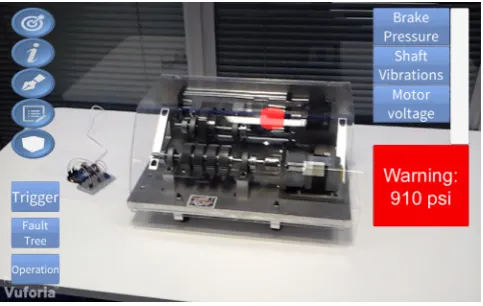
The need for contextualising maintenance information using equipment real-time data is considered by the Context-Awareness Module (CAM). An example is shown in Fig. 3 for diagnosis activities; the information acquired from the microprocessor (Arduino Yun) is utilised to highlight and give the measures of the equipment components that are outside the ranges of expected values; giving an alert of probable failures.
Regarding the health condition, CAM uses CDF information as inputs to contextualise MDF information. It utilises Internet of Things (IoT) capabilities to connect (through WiFi) to sensors to retrieve their data and give ARAUM users an overview of the equipment’s health condition. This helps to enhance their intuition for diagnosing unprecedented failures and selecting the mainte-nance operations to perform more efficiently.
2.3. Context-awareness from maintainer
The other important factor in which maintenance information should be contextualised is the maintainer itself. This subsection presents a unique process to sequence the augmented content based on tasks performed and the level of expertise. The Maintenance Logic Module (MLM) proposes a method for adapting information based on the user and the maintained equipment. It provides the sequencing of information depending on the equipment and user detected, creating different user interfaces to display and acquire maintenance information (one interface per step), as shown inFig. 4.
[image:3.595.314.542.56.157.2][(Fig._1)TD$FIG]
Fig. 1.ARAUM: framework overview.
[(Fig._3)TD$FIG]
Fig. 3.Example context-awareness module.
[image:3.595.37.282.265.422.2][(Fig._2)TD$FIG]
Fig. 2.ARAUM: information frameworks module.
J.A. Erkoyuncu et al. / CIRP Annals - Manufacturing Technology 66 (2017) 465–468
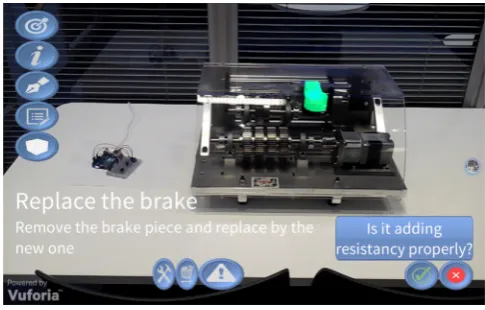
[image:3.595.308.550.477.630.2]The first step in MLM is ‘User and Equipment Selection’. It allows the ARAUM application to define the type of user and the equipment. The second step, ‘Operation Selection’ (an example shown inFig. 3), involves the information the user will use to decide the maintenance procedure. Reference books provide general background about the equipment. The green boxes inFig. 4refer to the maintenance information that is contextualised with real-environment data; either from the user or the equipment. ‘Equipment Repair’ involves instructions (e.g. text and animations) for mainte-nance procedures as created in the Rendering Module (RM).
Completion time is recorded, as well as errors for less-experienced maintainers, as shown in Fig. 5. For example, the amount of data overlaid depends on the technicians’ skill level (e.g. novice is required to double check any errors made). ‘‘Operation Report’’ involves submitting feedback and good practices, by writing text and taking photographs.
2.4. Automatic authoring based on geographical awareness
The last research topic to study feasibility of AR solutions is the automation of content creation. In this subsection, a process to automate the creation of content using spatial context awareness is described. The Rendering Module (RM) is the most important module of the ARAUM architecture, as it allows AR content (e.g. animations) to be generated automatically within the parameters defined by non-programming users in the Authoring Platform interface. The RM works in real time. It uses key-feature point (markerless) tracking (Vuforia SDK) to detect the real object. It then registers objects’ position to render a 3D model on top of it. Finally, the 3D model’s position is updated by the RM to generate animations automatically, using the parameters given by the Authoring Platform’s interface (stored in RDF).
Fig. 6represents the animation creation process based on CAD files from the equipment. The CAD files of its components are converted into 3D models that contain the spatial relation according to the equipment object. Once the former is detected, the 3D model is overlaid on top of it, using that spatial relation to determine its origin and the other correspondent vectors to move it
along the virtual scene. Fig. 6also details the information to be determined by expert maintainers for ARAUM to create animations for overlaying maintenance information, from the vectors to determine the animation movement, to the colour and the 3D model to be animated as well as the tracking information for real objects. This information (determined using the Authoring Platform and stored in a database) enables ARAUM Application Platform to generate AR content in real-time and without previous equipment data to track and render.
3. Experimental set-up and results
The innovative context-aware adaptive authoring process proposed aims to test whether a feasibly-applicable AR authoring solution can enhance maintenance efficiency. The feasibility of authoring solutions in a maintenance context is important; otherwise AR systems will not be implementable and any potential improvement could not be considered. Therefore, two types of experiments were conducted in order to test the assumptions made. First, a comparison analysis of ARAUM with existing authoring solutions was used to determine its feasibility. These experiments focused on determining whether ARAUM could be used by maintenance experts in industry, considering they are personnel with no required experience in AR. Second, in order to test whether these AR solutions could enhance maintenance efficiency, the content created by ARAUM applications was tested on a maintenance case study relating to diagnose and repair activities. These tests aimed to check if these types of activities were performed in a shorter duration of time and less errors than with paper manuals, then analysing the efficiency in maintenance procedures against current procedures.
3.1. Authoring feasibility experiments
This experiment followed a user-centred approach that was proposed by Gimeno [7] and specifies different criteria and methodologies to assess the performance and usability of AR authoring tools. The experiments were designed to allow participants to compare ARAUM against similar authoring tools. However, from the maintenance perspective, there were no analogous platforms available, so a platform comprising Unity (interface) and Vuforia SDK (tracking) was selected due to the similarities in the AR development process (e.g. creating tracking datasets). A group of six people with different AR and image processing skills were involved in the experiments. These began with a tutorial of ARAUM, Unity and Vuforia.
In order to minimise the impact of varying skill level in AR development, the validation procedure focused on just one animation for a maintenance task rather than a complete set. Furthermore, each participant was provided a handbook manual to follow instructions, which meant learning curves were not considered in the experiments. Hence, the validation aimed to
[image:4.595.311.563.52.209.2][(Fig._5)TD$FIG]
[image:4.595.45.292.55.176.2]Fig. 5.‘Equipment repair’ example.
Fig. 4.ARAUM: maintenance logic module.
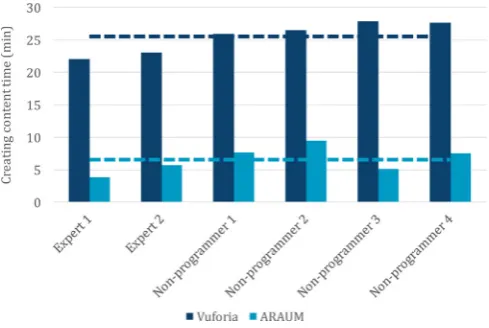
[image:4.595.46.289.380.535.2]test if non-expert users can create animations using ARAUM in less time than experts using Vuforia.Fig. 7presents the duration of time for developing an animation for each participant.
Overall, it can be seen that the time for developing maintenance related animation with ARAUM is around four times lower than when using Vuforia. Another interesting finding was that the gap between experts and non-programmers in terms of ‘maintenance time’ significantly decreased. Thus, if people with different backgrounds perform better and in similar levels when using ARAUM compared to other tools, it can be said that it is a feasible solution for maintenance experts with no experience in AR.
3.2. Maintenance efficiency experiments
In order to validate whether ARAUM created content can improve maintenance efficiency, a comparison was made between a paper based manual guidance and the ARAUM guided approach for a specific industrial maintenance task using a gear box representation as a demonstrator. This was measured in terms of the duration of time for completing the specified task. In total there were eight participant’s involved (different participants to Section3.1); four for each type of guidance. The participants were selected to have no experience in maintenance and AR. Considering the target population size for AR systems in maintenance, the sample can be considered representative.
The participants in the paper based experiment were provided a real-life, complex maintenance manual to follow and find the relevant information from a range of equipment and components covered. In the ARAUM guidance, the testers were asked to identify the correct maintenance operation, and to perform the task supported by the animations overlaid on to the demonstrator. The task involved several assembly and disassembly tasks of a brake disc, as highlighted inFigs. 3 and 5.
Fig. 8presents the results for the two groups that participated in the experiment. The participants using the ARAUM guidance were
able to complete the same task almost half the time compared to the paper based manual procedure. During the conduction of these experiments it was noted (also mentioned by participants) that what made easier the understanding of the tasks to perform was the contextualisation of the information presented. Thus, the decrease in time created by the use of AR can enhance maintenance efficiency, as better understanding of the tasks to perform can also result in fewer errors, which shows it was not only the reduction in duration of maintenance that was observed, thus less time to accomplish the same maintenance tasks.
4. Conclusions
It is possible to conclude that AR offers opportunities for industrial maintenance applications by displaying contextualised information and accessing end-user data. The validation has demonstrated that ARAUM can improve the efficiency in conducting maintenance. The main contributions of the paper, related to maintenance efficiency and AR fields, include:
Improving maintainer efficiency with adaptive data manage-ment: ARAUM contributes to authoring research by offering an innovative structure for the information needs of AR authoring tools, and a new method to automatically create overlaid animations in real-time.
Non-programmers can create AR content: ARAUM’s Authoring Platform decreases the resources needed to develop AR-animated content.
Design of context awareness modules: The CDF and the CAM offer a new approach for AR context awareness.
For future work, developing new approaches for connecting AR with Information Systems can capture multiple user feedback dynamically and reuse them in the future maintenance sessions. A critical future work needs to involve how continuous data management can be achieved to reduce implementation cost, and increase organisational knowledge with maintenance tasks. Additionally, further experimentation is required to compare the gain in efficiency with similar systems without information contextualisation, in order to demonstrate the findings from the testers. Furthermore, more research is required about interfaces to present the contextualised information and the added value to maintenance efficiency by reducing cognitive overload.
Acknowledgements
This research was partially supported by the EPSRC Centre for Innovative Manufacturing – Through-life Engineering Services. Grant number EP/1033246/1 and it was a cooperative work between Cranfield and Pisa Universities. The authors would also like to thank BABCOCK International for supporting this work.
References
[1]Roy R, Stark R, Tracht K, Takata S, Mori M (2016) Continuous Maintenance and the Future – Foundations and Technological Challenges.Annals of the CIRP 65(2):667–688.
[2]Nee AYC, Ong SK, Chryssolouris G, Mourtzis D (2012) Augmented Reality Applications in Design and Manufacturing.Annals of the CIRP61(2):657–679.
[3]Ong SK, Zhu J (2013) A Novel Maintenance System for Equipment Serviceability Improvement.Annals of the CIRP62(1):39–42.
[4]Dini G, Dalle Mura M (2015) Applications of Augmented Reality Techniques in Through-Life Engineering Services.Proceedings of the 4th International Confer-ence on TES38:14–23.
[5]Wang X, et al (2016) A Comprehensive Survey of Augmented Reality Assembly Research.Advances in Manufacturing4:11–22.
[6]Oliveira ACM, et al (2013) A Human Centered View on E-Maintenance.Chemical Engineering Transactions33:385–390.
[7]Gimeno J, Morillo P, Ordun˜a JM, Ferna´ndez M (2013) A New AR Authoring Tool Using Depth Maps for Industrial Procedures.Computers in Industry64(9):1263–1271.
[8]Manuri F, Sanna A (2016) A Survey on Applications of Augmented Reality. Advances in Computer Science5(1):18–27.
[9]Daponte P, et al (2013) State of the Art and Future Developments of Measure-ment Applications on Smartphones.Measurement: Journal of the International Measurement Confederation46(9):3291–3307.
[image:5.595.37.282.54.218.2][(Fig._7)TD$FIG]
Fig. 7.Authoring experiments: performance and usability.
[image:5.595.42.279.611.775.2][(Fig._8)TD$FIG]
Fig. 8.Maintenance efficiency experiments.
J.A. Erkoyuncu et al. / CIRP Annals - Manufacturing Technology 66 (2017) 465–468