NOTES AND COMMENTS
Loss rates of honey bee colonies during winter 2017/18 in 36 countries participating
in the COLOSS survey, including effects of forage sources
Alison Graya† , Robert Brodschneiderb , Noureddine Adjlanec, Alexis Ballisd, Valters Brusbardise, Jean-Daniel Charrieref , Robert Chlebog , Mary F. Coffeyh, Bram Cornelisseni ,
Cristina Amaro da Costaj , Tamas Csakik , Bjørn Dahlel, Jirı Danihlıkm , Marica Maja Drazicn , Garth Evanso, Mariia Fedoriakp , Ivan Forsytheq , Dirk de Graafr , Ales Gregorcs, Jes Johannesent ,
Lassi Kaukou , Preben Kristiansenv , Maritta Martikkalaw , Raquel Martın-Hernandezx ,
Carlos Aurelio Medina-Floresy , Franco Mutinelliz , Solenn Patalanoaa, Plamen Petrovab, Aivar Raudmetsac, Vladimir A. Ryzhikovad, Noa Simon-Delsoae , Jevrosima Stevanovicaf , Grazyna Topolskaag, Aleksandar Uzunovah, Flemming Vejsnaesai, Anthony Williamsaj , Marion Zammit-Mangionak and Victoria Sorokeral a
Department of Mathematics and Statistics, University of Strathclyde, Glasgow, UK;bInstitute of Zoology, University of Graz, Graz, Austria; c
Department of Biology, Universite M’hamed Bougara, Boumerde, Algeria;dChambre d'agriculture d'Alsace, Strasbourg, France;eLatvian Beekeepers Association, Jelgava, Latvia;fAgroscope, Swiss Bee Research Center, Bern, Switzerland;gDepartment of Poultry Science and Small Farm Animals, Slovak University of Agriculture, Nitra, Slovakia;hDepartment of Life Sciences, University of Limerick, Limerick, Ireland;iWageningen Plant Research, Wageningen University & Research, Wageningen, Netherlands;jAgriculture School, Polytechnic Institute of Viseu, Viseu, Portugal;kHungarian Research Institute of Organic Agriculture, Budapest, Hungary;lNorwegian Beekeepers Association, Kløfta, Norway;mDepartment of Biochemistry, Palacky University Olomouc, Olomouc, Czech Republic;nMinistry of Agriculture, Zagreb, Croatia;oWelsh Beekeepers Association, Northop, UK;pDepartment of Ecology and Biomonitoring, Yuriy Fedkovych Chernivtsi National University, Chernivtsi, Ukraine;qThe Agri-Food and Biosciences Institute, Belfast, UK;rHoneybee Valley, Ghent University, Ghent, Belgium;sFaculty of Agriculture and Life Sciences, University of Maribor, Slovenia;tDLR Fachzentrum f€ur Bienen und Imkerei, Mayen, Germany;uFinnish Beekeepers Association, K€oyli€o, Finland;vSwedish Board of Agriculture, Joenkoeping, Sweden;wFinnish Beekeepers Association, Helsinki, Finland;xCentro de Investigacion Apıcola y Agroambiental de Marchamalo (IRIAF), Marchamalo, Spain;yFaculty of Veterinary Medicine and Animal Science, University of Zacatecas, Zacatecas, Mexico;zIstituto Zooprofilattico Sperimentale delle Venezie, NRL for Honey Bee Health, Legnaro (Padova), Italy;aaInstitute of Basic Biomedical Sciences (IBBS), B.S.R.C“Alexander Fleming”, Vari, Greece;abDepartment of Animal Sciences, Agricultural University–Plovdiv, Plovdiv, Bulgaria;acEstonian Beekeepers Association, Tallinn, Estonia;adInstitute for Nature Management, National Academy of Sciences, Minsk, Belarus;aeBeekeeping Research and Information Centre, Louvain la Neuve, Belgium;afDepartment of Biology, Faculty of Veterinary Medicine, University of Belgrade, Belgrade, Serbia; ag
Department of Pathology and Veterinary Diagnostics, Faculty of Veterinary Medicine, Warsaw University of Life Sciences, Warsaw, Poland;ahFaculty of Agricultural Sciences and Food, Ss. Cyril and Methodius University, Skopje, Macedonia;aiDanish Beekeepers Association, Sorø, Denmark;ajSchool of Computer Science and Informatics, De Montfort University, Leicester, UK;akDepartment of Physiology & Biochemistry, University of Malta, Msida, Malta;alThe Volcani Center, Agricultural Research Organisation, Rishon LeZion, Israel
(Received 22 March 2019; accepted 22 April 2019)
This short article presents loss rates of honey bee colonies over winter 2017/18 from 36 countries, including 33 in Europe, from data collected using the standardized COLOSS questionnaire. The 25,363 beekeepers supplying data pass-ing consistency checks in total wintered 544,879 colonies, and reported 26,379 (4.8%, 95% CI 4.7–5.0%) colonies with unsolvable queen problems, 54,525 (10.0%, 95% CI 9.8–10.2%) dead colonies after winter and another 8,220 colonies (1.5%, 95% CI 1.4–1.6%) lost through natural disaster. This gave an overall loss rate of 16.4% (95% CI 16.1–16.6%) of honey bee colonies during winter 2017/18, but this varied greatly from 2.0 to 32.8% between countries. The included map shows relative risks of winter loss at regional level. The analysis using the total data-set confirmed findings from earlier surveys that smaller beekeeping operations with at most 50 colonies suffer significantly higher losses than larger operations (p<.001). Beekeepers migrating their colonies had significantly lower losses than those not migrating (p<.001), a different finding from previous research. Evaluation of six different forage sources as potential risk factors for colony loss indicated that intensive foraging on any of five of these plant sources (Orchards, Oilseed Rape, Maize, Heather and Autumn Forage Crops) was associated with significantly higher winter losses. This finding requires further study and explanation. A table is included giving detailed results of loss rates and the impact of the tested forage sour-ces for each country and overall.
Keywords:Apis mellifera; mortality; forage sources; colony winter losses; monitoring; beekeeping; survey; citizen science
*Corresponding author. Email: [email protected]
Wrote a first draft of the article.
†Did data processing and editing, all statistical analysis, and produced the map.
ß2019 The Author(s). Published by Informa UK Limited, trading as Taylor & Francis Group.
This is an Open Access article distributed under the terms of the Creative Commons Attribution-NonCommercial-NoDerivatives License (http://creativecommons.org/
Monitoring of losses of managed honey bee colonies is a core activity of the non-profit honey bee research association COLOSS. The COLOSS monitoring began in 2008, with a focus on losses over winter, the most important season for colony loss in Europe though not necessarily in all other countries. This ongoing research effort now involves many European and some additional countries, who undertake annual national surveys of beekeepers via a self-administered questionnaire involv-ing standardized questions for comparability of responses (van der Zee et al., 2013). The data collec-tion is organized at nacollec-tional level and takes place in dif-ferent ways depending on the country, including internet, paper and email surveys and telephone calls.
Here, we present summary results from the COLOSS survey of losses over winter 2017/18, con-ducted in spring 2018. This is the third report in a ser-ies of short communications (Brodschneider et al.,
2016, 2018) which together allow comparison of winter
colony losses between countries and over time. These COLOSS surveys represent many thousands of bee-keepers over a large and expanding number of
participating countries. Anonymous answers are optional, to encourage higher response rates. Earlier studies, including van der Zee et al. (2014), examined multiple risk factors for colony loss in multi-country models. In these short reports, we focus each time on a limited set of potential risk factors but examine their significance in each country providing the relevant data. Here we consider the impact of migration, operation size and the relevance of a few specific sources of for-age, for winter loss.
[image:2.595.122.474.76.393.2]Table 1. Winter 2017/18 survey results, showing number of respondents with valid loss data, corresponding number of colonies going into winter, hone y bee colony mortality, and loss rates (with 95% CIs). Country No. of respon- dents No. of
colonies going into winter
%
Mortality Rate (95%
CI) % Rate of loss of colonies due to queen problems (95% CI) % Rate of loss of colonies due to
natural disaster (95%
CI)
Overall winter loss
rate (95% CI) Estimated %o f beekeepers represented Effect of Orchards Effect of Oilseed Rape Effect of Maize Effect of Sunflower Effect of Heather Effect of
Autumn Forage Crops
[image:3.595.71.524.84.772.2]reported in Brodschneider et al. (2018). Responses with insufficient or illogical answers were excluded, but for most countries these were a relatively small part of their data-set. Many of the participating countries now access the survey questionnaire via a common online portal which encodes some of the required data con-sistency checks, hence improving data quality before the central compilation and further checking of data submit-ted from all countries prior to analysis.
Thirty-six countries submitted data, compared to 30 and 29 in the previous two surveys in 2017 and 2016 respectively. This is the largest number of countries par-ticipating in such a survey so far. Here we report for the first time results on colony losses for Portugal, Greece, and Bulgaria, as well as data from England and Hungary after an absence of some years. The Netherlands submit-ted data after being absent in the 2017 survey for the first time since the COLOSS monitoring began.
More than 27,000 responses were submitted in total, of which 783 limited responses from the Netherlands unfortunately only allowed calculation of the mortality rate (percentage of wintered colonies which were reported as dead after winter), but a further 25,363 beekeepers provided valid and usable loss data accord-ing to the above checks. Of the 544,879 colonies win-tered by these 25,363 beekeepers, 26,379 (4.8%) colonies were reported lost due to unsolvable queen problems, 54,525 (10.0%) colonies were reported dead after winter and 8,220 (1.5%) colonies were reported as lost due to natural disaster. The numbers of partici-pating beekeepers and colonies wintered are also the largest represented so far in our surveys. For the coun-tries represented here which are members of the European Union (EU), which may be of interest for evaluation of the impact of EU environmental standards and regulations, again excluding the Netherlands, 21,796 beekeepers provided valid loss data, and, of 395,704 colonies which they wintered, 4.8% of colonies (95% CI 4.7–4.9%) were reported lost due to unsolvable queen problems, 11.9% (95% CI 11.7–12.1%) were reported dead after winter, and 1.2% (95% CI 1.2–1.3%) were reported as lost due to natural disaster, giving an over-all loss rate of 17.9% (95% CI 17.6–18.2%). These are similar results as for the overall data-set, though the percentage of dead colonies and the overall loss rate are both slightly higher for the EU countries. For all the countries which are in Europe, apart from the Netherlands, the corresponding results were respect-ively 25,029 beekeepers with valid loss data, who win-tered 476,040 colonies and reported 4.6% (95% CI 4.5–4.7%) lost to queen problems, 11.0% (95% CI 10.8–11.2%) dead after winter, and 1.2% (95% CI 1.2–1.3%) lost due to natural disaster, giving an overall loss rate of 16.8% (95% CI 16.5–17.0%), which are simi-lar results to those for the EU countries.
As we have previously found (Brodschneider et al.,
2016, 2018), loss rates vary considerably between
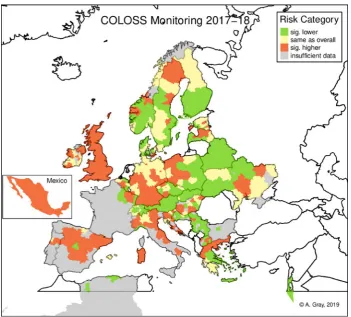
countries as well as years. Within countries, differences between regions are also evident. Figure 1 shows a color-coded map of the level of the colony loss rate over winter 2017/18 relative to the loss rate for the same winter over all the regions, in the countries and regions where sufficient data were available. This allows visual identification of countries and regions where the loss rates were relatively high for that winter, compared to the overall loss rate. For example, the UK had rela-tively high loss rates, as did most of the regions shown for Spain, while for Poland and Germany differences in risk levels can be seen between regions. Unfortunately, for some countries we still have data only from some regions, rather than national data. This situation has improved in Italy and Spain over the years of the COLOSS surveys, though relatively few regions of France, Bulgaria and Portugal are covered at present. Survey conditions in Algeria are difficult, and achieving national coverage is a challenge.
The overall loss rate in winter 2017/18 was highest in Portugal (32.8%), a new country to the survey. Other countries with high losses (above 25%) were Slovenia, Northern Ireland, England, Wales, Italy, and Spain, coun-tries mostly in Western Europe. This pattern is similar to the results for winter 2015/16, but different from the last year. For winter 2016/17 the highest winter loss rates were for Germany, Spain, Mexico, Malta, and Serbia. Bulgaria, another new country to this monitoring study, had the lowest loss rate, of just 2.0%, though based on data from only 27 professional beekeepers. Other low loss rates were found for Belarus, Serbia, Israel, Algeria, and Slovakia (all 10% or lower). A year previously, loss rates were lowest in Norway, Northern Ireland and Algeria, and the year before that in Central Europe. Although most rates of loss from natural disas-ter were very low, the two highest rates this time were above 5% (Mexico) and 10% (Portugal). Winter losses related to queen problems varied between 1.1% in Bulgaria to 20.3% in Slovenia, whereas for winter 2016/ 17 the rate of this loss for Slovenia was the lowest among the participating countries.
20.6–21.3%) over winter 2016/17 and 12.0% (95% CI 11.8–12.2%) over winter 2015/16. Even though these loss rates over the years are significantly different, the reasons for those differences remain unclear at present and require further studies.
Examining some potential risk factors for winter loss, by fitting a single factor quasi-binomial generalized linear model (van der Zee et al.,2013), to the overall data-set and identifying significant effects, we confirmed our pre-vious results from Brodschneider et al. (2016, 2018) that beekeeping operations with 50 or fewer colonies (hobbyist beekeepers) experience a significantly higher overall winter loss rate (p<.001) than larger scale operations. The very low loss rate cited here for pro-fessional beekeepers in Bulgaria appears to be consist-ent with this finding. Brodschneider et al. (2018) also considered migratory beekeeping, and found a significant effect only in a minority of countries and the direction of the effect of migration on the risk of winter loss var-ied. In the questionnaire for the survey in spring 2018, beekeepers were asked “Did you migrate any of your colonies at least once for honey production or pollin-ation in 2017?”, with possible responses “Yes”, “No”, and “Don’t know”. This time, the effect of migration was highly significant overall (p<.001) and those bee-keepers migrating their colonies had lower losses than those not migrating, and this level of loss in turn was much lower than for those responding “Don’t know”. As the impact of migration is expected to be dependent on distance as well as the reasons for migration, it would be worthwhile evaluating those factors and thus the role of colony migration on colony survival in a sep-arate but more detailed study.
Since lack of proper forage sources for nutrition can be one of the main risk factors for colony loss (Goulson, Nicholls, Botıas, & Rotheray,2015), we also studied the relative loss rates for beekeepers reporting whether or not their colonies had a significant flow on certain forage sources, namely Orchards, Oilseed Rape, Maize, Sunflower, Heather, and Autumn Forage Crops (intended as melliferous plants growing on land lying fallow). Not all of these forage sources were relevant for every country. The questionnaire responses are self-reported data, and beekeepers may not always be fully aware of all forage sources available to their bees. We found overall that for all these plant sources except Sunflower, beekeepers responding“No”had significantly lower losses than those responding“Yes” or“Don’t know”. For Sunflower, both those responding “Yes” and “No” had lower loss rates overall than those responding“Don’t know”. For each of the other forage sources, any effect was only significant for a minority of countries (Table 1). In these cases, for Orchards, the beekeepers responding“No”usually expe-rienced a lower loss rate, with an exception for Portugal. For Oilseed Rape, the nature of the effect varied; for example, for Finland, Scotland, Serbia and Ukraine those responding “Yes” had a lower loss rate than those
responding “No”, whereas for Austria, France and Germany the outcome was the opposite. The greatest number of significant results was found in the case of Maize, though the direction of the effect also varied, and only for Croatia, France, Italy and Sweden did the bee-keepers responding “Yes” have a lower loss rate. For Sunflower, only for France did those responding “Yes” have a lower loss rate. Heather was significant for very few countries, and only for Scotland did those responding “Yes”have a lower loss rate. Autumn Forage Crops were also only significant for a small number of countries, but the beekeepers responding“No”had the lower loss rate. In considering each of the above forage sources in a single factor model for each country, many statistical tests have been carried out. Hence, at country level some model effects (Table 1) are likely to be significant by chance alone. Therefore in the text we focus on the relatively fewer results of the tests for the overall data-set, each of which is both highly significant and based on a very large sample size. The sizes of the significant forage effects for the overall data-set are relatively small; for example, concerning the question of whether Maize constituted an important forage source, the loss rates were 17.6, 15.0, and 17.2% for the beekeepers responding “Yes”, “No”, and “Don’t know”, respect-ively. Nonetheless, in practice a number of factors, each with a small effect, acting together on honey bee colo-nies, could have a considerable impact.
both highly significantly associated with the risk of winter loss, though the modeling was confined to beekeepers with at most 50 colonies. In that study, colonies reported not to have access to Oilseed Rape had significantly lower risk of loss compared with those reported to have access, while loss rates of colonies managed by beekeepers responding “Don’t know” to this question about access were not significantly different to those of colonies with reported access. For Maize, both the colonies reported as having“No access”and those for which the beekeeper responded“Don’t know”had significantly reduced risk of colony loss compared to those with reported access to Maize. These results are similar to our results reported earlier. The presence of Oilseed Rape or Maize, often grown over large areas, might also be indicative of a lack of diversity of forage, which could have detrimental effects on colonies (van der Zee et al.,2014). Given the various possible explanations for the forage effects in the current data-set, the impact of agricultural versus natural forage should remain an important factor for future evaluation, especially in view of the current ban on vari-ous uses of widely applied neonicotinoid insecticides by the EU member states (OJEU,2018).
In conclusion, even though our current loss data are based on over 25,000 beekeepers from 36 countries, we aim in the loss monitoring surveys to obtain higher response numbers at national level, and high-quality data. Obtaining a high response rate is important to avoid bias and to achieve higher precision in loss esti-mation, but also to enable better dissection of the risk factors. In practice national co-ordinators in some coun-tries have reported difficulty in achieving sufficient co-operation to achieve a large sample size, including in Malta, Mexico, Israel and Serbia. Beekeepers may need more motivation to participate in the survey and to provide full and useful responses. In some other coun-tries efforts should continue to achieve a fuller repre-sentation of beekeepers at national level.
Acknowledgements
The colony loss monitoring group which carried out this study is a core project of the COLOSS research association (pre-vention of honey bee colony losses), which supports regular workshops facilitating research discussions and collaboration between group members. The authors thank very much all the beekeepers who gave their time to complete the COLOSS questionnaire providing the data for this work, and the additional COLOSS partners who contributed to survey organisation, data collection and/or data processing. The authors are also grateful to various national funding sources for their support of some of the monitoring surveys [includ-ing, in the Republic of Serbia, MPNTR-RS, through Grant No. (III46002), Slovenian Research Program P1-0164, and“Zukunft Biene”(grant number: 100972) in Austria], and acknowledge the financial support by the University of Graz for open access.
Disclosure statement
No potential conflict of interest was reported by the authors.
ORCID
Alison Gray http://orcid.org/0000-0002-6273-0637
Robert Brodschneider http://orcid.org/0000-0002-2535-0280
Jean-Daniel Charriere http://orcid.org/0000-0003-3732-4917
Robert Chlebo http://orcid.org/0000-0001-8715-0578
Bram Cornelissen http://orcid.org/0000-0001-6610-0811
Cristina Amaro da Costa http://orcid.org/0000-0001-8625-2206
Tamas Csaki http://orcid.org/0000-0002-3548-5461
JirıDanihlık http://orcid.org/0000-0002-6936-1766
Marica Maja Drazic http://orcid.org/0000-0002-7817-0419
Mariia Fedoriak http://orcid.org/0000-0002-6200-1012
Ivan Forsythe http://orcid.org/0000-0002-8642-102X
Dirk de Graaf http://orcid.org/0000-0001-8817-0781
Jes Johannesen http://orcid.org/0000-0002-8496-4100
Lassi Kauko http://orcid.org/0000-0001-7836-6553
Preben Kristiansen http://orcid.org/0000-0001-6718-2214
Maritta Martikkala http://orcid.org/0000-0001-5761-8627
Raquel Martın-Hernandez http://orcid.org/0000-0002-1730-9368
Carlos Aurelio Medina-Flores http://orcid.org/0000-0002-9330-565X
Franco Mutinelli http://orcid.org/0000-0003-2903-9390
Noa Simon-Delso http://orcid.org/0000-0003-1729-890X
Jevrosima Stevanovic http://orcid.org/0000-0003-0906-5911
Anthony Williams http://orcid.org/0000-0002-5383-3183
Marion Zammit-Mangion http://orcid.org/0000-0003-2940-0780
References
Brodschneider, R., Gray, A., Adjlane, N., Ballis, A., Brusbardis, V., Charriere, J.-D., … Danihlık, J. (2018). Multi-country loss rates of honey bee colonies during winter 2016/2017 from the COLOSS survey. Journal of Apicultural Research, 57(3), 452–457. doi:10.1080/00218839.2018.1460911
Brodschneider, R., Gray, A., van der Zee, R., Adjlane, N., Brusbardis, V., Charriere, J.-D., … Woehl, S. (2016). Preliminary analysis of loss rates of honey bee colonies dur-ing winter 2015/16 from the COLOSS survey. Journal of Apicultural Research, 55(5), 375–378. doi:10.1080/ 00218839.2016.1260240
Goulson, D., Nicholls, E., Botıas, C., & Rotheray, E. L. (2015). Bee declines driven by combined stress from parasites, pes-ticides, and lack of flowers. Science, 347(6229), 1255957. doi:10.1126/science.1255957
OJEU. (2018). Official Journal of the European Union, L 132. 30 May, 2018, 5–44. Retrieved from https://eur-lex.europa. eu/legal-content/EN/TXT/?uri¼OJ:L:2018:132:TOC
Simon-Delso, N., San Martin, G., Bruneau, E., Minsart, L.-A., Mouret, C., & Hautier, L. (2014). Honeybee colony dis-order in crop areas: the role of pesticides and viruses.PLoS One,9(7), e103073. doi:10.1371/journal.pone.0103073
van der Zee, R., Gray, A., Holzmann, C., Pisa, L., Brodschneider, R., Chlebo, R., … Wilkins, S. (2013). Standard survey methods for estimating colony losses and explanatory risk factors in Apis mellifera. In V. Dietemann, J.D. Ellis, P. Neumann (Eds.),The COLOSS BEEBOOK, Volume I: Standard Methods for Apis mellifera Research. Journal of Apicultural Research, 52(4). doi:10.3896/IBRA.1.52.4.18