Rochester Institute of Technology
RIT Scholar Works
Theses Thesis/Dissertation Collections
12-11-2014
Implementation of Cross-training for Multi-shift
Worker Allocation
Aditya Gandhi
Follow this and additional works at:http://scholarworks.rit.edu/theses
This Thesis is brought to you for free and open access by the Thesis/Dissertation Collections at RIT Scholar Works. It has been accepted for inclusion in Theses by an authorized administrator of RIT Scholar Works. For more information, please [email protected].
Recommended Citation
Rochester Institute of Technology
Implementation of Cross-training for Multi-shift Worker Allocation
A Thesis
Submitted in partial fulfillment of the
requirements for the degree of
Master of Science in Industrial Engineering
in the
Department of Industrial & Systems Engineering
Kate Gleason College of Engineering
by
Aditya Gandhi
DEPARTMENT OF INDUSTRIAL AND SYSTEMS ENGINEERING
KATE GLEASON COLLEGE OF ENGINEERING
ROCHESTER INSTITUTE OF TECHNOLOGY
ROCHESTER, NEW YORK
CERTIFICATE OF APPROVAL
M.S. DEGREE THESIS
The M.S. Degree Thesis of Student’s Name
has been examined and approved by the
thesis committee as satisfactory for the
thesis requirement for the
Master of Science degree
Approved by:
____________________________________ Dr. Scott E. Grasman, Thesis Advisor
ACKNOWLEDGEMENTS:
I owe a great debt of gratitude to the following individuals for their assistance and
motivation.
First and foremost, I want to thank Dr. Scott Grasman for giving me an opportunity to
work on this project. In particular, I would like thank him for his never-ending patience,
support and guidance throughout the duration of my master’s degree at RIT. I have learnt
numerous valuable lessons about the qualities of a successful leader from his words and
actions. I would also like to thank Dr. Mike Hewitt for teaching me linear, non-linear and
integer programming. I admire his approach towards operations research, and towards his
classes, which were a blast for all involved.
I would also like to thank Dr. Shrikant Jarugumilli; without whom this thesis would not
have been possible. Further, I would like to thank Naiping Keng for his guidance and
industry-oriented feedback, which was invaluable to this research work. I also owe a debt of
gratitude to Dr. Ruben Proano for his introductory course in operations research. His passion
for operations research was fundamental in driving me to work in this area.
I would like to thank my friends Srinath, Raghava, Sivakumar, Vasudev, Arun and Bala
for supporting me throughout the completion of this thesis.
Last, but not the least, I would like to dedicate this thesis to my mother, Mamta Gandhi,
TABLE OF CONTENTS
List of Figures……….………...vi
List of Tables………vii
Abstract……….viii
1. Introduction………...1
2. Literature Review………..5
2.1 Worker Allocation Models………..5
2.1.1 Single-shift Models………...5
2.1.2 Multi-shift Models………7
2.1.3 Strategic Models………...8
2.2 Cross-training Models……….9
2.3 Research Gap………...11
3. Problem Description and Formulation………..14
3.1 System under Consideration………15
3.1.1 Workers/Shifts/Shift Types………..15
3.1.2 Skill Levels………...16
3.1.3 Operations……….17
3.2 Multi-shift Cross-training Model……….19
3.2.1 Notation……….19
3.2.2 Mathematical Model………...23
3.3 Cost Parameter Structure………..29
3.4 Implementation Architecture………33
4. Numerical Example……….37
5. Testing Summary………..49
5.1 Testing for rolling horizon………..57
5.2 Changing cross-training requirements………59
6. Conclusions and Future Work………..61
References………...63
LIST OF FIGURES
Figure 1.1: Advantages of effective workforce scheduling………1
Figure 2.3.1: Focus areas of existing literature………...13
Figure 3.1.1: Normal functioning of factory floor………. 18
Figure 3.4.1: Implementation Architecture……….……33
Figure 5.1: Summary of Multiple Regression Model..………... 52
Figure 5.2: Logarithm (Solving Time) v/s Logarithm (Number of Workers)………..53
Figure 5.3: Logarithm (Solving Time) v/s Number of Skills Per Operation………55
Figure 5.4: Improved Fit for the Multiple Regression model………...56
Figure 5.5: Improved Linear Relationship between solving time and number of workers……56
LIST OF TABLES
Table 1.1: Factors considered while designing worker allocation models………... 3
Table 2.2.1: Comparison of selected works of workforce allocation and cross-training…..11
Table 3.1.1: Shift Structure Considered………16
Table 3.3.1: Worker Assignment Cost Parameters………32
Table 3.3.2: Other Cost Parameters………33
Table 3.4.1: Input Format………35
Table 3.4.2(a), (b), (c): Derived Requirements for L1, L2, L3………...35
Table 4.1: Test Case Specifications………36
Table 4.2(a), (b), (c): L1, L2, L3 Requirements for Test Case………....………37
Table 4.3: Critical Operations……….38
Table 4.4: Worker-Shift Type Details………38
Table 4.5: Worker Operation-Skill Level Qualifications………....40
Table 4.6: Number of shifts of training for each operation-skill level combination………..40
Table 4.7: Number of Shifts needed to train each worker on a skill level………..41
Table 4.8(a),(b),(c),(d): Output for ST1, ST2, ST3, ST4………...44
Table 4.9: Output of One Shift in the time horizon……….48
Table 5.1(a), (b), (c), (d), (e): Test Cases………..………..49
Table 5.2: Solving Times for all Test Cases………51
Table 5.3: Number of Skills per operation and solving time………...54
Table 5.1.1: Percentage Overtime Cost Reduction / Worker………..58
Table 5.1.2: Increase in Worker Qualification after 3 Planning Periods……….59
ABSTRACT
In workforce allocation, gaps between workers available and workers needed at various
operations result in production delays and a loss of profitability for the manufacturer. These gaps
can be reduced by overtime assignments of workers from other shifts. However, for a multiple
shift planning horizon, a mix of cross-training of workers over different tasks along with
overtime assignments may be a good strategy. This work develops an industry-motivated
cross-training framework that identifies workers and operations for normal, overtime, and cross-training
assignments. A mixed integer programming model that integrates all three assignment tasks is
formulated and solved. The production scenario consists of skill level based qualifications for
workers that need to be assigned to operations in every shift. Factory floor conditions such as
limits on worker levels at specific operations, scheduling restrictions and worker training
protocols are also considered. The data taken into account includes parameters such as
man-machine ratio, tool count, and limits on skill qualifications for workers. The output of the model
provides a cross-training schedule and an assignment schedule that can be used by floor
managers on a shift-by-shift basis. The MIP model is implemented in C# using the .NET
1. INTRODUCTION
Due to changing production demands, large organizations spend a significant amount of
resources to determine daily worker schedules. In a complex manufacturing environment, that is
both high-performance and labor-intensive, manual scheduling methods are inefficient and
time-consuming. Factors such as the use of state-of-the-art machinery, workforce efficiency and
production cost are important parameters that need to be taken into consideration while
designing worker schedules. Furthermore, intense competition existing in the industry
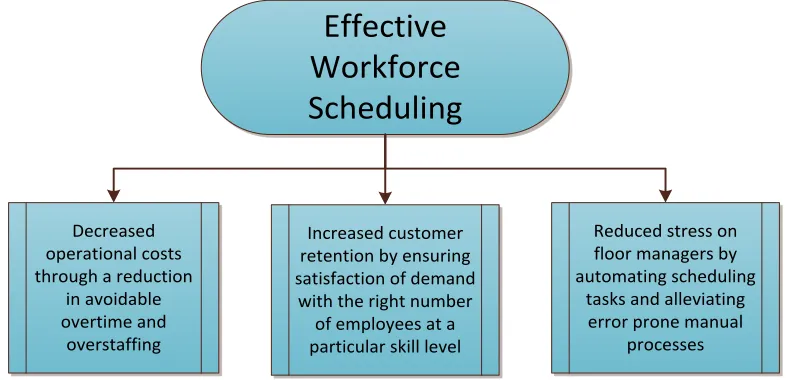
necessitates a highly optimized manufacturing process. As shown in Figure 1.1, the advantages
of optimized worker schedules are decreased expenses, increased customer retention and reduced
pressure on floor managers.
Effective
Workforce
Scheduling
Decreased operational costs through a reduction
in avoidable overtime and
overstaffing
Increased customer retention by ensuring satisfaction of demand
with the right number of employees at a particular skill level
Reduced stress on floor managers by automating scheduling
tasks and alleviating error prone manual
[image:10.612.108.501.369.559.2]processes
Figure 1.1: Advantages of Effective Workforce Scheduling
For effective scheduling, worker allocation models are popular. As mentioned in Celayix
(2013), the benefits of these models range from lower operating costs, increased customer
into account factors such as allocation of workers with lower qualifications, personal preference
of workers, and pre-allotment of specific workers to specific tasks. Also, parameters such as the
operational cost and the efficiency of workers need to be considered before assignment of the
worker. Sometimes, in labor-intensive tasks, multiple workers are needed for machines and/or
overtime, along with training of workers. Workforce planning, in general, also involves strategic
decisions such as the number of workers which are to be hired, trained or moved to other shifts
for a larger planning horizon.
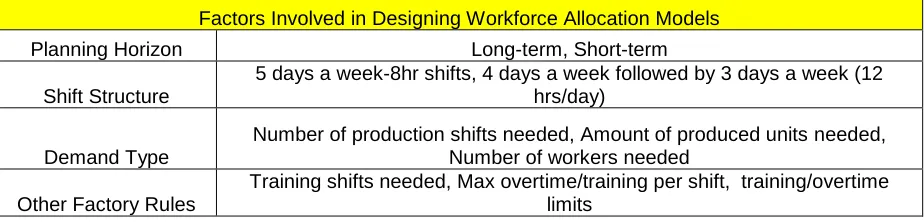
Worker allocation models must be developed considering different factors, such as type of
work, planning periods, and demand patterns. A few of these factors are given as follows.
• Planning Horizon: We consider three planning horizons; single shift planning, multiple
shift planning and strategic planning. Strategic planning models are generally long-term,
whereas single-shift and multiple-shift planning are short-term.
• Demand Type: The demand can be expressed in a number of ways. For example, it can
be the number of shifts of production needed, the number of workers needed at each
operation, or the number of units produced in one shift.
• Shift Structure: Proper management of the labor force is a daunting task. In particular,
assigning workers to different tasks involving regular work, overtime shifts and training
procedures is a challenge.
• Other Factory Rules: These are rules that are specific to the factory floor under
consideration. Some examples of factory rules are limits on cross-training/overtime per
Table 1.1 shows the some examples of planning horizons, shift structure and the demand
type associated with workforce allocation models.
Factors Involved in Designing Workforce Allocation Models
Planning Horizon Long-term, Short-term
Shift Structure
5 days a week-8hr shifts, 4 days a week followed by 3 days a week (12 hrs/day)
Demand Type
Number of production shifts needed, Amount of produced units needed, Number of workers needed
Other Factory Rules
[image:12.612.73.535.138.249.2]Training shifts needed, Max overtime/training per shift, training/overtime limits
Table 1.1: Factors considered while designing worker allocation models
In a competitive industry, it is imperative to achieve production targets on time, and for
this purpose, workers need to be assigned to operations optimally, such that the demand at every
operation is met. A mismatch between the available workers and the workers needed causes
workforce gaps that result in a loss of profit and goodwill for the manufacturer. Similarly, each
company has its own set of rules that need to be followed throughout the production process.
These rules may be related to machinery, workforce, schedules, and skill qualification. This
work is an industry-motivated project that aims to schedule regular work, overtime work and
cross-training such that workforce gaps are minimized. Also, factory rules are given high
importance, and we observe the effects that these have on individual worker-task allocations.
Skill level considerations also form an important component of the mathematical model, along
with standard factory floor limitations.
The rest of this thesis is organized as follows. Section 2 surveys the literature related to
worker allocation and cross-training models and also highlights the research gap. Section 3
describes the problem and describes the industry-based system under consideration. This section
structure of cost parameters and the implementation architecture. Section 4 contains a numerical
example of the mathematical model developed in Section 3. Section 5 presents the summary of
test cases and experimentation. Also, we discuss the solving time associated with the model and
its overall impact. Section 6 concludes this thesis and proposes future extensions to this research
2. LITERATURE REVIEW
The literature related to this research can be divided into two parts, worker allocation
models, and cross-training models. The discussion of worker allocation models is presented in
Section 2.1 and the discussion of cross-training models is presented in Section 2.2. Section 2.3
highlights the research gap that this work aims to fill.
2.1 Worker Allocation Models
Existing literature in the area of worker allocation can be divided broadly into three areas:
single-shift models, multi-shift models and strategic models. Although we develop a multi-shift
model in this thesis, we have reviewed relevant literature related to single shift models too, since
they are building blocks for multi-shift allocation models. We also present an overview of related
strategic models. Review papers such as Wang (2005) and Ernst et al (2004) perform an
overview of the different personnel scheduling papers. Ernst et al (2004) divides allocation
models according to various parameters such as demand modeling, days off, shift scheduling and
task/shift assignment. Wang (2005) provides an overview of the different application areas such
as healthcare, emergency services, airlines and hotels. A discussion of the individual papers
directly relevant to this research work is provided in the sections below.
2.1.1 Single-Shift Models
Suer (1996) designs an optimal assignment policy for a single period allocation problem
by designing a mixed integer program to determine the operator allotment for a variety of
demand scenarios. The results show that before implementation of this methodology, all
model is applicable for both continuous production and cyclic production. Brusco and Johns
(1998) develop an integer programming model that minimizes the workforce staffing costs for a
single work shift. Different cross-training configurations are evaluated and the model is used to
analyze these configurations. The results indicate that asymmetric training configurations allow
better operator-skill relationships. Campbell (1999) formulates a single shift assignment problem
that considered various skill levels across different departments of an organization. The paper
concludes that the approach used is better than the Lagrangian approach used by other authors.
Askin and Huang (2001) develop two MILP formulations that determine allocation of workers
with different costs for training on different skill levels. The output of the first model assigns
workers to cells and gives the assignment of tasks for the worker at that particular cell. The
second model determines the individual training schedule. Norman et al (2002) considers human
skills such as leadership and decision making while assigning workers. A mixed integer program
is developed to maximize the profit which is expressed in the form of a function of training cost
and throughput. The results indicate that better results occur when only technical skills are
considered. Wu and Fu (2005) present a linear programming model for operator staffing and
assignment in a foundry fab. Their model minimizes the cost of staffing and chooses a staffing
position which is assigned to an operator.
Kuo and Yang (2006) solve an operator allocation problem using mixed integer
programming where the formulation assumes that there is no difference between the skill levels
of operators. It was concluded that this assumption does not hold true when there is significant
difference in between skill levels. Jarugumilli et al (2010) consider rules such as the lower limit
on the number of workers at a machine group, the desired mix of workers with a certain skill
knowing the most effective allocation of resources despite not always being able to meet the
worker requirements. A two-phase goal programming formulation is used which minimizes the
cost of assigning workers and the slack/surplus of workers at each operation. The cost structure
is specified for the parameters used in the optimization. The results indicate that operations and
workers for cross-training can be identified using the model.
2.1.2 Multi-shift Models
In Burns et al (1998), an algorithm for scheduling workforce over 4-day or 3-day work
week is developed. Employees work 4-days a week, have a fixed number of weekends off and
work a maximum of 5 days in a row without a break. The results of the model calculate the
minimum number of workers required to satisfy the demand. Azmat and Widmer (2004),
develop a three-step process for workforce planning and scheduling. First, the minimum
workforce that can satisfy the particular demand is computed. Second, the number of overtime
hours and days off for the workforce is determined. And the last step is the actual allocation of
the number of work days per week to each worker. The results show that the algorithm is a quick
method to allocate workers. Laporte and Pesant (2004) develop a constraint programming
algorithm that can handle a wide variety of constraints during a 24 hour, 7 days a week
manufacturing facility. The algorithm is also validated with computational results which support
their considerations of different shift structures, days off and breaks. Bhatnagar (2007) develops
a linear programming model for optimal allocation of workers for companies such as computer
manufacturers and cellphone makers. The results indicate that the cost of allocation increases
Suer and Tummaluri (2008) expand their single-shift model (Suer, 1996) by considering
a case of multiple periods, operator skill levels and operation times. A heuristic for operator
allotment is developed and considers learning/forgetting issues for a worker. Results show that
the proposed approaches in operator assignment outperform the classical approach of using
standard times. Jaurugmilli (2011) extends his single-shift model (Jarugumilli et al, 2010) by
linking the single-shift and multi-shift decision making scenarios. A multi-shift model is
formulated that makes both single-shift and multi-shift decisions for a two-week planning
horizon. The multi-shift decisions satisfy capacity plans and worker availability constraints,
while the single-shift decisions satisfy qualification and skill level requirements. The results help
workers in identifying operations and workers for cross-training. Also, the model considers
partial allocations for any shift during the planning period.
2.1.3 Strategic Models
Strategic models generally consist of a longer time horizon and often have stochastic
parameters. For instance, Ahn et al (2005) design a Markov decision process that determines the
number of workers to hire while minimizing the cost. Hiring and firing of workers is considered
along with a random demand scenario and linear costs. A dynamic programming based approach
is followed to obtain the optimal staffing levels. Gans and Zhou (2002) also implement a Markov
Decision Processes to determine an optimal policy to determine the number of workers to hire.
The results indicate that the when learning is high, a state dependent policy outperforms a policy
dependent on the number of workers in a system. Huang and Song (2007) use a successive
convex approximation method to model a multi-stage stochastic model. Numerical experiments
Techawiboonwong and Yenradee (2003) consider an aggregate production planning
model using mixed integer programming where the worker resources can be transferred along
production lines. The output provides benefits to managing the available production capacity by
using workforce transfers among the lines. Fowler et al (2007) use MIP to determine different
staffing decisions such as hiring, firing and cross-training to minimize workforce related costs
over multiple periods. Kulkarni et al (2013) uses a scenario-based approach to solve a workforce
planning problem formulated as a two-stage stochastic recourse program. Considerations include
fluctuating demand over a long planning horizon, business and labor rules, e.g., hiring, firing,
overtime, cross-training, and shift swapping. The results indicate that the cost of workforce
formulation can be reduced by using the recourse problem.
2.2 Cross-training Models
Early literature consists of industry implementations of cross-training and its benefits to
individual workers. Hackman and Oldham (1980) talk about the positive effect that
cross-training has on a worker’s quality of life and motivation. Jordan and Graves (1995)provide an
actual guideline for management on the methods used to implement cross-training policies in a
manufacturing environment. In Brandt (1997), an example of a cross-training policy was
CTRAIN, used in semiconductor manufacturing at IBM. The results showed an increase in
teamwork and reduced the pressure felt by workers to adapt to ever-changing demands. Another
work, Bailey (1998), talks about the importance of forming cross-functional teams. This work
also compares different team structures (with a particular level of cross-training) and their
associated with the highest productivity. Slomp and Molleman (2002) distinguish four
cross-training policies depending on their effect on important performance metrics such as load of the
bottleneck workers and the number of new qualifications used. It is shown that a worker oriented
cross-training policy, which spreads functions evenly among employees, performs well.
Hopp and Van Oyen (2003) prove that worker coordination, team structure and training
efficiency are parameters essential in evaluating workforce agility. Also, workforce agility is
supported by cross-training and leads to increased task responsiveness, improved quality of
products, and an increased capability to produce a wider range of products. Slomp et al (2003)
include cross-training into an integer programming formulation that minimizes the cost
associated with training. Also, the model is tested with different values of redundancy of
machines and multi-functionality of workers. The purpose of the formulation is to achieve equal
distribution of workload among the workers. Once the amount of cross-training required has
been determined, a strategy needs is developed to assign workers to training. Bokhorst, et al
(2004) extends on Slomp et al (2003) using the concept of skill chaining to develop different
cross-training configurations.Hopp et al (2004), goes in a different direction from Hopp and Van
Oyen (2003), and analyzes the benefits of cross-training of workers for serial production lines.
Bokhorst (2010) measures the impact of the work-in-process on the use of cross-training skills
received by a worker.
Literature Single-shift /Multi-shift/ Strategic
Overtime Allocations
Cross-training
Multiskilling Considered
Non-stop Production
Fractional Allocation Askin and Huang
(2001) Single-shift √ √ √
Aykin (1996) Single-shift √ √
Azmat and Widmer
(2001) Single-shift √ √
Bokhorst et al (2004) Single-shift √ √
Brusco and Johns
(1998) Single-shift √ √
Campbell (1999) Single-shift √ √
Kuo and Yang (2006) Single-shift √
Norman et al (2002) Single-shift √ √
Slomp and Molleman
(2002) Single-shift √ √
Bhatnagar et al (2007) Multi-shift √ √ √
Fowler et al (2008) Multi-shift √ √
Gomar et al (2002) Multi-shift √
Jarugumilli (2011) Multi-shift √ √ √ √
Subramanian and An
(2008) Multi-shift √ √ √ √
Ahn et al (2005) Strategic √ √
Gans and Zhou (2002) Strategic √
Huang and Song
(2007) Strategic √ √
Techawiboonwong
and Yenradee (2003) Strategic √
Fowler et al (2007) Strategic √ √
[image:20.612.72.549.69.497.2]Kulkarni et al (2013) Strategic √ √ √ √
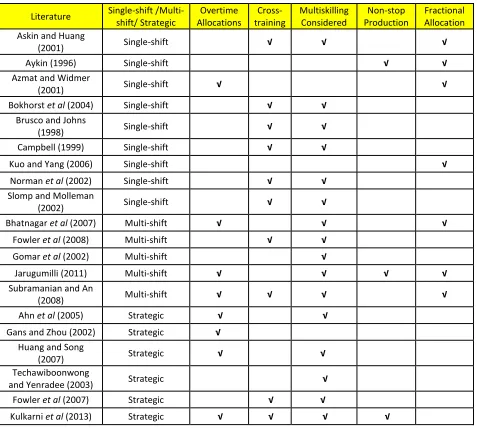
Table 2.2.1: Comparison of selected works of workforce allocation and cross-training
2.3 Research Gap
Figure 2.3.1 describes relevant papers from workforce allocation, cross-training and the
intersection of both. From the papers in the intersection, i.e., Brusco and Johns (1998) and Askin
and Huang (2001), skill levels are relevant, but both are single-shift models. Brusco and Johns
Huang (2001) propose two models developed for only cellular manufacturing systems, and focus
on the synergy between the teams instead of minimizing allocation cost.
As mentioned in Jarugumilli (2011) - to satisfy the different demand scenarios, existing
workforce capabilities might not be sufficient. This results in workforce gaps that result in
unsatisfied demand at the manufacturing floor operations. In previous models such as Bhatnagar
(2007), gaps have been minimized by the use of a large number of overtime workers (i.e.
workers from other shifts) to satisfy the demand of the current shift. However, the use of
overtime workers is a shift-by-shift solution. Over a larger time duration, implementation of
cross-training is needed. Hence, this work integrates cross-training procedures along with regular
and overtime allocation.
As can be observed from Table 2.2.1, we plan to develop a multi-shift model that
integrates regular/ overtime/training allocations, multiskilling, non-stop production and fractional
allocation in the same formulation. In addition, this work also considers many specific factory
3. PROBLEM DESCRIPTION AND FORMULATION
Consider a system that has a fixed number of workers, operations, shifts and skill levels. The
problem involves optimally allocating regular workers, assigning overtime, and assigning
workers for cross-training such that the cost of all three actions along with the cost of the
workforce gaps is minimized.
Depending on the system under consideration, a worker can have a number of skill levels.
Lower skill levels involve doing regular work, and advanced skill levels are related to machine
maintenance. Worker assignments can be made to only one operation at a time at one skill level,
but the worker can be assigned to multiple operations in the same shift.
In case of worker assignment, a worker can work on an operation for some duration of his
shift, while in case of training, a worker has to work for the complete duration of the
cross-training period. If lower skill level cross-training is taking place on an operation, then that operation
can be used by another worker. If higher skill level training is taking place, then that particular
operation cannot be used for any other activity. Every operation has a minimum threshold limit
for which a worker can be assigned to it
There is a set of specified workers for each shift, known as the regular workers. Overtime
workers are regular workers from other shifts who can be contacted if the requirements are not
met by regular workers. Different sets of workers work shifts on fixed days. Based on the
workers working on that particular day, each shift can be classified as part of a shift type.
Workers cannot work in back-to-back shifts, but they can do overtime work in a shift of another
3.1 System under Consideration
The aim is to minimize the costs associated with regular allocation, overtime allocation,
cross-training and workforce gaps. These costs are not monetary costs, but values associated
with the assignment of regular work, overtime, cross-training or gaps. The cost parameters have
been determined based on industry feedback. The structure of these costs will be explained in
Section 3.3.
For the testing and analysis of the model, we have considered a system that includes the
different factors associated with the problem. The components of the system under consideration
are explained below.
3.1.1 Workers/Shifts/Shift Types
This facility has two non-overlapping daily shifts of 12 hours each. There is a fixed
planning horizon of two weeks, i.e., a total of 28 shifts. There are four types of shifts - ST1, ST2,
ST3 and ST4. ST1 and ST3 are daytime shifts, while ST2 and ST4 are night time shifts. Workers
in ST1 and ST2 work for forty-eight hours in week 1 of the planning period, and for thirty-six
hours in week 2 of the planning period. Similarly, workers in ST3 and ST4 work for thirty-six
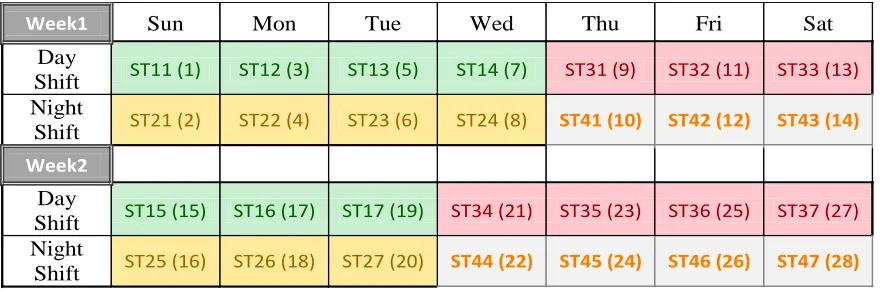
hours in week 1 and forty-eight hours in week 2. Table 3.1.1 shows the shift distribution for the
Table 3.1.1: Shift Structure Considered
To explain the notation, ST13 means that it is shift type 1 (ST1) and the third shift in the
time horizon. So, the general notation is ST[Shift type][Shift number in shift type]. The numbers
in parentheses show the shifts in the order of actual occurrence.
Every shift type contains a set of workers, and apart from overtime situations they work
in shifts of that particular shift type itself. For example, let us say that there are 60 workers; and
workers 1-15 only work in ST1, 16-30 only work in ST2, 31-45 only work in ST3, and 46-60
only work in ST4. These are called as the regular workers for each shift. ST1 and ST2 workers
work day/night shifts on the same day, while ST3 and ST4 workers work day/night shifts on the
same day. Workers in ST3 and ST4 can do overtime work only in shifts ST1 and ST2 (since they
are on different days) and vice versa (i.e., ST1, ST2 workers can do overtime only in ST3 and
ST4).
3.1.2 Skill Levels
A worker can have three skill level qualifications; L1, L2, and L3. L1 is a basic skill
level; L2 and L3 are advanced skill levels that include machine repair and maintenance. Every
operation needs workers that are qualified on L1, L2 and L3. Workers that are qualified on a
Week1 Sun Mon Tue Wed Thu Fri Sat
Day
Shift ST11 (1) ST12 (3) ST13 (5) ST14 (7) ST31 (9) ST32 (11) ST33 (13) Night
Shift ST21 (2) ST22 (4) ST23 (6) ST24 (8) ST41 (10) ST42 (12) ST43 (14)
Week2
Day
Shift ST15 (15) ST16 (17) ST17 (19) ST34 (21) ST35 (23) ST36 (25) ST37 (27) Night
higher skill level (L2 or L3) of a particular operation are capable of doing work at lower skill
levels for the same operation. For example, if a worker is qualified on L3, he can do
OP7-L2 and OP7-L1. If he is qualified on OP7-OP7-L2, he can do OP7-L1 also. However, if he is qualified
on OP7-L1, he cannot do work at OP7-L2 or OP7-L3. Also, to be cross-trained on OP7-L2, a
worker needs to be qualified on OP7-L1; and to be cross-trained on OP7-L3, a worker needs to
be qualified on OP7-L2.
3.1.3 Operations
Every operation has a fixed requirement, i.e., for workers qualified on L1, L2 and L3 on
that operation. Overtime workers (regular workers from other shifts) can be contacted if the
demand for workers is not met by the regular workers on any operation. Every operation is
unique, and a worker that is qualified on an operation skill level combination, cannot
automatically perform work of the same skill level on other operations. Hence, it is essential to
determine the number of workers that need to be qualified on any particular operation. The
solution to the problem involves optimally (at the lowest cost) assigning workers to operations
such that worker requirement at every skill level, on every operation is met. If regular workers
are not sufficient then overtime workers from other shifts (not shifts on the same day) are used.
The two-week schedule for normal allocation of workers and that for cross-training of workers
needs to be developed before the start of each planning period.
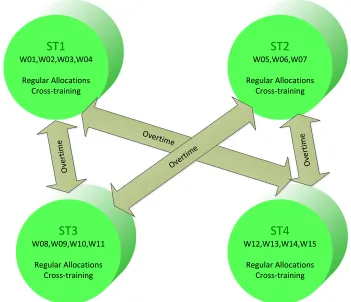
Figure 3.1.1 denotes the normal operating procedure of the factory floor. The initial
scenario depicts workers slotted into the 4 different shift types, i.e., workers 1-4 in ST1, workers
5-7 in ST2, and so on. The same operations exist for each shift of a shift type, and each operation
allocation of workers, cross-training of workers, and overtime allocations (if needed) from other
shift types take place. For example, for ST1, overtime on an operation is obtained from workers
in ST3 and/or ST4. ST2 cannot provide overtime workers because it would mean that a worker,
if assigned for overtime in this shift, would work for 24 hours non-stop. Similarly, for ST2
overtime is obtained from ST3 and/or ST4 and for ST3 and ST4, overtime is obtained from ST1
and/or ST2. If even after assigning overtime, the demand is not satisfied, then workforce gaps are
created.
ST3
W08,W09,W10,W11
Regular Allocations Cross-training
ST1
W01,W02,W03,W04
Regular Allocations Cross-training
ST2
W05,W06,W07
Regular Allocations Cross-training
ST4
W12,W13,W14,W15
Regular Allocations Cross-training
O
ve
rt
im
e
Overtime
Overt ime
O
ve
rt
im
[image:27.612.130.481.277.579.2]e
3.2 MULTI-SHIFT CROSS-TRAINING MODEL
To integrate regular, overtime and cross-training assignments, we develop a multi-shift
cross-training model formulated as an MIP model. It is a deterministic formulation for a fixed
time horizon and the assignment of workers and cross-training schedules are developed for each
shift. The regular work requirements and the cross-training requirements are known entities, and
the aim is to satisfy these values while minimizing the cost associated with regular allocations,
overtime allocations, cross-training assignments and workforce gaps and cross-training gaps.
Other factory floor considerations have also been taken into account in the formulation.
3.2.1 Notation
The notation used in the mathematical model is given as follows:
Sets
𝑠𝑒𝑡 𝐼 = {1,2, … . . I} is the set of workers.
𝑠𝑒𝑡 𝑁 = {1,2, … . N} is the set of operations.
𝑠𝑒𝑡 𝐿 = {1,2, … . . L} is the set of skill levels.
𝑠𝑒𝑡 𝐾 = {1,2, … . K} is the set of shifts.
𝑠𝑒𝑡 𝐽 = {1,2, . . J} is the set of shift types.
𝑠𝑒𝑡 𝐾𝑗 = Set of shifts present in shift type 𝑗 𝜖 𝐽.
Variables
𝑆𝑖𝑙𝑛𝑗𝑘 = Binary variable which is 1 if training starts for worker 𝑖 𝜖 𝑊𝑗, on skill level 𝑙 𝜖 𝐿, operation
𝑛 𝜖 𝑁, during shift type 𝑗 𝜖 𝐽 and shift number 𝑘 𝜖 𝐾𝑗, and 0 otherwise.
𝑋𝑖𝑙𝑛𝑗𝑘 = Continuous variable from 0 to 1 which denotes the percentage of the shift duration for
worker 𝑖 𝜖 𝑊𝑗, on skill level 𝑙 𝜖 𝐿, operation 𝑛 𝜖 𝑁, during shift type 𝑗 𝜖 𝐽 and shift number 𝑘 𝜖 𝑇𝑗.
𝑌𝑖𝑙𝑛𝑗𝑘 = Binary variable which is 1 if worker 𝑖 𝜖 𝑊𝑗 is being trained on skill level 𝑙 𝜖 𝐿, operation
𝑛 𝜖 𝑁, during shift type 𝑗 𝜖 𝐽 and shift number 𝑘 𝜖 𝑇𝑗, and 0 otherwise.
𝑂𝑇𝑙𝑛𝑗𝑘 = Amount of overtime worker-shifts needed for operation 𝑛 𝜖 𝑁, skill level 𝑙 𝜖 𝐿 during
shift type 𝑗 𝜖 𝐽 and shift number 𝑘 𝜖 𝐾𝑗.
𝐺𝑙𝑛𝑗𝑘 = Gap in the allocation at operation 𝑛 𝜖 𝑁, on skill level 𝑙 𝜖 𝐿 during shift type 𝑗 𝜖 𝐽 and shift
number 𝑘 𝜖 𝐾𝑗.
𝐸𝑖𝑙𝑛𝑗𝑘 = Binary variable which is 1 when worker 𝑖 𝜖 𝑊𝑗 on operation 𝑛 𝜖 𝑁 and skill level 𝑙 𝜖 𝐿 is
being trained during shift type 𝑗 𝜖 𝐽 and shift number 𝑘 𝜖 𝐾𝑗, and the training ends in shift k-1,
and 0 otherwise.
𝑆𝐿𝑙𝑛, 𝑆𝑃𝑙𝑛 = Slack variable and surplus variable which denote the gap in cross-training on
operation 𝑛 𝜖 𝑁 and skill level 𝑙 𝜖 𝐿.
𝑍𝑖𝑙𝑛𝑗𝑘 = Binary variable that is 1 if worker 𝑖 𝜖 𝑊𝑗 is assigned to operation 𝑛 𝜖 𝑁, skill level 𝑙 𝜖 𝐿
𝑇𝑊𝑛𝑗𝑘 = Binary variable that is 1 if training of skill level L2 or L3 is taking place at n 𝜖 𝑁 in shift
type 𝑗 𝜖 𝐽, shift 𝑘 𝜖 𝐾𝑗. It is 0 otherwise.
𝑆𝑇𝑙𝑛𝑗𝑘 = Binary variable that is 1 if training takes place on operation n, skill level l in shift type
𝑗 𝜖 𝐽, and shift 𝑘 𝜖 𝐾𝑗, and 0 otherwise.
Parameters
𝑟𝑙𝑛𝑗 = Number of worker-shifts needed on operation 𝑛 𝜖 𝑁 and skill level 𝑙 𝜖 𝐿 during shift type
𝑗 𝜖 𝐽.
𝑟𝑐𝑙𝑛 = Number of worker-shifts of training needed on operation 𝑛 𝜖 𝑁 and skill level 𝑙 𝜖 𝐿.
𝑚𝑠ℎ𝑖𝑓𝑡𝑙𝑛 = Number of shifts of training needed for a worker to be completely trained on
operation 𝑛 𝜖 𝑁 and skill level 𝑙 𝜖 𝐿.
𝑚𝑛/𝑚𝑥 = Minimum/maximum number of qualifications a worker can have at any moment in
the time horizon.
𝑐𝑖𝑙𝑛 = Cost of assignment for worker 𝑖 𝜖 𝐼, on skill level 𝑙 𝜖 𝐿 and operation 𝑛 𝜖 𝑁.
𝑐𝑡𝑖𝑙𝑛 = Cost of training worker 𝑖 𝜖 𝐼, on skill level 𝑙 𝜖 𝐿 and operation 𝑛 𝜖 𝑁.
𝜖𝑖𝑙𝑛𝑗𝑘 = Pre-allocation if training has been carried forward for worker 𝑖 𝜖 𝑊𝑗, on skill level 𝑙 𝜖 𝐿
𝜑𝑖𝑙𝑛𝑗𝑘 = Partial allocation for cross-training that is given to the worker 𝑖 𝜖 𝑊𝑗, on skill level 𝑙 𝜖 𝐿
and operation 𝑛 𝜖 𝑁, in shift type 𝑗 𝜖 𝐽 and shift number 𝑘 𝜖 𝐾𝑗.
𝑞𝑖𝑙𝑛 = Value is 1 if worker 𝑖 𝜖 𝑊𝑗, is qualified at skill level 𝑙 𝜖 𝐿 and operation 𝑛 𝜖 𝑁 at the
beginning of the planning period, and 0 otherwise.
𝑜𝑡𝑙𝑖𝑚𝑖𝑡 = Limit on overtime for the entire factory.
∝𝑠ℎ𝑖𝑓𝑡 = Limit on training for every shift.
𝛽𝑓𝑎𝑐𝑡𝑜𝑟𝑦 = Limit for training for the complete factory.
𝑝𝑙𝑛 = Cost of overtime on operation 𝑛 𝜖 𝑁 and skill level 𝑙 𝜖 𝐿.
𝑝𝑠𝑙𝑛= Cost of a gap at operation 𝑛 𝜖 𝑁 on skill level 𝑙 𝜖 𝐿.
𝑝𝑝𝑙𝑛, 𝑝𝑛𝑙𝑛 = Cost of surplus/slack in cross-training on operation 𝑛 𝜖 𝑁 and skill level 𝑙 𝜖 𝐿.
𝑀 = A big number (condition : 𝑀 ≥ 1/𝑠𝑚)
𝑠𝑚 = Lowest allocation that a worker can take if he is assigned (Eg: If assigned, the worker can
take a value of greater than 0.1).
𝑐𝑜𝑢𝑛𝑡𝑖 = Number of individual operation-skill level qualifications a worker 𝑖 𝜖 𝑊𝑗 possesses at
the beginning of the shift.
𝑡𝑙 = Upper limit on the number of worker than can be trained on an operation in any particular
shift.
𝐿𝑖𝑚 = Number of times a worker can be trained over the planning horizon.
3.2.2 Mathematical Model
The data in the previous section is used to formulate the mathematical model that can be given as
follows.
Objective Function
The objective function [1] is a cost-parameter based formula that minimizes the sum of the
following:
Total cost of assignment of regular workers on all the operations over two weeks,
Total cost of all overtime assignments over the two weeks,
Penalty costs due to all the operations where workforce gaps exist over two weeks,
Total cost of cross-training workers over two weeks, and
Penalty costs associated with not meeting cross-training targets that are specified at the
beginning of the two weeks.
Minimize ∑ ∑ ∑ ∑ ∑ 𝑐𝑙 𝑖 𝑛 𝑘 𝑗 𝑖𝑙𝑛. 𝑋𝑖𝑙𝑛𝑗𝑘 + ∑ ∑ ∑ ∑ 𝑝𝑙 𝑛 𝑘 𝑗 𝑙𝑛 . 𝑂𝑇𝑙𝑛𝑗𝑘+ ∑ ∑ ∑ ∑ 𝑝𝑠𝑙 𝑛 𝑘 𝑗 𝑙𝑛. 𝐺𝑙𝑛𝑗𝑘+
∑ ∑ ∑ ∑ ∑ 𝑐𝑡𝑖𝑙𝑛. 𝑌𝑖𝑙𝑛
𝑗𝑘 𝑗
𝑘 𝑛 𝑙
Constraints
Constraint [2] ensures that the total worker allocation at each operation (including overtime
allocations) should satisfy the requirement at that operation in each shift. If it does not, then
worker gaps are observed. Similarly, even the cross-training requirements are given. Constraint
[3] ensures that the number of workers trained on every operation over the two weeks should be
equal to the pre-established targets.
∑ 𝑋𝑖 𝑖𝑙𝑛𝑗𝑘 + 𝑂𝑇𝑙𝑘𝑗𝑘+ 𝐺𝑙𝑛𝑗𝑘 = 𝑟𝑙𝑛𝑗 ∀ 𝑙, 𝑛, 𝑗, 𝑘 [2]
∑ ∑ ∑ 𝑌𝑖 𝑗 𝑘 𝑖𝑙𝑛𝑗𝑘− 𝑆𝑃𝑙𝑛+ 𝑆𝑁𝑙𝑛 = 𝑟𝑐𝑙𝑛 ∀ 𝑙, 𝑛 [3]
Constraints [4] and [5] work together. If a worker is allocated, he can only be allocated for a shift
duration that is greater than or equal the minimum limit, sm. Generally, for most test cases, we
have assumed this value to be 25% of the total shift duration.
𝑍𝑖𝑙𝑛𝑗𝑘 ≥ 𝑋𝑖𝑙𝑛𝑗𝑘 ∀ 𝑖, 𝑙, 𝑛, 𝑗, 𝑘 [4]
𝑍𝑖𝑙𝑛𝑗𝑘 ≤ 1
𝑠𝑚. 𝑋𝑖𝑙𝑛 𝑗𝑘
∀ 𝑖, 𝑙, 𝑛, 𝑗, 𝑘 [5]
Constraint [6] ensures that the total overtime allocation for the factory does not cross an upper
limit. Constraint [7] ensures that a worker cannot be assigned to training while doing work, and
vice versa. There are upper limits on the number of workers cross-trained per shift as given in
Constraint [8], and the number of workers that can be cross-trained in the planning period as
∑ ∑ ∑ ∑𝑙 𝑛 𝑗 𝑘𝜖𝐾𝑗𝑂𝑇𝑙𝑛𝑗𝑘 ≤ 𝑜𝑡_𝑙𝑖𝑚𝑖𝑡 [6]
∑ ∑ 𝑋𝑙 𝑛 𝑖𝑙𝑛𝑗𝑘 + ∑ ∑ 𝑌𝑙 𝑛 𝑖𝑙𝑛𝑗𝑘 ≤ 1 ∀ 𝑖 𝜖 𝑊𝑗, 𝑗 𝜖 𝐽, 𝑘 𝜖 𝐾𝑗 [7]
∑ ∑ ∑ 𝑌𝑖 𝑙 𝑛 𝑖𝑙𝑛𝑗𝑘 ≤ ∝𝑠ℎ𝑖𝑓𝑡 ∀ 𝑗 𝜖 𝐽, 𝑘 𝜖 𝐾𝑗 [8]
∑ ∑ ∑ ∑ ∑ 𝑌𝑙 𝑛 𝑘 𝑗 𝑖 𝑖𝑙𝑛𝑗𝑘≤ 𝛽𝑓𝑎𝑐𝑡𝑜𝑟𝑦 [9]
Constraints [10] and [11] address the fact that if a worker starts, then the starting shift needs to
be kept track of)
𝑆𝑖𝑙𝑛𝑗𝑘 = 𝑌𝑖𝑙𝑛𝑗𝑘 ∀ 𝑖 𝜖 𝑊𝑗, 𝑙 𝜖 𝐿, 𝑛 𝜖 𝑁, 𝑗 𝜖 𝐽, 𝑘 = 𝑘𝑗[1] 𝜖 𝐾𝑗 [10]
𝑆𝑖𝑙𝑛𝑗𝑘 ≥ 𝑌𝑖𝑙𝑛𝑗𝑘− 𝑌𝑖𝑙𝑛𝑗𝑘′ ∀ 𝑖, 𝑙, 𝑛, 𝑗, 𝑘 > 𝑘𝑗[1] , 𝑘′= 𝐸𝑙𝑒𝑚𝑒𝑛𝑡 𝑜𝑓 𝐾
𝑗 𝑏𝑒𝑓𝑜𝑟𝑒 𝑘 𝜖 𝐾𝑗 [11]
Constraint [12] satisfies the requirement that if a worker is has started training, then he must be
trained for the pre-specified number of shifts needed to be qualified at that skill level.
𝑚𝑠ℎ𝑖𝑓𝑡𝑙𝑛. 𝑆𝑖𝑙𝑛𝑗𝑘 ≤ ∑𝑟 ≤𝑘′=𝑘+𝑚𝑠ℎ𝑖𝑓𝑡𝑙𝑛−1𝑌𝑖𝑙𝑛𝑗𝑟
𝑟 ≥ 𝑘 ∀ 𝑖 𝜖 𝑊𝑗, 𝑙, 𝑛, 𝑗, 𝑘 𝜖 𝐾𝑗, 𝑘 ′𝜖 𝑇
𝑗 [12]
Constraint [13] prevents duplicate training of a particular worker on the same operation-skill
level combination.
∑𝑘 𝜖 𝐾 𝑆𝑖𝑙𝑛𝑗𝑘
The shift in which training for a worker ends is kept track of using Constraints [14] and [15].
Constraint [14] recognizes the ending shift, and if training shifts are more than 1, Constraint [15]
ensures that the variable denoting the end of training is 0 in the shifts between the start and end
shifts.
𝑆𝑖𝑙𝑛𝑗𝑘 = 𝐸𝑖𝑙𝑛𝑗𝑘′ ∀ 𝑖, 𝑙, 𝑛, 𝑗, 𝑘 𝜖 𝐾𝑗 , 𝑘′= (𝑚𝑠ℎ𝑖𝑓𝑡𝑙𝑛+ 𝑘)𝑡ℎ 𝑚𝑒𝑚𝑏𝑒𝑟 𝑜𝑓 𝑇𝑗 [14]
Only if 𝑚𝑠ℎ𝑖𝑓𝑡𝑙𝑛> 1;
𝐸𝑖𝑙𝑛𝑗𝑘 = 0 ∀ 𝑖, 𝑙, 𝑛, 𝑗, 𝑘 ≤ (𝑚𝑠ℎ𝑖𝑓𝑡𝑙𝑛)𝑡ℎ 𝑚𝑒𝑚𝑏𝑒𝑟 𝑜𝑓 𝑇𝑗 && 𝑘 𝜖 𝐾𝑗 [15]
Constraints [16] and [17] put lower and upper limits on the number of possible qualifications a
worker can have in any shift.
∑ ∑ ∑ 𝑆𝑛 𝑙 𝑘 𝑖𝑙𝑛𝑗𝑘 + 𝑐𝑜𝑢𝑛𝑡𝑖 ≥ 𝑚𝑛 ∀ 𝑖, 𝑗 [16]
∑ ∑ ∑ 𝑆𝑛 𝑙 𝑘 𝑖𝑙𝑛𝑗𝑘 + 𝑐𝑜𝑢𝑛𝑡𝑖 ≤ 𝑚𝑥 ∀ 𝑖, 𝑗 [17]
Constraint [18] enforces that a worker can only be trained on skill level L2 of an operation if he
is qualified on skill level L1 of that same operation. Similarly, Constraint [19] enforces that
condition for L3 and L2.
𝑀. 𝐸𝑖𝑙𝑛𝑗𝑘 ≥ ∑ 𝑌𝑖𝑙𝑗𝑘′𝑛
′
𝑀. 𝐸𝑖𝑙𝑛𝑗𝑘 ≥ ∑ 𝑌𝑖𝑙𝑗𝑘′𝑛 ′
𝑘′>𝑘 ∀ 𝑙 = 𝐿2, ; 𝑙′ = 𝐿3; 𝑛, 𝑖, 𝑗 && 𝑞𝑖𝑙𝑛𝑗𝑘 = 0 ∀ 𝑙 = 𝐿2, 𝐿3 [19]
Constraint [20] puts an upper limit on the number of workers that can be trained on the same
operation-skill level combination in the same shift.
∑ ∑ 𝑌𝑙 𝑖 𝑖𝑙𝑛𝑗𝑘 ≤ 𝑡𝑙 ∀ 𝑗 𝜖 𝐽, 𝑘 𝜖 𝑇𝑗, 𝑛 𝜖 𝑁 [20]
Constraint [21] puts an upper limit on the number of assignments of a worker that can be made in
one shift.
∑ ∑ 𝑍𝑙 𝑛 𝑖𝑙𝑛𝑗𝑘 ≤ 𝑤𝑙 ∀ 𝑗 𝜖 𝐽, 𝑘 𝜖 𝐾𝑗, 𝑖 𝜖 𝑊𝑗 [21]
Constraint [22] puts an upper limit on the number of times a worker can be trained during the
planning horizon.
∑ ∑ ∑ 𝑆𝑘 𝑛 𝑙 𝑖𝑙𝑛𝑗𝑘 ≤ 𝐿𝑖𝑚 ∀ 𝑖 𝜖 𝑊𝑗, 𝑗 [22]
Constraints [23] and [24] ensure that training of skill levels L2 and L3 only occurs if there is no
work currently taking place at the particular operation in that shift.
∑ ∑𝑖 𝑙=𝐿2,𝐿3𝑌𝑖𝑙𝑛𝑗𝑘 ≤ 𝑀. 𝑇𝑊𝑛𝑗𝑘 ∀ 𝑗 𝜖 𝐽, 𝑘 𝜖 𝐾𝑗, 𝑛 𝜖 𝑁 [23]
Constraints [25] and [26] enforce the condition that for any operation, in any shift of the
planning horizon, training cannot occur at multiple skills levels.
∑ 𝑌𝑖 𝑖𝑙𝑛𝑗𝑘 ≤ 𝑀. 𝑆𝑇𝑙𝑛𝑗𝑘 ∀ 𝑙, 𝑛, 𝑗, 𝑘 𝜖 𝑇𝑗 [25]
∑ 𝑆𝑇𝑙 𝑙𝑛𝑗𝑘≤ 1 ∀ 𝑗, 𝑛, 𝑘 𝜖 𝑇𝑗 [26]
If there are any pre-allocations for cross-training before the beginning of the planning horizon,
then they can be assigned in the model using Constraint [27].
𝜖𝑖𝑙𝑛𝑗𝑘 ≤ 𝑌𝑖𝑙𝑛𝑗𝑘 ∀ 𝑖, 𝑙, 𝑛, 𝑗, 𝑘 [27]
Similarly, the partial allocations assigned in the model before the planning period starts can be
assigned using Constraint [28].
𝜑𝑖𝑙𝑛𝑗𝑘 ≤ 𝑋𝑖𝑙𝑛𝑗𝑘 ∀ 𝑖, 𝑙, 𝑛, 𝑗, 𝑘 [28]
Constraint [29] ensures that the duration a worker can be assigned on any operation skill-level
combination in any shift is between 0 and 1, i.e, from 0% of the worker’s shift to 100% of the
worker’s shift.
Constraint [30] specifies the binary variables used in the model.
𝑆𝑖𝑙𝑛𝑗𝑘, 𝑍𝑖𝑙𝑛𝑗𝑘, 𝐸𝑖𝑙𝑛𝑗𝑘, 𝑌𝑖𝑙𝑛𝑗𝑘, 𝑇𝑊𝑛𝑗𝑘, 𝑆𝑇𝑙𝑛𝑗𝑘 𝜖 {0,1} ∀ 𝑖, 𝑙, 𝑛, 𝑗, 𝑘 [30]
3.3 COST PARAMETER STRUCTURE
Here, we present the structure of the cost parameters used in the objective function
presented in the previous sub-section. For every operation skill-level scenario, we can split the
set of workers I in any shift type j, into two groups; 𝐼𝑙𝑛 – the set of workers qualified on skill
level l and operation n and 𝐼𝑙′𝑛′- the set of workers not qualified on skill level l and operation n.
Also, if worker 𝐼𝑙𝑛 is present in shift type j, then we denote the worker as 𝐼𝑙𝑛𝑗 , and if the worker is
not present in shift type j, then we denote the worker as 𝐼𝑙𝑛𝑗′.
Definition 1: An operation-skill level combination is defined as a particular instance of the
operation and the skill level. For example, if there are three operations - OP1, OP2 and OP3, and
two skill levels – L1 and L2, then the set of operation-skill level combinations is {OP1-L1,
OP2-L1, OP3-OP2-L1, OP1-L2, OP2-L2, OP3-L2}.
Definition 2: A skill level relaxation occurs when there exists a requirement on an operation of a
specific skill level and it is filled by a worker qualified on the same operation but of a lower skill
level.
Theorem 1: This theorem is derived from a theorem in Jarugumilli (2011). If an optimal
solution is to be obtained, the cost of assigning a worker that is qualified on a particular skill
Proof: We need the qualified workers to perform the task, not the ones that are not qualified.
Since, the optimal value of the objective function is a minimization of the costs, we obtain
𝑐𝑖𝑙𝑛 < 𝑐𝑖′𝑙𝑛, 𝑖’ is the worker that is not qualified on skill l and operation n.
Theorem 2: If the cost of allocating any worker qualified on a particular operation-skill level
combination is less than the cost of cross-training any worker on the same operation-skill level
combination, i.e.,𝑐𝑖𝑙𝑛 < 𝑐𝑡𝑥𝑙𝑛, for x = i and x≠i., then we obtain an optimal solution.
Proof:This can be divided into 2 conditions, (𝑖)𝑖 = 𝑥 = 𝐼𝑙𝑛 𝑎𝑛𝑑 (𝑖𝑖)𝑖 = 𝐼𝑙𝑛 , 𝑥 = 𝐼𝑙′𝑛′. Also, we
can say that the objective function value for each case is W1 and W2.
For (i), we compare the costs of cross-training and allocation for the same worker. Assuming he
is qualified on OP2-L1, we do not need to assign him to cross-training for OP2-L1. Hence, if
𝑐𝑖𝑙𝑛 > 𝑐𝑡𝑥𝑙𝑛, the value W1 would favor cross-training and not allocation. Hence, 𝑐𝑖𝑙𝑛 < 𝑐𝑡𝑥𝑙𝑛.
For (ii), we consider a worker that is not qualified on the operation-skill level combination to
another worker that is qualified on it. From Theorem 1, for worker i we obtain 𝑐𝑖𝑙𝑛 < 𝑐𝑥𝑙𝑛.
Also, from part (i) of this theorem, we obtain that 𝑐𝑥𝑙𝑛 < 𝑐𝑡𝑥𝑙𝑛. Hence, we can prove that
𝑐𝑖𝑙𝑛 < 𝑐𝑡𝑥𝑙𝑛.
Theorem 3: If a skill level relaxation takes place, the cost of assigning a worker to the different
skill level on the same operation is always higher.
Proof: If a skill level relaxation takes place for skill level 𝑙, it means that instead of assigning
worker 𝐼𝑙𝑛 on operation n, we have assigned worker 𝐼𝑙′𝑛 on operation n. This means that one less
worker is available to be assigned on skill level 𝑙’. There is an extra overhead cost that needs to
Theorems 1, 2 and 3 were concerned with comparing the costs for single workers. Now,
we will consider costs for overtime allocation, workforce gap, and slack/surplus in cross-training
for the complete set of workers present in each shift type.
Definition 3: The workforce gap is defined the gap observed at every operation-skill level
combination in each shift in the planning horizon.
Definition 4: The slack and surplus in cross-training is the number of shifts lesser than and
greater than the cross-training targets (specified at the beginning of the planning horizon)
respectively for every operation skill level combination.
Theorem 4: The cost of cross-training surplus is less than the cost of cross-training slack, which
is in turn less than the cost of total overtime per shift which is in turn less than the cost of the
workforce gap per shift.
Proof: We will prove this theorem in parts. (i) 𝑝𝑙𝑛 < 𝑝𝑠𝑙𝑛 (ii) 𝑝𝑝𝑙𝑛 < 𝑝𝑛𝑙𝑛 (iii) 𝑝𝑛𝑙𝑛 < 𝑝𝑙𝑛
The cost of a workforce gap at a particular operation skill level combination is the highest. This
is because a workforce gap causes a shortage in production, and a shortage causes a loss of profit
and reputation for the company. Hence, 𝑝𝑙𝑛 < 𝑝𝑠𝑙𝑛 and (i) holds true.
Similarly, a surplus in cross-training targets is preferable as compared to a slack. Hence, 𝑝𝑝𝑙𝑛 <
𝑝𝑛𝑙𝑛, and (ii) holds true.
We can prove (iii) by negation. The cost parameters need to be structured such that satisfying the
operational demand is a higher priority as compared to worker training. If we assume 𝑝𝑛𝑙𝑛 >
overtime to meet the extra demand, training assignments will be given a priority in the objective
function. Hence, 𝑝𝑛𝑙𝑛 < 𝑝𝑙𝑛.
Tables 3.3.1 and 3.3.2 show an example that denotes the values taken for the cost
parameters in the model. As we can observe from Table 3.3.1, the cost parameters for a worker
qualified at a skill level and performing work at that skill level are the lowest values in the table.
L1 at L1 is 270/271/272, L2 at L2 is 210/211/212 and L3 at L3 is 100/101/102. These three
parameters are in descending order, because L3 work is generally considered more important and
the workers qualified on L3 should be working at L3 instead of working on lower skill levels. It
is to be noted that the specific values themselves are not important as the relationship between
these values.
Table 3.3.2 highlights the difference in costs for critical operations. The cost parameters
are close to each other, but the cost of workforce gaps is higher for critical operations, the cost of
training slack is higher and the cost of training surplus is lower for critical operations.
Trained_Skill Level
Performs Work of
Preference 1
Preference 2
Preference 3
L1 L1 270 271 272
L1 L2 5900 5910 5920
L1 L3 6700 6710 6720
L2 L1 2300 2310 2320
L2 L2 210 211 212
L2 L3 5300 5310 5320
L3 L1 1900 1910 1920
L3 L2 1700 1710 1720
L3 L3 100 101 102
Critical
Operation Training Cost
Cost of Overtime
Cost of Training
Slack
Cost of Training
Surplus
Cost of Workforce
Gap
Yes 5001 12000 11000 9000 1200000
[image:42.612.120.495.72.144.2]No 5001 12500 10500 9500 1000000
Table 3.3.2: Other Cost Parameters
[image:42.612.73.537.326.569.2]3.4 Implementation Architecture
Figure 3.4.1 shows the implementation architecture for the mathematical model. The input
requirements are converted into a Derived Requirements document, which is then used by a C#
code. The solver used to perform the optimization is IBM ILOG CPLEX 12.4.
Output from Multi-shift Cross-training Model Input to Multi-Shift Cross-training Model
Worker Qualification
Data Operational Requirement and Training
Data
Worker Cross-training List Shift-by-shift Worker Assignment
C# Interface
IBM CPLEX
12.4 Worker
Overtime Allocations Input Format
Requirements
Derived Requirements
Figure 3.4.1: Implementation Architecture
The input requirements are given in terms of values such as man-machine ratio, L1:L2:L3
ratio, and the tool count needed for each shift. These values are then converted in a derived
each operation-skill level combination (additional information on this procedure is given in
Section 4). Similarly, even the training data is specified in the form of number of shifts.
Furthermore, the workers qualification matrix at the beginning of the planning period is also
needed as an input. An example of the input format is shown in the Table 3.4.1, and the
corresponding derived requirements are shown in Tables 3.4.2(a), (b) and (c). The columns of
Table 3.4.1 are described below.
Operation: It is the actual operation under consideration on the manufacturing floor.
MMR (Man-Machine Ratio): The value that is used to convert the amount of workers needed
with respect to the amount actually needed at the machines.
L1:L2:L3: This is the ratio of the requirement for each skill level at every operation.
Tool Count: This denotes the actual machine requirement at each shift type. Hence, here we have
values for ST1, ST2, ST3 and ST4 in each column.
The calculation for each cell in Table 3.4.3 is given as:
L1 Req. = (Tool Count)*MMR*L1 / (L1+L2+L3)
L2 Req. = (Tool Count)*MMR*L2 / (L1+L2+L3)
L3 Req. = (Tool Count)*MMR*L3 / (L1+L2+L3)
The values denote the total number of worker-shifts that are needed to satisfy the requirement for
Table 3.4.1: Input Format
L1 Req. ST1 ST2 ST3 ST4
OP1 0.1 0.1 0.14 0.1 OP2 0.45 0.15 0.25 0.3 OP3 0.2 0.32 0.16 0.28
Table 3.4.2(a): Derived Requirements (L1)
L2 Req. ST1 ST2 ST3 ST4
OP1 0.1 0.1 0.14 0.1 OP2 0.45 0.15 0.25 0.3 OP3 0.2 0.32 0.16 0.28
Table 3.4.2(b): Derived Requirements (L2)
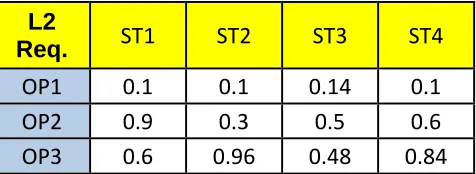
L2
Req. ST1 ST2 ST3 ST4
OP1 0.1 0.1 0.14 0.1 OP2 0.9 0.3 0.5 0.6 OP3 0.6 0.96 0.48 0.84
Table 3.4.2(c): Derived Requirements (L3)
The output of the model provides the shift-by-shift worker assignment, the worker
cross-training list and the worker overtime allocations. The output tables for a numerical example are
Operation MMR L1:L2:L3 Tool Count ST1
Tool Count ST2
Tool Count ST3
Tool Count ST4
Op1 2:3 1:1:1 0.45 0.45 0.63 0.45
Op2 1:2 1:1:2 3.6 1.2 2 2.4
[image:44.612.189.427.490.577.2]described in detail in Section 4. Section 4 also contains a shift type based view of these
allocations and also an individual shift based view of each worker during the shift.
4. NUMERICAL EXAMPLE
In this section, we discuss a numerical example that has been solved using the integrated
multi-shift cross-training model formulated in Section 3. The specifications of this test case are given
in Table 4.1.
Shifts 28
Shift Types 4
Number of shifts in each Shift Type 7
Workers 15
Operations 5
Skill levels L1, L2, L3
Regulars Worker / Shift type
1-6 (ST1) 7 (ST2) 8-11 (ST3) 12-15 (ST4) Table 4.1: Test Case Specifications
The tables that act as input to the model and output to the model are discussed below.
Tables 4.2 (a), (b) and (c) show the number of shifts of regular allocation (parameter 𝑟𝑙𝑛 needed
for each operation skill level combination in a shift of each shift type, i.e, these are the derived
L1 Req. ST1 ST2 ST3 ST4
OP1 0.50 1.19 0.51 0.96 OP2 0.51 0.48 0.72 0.50 OP3 0.47 0.42 0.72 0.39 OP4 0.30 0.47 0.60 0.65 OP5 0.33 0.43 0.45 0.49
Total 2.11 3.00 3.00 3.00
Table 4.2(a): L1 Requirements for Test Case
L2 Req. ST1 ST2 ST3 ST4
OP1 0.25 0.25 0.25 0.25 OP2 0.33 0.26 0.25 0.25 OP3 0.27 0.25 0.25 0.25 OP4 0.31 0.25 0.40 0.38 OP5 0.25 0.33 0.34 0.25
Total 1.40 1.34 1.49 1.38
Table 4.2(b): L2 Requirements for Test Case
L3 Req. ST1 ST2 ST3 ST4
OP1 0.28 0.25 0.25 0.25 OP2 0.25 0.31 0.25 0.25 OP3 0.31 0.25 0.25 0.25 OP4 0.25 0.25 0.28 0.25 OP5 0.25 0.33 0.26 0.42
Total 1.35 1.39 1.28 1.42
Table 4.3 denotes the critical operations present on the manufacturing floor. The critical
operations are important to obtain effective production in the manufacturing process. Hence, a
gap at these operations provides more of a problem than a gap faced at other operations.
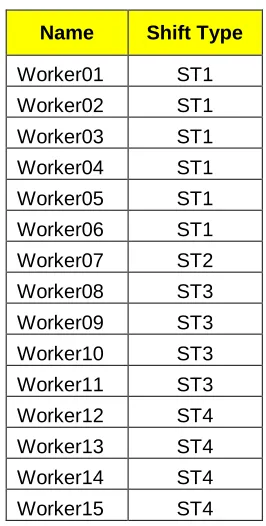
Table 4.4 denotes the workers assigned to each shift type.
Operation Critical Operation
Cross Training Area
Op1 No Assembly
Op2 No Assembly
Op3 Yes Assembly
Op4 No Assembly
[image:47.612.212.400.175.292.2]Op5 No Assembly
Table 4.3: Critical Operations
Name Shift Type
Worker01 ST1
Worker02 ST1
Worker03 ST1
Worker04 ST1
Worker05 ST1
Worker06 ST1
Worker07 ST2
Worker08 ST3
Worker09 ST3
Worker10 ST3
Worker11 ST3
Worker12 ST4
Worker13 ST4
Worker14 ST4
[image:47.612.239.372.422.685.2]Worker15 ST4
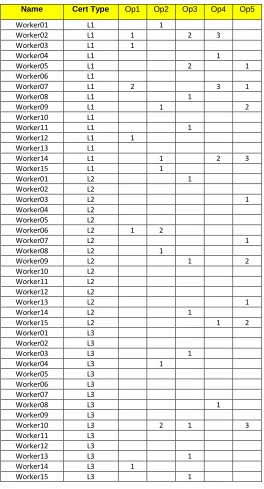
Table 4.5 shows the qualifications of each worker on each operation-skill level combination. The
numbers 1, 2 and 3 denote the preference of the worker on that particular operation. Preference 1
means that the worker prefers to work on this operation as compared to any other operation for
that particular skill level. (Similarly for preference 2 means the worker prefers to work on one
operation before this operation). The fields that do not have any number present indicate that the
worker is not qualified on any of these operations. The workers are eligible to be trained on these
operation-skill level combinations.
Table 4.6 shows the shifts of training needed for each operation-skill level combination. The
numerical value indicates the number of worker-shifts of training that need to be completed in
this time horizon. This number can be obtained from strategic level models that make use of the
long-term results to extrapolate the training levels needed for two weeks.
Table 4.7 shows the number of shifts needed to complete training at a particular skill level,
Name Cert Type Op1 Op2 Op3 Op4 Op5
Worker01 L1 1
Worker02 L1 1 2 3
Worker03 L1 1
Worker04 L1 1
Worker05 L1 2 1
Worker06 L1
Worker07 L1 2 3 1
Worker08 L1 1
Worker09 L1 1 2
Worker10 L1
Worker11 L1 1
Worker12 L1 1 Worker13 L1
Worker14 L1 1 2 3
Worker15 L1 1
Worker01 L2 1
Worker02 L2
Worker03 L2 1
Worker04 L2 Worker05 L2
Worker06 L2 1 2
Worker07 L2 1
Worker08 L2 1
Worker09 L2 1 2
Worker10 L2 Worker11 L2 Worker12 L2
Worker13 L2 1
Worker14 L2 1
Worker15 L2 1 2
Worker01 L3 Worker02 L3
Worker03 L3 1
Worker04 L3 1
Worker05 L3 Worker06 L3 Worker07 L3
Worker08 L3 1
Worker09 L3
Worker10 L3 2 1 3
Worker11 L3 Worker12 L3
Worker13 L3 1
Worker14 L3 1
Worker15 L3 1
Table 4.5: Worker Operation-Skill Level Qualifications
Operation L1 L2 L3
OP1 18 16 18
OP2 6 5 15
OP3 2 20 9
OP4 11 19 9
[image:49.612.175.439.68.557.2]OP5 10 5 15
The cross-training model is solved using CPLEX and a raw excel sheet output is obtained. The
raw output has been formatted in Tables 4.8 (a), (b), (c), (d). The output is shown for ST1, ST2,
ST3 and ST4 in each sub-table. Every column in Table 4.8 denotes parameters essential to the
output. These parameters are described below.
Number of Qualified Workers: Provides a reference to the floor manager regarding the number of
workers available to perform a particular task.
Qualified Workers for Current Shift: Displays the qualified workers available in the current shift.
Qualified Workers for Overtime: Shows the number of workers in other shift types that are
capable of doing the task.
Worker: The actual worker number that is doing the particular task.
Allocation in Shifts: The individual value of the fraction of the shift duration that the particular
worker has been assigned on the operation-skill level combination. This is given for each of the
seven shifts present in the shift type. Hence, for ST1, it is given for shift 1, 3, 5, 7, 15, 17, 19.
The values in red denote overtime or training.
Requirement: Denotes the number of worker-shifts needed (values in Table 4.2).
Skill levels Mshifts
L1 1
L2 2
[image:50.612.231.382.90.155.2]L3 2