City, University of London Institutional Repository
Citation
:
Makri, S., Ravem, M. and McKay, D. (2017). After serendipity strikes: Creating
value from encountered information. Proceedings of the Association for Information Science
and Technology, ISSN 2373-9231
This is the accepted version of the paper.
This version of the publication may differ from the final published
version.
Permanent repository link: http://openaccess.city.ac.uk/17704/
Link to published version
:
Copyright and reuse:
City Research Online aims to make research
outputs of City, University of London available to a wider audience.
Copyright and Moral Rights remain with the author(s) and/or copyright
holders. URLs from City Research Online may be freely distributed and
linked to.
City Research Online:
http://openaccess.city.ac.uk/
[email protected]
1
After Serendipity Strikes: Creating Value from
Encountered Information
Stephann Makri
City, University of London
Northampton Square
London EC1V 0HB, UK
[email protected]
Mina Ravem
Telia Norge AS
Netcom, Sandakerveien 140
Postboks 444 Nydalen, 0484,
Oslo
Dana McKay
University of Melbourne
Parkville, VIC 3010
Australia
[email protected]
ABSTRACT
Existing research into serendipitous information encountering has focused on how people stumble upon information, rather than how they create value from the information encountered. This online diary study with follow-up interviews provides an enriched understanding of the subjective value of information encounters and the motivators, barriers and actions involved in creating value from them. We leverage our findings to generate design suggestions for digital information tools aimed at assisting in creating value from encountered information.
Keywords
Serendipity, information encountering, relevance, value
INTRODUCTION
Information seeking (i.e. search and browse) has been the historic focus of information behavior research. Recently, however, Information Encountering (IE) has received increased recognition as an important mode of information acquisition. IE happens when people are looking for information on a different topic, when they are not looking for any information in particular, or when they are not looking for information at all. IE can facilitate connection-making between seemingly unrelated pieces of information; spark new insights, propel people forward in new directions and surprise and delight them along the way.
Prior research on IE has focused on how people stumble upon information and how digital information tools can support this (e.g. through recommendations or information visualization). For IE to be beneficial, though, it is necessary to create value from the encountered information, by following it up and applying it in one’s life or work. Therefore, stumbling upon information is not enough; the finder must also take action to maximize the potential value
of the information. What taking action in this way involves remains largely unstudied.
The notion of ‘value’ has been examined in the context of whether or not users are likely to pursue acquired information and incorporated into several models of serendipity (e.g. Foster & Ford, 2003; Makri & Blandford, 2012a; McCay-Peet & Toms, 2015). We have some idea of why encountered information is considered valuable; it can be knowledge-enhancing, impactful, timely or time-saving (Makri & Blandford, 2012a). Other aspects of value creation from encountered information, e.g. the actions, motivators, and barriers involved, are less well understood; this is an area ripe for study and enhanced digital support.
We conducted an online diary study to discover how people create value from encountered information, and their related motivators and barriers. Participants took screenshots of information they encountered and shared them privately with us in the cloud. Screenshots were then used as probes in follow-up interviews. Interviews focused on whether participants had found encountered information valuable and whether they had followed it up (or intended to) and why or why not. Several motivators, barriers and actions involved in value creation emerged. These elements form an empirically-grounded framework for discussing how people create value from their information encounters, and how they subjectively experience that value. The primary contribution of this work is that framework and the resultant design suggestions for creating value from encountered information. In the remainder of this paper, we discuss background literature on IE, outline and justify our method, present our findings and build a framework that describes aspects of post-encounter value creation. We then discuss our findings in the context of previous work and present design implications. Finally, we draw conclusions.
BACKGROUND
In this section we provide a theoretical definition of IE, and examine work on influencing IEs. We briefly discuss what value might mean in an IE context, then give an overview of the sparse literature on how it might be created.
2
Information Encountering
Erdelez coined the term Information encountering, defining it as ‘accidental discovery during an active search for some other information’ (Erdelez, 2005). This definition has since been expanded by other researchers (e.g. Agarwal, 2015; Kefalidou & Sharples, 2016) to include information discovered when browsing or when not looking for information at all. Erdelez has referred to this broader scope as ‘opportunistic information discovery’ (Erdelez, 2004).
The precise definition we use for information encountering aligns with the more commonly used broader scope, and is grounded in our own earlier work (Makri & Blandford, 2012a, 2012b; Makri, Blandford, Woods, Sharples, & Maxwell, 2014; Makri et al., 2015). We define an information encounter as finding useful or potentially useful information when looking for different information, not looking for any information in particular, or not looking for information at all. This definition aims to capture the essence of serendipity in the context of information acquisition; in this paper we describe such serendipitous experiences as IE rather than serendipity.
Given this definition, IE sits outside many traditional information seeking models (Kuhlthau, 1991; Marchionini, 1997), though Bates’ Berrypicking model does allow for a shift in focus as a result of IE (Bates, 1989). IE is a component of McKenzie’s (2003) model. However, while this model proposes that IE only happens during non-directed monitoring, it has also been found to occur during active information seeking (Erdelez, 2004; Makri et al., 2015). Many empirical studies note that IE, rather than being marginal, is an important mode of information acquisition (D'Antonio et. al., 2012; Erdelez, 1997; Foster & Ford, 2003; Makri & Blandford, 2012a, 2012b; Makri & Warwick, 2010; McCay‐Peet & Toms, 2015).
Influencing Information Encountering
Several studies have sought to examine ways in which IE might be influenced on both an individual level (Heinström, 2006; Makri et al., 2014; McBirnie, 2008; McCay-Peet, Toms, & Kelloway, 2015; McCay‐Peet & Toms, 2015) and an organizational level (Cunha, Clegg, & Mendonça, 2010; Napier & Quan, 2013). At an individual level, the influence of personality has been examined, but findings have varied; Heinström (Heinström, 2006) found that IEs were more likely for students who were outgoing, confident and took a strategic approach to information seeking. Findings of a recent study (McCay-Peet et al., 2015) were more modest; extroverts were more likely to report experiencing serendipity in general, but this did not extend to IE.
Some environments are notable for creating opportunities for productive IEs; especially the library shelves (Kleiner, Rädle, & Reiterer, 2013; Thudt, Hinrichs, & Carpendale, 2012). Semantic addressing is designed specifically to make it easier for information seekers to find other books that may pique their interest (Svenonius, 2000). In view of this, various digital tools have emerged to attempt to facilitate IE
within the limited scope of the digital library (e.g. Kleiner et al., 2013; Pearce & Chang, 2014; Thudt et al., 2012). Although these tools have not been investigated in terms of whether and how users leverage the encountered information, McCay-Peet has shown that digital tools can influence IE (McCay-Peet et al., 2015). Her work demonstrates that tools that provide opportunities for consuming a variety of information, that facilitate connection making and that offer unexpected interactions best encourage IE. These findings are aligned with our own earlier work on serendipity generally (Makri et al., 2014). This paper investigates how tools might support not just the occurrence of IE, but the extraction of value from them.
Some work has examined control in IE; findings here have been mixed. Foster and Ford found academic researchers’ perceptions of control varied considerably; some thought encountering information was ‘almost deliberate randomness’ while others a result of persistence and hard work (Foster & Ford, 2003). McBirnie noted a paradox in control and IE; that it is not possible to control the process, but that it is possible—for example by being open and flexible during information acquisition—to control the perception of it (McBirnie, 2008). This evaluation, though, rests on the process of IE ending immediately one the information is encountered. Our earlier work highlights that the process continues post encounter, and can be influenced by taking action to leverage unexpected encounters to make them valuable (Makri & Blandford, 2012a). This paper extends our work on value, looking at how value is created.
‘Value’ in the Context of Information Encountering
Traditionally the value of a given piece of information in an information seeking context has been ‘precision’, a measure of how well the textual content of a document matches a user’s query (Baeza-Yates & Ribeiro-Neto, 1999). However, this approach requires the information seeker to know and describe the information they need; something Borgman noted to be notoriously difficult (Borgman, 1996). Barry (1994) proposed a framework for user (as opposed to system) defined relevance, but this does not address value when encountering information (i.e. outside of active information search). Serendipity is, by definition, a happy accident; the value of encountered information, therefore, is what makes the accident happy. This value may be derived from the match to a non-specified, often unconscious information need or gap. As there are no user or system-determined relevance criteria to meet, users subjectively determine the value of encountered information.
Creating Value from Encountered Information
3 action, value to the individual is maximized (Makri & Blandford, 2012a). These stages are termed ‘follow up’ in another model of serendipity (McCay-Peet & Toms, 2015). Other models do not describe these actions directly but give examples of them (see Foster & Ford, 2003; McKenzie, 2003). Our study elaborates on the actions taken to extract value from IE, and the associated motivations and barriers.
Our own earlier work examined creative professionals’ approaches to serendipity (Makri et al., 2014), and (incidentally) value creation, and Napier and Quan (Napier & Quan, 2013) examined value creation from serendipity in organizations. Creative professionals maximized their chances of value creation by ‘seizing opportunities’ when they arose. This involved exploring places stumbled upon and, most relevant to this study, making use of encountered information. Napier and Quan (2013) identified two evaluation strategies for identifying value from encountered information in organizations: flash and systematic. Flash evaluation is based on a rapid ‘gut feel’ assessment; systematic evaluation is more analytical. They found organizational decisions on whether to invest time and money in pursuing serendipitous discoveries were often ‘entirely politically pragmatic’ and made on factors such as sponsorship of an idea rather than its inherent quality. They also identified a need to take action to generate value from IE, and identified motivators and barriers in doing so for organizations (e.g. loose deadlines, space for mental planning, lack of vested interest, internal politics). This paper examines IE motivators and barriers for individuals.
METHOD
We conducted an online diary study and follow-up interviews, mirroring McKenzie’s approach for obtaining accounts of everyday information practices (McKenzie, 2003). We recruited a convenience sample of 14 Masters students from Ravem’s social network. The study was timed to coincide with their dissertation literature search, though many of the encounters they describe are social, rather than academic. We asked the students to restrict their diary entries to examples of information encounters in digital environments. 13 students provided entries, however one did not give enough information to generate useful interview questions. As such, our study is based on data from 12 participants (7 female, 5 male), studying on various degrees including Human-Computer Interaction, Engineering and Economics. This section describes our data collection and analysis approach, and its limitations.
Diary study
IEs are ‘regular but rare’ (McBirnie, 2008). As such we used a 4 week diary study duration to capture IEs. This timing was important because IE tends to happen when people are given enough opportunity to interact with information (Makri et al., 2015).
Diary studies can be used for feedback or ‘elicitation’; the latter typically includes cultural probe style prompts for images, text and other media (Carter & Mankoff, 2005).
Like in a previous study of serendipity in everyday life (Sun, Sharples, & Makri, 2011) we combined feedback and elicitation. Specifically, we asked participants to:
1. Take screenshots of useful or potentially useful information they found unexpectedly. The instructions explained this might be when:
Looking for different information (i.e. partly or seemingly unrelated information);
Looking for information with no particular aim; Not looking for information at all (i.e. not actively
seeking information).
2. Note down (a) why they thought finding the information was unexpected and (b) why they thought the information was useful or might be potentially useful.
This approach was designed to maximize the opposing benefits of both simple data entry and creating a useful memory prompt without unduly burdening participants (Carter & Mankoff, 2005; Makri et al., 2015; Sun et al., 2011). We used the word ‘useful’ (rather than valuable) because we did not want to overstate the case for value; ‘valuable’ is defined as ‘having considerable importance or worth, whereas useful as ‘able to be used for a practical purpose or in several ways’ (Oxford English Dictionary). Similarly, we took the same approach as previous work, (e.g. Makri & Blandford, 2012a; McCay-Peet & Toms, 2015), and did not provide examples or definitions of ‘information,’ ‘useful’ or ‘unexpected’, to avoid restricting or biasing responses.
We further simplified diary entries by using familiar technologies; our diaries comprised screenshots and notes captured in Google Docs. We provided several template diary entries, and participants shared their diaries with us. We instructed them to delete their diaries at the end of the study to preserve their privacy. Participants were encouraged to take screenshots of IEs using whatever type of device they were using at the time, and to fill out diary entries as soon as possible after their encounters, while their memories were fresh. This type of online, cloud-based diary study is new, and was lightweight and simple for both participants and researchers; we advocate its future use in information behavior studies.
Follow-up interview
4 to test our assumptions and elicit more detail. Interviews were transcribed and anonymized on transcription.
The interviews were also used to triangulate findings from our diary study; the overlapping data enhances the validity of our findings (Fidel, 1993).
Analysis
We used an inductive grounded method based on Grounded Theory (GT) (Corbin & Strauss, 2015) to analyze the interview data. However, unlike in GT, we analyzed it all in succession rather than feeding findings into questions for subsequent participants. The cloud-based qualitative data analysis tool Dedoose was used to support coding. Codes emerged related to dimensions of expected and actual usefulness, motivators for and barriers to value creation and actions taken to create value from encountered information. These codes gave rise to a framework that classified each IE by the value created, the motivators and barriers to value creation that were inherent in the encounter and the value-creating actions taken by participants. While the framework can be considered an empirically-derived theoretical output, it is not a ‘Grounded Theory’ as integrative coding was not deemed to be useful for our purpose of informing design.
We wrote the equivalent of a ‘serendipity story’ for each encounter (Makri & Blandford, 2012a). Each story is a third-person account of participants’ goals, the information they encountered, why they considered the encounter unexpected and the actions they took to extract value from the information. These stories are excerpted in our findings.
Our findings illustrate the fine line between information seeking and encountering; most encounters occurred during active seeking. We allow participants’ judgements of ‘unexpected’ and ‘useful’ to stand, considering them the authority on the serendipity of their own experiences. We include all entries participants deemed both unexpected and useful (or potentially useful).
Limitations
A limitation of this study is that information capture changes the experience from fleeting and ephemeral to concrete. According to Loizides & Buchanan (2013) the act of capturing a piece of information is an investment and therefore an explicit statement about the value of that information. Therefore the very act of capturing IEs has the potential to influence their occurrence, frequency and perceived value. This means the volume and perceived usefulness of encounters are likely to be overrepresented here. However their nature (which was what our study was interested in) is likely to be representative.
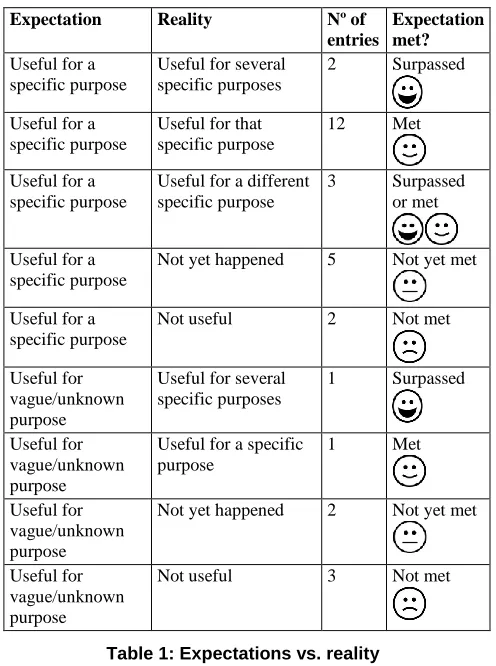
As 4 weeks is a relatively short timeframe for a longitudinal diary study, the long-term value of encountered information cannot be fully evaluated. Even so, only 7/31 diary entries described an information use that had not yet happened (see Table 1); value had already been realized in most cases.
McKenzie (McKenzie, 2003) notes that findings on academic information use may not be applicable outside
academia. While our participants are fledgling academics, many of the IE examples they provided are social; as such our findings have broader applicability than just academia.
FINDINGS
All participants made at least one diary entry (max 5, mean 2.6, s.d. 1.78). The low number of entries is unsurprising given the rarity of IEs. In this section we present our findings on value creation, motivators and barriers to value creation, and actions taken to create value. These findings form an emergent framework for discussing how people create value from their information encounters, and how they subjectively experience that value.
Value of information encounters
Participants’ experience of the value of their encounters can be classified according to both their expectation of value and the reality—their perception of the actual value
[image:5.612.316.564.319.652.2](see Table 1). Value assessment is made subjectively by participants; this classification reflects their views. While one might see the value gained from these IEs as relatively modest, participants noted their encounters as useful because they seemingly happened with little or no effort.
Table 1: Expectations vs. reality
Participants expected the information might either be useful
for a specific purpose or for a vague/unknown purpose. In
reality, they either deemed the information useful for
several specific purposes, for the specific purpose they
initially thought it might be useful for or for a different
Expectation Reality Nº of entries
Expectation met? Useful for a
specific purpose
Useful for several specific purposes
2 Surpassed
Useful for a specific purpose
Useful for that specific purpose
12 Met
Useful for a specific purpose
Useful for a different specific purpose
3 Surpassed
or met
Useful for a specific purpose
Not yet happened 5 Not yet met
Useful for a specific purpose
Not useful 2 Not met
Useful for vague/unknown purpose
Useful for several specific purposes
1 Surpassed
Useful for vague/unknown purpose
Useful for a specific purpose
1 Met
Useful for vague/unknown purpose
Not yet happened 2 Not yet met
Useful for vague/unknown purpose
5
specific purpose. Sometimes they decided the information
was not useful after all. Other times, value had not yet been
created from the encounter (not yet happened).
Expectations surpassed
Better book: useful for a specific purpose—useful for several specific purposes: P1 was searching the library catalogue for a specific book recommended by her dissertation supervisor. Based on the publisher’s description she was concerned about the book’s readability. While the library did not stock her target book, an eBook with a similar title caught her eye and by reading excerpts she decided it was a better match for her information need than her original target. The book provided a readable overview of her topic and was also useful for helping her to write her literature review and for designing her questionnaire-based study. She commented: ‘I didn’t expect it to have
interviews, I expected it to be just explaining concepts. Those interviews gave me practical knowledge for my methodology. It was really helpful for designing my
approach.’ Her expectations were surpassed.
[image:6.612.65.287.503.630.2]Comic connection: useful for vague/unknown purpose— useful for several specific purposes: P1 was ‘aimlessly’ scrolling through her Facebook feed when she noticed a post by Joseph Gordon-Levitt. The post contained a comic strip with a distinct, familiar style of illustrated characters (Figure 1). Upon zooming, she discovered it was signed by an artist she knew and contained a link to his website. This pleased her: ‘the useful bit is that it gave me the actual link
of the artist.’ While browsing his website, she discovered
the artist had an online shop. This delighted her as she had previously seen his work on Tumblr and wondered how to buy it. She considered printing comic strips from the website or buying them, but did not have the spare money. P1 did not know exactly how the image would be useful when she first saw it, but after examining it in more detail and visiting the artist’s website and e-shop, she found it useful for several purposes.
Figure 1: Comic strip encountered on Facebook (P1)
Expectations met
High School musical: useful for a specific purpose— useful for that specific purpose: While P5 was browsing an events website looking for Cirque du Soleil tickets as an anniversary present for her boyfriend, she noticed Kadanza,
a featured junior musical. She thought tickets would make an excellent birthday gift for her niece: ‘there’s a different
junior musical each year. My niece liked it so much last year she bought the DVD. So that’s why I thought we could
go again.’ Before examining the encountered information
on Kadanza in detail, she found Cirque du Soleil tickets and ordered them. She then returned to the Kadanza page, read the show description, and booked tickets. When she encountered the information on Kadanza, she immediately thought it might be useful as a gift for her niece; this was indeed the case. P5’s expectations of the usefulness of the encountered information were met.
Elusive equation: useful for a specific purpose—useful for a different specific purpose: P7 needed help solving a complex mathematical equation; although he did not expect to find a solution online, he did hope for guidance. While looking for papers and books that might help, he found a reply to a blog post asking for help on a similar equation. The reply only mentioned literature P7 had seen, but it also mentioned its author was trying to solve exactly the same equation as he was. P7 contacted the author of the reply via LinkedIn; he had not solved the equation but shared a Dropbox folder of papers with P7. P7 had previously been unable to access many of the papers in the folder and found them useful for his literature review. While P7 thought the encountered blog post may help him solve the equation, instead it helped with his literature review—a different outcome than he anticipated, but useful all the same.
Olympic beach: useful for a vague/unknown purpose— useful for a specific purpose: P7 noticed new barriers going down the staircases at Queen Elizabeth Olympic Park in London. This led him to wonder whether there were to be any events at the venue in the near future: ‘maybe there will
be a concert, maybe something interesting.’ When he got
home, he checked the Olympic Park website and noticed there was to be a cycling race soon. His eye was caught by a snippet of information about turning part of the park into a temporary beach. He clicked the link above the snippet to find out more and thought to himself ‘it’s been here for
three months and I didn’t notice!’ He visited the beach and
enjoyed it, sending photos to friends in Italy to show them he has a beach in London. His expectations that the beach would be worth visiting were met.
Expectations not yet met
Passport to London: useful for a specific purpose—not yet happened: While booking train tickets from Brussels to London on the Eurostar website, P5 noticed a carousel advertising free entry to London museums with the purchase of a train ticket. As she likes to visit museums, P5 clicked for more information and discovered ‘you can go to
galleries that I didn’t even know existed in London. So it
was pretty interesting to know.’ The page mentioned a few
6 she had encountered had the potential to be useful but this potential had not yet been realised.
Storyboard studies: useful for a vague/unknown purpose—not yet happened: P2 was searching for a basic overview of the HCI storyboard technique on the Web. She clicked on the ‘Usability Body of Knowledge’ website which contains an overview of many HCI topics, including storyboards. While browsing the site, she noticed a section on ‘published studies’ on storyboards. She commented ‘I was really generally looking for information on storyboards to get a basic overview. So I didn’t expect it to have other public [sic] studies in there. That’s why I thought it was kind of serendipitous, because I wasn’t seeking out
academic papers.’ P2 followed the links from the website
to several of the published studies and made notes on one paper in particular. She commented ‘I don’t know how
much I’ll actually end up using it, but it was an interesting
paper to read. It may feed into my literature review.’ There
is still potential for the encountered information to be useful, but in this case, time will tell.
Expectations not met
True or Hocus Pocus?: useful for a specific purpose— not useful: P2 saw a poster advertising a movie—Hocus Pocus 2—on Facebook (Figure 2). She was excited, as she had enjoyed the first film: ‘the poster popped up on my feed and I really, really liked the first movie. So immediately I
was very excited when I saw that.’ When she investigated
[image:7.612.317.556.161.294.2]further, however, she discovered it was a hoax. Later that day, her friend texted her the very same poster (as she had also encountered it online). P2 broke the news to her friend that the poster was a fake. P2 expected the encountered information to lead to her watching a sequel to a beloved movie but her expectations were not met. Interestingly, the encounter did lead to information of potential objective value—P2 told her friend the movie was not real. But her expectation of seeing a movie she would enjoy was not met.
Figure 2: The poster for a fake movie P2 wanted to see
False Identities: useful for a vague/unknown purpose— not useful: P2 was ‘mindlessly’ browsing her Twitter feed when she noticed an article by Patrick Smith, an online journalist. The post was entitled ‘this is why people create false identities on the Internet’ and included a link to a
BuzzFeed article on the topic (Figure 3). A month earlier, P2 had read an interesting blog post about false identities and commented that this was one of the reasons she clicked on the link. She stated ‘it wasn’t anything I was looking for,
but it was an article that looked like it may be interesting,
without me seeking it out particularly.’ She started reading
[image:7.612.316.559.377.610.2]the article, but soon ‘lost interest’ and commented that this article was not as interesting as the blog post she had read a month ago. Her expectations of usefulness were not met.
Figure 3: Article (right) P2 encountered on Twitter (left)
Motivators for value creation
We identified several motivators for creating value from IEs. These are described in Table 2 and, as in the previous section, illustrated with serendipity stories.
Motivator Explanation Nº of
entries More
promising than initial goal
Encountered information deemed to be more potentially useful than continuing to pursue the initial information goal
2
Likely to address existing goal
Encountered information deemed to potentially address an existing (but not the initial) information/life goal
5
Likely to enhance knowledge
Encountered information was deemed to potentially provide new knowledge or enhance existing knowledge
8
Likely to be useful for someone else
Encountered information deemed to be potentially useful to someone else, based on knowledge of their interests
2
Relates to existing interest
Encountered information deemed to be related to one of the participant’s existing interests
13
Likely to be enjoyable
Participant expected pursuing encountered information to be fun, entertaining or otherwise enjoyable
5
Table 2: Motivators for value creation
More promising than initial goal: P7 initially searched for a book on non-linear acoustics but stumbled upon an interesting paper that provided an introduction to acoustics. He decided to stop searching for the book and to make use of the encountered paper in his literature review.
[image:7.612.119.230.491.627.2]7 mobile Facebook feed because several of her friends had ‘liked’ Topshop on Facebook. The ad featured a ‘limited edition’ clothing line she was not previously aware of. As the link did not work on her mobile, she visited the Topshop website when she got home and looked at various products. She bought a dress from the clothing line and, when it arrived, liked it so much she ordered several other items from the same line. This addressed her existing life goal of needing new outfits (in an unexpected way).
Likely to enhance knowledge: P1 was searching the web for information on designing web pages for emotion and stumbled upon an article entitled ’10 Cool Things that HTM Tags Can Do’. She commented that in her future career as an HCI designer ‘I may have to brief developers
on website design, so I should know what basic HTML can do. Maybe it will be helpful to me in the future’.
Likely to be useful for someone else: P7 had a friend in Switzerland whose office was relocating to London. Her friend was trying to decide if she would relocate and wanted to gain an overview of the UK tax system. P7 offered to search the Web for this general information. Although she was not looking specifically to estimate the amount of tax her friend was likely to pay if she decided to relocate, she came across a UK tax calculator site. Her friend found the calculator useful for making her decision.
Relates to existing interest: P2 came across a news article on false identities (a topic she had previously read about) and a fake poster advertising a sequel to a movie she loved.
Likely to be enjoyable: P11 came across information on a band he had heard of but nor listened to before, as it was only partly-related to his musical tastes. Although he said he may not end up listening to them again, he ‘ended up listening to that band for the next hour.’
Barriers to value creation
Three barriers to value creation from encountered information emerged (Table 3). These were: insufficient time to pursue the information, no current use for it and the information not being as useful as they first thought.
Table 3: Barriers to Value Creation
Insufficient time was the most common barrier to creating value from encountered information. None of the participants were working to a strict deadline, but dissertation pressures meant they had to weigh up the
potential value they stood to gain from investing time in creating value from the information they encountered with the amount of time it was likely to take. Referring to an article she encountered P1 said ‘it’s in my bookmarks but…I
haven’t used it, because I don’t have free time.’
Not having a current use for the encountered information was discussed as a barrier to value creation by several participants. While searching for information on how to automatically number his mathematical equations, P7 stumbled upon a YouTube channel with several tutorials on using Microsoft Word. He bookmarked the YouTube channel for future use, but did not need to learn anything other than auto-numbering about Word at that time.
Information not as useful as first thought P4 received a Facebook invitation to the ‘Three Peaks Challenge’—a hiking event that involves climbing to the summit of three UK mountains in one weekend. She was very interested in participating, but upon checking her calendar she realized the event clashed with an important religious festival. She said ‘I thought ‘oh no,’ I can’t divide myself into two to go
to both of these things. So I just rejected the event.’
Actions taken to support value creation
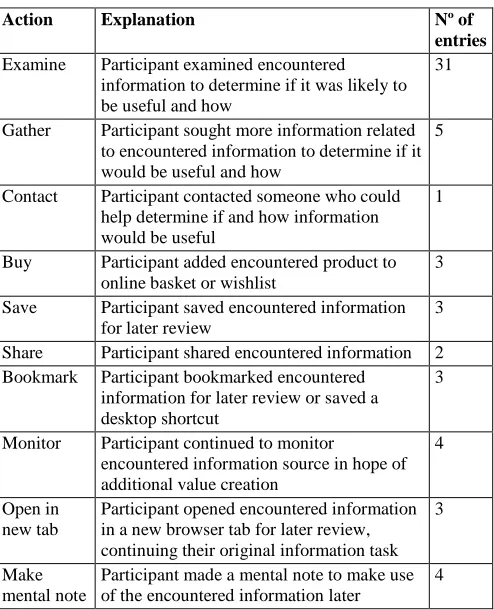
Participants took several actions to support value creation from the encountered information; these are outlined in Table 4. Again, we follow our descriptions with examples.
Participants examined information they encountered, reading text and viewing images and video. They read in varying detail from skimming to close reading. Referring to her ‘morning routine’ of checking BBC News, P5 explained
‘I don’t read the entire website, I just go through the whole website reading the titles.’
In many cases, participants gathered additional information related to the encountered information to determine if it would actually be useful and how by searching or browsing. For example, P11 browsed the biography of a new band he encountered information on before listening to them.
P7 contacted someone who replied to a blog post he encountered, resulting in sharing resources. Some participants bought a product they encountered or added it to a wishlist; e.g. P2 bought the ‘limited edition’ dress featured in the Facebook ad she encountered (along with several other items from the same clothing line). P1 saved a copy of the eBook she encountered on ‘designing for emotions’. P7 shared the tax calculator she encountered with her friend. Several participants bookmarked
encountered information for later review (e.g. P13 bookmarked a wedding gift for a friend).
Some participants continued to monitor the source of encountered information to see if it would result in additional interesting information. For example, P5 made it part of her morning routine to browse the BBC Food website in addition to BBC news, after encountering a tapas recipe that ‘went down well’ with her friends.
Barrier Explanation Nº of
entries Insufficient
time
Participant did not feel they had sufficient time to pursue encountered information
10
No current use
Participant could not currently think of a use for the encountered information
3
Not as useful as first thought
After examining the encountered information in more detail, the participant did not think it was as useful/potentially useful as they first thought
8
Table 4: Actions Taken to Create Value
Most participants also opened the encountered information in a new browser tab for later review, continuing their original information task in the meantime. For example, P2 opened the paper she encountered on storyboarding in a new tab, skim-reading it after she finished browsing the ‘Usability Body of Knowledge’.
Several participants made a mental note to make use of the encountered information at a later time. For example, P1 encountered information about design and innovation consultancy firm IDEO when browsing a Wikipedia article on her dissertation topic of ‘empathetic design’. She was pleased to find out from the article that IDEO were also interested in the topic, as she had considered applying for a job with them. She made a mental note to incorporate the encountered information into a cover letter when applying for a job at IDEO, which she did a few days later.
Bringing it all together: Expectation vs. reality, motivators, barriers and actions
Some information encounters involved multiple motivators, barriers or actions. For other encounters, participants did not identify explicit motivating factors, barriers or actions (perhaps because some time had passed between the encounters and the follow-up interview). Across these axes, many combinations of expectation and reality can and do exist. We illustrate these complexities with an example from our interviews.
Information intersection: P6 was hoping to develop a collaborative information visualization tool for his dissertation, but had not yet chosen a domain to focus on. While searching online for collaborative InfoVis tools, P6 remembered he had previously taken a class with InfoVis researcher Marian Dörk. He decided to look for articles by Dörk in the hope they would provide examples of tools. He came across a paper entitled ‘Urban Co-Creation’ by Dörk and Monteyne, on digital tool support for urban civic participation. He stated ‘weirdly enough I found this paper
which isn’t really about visualization as such, but about urban planning and how urban co-creation can be
supported by digital tools.’ P6 did not read the paper in
detail, but had the idea of adopting the domain of urban planning for his collaborative InfoVis tool.
P6’s expectation was that the article would be useful for
the specific purpose of informing his domain choice. In
reality this had not yet happened, as he did not have sufficient time (barrier) to read the paper in more detail. However, he took the action of making a mental note to read it thoroughly when writing his literature review as it had the potential to enhance his knowledge (motivator) and
to address his existing goal (motivator) of choosing a
domain to focus on.
As seen in this example, information encounters are complex and context-sensitive. Factors such as time, tools and mindset interact to determine whether, for an individual encounter, the encounterer’s expectations of value will be met. What is consistent is that information encounters do not end when serendipity strikes, they are only beginning; after a ‘happy information accident’, information seekers must work to generate value from the encounter.
DISCUSSION
In this section we will relate our findings to previous work and discuss design implications.
Relation to previous work
Previous work on serendipitous information acquisition has emphasized that the most successful information encounterers ‘make their own luck’ (Foster & Ford, 2003; Makri et al., 2014). Our work has shown that the desire to make one’s own luck is not just a precursor to serendipity, it is also a determinant of it. Not one encounter in this study was immediately valuable without any work on the part of the participant; there is work involved in generating encounters that are post-hoc deemed serendipitous (Makri & Blandford, 2012a, 2012b).
In some of the examples we give, the effort expended in pursuit of serendipity was considerable, spanning time and tools. This effort was no guarantee of success, however; many encounters generated expectations that remained unmet. Conversely, some encounters resulted in participants’ expectations being exceeded. The concept of ‘expectation’ during information acquisition has been addressed before. Kuhlthau (Kuhlthau, 1991) explains that
Action Explanation Nº of
entries Examine Participant examined encountered
information to determine if it was likely to be useful and how
31
Gather Participant sought more information related to encountered information to determine if it would be useful and how
5
Contact Participant contacted someone who could help determine if and how information would be useful
1
Buy Participant added encountered product to online basket or wishlist
3
Save Participant saved encountered information for later review
3
Share Participant shared encountered information 2 Bookmark Participant bookmarked encountered
information for later review or saved a desktop shortcut
3
Monitor Participant continued to monitor
encountered information source in hope of additional value creation
4
Open in new tab
Participant opened encountered information in a new browser tab for later review, continuing their original information task
3
Make mental note
Participant made a mental note to make use of the encountered information later
9 people develop expectations of information as they interact with it, making predictions of potential relevance. Marchionini (1997) explains that people may not always know what precise information they need, but will have an expectation of what it might ‘look like’—e.g. a fact, idea, interpretation. In both of these models, people’s assessment of whether their expectations are met involves making relevance judgments. McKenzie’s model (McKenzie, 2003) alludes to both this more formal relevance assessment, and a less structured approach where information-seekers do not know what they will find. None of these previous models, though, account for how value is determined.
Our work identifies a similar judgement process for information encounters: sometime after encountering information, people will make a decision on whether their expectations of value are met. Consistent with a previous study (Makri & Blandford, 2012a), we found participants’ assessments of the usefulness of encountered information were subjective. Even in instances where an encounter could be objectively considered to have delivered value— such as knowing the Hocus Pocus 2 poster was fake— participants’ own assessments were what determined value.
The motivators, barriers and actions identified in our study are not new; all have been discussed in the context of information seeking and some in the context of information encountering. For example, information and entertainment have been discussed as intrinsically linked (Cermak, 1996), IE has been found to result in knowledge enhancement (Makri et al., 2015; Makri & Blandford, 2012a, 2012b). Time has been discussed as important in information seeking behaviour (Savolainen, 2006) and identified as a constraint to serendipity (Makri et al., 2014). Monitoring sources has been identified as an important information behaviour (Ellis, 1989; Makri, Blandford, & Cox, 2008; Meho & Tibbo, 2003) and a means of encountering information (Makri & Warwick, 2010). Gathering more information to determine usefulness is similar to the notion of ‘confirming’ or ‘disputing’ the encountered information (Napier & Quan, 2013). The actions we identified complement Erdelez’s model; where information is ‘captured’ after it is noticed (Erdelez, 2014). We noted several means of capturing, including saving bookmarking and mental capturing. Sharing encountered information with others who may find it useful has also been seen in previous work (D'Antonio et al., 2012; Erdelez & Rioux, 2000). While all these features have been seen previously, the novelty in our work is that we discuss them features in relation to the subjective value generated by each IE.
Finally, our study crosses a boundary in information behaviour research: many information behaviour studies are of academics (e.g. D'Antonio et al., 2012; Foster & Ford, 2003; Sun et al., 2011). McKenzie (McKenzie, 2003) notes that academic or work-related information behaviour is likely to be notably different from ‘social’ information seeking, and presents a model of non-professional information seeking that is quite different from traditional
models of information behaviour (e.g. Kuhlthau, 1991; Marchionini, 1997). Our work captures information encounters in both contexts, and there is not a notable difference in terms of value creation behaviour. This is a notable finding in its own right.
Design implications
Digital information tools are beginning to offer dedicated and meaningful support for IEs (e.g. Kleiner et al., 2013; Thudt et al., 2012), however these tools are focused on discovery not use and therefore not value creation.
Our value creation framework can be leveraged by designers of digital information tools on all four axes: the reality/expectation gap, motivators and barriers, and (most readily) actions. Tools could encourage users to ask themselves questions such as ‘do I (still) think this information might be useful? How so? Can I do anything to make it useful?’ Such questions can nudge users to reflect on whether and how their value expectations match reality or what they need to do to leverage information.
Technology can allow users to capture, review and reflect on encountered information, thus supporting them in generating value from it. Capture for later review allows users to delay the decision of deciding to keep or discard encountered information; allowing them to annotate and highlight could further support this later review. Tools could also automatically capture features such as date and time that might offer valuable context for the encounter at a later date. Ease of capture would ameliorate the time barrier to value creation, and review could diminish barriers involved in assessment of current or future potential use. This latter barrier could be further reduced by the ability to set up an alert for review, allowing users to choose a time to keep or discard information.
Tools could augment motivators for value creation by supporting information sharing, or automatically generating a list of related content previously accessed by the same individual. They could also allow users to easily categorise encountered information according to their interests.
While it is not possible to force value from encountered information, digital tools could certainly better support value creation, Many of the features described above already exist in some tools, but bringing them together to create one click capture, annotation and categorization would minimize the time spent away from a primary information task. The smaller the disruption to whatever users were doing when serendipity struck, the more likely they will be to justify the investment in value creation.
10
CONCLUSION
Information encountering is a richly satisfying information experience that happens unexpectedly and seemingly effortlessly. For an information encounter to be experienced as serendipitous, though, the encounterer must take action to generate value from it. (Makri & Blandford, 2012a); this paper is the first, to our knowledge, that considers in detail what happens after serendipity strikes.
Our work highlights that information encounterers’ actions may be as simple as making a note, or very complex, spanning multiple information sources and tools. All efforts, though, occur within a framework of expectations and outcomes, barriers and motivators. This empirically grounded framework is the major contribution of this paper.
This framework can be leveraged not only to describe information encounters and reason about their subjective value, but also to relate information encountering to other types of information acquisition and to make design suggestions. By designing tools that more adequately support the creation of value from encountered information, we can maximize opportunities for users to make the most of their ‘happy information accidents.’ Future research might examine how best to design such tools to maximize the opportunity for value creation and to evaluate the success of these tools in this regard.
ACKNOWLEDGMENTS
Our warmest thanks go to our participants.
REFERENCES
Agarwal, N. K. (2015). Towards a Definition of Serendipity in Information Behaviour. Information Research, 20(3).
Baeza-Yates, R., & Ribeiro-Neto, B. (1999). Modern
information retrieval (Vol. 463): ACM Press. New York.
Barry, C. L. (1994). User-defined relevance criteria: An exploratory study. User-defined relevance criteria: An
exploratory study, 45(3), 149-159.
doi:10.1002/(SICI)1097-4571(199404)45:3<149::AID-ASI5>3.0.CO;2-J
Bates, M. J. (1989). The design of browsing and berrypicking techniques for the online search interface.
Online Review, 13(5), 407-424. doi:10.1108/eb024320
Borgman, C. L. (1996). Why are online catalogs still hard to use? JASIS, 47(7), 493-503. doi:10.1002/(SICI)1097-4571(199607)47:7<493::AID-ASI3>3.0.CO;2-P
Carter, S., & Mankoff, J. (2005). When participants do the
capturing: the role of media in diary studies. In Proc CHI
98, Portland, Oregon, USA. 899-908. doi:10.1145/1054972.1055098
Cermak, G. W. (1996). An approach to mapping entertainment alternatives New infotainment technologies
in the home: Demand-side perspectives (pp. 115-134).
NY: Routledge.
Corbin, J., & Strauss, A. (2015). Basics of qualitative
research (4th Ed.). London: Sage.
Cunha, M. P. e., Clegg, S. R., & Mendonça, S. (2010). On serendipity and organizing. Europe Man J, 28(5), 319-330. doi:10.1016/j.emj.2010.07.001
D'Antonio, L., Makri, S., & Blandford, A. (2012). Coming across academic social media content serendipitously.
ASIST Proceedings, 49(1), 1-10.
doi:10.1002/meet.14504901002
Ellis, D. (1989). A behavioural model for information retrieval system design. J Inf Sci, 15(4-5), 237-247. doi:10.1177/016555158901500406
Erdelez, S. (1997). Information encountering: A conceptual framework for accidental information discovery. In Proc
ISIC 97, Tampere, Finland. 412-421.
Erdelez, S. (2004). Investigation of information encountering in the controlled research environment.
IP&M, 40(6), 1013-1025. doi:10.1016/j.ipm.2004.02.002
Erdelez, S. (2005). Information encountering. In K. E. Fisher & L. McKechnie (Eds.), Theories of information
behavior (179-184). Medford NJ: Information Today.
Erdelez, S., & Rioux, K. (2000). Sharing information encountered for others on the Web. New Rev. Inf. Behav.
Res., 1, 219-233.
Fidel, R. (1993). Qualitative methods in information retrieval research. Lib Inf Sci Res, 15(3), 219-247.
Foster, A., & Ford, N. (2003). Serendipity and information seeking: An empirical study. J. Doc, 59(3), 321-340. doi:10.1108/00220410310472518
Heinström, J. (2006). Psychological factors behind incidental information acquisition. Lib Inf Sci Res, 28(4), 579-594. doi:10.1016/j.lisr.2006.03.022
Kefalidou, G., & Sharples, S. (2016). Encouraging serendipity in research: Designing technologies to support connection-making. IJHCS, 89, 1-23. doi: 10.1016/j.ijhcs.2016.01.003
Kleiner, E., Rädle, R., & Reiterer, H. (2013). Blended shelf: reality-based presentation and exploration of library
collections. In proc. ACM SIGCHI 13, Paris, France.
577-582. doi:10.1145/2468356.2468458
Kuhlthau, C. C. (1991). Inside the Search Process: Information Seeking from the User's Perspective. JASIST, 42(5), 361-371. doi:10.1002/(SICI)1097-4571(199106)42:5<361::AID-ASI6>3.0.CO;2-#
Loizides, F., & Buchanan, G. (2013). Towards a
Framework for Human (Manual) Information Retrieval.
In proc. IRFC 13, Limassol, Cyprus. 87-98.
doi:10.1007/978-3-642-41057-4_10
11 Makri, S., & Blandford, A. (2012a). Coming across
information serendipitously: Part 1 – A process model. J.
Doc, 68(5), 685-704. doi:10.1108/00220411211256030
Makri, S., & Blandford, A. (2012b). Coming across information serendipitously: Part 2 - A classification framework. J. Doc., 68(5), 706-724. doi:10.1108/00220411211256049
Makri, S., Blandford, A., & Cox, A. L. (2008). Investigating the information-seeking behaviour of academic lawyers: From Ellis’s model to design. IP&M, 44(2), 613-634. doi:10.1016/j.ipm.2007.05.001
Makri, S., Blandford, A., Woods, M., Sharples, S., & Maxwell, D. (2014). “Making my own luck”: Serendipity strategies and how to support them in digital information environments. JASIST, 65(11), 2179-2194. doi:10.1002/asi.23200
Makri, S., & Warwick, C. (2010). Information for inspiration: Understanding architects' information seeking and use behaviors to inform design. JASIST, 61(9), 1745-1770. doi:10.1002/asi.21338
Marchionini, G. (1997). Information Seeking in Electronic
Environments (Vol. 9). Cambridge, UK: CUP.
McBirnie, A. (2008). Seeking serendipity: the paradox of control. Aslib Proceedings, 60(6), 600-618. doi:10.1108/00012530810924294
McCay-Peet, L., Toms, E. G., & Kelloway, E. K. (2015). Examination of relationships among serendipity, the environment, and individual differences. IP&M, 51(4), 391-412. doi:dx.doi.org/10.1016/j.ipm.2015.02.004
McCay-Peet, L., & Toms, E. G. (2015). Investigating serendipity: How it unfolds and what may influence it.
JASIST, 66(7), 1463-1476.
McKenzie, P. J. (2003). A model of information practices in accounts of everyday-life information seeking. J. Doc., 59(1), 19-40. doi:10.1108/00220410310457993
Meho, L. I., & Tibbo, H. R. (2003). Modeling the information-seeking behavior of social scientists: Ellis's study revisited. JASIST, 54(6), 570-587. doi:10.1002/asi.10244
Napier, N. K., & Quan, H. V. (2013). Serendipity as a Strategic Advantage? In T. J. Wilkinson & V. R. Kannan (Eds.), Strategic Management in the 21st Century (pp. 175-199). Santa Barbara, CA: Praeger.
Oxford English Dictionary. "valuable, adj. and n.": Oxford University Press.
Pearce, J., & Chang, S. (2014). Exploration without
Keywords: The Bookfish Case. In proc. OzCHI 2014,
Sydney, Australia. 76-79. doi:10.1145/2686612.2686639
Savolainen, R. (2006). Time as a context of information seeking. Lib. Inf. Sci. Res., 28(1), 110-127. doi:10.1016/j.lisr.2005.11.001
Sun, X., Sharples, S., & Makri, S. (2011). A user-centred mobile diary study approach to understanding serendipity in information research. Information Research, 16(3).
Svenonius, E. (2000). The Intellectual Foundation of Information Organization. Boston, MA: MIT Press.
Thudt, A., Hinrichs, U., & Carpendale, S. (2012). The bohemian bookshelf: supporting serendipitous book
discoveries through information visualization. In proc.