VERIFICATION AND VALIDATION OF NUMERICAL MODELLING
OF DTMB 5415 ROLL DECAY
Simone Mancini, University of Naples Federico II, [email protected] Ermina Begovic, University of Naples Federico II, [email protected]
Alexander H. Day, University of Strathclyde, Glasgow, [email protected] Atilla Incecik, University of Strathclyde, Glasgow, [email protected]
Abstract
The paper presents a numerical roll damping assessment of the intact DTMB 5415 naval ship at zero speed. Free model motions from four experimental roll decays with initial heeling angle of 4.0, 13.5, 19.58 and 24.50 deg, performed previously at the University of Strathclyde, Glasgow, have been analysed and the one with 19.58 deg initial heeling has been chosen for the Computational Fluid Dynamic (CFD) analysis. All calculations are performed using CD Adapco Star CCM+ software investigating the accuracy and efficiency of the numerical approach for case of high initial heeling angle of bare hull. In the numerical procedure the verification analysis of mesh refinement and time step was performed with the aim to investigate the numerical error/uncertainty. For grid refinement and time step, validation and verification procedure has been performed according to the Grid Convergence Index (GCI) method. Moreover, to verify the main source of the modelling error/uncertainty, the effect of degrees of freedom are evaluated, comparing the numerical results with the experimental results. Conclusions are identifying best practice for roll decay simulations commenting the accuracy of numerical results and required calculation time.
Keywords: DTMB 5415 intact ship, CFD, EFD, roll decay, uncertainty analysis, verification and validation (V&V).
Introduction
assessments of roll decay is by Chen et al. (2001), that investigated Reynolds Averaged Navier Stokes (RANS) method using chimera/overset mesh in conjunction with 6 Degree-of-Freedom (DoF) motion program for time domain simulation of barge roll decay. Simulations were performed for six loading conditions, i.e. two drafts and three positions of center of gravity (CG), and for each investigated case the experiments were conducted and measured periods are reported. Furthermore, authors investigated the influence of 2D (sway, heave, roll) and 3D (6-DoF) simulations on results. Obtained roll periods are different for 2D and 3D simulations, and 3D results are closer to the measured ones. However, the authors didn’t report the details on mesh size and computational time required neither comparison of decay curves for different loading cases.
Wilson et al. (2006) performed simulations for a bare hull and bilge-keel-appended surface combatant model (referred as DTMB 5512) using the software CFD Ship-IOWA. Roll decay simulations are performed for three cases: the bare hull at Froude Numbers (Fr) equal to 0.138 and 0.280 and the hull with bilge keels at Fr = 0.138. Authors analyzed the effect of grid refinement and time step variations on the numerical uncertainty. Comparisons of EFD (Experimental Fluid Dynamics) and CFD extinction coefficients for the low speed case with bilge keels showed very small differences, generally less than 2.0%. Yang et al. (2012) presented simulation in software Fluent of roll decay for the same vessel, DTMB 5512, with initial heel angles: 5.0, 10.0 and 15.0 deg at Fr = 0.280. The authors reported very good results in terms of damping coefficient and two examples of decay curve but no details on the method and calculation procedure are given. Yang et al. (2013) performed numerical simulations of free decay for DTMB 5512 bare hull model inclined to 10.0 deg at Fr = 0.138 and 0.280 and using Fluent RANS solver with a dynamic mesh technique. The authors reported that the natural period is overestimated by 1.3% for the low speed case and under-estimated at higher speed by 2.50%. The total damping coefficient is determined from linear and quadratic terms, where the linear damping is estimated from the last five cycles because of the weak non-linearity and the quadratic term is derived from the first three cycles due to stronger nonlinearity. However, the authors do not report The details about mesh size or calculation efforts are not reported.
(2012b) applied previously tested RANS numerical setup to calculate roll damping coefficients of a Ro-Pax ferry at full scale. The influence of roll amplitude, ship speed, and vertical position of the roll axis on roll damping was investigated. Detailed validation data for a Ro-Pax ship was not available, but authors compared the numerical results with Ikeda’s method (1978) commenting on merits and limitations of both approaches.
Avalos et al. (2014) investigated a roll decay test of the middle section of a Floating Production Storage and Offloading (FPSO) ship with bilge keels by the numerical solution of the incompressible two-dimensional RANS equations. The free surface was considered flat so that the wave radiation was neglected and the simulations were focused to assessing the effect of bilge shape and three bilge keels on the damping coefficient of the FPSO section. Very good results were generally obtained for cases with bilge keels, the worst result in terms of damping and oscillation period was obtained for the section without bilge keels.
Gao and Vassalos (2011) presented results of roll decay numerical simulations for DTMB 5415 with bilge keel at Fr = 0.138 and 10.0 deg initial angle for intact and damaged case performed using an “in house” developed software. The comparison shows that the agreements between calculation and model test for intact ship are acceptable with slightly larger period and smaller damping obtained from the calculation. For the damaged ship case, the authors analysed ±5.0 deg initial heel with and without sway motion and concluded that added moment of inertia and damping from roll decay without sway are significantly larger than those from roll decay with sway. Gao et al. (2013) presented an integrated numerical method that couples a seakeeping solver based on the potential flow theory and a Navier–Stokes (NS) solver with the volume of fluid (VOF), developed to study the behaviour of a damaged ship in beam seas. The integrated method was used to simulate the roll decay of a damaged Ro–Ro ferry (known as PRR1, ITTC benchmarking model). Two meshes have been modelled (coarse and fine) using time steps of the 0.02 s and 0.01 s on the coarse and fine grids, respectively. Simulations were performed with four degrees of freedom of the ship (sway, heave, roll and pitch); the maximum roll amplitude was about 5.0 deg. Validation against experimental data showed difference in natural frequency of about 3.60%.
model, mesh size was optimized and necessary CPU time has been reported. Authors consider one degree of freedom (roll motion) and variable time-step. The CFD simulations show good agreement with the experimental measurements in all cases for about 10 cycles or more. It may be seen that at a time which is beyond about 10 cycles or more, i.e. at very small roll angles, the CFD simulations deviate from monotonic decay of peaks, indicating some numerical instability. Generally, for the cases without bilge keel, the numerical simulations are less accurate than in cases with bilge keels. Begovic et al. (2015) presented the roll decay simulations for damaged and intact DTMB 5415 by CD Adapco Star CCM+ at zero speed. The authors investigated different meshes, time steps and turbulence models. Mesh sensitivity in numerical simulations is optimised for the damaged ship case considering hexahedral trimmed and hybrid meshes with different grid refinements in terms of sizes and shapes. The trimmed mesh is chosen as it has the same accuracy of fine hybrid but significantly lower computational time. Numerical results have been compared against the experimental results performed by the authors. The numerical results have reasonable damping coefficient prediction but the period of oscillations differ from experiments by up to 4.0%. These results are in line with those presented by Gao et al (2011, 2013) and Avalos et al (2014). Furthermore, it has been pointed out the deviation of decay curve after 15 seconds of simulation time (about 10 cycles) and to obtain complete extinction curve authors performed two simulations starting from high (about 20 deg) and low (about 4 deg) heeling angle.
Sadat-Hosseini et al. (2012) presented results of Unsteady RANS (U-RANS) simulations for zero-speed intact and damaged ship roll decay. Simulations are performed by CFD Ship-Iowa v. 4.5, computing 6-DoF model motions, for three mesh sizes. The authors reported detailed uncertainty analysis for all calculated cases concluding that the simulations predicted well roll period and flood water height in the compartment, with 5.5% and 7.0% error respectively. Damping magnitudes were under-predicted up to 25.0%. Generally, better prediction has been obtained for damaged ship than for intact. Authors reported three times larger damping with two compartments damage than one-room compartment and pointed out that the simulations display strong roll, sway and yaw coupling for which validation data is not available.
experimental data than those by the sliding mesh method, while the sliding mesh technique is better for amplitudes definition of roll decay curves. Furthermore, the results for Model 2792 are significantly better than for car carrier. The authors provided equivalent extinction coefficient from numerical simulations and by Ikeda’s method. For pure car carrier the differences are from 20 to 40% for overset grid method, from 14 - 27% for sliding mesh, and from 30 - 44% for Ikeda’s method, depending on the initial heel angle. It has to be noted that from the extinction curves reported in paper is difficult to note such a big difference among experimental and numerical decay. The results for Model 2792 are significantly better than for car carrier, ranging from 0.5% to 10% error for the numerical results against 16 - 28% by Ikeda’s method. No information about the computational time required was provided in this paper.
It has to be pointed out that in parallel with CFD approach some new experimental results are presented giving valuable contributions for verification and validation of numerical simulations. Wassermann et al. (2016) reviewed different experimental methods (roll decay, harmonic excited roll motion and harmonic forced roll motion) of roll damping coefficients determination. The authors concluded that the decay motion has advantages if the ship has no forward speed and has small damping values, while harmonic excited roll motion technique is the most advantageous as regard possibility of testing real motion coupling, steady roll motion, different roll amplitudes, forward speed versus time and cost of testing. Begovic et al. (2013a) presented the roll decay analysis of hard chine hull versus round bilge hull with exactly the same parameters and coefficients applicable to the large yacht hull form. Several roll decay tests in calm water have been carried out at zero speed and ship speeds of 2.0, 4.0, 7.0, 9.0, 13.0 and 17.0 knots. The presented results show linear and quadratic extinction coefficients and equivalent linear coefficient and natural roll periods for all speeds. Acanfora et al. (2016) presented experimental roll decays of intact and damaged small passenger ferry boat. They analysed effect of damage opening position on roll decay and roll, heave and sway RAO (Response Amplitude Operator) in beam seas. Both works offer decays results as valuable asset for benchmarking database as they are relative to hard chine hulls with high damping coefficient, short roll periods and are relevant to the ships which are using very sophisticated stabilisation devices.
presented the complete procedure for uncertainty analysis of roll decay CFD simulations. The authors considered bare hull DTMB 5512 at three different Fr and the simulations were performed using FLUENT software with 3-DoF and the k-ω SST turbulence model. The verification analysis was performed for three grid refinements and two time steps. Obtained results for numerical uncertainty are within 2.0 %. Error in natural period calculation is from 1.3% to 2.5%.
It can be seen from the above discussion that several RANS based CFD studies of roll motion, both with and without bilge keel, at forward and at zero speed have been reported in the literature. It can be commented that major part of works are reporting better agreements with experimental roll decays when considering bilge keel and forward speed, i.e. in other words when model itself has a higher damping, the numerical simulations are more effective. With this background, the present work focuses on the numerical assessment of free roll decay tests at zero speed of intact 5415 DTMB naval vessel, identified as most critical condition. Time series of free model’s motions during four experimental roll decays with initial heeling angle of 4.0, 13.5, 19.58 and 24.50 deg, performed previously by authors at University of Strathclyde, Glasgow, have been analysed. The one with 19.58 deg initial heeling has been chosen for the CFD analysis. Effects of systematic variation of grid refinements, time step and degrees of freedom within the simulation on the accuracy of roll decay curve have been studied. The numerical uncertainty analysis of simulation results has been performed, according to ITTC recommended procedure for each of systematically varied parameters. Conclusions identify best practice for roll decay simulations commenting the accuracy of numerical results and required calculation time.
DTMB 5415 Model
Roll decays have been performed for the well-known benchmark naval hull form DTMB 5415, used in experimental campaign in Begovic et al. (2013b, 2015, 2017). The main particulars of the fibreglass model (1/51 scale) are given in Table 1. The model ready for experiments is shown in Figure 1.
Table 1. DTMB 5415 model main particulars
Experimental results
The tests presented here have been performed at Kelvin Lab, Strathclyde University during experimental campaign presented in Begovic et al. (2017). For the purpose of numerical simulation validation, four roll decays have been identified as representative of the damping phenomenon; i.e. roll decays with initial heeling angle of 4.0, 13.5, 19.58 and 24.50. The initial heel of the model is induced manually and then the model is released. The initial heeling angle and subsequent roll motions are measured in real time using the motion capture system Qualisys at frequency of 137.36 Hz. Uncertainty of experimental results has been extensively reported in previous works, for the RAO in waves it is than 2.0% and it has been considered the same also for the decay experiments. Non-filtered time series of four roll decays together with sway, heave and yaw at the CG performed at zero-forward-speed condition for the intact model at zero speed are given in Figures 2, 3, 4 and 5.
Figure 2. Intact ship free roll decay test (initial heel angle of 4.0 deg)
Figure 3. Intact ship free roll decay test (initial heel angle of 13.5 deg)
Figure 4. Intact ship free roll decay test (initial heel angle of 19.58 deg)
Figure 5. Intact ship free roll decay test (initial heel angle of 24.50 deg)
It can be seen from Figures 2, 3, 4, and 5 that the sway may be considered negligible up to heeling angle of 19.58 deg, i.e. the sway displacement is less than 10.0 mm. The same behaviour can be seen also for yaw; its maximum displacement is ± 4.0 deg. At the highest heeling angle, it can be seen coupling of sway and yaw with roll. Sway displacement is significantly higher than in previous cases, up to 30 mm, and yaw angle up to 6.0 deg. In all four decays, heave motion is completely negligible, as expected.
The behaviour of roll decay curve for all four decays is summarised in Figure 6. It can be seen that
From analysed roll decays, the one with initial heel of 19.58 deg has been chosen to be simulated by CFD. It has a large roll amplitude and represents a challenge for mesh discretisation and, on the other hand, coupling with sway and yaw can be neglected.
Figure 6. Roll decays of DTMB 5415
Numerical set up
In the previous work, Begovic et al. (2015), a detailed study on the mesh type and number of cells used for the damaged 5415 ship with 19.58 deg initial heel was presented. The computational domain was modelled by chimera/overset grid investigating hybrid polyhedral and trimmed meshes. For the same accuracy, the hybrid polyhedral mesh required almost double of computational time and therefore the trimmed mesh has been chosen as starting point in this work. Finally, the trimmed mesh, used in the region around the hull, is finer than the far field regions, as shown in Figure 7.
Figure 7. Mesh visualization around the hull
An implicit solver has been used to find the field of all hydrodynamic unknown quantities, in conjunction with an iterative solver to solve each time step. The software uses a Semi Implicit Method for Pressure Linked Equations (SIMPLE) to conjugate pressure and velocity field, and an Algebraic Multi-Grid (AMG) solver to accelerate the convergence of the solution. A segregated flow solver approach is used for all simulations.
The free surface is modelled with the two phase VOF approach with a High Resolution Interface Capturing (HRIC) scheme based on the Compressive Interface Capturing Scheme for Arbitrary Meshes introduced by Ubbink (1997) and developed by Muzaferija and Peric (1999). The HRIC scheme is currently the most successful advection scheme and extensively used in many CFD codes, as reported in Wackers et al. (2011). The standard configuration of the HRIC scheme depends on the local Courant–Friedichs–Lewy number (CFL) on the air-water interface.
boundary layer with acceptable quality and the time required for the calculation. The values of wall y+ on the hull surface is shown in Figure 8.
Figure 8. Wall y+ visualization on the ship hull at instantaneous 0.0 deg roll angle value (≈ 4.0 s of physical time simulation – 19.58 deg initial heel angle)
The Reynolds stress is solved by means of the k-ω SST turbulence model. In Begovic et al. (2015) has been reported that the numerical results from simulations with k-ω SST and k-ε turbulence models are within 1.0% difference and it is not possible to appreciate the difference between the two numerical curves.
Domain Dimensions, Boundary Conditions and Time-step
The chimera/overset mesh technique required two different regions, i.e., the background and overset regions, is shown in Figure 9. The background region is usually designed in compliance with the ITTC (2011) “Practical Guidelines for Ship CFD Applications”. However, no defined recommendations in terms of domain dimensions are available for the overset region, as indicated in Tezdogan et al (2015). One example of overset and background region dimensions, as defined in Figure 9, reported by Handschel et al. (2012a), is given in Table 2 together with those used in this work. The connectivity between the background and the overset regions takes place through an interpolation scheme. In this case a least square method is used. This method is suitable when there is a large variation of the moving grid respect to the background mesh, as indicated in CD Adapco User’s Guide (2014) and De Luca et al. (2016).
Figure 9. Representation regions and domain dimensions
Table 2. Summary of the domain dimensions
Figure 10. Boundaries representation for moving and static regions
Table 3. Boundary conditions and solver settings summary
According to the ITTC (2011) recommendation for periodic phenomena like roll decay and vortex shedding the time step should be at least 1/100 of phenomenon period. Measured roll period is 1.37 seconds resulting in a recommended value of about 0.014 s. From the previous work, it has been seen that the convergence is obtained with one order of magnitude lower time step, i.e. 0.001 s. The reason for this choice is related to the numerical stability of donor and acceptor cells scheme adopted in the overset mesh approach, i.e. to obtain numerically a correct interpolation process between background and rotating mesh regions very short time step has to be imposed (huge angle variation in a short time). In this work, a time step numerical uncertainty assessment has been performed, considering an increment ratio equal to √2. Therefore, three time steps have been considered: 0.001, 0.0014 and 0.002 seconds. Reference time step for all other simulations (mesh uncertainty analysis) is 0.002 s as it has been shown it is accurate enough. The numerical set up used for the simulations is reported in Table 3 while summary of performed calculations is given in Table 4.
Table 4. Summary of performed calculations
Numerical Uncertainty Analysis
Uncertainty Analysis
SM SN
E= − =D S δ +δ (1)
The simulation uncertainty equation follows directly from the equation 1.
2 2 2
S SM SN
U =U +U (2)
Where US is the simulation uncertainty and USM and USN are the simulation modeling uncertainty and simulation numerical uncertainty, respectively. The USN is estimated by the solution verification process. The errors due to specification of input parameters can be mainly decomposed into: error from iteration number (δI), error from grid size (δG), and error from time step (δTS), which gives the following expressions for the simulation numerical error (3) and uncertainty (4).
SN I G TS
δ =δ δ+ +δ (3)
2 2 2 2
SN I G TS
U =U +U +U (4)
The verification process for many common input parameters (e.g. grid spacing, and time-step) is conducted using multiple solutions (m) method. In order to do this, it is necessary to use a minimum of three solutions (m=3), which have been uniformly refined with a cells increment Δxksuch that defines a constant refinement ratio rk
1
m m
k k k
r = ∆x ∆x − (5)
The ITTC (2008) guidelines and procedures recommend a value of refinement ratio rk between √2
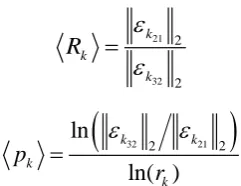
and 2. In order to give information about convergence of solutions, the convergence ratio Rk is
defined by considering the solution changes (εijk = Ski - Skj)for the k-input parameter between three solutions rangingfrom fine (Sk1)to medium (Sk2)and coarse (Sk3).
21k 32k
k
R =ε ε (6)
According to the ITTC guidelines ITTC (2008), three different cases of Rk may occur:
3. Monotonic divergence: Rk > 1;
In the case 1 the generalized Richardson Extrapolation (RE) is used to assess the uncertainty Uk. For oscillatory convergence (case 2) the uncertainty Uk is estimated by determining the error between lower (SL) and upper (SU) values of the oscillation.
(
)
1 2
K U L
U = S −S (7)
In the case of monotonic divergence (case 3), it is not possible to estimate errors or uncertainties. As stated above, in case of monotonic convergence the generalized RE is used to determine the error δk (in this case can be called δRE) with respect to refinement ratio (rk)and order-of-accuracy
(pk). The formulation has been generated from an analytical derivation of the simulation error equation which is given in detail by Stern et al. (2001). The general form of the uncertainty evaluation is given in equation (8).
21 1
k
k
k S p
k
U F
r
ε
=
−
(8)
The Grid Convergence Index (GCI) method, proposed by Roache (1998, 2002), is used extensively and it is recommended for example by the American Society of Mechanical Engineer (ASME), Celik et al (2008), the American Institute of Aeronautics and Astronautics (AIAA), and Cosner et al. (2006). The value for FS recommended by Roache (1998) for careful grid studies (three or more grids) is 1.25.
Another method is the Correction Factor (CF) method described by Stern et al. (2001). This method uses a variable FS, called Ck. In the CF method, unlike the GCI method, the uncertainty of the error depends on how close the solutions are to the asymptotic range.
21
32 2
2
k
k
k
R ε
ε
= (9)
(
32 2 21 2)
ln
ln( )
k k
k
k
p
r
ε ε
= (10)
Where < > is used to denote a profile-averaged value.
Grid Uncertainty Analysis
[image:13.595.217.338.89.182.2]According to the procedures mentioned above, the grid uncertainty analysis for point variables is carried out by using the numerical results of three grid cases, i.e. coarse (A) 1.30 million of cells, medium (B) 1.83 million of cells, and fine mesh (C) 2.60 million of cells. A synoptic view of the three different mesh cases is shown in Figure 11. The three mesh cases are obtained with refinement ratio equal to √2, similarly to Wilson et al. (2006). The three solutions required for the grid study were run with the same time step (i.e., the largest time step from the time step study, Case 1 0.002 s) and for 1-DoF case (only roll motion). The simulations are performed for 12 seconds physical time, as shown in Figure 12, and the uncertainty analysis is performed for whole duration of the roll decays simulation.
Figure 11. The three mesh cases tested: (A) coarse case, (B) medium case, and (C) fine case
Table 5. Results of grid uncertainty analysis
Where RG, pG, and CG are the convergence ratio, the observed order of accuracy, and the correction factor for the grid uncertainty analysis. The results, shown in Table 5, indicated that the monotonic convergence is achieved. However, the trend of the point variable was far from the asymptotic range, as indicated observing the 1 - CG values (asymptotic range: 1 - CG→ 0).
As highlighted by Eça & Hoekstra (2006), when the estimated order of accuracy, pG, is less than one, it indicates an over-conservative estimation of δRE. When pG > 2, which is the value of the theoretical order of accuracy, δRE is not reliable because that means the underestimation of UG. Furthermore, it is good practice to conduct a local control of RG, e.g. the crest and trough values, in order to confirm the convergence condition based on the definition of the L2 norm.
non-convergent condition for the Maximum 2 first-crest-point and for the Minimum 1, whereas the Maximum 3, and Minimum 2 converged monotonically.
The calculation was performed using 4 computational racks type DELL blade M600 dual-processor quad core Intel XEON® E5450 3.0 GHz with Infiniband connection and MPI protocol. The comparison of the total computational time for each simulation shows that the fine mesh case requires 30% more than the coarse mesh case.
Figure 12. Simulation results of the three different grids tested at time-step of 0.002 s
Time-step Uncertainty Analysis
The time-step convergence study is conducted on the finest grid (Case C) and 1-DoF case (only roll motion) by systematically decreased time steps with a ratio equal to √2, i.e. 0.002 s (Case 1), 0.0014 s (Case 2) and 0.001 s (Case 3). The results of this study are plotted in Figure 13. As for the UG, the UTS estimation was performed for 8 seconds of the roll decay simulation time and obtained using the GCI method.
The results are shown in Table 6. The convergence was achieved and similar to the grid uncertainty the process is far from the asymptotic range. Furthermore, it can be seen that the time-step uncertainty value is significant lower than the grid uncertainty.
Table 6 Results of time-step uncertainty analysis
The other sources of uncertainties, such as iteration uncertainty (UI), were negligible with respect to other main of uncertainty, similarly to what reported in other studies, e.g. (Wilson, et al. 2006).
Figure 13. Simulation results of the three different time step tested
Validation Results
The validation uncertainty (UV) is given by the following equation:
2 2 2
V D SN
where UD is the uncertainty of the experimental data and in this case, as previous indicated, is equal to 2.00%. The USN and UV valuesare calculated according to Equation 4 and Equation 11 and the results are shown in Table 7. The comparison error was found for the fine mesh case and time step equal to 0.002 s.
Table 7. Results of validation uncertainty analysis
Referring to Equation 1, in order to determine whatever a value has been validated, E is compared with UV. In this analysis |E| > UV. In this analysis observing the last column of Table 7, the validation is not achieved at the UV interval.
For the above mentioned reasons, a way to validate the simulation process is to reduce the comparison error. Hence, an analysis of one of the main source of modelling error, such as the degree of freedom, become essential to achieve the aim of the work.
Results and Discussion
After the analysis of the main sources of numerical error and uncertainty through systematic variation of grid refinements and time step, the modelling error is investigated. One of the main source of modelling error, jointly to free surface models, as indicated in De Luca et al. (2016), is the DoFs hull. This aspect is extremely significant in particular for a roll decay simulation. The effect of the DoFs of the hull, for a defined numerical set-up (grid configuration and time-step), has been analysed through a systematically increasing of the degree of freedoms, starting from the 1-DoF condition. Furthermore, a sensitivity analysis of the results to the domain dimensions was performed.
Degrees of Freedom
For the set up with medium grid and time step of 0.0014 seconds, the systematic variation of degrees of freedom is performed. The simulations are performed with 1-DoF – roll only 3-DoF – roll, sway, and yaw and 6-DoF. The simulations are performed for 15.0 s of physical time simulation. In the Figures 14, 15 and 16 the results for roll, sway and yaw respectively are presented.
Figure 15. Sway curve for different degrees of freedom allowed to hull
Figure 16. Yaw curve for different degrees of freedom allowed to hull
Figure 17. Min-Max values of roll decay curves for 1-DoF, 3-DoF, 6-DoF simulations and experiments
It can be noted from Figures 15 and 16 that after 4 s of physical time, sway and yaw start to deviate. It is reasonable to suppose that this deviation of sway and yaw are due to close transversal limits of computational domain, although the considered breadth and cylinder diameter of computational domain is almost three times bigger than in Handschel et al. (2012a). The results obtained for sway behavior put in doubts the validity of the 3-DoF and 6-DoF modelling, although from Figure 14 it can be seen that allowing more degrees of freedom improves the natural period prediction.
In the Figure 17, only min-max values of roll amplitudes obtained from different simulations are shown for easier analysis of decay data. It can be seen from Figures 14 and 17 that 1-DoF has the best results in terms of roll amplitude values. It can be noted that the differences in roll amplitudes from 3-DoF and 6-DoF are negligible.
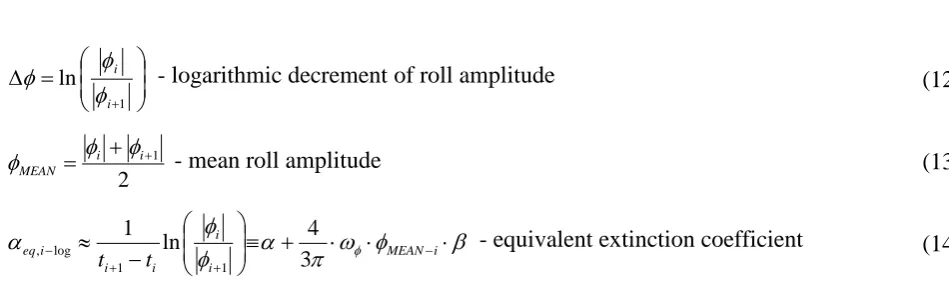
Finally, to see the differences of obtained roll decay curves in terms of extinction coefficients, analysis of 1-DoF, 6-DoF and experimental results is performed according to the procedure explained in detail in Begovic et al. (2017). Here only the definitions of variables reported in Table 8 are given:
= ∆ +1 ln i i φ φ
φ - logarithmic decrement of roll amplitude (12)
2
1
+
+
= i i
MEAN
φ φ
φ - mean roll amplitude (13)
β φ ω π α φ φ
α ≡ + ⋅ φ⋅ ⋅
− ≈ − + +
− MEAN i
i i i i i eq t t 3 4 ln 1 1 1 log
, - equivalent extinction coefficient (14)
completely. For the fair comparison of extinction coefficients: linear α and quadratic β, experimental results have been analyzed considering only first 9 cycles and also 25 cycles, i.e. complete decay curve. The logarithmic decrements for all cases are reported in Figure 18, where the trend lines coefficients a and b represent the required quadratic and linear extinction coefficient respectively:
b
≡
α (15)
a
⋅ ⋅ ≡
φ
ω π β
4 3
(16)
Finally, damped natural frequency is calculated as:
2 2
0 ω αeq
ωφ = φ + - damped natural frequency (17)
Table 8. Extinction coefficients calculation for 1-DoF, 6-DoF simulations and for experimental results
Figure 18. Extinction coefficient assessment
Final results are reported in the Table 9.
Table 9. Extinction coefficients
Finally, the Runge-Kutta simulation is performed with obtained coefficients α and β for simulation of decay with another three experimental decays, i.e. 24.5 deg, 13.5 deg, and 4 deg initial roll angles for 30 seconds, using experimental value for natural damped frequency. These curves are compared against experimental ones as reported in Figure 19.
Figure 19. Obtained roll decay curves using extinction coefficients from numerical simulations
Domain dimension vs Degrees of Freedom
enlarging 2.0 m in the x-direction and 3.0 m in the y-direction, as shown in Figure 20. The second domain was a further enhance of the first-enlarged-domain with the same extension in the x and y directions. The comparison with the results of the initial domain shows that the influence of the distance from hull to the boundaries affect the yaw (Figure 21) and sway results (Figure 22) more than the roll angle (Figure 23).
Figure 20. Comparison between initial and the first enlarged domain
Figure 21. Domain enlargement sensitivity analysis – Yaw results
Figure 22. Domain enlargement sensitivity analysis – Sway results
Figure 23. Domain enlargement sensitivity analysis – Roll results
Conclusions
This work focuses on the use of commercial software CD Adapco Star CCM+ for the analysis of roll damping properties of the bare hull naval ship DTMB 5415 at zero speed. From the review of the state of the art it was noted that the most critical case for numerical accuracy is when hull has small damping (only viscous and wave radiation components, no appendages and no lift contributions) as in considered case.
Roll damping is considered through the roll decay curve prediction, which is the beginning for any further analysis of roll damping coefficients and it is directly compared with the decay curves obtained from experiments previously performed by the authors. It is important to point out that in numerical simulation the moments of inertia have not been tuned with the experimental results; i.e. they have been calculated from the weight distribution on model ready for testing.
A validation and verification analysis has been performed for grid, and time step according to the GCI method. The CF method was considered not applicable for this physical phenomenon because the solutions are not close to the asymptotic range. The validation of numerical results has not been achieved as the obtained comparison error is 19.34%. Hence, in order to reduce the comparison error, it has to be analysed the main source of modelling error, such as the DoFs.
3-DoF and 6-DoF simulations. Nevertheless, releasing degrees of freedom in sway and yaw, improved the natural period prediction. Furthermore, in 3-DoF and 6-DoF simulations, it was observed that after four seconds of physical time, the values of sway and yaw diverged. It is reasonable to consider that it is due to the numerical reflection of radiated waves from the sides of the computational domain. This hypothesis has been confirmed by another two simulations carried out with the two enlarged domains.
For these simulations, the convergence of time step is obtained for 1/500 of the phenomenon period or lower. The reason for this could be the numerical stability of donor and acceptor cells process, i.e. to obtain numerically a correct interpolation process between background and rotating mesh regions very short time step has to be imposed. Furthermore, the number of degrees of freedom and grid refinement are the most important parameters for accuracy of results. While the grid refinement is possible to control through grid uncertainty evaluation, the number of DoF has to be chosen carefully. The calculated unphysical sway displacement in 3-DoF and 6-DoF and worse roll decay indicates that further improvement are necessary in modelling. Final verification of calculated linear and quadratic extinction coefficients has been performed by Runge-Kutta simulation of roll decays with initial angles different from the one for which the coefficients have been obtained. It has been shown that 1-DoF model is giving very good prediction for large initial roll angles (13.5 and 15 degrees). In the simulation with 4 deg initial angle the coefficients obtained from 6 DoF simulation perfectly fit experimental curve.
Acknowledgements
The authors gratefully acknowledge the availability of 32 processors at Calculation Centre SCoPE, University of Naples and thanks to SCoPE academic staff for the given support.
References
Acanfora, M., De Luca, F., 2016, “An Experimental Investigation into the Influence of the Damage”, Applied Ocean Research, 58, pp. 62 – 70.
Avalos, G. O. G., Wanderley, J. B.V., Fernandes, A. C., Oliveira, A. C, 2014, “Roll Damping Decay of a FPSO with Bilge Keel”, Ocean Engineering 87, pp. 111 – 120.
Bassler, C.C., Reed, A. M., Brown, A. J., 2010, “A Method to Model Large Amplitude Ship Roll Damping”, Proceedings of the 11th International Ship Stability Workshop.
International Conference on Ocean, Offshore and Arctic Engineering OMAE 2013, June 9-14, 2013, Nantes, France.
Begovic, E., Mortola, G., Incecik, A., and Day, A.H., 2013b, “Experimental Assessment of Intact and Damaged Ship Motions in Head, Beam and Quartering Seas”, Ocean Engineering, 72, pp. 209 - 226.
Begovic, E., Day, A. H., Incecik, A., Mancini S., Pizzirusso D., 2015, “Roll Damping Assessment of Intact and Damaged Ship by CFD and EFD Methods”, Proceedings of 12th International Conference on Stability of Ships and Ocean Vehicles. Glasgow, 2015, ISBN-13: 978-1-909522-13-8.
Begovic, E., Day, A. H., Incecik, A., 2017, “An Experimental Study of Hull Girder Loads on an Intact and Damaged Naval Ship”, Ocean Engineering, 133, pp. 47-65.
Bassler, C.C., Reed, A., Brown, A.J., 2010, “A Method to Model Large Amplitude Ship Roll Damping”, Proceedings of the 11th International Ship Stability Workshop, 2010, 21-23 June 2010, Wageningen, The Netherlands pp.217-224.
Celik, I. B., Ghia, U., Roache, P. J., Freitas, C. J., Coleman, H., Raad, P. E., (2008), “Procedure for Estimation and Reporting of Uncertainty due to Discretization In CFD Applications”, J. Fluids Eng 130(7), 078001, Jul 22, 2008.
Chen, H. C., Liu, T., Huang, E. T, 2001, Time Domain Simulation of Large Ship Roll Motions by a Chimera RANS Method, Proceedings of 11th ISOPE Conference, ISBN 1-880653-51-6.
Cosner, R. R., Oberkampf, W. L., Rumsey, C. L., Rahaim, C. P., Shih T. P., “AIAA Committee on Standards for Computational Fluid Dynamics: Status and plans”, Proceedings of 44th Aerospace Sciences Meeting and Exhibit, Reno, Nevada.
De Luca, F., Mancini, S., Miranda, S., Pensa, C., 2016, “An Extended Verification and Validation Study of CFD Simulations for Planing Hulls, Journal of Ship Research 60 (2), pp. 101–118.
Eça, L., Hoekstra, M., 2006, “Discretisation Uncertainty Estimation Based on Least Squers Version of the Grid Convergence Index”, 2nd Workshop on CFD Uncertainty Analysis, Lisbon 2006.
Fernandes, A. C., Oliveira, A. C., 2009, “The Roll Damping Assessment via Decay Model Testing (New Ideas about an Old Subject)”, Journal of Marine Science and Application, June 2009, Volume 8, Issue 2, pp 144–150.
Gao, Z., Gao, Q., Vassalos, D., 2013, “Numerical study of damaged ship flooding in beam seas”, Ocean Engineering 61, pp. 77 – 87.
Gu, M., Bu, S., Qiu, G., Zeng, K., Wu, C., Lu, J., 2016, Validation of CFD Simulation for Ship Roll Damping using one Pure Car Carrier and one Standard Model, Proceedings of the 15th International Ship Stability Workshop, 13-15 June 2016, pp. 165-172, Stockholm, Sweden.
Handschel, S., Köllisch, N., Soproni, J. P., Abdel-Maksoud M., 2012a, “A Numerical Method for Estimation of Ship Roll Damping for Large Amplitudes”, 29th Symposium on Naval Hydrodynamics Gothenburg, Sweden, 26-31 August 2012.
Handschel, S., Kollisch, N., Abdel-Maksoud, M., 2012b, “Roll Damping of Twin-Screw Vessels: Comparison of RANSE with Established Methods”, Proceedings of the 11th International Conference on the Stability of Ships and Ocean Vehicles, Athens, Greece, pp.887-897.
Ikeda, Y., Himeno, Y., Tanaka, N., 1978, “Components of roll damping of ship at forward speed” Journal of Society of Naval Architects Japan 1978:143.
Lee, Y., Chan, H. S, Pu, Y., Incecik, A., Dow, R. S., 2012, “Global Wave Loads on a Damaged Ship”, Ships and Offshore Structures 7(3), pp. 237-268.
Lewandowsky, E. M., 2004, “The Dynamics of Marine Craft: Manoeuvring and Seakeeping”, World Scientific Publishing Co. Pte Ltd, Advanced Series on Ocean Engineering, Vol. 22.
Manderbacka, T., Ruponen, P., Kulovesi, J. Matusiak, J., 2015, “Model experiments of the transient
response to flooding of the box shaped barge, Journal of Fluids and Structures 57 (2015), 127–143.
Moshin, A.R. Irkal, Nallayarasu, S., Bhattacharyya S. K., 2016, “CFD approach to roll damping of ship with bilge keel with experimental validation”, Applied Ocean Research 55 (2016), 1-17.
Moshin, A.R., Irkal, Nallayarasu, S., Bhattacharyya S. K., 2014, “Experimental and CFD Simulation of Roll Motion of Ship with Bilge Keel”, International Conference on Computational and Experimental Marine Hydrodynamics MARHY 2014 3-4 December 2014, Chennai, India. Muzaferija, S., Peric, M., 1999, “Computational of Free Surface Flows Using Interface Tracking and Interface Capturing Methods”, Nonlinear Water Wave Interaction, Southampton WIT Press, 1999.
Oberkampf, W. L., Blottner, F. G., 1998, “Issues in Computational Fluid Dynamics Code Verification and Validation”, AIAA Journal, Vol. 5, No.36, pp. 687-695, May 1998.
Roache, P. J., 2002, “Code Verification by the Method of Manufactured Solutions”, Journal of Fluids Engineering, vol. 1, no. 124, pp. 4-10, 2002.
Roache, P. J., 1998, “Verification and Validation in Computational Science and Engineering”, New Mexico, Hermosa Publishers, 1998.
International Conference on the Stability of Ships and Ocean Vehicles, 23-28 September, Athens, Greece
Stern, F., Wilson R.V., Shao J., 2006, “Quantitative Verification and Validation of CFD Simulations and Certification of CFD Codes, Int. Journal of Numerical Methods in Fluids, Vol. 50, pp.1335-1355, 2006.
Stern, F., Wilson, R. V., Coleman, H. W., Paterson, E. G., 2001, “Comprehensive Approach to Verification and Validation of CFD Simulations – Part 1: Methodology and Procedures”, Journal of Fluids Engineering, Vol. 23, pp.793-802, December 2001.
Tezdogan, T., Demirel, Y. K., Kellet, P., Khorasanchi, M., and Incecik, A., 2015, ”Full-Scale Unsteady RANS-CFD Simulations of Ship Behaviour and Performance in Head Seas due to Slow Steaming” Ocean Engineering, no. 97, pp. 186-206, 2015.
Ubbink, O., 1997, “Numerical Prediction of two fluid Systems with sharp interfaces”, PhD: 138, Department of Mechanical Engineering, Imperial College of Science, Technology & Medicine, London.
Wackers, J., Koren, B., Raven, H. C., van der Ploeg, A., Starke, A. R., Deng, G. B., Queutey, P., Visonneau, M., Hino, T., and Ohashi, K., 2011, “Free-Surface Viscous Flow Solution Methods for Ship Hydrodynamics,” Archives of Computational Methods in Engineering, No. 18, pp. 1-41, 2011. Wassermann, S., Feder, D. F., Abdel-Maksoud, M., 2016, “Estimation of ship roll damping—A comparison of the decay and the harmonic excited roll motion technique for a post-panamax container ship”, Ocean Engineering 120 (2016), 371-382.
Wilson, R. V., Carrica, P. M., Stern F., 2006, “Unsteady RANS method for ship motions with application to roll for a surface combatant”, Computers & Fluids 35, pp. 501–524.
Yang, B., Wang, Z. C., Wu, M., 2012, “Numerical Simulation of Naval Ship’s Roll Damping Based on CFD”, Procedia Engineering 37, pp. 14 – 18.
Yang, C. L., Zhu, R. C., Miao G. P., Fan J., 2013, “Numerical simulation of rolling for 3-D ship with forward speed and nonlinear damping analysis”, Journal of Hydrodynamics, 25(1), pp. 148-155.
Zhu, R. C., Yang, C. L., Miao, G. P., Fan, J., 2015, “Computational fluid dynamics uncertainty analysis for simulations of roll motions for a 3D ship”, Journal of Shanghai Jiaotong University (Science), October 2015.
CD-Adapco, “STAR CCM+ User's Guide Version 12.04.010”, 2017.
ITTC Procedures and Guidelines, 2011, “Practical Guidelines for Ship CFD Applications”, 7.5-03-02-03.