JOURNALOF VIROLOGY, May 1989,p. 2048-2055 Vol. 63, No. 5 0022-538X/89/052048-08$02.00/0
Copyright©D 1989, American SocietyforMicrobiology
Molecular Biology of
Rotaviruses
VIII.
Quantitative Analysis of Regulation
of Gene
Expression
during
Virus
Replication
MOIRA A. JOHNSON ANDMALCOLM A. McCRAE*
Departmentof Biological Sciences, University of Warwick, Gibbet HillRoad, Coventiy CV4 7AL, UnitedKingdom
Received 5 October 1988/Accepted 13 January 1989
A sensitive and quantitative solution hybridization assay recently developed in this laboratory has been appliedto thestudy oftheregulation ofviral geneexpression inrotavirus-infected cells. Measurementofthe cumulative levelof viral plus-strand (mRNA) synthesisathourly intervals throughout the growth cyclehas provided evidence for both quantitative and qualitative regulation of transcription. Qualitative control was found onlywhencycloheximidewasused to blockprotein synthesisininfectedcells,whentranscriptionoffour ofthe viral genes (genes 5, 6, 7, and9) was independent ofprotein synthesis. Quantitative regulation was demonstrated by the accumulation ofmRNAto muchhigherlevelsforsomeofthe viralgenes(e.g., genes2and 7) relative to others (e.g., genes4 and 6). In addition to quantitative control at the level of transcription, measurementofthe relative molar amountsofthe variousviralproteinsat6.5hpostinfectionshowed that their levels did notdirectly reflectthose of theirencoding RNAs, indicatingthe existenceoftranslational control of geneexpressionin therotavirus system. Analysis ofthe levelsofminus strandsynthesizedfor eachviralgene
showedthat they were notallaccumulated to the same level. The significanceof this resultinthelight of the presumed similaritiesin replication strategy tothatofthe mammalian reoviruses isdiscussed.
Itis now some 15 years since rotaviruseswere identified as amajor cause of acute viralgastroenteritisintheyoungof humans and all the major species of domestic livestock (5, 7). In the developing countries of Africa, Asia, and Latin America, rotavirus infection is perhaps the major single cause of infant mortality, accounting for an estimated 2 million to 5 million deaths perannum(3, 10). Intheso-called
developedworld, the problems causedbyrotavirus infection
aremainlyeconomic ones, which can be subdividedinto two
broadcategories.In theagriculturalindustry,animalwasting
and,in severe cases,deathasthe result ofrotavirus-induced diarrhoeaareestimated to costmillions of pounds each year in the British dairy industry alone. In humans, a significant amountof theinfant morbiditycausedbygastroenteritiscan be attributedtorotavirus infection, which is costly totreat. Becauseof the medical and agricultural importance of rota-viruses, there is now a substantial amount of interest in the
development ofaneffective antirotavirus vaccine. To help
support advances toward this goal, it is desirable that we should have a more complete understanding of rotavirus
replicationat the molecular level.
Rotaviruses are members of thefamilyReoiiridae, having
agenomecomposed ofanumber, 11,of discrete segments of
double-stranded RNA(dsRNA) (18, 25, 28). The molecular
detailsof their replication cycle have not been analyzed to date, but their similarity in genome type tothe mammalian reoviruses, whose replication cycle has been analyzed in some detail, hasled to the assumption that rotavirus repli-cation would follow the same basic strategy as that of reovirus. The information available from the reovirus system formed a good basis on which to begin our experimental work. Mammalian reoviruses have a genome composed of 10 segmentsof dsRNA which have been shown to replicate in a nonconservative fashion (1, 27). The mechanism first in-volves the transcription of the parental input dsRNA genome
* Correspondingauthor.
within the viral corebyavirion-associated RNA polymerase to generate mRNA. This mRNA serves two functions: it is translatedtoproduce the viral encoded proteins, and it also acts as the template for the synthesis of new minus-sense RNA strands to produce progeny genomes, a process that takes place inside a particulate preprogeny virion. The transcription of reovirus RNA was studied some years ago by Nonoyama et al. (20), who used hybridization of in vivo-labeled RNA to an excess of unlabeled genomic RNA to capture the transcripts into dsRNA hybrids and then
quantifythemby polyacrylamide gelanalysis.Inadditionto thequantitative regulationoftranscription, they found qual-itative control, since only4of the genesweretranscribedat early timespostinfection, whereas all 10werefound atlater times. If infected cells were treated with cycloheximide to block protein synthesis,the early pattern of viral transcrip-tion could be preserved until late in infection. This suggests that at least some of the protein products of the fourearly
genesmayplayaregulatoryrole in thereplication cycle(12).
Unfortunately, the techniqueused by Nonoyamaetal. (20)
was not able to distinguish between plus-sense mRNA
transcriptsand newminus-sense RNAcopies, andalthough
itallowed the relativeamountsof the differenttranscriptsto becompared,it couldnotdosointermsof absolute numbers ofRNA molecules per infected cell.
The aim of our studies with rotavirus was to analyze in detail both viral transcription and replication, and it was
thereforeimportantto use anassaycapable ofdistinguishing
between newly synthesized plus and minus RNA strands. The assay developed (9) is a solution hybridization which makes use ofvirus strand-specific probes generated by in vitro transcription ofcDNAcopies of viral genes from the SP6 and T7promoters of the Gemini transcription vectors. The assay has been exploited to accurately measure the levelsofplus- and minus-strand synthesis for each of the11 rotavirus genes. In addition, because the complete RNA
protein-coding assignments for the UKtc bovine virus are
2048
on November 10, 2019 by guest
http://jvi.asm.org/
known (14), we also aimed to determine the relative trans-lational efficiencies of each of the viralmRNAsby quantify-ing the levels of the various virus-encoded proteins.
MATERIALS AND METHODS
Cells and virus stocks. BSC-1 cells were maintained in Glasgow modified minimal essential medium supplemented with nonessential amino acids, 5% fetal calf serum, and 50
p.g ofgentamicin sulfate per ml. The Compton UK tissue culture-adapted bovine rotavirus strain was originally ob-tained from M. Thouless. Virus stocks were prepared by infection of confluent monolayers of BSC-1 cells at a multi-plicity of infection of 0.1 PFU per cell, and growth was allowed to proceed for 72 h at 37°C. The infectivity of the virus stock wasdetermined by titration on BSC-1 cells (13). Preparation of infected cells and extraction of RNA. The accumulation of both strands of all 11 rotavirus genes was analyzed on the same stock of infected-cell RNA by using 150 x 106 cells contained in two 650-cm2 roller bottles for each sampling time. The infected-cell RNA was standard-ized by labeling the cells with[3H]uridine (2.5
[iCi/ml)
for 16 h prior to infection. At the time of infection, the uridine-containing medium was removed from the cells to ensure labeling of cellular RNA only. Cells were infected at .. multiplicity of 10 PFU per cell and harvested by trypsinisa-tion (0.05%trypsin) and low-speed centrifugation at hourly intervals during an 8.5-h infection. Cell pellets were sus-pended in 10 ml of 50 mM Tris hydrochloride (pH 8.0), and asmall sample was reserved for titration of infectivity (13). The remainder was dispersed by sonication followed by 10 strokes with a Dounce homogenizer. Sodium dodecyl sulfate wasadded to afinal concentration of1%, and the suspension was extracted once with phenol equilibrated with 0.1 M sodium acetate (pH 5.0) at 60°C and twice with water-saturated phenol at 37°C. RNA was collected byprecipita-tion with 2 volumes of absolute ethanol in the presence of 0.15 M lithium chloride and suspended in 1,500
[lI
of piperazine-N,N'-bis(2-ethanesulfonic acid) (PIPES)-form-amide hybridization buffer (40 mM PIPES [pH 6.7], 0.4 M sodium chloride, 1 mM EDTA, 80% deionized formamide). The trichloroacetic acid-precipitable radioactivity (3H) in eachsamplewasthen usedtoadjust the volumes so that all samples contained thesame amountof cellularRNAperunit volume.Production of RNAcopies ofrotavirus cDNA sequences by in vitrotranscription. Rotavirus-specific cDNA clones
orig-inally isolated by McCrae and McCorquodale (15) were
subcloned into appropriate restriction enzyme sites within
the polylinker region of pGEM1 and pGEM2 transcription
vectors (Promega Biotec). The size of the cDNA inserted was in the rangeof 200 to 1,150 base pairs. Small amounts of
high-specific-activity RNA and larger amounts of unlabeled
RNAweregeneratedfrom these clones and used in solution hybridization assays as described by Johnson and McCrae (9) to evaluate the accumulation of specific RNA species throughout infection.
Analysis of protein synthesis. Cells were incubated in methionine-free medium for 16 h priorto pulse labeling (at 6.5 h postinfection) with
[35S]methionine
(800 Ci/mmol). Sampleswerebalanced with respect totrichloroacetic acid-precipitable radioactivity, and labeled polypeptides were fractionated on 5 to 11% polyacrylamide gels by using the Laemmli discontinuous buffer system (11). Treatment withdiphenyloxazole allowed fluorography to be carried out.
When cycloheximide was used, it was added 2 h prior to
60
-J 50_--J
z 40-a A} 30-0
CL-
10-0
I 1
O-
I I I I I I ITIME POST-INFECTION (hours)
FIG. 1. One-step growth of rotavirus: production of infectious progeny virions. Cells were infected at amultiplicity of10PFU per cell and harvested at hourly intervals throughout an8.5-h growth curve. Titers ofsamples werefoundas described in Materials and Methods. The overall yield of virus was calculated from these results to be54PFU per cell.
infectionat aconcentration of20p.g/ml and maintained until indicated.
RESULTS
Parametersof thegrowth cycleusedforanalysis.To ensure that the results ofanalysisof the different viral genes could be directly compared, we prepared large quantities of cells sufficient to carry outassays on all thegenes for each time point used. In addition to extracting most of the cells for RNA analysis, plaque assays and particle counts were carried out on each sample so that the kinetics of the
orne-step growth curve under the conditions used could be
related to the biochemical results from the RNA studies. Under theconditions of infection used(multiplicityof infec-tion, 10 PFU percell), the expected one-step growth curve wasproduced (Fig. 1). After an initial eclipse phase of 3.5 h, progenyvirionproduction proceeded exponentiallyuntil7.5 h postinfection, at which time a plateau was reached. The overall yieldof infectious virus duringthe replication cycle
used in thesestudies was54 PFUpercell, which represents anapproximatefivefoldamplificationof theinputinfectivity.
A particle-to-PFU ratio was measured for the
8.5-h-postin-fectionsample andwasshowntobe4.7.This illustrated that under the conditions used in the virus plaque assay, only
approximately 20% of the progeny virus particles were
capable of causingan infection.
Kineticsofsynthesisofplus-sense RNA strands(mRNA). A
compilation of the data obtained for the accumulation of
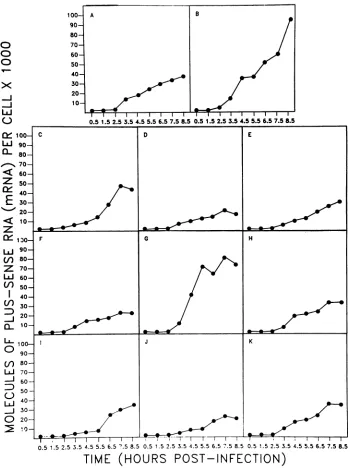
plus-sense RNAstrands(mRNA) foreachofthe viralgenes is shown in Fig. 2. Inspection of these results revealed two levelsoftranscriptional control. First, there was clear
tem-poral control of synthesis, with three broad patterns of mRNAaccumulation beingdiscernible. In thefirst category (genes 1, 2, 6, 8, and 11), mRNA synthesis
proceeded
at amore orless linear ratethroughout the infection
cycle.
Theon November 10, 2019 by guest
http://jvi.asm.org/
[image:2.612.364.501.72.296.2]2050 JOHNSON AND McCRAE
o 70 -j
O 60
-o ~~~50-j
40-I
X
~~~~~30.-1
~~201
10
O) 0.5 1.52.5 3.5 4.5 5.5 6.5 7.5 8.5 0.5 1.52.5 3.5 4.5 5.5 6.5 7.5 8.5
I
o00 C D E
80-<
60-Z
50-
Qf40-E
30-20-<10o
Z 70-LU
60-Vf)
50
I40-
20-
10-0 90-Lii
70-6060
~50-LU 40-_j
30-0
20-0.5 1.5 2.5 35 45 5.56.57585 0.5 1.5 2.5 3.5 4.5 5.5 6.5 7.5 8.5 0.5 1.5 2.5 3.5 4.5 5.56.5 7.5 8.5
[image:3.612.137.487.72.540.2]TIME
(HOURS
POST-INFECTION)
FIG. 2. Accumulation of mRNA. Thefigureshows the accumulation ofplus-sense (mRNA)strands for the 11rotavirusgenesoccurring
duringasingle-step growth experimentcarriedoutasdescribed in Materials and Methods. The results obtained forgenes 1 to11presented
asmolecules of RNA percellare shown inpanelsAtoK, respectively. second patternwasexhibitedby onlyonegene(gene7),and in this case, mRNA accumulated rapidly during the early
partofthe infectious cycle and then reached aplateau that was maintained for the remainder of the growth cycle. The third category of genes (genes 3, 4, 5, 9, and 10) contained those in which there was a relatively slow accumulation of
mRNA during the early part of the growth cycle, with the
rate increasing later. It was not possible in this initial accumulation experiment to see any distinct division or switch between a set of early and late genes in terms of mRNA synthesis. The absolute levels of mRNA
accumulat-ing atearly times for some genes, e.g., 1, 2, and 7, were
higherthanfor others. However, because of the incomplete
inhibition ofhost proteinsynthesis atearly times
postinfec-tion, it wasnot possible to accuratelymeasure the relative levels ofsynthesis ofthecorresponding viral proteins, and hence it was impossible to assess whether the increased mRNAlevels resulted in increasedproteinsynthesis.
The second level at which transcriptional control was evidentwas aquantitativeone. Inspectionof the data shown inFig.2showed that uptoandincluding7.5 hpostinfection,
the viral genes could be divided into four broad categories
based on the amount of mRNA accumulated. The highest
levels(73,000to94,000 molecules percell)were reachedby
two genes 2 and 7. Gene 3, which accumulated 45,000
molecules percell,wasthesolerepresentativeof the second group. In thethird group, which had accumulated30,000to
36,000 molecules per cellby7.5hpostinfection, therewere J. VIROL.
on November 10, 2019 by guest
http://jvi.asm.org/
TABLE 1. Relative production ofrotavirus proteins at6.5hpostinfection"
Protein Relative molar amts
synthesized(-fold) VP1... 0.15 ± 0.05
VP2... 1.32 ± 0.14
VP3/4... 1.27 ± 0.12
VP5... 1.57 +0.18
VP6... 25.02 ± 2.52
VP7... 3.48 ± 0.64
VP8... 10.68 ± 2.35
VP9... 4.43 +1.84
VP10... 38.65 ± 3.43
VP11...1+ 0.07 ' Virus-infected cells were pulse-labeled for 15 min and fractionated on polyacrylamide gradient gels,and the levelofeachpolypeptidewascalculated (seeMaterials and Methods). The resultsatre expressedrelative to theamouint ofVP11. which was given an arbitraryvatlueof 1.
five genes, 1, 5, 8, 9, and 11. Finally, the lowest levels of mRNA accumulation (14,000 to 21,000 molecules per cell)
were shown by threegenes, 4, 6, and 10.
Quantitation ofviral polypeptide production. It was
possi-ble that the different levels of mRNA detected in the experiments described above would be reflected directly in the amounts ofthe corresponding viral proteins, indicating thatcontrol of viralgeneexpressionwasprimarily
transcrip-tional. Since the complete RNAprotein-coding assignments for the UKtc bovine virusused in thisstudyare known(14),
it isfeasible toquantitate the synthesis levels of thevarious
virus-encoded proteins and see whether their amounts do indeed directly correspond to those of their respective mRNAs.
Theproduction ofviralproteinsduringa15-min pulsewith [35S]methionine was measured at 6.5 h postinfection. After labeling, the infected cells were fractionated on 5 to 11% polyacrylamide gradient gels, which were then dried and
autoradiographed. Individual viral protein bands were
ex-cised from the gel, and the
15S
that they contained wascounted. The results obtained were adjusted for the
back-ground radioactivity, the methionine content of the protein
(when known), andtheapproximate molecular weightofthe final protein product (13) and expressed relative to VP11, whichwasassignedavalueofunity (Table 1). Datafromfive
independent experimentswerecombined, and theirmean is presentedin Table 1. Of the 11 final geneproducts. 9could be resolved completely; it was difficult to achieve the
com-plete resolution of VP3 and VP4, and so the data for these werecombined (Table 1).
From Table 1 it is clear that not all of the viral proteins
werebeing synthesized in equal amounts at6.5 h postinfec-tion. Thus, VP6 and VP10 were both produced in large excess over the remaining nine proteins. VP6 is the major
component of the innercapsid shell of the virus and carries the group antigen determinants ofgroupA rotaviruses (23,
29), and VP10 is a nonstructural glycoprotein (4). VP8,
which has not yet been unequivocably identified as being
structural or nonstructural, was also synthesized in
rela-tively large quantities, although only to about half that of VP6. The apparentpredominance ofVP8 in protein profiles of infected cells (Fig. 3) was due in part to itshigh methio-ninecontent(4.7%) relativetoother viralproteins. VP9,the second clearly established nonstructural protein, and the VP7 glycoprotein complex, which makes up the major
neutralization antigen found in the outershell of the virion. were both produced in an approximately fourfold excess
A B
C
D E
VP] _-_ - VP2
VP3&4
-.VP5
_VP6
-..--VP7
_-VP7
--VP8
VP9 --VP 0
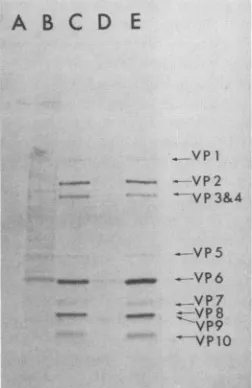
FIG. 3. Selective transcriptioninthe absenceofhost cellprotein synthesis. Infected cells treated with cycloheximide were pulse-labeledfor 15 min at 6.5 h postinfection as described in Materials and Methods. Samples wereanalyzed on 5 to11% polyacrylamide gradient gels. Lanes: A,cycloheximide-treated uninfectedcells; B. untreated uninfected cells; C, untreated infected cells at 6.5 h postinfection; D, cycloheximide-treated infected cells labeled 15 minafterremoval;E. cycloheximide-treatedinfected cells labeled 3 hafter removal.
overVP11. Theremainingproteins areall structural compo-nents of the virion, and each was produced in very small amounts relative to VP11. For example, VP1 was synthe-sized at only 1/260 of the rate of VP10 at this time postin-fection.
Having determined the relative levels of synthesis of both individual viralmRNAsandproteins,wecould compare the two. When thiswasdone(Table 2), it became clearthat the level of mRNA for a particular gene was not directly
reflected in the relativeamountof thecorresponding protein.
Forexample, gene 10 mRNAaccumulatestoabout one-third ofthat for gene 7 at 6.5 h postinfection, whereas VP1O is being synthesizedat aboutfour times the level of VP8.This suggests thatgene 10 mRNA is beingtranslated at 12 times
TABLE 2. Analysisof levels oftranscriptionand translation for the11 rotavirusgenes"
Production of Accumulation Transiation-Protein/gene proteins" ofmRNA" frequency
VP1/SP1 0.15 1.3 0.1
VP2/SP2 1.32 2.3 0.5
VP3/SP3 1.3
1.27 0.6
VP4/SP4 0.6
VP5/SPS 1.57 0.9 0.6
VP6/SP6 25.02 0.7 36.6
VP7/SP8 3.48 0.9 3.9
VP8/SP7 10.68 2.8 3.8
VP9/SP9 4.43 0.9 4.9
VP1O/SP10 38.65 0.7 54.3
VP11/SP11 1 1 1
"The results presented in this table were taken from Fig. 2 for the trainscriptionatl dataaindTable1for the translationaldaita.
RelativetoVP11.
on November 10, 2019 by guest
http://jvi.asm.org/
[image:4.612.371.497.76.270.2]2052 JOHNSON AND McCRAE
the efficiency ofgene 7 mRNA. For the five proteins other
than VP6 thatarethought tomakeupthe inner capsid shell
(although the position of VP5 has not been precisely defined), their relatively low levels ofsynthesisappeartobe due to poortranslational efficiencies, since the mRNAs for theseproteins accumulatetosimilarorhigher quantitiesthan someof the othermRNAspecies. Bycontrast, proteins such
as VP6 and VP10, which are produced in large amounts,
have mRNAs whichare veryefficiently translated, whereas
VP8 appears to rely more on producing high levels of an
inefficiently translated mRNA to achieve its relatively high levels of synthesis. The overall conclusion that can be
reached from this analysis is that both transcriptional and translational control ofgene expression operate in the
rota-virus system to achieve the regulated synthesis of viral proteins during the viral replication cycle.
Qualitative regulationofviraltranscription. Lauetal. (12) used the protein synthesis inhibitor cycloheximide in the mammalian reovirus system toobtain evidence foran
early-late switch in the pattern of viral gene transcription. With
appropriate adjustments for the differing kinetics of virus replication, a similar strategy was applied to the rotavirus
system. Cycloheximide (20 p.g/ml) wasapplied tothe cells 2 hpriortoinfection and maintained until 6.5 h postinfection. The cycloheximide was then removed, and the cells were
pulse-labeled for 15 min with [35S]methionine at 15 min and
at3h afterremoval. The labeled samples werebalanced with
respect to acid-precipitable radioactivity, and the proteins
present were fractionated on gradient polyacrylamide gels.
After autoradiography the protein profiles were examined
withaviewtoidentifyinganyviral proteinbeing synthesized
15 min after the removal of the protein synthesis inhibitor. The results (Fig. 3) showed that as early as 15 min after
removal of the block, four virally encoded proteins, VP5, VP6, VP8, and VP9, could be detected. On the basis of relative band intensities, both VP5 and VP9 appeared tobe being synthesized at near-normal levels, whereas VP6 and VP8 had not completely recovered their normal levels of synthesis so early after release of the protein synthesis
block. The production ofthese four proteins so soon after
the removalof thecycloheximide impliedthatthe transcrip-tion of the genes encoding them (genes 5, 6, 7, and 9,
respectively) was independent of protein synthesis in the
infectedcells. The quantities of viralmRNAfor thesegenes
in cycloheximide-treated cells should therefore reflect the
pattern of protein synthesis shortly after the block was
released. RNA was extracted from cycloheximide-treated
cells at 6.5 hpostinfection, and the levels of mRNA
accu-mulatedforgenes 5, 6, 7,and9weremeasured. Thelevelof
transcription of these genes was then compared with the
level of transcription of genes 3 and 10, whose protein
products, VP3 and VP10, respectively, were both absent
from the protein profile made 15 min after removal of cycloheximide (Fig. 3). Thepatternofprotein synthesisseen
immediately afterremoval of the protein synthesis inhibitor didindeed reflect the levels ofmRNApresentin the infected cells (Table 3). Although all the viral genes examined
showed a reduction in their levels of accumulation in the presenceof cycloheximide,the dropseenforthe genesthat
wereexpressed shortlyafterremovalof the block wasmuch
lower than forthose whose protein products could not be detected. Thus, accumulation of mRNA for genes 5, 6, 7,
and9wasreducedbybetween 1.5-and6.5-fold, whereas for
genes 3 and 10 there was a 34- and 13-fold reduction,
respectively.
Kinetics of minus-sense RNA synthesis. The results
ob-TABLE 3. mRNA accumulation in the presenceof cycloheximide
MoleculesofRNAaccumulated/cell
Gene Untreated Treated Fold
cells cells reduction
SP5 20,470 15,300 1.3
SP6 15,795 2,870 5.5
SP7 63,900 12,500 5.1
SP9 21,180 3,290 6.4
SP3 28,400 835 34.0
SP1O 16,960 1,300 13.0
"Theaccumulation ofplus-sense transcripts (mRNA)for sixof the viral genes in virus-infected cells maintained in the presence and absence of cycloheximidewasmeasuredasdescribed in Materials and Methods.
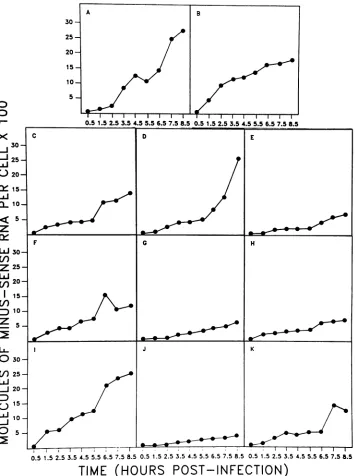
tained for the accumulation of the minus-sense RNA strands of each viral gene are shown in Fig. 4. Since extraction of genomic dsRNAfrom purifiedvirions shows that each of the 11 genes is present in equimolar amounts, it was expected thatthe 11 minus-sense RNAs would accumulate to the same level, but this clearly did not occur. There was as much as an 8.5-fold excess of minus-sense RNA for genes 1, 4, and 9 overthat for gene 10, and since the variability of the assay being used did not exceed20%(9),this difference appears to beareal one. Theassumption that the strategy of rotavirus
replication will follow the nonconservative mechanism
es-tablished for mammalian reoviruses (1) precludes the
possi-bilitythat theexcessminus-strand RNAapparently made for some genes was free in the cell cytoplasm, and so the
possibilityis suggested thatdefectivevirusparticles,lacking someof the viral genome segments, were beinggenerated.
On the basis of the temporal patterns of synthesis of minus-sense RNA, the viral genes could be divided into four groups. In thefirst group,which consisted ofgenes2and 9, minus-sense RNAcould already be detected in the earliest
sampletaken(1.5 h postinfection). Minus-sense RNAofthe
solememberofthe second group, gene1,beganto accumu-lateat3.5 hpostinfection. Thethird groupconsisted offour member genes, 6, 3 and 4, and 11, whose accumulation of minus-sense RNA wasfirst detected at 4.5, 6.5, and 7.5 h
postinfection, respectively. The accumulation of
minus-senseRNAfor the final group of four genes (5, 7,8, and10)
was slow compared with the other groups and reached the lowest final levels.
By analogy with the replication strategy established for reovirus (1), it had been predicted that minus-sense RNA would not begin to accumulate until the later phases ofthe
growth cycle (production of progeny virions was first
de-tected at 3.5 h postinfection; Fig. 1). Foreight oftheviral
genes, this appeared to be true, with accumulation either
accelerating after this time (genes 3, 4, 6, and 11) or
increasing slowly andsteadily duringthe later stagesof the growth cycle (genes 5, 7, 8, and 10). However, for genes2 and9, and to alesser extentfor gene 1, minus-sense RNA accumulated rapidly earlier during the infection cycleprior
toprogeny virusproduction.Thepossible significanceof this ratherunexpected temporal pattern of minus-strand synthe-sis is at present unclear.
DISCUSSION
The strand-specific probesused in the solution
hybridiza-tion method developedfor thisstudy have allowed accurate
quantitationof the patternofsynthesisof bothplus- (mRNA)
J. VIROL.
on November 10, 2019 by guest
http://jvi.asm.org/
0.51.5 2.5 3.54.5 5.56.57.58.5 0.51.5 2.5 3.5 4.55.56.5 7.58.5
>< C D E
_j30
-j25-0
20-CY
15-CL
10-<
5F GH
LU
30-Z
25-
Li20-I
15-v)
:D10-0
30-(V)
25-Li1... 20
:D
0
15-
Li10-0
50.5 1.52.5 3.5 4.5 5.5 6.5 7.5 8.5 0.5 1.5 2.5 3.5 4.5 5.5 6.5 7.5 8.5 0.5 1.5 2.5 3.5 4.5 5.5 6.5 7.5 8.5
TIME
(HOURS POST-INFECTION)
FIG. 4. Accumulation of minus-sense RNA. Thefigureshows the accumulation of minus-sense RNA strands occurring ina single-step
growth curvecarriedoutasdescribed in Materials and Methods. The results obtained forgenes1 to11expressed in termsof moleculesof RNApercellare shown inpanelsAtoK, respectively.
and minus-senseRNAstrands for eachof the11 segmentsof rotavirus RNA. In thisrespect, it has been able toprovide much moredetailed information than could be obtained by the previous generation of assay used for this type of analysis ofdsRNAviruses (20). Ithastheadditional
advan-tage that it allows the actual numbers ofRNA molecules synthesizedpercelltobe measuredrather thanrelying only
onrelative values ofone speciesto another.
Examining the pattern oftranscription for the different genesdoes allowsomespeculation ofthefunctionofsomeof thegeneproducts; forexample, VP8,theproductofgene7,
issynthesized inlargeamounts veryearlyinthereplication
cycle.Thelocationof VP8 is stillequivocal;insomeviruses
(SAl
[6]) it iscategorized asbeing nonstructural, whereasin the UKtc strain it appearstobe a structural protein (13). Irrespective of its location, this protein has been shown to
have RNA-binding properties (H. N. Baybutt and M. A.
McCrae, unpublished observation). This, together with its
early accumulation, suggests that it may play a role in the
earlystages ofmorphogenesis, suchastheassemblyofsets
of mRNA into immature virions.
In earlier studies (13) we acknowledged that temporal
control of gene expression was
probably operating
in this virus system, since three temporal classes ofpolypeptide
could be defined. Thefirst, which includedVP9,reached the maximumrate ofsynthesis very early (2h
postinfection)
inon November 10, 2019 by guest
http://jvi.asm.org/
[image:6.612.127.482.71.547.2]2054 JOHNSON AND McCRAE
thereplication cycle. Inthesecondgroup wereproteinssuch
as VP1, whose maximumrateof synthesiswasnotseenuntil
later in the cycle (4 h postinfection). Finally, there were
proteins such as VP6, whose rate of synthesis appeared to
increase steadily throughout the infectious cycle. The pat-tern ofplus-strand RNA synthesis (Fig. 1) shows,however, that for all of the genes, the levels of mRNA continue to
increase until at least 7.5 h postinfection. Some form of general translational control must therefore be operative.
otherwise therateof synthesis of all theviralproteins would be expected to increase throughout the cycle, i.e., the
frequency oftranslation formRNAs ofthe first twogroups
ofproteins mustdecrease with time. Itis possible that there
is some form of structural modification of these mRNAs
which, although it affects their translatability, does not prevent them from hybridizing to the RNA probes used in this study. The inability ofthe current assay to distinguish between functional and nonfunctional mRNA molecules obviously has to be taken into account when trying to
interpret the accumulation data.
Despite the temporalcontrol of transcription thatwas seen
for the various genes, under normal infection conditions it was not possible to see any clear qualitative switching of
transcription of the early-late typeof transition observed for
a number of DNA viruses such as simian virus 40 and
vaccinia virus(8,21, 22). Intheir studies of reovirus, Lauet
al. (12) were able to use the protein synthesis inhibitor
cycloheximide to define a group of so-called early genes
whosetranscription wasindependent ofproteinsynthesis in
the infected cell, and these authors speculated that the protein products of thesegenes mayplayaregulatory rolein
the replication cycle. By analogy, the similar experiment carried out in this study revealed a group of four genes
(genes 5, 6, 7, and 9) whose transcription was similarly
partially independent of host protein synthesis. Itispossible
that the protein products of these genes, VP5. VP6, VP8,
and VP9, respectively, also havesome regulatory functions
in the viral growth cycle, and certainly the RNA-binding properties of VP8 would befit it for such a role. Further
studies are clearly needed to substantiate this putative regulatory role for these early genes.
The levels of minus-strand accumulation duringthe repli-cation cycle were in all cases much lower than those of
plus-strand accumulation, ranging from6-to 130-fold lower. This suggests that the majority (83 to -99%) of the
plus-sense transcripts function solely as templates for protein
synthesis, with the minority servingasthe template for the
addition of minus-sense RNA and hence progeny genome
production. By analogy with the reovirus system, the pres-ence of equimolar amounts of the 11 RNAs in infectious rotavirusparticles suggested that there should beequimolar quantities of the various minus strands synthesized in
in-fected cells. When the quantities of minus strands
accumu-lated were compared with the yield of infectious virus
particlesand theparticle-to-PFU ratio,the percentageof the minus-sense RNA that could be accounted for as being
present in virus particles varied for the different RNA
segments. Thus, for gene 10, which accumulated to the lowestlevels,300moleculespercell hadaccumulated by8.5
h postinfection. This compares with the yield of infectious
virus at this time of 54 PFU percell, which, based on the
measured particle-to-PFU ratio of 4.7:1, represents 254 molecules of gene 10 minus-sense RNA in recognizable
virions, i.e.,84%ofthe total. At the otherextremewas gene
1, with only 9.8% of the minus-strand RNA accumulated being accounted for in identifiable virus particles. The
con-clusion of such an analysis was that for some of the RNA segments, the amount of minus-strand RNA accumulated corresponded well to the number of virus particles pro-duced, whereas in othercases, mostnotably genes 1, 4,and 9, there was avast overproductionof such RNA. Forgenes
givingthehighestlevelsofminus-strandaccumulation, only about 2% of the RNA became part of a virion capable of
initiating infection, suggesting that thereplication processis extremely inefficient. Since these experiments were carried out with cells infected at a high input multiplicity, it is feasible that large numbers of defective particles mayhave beengeneratedwhich containedcompletecopiesofgenes1, 4, and 9but which lacked one or more of the othergenome segments and hence weresufficientlyunstable that theydid not survive to be counted as recognizable virions in the electron microscope. Defective virus particles deleted for a number of genomic RNA segments have previously been
reportedfor both influenza virus(16,17, 24)and reovirus(2,
19, 26). However, to date, similar defective particles have
not been reported forthe rotavirus system, and so further
work is needed to substantiate the production of defective virions as being the reason for the large disparities in the levels ofaccumulation of the different minus-sense RNAs seen in this study.
ACKNOWLEDGMENTS
This work was supported by grants from the Medical Research Council andbyaMedical ResearchCouncilStudentshipfortraining in research methods to one of us (M.A.J.). M.A.M. is a Lister Institute Fellow.
LITERATURE CITED
1. Acs,G.,H.Klett,H.Schonberg, J.Christman,D. H.Levin,and S. C.Silverstein. 1971. Mechanism ofreovirusdouble-stranded ribonucleic acid synthesis in vivo and in vitro. J. Virol. 8: 684-689.
2. Ahmed, R., and A. F. Graham. 1977. Persistant infection in L cells with temperature-sensitive mutants ofreovirus. J. Virol. 23:250-262.
3. Argarwal,A. 1979.A cureforakiller: but howtoadministerit. Nature (London)278:389-391.
4. Baybutt,H.N.,and M. A. McCrae. 1984.Themolecularbiology of rotavirus. VII. Detailed structural analysis of gene 10 of bovine rotavirus.Virus Res. 1:533-541.
5. Bishop, R. F., G. P. Davidson, I. H. Holmes, and B. J. Ruck. 1974. Detection ofa new virusbyelectron microscopy of faecal extracts from children with acute gastroententis. Lancet i: 149-151.
6. Estes,M. K., J.G.Obijeski,and E. L. Palmer. 1983. Rotavirus: a review. Curr.Top. Microbiol. Immunol. 105:123-184. 7. Flewett, T. H., A. S. Bryden, H. Davies, G. N. Woode,J. C.
Bridger, and J.M. Derrick. 1974. Relation between viruses from acute gastroenteritis of children and newborn calves. Lancet ii:61-63.
8. Griffin,B. E. 1981.Structureandgenomic organisationofSV40 polyoma virus, p. 61-123. In J. Tooze (ed.). DNA tumour viruses. Molecular biology of tumour viruses. Cold Spring
HarborLaboratory. ColdSpring Harbor, N.Y.
9. Johnson,M. A.,and M. A.McCrae. 1988. Arapidandsensitive solution hybridisationassay for the quantitative determination ofspecificviralRNAsequences. J. Virol. Methods22:247-254. 10. Kapikian,A.Z.,J. Flores,Y.Hoshino,R.I.Glass,K.Midthun,
M. Gorziglia, and R. M. Chanock. 1986. Rotavirus: the major etiologicalagentofsevereinfantile diarrhea may be controllable by a 'Jennerian' approach to vaccination. J. Infect. Dis. 153:815-822.
11. Laemmli,U. K. 1970.Cleavageof structural proteinsduringthe assembly of the head of bacteriophage T4. Nature (London) 227:680-685.
J. VIROL.
on November 10, 2019 by guest
http://jvi.asm.org/
12. Lau, R. Y., D. Van Alstyne, R. Berkmans, and D. Y. Graham. 1975. Synthesis of reovirus-specific polypeptides in cells pre-treated with cycloheximide.J. Virol. 16:470-478.
13. McCrae, M. A., and G. P. Faulkner-Valle. 1981. The molecular biology of rotaviruses. I. Characterisation of basic growth parameters and pattern ofmacromolecular synthesis. J. Virol. 39:490-496.
14. McCrae, M. A., and J. G. McCorquodale. 1982. The molecular biology of rotaviruses. II. Identification ofthe protein coding assignments ofcalfrotavirus genome RNA species. Virology 117:435-443.
15. McCrae, M. A., and J. G. McCorquodale. 1982. The molecular biology of rotaviruses. IV. Molecular cloning of the bovine rotavirusgenome. J. Virol. 44:1076-1079.
16. Nayak, D.P. 1972. Defective virus RNAsynthesis and produc-tion of incomplete influenza virusinchickembryo cells. J.Gen. Virol. 14:63-67.
17. Nayak, D. P., T. M. Chambers, and R. K. Akkina. 1985. Defective interfering (DI) RNAs of influenza virus: origin, structure, expression and interference. Curr. Top. Microbiol. Immunol. 114:103-151.
18. Newman, J. F. E., F. Brown, J. C. Bridger, and G. N. Woode. 1975. Characteristics of a rotavirus. Nature (London) 258: 631-633.
19. Nonoyama, M., and A. F. Graham. 1970. Appearance of defec-tivevirions inclonesof reovirus.J. Virol. 6:693-694.
20. Nonoyama, M., S. Millward, and A. F. Graham. 1973. Control of transcription ofthe reovirus genome. Nucleic Acids Res. 1:
273-385.
21. Oda, K., and W. K. Joklik.1967. Hybridisation and sedimenta-tion studiesonearly and late vaccinia messenger RNA. J. Mol. Biol.27:395-419.
22. Paoletti, E., and L. J. Grady. 1977.Transcriptional complexity of vacciniavirus in vivo and in vitro. J. Virol. 23:608-615. 23. Pedley, S., J. C. Bridger, J. F. Brown, and M. A. McCrae. 1983.
Molecular characterisation of rotaviruses with distinct group antigens.J. Gen. Virol.64:2093-2101.
24. Pons, N. W. 1980. Thegenome ofincompleteinfluenza virus. Virology 100:43-52.
25. Rodger, S. M., R. D.Schnagl, and I. H. Holmes. 1975. Biochem-ical and biophysBiochem-icalcharacteristics of diarrhea viruses of human and calforigin. J. Virol. 16:1229-1235.
26. Schuerch, A. R., T. Matsuthisa, and W. K. Joklik. 1974. Temperaturesensitive mutantsof reovirus. VI. Mutant ts 447 and ts 556 particles that lack either one or two genome seg-ments. Intervirology 3:36-46.
27. Silverstein, S. C.,J.Christman, and G. Acs. 1976. The reovirus replicative cycle. Annu. Rev. Biochem. 45:375-408.
28. Todd, D., and M. S. McNulty. 1976. Characterisation ofpig rotavirusRNA. J.Gen. Virol. 33:147-150.
29. Woode, G. N., J. C.Bridger, J. M. Jones, T. H. Flewett,A.S. Bryden, H. A. Davies, and G. B. B. White. 1976.Morphological and antigenic relationships between viruses (rotaviruses)from acutegastroenteritis of children, calves, piglets, mice, and foals. Infect. Immun. 14:804-810.