communication systems with multimode fiber feeds
.
White Rose Research Online URL for this paper:
http://eprints.whiterose.ac.uk/724/
Article:
Dixon, B.J., Pollard, R.D. and Iezekiel, S. (2001) Orthogonal frequency-division
multiplexing in wireless communication systems with multimode fiber feeds. IEEE
Transactions on Microwave Theory and Techniques, 49 (8). pp. 1404-1409. ISSN
0018-9480
https://doi.org/10.1109/22.939920
[email protected] https://eprints.whiterose.ac.uk/
Reuse
See Attached
Takedown
If you consider content in White Rose Research Online to be in breach of UK law, please notify us by
Multimode Fiber Feeds
Bryn J. Dixon, Student Member, IEEE, Roger D. Pollard, Fellow, IEEE, and Stavros Iezekiel, Senior Member, IEEE
Abstract—The feasibility of using multimode fiber as an
inex-pensive cell feed in broad-band indoor picocellular systems is in-vestigated in this paper. The performance of coded orthogonal fre-quency-division multiplexing (OFDM) for a variety of multimode fiber profiles, including stepped index and -profile graded index fibers, is assessed. In addition to its ability to perform well in a fre-quency-selective multipath environment, OFDM is shown to offer good protection against the frequency selectivity of a dispersive multimode fiber. Data rates in excess of 100 Mb/s (without equal-ization) over a multimode fiber channel are possible, whereas they may be limited to some 20–30 Mb/s using conventional ASK mod-ulation.
Index Terms—Broad-band indoor picocellular systems,
fiber-radio systems, OFDM modulation, optical fiber dispersion.
I. INTRODUCTION
M
ILLIMETER-WAVE wireless systems employing fiber feeds are seen as having the potential to provide bit rates in excess of 100 Mb/s to both mobile and fixed users [1]. A common theme in fiber-radio technology, especially at 60 GHz, is the small cell sizes and the corresponding need for mass production of low-cost base stations and confinement of millimeter-wave sources at the central office [2]. This has motivated the investigation of a large number of alternative architectures for fiber-radio picocells and fiber-radio networks. The ultimate success of millimeter-wave fiber-radio tech-nology, however, will not only depend on the network and picocell implementation, but also on the modulation formats and communication protocols adopted. In addition to over-coming the significant problems of multipath fading for high bit-rate signals in a millimeter-wave wireless environment, they will have to be compatible with the fiber backbone. Moreover, the technique should provide for a seamless transition between the millimeter-wave wireless and fiber parts of the system.Coded orthogonal frequency-division multiplexing (COFDM) has become the popular choice for broad-band transmission in a frequency selective indoor multipath envi-ronment and is now the focus of emerging standards [3]. In COFDM, the fast serial data stream is reduced to many parallel low-speed channels, which are frequency multiplexed on overlapping subcarriers using an inverse fast Fourier transform
Manuscript received December 15, 2000. This work was supported by Tand-berg Television and by NDS Ltd.
The authors are with The Institute of Microwaves and Photonics, School of Electronic and Electrical Engineering, The University of Leeds, Leeds LS2 9JT, U.K. (e-mail: [email protected]).
Publisher Item Identifier S 0018-9480(01)06150-6.
(a)
[image:2.612.328.526.185.358.2](b)
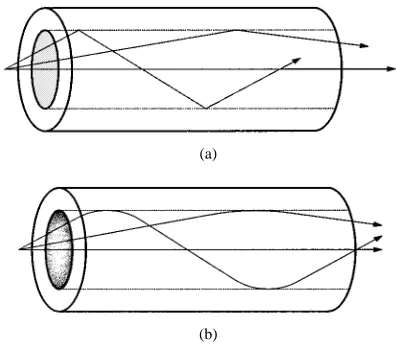
Fig. 1. Intermodal dispersion in multimode fiber (shading represents refractive index profile of the core). (a) Stepped index fiber. (b) Graded index fiber.
(a) (b)
Fig. 2. Impulse responses for: (a) suboptimum case = 1, 3, 4 and 1 (1 km,
1 = 0:01) and (b) optimum case = 2 0 21 (10 km).
(IFFT) [4]. The bandwidth of each of these lower data-rate carriers is less than the coherence bandwidth of the room and is, therefore, less sensitive to channel dispersion since fading on a given subcarrier can be considered flat [5]. Data loss on carriers situated about nulls in the channel’s frequency response can be recovered using forward error correction (FEC) because the data on the other carriers remains intact. Since the subcarriers
[image:2.612.318.539.406.599.2]Fig. 3. Simulated fiber-radio system.
are densely packed in the frequency domain, a further advan-tage of orthogonal frequency-division multiplexing (OFDM) is that it achieves its resilience to multipath fading without sacrificing bandwidth [6].
Remote upconversion, in which the fiber backbone is used for data transmission alone, and the millimeter-wave signals are generated at the picocells is being advocated as a low-cost route to fiber radio [7]. This approach allows the modulation to be per-formed at a central office, thus reducing the size, complexity, and power requirements of the remote hubs [8]. Such an ap-proach may also allow the use of multimode fiber.
Although in many respects the performance of multimode fiber is far inferior to that of single mode, it is cheaper and also allows less stringent connection tolerances. For low data-rate communications, it therefore proves to be the more appropriate choice. However, for broad-band communications ( 30 Mb/s), multimode dispersion can become a serious problem. This dispersion is a result of the different group velocities of the large number of modes that the fiber allows to propagate [see Fig. 1(a)]. Although not totally alleviated, the effect is consid-erably reduced by the use of graded index fiber, which can, to a great extent, equalize these group velocities by varying the refractive index of the fiber as a function of the radial distance from the core center [see Fig. 1(b)].
The resilience of OFDM to multipath fading in the RF channel suggests that it may also be tolerant of the effects of dispersion in multimode fiber, thus permitting the use of easily installed inexpensive fiber-radio picocells. This paper proposes the use of OFDM to combat the effects of multimode fiber dispersion and reports on the feasibility of its use for a variety of refractive index profiles.
II. EVALUATION OFCOFDMFORFIBERRADIO
The multimode fiber was simulated using impulse response models [9]. Fig. 2 shows the impulse responses for a selection of 1 km profile fibers, and also that of the optimum profile, which exists at (shown for 10 km).
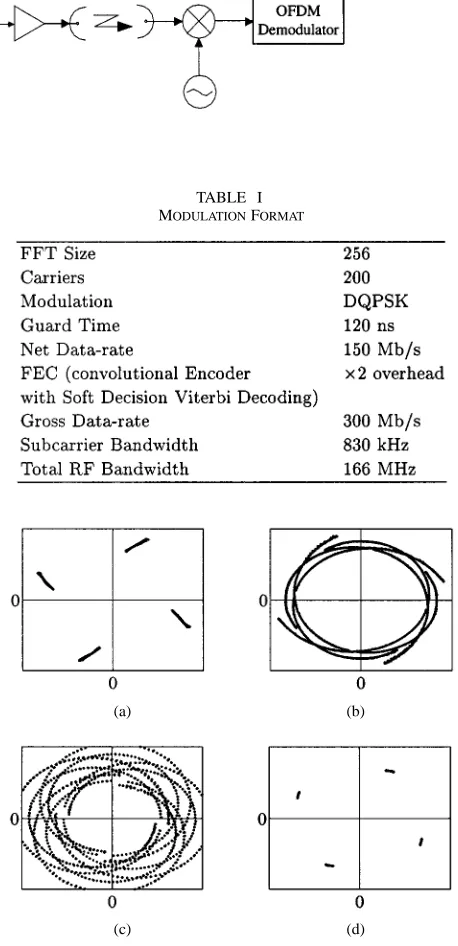
The performance of COFDM over multimode fiber has been evaluated by means of a sophisticated link-budget simulation for a 150-Mb/s 60-GHz remotely upconverted fiber feed pic-ocell. A system level diagram of the fiber-radio simulation is given in Fig. 3, and the OFDM modulation format employed is summarized in Table I. The 60-GHz indoor channel was simu-lated using a realistic finite-impulse-response model [10].
In many cases, the frequency response of the dispersive fiber exhibited significant phase variations within a narrow band-width. The influence of this phase distortion can be seen clearly in Fig. 4. This shows the constellation plots of demodulated OFDM–QPSK symbols after transmission over fibers with
TABLE I MODULATIONFORMAT
(a) (b)
[image:3.612.311.540.73.546.2](c) (d)
Fig. 4. Constellation plots for 1 km of fiber without differential modulation. (a) = 1 km, (b) = 3 km, (c) = 6 km, (d) = 2 0 21 km.
profiles , , and . In all cases, both amplitude and phase distortion is present. However, for systems with , the phase distortion is quite severe and, without some method of phase compensation, these profiles are unsuitable for broad-band OFDM signals. In addition, as increases (i.e., the profile tends toward that of a stepped index), the amplitude and phase distortion increase significantly. This is reflected in the link-budget performance comparisons given below.
(a) (b)
[image:4.612.53.279.59.268.2](c) (d)
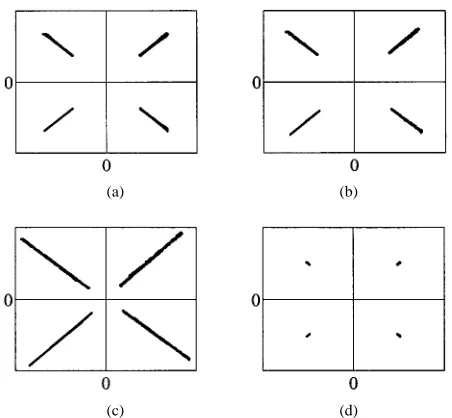
Fig. 5. Constellation plots for 1 km of fiber showing improvement offered by DQPSK. (a) = 1, (b) = 3, (c) = 6, (d) = 2 0 21.
Fig. 6. Comparison of DQPSK constellation plots for 1 and 5 km for fiber where = 3.
Although amplitude distortion is still present, the ability of differential quaternary phase-shift keying (DQPSK) to combat the phase distortion is clearly evident when comparing Figs. 4 and 5. Upon closer inspection of Fig. 5(a) and (b), a residual phase error is found to exist in the corrected constellation. This phase offset results from applying differential encoding between adjacent OFDM carriers where the phase distortion introduced by the fiber cannot be considered constant over such a band-width. This phase error is approximately 1.4 worse for . It is also noteworthy that this residual phase offset worsens with increasing distance for (Fig. 6). The problem could be al-leviated by applying DQPSK between symbols on a given car-rier in the time domain. However, this method assumes that the channel is stationary between OFDM symbols. Although such an assumption holds for fiber, it is not normally valid for the RF channel. This method of differential encoding is also less resilient to the effects of oscillator phase noise, which is a very important consideration in millimeter-wave systems.
TABLE III
EXAMPLERF LINKBUDGET FOR60-GHz INDOOR30-m RADIUSCELL
Although frequency selectivity is overcome by transmitting the data on many narrow-band carriers, consecutive OFDM modulation blocks can still overlap. This is prevented by inserting a time-domain guard region between blocks, the duration of which equals the maximum delay spread of the channel. It is important to note that the dispersion of the fiber increases the effective channel delay spread of a fiber-radio link. Simulations show that significant penalties are incurred if the guard region is not increased accordingly. The added overhead is, however, relatively small in terms of increased signal bandwidth (140 kHz/ns for 150-Mb/s 256-carrier QPSK–COFDM).
Table II shows a typical optical link budget used to evaluate the SNR after optical detection, while Table III shows an ex-ample of the link budget used to evaluate the RF performance. In the case of the optical link budget, a simple low-impedance photo detector front end is assumed; however, increased link length and dynamic range could be achieved by the use of a transimpedance design.
[image:4.612.53.277.315.497.2]Fig. 7. BER dependence on fiber length for = 1.
Fig. 8. BER dependence on fiber length for = 3.
Fig. 9. BER dependence on fiber length for = 6.
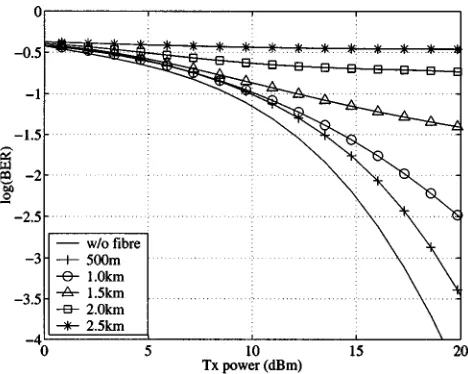
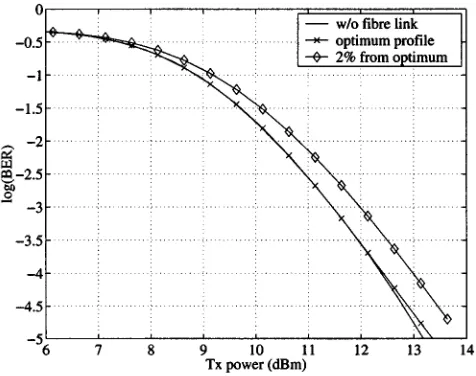
[image:5.612.46.281.277.466.2]The required transmitter power to achieve a given BER for the full fiber-radio link has been simulated for a selection of fibers (Figs. 11–13). For 1 km of fiber, simulations indicate
[image:5.612.307.546.288.472.2]Fig. 10. BER dependence on fiber length for = 2 0 21.
Fig. 11. Link budget evaluation for 700 m of stepped index fiber with 100-Mb/s COFDM.
Fig. 12. Link budget evaluation for = 1, 3, and 6 using 1 km of fiber.
[image:5.612.47.281.499.686.2] [image:5.612.308.544.515.699.2]Fig. 13. Link budget evaluation for = 2021 (optimum), also showing the effect of 2% deviation from optimum.
(Fig. 12). Although showing no indication of an actual BER floor, the required transmit power when using stepped index fiber is somewhat impractical by comparison (Fig. 11). To achieve a practical BER, for the system evaluated here, one is limited to lengths of less than 1 km and data rates of approximately 100 Mb/s. To achieve the results shown in Fig. 11, it was also necessary to use a 512-point IFFT with 400 carriers, as opposed to the 256-point IFFT system used in all other simulations. The comparatively poor performance of this fiber profile is thought to be mainly due to the number of spectral notches that it presents when approaching the limits of the system’s FEC capabilities. Although interleaving in conjunction with soft-decision Viterbi decoding has been used, channel state information could possibly be used to further improve performance. This aside, the data rate achieved for this fiber is still higher than one could expect from many other modulation schemes, and the transmit power may not be impractical at lower frequencies.
For , the delay spread of the fiber channel is ob-viously far less, therefore, its performance has been evaluated for 10 km of fiber. A point of interest is that only slight devi-ations from this optimum index result in significant increases in the delay spread [9]; however, the simulations here indicate that OFDM is very tolerant of such variations. Even a 2% de-viation, which increases the delay spread by a factor of greater than eight ( , ), induces less than a 1-dB link-budget penalty (Fig. 13).
III. CONCLUSION
A comprehensive link-budget simulation has been used to assess the performance of a broad-band 60-GHz fiber-radio system. The resilience of OFDM to frequency-selective effects has been shown to permit the use of inexpensive multimode fiber in such systems. Performance has been evaluated for a va-riety of fiber profiles. The significance of amplitude and phase distortion introduced by the various fibers has been shown by
length have been assessed and, for many situations, OFDM has been shown to be capable of offering a hardware-independent solution to dispersion in multimode fiber for lengths less than 2 km. For long distances ( 10 km), a graded index fiber with the optimum profile of has been shown to perform well, with OFDM being extremely tolerant of variations in the profile that may be caused by fabrication defects. It is believed that these results augur well for the use of multimode fiber feeds for wireless COFDM networks and merit experimental investigation.
REFERENCES
[1] H. Ogawa, D. Polifko, and S. Banba, “Millimeter-wave fiber optics systems for personal radio communication,” IEEE Trans. Microwave
Theory Tech., vol. 40, pp. 2285–2293, Dec. 1992.
[2] S. Noël et al., “Novel techniques for high-capacity 60-GHz fiber-radio transmission systems,” IEEE Trans. Microwave Theory Tech., vol. 45, pp. 1416–1422, Aug. 1997.
[3] R. D. J. Van Nee et al., “New high-rate wireless LAN standards,” IEEE
Commun. Mag., vol. 37, pp. 82–88, Dec. 1999.
[4] S. B. Weinstein and P. M. Ebert, “Data transmission by frequency-di-vision multiplexing using the discrete Fourier transform,” IEEE Trans.
Commun., vol. COM-19, pp. 628–634, Oct. 1971.
[5] G. McGibney et al., “Implementation of a high performance wireless LAN,” in Int. Universal Personal Commun. Conf., Sept. 1994, pp. 645–650.
[6] W. Y. Zou and Y. Wu, “COFDM: An overview,” IEEE Trans. Broadcast., vol. 41, pp. 1–8, Mar. 1995.
[7] S. Iezekiel and N. Bourhill, “Optical control of millimeter-wave p-HEMT’s with applications to fiber radio,” in Int. Topical Microwave
Photon. Meeting, vol. 45, Oxford, U.K., 2000.
[8] P. M. Lane, R. A. Griffin, H. M. Salgado, and J. J. O’Reilly, “System capacity for millimeter-wave radio-over-fiber distribution employing an optically supported PLL,” J. Lightwave Technol., vol. 17, pp. 2480–2487, Dec. 1999.
[9] D. Gloge and E. A. J. Marcatili, “Multimode theory of graded-core fibers,” Bell Syst. Tech. J., pp. 1563–1578, Nov. 1973.
[10] J. Hübner et al., “Simple channel model for 60 GHz indoor wireless LAN design based on complex wideband measurements,” in IEEE 47th
Veh. Technol. Conf., vol. 2, 1997, pp. 1004–1008.
[11] H. Rohling and T. May, “Comparison of PSK and DQPSK modulation in a coded OFDM system,” in IEEE 47th Veh. Technol. Conf., vol. 2, 1997, pp. 870–874.
Bryn J. Dixon (S’99) was born in County Durham,
U.K., in 1974. He received the M.Eng. degree from The University of Leeds, Leeds, U.K., in 1997, and is currently working toward the Ph.D. degree at The University of Leeds.
Roger D. Pollard (M’77–SM’91–F’97) was born in
London, U.K., in 1946. He received the B.Sc. and Ph.D. degrees in electrical and electronic engineering from The University of Leeds, Leeds, U.K.
He currently holds the Agilent Technologies Chair in High Frequency Measurements and is Head of the School of Electronic and Electrical Engineering, The University of Leeds, where he has been a faculty member since 1974. He is an active member of the Institute of Microwaves and Photonics, The Univer-sity of Leeds, which has over 40 active researchers, a strong graduate program, and has made contributions to microwave passive and active device research. Since 1981, he has been a consultant to Agilent Technologies (previously Hewlett-Packard Company), Santa Rosa, CA. He has authored or co-authored over 100 technical papers and holds three patents. He also edits the IEEE Press book series on “RF and Microwave Technology.” His research interests are in microwave network measurements, calibration and error correction, microwave and millimeter-wave circuits, terahertz technology, and large-signal and nonlinear characterization.
Dr. Pollard is a Chartered Engineer in the U.K. He is a Fellow of the In-stitution of Electrical Engineers (IEE), U.K. He is an active IEEE volunteer, as an elected member of the Administrative Committee, the 1998 president of the IEEE Microwave Theory and Techniques Society (IEEE MTT-S), chair of the Products Committee, and member of the IEEE Technical Activities Board. He is an Editorial Board member of the IEEE TRANSACTIONS ONMICROWAVE
THEORY ANDTECHNIQUESand has been on the Technical Program Committee for the IEEE MTT-S International Microwave Symposium since 1986.
Stavros Iezekiel (S’88–M’90–SM’00) was born in
Coventry, U.K., in 1966. He received the B.Eng. and Ph.D degrees from The University of Leeds, Leeds, U.K., in 1987 and 1991, respectively. His doctoral studies concerned the nonlinear dynamics of laser diodes.
From 1991 to 1993, he worked in conjunction with the M/A-COM Corporate Research and Devel-opment Center on the develDevel-opment of microwave photonic multichip modules. Since 1993, he has been a Lecturer of high-frequency analog electronics at The University of Leeds, where he leads the research activity in microwave photonics.