JVTWSL[LN\PKL
to
CISM
®Assessing and Managing Security Risk in IT Systems: A Structured Methodology
John McCumber ISBN: 0-8493-2232-4
Audit and Trace Log Management: Consolidation and Analysis
Phillip Q Maier ISBN: 0-8493-2725-3
Building and Implementing Security Certification and Accreditation Program
Patrick D Howard ISBN: 0-8493-2062-3
The CISO Handbook: A Practical Guide to Securing Your Company
Michael Gentile; Ronald D Collette; Thomas D August ISBN: 0-8493-1952-8
The Complete Guide for CPP Examination Preparation James P Muuss; David Rabern
ISBN: 0-8493-2896-9
Curing the Patch Management Headache Felicia M Nicastro
ISBN: 0-8493-2854-3
Cyber Crime Investigator's Field Guide, Second Edition
Bruce Middleton ISBN: 0-8493-2768-7
Database and Applications Security: Integrating Information Security and Data Management Bhavani Thuraisingham
ISBN: 0-8493-2224-3
The Ethical Hack: A Framework for Business Value Penetration Testing
James S Tiller ISBN: 0-8493-1609-X
Guide to Optimal Operational Risk and Basel II Ioannis S Akkizidis; Vivianne Bouchereau ISBN: 0-8493-3813-1
The Hacker's Handbook: The Strategy Behind Breaking into and Defending Networks Susan Young; Dave Aitel
ISBN: 0-8493-0888-7
The HIPAA Program Reference Handbook Ross Leo
ISBN: 0-8493-2211-1
Information Security Architecture: An Integrated Approach to Security in the Organization,
Second Edition Jan Killmeyer Tudor ISBN: 0-8493-1549-2
Information Security Fundamentals
Thomas R Peltier; Justin Peltier; John A Blackley ISBN: 0-8493-1957-9
Information Security Management Handbook, Sixth Edition
Harold F Tipton; Micki Krause ISBN: 0-8493-7495-2
Practical Hacking Techniques and Countermeasures Mark D. Spivey
ISBN: 0-8493-7057-4
Information Security Policies and Procedures: A Practitioner's Reference, Second Edition Thomas R Peltier
ISBN: 0-8493-1958-7
Information Security Risk Analysis, Second Edition Thomas R Peltier
ISBN: 0-8493-3346-6
Information Technology Control and Audit, Second Edition
Frederick Gallegos; Daniel P Manson; Sandra Senft; Carol Gonzales ISBN: 0-8493-2032-1
Intelligence Support Systems: Technologies for Lawful Intercepts
Kornel Terplan; Paul Hoffmann ISBN: 0-8493-2855-1
Managing an Information Security and Privacy Awareness and Training Program
Rebecca Herold ISBN: 0-8493-2963-9
Network Security Technologies, Second Edition Kwok T Fung
ISBN: 0-8493-3027-0
The Practical Guide to HIPAA Privacy and Security Compliance
Kevin Beaver; Rebecca Herold ISBN: 0-8493-1953-6
A Practical Guide to Security Assessments Sudhanshu Kairab
ISBN: 0-8493-1706-1
The Security Risk Assessment Handbook: A Complete Guide for Performing Security Risk Assessments
Douglas J Landoll ISBN: 0-8493-2998-1
Strategic Information Security John Wylder
ISBN: 0-8493-2041-0
Surviving Security: How to Integrate People, Process, and Technology, Second Edition
Amanda Andress ISBN: 0-8493-2042-9
Wireless Security Handbook Aaron E Earle
ISBN: 0-8493-3378-4
AUERBACH PUBLICATIONS
www.auerbach-publications.comTo Order Call: 1-800-272-7737 • Fax: 1-800-374-3401 E-mail: [email protected]
[OVTHZYWLS[PLY
Q\Z[PUWLS[PLY
Boca Raton New York
Auerbach Publications Taylor & Francis Group
6000 Broken Sound Parkway NW, Suite 300 Boca Raton, FL 33487-2742
© 2007 by Taylor & Francis Group, LLC
Auerbach is an imprint of Taylor & Francis Group, an Informa business
No claim to original U.S. Government works
Printed in the United States of America on acid-free paper 10 9 8 7 6 5 4 3 2 1
International Standard Book Number-10: 0-8493-5356-4 (Hardcover) International Standard Book Number-13: 978-0-8493-5356-7 (Hardcover)
This book contains information obtained from authentic and highly regarded sources. Reprinted material is quoted with permission, and sources are indicated. A wide variety of references are listed. Reasonable efforts have been made to publish reliable data and information, but the author and the publisher cannot assume responsibility for the validity of all materials or for the conse-quences of their use.
No part of this book may be reprinted, reproduced, transmitted, or utilized in any form by any electronic, mechanical, or other means, now known or hereafter invented, including photocopying, microfilming, and recording, or in any information storage or retrieval system, without written permission from the publishers.
For permission to photocopy or use material electronically from this work, please access www. copyright.com (http://www.copyright.com/) or contact the Copyright Clearance Center, Inc. (CCC) 222 Rosewood Drive, Danvers, MA 01923, 978-750-8400. CCC is a not-for-profit organization that provides licenses and registration for a variety of users. For organizations that have been granted a photocopy license by the CCC, a separate system of payment has been arranged.
Trademark Notice: Product or corporate names may be trademarks or registered trademarks, and are used only for identification and explanation without intent to infringe.
Library of Congress Cataloging-in-Publication Data
Peltier, Thomas R.
Complete guide to CISM certification / Thomas R. Peltier, Justin Peltier. p. cm.
Includes bibliographical references and index. ISBN 0-8493-5356-4 (alk. paper)
1. Electronic data processing personnel--Certification. 2. Computer security--Management--Examinations--Study guides. I. Peltier, Justin, II. Title.
QA76.3.P43 2006
005.8068--dc22 2006049913
Visit the Taylor & Francis Web site at http://www.taylorandfrancis.com
and the Auerbach Web site at
v
Contents
Preface ...xv
About the Authors ... xvii
1
Information Security Governance ...1Functional Area Overview... 1
CISM® Mapping ... 2
Introduction ... 2
Developing an Information Security Strategy in Support of Business Strategy and Direction ... 4
Obtain Senior Management Commitment and Support... 12
Definitions of Roles and Responsibilities... 14
Obtaining Senior Management Commitment... 15
Change in Focus ... 16
Responsibilities and Functional Roles ... 17
Where Not to Report ... 17
Recommendation... 19
Establish Reporting Communications That Support Information Security Governance Activities... 19
Mission Statement... 23
Legal and Regulatory Issues... 24
Establish and Maintain Information Security Policies ... 32
Global Policy (Tier 1)... 33
Topic ... 34
Scope... 34
Responsibilities ... 35
Compliance or Consequences... 35
Topic-Specific Policy (Tier 2)... 35
Thesis Statement... 36
Relevance ... 36
vi
Compliance ... 37
Supplementary Information ... 37
Application-Specific Policy (Tier 3) ... 38
Key Security Concepts ... 39
Ensure the Development of Procedures and Guidelines That Support the Information Security Policy... 39
Develop Business Case and Enterprise Value Analysis Support ... 41
Summary ... 45
What Was Covered in This Chapter ... 45
Questions ... 45
2
Information Security Risk Management ...53Functional Area Overview... 53
CISM Mapping ... 54
Introduction ... 54
Develop a Systematic and Continuous Risk Management Process ... 58
Ensure Risk Identification, Analysis, and Mitigation Activities Are Integrated Into the Life Cycle Process... 60
Apply Risk Identification and Analysis Methods... 66
Step 1: Asset Definition ... 67
Step 2: Threat Identification... 69
Step 3: Determine Probability of Occurrence ... 72
Step 4: Determine the Impact of the Threat ... 72
Step 5: Controls Recommended ... 74
Step 6: Documentation ... 75
Cost-Benefit Analysis... 75
Define Strategies and Prioritize Options to Mitigate Risks to Levels Acceptable to the Enterprise ... 87
Step 1: Threat Identification... 91
Step 2: Threat Vulnerability... 93
Step 3: Controls and Safeguards... 98
Step 4: Cost-Benefit Analysis ... 101
Step 5: Documentation ... 114
Quantitative Versus Qualitative Risk Assessment ... 118
Report Significant Changes in Risk ... 121
Knowledge Statements ... 122
Gap Analysis... 122
Recovery Time Objectives ... 123
Data (Information) Classification ... 123
Summary ... 125
What Was Covered in This Chapter ... 125
Questions ... 126
3
Information Security Program Management...133Functional Area Overview... 133
vii
Introduction ... 134
The OSI Model... 134
Layer 1: Physical ... 135
Layer 2: Data Link... 135
Layer 3: Network... 136
Layer 4: Transport ... 138
Layer 5: Session... 139
Layer 6: Presentation ... 139
Layer 7: Application... 139
The TCP/IP Model ... 141
IP Addressing ... 142
Protocols ... 146
Internet Protocol (IP) Details ... 147
Internet Protocol (IP) Network and Host ... 147
Subnet Masks and Internet Protocol (IP) Classes ... 148
Class A Networks ... 148
Class B Networks ... 148
Class C Networks ... 148
Beyond Class C Networks ... 149
IP Address Availability and Internet Protocol (IP) Version 6... 149
IP Hosts... 150
Private Internet Protocol (IP) Networks... 152
Network Address Translation (NAT)... 152
The Internet Protocol (IP) Header ... 153
Datagram Structure ... 156
Transmission Control Protocol (TCP)... 159
TCP Ports ... 159
Well-Known Ports... 160
Registered Ports ... 160
Dynamic Ports ... 160
Port Scanning... 163
The TCP Header ... 163
The TCP Three-Way Handshake... 166
The First Shake: The SYN Packet... 166
The Second Shake: The SYN/ACK Packet... 168
The Third Shake: The ACK Packet ... 168
After the Shaking ... 169
TCP Summary ... 169
User Datagram Protocol (UDP) ... 170
UDP Error Messages ... 172
Internet Control Message Protocol (ICMP) ... 172
ICMP Header ... 173
ICMP Packet Structure ... 173
ICMP Common Examples... 176
Risks and Vulnerabilities Associated with IP Protocols ... 178
Common Threats ... 178
viii
PPPN ... 184
Process ... 184
Physical ... 184
Platform... 185
Network ... 186
Threats ... 186
Malicious Hackers ... 186
Attacking Methodology... 187
Malicious Code ... 189
Virus ... 189
Worms ... 189
Trojan Horses ... 190
Logic Bomb ... 190
Denial-of-Service Attacks ... 190
Distributed Denial-of-Service Attacks ... 191
Social Engineering... 191
Attacks Against Access Control Systems ... 193
Man-in-the-Middle (MITM) ... 193
Threats Summary... 194
Controls... 194
Access Control... 195
Mandatory Access Control ... 195
Discretionary Access Control... 196
Lattice-Based Access Control... 197
Rule-Based Access Control... 198
Role-Based Access Control... 198
Access Control Lists ... 198
Single Sign-On... 201
Script-Based Single Sign-On ... 201
Host-Based Single Sign-On... 201
Access Control Methods ... 202
One-Time Passwords ... 202
Password Selection... 203
Access Control Goals ... 203
Two-Factor Authentication ... 203
RADIUS ... 204
802.1x ... 204
The Role of RADIUS in 802.1x ... 205
TACACS ... 205
Access Control Zone of Control ... 206
Firewalls ... 206
Types of Firewalls... 206
Caching ... 214
Proxy Firewall Recap ... 214
Network Segmentation/Subdomain Isolation... 215
Virtual Local Area Networks (VLANs) ... 215
ix
Subnetting for Isolation ... 216
Routing for Isolation ... 218
Firewall for Isolation... 218
Intrusion Detection Systems... 218
Types of Intrusions ... 219
Network- Versus Host-Based Intrusion Detection Systems ... 219
IDS Information Processing... 220
IDS Versus IPS ... 222
Cryptography ... 222
Goals of Cryptography ... 224
Nonrepudiation... 224
Cryptographic Definitions... 225
Kerckhoff’s Principle ... 226
Private or Secret Key Cryptography ... 227
The Advanced Encryption Standard ... 230
Public Key Cryptography ... 231
Stream Ciphers ... 233
Block Ciphers ... 235
The Initialization Vector... 235
Methods of Attack... 237
One-Way Functions... 238
Digital Signatures ... 239
Classic Cryptographic Systems ... 240
Substitution Ciphers ... 240
Transposition Ciphers ... 241
Poly-Alphabetic Cipher ... 242
Running Key Cipher ... 242
Concealment ... 243
Steganography ... 243
Codes... 244
Encryption Machines... 244
Secure Sockets Layer (SSL) ... 245
Message Authentication Codes... 248
Public Key Infrastructure ... 248
Certificate Authority (CA) ... 249
Registration Authority (RA)... 249
Certificate Repository ... 249
Certificate Revocation System ... 249
IPSEC ... 249
Project Management for Information Security Managers... 250
Baselines ... 251
Wireless ... 252
How It Works ... 253
The Alphabet Soup ... 254
Securing Wireless—The Early Days... 254
RC4 and the One-Time Pad ... 255
x
Weakness: Key Management and Key Size ... 257
Help! My IV Is Too Small ... 258
The ICV and Its Weakness ... 258
RC4 ... 259
The Problems With Message Authentication ... 259
Another Standard 802.1x ... 260
The 802.1x Function ... 261
The Relationship between EAP and 802.1x ... 261
More on 802.1x ... 263
802.1x Doesn’t Work Alone ... 266
802.1x – Making Wireless Better ... 266
802.1x’s Partner TKIP... 266
Back to the Alphabet Soup One Last Time—802.11i ... 268
Wireless Summary ... 268
Buffer Overflows versus Application Security... 269
Virtual Private Networks (VPNs) ... 270
Web Server Security versus Internet Security ... 270
Security Testing ... 271
Vulnerability Assessment ... 272
Vulnerability Assessment... 272
Penetration Testing... 273
Risk Assessment ... 273
Hybrid Approach to Security Testing ... 273
Summary ... 273
What Was Covered in This Chapter ... 274
Questions ... 275
4
Information Security Management...293Functional Area Overview... 293
CISM Mapping ... 295
Introduction ... 295
Information Systems Compliance ... 297
Administrative Procedures ... 298
Ensure Services Outsourced Are Consistent ... 305
Measure, Monitor, and Report Effectiveness and Efficiency of the Controls and Compliance Policies ... 307
Ensure That Information Security Is Not Compromised Throughout the Change Management Process... 309
Perform Vulnerability Assessments to Evaluate Effectiveness of Existing Controls ... 311
Ensure That Noncompliance Issues and Other Variances Are Resolved in a Timely Manner... 318
Information Security Awareness and Education... 322
Introduction ... 322
Key Security Requirements... 323
xi
Program Goals... 326
Segmenting the Audience... 328
Current Level of Computer Usage ... 328
What Does the Audience Really Want to Learn? ... 328
Determine How Receptive the Audience Is ... 329
Seek Out Ways to Gain Acceptance ... 329
Possible Allies... 330
Program Development... 331
Methods to Convey the Message... 332
Presentation Keys... 334
Presentation Format ... 336
Effective Communication ... 336
When to Do Awareness ... 338
Presentation Styles ... 339
Senior Management... 339
Managers ... 340
Line Supervisors and Employees ... 340
The Message ... 340
Summary ... 341
What Was Covered in This Chapter ... 341
Questions ... 342
5
Response Management ...351Functional Area Overview... 351
CISM Mapping... 351
Introduction ... 352
Threat Source Information ... 352
The Role of Intrusion Detection and Anti-Virus Systems... 354
IDS Properties... 354
Business Continuity Planning and Disaster Recovery Planning ... 355
The Planning ... 356
Business Continuity Planning and Disaster Recovery Planning... 356
BCP Resources... 358
Stages of BCP ... 358
Reasons for BCP... 358
BCP Responsibilities... 360
Types of Plans... 360
Business Continuity Plan (BCP)... 360
Business Recovery Plan (BRP), also Business Resumption Plan ... 361
Continuity of Operations Plan (COOP) ... 362
Continuity of Support Plan/IT Contingency Plan/Network Contingency Plan ... 362
Crisis Communications Plan ... 362
Cyber Incident Response Plan ... 363
Disaster Recovery Plan (DRP)... 363
xii
Business Impact Analysis (BIA) ... 363
Performing a BIA ... 365
Business Impact Analysis Results... 368
Reasons for BIA ... 368
Finding Resources and Dependencies ... 369
Alternate Sites... 370
Cold Sites ... 372
Warm Sites ... 372
Hot Sites... 372
Mobile Sites ... 372
Mirrored Sites... 373
Reciprocal Agreements ... 373
Implementation and Writing ... 374
Team Training... 374
Testing the Plan ... 375
Exercising and Testing the BCP/DRP ... 375
Improve the Plan ... 376
Updating the Plan ... 377
Three Phases of BCP ... 377
Incident Response... 379
Discovery ... 380
Notification... 380
Preliminary Investigation ... 382
Goals of the Investigation ... 382
Disclosure ... 383
Conducting Surveillance ... 383
Electronic Surveillance ... 384
Physical Surveillance... 384
Running the Investigation ... 386
Factors of Investigation ... 387
Most Likely Suspects—Insiders, Outsiders, and Collaboration ... 388
Suspects/Witnesses/Interview... 389
Freezing the Environment ... 390
Team Members ... 390
Post-Incident Access ... 391
Seizing the System ... 391
Forensic Processes ... 393
Inventory Internal Devices ... 395
Forensic Processing—Imaging ... 396
Live System Variation... 400
Forensic Processing—Imaging ... 401
Forensic Reporting ... 403
Criminal and Civil Courts ... 403
Types of Evidence ... 403
Exclusionary Rule ... 404
Evidence Life Cycle... 404
xiii
Incident Response Training... 405
Difficulties with Following the Plan... 406
Containment... 407
Government Facilities to Assist in Planning for a Disaster ... 408
Escalation Procedures and Notification... 408
Help Desk Training... 408
Summary ... 409
What Was Covered in This Chapter ... 409
Questions ... 410
xv
Preface
The Certified Information Security Manager® (CISM®) certification
pro-gram was developed by the Information Systems Audit and Controls
Association (ISACA®). It has been designed specifically for experienced
information security managers and those who have information
secu-rity management responsibilities. The CISM® certification is for the
person who manages, designs, oversees, or assesses an organization’s
information security program. The CISM® certification references
inter-national practices such as ISO guidelines, NIST guidelines, and others. Certification has provided a positive effect on many careers as well as providing many benefits for employers. The Certified Information Security Manager is designed to provide executive management with assurance that those earning the designation have the required knowl-edge and ability to provide effective security management and consult-ing. The certification process examines the qualifi cations for the candidate in five functional areas (security governance, risk manage-ment, information security program managemanage-ment, information security management, and response management).
The CISM is not an entry-level certification, it is specifically devel-oped for the infor mation security professional who has acquir ed proven experience working on the “front lines.” Information security individuals with five years or more experience managing the informa-tion security funcinforma-tion of an enterprise or performing such duties will find the CISM most tailored to their knowledge and skills.
xvi
have included a workbook to allow the reader to go back over the materials to reinforce the concepts presented. After the workbook, the reader is presented with a thirty-question final exam.
xvii
About the Authors
Thomas R. Peltier is in his fifth decade in the field of computer tech-nology. During this time he has shared his experiences with fellow professionals and because of this work he has been awarded the 1993 Computer Security Institute’s (CSI) Lifetime Achievement Award. In 1999
the Information Systems Security Association (ISSA®) bestowed its
Indi-vidual Contribution to the Profession Award on him and in 2001 he was
inducted into the ISSA® Hall of Fame. Tom was also awarded the CSI
Lifetime Emeritus Membership Award. Currently he is the president of Thomas R. Peltier Associates, LLC, which is an information security training firm. Prior to this he was director of policies and administration for the Netigy Corporation’s Global Security Practice. Tom was the national direc-tor for consulting services for CyberSafe Corporation, and the corporate information protection coordinator for Detroit Edison. The security program at Detroit Edison was recognized for excellence in the field of computer and information security by winning the Computer Security Institute’s Infor-mation Security Program of the Year for 1996. Previously Tom was the information security specialist for General Motors Corporation responsible for implementing an information security program for GM’s worldwide activities.
Over the past decade, he has averaged five published articles a year on various computer and information security issues, including developing policies and procedures, disaster recovery planning, copyright compliance,
virus management, and security controls. He has had published: Policies,
Standards, Guidelines and Procedures, Editions 1 and 2;Information Secu-rity Risk Analysis, Editions, 1 and 2; Information System Security Policies and Procedures: A Practitioners’ Reference; The Complete Manual of Policies and Procedures for Data Security; How to Manage a Network Vulnerability Assessment; and Information Security Fundamentals, and is the co-editor
xviii
a contributing author for the Computer Security Handbook, Third and Fifth
Editions and Data Security Management.
Tom has been the technical advisor on a number of security films from Commonwealth Films. He is the past chairman of the Computer Security Institute Advisory Council, the chairman of the 18th Annual CSI Conference, founder and past president of the Southeast Michigan Computer Security Special Interest Group, and a former member of
the board of directors for (ISC)2®, the security professional certification
organization. He has conducted numerous seminars and workshops on various security topics and has led seminars for CSI, Crisis Manage-ment, American Institute of Banking, the American Institute of Certified
Public Accountants, Institute of Internal Auditors (ISACA®), and Sungard
Planning Solutions. He was also an instructor at the graduate level for Eastern Michigan University. He is currently an adjunct professor in the information assurance master’s degree program at Norwich University.
Justin Peltier is a senior security consultant with Peltier Associates with over eleven years of experience in information security technol-ogies. As a consultant, Justin has been involved in implementing, sup-porting, and developing security solutions, and has taught courses on many facets including vulnerability assessment and CISSP preparation. Formerly with Suntel Services, Justin directed its security practice devel-opment. Prior to that he was with Netigy where he was involved with the corporate training effort. Justin has led classes for MIS, Netigy, Suntel Services, and Sherwood Associates. Justin currently holds ten certifications in an array of technical products.
Justin has led classes across the United States as well as in Europe and Asia, for Peltier Associates, Sherwood Associates, Computer
Secu-rity Institute, (ISC)2, Mark I. Sobell Training Institute, Netigy Corporation,
and Suntel Services. Justin has developed or led the following courses:
Introduction to Windows NT Security
Intermediate Windows NT Security
Advanced Windows NT Security
Installation and Configuration of Red Hat Linux
Business Benefits of Virtual Private Networks
Developing Policies and Procedures
Risk Assessment Processes
Conducting a Penetration Test
Introduction to CheckPoint Firewall-1™ Administration
Advanced CheckPoint Firewall-1™ Administration
Conducting a Vulnerability Assessment
xix
Hands-On Wireless
Hands-On Hacking
Justin has written books on many dif ferent subjects related to computer security. His works include two books that ar e privately owned on Intermediate Windows NT Security and Advanced Windows
NT Security. He is co-author of the book How to Manage a Network
Vulnerability Assessment. He is also a contributing author of the fi rst
edition of The Total CISSP Exam Prep Book: Practice Questions, Answers,
and Test Taking Tips and Techniques and editor of the second edition
of the same book. In 2003, Justin co-author ed Information Security
Fundamentals, a set of new sample questions for CISSP and CISM exam
preparation. In 2007, Justin is slated to write Security Testing: Practices,
1
Chapter 1
Information Security
Governance
Functional Area Overview
The objective of this job practice area is to focus on the need for a stable security governance program to be in place so all security strategies and processes can be planned, designed, implemented, and maintained. Only with a stable information security governance in place can an organization begin to address the threats to their survivability and profitability. This
functional area comprises 21 percent of the CISM® examination and consists
of approximately 42 questions.
Security governance is supported by such documents as
Organization for Economic Co-operation and Development (OECD)
Institute of Chartered Accountants in England
ISO/IEC 17799 (ISO 27002)
British Standard 77 99 (ISO 27001)
Information Systems Audit and Contr ol (ISACA®), Control
Objectives for Information Technology (CobiT®)
National Institute of Standards and Technology (NIST) Special
Publication (SP) 800–55, 800-26, and 800-12
2 Complete Guide to CISM Certification
shareholders, and other stakeholders. Corporate governance also pro-vides the structure through which the objectives of the organization are set and the means of attaining those objectives are met, and the ability to monitor performance levels is determined.
In this chapter you will learn about the information security gov-ernance tasks:
1. Develop the information security strategy in support of the business strategy and direction.
2. How to obtain senior management commitment and support for information security throughout the organization.
3. Definitions of roles and responsibilities throughout the organi-zation including information security governance.
4. Establish reporting and communication channels that support information security governance activities.
5. Identify current and potential legal and regulatory issues affecting information security and assess their impact on the organization. 6. Establish and maintain information security policies that
sup-port business goals and objectives.
7. Ensure the development of procedures and guidelines that sup-port information security policies.
8. Develop a business case which provides an organization value analyses that support information security investments.
CISM
®Mapping
When the information security program management functional area is
mapped over to ISO 17799 and the domains from the CISSP® common body
of knowledge, it shows just how many different areas of knowledge from which we are going to be drawing information. Information security program management is so large that it basically encompasses everything in telecom-munication and network security, everything in security architecture, every-thing in cryptography, and everyevery-thing in access control systems and methodologies. It is a very, very large functional area (see Table 1.1).
Introduction
Information Security Governance 3
The foundation of a successful information security program begins with strong upper-level management support. This support establishes a focus on security within the highest levels of the organization. Without a solid foundation (i.e., proactive support of those persons in positions that control IT resources), the effectiveness of the security program can fail when pressured by politics and budget limitations.
Any information security program must get its direction from exec-utive management (see Figure 1.1). The requirements of today’s laws and regulations have identified either the organization’s board of direc-tors or an executive management steering committee as r esponsible for instituting an effective program.
Table 1.1 Mapping CISM Governance to ISO 17799 and CISSP ® Domains
Information Security Program Management
ISO 17799 Section CISSP® Domain
4. Information Security Policy 3. Security Management 5. Information Security Organization 9. Law, Investigation and Ethics 9. Communications and Operations
Management
Figure 1.1 Security management hierarchy.
Applications Networks Systems Desktop Operations Management
Board
Information Security Steering Committee
Sub-Committees
Architecture, Security
Service Delivery &
Functional Operation Management Teams
Strategy
4 Complete Guide to CISM Certification
The responsibilities for each group of management and employees must be established (see Table 1.2). Typically the roles and responsibilities are established in a mission statement, which we examine later. The require-ments might resemble something like that shown in Table 1.3
The second component of an effective security program is practical security policies and procedures backed by the authority necessary to enforce compliance. Practical security policies and pr ocedures are defined as those that are attainable and provide meaningful security through appropriate controls. The ability to determine the effectiveness of the security program is not easily obtainable if there are no proce-dures in place.
The third component of developing and establishing an effective security program is the ability to capture and provide meaningful information on program effectiveness. To provide meaningful data, quantifiable security metrics must be based on IT security performance goals and objectives, and be easily obtainable and feasible to measure. They must also be repeatable, provide relevant performance trends over time, and be useful for tracking performance and directing resources.
Finally, the security program itself must emphasize consistent peri-odic analysis of the program. The results of this analysis are used to apply lessons learned, improve the effectiveness of existing security controls, and plan future controls to meet new security requirements as they occur. Accurate data collection must be a priority with stake-holders and users if the collected data is to be meaningful to the management and improvement of the overall security program.
The success of an information security program implementation should be judged by the degree to which meaningful results are produced. A comprehensive security analysis program (see Table 1.4) should provide substantive justification for decisions that directly affect the security posture of an organization. These decisions include budget and personnel requests, and allocation of available resources. A security program should provide a precise basis for preparation of required security performance-related reports.
Developing an Information Security Strategy in
Support of Business Strategy and Direction
Information Security Governance 5
Table 1.2
Senior Management Requir
ements
ISO 17799 Sec
tion
C
ont
rol
R
equirement
HIP
AA
GLB
A
Sarbanes- Oxle
y
Organizational Security (4.1)
Manag
ement
Inf
ormation
Security Forum Risk Manag
ement
(Required) Sanction P
olic
y
(Required) Priv
ac
y Of
ficer
(Required)
Inv
olv
e the
Board of Directors Assign Specifi
c
Responsibilities
Corporation manag
ement is
responsible f
or
6 Complete Guide to CISM Certification
All security decisions must be linked to the organization’s business objectives or mission statement. As with other organizationwide poli-cies, the information security program must be established by the implementation of a Global or Tier 1 policy. This type of policy is organizationwide and requires that all areas of the organization comply with the policy. We discuss policies in more detail later in this chapter.
Table 1.3 Governance Roles and Responsibilities
Information Security Roles and Responsibilities
Governance Body Membership Responsibilities
Information Security Steering Committee
CEO, CFO, COO, CTO
VP Business Units Chaired by CISO
Establishes and supports security program
Senior Management C-level, Senior VPs and Unit VPs
Provides management, operational, and technical controls to satisfy security requirements
Chief Information Security Officer (CISO)
CISO & staff Directs and coordinates implementation of information security program
Business Unit Managers
Department heads and Supervision
Classifies and establishes requirements for
safeguarding information assets
Table 1.4 Security Program Infrastructure
Maturity
Level Description
Level 1 Control objectives have been documented in a policy
Level 2 Security control processes have been documented in procedures Level 3 Supporting procedures have been implemented (stakeholders
have been made aware and trained)
Level 4 Policies, procedures and controls are tested and reviewed to ensure continued adequacy
Information Security Governance 7
To be successful, the security and privacy policies and procedures must have three key elements. They must be:
Documented
Communicated
Current
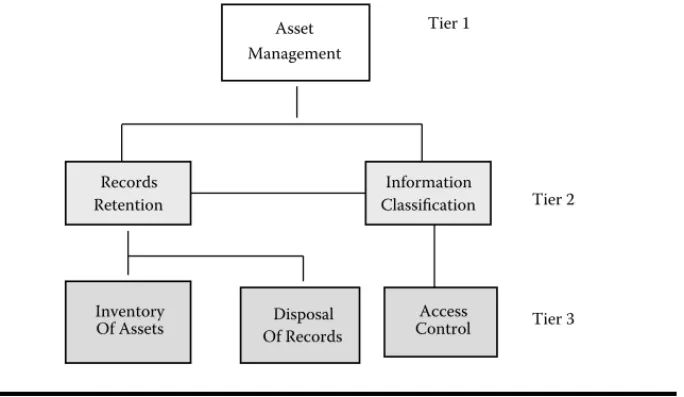
To supplement an information security policy, the organization must offer awareness programs, user training, and support education. In the hierarchy of documentation we might see a structure such as that shown in Figure 1.2
We go into more detail later in this chapter on policies and sup-porting documents.
When establishing an information security strategy, the goal of what must be accomplished must be pr esent in all that we cr eate and implement. Information security’s goal is not to stop all access to all information but to provide a safe and secure process for all authorized personnel to gain access. The information strategy must, therefore, address three key concepts:
Identification
Authentication
Authorization
To gain access to information and the processing systems everyone needing access must be assigned a unique, individual access code. Figure 1.2 Policy and procedure architecture.
Asset Management
Records Retention
Inventory
Of Assets Of RecordsDisposal
Access Control Tier 1
Tier 2
Tier 3 Information
8 Complete Guide to CISM Certification
Typically this access code is called a userID or an account. There must be procedures in place to provide the information necessary and the approvals required to grant an individual a unique userID.
Once a userID has been established, it will be necessary to authenticate the individual to the system or application they need to access the infor-mation. This process is termed authentication and is the process of iden-tifying an individual, usually based on a username and password. A userID and password is termed one-factor authentication. The userID can be teamed up with a token card (such as a SecureID card that changes the password every 60 seconds) or with a biometric (a fingerprint or voice-print). Many secure systems require two-factor authentication. This means teaming the userID up with a password and one or more of the other methods.
So we have identification, authentication, and the last element is authorization. So once I have identified who I am and authenticated who I am, then I am authorized. I will be authorized to access those things I need to in order to perform my job. There are two key elements
regarding authorization and those are need to know and least privilege.
In authentication it is necessary to establish the parameters that verify individuals are who they present themselves to be. Once authenticated, the individual must be authorized to access the resources of the orga-nization. To accomplish that, the individual must present a business need for access. Once business need has been established, the individ-ual is granted only that level of access necessary to perform that specific job function. This process is termed least privilege.
Access can be granted either to an individual or based on the function the individual is performing for the business. You can have individual authorization or you can have group authorization. When somebody comes into a group it signals group authorizations and when they leave they’re relieved from the group and those authorizations are taken away. This is a concept known as least privilege. With need to know, you have to have a business need to have access to whatever you’re looking at.
Information Security Governance 9
post-development life cycle. Security strategy must become part of the business and System Development Life Cycle (SDLC). I prefer business process life cycle because the things that we implement in this controlled environment are such that it’s not just for information technology; it is for the entire organization. It’s a business process because all of those things that we have to do in developing systems and applications are to be done whenever we have a project or business process that is to be developed. So it maps across the entire thing, information by the way is not the IT purview. Information is a corporate activity and corporate function and (here is where we get to the theory part) should not be part of IT.
An effective information security strategy requires four types of controls: preventive, detective, containment, and recovery. Dr. Peter Stephenson has altered these elements to currently address assurance, avoidance, detection, and recovery. Our strategy is to prevent as much as possible; then we want to able to detect when we have problems, to contain the problem, and we want to have the ability to recover from it. Business continuity planning is part of our overall organization process as an example so you understand what business continuity planning is.
Business Continuity Planning, BCP, is a corporate requirement. As you can see later on it is one of the 12 corporate policies. It’s not an IT function and it’s not run by IT; typically it’s run by facilities man-agement, risk manman-agement, or physical security. The business unit’s BCP must be integrated with the IT Disaster Recovery Plan (DRP) and the organizationwide BCP. Typically we should see each business unit have a line item budget for their BCP and a line item in their budget for their portion of the data center disaster recovery plan.
So the difference between business continuity planning and disaster recovery planning is that all departments within organizations have to do business continuity planning. The IT recovery processing portion is called disaster recovery planning. So in key terms (see Table 1.5) that you should know is to go through and to prepare for the exam on business continuity planning.*
We used to call it business resumption or recovery planning but it’s fallen out of favor because that means that you’ve had an interruption and you couldn’t back up when we were selling things. Continuity of operations plans provides procedures and capabilities to sustain the organization’s central strategic functions at an alternate site. In order for us to do this we must perform this business in-dropped analysis. This tells us what our most critical systems applications and business processes are and when we get into that we’ll talk more about it as we go online but that’s talking about
10 Complete Guide to CISM Certification
bringing up your most critical business processes, systems, and applications at a recovery site. Continuity of operations plans provide procedural capa-bilities to assist updates.
Table 1.5 Contingency Plan Definitions
Plan Purpose Scope
Business
Continuity Plan (BCP)
Provide procedures for sustaining essential business operations while recovering from a significant disruption
Addresses business processes; IT addressed based only on its support for business process
Business Recovery (Resumption) Plan (BRP)
Provide procedures for recovering business operations immediately following a disaster
Addresses business
processes; not IT-focused; IT addressed based only on its support for business process
Continuity of Operations Plan (COOP)
Provide procedures and capabilities to sustain an organization’s essential, strategic functions at an alternate site for up to 30 days
Addresses the subset of an organization’s missions that are deemed most critical; usually written at
headquarters level; not IT-focused
Crisis
Communications Plan (CCP)
Provide procedures for disseminating status reports to personnel and the public
Addresses communications with personnel and the public; not IT-focused
Cyber Incident Response Plan (CIRP)
Provide strategies to detect, respond to, and limit consequences of malicious cyber incident
Focuses on information security responses to incidents affecting systems and/or networks
Disaster Recovery Plan (DRP)
Provide detailed
procedures to facilitate recovery of capabilities at an alternate site
Often IT-focused; limited to major disruptions with long-term effects Emergency Response Plan (ERP) Provide coordinated procedures for
minimizing loss of life or injury and protecting property damage in response to a physical threat
Information Security Governance 11
The crisis communications plan includes senior management, legal, human resources, public relations, and the recovery planning coordinator. Talking about a group that’s aptly named, crisis management, this group is responsible for activating and overseeing the recovery processes.
The cyber incident response plans include the normal day-to-day activities and when they have a need for recovery you need to have procedures in place to do them in a structured and formatted manner and not ad hoc.
The data center disaster recovery plan is for the information pro-cessing environment and the emergency response plan is one of the elements of an overall plan but is also a key component of the infor-mation security strategy. The emergency response plan stabilizes the environment and ensures the safety of the employees. We discuss these topics in depth later in the book.
As part of the information security strategy and the BCP process, it will be necessary to ensure that Service Level Agreements (SLA) are in place between the organization and the service provider. This includes internal as well as external third parties. So whenever there is a new application system or a business process is moved into production, a service level agreement should be implemented to identify service levels. The SLA should include things such as time that it’s going to be run, from what period to what period; you’ll talk about r ecovery requirements, backup requirements, and when it has to be up. All of these things are established in service level agreements and you do this internally; you do it externally with third parties.
Testing for the BCP should be done whenever there is a change in the plan or anything in environment business resumption, business continuity planning, or disaster recovery planning which has to be done on a regular basis not to exceed annually. The Of fice of the Comptroller of the Currency (OCC) requires that you attest that banks and financial institutions have their plans tested at least on an annual basis and that management attests that this has to be done.
When establishing an information security strategy, the information security manager must consider the skills necessary to per form the various security-related activities and the ability to implement the tasks and projects that make up information security. It is management’s responsibility to define the skills required to perform these tasks. What often happens is that the security professional confuses the oversight task with the day-to-day administration functions.
12 Complete Guide to CISM Certification
information security will be involved in establishing the security posture and strategy for such activities as firewall administration, user account administration, anti-virus program, encryption, or privacy compliance. Once these processes are in place, information security is responsible for ensuring that the processes are implemented as required.
Who is in security? It is the information security staff. The group will establish the security program, set the standards, and you work to assess the level of compliance. They do not actually do day-to-day activities. They do awareness and training. They establish the policies, procedures, and standards. They have enough on their plates to do those kinds of activities and don’t actually do the day-to-day operations activities.
Obtain Senior Management Commitment and Support
Information Security Governance 13
Fiduciary duty assigns a trust to management to protect the assets of the organization. The duty or responsibility is made up of two key components: duty of loyalty and duty of care. Duty of loyalty requires that any decision made by management must be made in the best interest of the enterprise. Duty of care requires that management will implement reasonable and prudent controls.
The other key concept is that of due diligence. Due diligence is the process of systematically evaluating information to identify risks and issues relating to a proposed transaction (i.e., verify that information is what it is proposed to be). This ensures that management will make informed business decisions. We address this issue further when we discuss risk management in Chapter 2.
There are three ways that senior management demonstrates their com-mitment to information security. The first is to become more directly involved in high-level security elements such as policy approval and implementation. This is currently being done by an Information Security Steering Committee (ISSC) made up of representatives of the various business units. The ISSC is the champion and the approver of the policies, the business continuity plan, and business impact analysis results. They are on a hook for that. It’s required by law and by international standards. The second way to demonstrate support is to demonstrate openly their support for the program. This could be as simple as wearing their employee identification badges. Finally, allocating sufficient resources to information security is the third way to demonstrate support. We would all like to have the budget to things.
Information security programs are doomed to failure without the overt support of senior management. To be most effective, information security should not be part of information technology and must be supported by the ISSC.
Information security responsibilities should be defined in each employee’s job description. It is a responsibility of management to incor-porate information security into the employee standards of conduct doc-ument. We discussed unacceptable activities and what will happen if employees are found to be in a noncompliant situation. Compliance with information security should be tied to an employee’s performance-based objectives and part of the employee’s review progress.
14 Complete Guide to CISM Certification
users, partners and employees’ sensitive information, such as wages, social security numbers, and health care information. It is the ultimate responsi-bility of senior management to assume the fiduciary duty to protect the assets of the organization. From the context of a security program, senior management needs to witness and have demonstrated how these goals and objectives will be met.
Definitions of Roles and Responsibilities
The importance of security governance must be reinforced in every employee’s job description. When reviewing the employee’s perform-ance annually, their compliperform-ance to security regulations, policies, and attitudes should be a factor in the appraisal pr ocess. Security-related competencies for various job positions should be defined and docu-mented for inclusion in job descriptions. It is important that infor ma-tion security work with human resources to ensure that this task is completed.
Information security is an enterprisewide management responsibil-ity. Each group has a different role and these roles support the activities of the other roles and responsibilities. Let us examine typical roles found in an organization and what they are responsible for with regard to risk assessment and risk management.
Senior Management: Under the standard of due car e, senior management is charged with the ultimate r esponsibility for meeting business objectives or mission r equirements. Senior management must ensure that necessary resources are effectively applied to develop the capabilities to meet the mission require-ments. They must incorporate the results of the risk assessment process into the decision-making process.
Chief Information Security Officer (CISO): The CISO is responsible for the organization’s planning, budgeting, and per formance including its information security components. Decisions made in this area should be based on an effective risk management program.
Information Security Governance 15
Business Managers: The managers (AKA, owners) are the indi-viduals with the authority and responsibility for making cost-benefit decisions essential to ensure accomplishment of organi-zation mission objectives. Their involvement in the risk man-agement process enables the selection of business-oriented controls. The charge of being an owner supports the objective of fulfilling the fiduciary responsibility of management to protect the assets of the enterprise.
Information Security Officer: The security program manager is responsible for the organization’s security programs, including risk management.
Obtaining Senior Management Commitment
There are many process and enabling technologies that will ensure the success of an organization’s security strategy. These might include:
Achieving a high level of standards and corporate governance
Treating information security as a critical business issue and
creating a security-positive working culture
Demonstrating to third parties that the organization manages
information security in a professional manner
Applying fundamental principles such as assuming ultimate
respon-sibility for information security, implementing controls that are proportionate to risk, and achieving individual accountability
As we discussed earlier, management is charged with two key responsibilities and those are fiduciary duty and due diligence. An important deliverable from an effective information security program is the ability for management to demonstrate their compliance with these key requirements.
When we mapped out current legislation requirements and business directives, we saw that senior management must become dir ectly involved in the high-level information security arrangements. Their task is to approve and support policies and allocate sufficient funding to ensure a quality information security program.
Where information security should report is one of the perennial questions that has concerned the information security practitioner for nearly three decades. The computer security group achieved its goals and objec-tives by working within the IS structure. This security function supported
16 Complete Guide to CISM Certification
access to the system. The primary responsibilities of this group were access control and disaster recovery planning.
Until the introduction of desktop-based computing, the needs of the organization and the role of the computer security group changed dramat-ically. The arrival of the personal computer and the ongoing transition to the client/server open systems operating environment, shifted information processing and storage from the mainframe data center to the business unit workplace. This change has forced internal auditing, the “Big 4” accounting firms, and security professionals to reassess the efficient location
of the information protectionactivity.
The National Cyber Security Summit Task Force in 2004 published
Information Security Governance: A Call to Action. This call to action was
a result of the Corporate Governance Task Force which was founded in
2003. This task force was chaired by the CEO of Entrust and CEO of RSA Security and the task force was made up of a Who’s-Who of industry, government, and academia.*
Change in Focus
The notion that information security is a function of information technology no longer fits the dynamically changing telecommunication efforts of today’s business and industry. With the requirements of the laws and regulations that we have discussed before, and the need to report to executive management on a regular basis, the best and most efficient place for information security to report is to these senior management boards or committees.
The Cyber Security Industrial Alliance published their National Agenda
for Information Security in 2006 in December, 2005. In this document the Alliance noted that “Information assurance in the private sector is critical to creating a more secure infrastructure.” The report recommended that the federal government “encourage” CEOs to review cyber security measures at board meetings. This effort will help senior executives under-stand the security-related implications of Sarbanes–Oxley, GLBA, and HIPAA.**
* Corporate Governance Task Force Report, Information Security Governance A Call to Action, April 2004.
** Cyber Security Industry Alliance, National Agenda for Information Security in 2006,
Information Security Governance 17
Responsibilities and Functional Roles
The information security governance responsibilities and role assign-ments might look like the example shown in Table 1.6.
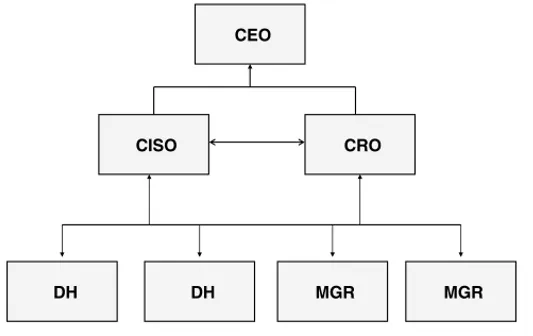
Figure 1.3 gives a graphic example of how the reporting responsi-bilities might manifest themselves in a larger and a smaller organization. A smaller organization may have a number of variations on this theme. Figure 1.4 gives an example of an organization chart for a smaller enterprise.
Where Not to Report
Auditing: Reporting here would put the information security activity into a conflict of interest. It would be the same as having those that make the laws and those that judge compliance with them r eporting in the same organization. It is best to establish a partnership between the groups.
Operations: The key problem here is that operations must concentrate on completing the production schedule and keep the system available for the users. Some necessary control measures may be ignored or circumvented if the information security function reported to the head of operations.
Table 1.6 Roles and Responsibilities
Responsibility Task
Chief Executive Officer (CEO) – Oversee overall “Organization
Security–Posture” (Accountable to Board) Brief Board, customers, public
Chief Information Security Officer (CISO)
Chief Risk Officer (CRO) Department/Agency Head
(DH)
– Set security policy, procedures, standards, program, training and awareness for Organization – Respond to security breaches
(investigate, mitigate, litigate)
– Responsible for independent annual audit coordination
Mid-Level Manager (MGR) – Implement /audit/enforce/assess compliance*
– Communicate policies, program, awareness and training
Staff and Employees – Implement Policy
Physical Security: Many employees associate “security” with guards, dogs, guns, and badges, hardly the image of today’s security professional (either physical or information). The problem with having information security report into this structure is that it is a perception problem. For many organizations, security is viewed as being responsible for loss control. Instead of an IP function being viewed as an enabling tool, it may be seen as the “cop.”
Figure 1. 3 Larger organization reporting matrix.
Figure 1.4 Smaller organization reporting matrix.
CEO
CISO CRO
MGR MGR
DH DH
Larger Organization
EXEC
CISO, CRO, DH
MGR MGR
MGR MGR
Recommendation
The information security function must grapple with the new challenges posed by the decentralized client/server workplace and an increased level of legal and regulatory issues. Senior management increasingly recognizes that information is an asset of the organization, and that they are respon-sible for exercising their fiduciary duty to ensure that organizational information resources are properly protected. A successful information security program requires senior management support, internal and exter-nal auditors’ recommendations, assigned responsibility, and effective reporting structures.
The user community’s perception of information security is equally essential to a program’s success. To implement a world-class program, ensure that the business units understand their role in information security. To facilitate the proper image and foster active partnerships, information security needs a semblance of autonomy to be successful. To achieve this, information security should report directly to the CISO.
Establish Reporting Communications That Support
Information Security Governance Activities
An annual report of the state of information security should be presented to the Information Security Steering Committee. This reporting requirement has been established in current legislation and information security inter-national standards. This report should not be confused with a standard feature audit performed by the audit staff, nor is it part of some third-party certification process.
Typically the CISO would prepare a report on the levels of compliance currently seen throughout the business units. The report development process normally has two key components: compliance with core infor-mation security requirements; and the level of implementation for the current information security initiative. An example questionnaire is shown in Table 1.7.
Table 1.7 Information Security Questionnaire
Information Protection Question
Compliance
Yes/No Comments Date Initials
A Corporate Information Officer (CIO) has been named and the CIO is responsible for implementing and maintaining an effective IP program.
The Information Protection (IP) program supports the business objective and/or mission statement of the organization.
An enterprise-wide IP policy has been implemented.
An individual has been assigned as the corporate information
protection coordinator and overall responsibility for the IP program implementation has been assigned. The IP program is an integral
element of sound management practices.
Information Protection is identified as a separate and distinct budget item (approximately 1-3% of the overall ISO budget).
Senior management is aware of the business needs for an effective IP program, and is committed to support its success.
An effective risk analysis process has been implemented to assist management in identifying potential threats, probability of threat occurrence, and possible counter measures.
Table 1.7 Information Security Questionnaire (Continued)
Information Protection Question
Compliance
Yes/No Comments Date Initials
Each business unit, department, agency, etc. has designated an individual responsible for implementing the IP program for that organization.
The IP program is integrated into a variety of areas both within and outside the computer security field. Comprehensive information
protection policies, procedures, standards and guidelines have been created and disseminated to all employees and appropriate third parties.
An ongoing IP awareness program has been implemented for all organization employees.
A positive, proactive relationship with the audit staff has been established.
Employees have been made aware that their activities may be monitored.
An effective program to monitor IP program-related activities has been implemented.
Employee compliance to IP-related issues is an annual appraisal element.
The system development life cycle addresses IP requirements during the Initiation or Analysis (first) phase.
undertake large-scale research efforts to expand the knowledge and value of the IT governance and control field.
Today, membership to ISACA—more than 50,000 strong worldwide—is characterized by its diversity. Members live and work in more than 140 countries and cover a variety of professional IT-related positions: to name just a few, IS auditor, consultant, educator, IS security professional, regu-lator, chief information officer, and internal auditor. Some are new to the field, others are at middle-management levels, and still others are in the most senior ranks. They work in nearly all industry categories, including financial and banking, public accounting, government and the public sector, utilities, and manufacturing. This diversity enables members to learn from each other, and exchange widely divergent viewpoints on a variety of professional topics. It has long been considered one of ISACA’s strengths. Another organization that supports the information security professional is the Information Systems Security Association (ISSA). ISSA is a not-for-profit, international organization of information security professionals and practitioners. It provides educational forums, publications, and peer inter-action opportunities that enhance the knowledge, skill, and professional growth of its members.
With active participation from individuals and chapters all over the world, the ISSA is the largest international, not-for-profit association spe-cifically for security professionals. Members include practitioners at all levels of the security field in a broad range of industries, such as commu-nications, education, healthcare, manufacturing, finance, and government. The primary goal of the ISSA is to promote management practices that will ensure the confidentiality, integrity, and availability of information resources. The ISSA facilitates interaction and education to create a more successful environment for global information systems security and for the professionals involved.
A third such organization is the Computer Security Institute (CSI). CSI is the world’s leading membership organization specifically dedicated to serving and training the information, computer, and network security professional. Since 1974, CSI has been providing education and aggres-sively advocating the critical importance of protecting information assets. CSI sponsors two conference and exhibitions each year: CSI NetSec in June, and the CSI Annual Computer Security Conference and Exhi-bition in November. CSI also offers a full schedule of training classes on encryption, intrusion management, Internet, firewalls, awareness, Windows, and more. CSI membership benefits include the ALERT newsletter, quarterly journal, discounts on CSI conferences and train-ing, and SecurCompass, an automated, standards-based security
Crime and Security Survey, Frontline end-user awareness newsletter, and Topline security brief for executives.
Mission Statement
Throughout the enterprisewide policy document references to information security and the information security program should be incorporated. These concepts should begin with a review of the enterprise’s shared beliefs that usually discuss such important concepts as teamwork, account-ability, communication, continuous improvement, and benchmarking. Because of the increased emphasis on proper conduct, a formal discussion of the enterprise’s support of due diligence concepts should be established. The use of the term “accountability” when establishing organization goals and beliefs allows the enterprise to commit to the concept that it is willing to accept accountability for the results of decisions made to support the business process or mission of the enterprise. To ensure that appro-priate, informed business decisions are made in an open climate of discussion and research, a formal risk analysis process should be imple-mented to document all management decisions.
By establishing this level of accountability, the enterprise is creating a climate of due diligence throughout the organization. A formal business-related risk management process will ensure that all decisions are made quickly and efficiently and that the process is recorded. This will allow third parties to examine the process and verify that due diligence was performed.
As a security professional, it is very important that due diligence is established as an enterprise objective and guiding principle. Risk manage-ment will ensure that all decisions are based on the best needs of the enterprise and those prudent and reasonable controls and safeguards are implemented. With the implementation of more stringent reporting mechanisms and laws (Sarbanes–Oxley) or international standards such as British Standards 7799 (BS 7799) or ISO 17799, the formal adoption of a risk management process will assist in proving the enterprise is being managed in a proper manner.
Another important element found in most enterprisewide policy doc-uments is a section on organizational responsibilities. This section is where the various mission statements of the enterprise organizations are resi-dent along with any associated responsibilities. For example: