This is a repository copy of Decoherent scattering of light particles in a D-brane background.
White Rose Research Online URL for this paper: http://eprints.whiterose.ac.uk/102594/
Version: Submitted Version
Article:
Ellis, J., Kanti, P., Mavromatos, N.E. et al. (2 more authors) (1998) Decoherent scattering of light particles in a D-brane background. Modern Physics Letters A, 13 (4). pp. 303-319. ISSN 0217-7323
https://doi.org/10.1142/S021773239800036X
Preprint of an article published in Modern Physics Letters A, 13, 1998, 303-320 10.1142/S021773239800036X © World Scientific Publishing Company
http://www.worldscientific.com/worldscinet/mpla
[email protected] https://eprints.whiterose.ac.uk/
Reuse
Unless indicated otherwise, fulltext items are protected by copyright with all rights reserved. The copyright exception in section 29 of the Copyright, Designs and Patents Act 1988 allows the making of a single copy solely for the purpose of non-commercial research or private study within the limits of fair dealing. The publisher or other rights-holder may allow further reproduction and re-use of this version - refer to the White Rose Research Online record for this item. Where records identify the publisher as the copyright holder, users can verify any specific terms of use on the publisher’s website.
Takedown
If you consider content in White Rose Research Online to be in breach of UK law, please notify us by
arXiv:hep-th/9711163v1 20 Nov 1997
ACT-16/97 CTP-TAMU-47/97 OUTP-97-67P
Decoherent Scattering of Light Particles in a
D
-Brane
Background
John Ellisa, P. Kantib, N.E. Mavromatosc,⋄, D.V. Nanopoulosd
and
Elizabeth Winstanleyc
Abstract
We discuss the scattering of two light particles in aD-brane background. It is known that, if one light particle strikes theDbrane at small impact parameter, quantum recoil effects induce entanglement entropy in both the excitedDbrane and the scattered particle. In this paper we compute the asymptotic ‘out’ state of a second light particle scattering off theD
brane at large impact parameter, showing that it also becomes mixed as a consequence of quantumD-brane recoil effects. We interpret this as a non-factorizing contribution to the superscattering operatorS/ for the two light particles in a LiouvilleD-brane background, that appears when quantumD-brane excitations are taken into account.
a Theory Division, CERN, CH-1211, Geneva, Switzerland,
b Division of Theoretical Physics, Physics Department, University of Ioannina, Ioan-nina GR-451 10, Greece,
c University of Oxford, Dept. of Physics (Theoretical Physics), 1 Keble Road, Ox-ford OX1 3NP, United Kingdom,
d Academy of Athens, Chair of Theoretical Physics, Division of Natural Sciences, 28 Panepistimiou Ave., Athens GR-10679, Greece, Center for Theoretical Physics, Dept. of Physics, Texas A & M University, College Station, TX 77843-4242, USA, and Astroparticle Physics Group, Houston Advanced Research Center (HARC), The Mitchell Campus, Woodlands, TX 77381, USA.
⋄ P.P.A.R.C. Advanced Fellow.
ACT-16/97
1
Introduction and Summary
The fate of quantum coherence in the presence of topologically non-trivial space-time backgrounds is currently the subject of intensive research. The problem may be posed at two levels: that of quantum fields in semi-classical gravitational back-grounds such as macroscopic black holes, and in the presence of non-perturbative mi-croscopic quantum fluctuations in the space-time background. At the semi-classical level, the pioneering work of Hawking and Bekenstein demonstrated that a descrip-tion in terms of pure quantum-mechanical states could not be maintained. Proceed-ing to the microscopic quantum level, HawkProceed-ing [1] has argued that the conventional rules of quantum field theory require some revision, and that particle scattering should be described by a scattering operatorS/ that does not factorize as a product of S and S† matrix elements:
ρout =Sρ/ in : S/ 6=SS† (1)
If this is the case, there should be a modification [2] of the conventional Liouville equation for the time evolution of the density matrix ρ:
∂tρ=i[ρ, H] +δHρ/ (2)
where H is the conventional Hamiltonian. This formulation is reminiscent of open systems, with Planck-scale degrees of freedom playing the rˆole of the unobserved ‘environment’ through which light low-energy particles move.
This possibility has been analyzed from various points of view in recent years. In particular, it has been argued that behaviours of the form (1) and (2) are inevitable in the non-critical Liouville string approach, with the non-factorizability ofS/ and the magnitude ofδH/ related explicitly to departures from the criticality that defines classical string vacua [3]. Pursuing a more conventional quantum-gravity approach, divergences in the partition function of a scalar field in a semi-classical Einstein-Yang-Mills background have been exhibited, which have been interpreted [4] as leading to a modified quantum Liouville equation of the type (2).
Recent advances inD-brane technology [5] have provided more powerful tools for analyzing these issues. In particular, it has been shown that D branes provide in
principle an exact accounting for the quantum states of black holes [6]. On the
other hand, it has been argued that not all these states are in practice measurable in feasible low-energy experiments, and specific calculations [7] exhibit a loss of information and corresponding gain in entropy in the scattering of a light low-energy particle off a massive D brane, associated with quantum recoil effects.
Ricci and curvature tensors associated with the singular metric that describes quan-tum D-brane recoil. This metric had previously been derived using conformal field theory techniques, and has many of the properties argued for independently in [8]. We then proceed to compute the effective action that characterizes long-wavelength physics in the presence of this D-brane recoil. We find singularities associated with the quantum recoil of the D brane induced by the impact of the first scalar par-ticle, and compute properties of a low-energy scalar field in the presence of such a recoiling D brane, exhibiting a non-trivial Bogolubov transformation and parti-cle production. These effects are sensitive to quantum fluctuations in the D-brane recoil, which may be treated as a stochastic source. This induces a non-trivial influ-ence functional, which in turn makes a non-trivial contribution to the evolution of the density matrix for the external light particle, as foreseen in (1,2) [2, 3] 1. This
calculation may be regarded as a contribution to low-energy scalar-scalar scattering in a D-brane black-hole background, incorporating the effects of quantum D-brane recoil, whose magnitude we estimate. Our approach opens the way towards a rep-resentation of the associated non-factorizing terms in theS/ matrix description as a spectral integral over D-brane states weighted by their recoil properties.
2
Space-Time Curvature Induced by Quantum
D
-Brane Recoil
We consider the collision of two low-energy, light closed-string particles in a D -brane background, examining the possibility of a loss of quantum coherence that cannot be accommodated in a conventional S-matrix description. We consider ex-plicitly a configuration in which one closed-string state impacts the D brane and has a ‘hard’ scattering off it, while the second light state passes by at large impact parameter. We have shown previously that the colliding particle loses coherence as a result of the necessary sum over D-brane states excited by the collision [7]. Our interest here is whether the more distant light particle also loses some coherence during the scattering process.
A necessary preamble to this discussion of light-particle scattering in a D-brane background is a brief review of relevant aspects of our previous analysis of quantum effects in the recoil of theDbrane struck by the first low-energy light particle [7]. We have demonstrated that this quantum recoil problem is described in conformal field theory language by a pair of logarithmic operators [10] C, D, which are conjugate to the D-brane position yi and velocityui. The ‘kick’ provided by the incident low-energy particle requires the introduction of a Heaviside step function, for which we
1
adopt the following integral representation:
Θǫ(t) = −i
Z ∞
−∞
dq q−iǫe
iqt :ǫ
→0+ (3)
where ǫ is an infrared regulator parameter. The quantum treatment of D-brane recoil necessitates the introduction of world-sheet annulus diagrams, whose large-size limit is characterized by an infrared regulator large-size parameter L that, together with a conventional ultraviolet world-sheet regulator parametera, specifies the value of ǫ [10]:
1
ǫ2 ≃2log|L/a|
2 (4)
Further, in our interpretation, we identify the Liouville field φ with the renormal-ization scale on the world sheet [3, 11], and its zero mode, φ0, is further identified
with the time variable
φ0 = t ≃ log|L/a| (5)
Note that there is no absolute time in this approach, since physical quantities are described by the renormalization group, which relates different scales L, L′ that
correspond to time differences δt≃log|L/L′|.
These identifications of the renormalization scale, the zero mode of the Liouville field and the time variable are supported by various consistency checks, notably of momentum and energy conservation, which are documented in [7] and references therein. On the basis of this analysis, we derived the following form for the singular part of the target-space metric GM N around the moment of the collision:
G00 =−1, Gij =δij, G0i =Gi0 =ǫ(ǫyi+uit)Θǫ(t) (6)
It is to be understood that, in addition to (6), there is also a static, spherically-symmetric part of the metric, which is O(M/R) at large distances R from the struck D brane of mass M. We will consider the scattering of a second low-energy light particle at large impact parameter R, so that we may neglect this spherically-symmetric part in a first approximation, and consider the asymptotic metric as flat to zeroth order in M/R. The physics that interests us is that associated with the
ǫ-dependent singularity in (6).
We have already pointed out that (6) implies a singularity in the Riemann cur-vature scalar as t → 0 [7]. Our first priority in this paper is to compute this more explicitly. To do this, we consider the following more general form ofD-dimensional metric:
It is easy to check that, for the above metric, the only non-vanishing components of the fully covariant form of the Riemann curvature tensor Rµνρσ are the following:
R0i0i =
∂2f
i
∂yi∂t −
1 (1 +PD−1
k=1 fk2)
∂fi
∂yi D−1
X k=1 fk ∂fk ∂t ! (8)
Rijij =
1 (1 +PD−1
k=1 fk2)
∂fi
∂yi
∂fj
∂yj
(9)
Correspondingly, the different components of the Ricci tensorRµν take the following forms:
R00 = −
1 (1 +PD−1
i=1 fi2)2 D−1
X i=1 fi ∂fi ∂t ! D−1
X
j=1
∂fj
∂yj
1 + D−1
X
k=1,k6=j
fk2
(10)
+ 1
(1 +PD−1 i=1 fi2)
D−1
X
i=1
∂2f
i
∂yi∂t
1 + D−1
X
j=1,j6=i
fj2
(11)
Rii =
1 (1 +PD−1
k=1 fk2)2 ∂fi ∂yi D−1
X j=1 fj ∂fj ∂t
−(1 + D−1
X
k=1
fk2) ∂
2f
i
∂yi∂t
+ ∂fi
∂yi
D−1
X
j=1,j6=i
∂fj
∂yj (1 +
D−1
X
k=1,k6=j
fk2) (12)
R0i =
fi (1 +PD−1
k=1 fk2)2 ∂fi ∂yi D−1
X j=1 fj ∂fj ∂t
− 1 + D−1
X
k=1
fk2
!
∂2f
i
∂yi∂t
(13)
Rij =
1 (1 +PD−1
k=1 fk2)2
fifj
∂fi
∂yi
∂fj
∂yj
(14)
Finally, the Riemann curvature scalar R is given by
R = 2
(1 +PD−1 i=1 fi2)2
(
− 1 +
D−1
X
i=1
fi2
! D−1 X
i=1
∂2f
i
∂yi∂t !
+ D−1
X
i=1
fi
∂fi
∂t
! D−1 X i=1 ∂fi ∂yi ! +
D−1
X
i,j=1,i6=j
∂fi
∂yi
∂fj
∂yj
1 + D−1
X
k=1,k6=i,j
f2 k (15)
It is a trivial matter to insert into the above expressions the specific form of the metric (6) found in the previous quantum D-brane recoil calculation. We find the following expressions for curvature scalars
RµνRµν = D(D−1)ǫ4[δǫ(t)]2+O(ǫ6)
R2 = 4 (D−1)2ǫ4[δ
ǫ(t)]2+O(ǫ6) (16) where δǫ(t) is the appropriate derivative of Θǫ(t) (3), that will be used in the next section. The reader should not be alarmed by the appearance of the [δǫ(t)]2 factors,
which do not makeǫ-dependent divergent contributions to the physical quantities of interest to us, such as the integrated central charge deficit Q, etc., even in the limit
ǫ → 0+. In our regularization, it can be easily shown that in this limit Θǫ(0)→ π
whilst δǫ(0) becomes formally a linearly-divergent integral that is independent of ǫ.
We note that the derivation of the space-time discussed above was essentially non-relativistic, since we worked in the approximation of a very heavy D brane. This is the reason why the singularity in the geometry (15) is space-like, and why the consequent change in the quantum state also occurs on a space-like surface. This apparent non-causality is merely an artifact of our approximation. We expect that, in a fully relativisticD-brane approach, the space-time singularity would travel along a light-cone, and that the quantum state would also change causally. Here we are interested in the difference between early- and late-time quantum states, and this apparent non-causal behaviour is irrelevant.
3
Derivation from an Effective Action
We expect that the metric (7) can be derived using the equations of motion for a suitable singular effective action induced by quantum D-brane effects. The most naive guess for a possible form of the action is
S = Z
dDx√−G α′e−2φRˆ2GB (17)
whereφ is the dilaton field and ˆR2GB is the ghost-free Gauss-Bonnet quadratic com-bination of the Riemann tensor, Ricci tensor and curvature scalar:
ˆ
R2GB =RµνρσRµνρσ −4RµνRµν +R2 (18) This is indeed the case, as we now show.
The field equations derived from the action (17) and (18) are
α′Rˆ2GB = α′(RµνρσRµνρσ−4RµνRµν +R2) = 0 (19)
α′Kµν ≡ α′(R φ;µν−R φ;ρρGµν−2Rµρφ;νρ−2Rνρφ;µρ
+ 2Rρσφ;ρσGµν+ 2Rµνφ;ρρ−2Rµρνσφ;ρσ)
− 2α′(R φ;µφ;ν −R φ;ρφ;ρGµν−2Rµρφ;νφ;ρ−2Rνρφ;µφ;ρ
where ; denotes covariant differentiation. In the case of the first equation of motion, we see immediately from the expressions (16) that
RµνρσRµνρσ −4RµνRµν+R2 =O(ǫ6) (21)
Therefore, the first equation of motion (20) is satisfied to leading order in the small parameter ǫ.
Motivated by the Liouville string theory approach of ref. [7], we use the linear-dilaton configuration [12, 3]
φ=Qt (22)
where Q2 is the central-charge deficit of the Liouville string, and Q = O(ǫ2), as
we shall argue below. This linear dependence of the dilaton field on the time t is expected to be valid approximately at large timest ∼1/ǫ2 >> 0 after the collision,
where the system is close to its non-trivial world-sheet fixed point [7, 3]. This is sufficient for our purposes to demonstrate particle production and decohering effects, as we shall argue in the next sections. Using (22), we obtain for the components of the second (Einstein) equation of motion (20):
K00 = O(ǫ8) (23)
K0i = 2Q fi
D−1
X
j,k=1, j6=k6=i
∂fj
∂yj
∂2f
k
∂yk∂t
+O(ǫ8)
= 2 (D−2) (D−3)Q ǫ5uitΘǫ2(t)δǫ(t) +O(ǫ8) (24)
Kii = 2Q
D−1
X
j,k=1, j6=k6=i
∂fj
∂yj
∂2f
k
∂yk∂t
+O(ǫ8)
= 2 (D−2) (D−3)Q ǫ4Θǫ(t)δǫ(t) +O(ǫ8) (25)
Kij = O(ǫ10) (26)
Thus, we again conclude that the equations of motion are satisfied at least through O(ǫ6).
To see that the central charge deficitQ=O(ǫ2), we proceed as follows. We recall that Q2 is the change in the Zamolodchikov C function over the entire world-sheet
renormalization-group trajectory from the Gaussian to the non-trivial fixed point. In our interpretation of target time as the world-sheet Liouville scale, this results for our purposes in the following space-time integrated expression:
Q2 ∼
Z
whereβi is the β function of a generic string background characterized by couplings
gi, and G
ij is the corresponding Zamolodchikov metric. In our case, to lowest non-trivial order in α′, the only background that contributes to G is the target metric
Gij 2, and the corresponding Zamolodchikov metric is given by
Gµναβ =a[GµνGαβ −GµαGβν −GµβGαν] +O(α′) (28)
whereais an arbitrary constant [13]. The lowest-order gravitonσ-modelβ-function is:
βµνG =α′{Rµν + 2∇µ∇νΦ}+O[(α′)2] (29) so that the integrand in (27) simplifies to
βiGijβj = (α′)2aǫ4 h
2(D−1)(D−2)[δǫ(t)]2i+O(ǫ6). (30)
to leading order in ǫ.
The above expression (30) is understood to be multiplied by an overall normal-ization factor of the form W = h1 +PD−1
i=1 ǫ2(ǫyi+uit)2Θ2(t) i−1
, which ensures the finiteness of all spatial integrals. At leading order in ǫ, this factor may be ap-proximated by unity. The temporal integration over t yields a divergent constant normalization factor δ(0), which is irrelevant because a is arbitrary [13]. We con-clude that
Q2 ∼(α′)2aǫ4[2(D−1)(D−2)δǫ(0)] +O(ǫ6), (31) which implies that Q is of orderǫ2 for D >2, as assumed above.
4
Particle Creation in the
D
-Brane Background
In this section we show that an observer who scatters a scalar field off the space-time whose geometry is described by (6) sees particle creation in the singular back-ground metric of the struckDbrane. To this end, we first note that an on-mass-shell scalar field φ of mass µ in the background (6) may be expanded in terms of ordi-nary flat-space Minkowski modes which play the rˆole of the “in” modes, since our background space (6) can be mapped, for t > 0, to a flat space toO(ǫ2) by means
of a simple coordinate transformation:
˜
t=t , X˜i =Xi+ 1 2ǫuit
2 (32)
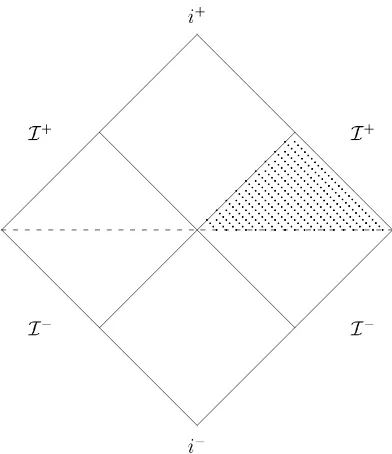
which may be represented by the Penrose diagram shown in Fig. 1.
2
Each of the four diamonds corresponds in a conventional Rindler space to one of the causally-separated regions [14]. Our space-time corresponds to the right-hand diamond. We see that it is flat Minkowski fort <0, and that for t >>0 the shaded region of the space-time resembles, toO(ǫ), a Rindler wedge, with ‘acceleration’ǫui. The event horizons are indicated by the straight lines separating the diamond-shaped regions of the diagram. The dashed line corresponds to the curvature singularity
ǫ2δǫ(t), which may be ignored in orderO(ǫ). As a consequence of the non-relativistic
nature of the D brane, this singularity appears to violate causality, lying outside the light cone. This is merely an artifact of taking the limit as the velocity of light
c → ∞, as is appropriate for a non-relativistic (heavy) D particle. One expects causality to be restored, with a rotation of the singular surface so as to become light-like, in a fully relativistic treatment of the problem, which lies beyond the scope of the present work.
In view of this figure, we expect [14] to find a non-trivial Bogolubov transformation between the “in” and “out” vacua att <0 and t >>0, which we now exhibit. The Minkowski mode expansion for the scalar field takes the standard form:
φ = Z
dEdD−1K[aEKuˆEK+a†EKuˆ∗EK] (33)
where
ˆ
uEK = exp(−iEt+iK.X) E2−K2 =µ2 (34) are the usual Minkowski “in” modes. Such an expansion is valid for t < 0. For
t >>0 one may expand the scalar field in terms of “out” modes,
φ= Z
dEdD−1K[bE,Ku˜E,K+b†E,Ku˜∗E,K] (35)
with
˜
uEK = exp(−iEt+iK.X+i 1 2ǫu.Kt
2) +
O(ǫ2) (36)
These modes are related to the “in” ones by the Bogolubov coefficients α, β:
˜
uE,K = Z
dE′dD−1K′[α
EE′KK′uˆE′K′ +βEE′KK′uˆ∗E′K′] (37)
Extending appropriately the definitions of the “in” and “out” modes to the entire space-time, we find that the Bogolubov coefficients are given by:
αEE′KK′ =
Z
dtdD−1Xu˜E,Kuˆ∗E′K′ =
δ(D−1)(K−K′)[δ(E−E′) + i
2ǫ(u.K) Z ∞
0 dte
−i(E−E′)t
t2+O(ǫ2)
βEE′KK′ =
Z
dtdD−1Xu˜E,KuˆE′K′ =
δ(D−1)(K+K′)i
2ǫ(u.K) Z ∞
0 dte
−i(E+E′)t
t2+O(ǫ2) (38)
Bearing in mind the analogy with Rindler space, we expect particle creation, which is controlled by the Bogolubov β coefficient, since it is this term that contributes to positive frequency mixing [14]. Indeed, we find that the number of particles created in the mode labelled by E and K is given by:
nEK = INh0|b†EKbEK|0iIN =|βEKEK2 | ≃(ǫu.K)2|
Z ∞
0 dte
−i2Ett2
|2
∝ ǫ
2(u.K)2
E6
!
(39)
The formula (39) describes particle creation with a non-trivial angular distribution around the direction of the velocity vector ui. The particle spectrum isnot thermal
as it would have been in the case of a uniform acceleration [15].
This particle creation (39) may be interpreted as non-thermal Hawking radiation from the recoiling D-brane. An analogous effect was suggested in the context of non-critical string theory [3] on the basis of an analysis of two-dimensional stringy black holes [16], the latter being viewed as ‘massive’ string particles. It was argued in [16] that the scattering of light matter off the black hole excites the black hole to a higher string level. Quantum instabilities would then cause the decay of this excited state, with the inevitable emission of non-thermal radiation. In a similar context, we mention a related work [17], where the presence of non-thermal radiation has been demonstrated when a massive scalar field is quantized in a two-dimensional dilaton-gravity black-hole background. In a large-mass 1/m expansion for the scalar field, such non-thermal radiation effects appear, associated with R2/m2-corrected terms
in the target-space effective action. These describe effects due to the back reaction of the massive matter on the two-dimensional space-time geometry, and are very analogous to our higher-dimensional case, in which we also obtained an effective Gauss-Bonnet R2 target-space action term (17),(18), describing the leading effects
of the back reaction of the heavy recoiling D brane on the surrounding space-time geometry.
5
Quantum Background Fluctuations
the classical value which would be expected on the basis of momentum conservation in an elastic collision [18, 7].
Using generic arguments [18] based on the quantization of σ-model backgrounds in string theory associated with the summation over genera [3], it has been shown that the D-brane velocity fluctuates about ui with a Gaussian distribution
P =e−
(δui)2
Γ2u Γ2
u ∼(gs2+δgs2) lnδ, δ→0 (40) where δgs2 is the change in the square of the coupling constant for the string, gs2, induced by the matter deformation of the σ model describing the D brane that is caused by the scattering of the first string particle. The appearance of a lnδ
dependence is due to world-sheet divergences, arising from world-sheet loops down to a size δ << 1, which were argued in [18] to dominate the description of velocity fluctuations around a recoiling heavy-D-brane background.
It is this divergence related to a pair of logarithmic operators [10] that explains in conformal-field-theory language why decoherence appears in scattering off a D
brane, but would not appear in scattering off a conventional massive string state. Physically, the dispersion in recoil velocity ui implies that at large times the D -brane state must be described by an ensemble of widely-separated configurations. In addition to the mixed nature of theD-brane state itself, this distributed ensemble yields a superposition of macroscopically-distinct space-time backgrounds, leading to entropy growth also for the second light string state in the scattering process, as we discuss below.
The change δgs in gs due to the matter deformation is given in conventional σ -model perturbation theory by:
δgs2 =e−2<Φ>g
−e−2<Φ>0 ≃g2
s X
N
<ΦVi1. . . ViN > q
i1. . . qiN (41)
where theqidenote background target-space couplings corresponding to vertex oper-atorsVi, and < . . . >g (< . . . >0) denotesσ-model correlators in the deformed (free)
string. In our case, only correlators with even powers of D are non-vanishing, and an order-of-magnitude estimate of δgs can be made using the two-point correlator of the recoil operator Di on the disc, which diverges as 1/ǫ:
δg2s =g2s <Φ Z Z
∂ΣDiDj > u
iuj+. . .
∼gs21
ǫ2 × O(E
2/M2
for weak string couplings gs << 1. Using a generalized Fischler-Susskind mecha-nism [19], we may identify 1/ǫ2 = lnδ, thereby implying the following expression for
the dominant terms in the width (40):
Γ2u ≡(∆u)2 ∼gs2lnδ+gs2u2iln2δ (43)
It is clear from this discussion that if the string is very weakly coupled: gs→0, the quantum fluctuations ∆ui will be suppressed, as is appropriate for a semi-classical heavy D brane of mass M ∼1/gs.
As discussed above, here and in [7] we further identify 1/ǫ2, and hence lnδ, with
the target time t3. Within this interpretation, we may interpret (43) as the spread
in time t of the probability distribution |Ψst(u
i, t)|2 for the string wave function. This interpretation of the summation over topologies in a σ-model path integral has previously been made in [20, 21], where it was shown that such probability distributions satisfy stochastic Fokker-Planck diffusion equations.
We now show how this effect leads to stochastic dynamics and decoherence for the spectator scalar field propagating in the background of a D brane with such a quantum-mechanical treatment of recoil. Using the initial coordinate system (yi, t) and the metric (6), we find the following equation of motion for a massive scalar field ϕ, of massµ,
−∂2tϕ+ D−1
X
i=1
∂i2+ 2fi∂i∂t
ϕ+ D−1
X
i=1
[X i6=j
fj2]∂2iϕ−
X
i6=j
fifj∂i∂jϕ+ρ∂tϕ+ D−1
X
i=1
Bi∂iϕ−µ2W ϕ= 0 (44)
where fi = ǫ(ǫyi + uit)Θǫ(t) and W = 1 + PDi=1−1ǫ2Θǫ(t)2(ǫyi +uit)2 as before, √
−G=√W, and
ρ = W−1
(D−1 X
i=1
ǫ2(ǫyi+uit)Θǫ(t) [uiΘǫ(t) +δǫ(t) (ǫyi+uit) ]
+ (D−2)ǫ2Θǫ(t)W +ǫ2Θǫ(t))o,
Bi = ǫuiΘǫ(t) +ǫ(ǫyi+uit)W−1δǫ(t)−fiΘǫ(t)W−1 D−1
X
j=1
ǫujfj
− (D−2)fiǫ2Θǫ(t)−ǫ2W−1fiΘǫ(t) (45)
We see that (44) contains a friction term, proportional to the quantity ρ=O(ǫ2) in
(45), which is of the same order as the curvature in our space time, and depends on the δǫ(t) singularity structure.
3
To illustrate our basic argument for the stochastic nature of the problem, we consider the simplest possible configuration for the massive scalar field ϕ, namely that of a field that is constant in space: ϕ(t). In this case (44) simplifies to:
−∂t2ϕ(t) +ρ∂tϕ =µ2W ϕ (46)
Consistency with the approximation of spatial independence can be maintained only up to order ǫ2, where the y
i dependent terms in ρ are ignored, and the latter may be approximated by
ρ≃ǫ2u2
itΘǫ(t)(Θǫ(t) +tδǫ(t)) + (D−1)ǫ2Θǫ(t) +O(ǫ3) (47) For large times t∼1/ǫ2, the equation of motion (46) resembles that for an inflaton
field to the order in ǫ studied, with ‘friction’∼u2
i, and a time-dependent force that increases linearly with large times t >>0:
−∂t2ϕ(t) +u2iΘǫ(t)∂tϕ=µ2ϕ−µ2u2itΘǫ(t)ϕ (48)
Thus there are two possible sources of decoherence in our problem. One is related to the friction term in (48), which for any finite time t <1/ǫ2, is of the same order
in ǫ as the space-time curvature, i.e., of O(ǫ2), and hence can be ignored in our
present discussion. The other is due to the interaction of the scalar field ϕ with the gravitational background - recall that W is the determinant of the metric tensor - and therefore provides [21] an environmentally-induced stochastic source term in the inflation equation (48), associated with the quantum recoil degrees of freedom of the D brane, which survives to order ǫ in the flat space-time limit that we are considering here. It is this source that we now explore further, and use to estimate the size of the induced decoherence effects.
A general approach to the analysis of such a system, described by field variables
a in interaction with some environmental degrees of freedom q with some action:
S[a, q] = S[a]+Se[q]+Sint[a, q], is provided in [22, 23]. The systemais characterized by a reduced density matrix ρr(a, a′):
ρr(a, a′) = Z ∞
−∞dq
Z ∞
−∞dq
′ρ(a, q;a′, q′)δ(q
−q′) (49)
whose time evolution is given by the evolution operator Jr:
ρr(a, a′, t) = Z Z ∞
−∞daida ′
iJr(a, a′, t|ai, a′i, ti)×ρr(ai, a′i, ti) (50)
with the subscript idenoting initial data at a time t=ti, when the system and the environment are assumed to be uncorrelated: ρ(ti) =ρr(ti)×ρˆenvironment(ti). Using the path-integral formalism [22], it has been shown that the evolution operator can be expressed in terms of the influence functional F(a, a′):
Jr(af, a′f, t|ai, a′i, ti) = Z af
ai
Z a′f a′
i
with the subscript f denoting the ‘final’ state at some large time t. A formal representation of the influence functional is given by [22, 23]:
F(a, a′)≡e¯hiSIF =
Z Z Z ∞
−∞dqfdqidq ′
i Z qf
qi
Dq
Z q′
f
q′
i
Dq′exp i
¯
h{Se[q] +Sint(a, q)}
exp
−¯hi{Se[q′] +Sint(a, q′)}
ρe(qi.qi′, ti) (52)
There is a simple representation 4 of the influence functional in terms of the
Bogol-ubov coefficientsαk(a),βk(a) that appear in the transformation between the creation and annihilation operators of field amplitudes at different times:
F(a, a′) =Y k
1 q
αk(a′)α∗k(a)−βk(a′)βk∗(a)
(53)
Note that since the Bogolubov coefficients in general satisfy |α(a)|2 − |β(a)|2 = 1,
the influence functional reduces to the unit matrix when a′ =a, as it should.
In the application of this formalism to our problem, the rˆole of the field variables
a at an initial time ti ≤ 0 is played by the Minkowski “in” modes ˆuEK of the previous section, whilst the rˆole of the field variables a′, at a later time t >> 0,
is played by the “out” modes ˜uEK (36), but corresponding to a velocity which is given by the quantum fluctuations (43). We shall consider decoherence between two field configurations that preserve energy and momentum. This is a feature which is respected on average by our Liouville approach to target time [3].
From the expressions (38) for the Bogolubov coefficients we find the following order of magnitude of the pertinent influence action SIF (52),(53):
SIF ∝ −i¯hlnF(a, a′)∼i¯h[ 1
2ln (αEKEK(˜uEK)) +. . .] ∼i¯h[1
4g
2
s|u.Kˆ |2 t+O(g2su2i|u.Kˆ |2 t2)] +. . . (54)
where ˆu denotes a unit vector in the direction of u, and the . . . indicate real parts, which are not of interest to us here, as well as terms of higher order inǫ2, which are
suppressed asǫ→0. We see that the term in (54) proportional tot2, which owes its
existence to the δg2
s term in (40), is subleading for smallu2 << 1, compared to the term with a lineart dependence. This follows from the fact that, for asymptotically large times t∼1/ǫ2, these terms are of order (u2
i/ǫ2)t. It has been argued in [7, 18] that ui/ǫ= uRi is a ‘renormalized’ velocity, corresponding to theσ-model coupling of an exactly-marginal velocity recoil operator D, which in our framework is also assumed small uR
i <<1. 4
Thus, we see that the quantum fluctuations of the D-brane recoil velocity (43) induce decoherence for the second light particle that grow linearly in time, provided that the modular world-sheet infinities lnδ have the target-time interpretation [7] assumed here. If only classical recoil velocity were present, there would be no lnδ
dependence and hence no time dependence and no decoherence. The imaginary coefficient in (54), and its linear dependence on t, imply that the quantum recoil of the D brane, which corresponds in conformal-field-theoretic language to a de-parture from criticality, induces a non-Hamiltonian contribution δH/ (2) into the generic evolution equation of the reduced density matrix for the scalar particle in this background. Since the momentum of the spectator particle, K, may be taken generically to be of the same order of magnitude as its energy E, one obtains from (54) the order-of-magnitude
/
δH ∼ O(E2/M
D) (55)
where MD is the heavy D-brane mass, which is related to the conventional string scale Ms = (α′)−1/2, with α′ the Regge slope, via gs ∼Ms/MD <15. The formula (55) agrees with the generic estimates of [2, 3, 7], which indicated a suppression by a single power of the heavy mass scale, in this case MD.
6
Conclusions and Outlook
We had previously shown explicitly using conformal field theory techniques [7] that a light particle that has a ‘hard’ scattering off aDbrane finishes up in a mixed state, with an entanglement entropy corresponding to that of the excited struck
D brane. The analysis in the previous section demonstrates that a light spectator particle passing by at large impact parameter is also converted into a mixed state, by virtue of the quantum fluctuations in the recoil of the struck D brane. This can be regarded as a decohering contribution to the scattering of light particles in a D-brane background, and hence a non-trivial contribution to theS/ matrix, over and above the decohering effects ofD-brane scattering on the propagation of a light particle that we discussed previously [7].
More specifically, we have demonstrated that this decoherence effect causes off-diagonal density matrix elements to decay exponentially with time, just as expected in [2], on the basis of the non-Hamiltonian termδH/ in (2). Moreover, this effect increases quadratically with the particle energy E, as also suggested previously [2, 3, 4].
In the future, it would clearly be interesting to extend this analysis to light-particle scattering in the absence of an initial-state D brane, but taking into account the
5
Here we assume that the dimensionless time scale t ∼ lnδ is expressed in units of M−1 D .
Further analysis is needed to pin down the most appropriate scaling. If instead one assumes that the dimensionless time scale lnδis expressed in string unitsM−1
excitation of intermediate virtualD-brane states. Such a computation goes beyond the scope of this paper, but we expect it to share features with this calculation, in particular that it would lead to a contribution toδH/ ∼E2.
Acknowledgements
P.K. would like to thank the CERN Theory Division for its hospitality and finan-cial support. The work of D.V.N. is supported in part by D.O.E. Grant DE-FG03-95-ER-40917, and that of E.W. is supported by Oriel College, Oxford.
References
[1] S.W. Hawking, Comm. Math. Phys. 87 (1982), 395.
[2] J. Ellis, J.S. Hagelin, D.V. Nanopoulos and M. Srednicki, Nucl. Phys. B241 (1984), 381.
[3] J. Ellis, N.E. Mavromatos and D.V. Nanopoulos, Phys. Lett. B293 (1992), 37; Mod. Phys. Lett. A10 (1995), 425, and hep-th/9305117;
Lectures presented at theErice Summer School, 31st Course: From
Supersym-metry to the Origin of Space-Time, Ettore Majorana Centre, Erice, July 4-12
1993 ; hep-th/9403133, ‘Subnuclear Series’ Vol. 31, (World Scientific, Singapore 1994), p.1;
For a pedagogical review of this approach see: D.V. Nanopoulos, Riv. Nuov. Cim. 17 (1994), 1.
[4] J. Ellis, N.E. Mavromatos, D.V. Nanopoulos and E. Winstanley, Mod. Phys. Lett. A12 (1997), 243.
[5] J. Dai, R.G. Leigh and J. Polchinski, Mod. Phys. Lett. A4 (1989), 2073; J. Polchinski, Phys. Rev. D50 (1994), 6041; Phys. Rev. Lett. 75 (1995), 184; C. Bachas, Phys. Lett. B 374 (1996), 37;
J. Polchinski, S. Chaudhuri and C. Johnson, preprint hep-th/9602052, and references therein.
[6] A. Strominger and C. Vafa, Phys. Lett. B379 (1996), 99; C.G. Callan and J. Maldacena, Nucl. Phys. B472 (1996), 591; A. Strominger and J. Maldacena, Phys. Rev. Lett. 77 (1996), 423.
[8] S. Hawking and M. Taylor-Robinson, Phys. Rev. D55 (1997), 7680.
[9] D. Amati, preprint hep-th/9706157, and references therein.
[10] I. Kogan, N.E. Mavromatos and J.F. Wheater, Phys. Lett. B387 (1996), 483.
[11] I. Kogan, Proc. Particles and Fields 91 (eds. D. Axen, D. Bryman and M. Comyn, World Scientific, Singapore 1992), p.837.
[12] I. Antoniadis, C. Bachas, J. Ellis and D.V. Nanopoulos, Nucl. Phys. Phys. Lett. B211 (1988), 393; Nucl. Phys. B328 (1989), 117.
[13] N.E. Mavromatos and J.L. Miramontes, Phys. Lett. B201 (1988), 473.
[14] N.D. Birrell and P.C.W. Davies, Quantum Fields in Curved Space (Cambridge University Press (1982)).
[15] W. Unruh, Phys. Rev. D14 (1976), 870.
[16] J. Ellis, N.E. Mavromatos and D.V. Nanopoulos, Phys. Lett. B276 (1992), 56;
ibid. B284 (1992), 27, 43.
[17] C. Chiou-Lahanas, G.A. Diamandis, B.C. Georgalas, X.N. Maintas and E. Pa-pantonopoulos, Phys. Rev. D52 (1995), 5877;
C. Chiou-Lahanas, G.A. Diamandis, B.C. Georgalas, A. Kapella-Economou and X.N. Maintas, Phys. Rev. D54 (1996), 6226.
[18] F. Lizzi and N.E. Mavromatos, Phys. Rev. D55 (1997), 7859.
[19] W. Fischler and L. Susskind, Phys. Lett. B171 (1986), 383; ibid. 173 (1986), 262.
[20] J. Ellis, N.E. Mavromatos, D.V. Nanopoulos, Lectures presented at the
confer-encePhenomenology of Unification from Present to Future, Roma, March 23-26
1994 (World Scientific, Singapore 1994), p. 187; hep-th/9405196.
[21] J. Ellis, N.E. Mavromatos and D.V. Nanopoulos, Mod. Phys. Lett. A10 (1995), 1685.
[22] R. Feynman and F. Vernon, Ann. Phys. (N.Y.) 24 (1963), 118.
[23] B. Hu and A. Matacz, Phys. Rev. D51 (1995), 1577;
i I + I . . . . . . . . . . . . . . . . . . . . . . . . . . . . . . . . . . . . . . . . . . . . . . . . . . . . . . . . . . . . . . . . . . . . . . . . . . . . . . . . . . . . . . . . . . . . . . . . . . . . . . . . . . . . . . . . . . . . . . . . . . . . . . . . . . . . . . . . . . . . . . . . . . . . . . . . . . . . . . . . . . . . . . . i . . . . . . . . . . . . . . . . . . . . . . . . . . . . . . . . . . . . . . . . . . . . . . . . . . . . . . . . . . . . . . . . . . . . . . . . . . . . . . . . . . . . . . . . . . . . . . . . . . . . . . . . . . . . . . . . . . . . . . . I I +
Figure 1: Penrose diagram for the space-time environment derived from the quantum