i
CAREER DEVELOPMENT WITH RESEARCH
SCIENTISTS IN SUB-SAHARAN AFRICA
This thesis is submitted in accordance with the requirements of the University of Liverpool for the degree of Doctor in Philosophy
By
Hazel McCullough
ii
Page
APPENDICES... x
ACKNOWLEDGEMENTS... xi
ABSTRACT... xii
LIST OF TABLES... xiv
LIST OF FIGURES... xv
DEFINITIONS AND ABBREVIATIONS... xvi
CHAPTER 1. OVERVIEW OF THE STUDY Introduction... 1
Background to the study... 4
Building research capacity in Africa... 4
Career challenges for research scientists in Africa... 5
The Gates Malaria Partnership... 8
Purpose of the study... 9
Why use Personal Development Planning?... 11
PDP in a Sub-Saharan African context... 13
Design of the study... 14
Significance of the study... 18
Timeline of the study... 19
Summary of chapters... 21
CHAPTER 2. LITERATURE REVIEW Introduction... 23
Personal Development Planning (PDP)... 24
Definitions... 24
iii
The developing PDP evidence base... PDP in Higher Education in the UK... PDP policy in UK Higher Education... PDP for research scientists in the UK... The “skills agenda” for postgraduate researchers... The Joint Skills Statement... The “research career builder” for postdoctoral researchers... Supporting PDP for researchers... The role of PDP in career development...
Careers and career models... 34 35 37 38 39 41 42 42 43 43
Career models and research scientists... 45
Career management and early-career researchers... 46
Career development for early-career researchers... Challenges for early-career researchers... Support for early-career researchers... Developing PDP for a Sub-Saharan African context... Developing PDP for research scientists in Africa... Implementing PDP in Sub-Saharan Africa... Summary... 48 50 52 55 56 57 59 CHAPTER 3. METHODOLOGY Introduction... 61
Theoretical approach... 62
Action Research... 62
Criticism of Action Research... 64
iv
Evaluations framework... 69
Research design... 72
Research procedures... 74
Sampling... 74
Description of the participants... 75
Ethical considerations... 78
Approval and informed consent... 78
Ethical issues... 79
Data collection strategies and instruments... 81
Initial reaction survey and follow-up questionnaires... 83
Semi-structured interviews... 84
Nominal Group Technique and Online Focus Group Discussion.... 87
Managing, selecting and utilising data... 89
Data analysis... 91
Role of the researcher... 92
Insider in the research process... 93
Limitations of the study... 94
Summary... 95
CHAPTER 4. DEVELOPING AND IMPLEMENTING THE PDP SYSTEM AND INDIVIDUAL ACTION PLANS Introduction... 97
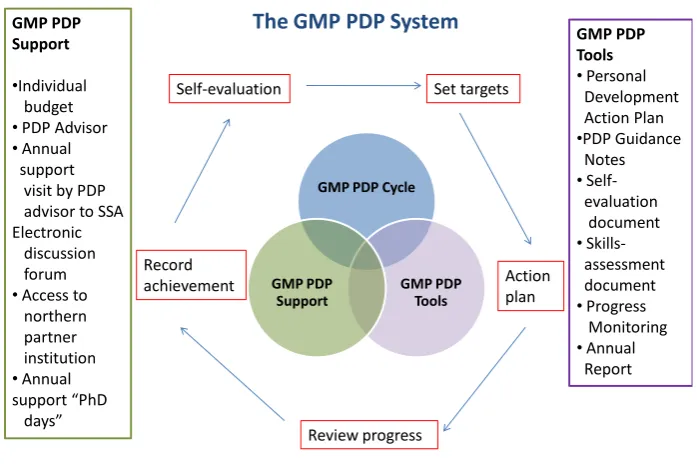
Developing an evidence-based PDP system for the GMP PDP Group... 98
Needs analysis... 98
What the GMP PDP group wanted... 98
The group‟s intended purpose for PDP... 99
v
GMP PDP documentation and supporting materials... 111
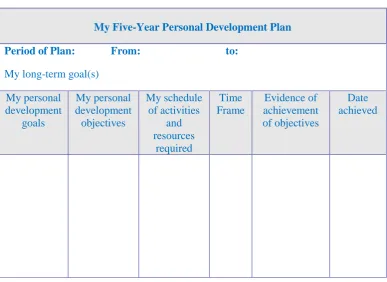
The GMP Personal Development Action Plan... 111
Developing the Personal Development Action Plan... 113
The Self-evaluation document... 115
The Skills-assessment document... 117
The Progress Monitoring and Annual Report forms... 118
The Guidance Notes... 119
Piloting and refining the GMP system and tools... 119
Implementing the GMP PDP system and tools... 121
Monitoring and reviewing the GMP PDP system... 122
Developing an infrastructure to support the PDP system... 123
The GMP built-in support mechanisms... 126
Supervisory support... 126
PDP Advisor... 127
Financial support... 128
Annual “PhD” days... 128
Setting up an electronic discussion forum for peer support... 129
Looking for discussion forum models... 129
The GMP PDP Group designing the forum... 131
Developing the forum... 132
Implementing the forum... 133
Managing the forum... 133
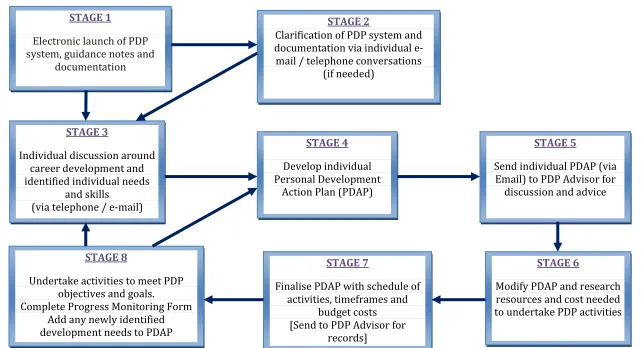
Developing individual PDP action plans... 134
vi
Introduction... 138
Evaluation level 1 – Reaction to using PDP... 138
The positive aspects of using PDP... 141
Career... 141
Reflection... 142
Opportunity to plan and develop skills... 143
Other... 143
Difficulties and issues with using PDP... 144
Time... 144
Self... 145
Planning difficulties... 146
Resource and budget difficulties... 147
Other... 147
Evaluation level 1 – Reaction to the GMP PDP system... 147
GMP PDP tools and supporting materials... 148
Personal Development Action Plan (PDAP)... 151
Guidance notes... 153
Self-evaluation document... 154
Skills-assessment document... 155
The Progress Monitoring and Annual Report forms... 156
Evaluation level 1 – Reaction to the GMP PDP processes... 158
Implementation of PDP and the GMP PDP system... 158
Action Planning – developing individual action plans... 160
Skills deficit... 166
vii
Evaluation level 1 – Reaction to the GMP PDP support systems... 172
Support and resources... 172
Institutional support... 173
Improving institutional support... 176
Financial support... 177
PDP advisor... 180
Summary and recommendations... 181
CHAPTER 6. EVALUATION: LEARNINGAS A RESULT OF ENGAGING WITH PDP Introduction... 184
Evaluation level 2 – Learning as a result of engaging with PDP... 185
Skills identified... 189
Research-related skills... 189
Generic skills... 192
Professional and profession-related skills... 195
Developing teaching and lecturingskills... 196
Developing project management skills... 199
Developing skills for varying stages of career development... 200
Gaining the skills... 202
Courses... 203
Sourcing resources... 205
viii
Evaluation level 3 – Learning and application to practice... 208
Learning... 209
Opportunistic learning... 210
Learning with and from others... 211
Reflection and experiential learning... 213
Learning experiences in Africa... 215
Application of learning to practice... 218
Summary... 221
CHAPTER 7. EVALUATION: PDP AND CAREER DEVELOPMENT Introduction... 223
Evaluation level 4 – Results of using PDP for career development... 223
PDP: relevant and useful to the GMP PDP Group‟s needs... 225
How was PDP relevant?... 226
Seeing the value in using PDP... 227
GMP PDP Career Paths... 229
Senior career researchers... 230
Advanced early-career researchers... 230
Early-career researchers... 231
Attributing PDP to their career development... 233
Recommending PDP to others... 235
PDP: a “one-off” activity or habitual behaviour?... 237
Transferability of PDP more widely in Africa... 238
ix
A proposed PDP system for transfer to a wider context Africa... 246
Summary... 249
CHAPTER 8. SUMMARY, KEY LESSONS LEARNED AND RECOMMENDATIONS Introduction... 251
Summary of the study... 251
Methodology... 252
Summary of the main findings... 254
Key lessons learned... 255
Recommendations... 256
Suggested further research... 257
Current events... 258
x Appendix 1. Informed consent form
Appendix 2. Reaction survey questionnaire Appendix 3 Follow-up questionnaire Appendix 4. Interview schedule Appendix 5. Joint Skills Statement
Appendix 6. PDP Progress monitoring Form Appendix 7. PDP Annual Report
Appendix 8. PDP Guidance Notes Appendix 9. PDP Brief
xi
I am thankful to the many people who supported me through this long journey. I am particularly thankful to my supervisors, Dr Imelda Bates and Dr Anne Qualter who provided me with the support and motivation
throughout, but particularly towards the end. I am grateful to the Gates Malaria Partnership for the sponsorship, and also for the opportunity to work on such an exciting project. I am also thankful to all my family and friends who supported me throughout this time – and a big thank you to my sisters and all my nieces and nephews who kept me going through the tough times. Each one of you are an inspiration to me. Thank you to Rory for all the help. And last but not least, thank you to my husband John for everything.
xii
Using Personal Development Planning (PDP) for Career Development with Research Scientists based in Sub-Saharan Africa
Hazel McCullough
This research study evaluated the use of Personal Development Planning (PDP) as a strategy to help a group of ten doctoral and fourteen
postdoctoral research scientists, based in eight developing countries in Africa, enhance and progress their career development. To achieve this, a PDP system, with built-in tools and support systems was developed
xiii
to helping them enhance and progress their career development; and was successful in helping them to feel confident about planning and managing their career development and progression.
The study does not evaluate, given the focus and limited time, the broader impact that engagement with PDP might have on career progression. A follow-up and longitudinal study would be needed to evaluate this aspect of PDP in relation to career development in Africa.
xiv
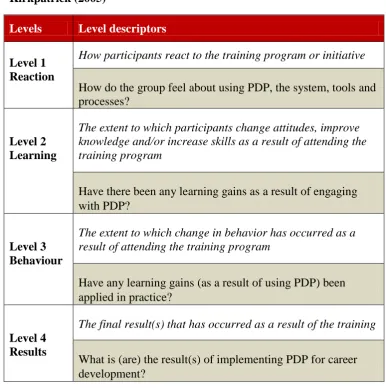
1. The variety of PDP purposes... 12 2. Evaluation framework – adapted from “Four Levels
of Evaluation” Kirkpatrick (2005)... 71 3. Data sources for elements to be evaluated... 82 4. The GMP Personal Development Action Plan
(Not to scale)... 112 5. The GMP Self-evaluation document (Not to scale)... 116 6. The GMP Skills-assessment document (not to scale)... 117 7. Demographic information of 23 participants and their
experiences with PDP... 140 8. Reaction of 23 respondents to the PDP system,
documents, implementation and support... 150 9. Results from 24 group members on development of
individual PDAPs... 162
10. Rogers (1995) typology of adopting innovations... 165 11. Results of research-related skills, as identified by 24
participants... 190 12. Results of generic skills identified by 24 participants... 193 13. Results of profession-related skills as identified by 12
participants... 196 14. Total number of resources needed to meet PDP
objectives over a two-year period... 203 15. Results from 19 respondents on using PDP for career
xv
Figure Page
1. An overview of the PDP project (adapted from the Logic
Model by Taylor-Powell (2005)... 3
2. A timeline of key events in the PDP Project... 20
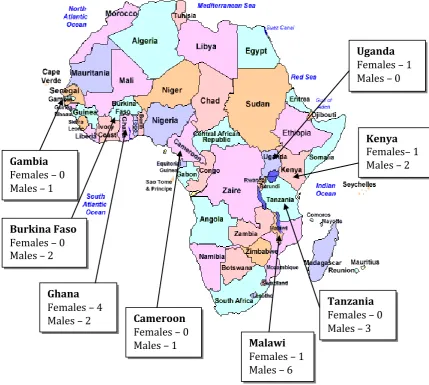
3. Description of the study participants... 77
4. PDP for the GMP PDP Group... 109
5. The GMP PDP Cycle adapted from Kolb (1984) and QAA (2009)... 110
6. Developing individual Personal Development Action Plans………... 135
xvi
FGD Focus Group Discussion
GMP The Gates Malaria Partnership – a nine-partner consortium with the aim of building research capacity in malaria in Sub-Saharan Africa GMP PDP
Group
The participant group for which the PDP system was designed and implemented
HEI Higher Education Institution JSS Joint Skills Statement NGT Nominal Group Technique
PDAP Personal Development Action Plan PDP Personal Development Planning PGR Postgraduate Research (students)
QAA Quality Assurance Agency (for Higher Education in the UK)
1 INTRODUCTION
This research study began its life as a brainstorming session in Yaoundé, Cameroon in 2005. The event was an annual support workshop for a cohort of African scientists who were awarded grants, by the Gates Malaria Partnership (GMP) to undertake research studies in an aspect of malaria control. The workshop brought together this group of ten doctoral and fourteen postdoctoral scientists from eight Sub-Saharan African (SSA) countries –who, in collaborative partnership with European and African institutions, were registered with an
institution in the United Kingdom or Denmark and undertook their field work in their home countries. During the workshop the group
2
3
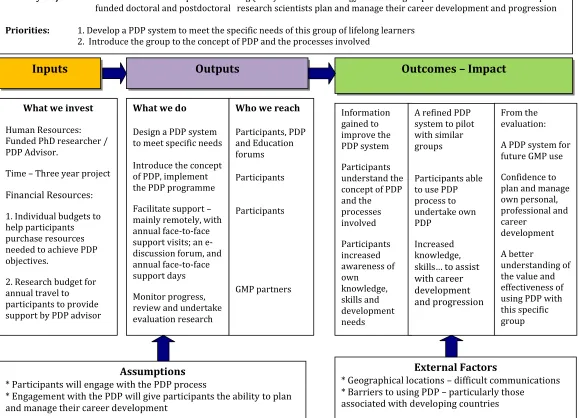
Inputs Outputs
Activities Participation
Outcomes – Impact
Short Medium Long What we invest
Human Resources: Funded PhD researcher / PDP Advisor.
Time – Three year project
Financial Resources:
1. Individual budgets to help participants purchase resources needed to achieve PDP objectives.
2. Research budget for annual travel to participants to provide support by PDP advisor
What we do
Design a PDP system to meet specific needs
Introduce the concept of PDP, implement the PDP programme
Facilitate support – mainly remotely, with annual face-to-face support visits; an e-discussion forum, and annual face-to-face support days
Monitor progress, review and undertake evaluation research
Who we reach
Participants, PDP and Education forums Participants Participants GMP partners Participants PDP and Education Forums Information gained to improve the PDP system Participants understand the concept of PDP and the processes involved Participants increased awareness of own knowledge, skills and development needs
A refined PDP system to pilot with similar groups
Participants able to use PDP process to undertake own PDP
Increased knowledge, skills… to assist with career development and progression
From the evaluation:
A PDP system for future GMP use
Confidence to plan and manage own personal, professional and career development A better understanding of the value and effectiveness of using PDP with this specific group
Assumptions
* Participants will engage with the PDP process
* Engagement with the PDP will give participants the ability to plan and manage their career development
External Factors
* Geographical locations – difficult communications * Barriers to using PDP – particularly those
associated with developing countries
Primary Objective: To use Personal Development Planning (PDP) as a formal strategy to assist a group of Gates Malaria Partnership-
funded doctoral and postdoctoral research scientists plan and manage their career development and progression
[image:19.842.184.763.121.539.2]Priorities: 1. Develop a PDP system to meet the specific needs of this group of lifelong learners 2. Introduce the group to the concept of PDP and the processes involved
4 B ACK GRO UN D TO THE STU DY :
Building research capacity in Africa
The concept of capacity building has featured in the discourse of
development for many years. Within the context of research it is seen as enhancing the abilities of individuals, organisations and systems to
undertake and disseminate high quality research efficiently and effectively (DFID, 2009; Gwin, 2005). At an individual level it is about building up a critical mass of researchers competent in a particular thematic, disciplinary or methodological area (Jones et al, 2007). The need for building research capacity in Africa is documented within the literature (Costello and zumla, 2000; Nchinda, 2002; Ntoumi et al., 2004; Lansang and Dennis, 2004; Nuyens, 2005; Whitworth et.al. 2008).
Building a critical mass of competent researchers in Africa is seen as essential, not only to enable researchers to undertake studies in their own national settings, but also to ensure that the problems can be analysed and addressed in their epidemiological context; and ensure that the research findings are translated into policy and practice (Nchinda, 2002; Ntoumi et al, 2003; Dison, 2007). Ways of developing this critical mass of
researchers in Africa is something that has been on-going and evolving over the years; with strategies including research collaboration and partnerships (Costello and Zumla, 2000) and donor-funded PhD
scholarship programmes (Harle, 2009). The PhD Scholarship programmes are increasingly shifting – from the individual being registered and
5
country; to joint programmes, (like the GMP programme) where the individual is registered with the donor-funded institution and undertakes field work in their home country; to being registered with their home institutions and undertaking the majority of their study in their home countries but benefitting from access to joint supervision, support and facilities of the donor-funded institution for a period of the time. The aim for the GMP was not just to help build a critical mass of
researchers in malaria in Africa but also to help build some sustainability in malaria research in Africa. In order to help this cohort of African scientists continue to work in the field of malaria and to use their newly-acquired skills and knowledge to best serve the needs of their populations, the GMP sought to explore the use of PDP as a strategy to help with the career development of these research scientists. This can be seen in the GMP PDP project agreement document written in 2006, where the introduction of PDP is seen as a vehicle to, “...equip PhD students with individual prioritised professional skills and knowledge that will enhance their
professional development and improve their „career marketability‟ in
public health research and control in their home country” (GMP PDP Project Agreement, 2006).
Challenges for early-career researchers in Africa
Managing a career in the 21st century is a challenge in itself. The shift from an organisation-based (and owned) career to one that is
6
organisation is becoming progressively more widespread (Kidd and Green, 2004; Amundson, 2006; Donner and Wheeler, 2001).
Lips-Wiersma and McMorland (2006) show how the focus is now increasingly on self organisation to develop the portfolio of skills, flexible know-how and adaptability needed to increase the marketability and employability required to manage the “boundaryless” career (Arthur, 1994).
For the research scientist, whose career development and progression often involves taking on increasingly challenging assignments – for example, attracting and managing bigger grants and research projects, to develop a reputation amongst peers, colleagues and the wider research community – there is indeed a recognised need for the requirement of a portfolio of skills, to help manage these challenges.
Career development and progression is dependent upon many social, political, cultural and economic variables; both locally and globally. This is nowhere more highlighted than in developing countries in Africa, where forces external to the individual can be seen to have a greater influence than in developed countries. Changes to the political
7
The literature highlights some of the specific challenges that early-career research scientists in Africa face. These include the lack of good research facilities, poor access to literature and inadequately funded support services and resources (Nchinda, 2002). For African research scientists forging a career in the public sector or academia, these challenges also include low salaries, difficulties with establishing a publication record and significant academic workloads (Harle, 2009; Beoku-Betts, 2005; Campion and Shrum, 2004).
While it should be recognised that there is no single and homogenous African culture, it is important to be aware that there social and cultural constructs that are particular to Africa. These include the importance of status and hierarchy in professional and social life, nepotism and the lack of meritocratic societies. It is essential to be aware of these challenges faced by the research scientist in Africa, since they can have a significant influence in the individual‟s career progression.
Many Africans (and not exclusively research scientists) who struggle to manage their careers amid these challenges, end up leaving for higher paying private sector or international donor-funded employment, or take on part-time positions to supplement their low salaries or as a last resort, take higher paying university or research positions abroad. For the early-career research scientist this often includes remaining in the donor-funded country to take up postdoctoral research positions. Commonly referred to as “brain drain” some authors see this move abroad, or decision to move abroad or remain in the donor-funded countries, in itself as one of the
8
career challenges faced by research scientists in Africa (Docquier et al., 2007; Hall, 2005; Seguin et al., 2006; Tansel and Demet Gungor, 2003). To put the issue of “brain drain” from Africa into perspective, the United Nations Economic Commission for Africa and the International
Organization for Migration (IOM) estimate that since 1990, at least 20,000 professionals leave the continent each year; and out of the 300,000+ professionals in the Diaspora, 30,000 of these have PhDs (Mutume, 2003; Tebeje, 2005).
The Gates Malaria Partnership
In 2000, with funding support from the Bill and Melinda Gates Foundation, a collaboration called the Gates Malaria Partnership (GMP) was formed between five African and four European academic and research
institutions. The broad aim of this partnership was to help address the burden of malaria in Sub-Saharan Africa (SSA); and more specifically, aimed to build knowledge, promote applied research and develop capacity in malaria in SSA. In addition to other capacity-building initiatives implemented by the GMP, such as developing infrastructure through building laboratories and training centres, the GMP also invested in
developing individuals through funding training and research. This was by way of implementing a PhD programme and awarding postdoctoral
research grants to African scientists from malaria-endemic countries in SSA (GMP report, 2001 – 2006).
Chapter 1 – Overview of the Study
9
The GMP recruitment process to the PhD programme was highly
competitive and selective; and with the final cohort of grantees (selected from hundreds of applicants) seen as the potential leaders in malaria research in their home countries. With this investment made in these individuals, the GMP sought to help this cohort return to their home countries, to become embedded in their home institutions and continue with careers in malaria research; where they could help address the burden of disease in their home countries. To help achieve this, the GMP project supported two main career development initiatives. The first was a re-entry grant programme, which gave the PhD students the opportunity to apply (competitively) for funds to continue postdoctoral research in malaria in their home countries. The second was a supportive PDP programme, which gave the individuals the opportunity to engage in a process that would help them identify and develop the skills and
knowledge needed to enhance and progress their career development in their home countries.
PURPOSE OF THE STUDY
As part of the GMP career development initiatives, this research study sets out to formalise the PDP process and rigorously develop and evaluate PDP to see whether it is workable in an African context; to look at what makes it workable and whether it could be transferable to other African settings. To do this, the study aims to capture the experiences of the participants as they explore and use the PDP system, developed
10
specifically for this context. It endeavours to develop what Elliot (1993, pg 53, cited in Somekh, 1995) calls “situational understanding” – that is, gain evidence and knowledge of how PDP (used widely in developed countries to assist with personal and professional development) might work with individuals in the complex environment of an African developing country setting.
To that end, the purpose of the study is threefold:
1. To develop a PDP system and tools to use as a means to help this group of research scientists enhance and progress their career development
2. To gain evidence, knowledge and an understanding of how using PDP might help these individuals with their career development 3. As a result of the evaluation of using PDP with this group, to
develop a transferable tool for future use with other research scientists based in these and other developing countries in Africa
To achieve this, the study aims to explore the following questions:
1. How do these research scientists feel about using PDP, the system, tools and processes?
2. What, if anything, are they doing differently as a result of engaging with PDP?
(a) Are there any learning gains as a result of engaging with PDP? (b) Is any new learning applied in practice?
Chapter 1 – Overview of the Study
11
3. To what extent has PDP helped these research scientists feel confident about planning and managing their career development and progression?
4. How far is it feasible to implement PDP more widely with other research scientists in Africa?
Why use Personal Development Planning (PDP)
PDP, defined as “a structured and supported process to help students become independent, effective and confident lifelong learners (Quality Assurance Agency for Higher Education [QAA] 2000), is a broad
12 Table 1. The variety of PDP purposes
The broad approach to PDP, and the fact that it cuts across the contexts of career development, personal development and learning, makes it a good strategy to explore with this group of individuals starting out on their careers as researchers in Africa. However, it is not just the versatility and adaptability of purpose that makes PDP a good transferrable strategy to use in a developing country context, but it is also the fundamental
principle of focus on self, that is: self organisation, self management, self improvement and self direction, that makes PDP an attractive strategy to
Author PDP Purposes
Higson and Wilson (1995) Manage staff and organisational performance
Floodgate and Nixon (1994); Tucker and Moravec (1992)
Manage employee career development within organisations
Tamkin (1996) To develop a more autonomous workforce in organisations
Quality Assurance Agency for Higher Education [QAA] (2000)
In education as “a structured and
supported process to help students become independent, effective and confident lifelong learners”
Donner and Wheeler (2001); Little and Hayes (2003)
Supporting Continuing Professional Development (CPD
Newby (2003); Wojtczak (2002); Cornford (2001)
Assist in the appraisal and revalidation process within the medical profession in the UK
13
use with this group of researchers; in order to help them develop the confidence to plan and manage their career development.
In addition, the individually-centred approach to career planning that PDP promotes, would assist these individuals to develop goals, manage
activities and processes, organise their learning and review their outcomes – all to meet their own personal development needs, suit their individual contexts, and enable personal elements such as learning styles and time management to be taken into consideration.
For this group of individuals who had no exposure to PDP, and in some cases, no access to career development in their home countries, it was not just about helping them to develop the skills that they needed to progress their careers in Africa, but also to give them the opportunity to have something that they could have ownership of, as well as develop habits of mind that might support them through their career development beyond the lifespan of the GMP project.
PDP in a Sub-Saharan African context
14
comes with its own set of challenges, namely acceptance of a concept and ways of working that might not fit with the culture of the setting, in addition to the practicalities of implementation. Context therefore plays a significant role in this study, as the strategy of PDP (to help these
researchers enhance their career development) is transported and situated within a challenging environment, in which the development and
progression of a career is subject to the complexities of the many social, political, cultural and economic variables particular to developing countries in Africa.
DESIGN OF THE STUDY
The research study aimed to capture the experiences of the GMP PDP Group as they implement the PDP system, and use the tools to work through the PDP processes. While the exploratory and inductive nature of the study lends itself to an interpretive, naturalistic approach, and is indeed conducted within a predominantly qualitative paradigm, it also draws on perspectives and methodologies from the quantitative paradigm. Walji (2009) sees the choice of paradigm or research framework as being informed by contextual realities; and that it is the research quest which informs paradigmatic choice, and in turn determines research
15
and Corley, 2006; Ivankova et al., 2006; Denscombe, 2007; Black, 2002; Patton, 1990).
Several reasons and benefits are cited for the use of a methodological mix in research studies. Patton (1990) sees it as a means of triangulation, in order to strengthen the research design, while Ivankova et al., (2006, pg.3) see “neither quantitative nor qualitative methods as being sufficient, by themselves, to capture the trends and details of the
situation” and Black (2002, pg.3) proposes that “it often takes both to answer a good question comprehensively”.
However, the rationale for using a mixed-method approach in this study is to use the combined strengths from both approaches to gain a more rounded and deeper understanding of the value of using PDP for this specific group, and within their specific context.
The study is organised around the project management cycle of planning, developing, implementing, monitoring and evaluating; and to frame its methodologies, draws on key features from the approaches of Action Research. Some of the features borrowed include: actively engaging participants in the research process; using the cyclical process to continuously make improvements as the study moves through the evaluation phases; and integrating practice with the construction of
16
An adapted version of an evaluation framework devised by Kirkpatrick (2005) was used to undertake both formative evaluations, to inform the cycles of improvement, and summative evaluations, to inform the overall study. The “Four Levels of Evaluation” structure of the framework is worked through systematically to promote a holistic approach to the evaluation of using PDP, the system, tools and process.
The participants in this study are a self-selecting group from a cohort of thirty-three research scientists based in eight developing countries in Sub-Saharan Africa. Eligibility for inclusion to the study was that the
individual had to be returning to work in a malaria-endemic country in Sub-Saharan Africa. Three members of the group were excluded from the study (and the PDP programme) on the grounds of not meeting this criterion. Of the thirty remaining group members, six chose not to participate in the PDP programme; thus reducing the sample size to twenty four.
Ethical approval was obtained from the researcher‟s institution and signed informed consent (Appendix 1) was obtained from each of the participants in the study.
A variety of data collection methods and instruments were used to collect data during this research study; and these were collected from both primary and secondary sources. These included: questionnaires
17
included all the documentary evidence from the completed PDP documentation, communication (email, telephone and text messaging) and field notes, which were recorded during the annual monitoring and support visits to the participants‟ home countries.
With no previous research conducted with such a specific group, and in such a specific context, there were no “off-the-shelf” validated data collection tools available for use – so all the data collection tools for this research study were adapted specifically from validated evaluation tools. During the study, the evaluation tools underwent a process of piloting, testing and refining, in order to improve their validity and reliability and ensure their fitness-for-purpose. The research study generated a
substantial amount of data, which was managed using both qualitative management software (NVIVO) and quantitative management software Statistical Packages for the Social Sciences (SPSS).
18
Context played a major role in the analysis of the data – particularly of the qualitative data in relation to perspectives from both the researcher, in terms of reflexivity, and the participants in terms of their differing social and cultural settings.
SIGNIFICANCE OF THE STUDY
While there is a growing body of literature on PDP for employability and career development within higher education in the UK (for example, the “PDP and Employability” Series One and Two (ESECT/ Higher
Education Academy, 2004; 2005), much of it relates to graduate students within the higher education system and focuses on the development of skills required by graduate employers.
That said, PDP for employability or for career management is not unique to the UK. Other literature such as introducing PDP for engineers in Oman (Goodliffe, 2004), a Canadian government initiative to invest in developing frameworks for career management skills at all levels in the educational curriculum1 (Jarvis, 2003); the Inter/National Cohort Project involving ten universities from mainland Europe, the UK and the United States‟ cohort study into the use of Electronic Portfolio in PDP2
; and the Australian ePortfolio Project (AeP) undertaken by four Australian universities3, all demonstrate use of PDP outside of the UK.
1
http://www.guidance-research.org/collaborate/guidance/entries/2464277445/6041765151/attach/Blueprint%20Phil%20J arvis.pdf
2http://www.recordingachievement.org/international/projects.html 3
http://www.eportfoliopractice.qut.edu.au/information/
19
However, with the exception of the study from Oman, what these studies show is that much of the research undertaken in this area is from the perspective of a developed country. There is no published literature to show that research is being undertaken into the use of PDP as a strategy for career development with doctoral and postdoctoral researchers within developing countries in Sub-Saharan Africa. To this end, this research study aims to contribute to the body of knowledge and the evidence base of PDP for doctoral and postdoctoral research scientists in Sub-Saharan Africa.
In addition to providing an insight into the use of PDP to support career development for research scientists in a Sub-Saharan African context, the study also seeks to provide useful information to contribute to the body of practical knowledge required by the GMP, and to inform any future capacity-development projects.
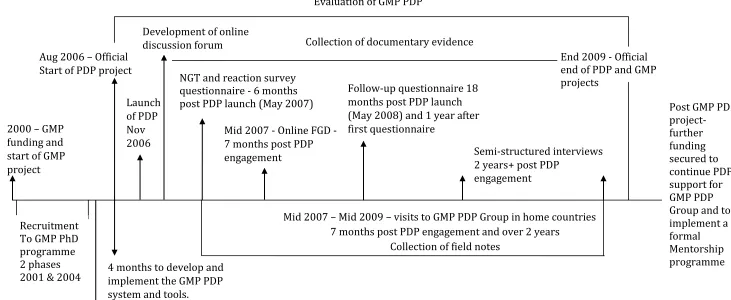
TIMELINE OF THE STUDY
20 Figure 2. Timeline of key events in the PDP project
End 2009 - Official end of PDP and GMP projects
2000 – GMP funding and start of GMP project
NGT and reaction survey questionnaire - 6 months post PDP launch (May 2007) Aug 2006 – Official
Start of PDP project
Recruitment To GMP PhD programme 2 phases 2001 & 2004
PDP needs analysis undertaken at PhD day in Cameroon – Nov 2005
4 months to develop and implement the GMP PDP system and tools. Aug 2006 – Nov 2006
Mid 2007 – Mid 2009 – visits to GMP PDP Group in home countries 7 months post PDP engagement and over 2 years
Collection of field notes Launch
of PDP Nov 2006
Follow-up questionnaire 18 months post PDP launch (May 2008) and 1 year after first questionnaire
Mid 2007 - Online FGD - 7 months post PDP
engagement Semi-structured interviews
2 years+ post PDP engagement Evaluation of GMP PDP
Development of online discussion forum
21 SUMMARY OF CHAPTERS
Chapter one gives an overview of the study. It provides the background, and purpose; and includes the design and significance of the study. Chapter two reviews the literature. It explores the literature of career development and management, and relates this specifically to early-career research scientists, and to Africa. It also examines the current PDP
literature, and from a UK higher education perspective, looks at
definition, how it came to be framed as policy, and the debates around the emerging and developing evidence base. From the perspective of the research scientist, it looks at PDP and the support underpinning PDP for researchers. Chapter three discusses and justifies the methodology chosen to carry out the study, and in exploring the evaluation and theoretical literature, provides a rationale for the choice of frameworks used for the study evaluation. It focuses on the research design, the choice of sample and participants, and the procedures, including data collection and analysis. It also discusses the role of the researcher. Chapter four focuses on the development of the PDP system, tools and supportive infrastructure; and discusses the implementation of the system and PDP processes, and the development of individual personal
22
23
LITERATURE REVIEW
INTRODUCTION
In the previous chapter, the overview of the research study set out the background, purpose, design and significance of the study. In this chapter, the focus is on the review and examination of the literature that is used to inform and support the research.
The context of this research project is the need to support research scientists as they begin their careers in Africa; and to contribute to the retention of this valuable resource in Africa. It also seeks to maximise the value of these researchers by setting out to promote and enhance their career development and progression within this setting. The project therefore, is concerned with Personal Development Planning (PDP) and the tools and processes within PDP that might be used to promote successful career development
24
characteristics of a research career and what skills, knowledge, and career management behaviours do individuals need to have in order to build a successful research career as a scientist in Sub-Saharan Africa (SSA)? Without such an understanding, it would be difficult to develop a tool to support career planning and development for this context. The review therefore drew from the literature found within the key areas of career development. Since the area of career development yielded an extensive body of literature, the focus of the review was kept, where possible, to the areas that related specifically to research scientists, Africa, and personal development planning.
In searching the PDP literature, it became apparent that much of the expanding literature base was focused at undergraduate level; and almost all in developed countries. That said, there was an emerging literature base of PDP for doctoral and postdoctoral researchers; which came mainly from the academic community within the UK. For this reason, the study draws mostly from the experiences and development of PDP from a UK perspective.
PERSONAL DEVELOPMENT PLANNING
Definitions
25
learning, performance and / or achievement and to plan for their
personal, educational and career development” (pg. 2). QAA saw the aim of PDP as helping individuals to become independent, confident self-directed learners – who could relate their learning to a wider context, as well as improve general skills for career management, articulate personal goals and evaluate progress towards achievement. Within the context of the UK higher education system, QAA (2001) saw PDP as a
constituent part of the Higher Education Progress File – a broader strategy comprising of: an academic transcript (information owned by the institution); Personal Development Records (information owned by the student) and PDP (a reflective process to improve own learning).
In the context of PDP for career development with these research scientists in Africa, PDP might be seen as an opportunity to use a structured and supported process to help with reflecting upon their own achievements and development, in order to confidently plan and manage their personal, professional and career development.
Challenges faced with definition and purpose of PDP For practitioners within the UK higher education system,
26
by QAA led to the concept being interpreted and conceptualised in multiple ways; which led to an emergence of a variety of models and approaches to PDP development and implementation. This was
highlighted in a report on the implementation of progress files, where it reported a slow and uneven progress with the introduction of PDP; and considerable variation between and within institutions, modes of delivery, and levels of central support and encouragement for PDP (Brenan and Shah, 2003). They also concluded that much of this variation was down to the fact that there was “no common understanding about what PDP really is” (pg. 7).
Lack of a clear and common meaning of PDP was also highlighted in the systematic map and review undertaken to assess the effectiveness of PDP for improving student learning (Gough et al., 2003). The authors propose PDP to be seen more as a proxy for a number of constructs that
27
rather than a specific approach; and Croot and Gedye (2006, pg. 173) – in disseminating information about PDP to their Geography students,
describe it as a “whole set of processes that collectively are sometimes called Personal Development Planning (PDP).” They list all the elements and processes of the progress file (and more) as some definitions of PDP that the students might hear being used, and do a good job in helping the students to understand the differences in PDP terminology – namely, that reference to PDP is used to denote the process, but when qualified is used to denote the product – that is “a” or “the” PDP (personal development plan).
Understanding the differences in terminology and the associated
challenges of PDP development and implementation was a good starting point for me, in that it helped me to focus on the process of PDP as well as the product and the development of the tools; and in addition gave me an awareness of the varying interpretations of the concept of PDP.
THEORETICAL UNDERPINNING OF PDP
PDP draws its theoretical base from education, and in particular from learning theories. The experiential learning theory developed by Kolb (1984) – which sees effective learning taking place within a four-stage cycle of: concrete experience, reflective observation, abstract
28
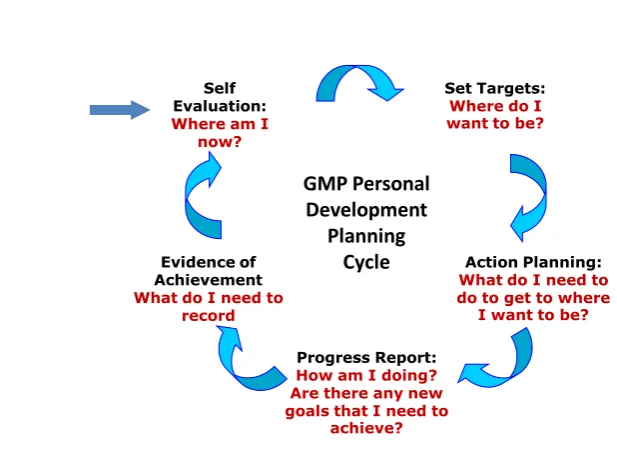
identify needs for development, action planning for these needs through setting goals and targets, carrying out the action plan through undertaking PDP activities, recording the achievement, and identifying further needs for development. Central to the PDP cycle is the concept of reflection; not just the reflection-in-action and the reflection-on-action as espoused by Schön (1983) as the stages of the cycle are worked through, but also the deeper reflection that promotes meta-cognition, which results in self understanding and self knowledge.
In addition to the experiential learning theory underpinning PDP, Jackson, et. al. (2004) note that the self-regulation theory of learning, as developed by Zimmerman (2000) is increasingly consistent with the sets of activities and behaviours found within the PDP processes.
Zimmerman (2000) sees self-regulation or self-regulated learning as the self-generation of thoughts, feelings and actions that are systematically designed to affect one‟s learning of knowledge and skills; and
conceptualises it as consisting of three phases: forethought, performance control, and reflection. The directive process involved with self-regulated learning allows the individual to be proactive, rather than reactive about their PDP; an aspect that helps to achieve the aim of PDP to develop independent, confident and self-directed lifelong learners.
29
formation have had a growing influence in the field of career development. The continuous reference in the PDP literature to the changing social, technological and economic changes that make for a more dynamic and complex work place (Edwards, 2005; Leitch, 2006; Holden and Hamblett, 2007; Evans, 2008) – and the emphasis in the career development literature on the need to develop the portfolio of skills, flexible know-how and adaptability, in order to increase the marketability and employability required to manage the “boundaryless” career (Arthur, 1994) – makes the need to be able to build different identities for employability even more pertinent.
It would be reasonable to suggest that PDP can be seen to support these theories, because when used to its optimum potential PDP has the
capacity to change ways of thinking and habits of mind; and the role that it plays in helping individuals to develop new ways of thinking is crucial if they are to develop the means to enable fitting into the new world of career development and employability.
With learning being the major focus of PDP, and with one of its many purposes including PDP for employability and managing effective
30
from others in the workplace (Eraut, 2007); experiential learning (Kolb, 1984); learning styles to enhance experiential learning, (Kolb and Kolb, 2005), and reflective learning (Gibbs, 1988; Moon, 2001)
PDP EVIDENCE BASE
Debate on conceptual content of PDP
Whilst the policy guidelines were comprehensive and explicit in
determining PDP definitions; outlining composition of the progress file; giving examples of transcripts; and providing a detailed framework for understanding and explaining different approaches to PDP (QAA, 2001: Appendix 2a), it was less explicit in providing a unified approach to the development and implementation of PDP. It was recognised that in offering these “different approaches” the intention was to allow HEIs the flexibility to use, and build on existing infrastructures, practices and policies within their institutions to develop and implement PDP. Jackson et al., (2004) note that policy was framed as such in order to “secure ownership and encourage implementation of PDP in diverse learning contexts” – and so that it could be “customized and implemented to suit any learning or institutional context” (pg. 3). The authors admit that such flexibility is “challenging” because it does require institutions to
31
translate this policy into practice. It led to much interpretation and debate on practicalities such as: what was the exact purpose of PDP? Was its intention process or product? Should it be embedded into the curriculum or should it sit outside? Should the various elements be assessed – and if so, which ones? How right was it to assess the student‟s personal
reflections? Who should provide the student with support – should this be the student‟s personal academic tutor or should the student have a
dedicated PDP tutor–– if so how was this to be resourced? These were just some of the issues debated at the time.
While some of the issues in this conceptual debate were not directly relevant to this research project (for example, embedding PDP into the curriculum or not) it was nevertheless important to have an understanding of the current debate, since I needed a simple, easy communicable
approach – and the knowledge that different approaches were being used in PDP development at the time enabled me to be equally flexibility in my approach of customising and implementing a PDP programme to suit a diverse context.
Parallel research debate on implementation of PDP policy Parallel to this debate on conceptual content was a rising academic research debate around the implementation of policy that was “constructed from practice” (Ward et al., 2005, pg. 6), “developed through a brokered, consultative process” (Jackson, 2003a, cited in
32
Jackson et al., 2004, pg. 2), “based on beliefs and values promoted by committed enthusiasts” (O‟Connell, 2003, cited in Jackson et al., 2004, pg.18), and generally did not appear to have “a firm ontological, evidence base” (Buckley, 2008, pg.4).
Jackson et al., (2004) admit that resources, time or expertise to undertake a systematic review to search for evidence of the impact of PDP-type learning processes were not available to the policy-making agent (QAA); and further admit that from a policy maker‟s position, it was a “messy and inefficient approach” (pg.3). However, this was remedied in 2003 when the Evidence for Policy and Practice Information and Co-ordinating Centre (EPPI-Centre) commissioned a systematic map and synthesis review of the effectiveness of PDP for improving student learning (Gough et al., 2003).
33
Inevitably there was some criticism levelled against the review. Clegg (2005) saw the review as acting as a “post hoc” legitimisation of policy rather than genuinely informing it, since it was conducted post policy decision (pg. 418); and questioned whether the policy decision would have been reversed had the review produced negative results. She also had some difficulty with the research design, which was not levelled at the researchers themselves but rather at systematic review per se as a paradigm for gathering evidence within the social sciences. Argued also was that the researcher-manipulated PDP interventions were so diverse and culturally varied (as the studies were from a wide range of global literature) that it was not known whether the reported outcomes were produced by the same or different mechanisms, or whether interventions, for example such as reflection, were used with any consistency.
34
the use of such evidence to inform policy and practice, that Clegg (2005) found problematic; and believed that it was not the model of the
relationship between evidence-base and policy that practitioners are invited to endorse.
At a more practical level, Buckley (2008) saw much of the empirical work concentrating mainly on direct approaches to PDP rather than self-directed ones, and that in restricting the synthesis to particular features such as the use of learning logs and journals, reflection, self-assessment and regulation, it left aspects like action planning, portfolios, self-awareness and self-motivation relatively under-researched.
The developing PDP evidence base
It is recognised that the PDP evidence base is a developing one, and is therefore necessary to welcome and value all studies that will expand the knowledge base. This is not to suggest that everything within the
35
evidence based practice” Jackson et al., (2004, pg.3) assume that the PDP evidence base will have been developed and implemented over four or five years, and saw PDP practitioners, “whether they be teachers, staff and educational developer change agents, or policy makers” as being instrumental in this process; and that they will look to critically evaluate the evidence derived from the database of guidance in their own practice contexts, and where appropriate, integrate this knowledge into their own practice or policy.
PDP IN HIGHER EDUCATION IN THE UK
PDP is not a new concept, and has a history of being used in a variety of contexts before its shift into higher education within the UK. In the 1990s it was used in industry, business and management, to manage employee career development within organisations (Bennett, 2006; Floodgate and Nixon, 1994; Higson and Wilson, 1995; Tamkin, 1996; Tucker and Moravec, 1995).
36
et al., 1997). At the same time the term “profiling” was being used in higher education to describe the same formative processes of
“empowering students to be involved in the assessment, recording and reviewing of their own personal development and learning” (Assiter and Shaw, 1993, pg. 3). Also seen as central to this recording and reviewing is the stimulated dialogue between students and tutors – to encourage reflection (on their experience), giving and receiving feedback,
diagnosing strengths and weaknesses and agreeing future learning targets and action plans.
With such similarities between recording achievement, profiling and PDP, it was not hard to see how the evolution of PDP and its processes came to be adopted as practice in higher education in the UK.
While PDP is now used extensively within the UK higher education
system, it is not exclusive to the UK. The systematic map and synthesis
review by Gough et al., (2003) highlighted the use of PDP, and PDP
components (such as, portfolios, plans, reflective journals and logs) in a
variety of educational contexts in the USA, Canada, Israel, Spain,
Finland, Australia, South Africa and the Netherlands. Other PDP
literature also shows the use of PDP (and PDP-type processes) being
introduced in contexts outside of the UK (see thesis chapter 1, pg 18).
Chapter 2 – Literature Review
37 PDP policy in UK Higher Education
Whilst a version of PDP (in the form of profiling) was being used in higher education in the UK throughout the 1990s, it was not until recommendations made in the Dearing report in 1997, following a National Committee of Inquiry into Higher Education (NCIHE), that PDP emerged as formalised policy. The report made ninety-three recommendations, of which recommendation twenty advocated that all Higher Education Institutions (HEIs) introduce a higher education progress file – comprising of an academic transcript; personal
development records; and personal development planning (PDP). Following a national consultation involving universities, students, professional bodies and employers, QAA, in conjunction with policy advisors and representative bodies in higher education, published a “Policy statement on a progress file for Higher Education”4
in May 2001; and to help universities and colleges of higher education to develop and introduce progress files, published “Guidelines for HE progress Files”5 later the same year. The policy guidelines also stipulated deadlines for introduction, which saw transcripts to be used by 2002/3 and students provided with the opportunity to engage in PDP by 2005/6.
4
www.qaa.ac.uk/academicinfrastructure/progressFiles/archive/policystatement/default.asp
38
PDP FOR RESEARCH SCIENTISTS IN THE UK
In order to develop a PDP programme and system for a group of research scientists in Sub-Saharan Africa, I needed to have an understanding of how PDP for research scientists worked. In searching the literature it became evident that development of PDP for individuals at postgraduate and postdoctoral level was much further advanced in the UK than elsewhere, so for this reason much of the focus of the literature relating to the development and support for PDP is drawn from within the academic community in the UK.
The use of PDP for students in higher education in the UK was formalised as policy in 2001, when the QAA, following
recommendations made in a National Committee of Inquiry into Higher Education (NCIHE; 1997) stipulated that all students within higher education in the UK be provided with the opportunity to engage in PDP by 2005/6.
For postgraduate research students this opportunity was additionally formalised following recommendations from two further influential reports. One was the 2002 report for the funding councils in the UK on “Improving Standards for Research Degree Programmes”
39
the development and embedding of threshold standards (built on existing good practice within the sector) into section 1 of the QAA Code of Practice for Research Degree Programmes. In the revised code of practice, precept 20 relates to PDP, and states that “institutions will provide opportunities for research students to maintain a record of
personal progress, which may include reference to the development of
research and other skills” (QAA, 2004, pg.21).
The “skills agenda” for postgraduate researchers The Roberts‟ review went further, in that it was somewhat
prescriptive in its recommendations that “... major funders of PhD students make all funding conditional upon students‟ training meeting
stringent minimum standards” – and that these minimum standards “...should include the provision of at least two weeks of dedicated
training a year, principally in transferable skills...” (Roberts, 2002, pg: 11).
Whilst there was an overall positive response to the challenge of introducing transferable skills training at postgraduate research level (through government funding, the setting up of support systems, new policy guidelines and the compilation of a skills set) – in academia and at the level of delivery, the response was more divided.
Hinchcliffe (2007, pg. 9) proposes time pressure, a distrust of the generic skills vocabulary, and not the job of the university to train research graduates, as some of the main issues that make transferable
40
or generic skills training a contested area for some academics; and puts its antipathy by some academics as down to the current structural changes within higher education in the UK, which facilitates the rising of student numbers. In addition he also sees the fact that the skills training largely takes place outside of the student / supervisor relationship and therefore supervisors are required to adopt new practices that they have no experience of. Reeves (2007) picks up this point and offers the view that the skills training agenda not only challenges the substantive experience of doing a PhD but that it also presents an epistemic challenge that requires a conceptual shift in the way the process is viewed and supported. She argues that the PhD experience should result in a portfolio of skills for life, not simply a hard-bound manuscript that sits in a library.
For postdoctoral researchers, the “Set for Success review” (Roberts, 2002) recognisedthat this was a crucial phase in a researcher‟s career; a time in which they could make a name for themselves through ground-breaking, innovative research, and develop the skills to lead research projects. It believed that “...enabling the individual to establish a clear career path and a development plan to take them along it are
critical to improving the attractiveness of postdoctoral research” (pg: 13).
Even though the review was in the context of postdoctoral contract researchers in UK institutions, the observations and recommendations
41
of ensuring that all postdoctoral researchers are given the opportunity to develop individual career paths reflecting the different research career destinations open to them, could be generalised to all researchers at this stage of their career. For the group of African postdoctoral researchers in this study, the point of “improving the attractiveness of postdoctoral research” is a particularly salient one, if they are to feel motivated about staying in their chosen field of research for the benefit of the population in their home countries; and for the benefit of themselves in terms of their career development, satisfaction and opportunity for success.
The Joint Skills Statement
The skills set that was used to guide the development of transferrable skills was devised by the UK Research Councils and the Arts and Humanities Research Board (AHRB), (RCUK, 2001). The “Joint Skills Statement” (Appendix 6) comprising of seven areas of skills and
42
The “Research Career Builder” for postdoctoral researchers A career management system, focusing on longer-term career planning through the development of personal and professional skills, was developed to help support contract researchers and their managers.
Funded by the Higher Education Funding Council (HEFC) and jointly led by three UK universities (Sheffield, Manchester, and Loughborough) and in partnership with 14 other UK universities, a “Research Career Builder” was developed specifically for contract researchers within UK institutions (CRS, Good Management Practice, 2000). Elements of this career
management system were used in the development of the PDP system for the African career researchers in this research project.
Supporting PDP for researchers
While the UK QAA Code of Practice supported the use of PDP at doctoral level, postdoctoral career development was supported by an agreement between the funders and employers of researchers in the UK. “The Concordat to Support the Career Development of Researchers” – which incorporated the framework and practices from the European Charter for Researchers devised by the European Commission in 2005 – was launched in June 2008, and comprises of seven key principles, which set out the expectations and responsibilities of researchers, their
43
at all stages of their career (pg. 11), and the focus of principle five is from the perspective of the individual, and emphasises the sharing of
responsibility for, and need to be pro-actively engaged in own personal and career development and lifelong learning (pg. 12).
Despite the on-going and healthy debate around generic skills training for postgraduate researchers and the changing PhD process, PDP policy makers saw the recommendations within these reports as ensuring that researchers have access to training and development appropriate to their individual needs; and saw PDP as key to realising the ethos espoused within these reviews. While using PDP for this group of African doctoral and postdoctoral researchers did not have the same weight of policy or political drivers behind it, the principle of PDP providing access to development based on individual need for self improvement was a sufficient driving force to explore using it as a tool for career development with this group in Africa.
THE ROLE OF PDP IN CAREER DEVELOPMENT
Careers and career models
Careers within developing countries have seen a shift from a succession of related jobs arranged in a hierarchy of prestige that people work through in an ordered sequence (Wilensky, 1961, cited in Baruch, 2006), to the focus placed on the individual and their work-related experiences” over the span of their “work life” (Hall, 1987, pg.1; Arthur and Rousseau,
44
1996), to extending beyond a working life as it forms “a unique pattern over the individual‟s life span” (Sullivan and Baruch,2009, pg. 1543). As a result of these shifts, and changes such as increased globalisation, rapid technological advances and increased diversity within the
workplace and the workforce (part-time, temporary employees and people working for themselves) attitudes and behaviours towards career and models of careers have changed (Sullivan and Baruch, 2009). Dominant in the literature of career management and development is the “boundaryless” career model, as seen by Arthur (1994). The thinking within this model is a move away from the traditional linear career model that typically took place within a single organisation (Hall and Mirvis, 1995; McDonald et al., 2005; Sullivan and Baruch, 2009) to a model that sees the career transcending the boundary of a single path, occupation and employer. At the core of this “boundaryless” career model is career independence.
Also found within the literature, is the “protean” career model – which is proactively managed proactively by individuals, according to their own values (Sargent and Domberger, 2007), has the individual (rather than the organisation) taking responsibility for transforming their own career path (Hall and Mirvis, 1995); and the psychological focus rather than material success as being the main goal of a protean careerist (Hall, 2002, cited in Sullivan and Baruch, 2009).
Chapter 2 – Literature Review
45
While these two career models appear similar, the concepts are viewed in a variety of ways – as complementary (Inkson, 2006); distinct but
overlapping (Briscoe and Hall, 2006) or as two distinct constructs.
Career models and research scientists
Baruch and Hall (2004) argue that the scientific research career is typical of the modern “boundaryless” career model, in that there are some distinct features that support this career model. For example, a
professional basis, multi-directional career paths, a high degree of lateral movement across organisational boundaries, and a strong dependency on network. This observation is supported by the reality that the career development of a scientific researcher is reliant on at least some of these features – and particularly on the strong dependency on network – as seen later in the research where some of the researchers in the study identify networking with other researchers a skill that is needed to help them with their career development.
While the “boundaryless” career model can be seen to typify the career model of the career researcher, Sommerlund and Boutaiba (2007) found in their research study with scientists in a molecular biology laboratory in Denmark that, rather than the “boundaryless” career replacing the
traditional career model, the career of these research scientists were supported by a mix of the “old” traditional career models
46
career models – thus supporting the assertion that (in some organisations at least) traditional career models do still exist (Guest and McKenzie-Davey, 1996; Reitman and Schneer, 2003), are still valued (King, 2006), can exist alongside each other, and be supported within the same
organisation (McDonald, Brown and Bradley (2005).
This finding is also supported within this research study of the African research scientists based in SSA, where some of these research scientists manage what Sullivan and Baruch (2009) refer to as a “hybrid” career model – which contain aspects of both the traditional and “protean” or “boundaryless” career concepts. For example, the African researchers who have positions (and aspects of a traditional career) within a university, their National Health Services, or national research
institutions, whilst still having some aspects of protean and boundaryless careers through proactively managing independent research with
employers outside of their organisation.
Career management and early-career researchers
Despite the “boundaryless” career having a place within a career research pathway, and the model that most fits the economic necessity of the changing workplace, Zeitz et al., (2009) point out that, in order for an individual to have a successful boundaryless career, there are required needs for certain management behaviours, attitudes and support.