A Resolution Calculus for the Branching-Time Temporal Logic CTL
LAN ZHANG, Capital University of Economics and Business
ULLRICH HUSTADT, University of Liverpool
CLARE DIXON, University of Liverpool
The branching-time temporal logic CTL is useful for specifying systems that change over time and involve quantification over possible futures. Here we present a resolution calculus for CTL that involves the trans-lation of formulae to a normal form and the application of a number of resolution rules. We use indices in the normal form to represent particular paths and the application of the resolution rules is restricted dependent on an ordering and selection function to reduce the search space. We show that the translation preserves satisfiability, the calculus is sound, complete and terminating and consider the complexity of the calculus. Categories and Subject Descriptors: F.4.1 [Mathematical Logic and Formal Languages]: Temporal logic; F.4.1 [Mathematical Logic and Formal Languages]: Mechanical theorem proving; I.2.3 [Artificial In-telligence]: Deduction and theorem proving
General Terms: Theory, Algorithms, Verification
Additional Key Words and Phrases: Temporal Logic, Automated Theorem Proving, Resolution
ACM Reference Format:
Zhang, L., Hustadt, U., and Dixon, C. 2013. A Resolution Calculus for the Branching-Time Temporal Logic CTL.ACM Trans. Comput. Logic1, 1, Article 1 (October 12), 39 pages.
DOI:http://dx.doi.org/10.1145/0000000.0000000
1. INTRODUCTION
Computation Tree Logic (CTL) [Clarke and Emerson 1982] is a propositional branching-time temporal logic whose underlying model of time is a choice of possi-bilities branching into the future. CTL uses the path quantifiers A (for all paths) and E (for some path) and temporal operators, for example2 meaning now and at all future moments. Additionally CTL has the restriction that each temporal oper-ator must be paired with a path quantifier, for example A2ϕ means on all paths
ϕ always holds. There are many important applications that can be represented in and reasoned about in CTL such as the verification of digital circuits [Clarke et al. 2000], analysis of real time and concurrent systems [Manna and Pnueli 1992], XPath query processing [Afanasiev et al. 2004], communication protocol verification [Clarke et al. 1986], and Grid Component system verification [Basso and Bolotov 2007]. A variant on CTL has been used in [Attie 2003] applied to concurrent control protocols
This work was partially supported by the UK Engineering and Physical Sciences Research Council (EPSRC) grant number EP/D060451.
The first author was partially supported by (1) the Technology Foundation for Selected Overseas Chinese Scholars, Bureau of Human Resources and Social Security of Beijing and (2) National Natural Science Foun-dation of China (Grant No. 61303018) and (3) Research Improvement Funding, Beijing Municipal Education Commission.
Authors’ addresses: L. Zhang, School of Information, Capital University of Economics and Business, China; U. Hustadt, C. Dixon, Department of Computer Science, University of Liverpool, UK
Permission to make digital or hard copies of part or all of this work for personal or classroom use is granted without fee provided that copies are not made or distributed for profit or commercial advantage and that copies show this notice on the first page or initial screen of a display along with the full citation. Copyrights for components of this work owned by others than ACM must be honored. Abstracting with credit is per-mitted. To copy otherwise, to republish, to post on servers, to redistribute to lists, or to use any component of this work in other works requires prior specific permission and/or a fee. Permissions may be requested from Publications Dept., ACM, Inc., 2 Penn Plaza, Suite 701, New York, NY 10121-0701 USA, fax+1 (212) 869-0481, or [email protected].
c
12 ACM 1529-3785/12/10-ART1 $15.00
where the focus is synthesising a concurrent program from a specification. Addition-ally branching-time logics have been used to specify and verify robustness in systems. The logics RoCTL* [French et al. 2007] and RoCTL [McCabe-Dansted and Dixon 2010] are branching-time temporal logics with additional operators to deal with obligation and robustness (i.e. at mostnfailures can occur).
Given the specification of a system in some logic it is often useful to be able to verify properties of that system. This is to show that desirable properties do hold on all runs through the system and unwanted properties do not hold. There are two main ways to do this: model checking and theorem proving. Using model checking one inputs a model of the system, usually a state transition system and a property to be checked that is a formula in some logical language, for example CTL. The output is a set of states where the property holds. With theorem proving both the model of the system and the property are given as logical formulae. A calculus for the logic is applied to show that the property follows from the specification. In this paper we follow the theo-rem proving route and provide a resolution-based calculus for CTL. The complexity of the model checking problem for CTL is PTIME complete [Clarke et al. 1986] and the complexity of satisfiability is EXPTIME-complete [Clarke and Emerson 1982; Emer-son 1990; EmerEmer-son and Halpern 1985]. Whilst the complexity of satisfiability is higher than for model checking, theorem proving approaches to CTL are still useful, for exam-ple where a model of a system is not readily available or immediately obvious, or to use in conjunction with model checkers for example to check that complex CTL properties are in fact satisfiable before they are model checked.
This paper presents a sound, complete and terminating resolution calculus, R,SCTL, for the logic CTL. The overall approach involves transformation to a normal form, called Separated Normal Form with Global Clauses for CTL,SNFgCTLfor short, and the application ofstepandeventualityresolution rules inR,SCTL that deal with constraints on next states and on future states, respectively. This paper is a revised and extended version of the calculusR,SCTLfor CTL described in [Zhang et al. 2009a] and formed part of the thesis [Zhang 2010].
The calculus relates to that in [Bolotov 2000] that we have improved upon in the following aspects.
(1) An idea introduced in [Bolotov 2000] is the use of indices as part of the CTL normal form that relate to a particular path. We give a formal interpretation of indices and a formal semantics for the indexed normal form,SNFgCTL, which is missing from [Bolotov 2000].
(2) An ordering and a selection function are introduced into the calculus which allow us to reduce the number of possible applications of the inference rules during proof search.
(3) We show that our calculus R,SCTL is sound, complete and terminating. Using our completeness proof we can show that two eventuality resolution rules in [Bolotov 2000] are redundant.
(4) A detailed complexity analysis of the calculus is provided, which is absent for the earlier calculus.
(5) Finally, we have implementedR,SCTL in the theorem prover CTL-RP [Zhang et al. 2009b] whereas no implementation was provided for the earlier calculus in [Bolo-tov 2000].
our calculusR,SCTL. Finally, related work is discussed in Section 7 and conclusions are drawn in Section 8. Some of the proofs have been moved to an Electronic Appendix.
2. COMPUTATIONAL TREE LOGIC (CTL)
The language of CTL is based on
— a set of atomic propositionsPPL;
— propositional constants,trueandfalse;
— boolean operators,∧,∨,⇒,and¬(∧and∨are associative and commutative1); and — temporal operators 2 (always in the future), # (at the next moment in time), 3
(eventually in the future), U (until), and W (unless); and theuniversal path quan-tifierA(for all future paths) and theexistential path quantifierE(for some future path).
The set of(well-formed) formulae of CTLis inductively defined as follows:
(1) trueandfalseare CTL formulae;
(2) all atomic propositions inPPLare CTL formulae; and
(3) ifϕandψare CTL formulae, then so are¬ϕ,(ϕ∧ψ),(ϕ∨ψ),(ϕ⇒ψ),A2ϕ,A3ϕ, A#ϕ,A(ϕUψ),A(ϕWψ),E2ϕ,E3ϕ,E#ϕ,E(ϕUψ), andE(ϕWψ).
Formulae of CTL overPPL are typically interpreted inmodel structures(see for ex-ample [Emerson 1990]),M =hS, R, Li, whereS is a set ofstates;Ris a serial binary accessibility relationoverS; andL : S → 2PPL is an interpretation functionmapping
each state to the set of atomic propositions true at that state. These model structures are not required to be tree structures. However, CTL formulae can also be interpreted in tree model structures, which will be introduced later.
An infinite path χsi is an infinite sequence of states si, si+1, si+2, . . . such that for
everyj ≥ i,(sj, sj+1) ∈ R. A states0 ∈ S isreachablefrom the state s ∈ S iff there exists an infinite pathχssuch thats0∈χs. If there exists two statess, s0∈Ssuch that
(s, s0)∈R, we say thatsis apredecessorofs0ands0 is asuccessorofs.
The satisfaction relation|=between a pair consisting of a model structureM and a statesi∈S, and a CTL formula is inductively defined as follows:
hM, sii |=true hM, sii 6|=false
hM, sii |=p iffp∈L(si)for an atomic propositionp∈PPL
hM, sii |=¬ϕ iffhM, sii 6|=ϕ
hM, sii |= (ϕ∧ψ) iffhM, sii |=ϕandhM, sii |=ψ
hM, sii |= (ϕ∨ψ) iffhM, sii |=ϕorhM, sii |=ψ
hM, sii |= (ϕ⇒ψ) iffhM, sii 6|=ϕorhM, sii |=ψ
hM, sii |=E#ψ iff there exists a pathχsisuch thathM, si+1i |=ψ
hM, sii |=A(ϕUψ)iff for every pathχsi there existssj∈χsi such that
hM, sji |=ψand for everysk∈χsi, ifi≤k < j,
thenhM, ski |=ϕ
hM, sii |=E(ϕUψ) iff there exists a pathχsiand there existssj∈χsi
such thathM, sji |=ψand for everysk∈χsi,
ifi≤k < j, thenhM, ski |=ϕ
In addition, we use the following equivalences to define the remaining operators of CTL.
A3ϕ≡A(trueUϕ) E3ϕ≡E(trueUϕ)
A2ϕ≡ ¬E3¬ϕ E2ϕ≡ ¬A3¬ϕ
A(ϕWψ)≡ ¬E(¬ψU(¬ϕ∧ ¬ψ)) E(ϕWψ)≡ ¬A(¬ψU(¬ϕ∧ ¬ψ))
A#ϕ≡ ¬E#¬ϕ
A CTL formulaϕissatisfiable, iff for some model structureM =hS, R, Liand some states∈S,M, s|=ϕ, andunsatisfiableotherwise. A model structureM such thatϕis true at some states∈S is called amodelofϕ. A CTL formulaϕisvalid, written|=ϕ, iff for every model structure M = hS, R, Liand for every states ∈ S, M, s |=ϕ. The satisfiability problem of CTL is known to be EXPTIME-complete [Clarke and Emerson 1982; Emerson 1990; Emerson and Halpern 1985].
The set of valid CTL formulae is not affected whether the model structures are tree model structures or not [Emerson 1990; Emerson and Halpern 1982]. Essentially, asR
is a serial relation, any arbitrary model structure can be ‘unwound’ into an infinite tree model structure. Therefore, in the following we restrict ourselves to model structures
M =hS, R, L, s0isuch that
— there exists a unique states0, called therootsuch that every states∈Sis reachable from states0and there are no predecessors ofs0;
— for every states∈S except the root, stateshas exactly one predecessor;
For model structures M = hS, R, L, s0i, it is also convenient to use definitions of sat-isfiability and validity which are slightly different from the version presented ear-lier. In particular, we say a CTL formula ϕ is satisfiable iff for some model struc-ture M = hS, R, L, s0i, M, s0 |= ϕ and unsatisfiable otherwise. A model structure
M =hS, R, L, s0isuch thatϕis true ats0 is a model ofϕ. A CTL formulaϕis valid iff for every model structure M =hS, R, L, s0i, M, s0 |= ϕ. Thus, our definition requires that ifM is a model ofϕ, thenϕmust be satisfied at the root ofM, namely states0, whereas the previous definition allows ϕ to be satisfied at any state of M. It is not hard to see that there exists a model for a CTL formulaϕaccording to the previous definition iff there exists a model forϕaccording to our definition. The reason we add this restriction is that it can simplify the proof that our transformation rules preserve satisfiability.
3. NORMAL FORM
The calculus R,SCTL operates on formulae in a clausal normal form, called Separated Normal Form with Global Clauses for CTL, denoted by SNFgCTL. An important dif-ference between CTL formulae and SNFgCTL is an extension of the syntax of CTL to useindices. These are associated with the existential path quantifiers. Formulae such as E#p (or E3p) are decorated with an index ind to become Ehindi#p (respectively Ehindi3p) to denote thatpis satisfied on a particular successor state (respectively state accessible by a particular path). They are used to preserve satisfiability during the transformation into the normal form. The language ofSNFgCTLclauses is defined over an extension of CTL. That is the language is based on
— the language of CTL;
— a propositional constantstart; and — a countably infinite index setInd.
(i). A#,E#,A3,E3,A2,E2,AU,EU,AW,EW,E#hindi,Ehindi3,Ehindi2, EhindiU,EhindiW, whereind ∈Ind;
(ii). ¬; (iii). ∧;
(iv). ∨; and (v). ⇒.
Two operators in the same group have the same precedence. Higher precedence op-erators are applied before lower precedence opop-erators. Then the language ofSNFgCTL
clausesconsists of formulae of the following forms:
A2(start⇒Wk
j=1mj) (initial clause)
A2(true⇒Wk
j=1mj) (global clause)
A2(Vn
i=1li⇒A#W k
j=1mj) (A-step clause) A2(Vn
i=1li⇒Ehindi#W k
j=1mj) (E-step clause) A2(Vn
i=1li⇒A3l) (A-sometime clause) A2(Vn
i=1li⇒Ehindi3l) (E-sometime clause)
where k ≥ 0,n > 0, startis a propositional constant,li (1 ≤ i ≤ n), mj (1 ≤j ≤ k) andlare literals, that is, atomic propositions or their negation, andind is an element ofInd. For a literall,¬ldenotespifl is¬pand it denotes¬piflisp, for some atomic propositionp. We use ‘false’ to denote both the logical constant and empty disjunctions in clauses. As all clauses are of the formA2(P ⇒D), we often simply writeP ⇒ D
instead. We assume that allSNFgCTL clauses are always kept in condensed form, i.e. there are no duplicate literals in eitherPorD. For example, aSNFgCTLclauser∧q∧q⇒ A#(q∨p∨q)is always represented asr∧q⇒A#(q∨p). We call a clause which is either an initial, a global, anA-step, or anE-step clause adeterminate clause. The formula A3lis called anA-eventualityand the formulaEhindi3lis called anE-eventuality.
A key part ofSNFgCTLare indices. These indices can be used to preserve a particular path context. For example,
— the formulaE#p∧E#¬pis obviously satisfiable, as in general, these two existential path quantifiers can refer to two different paths; whereas
— the formulaEhindi#p∧Ehindi#¬pis unsatisfiable, as two existential quantifiers hav-ing the same indexind indicatepand¬pare satisfied at the same successor state of the current state.
Informally speaking, when an index ind is associated with a next operator (#), this allows the identification of a particular successor state. For instance, if Ehindi#pis satisfied at a state s, then there exists a state s0 such that the edge from s to s0 is labelled by ind and pholds at s0. When an index ind is associated with a multi-step operator (3,2,U or W),ind allows the identification of a particular path where the edge to each successor state in the path is is labelled byind. For instance, ifEhindi3p
is satisfied at states, then there exists a states0reachable fromssuch that each edge in the path fromstos0is labelled byindandpholds ats0.
We use indices in the transformation to normal form to preserve satisfiability. In particular, they are necessary to translate until formulae (for exampleE(pUl)). Here the transformation (see Section 3.2, Trans(11)) introduces global andE-step clauses that enforcel∨pin the next moment on some path. However we must ensure thatl
This must hold on thesame pathas theE-step clauses mentioned previously and we use indices to ensure this.
3.1. Syntax and semantics ofSNFgCTL
To provide a semantics for SNFgCTL, we extend model structures hS, R, L, s0i to hS, R, L,[ ], s0iwhere the unary function[ ] :Ind→2(S×S)maps every indexind ∈Ind to asuccessor function[ind]which is a total functional relation onSand a subset of the binary accessibility relation R, that is, for everys ∈ S,there exists exactly one state
s0 ∈ S such that(s, s0) ∈ [ind] and(s, s0) ∈ R. So [ ]applied toind results in a set of pairs denoting, for any state, exactly oneind-related successor state. A states0 ∈S is an ind-successor stateof states∈S iff(s, s0)∈[ind]. Aninfinite pathχhindisi is an
infi-nite sequence of states si, si+1, si+2, . . .such that for everyj ≥i,(sj, sj+1)∈ [ind]. An infinite pathχhindisk =s
0
k, s0k+1, . . .is asubpathofχ hindi
si iff there exists a natural number
l, l ≥i, where sl ∈χhindisi , such that for everyj ≥0,s
0
k+j =sl+j. Note that since[ind] is a function, for every statesi∈S, there exists exactly one infinite pathχ
hindi
si and for
every statesj ∈χhindisi ,χ
hindi
sj is a subpath ofχ
hindi
si . The semantics of SNF
g
CTL is then defined as shown below as an extension of the semantics of CTL defined in Section 2. Although the operators Ehindi2, EhindiU and EhindiW do not appear in the normal form, we state their semantics, because they occur in the normal form transformation. (The semantics of the remaining operators is analogous to that given previously but in the extended model structurehS, R, L,[ ], s0i.)
hM, sii |=start iffsi=s0
hM, sii |=Ehindi#ψ iff for the pathχhindisi ,hM, si+1i |=ψ
hM, sii |=Ehindi3ψ iffhM, sii |=Ehindi(trueUψ) hM, sii |=Ehindi2ψ iff for everysj∈χhindisi ,hM, sji |=ψ
hM, sii |=Ehindi(ϕUψ) iff there existssj∈χhindisi such thathM, sji |=ψand
for everysk∈χ hindi
si , ifi≤k < j, thenhM, ski |=ϕ
hM, sii |=Ehindi(ϕWψ)iffhM, sii |=Ehindi2ϕorhM, sii |=Ehindi(ϕUψ)
A SNFgCTL formula ϕ is satisfiable, iff for some model structure M =
hS, R, L,[ ], s0i, M, s0 |= ϕ, and unsatisfiable otherwise. A model structure M = hS, R, L,[ ], s0isuch that ϕis true at the state s0 ∈ S is called a model of ϕand we say thatM satisfiesϕ. ASNFgCTL formulaϕisvalid, written|=ϕ, iff for every model structureM =hS, R, L,[ ], s0i, M, s0|=ϕ.
3.2. Transformation
We first introduce definitions ofindexed CTL formulaandCTL clauses, which will be used in our definition of the transformation from an arbitrary CTL formula into a set of formulae in normal form.
Definition 3.1. [Indexed CTL formula] The set ofindexed CTL formulaeis induc-tively defined as follows:
(1) true,falseandstartare indexed CTL formulae;
(2) all atomic propositions inPPL are indexed CTL formulae; and
Definition 3.2. [CTL clauses] A CTL formula of the formA2(P ⇒ϕ), whereP is a conjunction of literals (possibly consisting of a single literal) or a propositional constant andϕis an arbitrary indexed CTL formula, is aCTL clauseor aclause.
We now define a set of transformation rules which allows us to transform an arbi-trary CTL formula into an equi-satisfiable set of SNFgCTLclauses.
Letnnf denote a function which transforms an arbitrary CTL formula into its nega-tion normal form by pushing neganega-tions ‘inwards’. Letsimpbe a function which simpli-fies an arbitrary CTL formula by exhaustive application of the following simplification rules,
(ϕ∧true)−→ϕ (ϕ∧false)−→false
(ϕ∨true)−→true (ϕ∨false)−→ϕ
¬true−→false ¬false−→true
where ϕ is a CTL formula and ∨ and ∧ are commutative and associative, plus the following rules which are based on the equivalences in [Emerson 1990].
PTfalse−→false PTtrue−→true P(ϕUfalse)−→false P(ϕUtrue)−→true P(falseUϕ)−→ϕ P(trueUϕ)−→P3ϕ
P(ϕWfalse)−→P2ϕ P(ϕWtrue)−→true P(falseWϕ)−→ϕ P(trueWϕ)−→true
whereP∈ {A,E}andT∈ {#,2,3}.
Letinit(ϕ)be the set of CTL clauses{A2(start⇒p),A2(p⇒simp(nnf(ϕ)))}, where
pis a new atomic proposition inPPLthat does not occur inϕ.
Then the transformation of an arbitrary CTL formula ϕintoSNFgCTL consists of a sequenceT0, T1, . . . , Tnof sets of CTL clauses such that (i)T0=init(ϕ)and (ii) for every
t,0≤t < n, Tt+1= (Tt\{ψ})∪Rt, whereψis a formula inTtnot inSNF g
CTLandRtis the result of applying a matching transformation rule toψ. Moreover, for everyt,0≤t < n,
Ttcontains at least one formula not inSNF g
CTLwhile all formulae inTnare inSNF g CTL. Note that for each rule ofTranscontaining a propositionp,prepresents a new atomic proposition inPPLwhich does not occur inTtwhen we apply the rule to a clause inTt. Furthermore, in the presentation of the rules, let
—qbe an atomic proposition, —lbe a literal,
—Dbe a disjunction of literals (possible consisting of a single literal), and —ϕ, ϕ1andϕ2, be CTL formulae.
The definition of the rule setTransis as follows.
— Index introduction rules:
Trans(1) q⇒ETϕ−→q⇒EhindiTϕ
Trans(2) q⇒E(ϕ1T0ϕ2)−→q⇒Ehindi(ϕ1T0ϕ2) whereT∈ {#,2,3},T0 ∈ { U,W }andindis a new index.
Trans(3) q⇒ϕ1∧ϕ2−→
q⇒ϕ1
q⇒ϕ2
Trans(4) q⇒ϕ1∨ϕ2−→
q⇒ϕ1∨p
p⇒ϕ2
ifϕ2is not a disjunction of literals.
Trans(5) q⇒D−→true⇒ ¬q∨D
q⇒false−→true⇒ ¬q
q⇒true−→ {}
— Temporal operator rules:
Trans(6) q⇒P#ϕ−→
q⇒P#p
p⇒ϕ
ifϕis not a disjunction of literals.
Trans(7) q⇒P3ϕ−→
q⇒P3p
p⇒ϕ ifϕis not a literal.
Trans(8) q⇒P(ϕ1Uϕ2)−→
q⇒P(ϕ1Up)
p⇒ϕ2 ifϕ2is not a literal.
Trans(9) q⇒P(ϕ1Wϕ2)−→
q⇒P(ϕ1Wp)
p⇒ϕ2 ifϕ2is not a literal.
Trans(10) q⇒P2ϕ−→
(q⇒p
p⇒ϕ
p⇒P#p
Trans(11) q⇒P(ϕUl)−→
q⇒l∨p
p⇒ϕ
p⇒P#(l∨p)
q⇒P3l
Trans(12) q⇒P(ϕWl)−→
(q⇒l∨p
p⇒ϕ
p⇒P#(l∨p)
whereP∈ {A,Ehindi}
Example 3.3. In the following, we transform the unsatisfiable CTL formula ϕ2 = E2¬l∧A3linto a satisfiability equivalent set ofSNFgCTLclauses. We apply the function
initto the CTL formulaϕ2:
Then we transform the setΓ2of clauses into a set ofSNFgCTL clauses.
1.start⇒p1
2. p1⇒E2¬l∧A3l
3. p1⇒E2¬l [2,Trans(3)]
4. p1⇒A3l [2,Trans(3)]
5. p1⇒Eh1i2¬l [3,Trans(1)]
6. p1⇒p2 [5,Trans(10)]
7. p2⇒ ¬l [5,Trans(10)]
8. p2⇒Eh1i#p2 [5,Trans(10)]
9.true⇒ ¬p1∨p2 [6,Trans(5)]
10.true⇒ ¬p2∨ ¬l [7,Trans(5)]
Then the set ofSNFgCTL clauses consisting of the following clauses is satisfiable iff the CTL formulaE2¬l∧A3lis satisfiable.
1.start⇒p1
4. p1⇒A3l
8. p2⇒Eh1i#p2
9. true⇒ ¬p1∨p2
10. true⇒ ¬p2∨ ¬l
We will return to this set ofSNFgCTLlater.
4. THE CLAUSAL RESOLUTION CALCULUSRCTL,S
Our clausal resolution calculusR,SCTLfor CTL is based on, but not identical to, the reso-lution calculus in [Bolotov 2000; Bolotov and Fisher 1999]. The calculusR,SCTLconsists of
— eightstepresolution rules SRES1 to SRES8,
— twoeventualityresolution rules ERES1 and ERES2, and — tworewriterules RW1 and RW2.
Furthermore, all the rules of R,SCTL operate on SNFgCTL clauses. The calculus can be used to develop an EXPTIME decision procedure for the satisfiability problem of CTL.
4.1. Step resolution
As the search space for resolution for classical propositional and first-order logic is large, in practice, refinements for resolution are necessary. In particular, ordering and selection function refinements are utilised by many efficient theorem provers, for ex-ample, SPASS [Max-Planck-Institut f ¨ur Informatik 2010], Vampire [Voronkov ] and Prover9 [McCune ]. The need for such refinements in order to be efficient in practice is also true for non-classical logics, for instance CTL. Moreover,R,SCTLis designed in such a way that the step resolution can be emulated by first-order resolution. Motivated by refinements of propositional and first-order resolution [Bachmair and Ganzinger 2001], we restrict the applicability of step resolution rules by means of an atom or-dering and a selection function. These refinements have two advantages: (i) we can prove that they do not impair the completeness of R,SCTL; and (ii) the efforts of imple-menting them can be dramatically reduced by reusing some existing high performance first-order resolution prover, which contains these refinements.
Definition4.1 (Partial ordering). A partial ordering R on a set S is the ordering such that
— for every elements∈S,(s, s)6∈R;
— for all elementss, t, uofS, if(s, t),(t, u)∈R, then(s, u)∈R.
Definition4.2 (Total ordering). A partial orderingRon a setSis atotal orderingif for every pair of distinct elementssandtofS,(s, t)∈Ror(t, s)∈R.
Definition4.3 (Well-founded ordering).
A partial orderingRon a setSis awell-founded orderingif every non-empty subset of
S has a minimal element with respect toR.
An atom ordering forR,SCTL is a well-founded and total ordering on the set PPL. The orderingis extended to literals such that for eachp∈PPL,¬pp, and for each q∈PPLsuch thatqpthenq ¬pand¬q ¬p.
A literal l is (strictly)maximalwith respect to a propositional disjunctionC iff for every literall0 inC,l06l(l0 6l).
A selection function is an arbitrary function S mapping every propositional dis-junction C to a possibly empty subset S(C) of the negative literals occurring in C. Ifl∈S(C)for a disjunctionC, then we say thatlisselectedinC.
In the following presentation of the rules ofR,SCTL,indis an index inInd,PandQare conjunctions of literals,CandD are disjunctions of literals, neither of which contain duplicate literals, andlis a literal.
SRES1
P ⇒A#(C∨l)
Q⇒A#(D∨ ¬l)
P∧Q⇒A#(C∨D)
SRES2
P ⇒Ehindi#(C∨l)
Q⇒A#(D∨ ¬l)
P∧Q⇒Ehindi#(C∨D)
SRES3
P ⇒Ehindi#(C∨l)
Q⇒Ehindi#(D∨ ¬l)
P∧Q⇒Ehindi#(C∨D)
SRES4
start⇒C∨l
start⇒D∨ ¬l
start⇒C∨D
SRES5
true⇒C∨l
start⇒D∨ ¬l
start⇒C∨D
SRES6
true⇒C∨l Q⇒A#(D∨ ¬l)
Q⇒A#(C∨D)
SRES7
true⇒C∨l
Q⇒Ehindi#(D∨ ¬l)
Q⇒Ehindi#(C∨D)
SRES8
true⇒C∨l
true⇒D∨ ¬l
true⇒C∨D
(C1) iflis a positive literal, then
(1) l must be strictly maximal with respect to C and no literal is selected in
C∨l, and
(2) (i)¬lmust be selected inD∨ ¬lor (ii) no literal is selected inD∨ ¬land¬l
is maximal with respect toD; or
(C2) iflis a negative literal, then
(1) (i) l must be selected in C∨l or (ii) no literal is selected inC∨l andl is maximal with respect toC, and
(2) ¬lmust be strictly maximal with respect to Dand no literal is selected in
D∨ ¬l.
Note that these two conditions are identical modulo the polarity of l, i.e. having or not having the negation¬in front ofl. Ifl inC∨l and¬l inD∨ ¬l satisfy condition (C1) or condition (C2), then we say thatliseligibleinC∨land¬liseligibleinD∨ ¬l.
The rewrite rules RW1 and RW2 are defined as follows:
RW1 Vn
i=1mi⇒A#false −→ true⇒W n i=1¬mi
RW2 Vn
i=1mi⇒Ehindi#false −→ true⇒W n i=1¬mi
wheren≥1and eachmi,1≤i≤n, is a literal.
An example of how to apply step resolution and rewrite rules is given below.
Example 4.4.
In Example 3.3, we have seen that the application of our transformation rules to the CTL formula ϕ = E2¬l ∧A3l results in the following satisfiability equivalent set of SNFgCTL clauses. Using the orderingl p1 p2 and the selection function S mapping every propositional disjunctionCto an empty set, the underlined literals are the eligible literals in these clauses.
1.start⇒p1
2. p1⇒A3l
3. p2⇒Eh1i#p2
4. true⇒ ¬p1∨p2
5. true⇒ ¬p2∨ ¬l
Using step resolution we are able to generate the following derivation where the no-tation[c1, . . . , cn,SRESi]indicates that we apply theith step resolution rule to clauses
c1, . . . , cn, respectively.
6.start⇒p2 [1,4,SRES5]
Note that without ordering and selection we would also be able to derive the following two clauses.
7. p2⇒Eh1i#¬l [3,5,SRES7]
8.true⇒ ¬p2∨ ¬l [4,5,SRES8]
selection function which always selects some negative literal if a clause has one. The completeness of this refinement of temporal resolution for the linear-time temporal logic PLTL was independently shown by Gago [Fern ´andez Gago 2004].
4.2. Eventuality resolution
The intuition underlying the eventuality resolution rule ERES1 below is to resolve an eventuality A3¬l, which states that3¬l is true on all paths, with a set of SNFgCTL clauses which together, provided that their combined left-hand sides were satisfied, imply that2lholds on (at least) one path.
ERES1
P† ⇒E#E2l Q⇒A3¬l
Q⇒A(¬(P†)W ¬l)
whereP†⇒E#E2lrepresents a set,ΛE2, of SNFgCTLclauses
P1
1 ⇒ ∗C11 P1n⇒ ∗C1n ..
. ...
P1
m1 ⇒ ∗C
1
m1 · · · P
n
mn⇒ ∗C
n mn
where for everyi,1≤i≤n, there is someind∈Indsuch that each∗is either empty or an operator in{A#,Ehindi#}and for everyi,1≤i≤n,
(Vmi
j=1C i
j)⇒l (1)
and
(Vmi
j=1Cji)⇒( Wn
i=1 Vmi
j=1Pji) (2)
are provable. Furthermore,P† =Wn i=1
Vmi
j=1P i
j. Conditions (1) and (2) ensure that the setΛE2of SNFgCTL clauses impliesP†⇒E#E2l.
Note that the conclusion of ERES1 is not stated in normal form. To present the con-clusion of ERES1 in normal form, we use a new atomic propositionwA
¬luniquely asso-ciated with the eventualityA3¬l. Then the conclusion of ERES1 can be represented by the following set of SNFgCTLclauses:
{wA
¬l ⇒A#(¬l∨ Wmi
j=1¬P i
j)|1≤i≤n} ∪ {true⇒ ¬Q∨ ¬l∨Wmi
j=1¬Pji|1≤i≤n} ∪ {true⇒ ¬Q∨ ¬l∨w¬lA, wA¬l⇒A#(¬l∨wA¬l)}.
The use of a propositionw¬lA uniquely associated with the eventualityA3¬l is impor-tant for the termination of our procedure. It allows us to represent all resolvents by ERES1 using a fixed set of propositions depending only on the initial set of clauses, i.e.,
n differentA-eventualities in the initial set of clauses require at mostn new atomic propositions to represent resolvents by ERES1.
In the following we give a concrete example to demonstrate an application of ERES1.
Example 4.5. We resolve theA-sometime clauseu⇒A3¬lwith the following set
ΛE2ofSNFgCTLclauses
p⇒Eh1i#l q⇒Eh2i#l
r⇒Eh1i#q q⇒Eh2i#p
where each column satisfies (1) and (2). Therefore,P† = ((p∧r)∨q)andP† ⇒E#E2l. We then can resolve the clauseu⇒A3¬lwith((p∧r)∨q)⇒E#E2las follows.
((p∧r)∨q)⇒E#E2l u⇒A3¬l
u⇒A(¬((p∧r)∨q)W ¬l)
Then the resolvents of the application of ERES1 above inSNFgCTL are as follows:
w¬lA ⇒A#(¬l∨ ¬p∨ ¬r)
wA
¬l ⇒A#(¬l∨ ¬q) true⇒ ¬u∨ ¬l∨ ¬p∨ ¬r
true⇒ ¬u∨ ¬l∨ ¬q
true⇒ ¬u∨ ¬l∨wA¬l wA
¬l ⇒A#(¬l∨w¬lA).
Similar to ERES1, the intuition underlying the ERES2 rule below is to resolve an eventuality Ehindi3¬l, which states that 3¬l is true on a path χhindisi , with a set of
SNFgCTL clauses which together, provided that their combined left-hand sides were true, imply that2lalso holds on the pathχhindisi+1.
ERES2
P†⇒Ehindi#(Ehindi2l)
Q⇒Ehindi3¬l
Q⇒Ehindi(¬(P†)W ¬l)
whereP† ⇒Ehindi#(Ehindi2l)represents a set,Λind
E2, of SNF g
CTLclauses which is anal-ogous to the setΛE2but each∗is either empty or an operator in{A#,Ehindi#}and for everyi,1≤i≤n, conditions (1) and (2) are provable. Furthermore,P†=Wn
i=1 Vmi
j=1P i j. Again, conditions (1) and (2) ensure that the setΛindE2 of SNFgCTL clauses implies the formulaP†⇒Ehindi#(Ehindi2l).
Similarly, we use an atomic propositionwind¬l uniquely associated withEhindi3¬l to represent the resolvent of ERES2 as the following set of SNFgCTLclauses:
{wind¬l ⇒Ehindi#(¬l∨W mi
j=1¬P i
j)|1≤i≤n} ∪ {true⇒ ¬Q∨ ¬l∨Wmi
j=1¬P i
j |1≤i≤n} ∪ {true⇒ ¬Q∨ ¬l∨wind
¬l , wind¬l ⇒Ehindi#(¬l∨w¬lind)}.
As for ERES1, the use of atomic propositions uniquely associated withE-eventualities allows us to represent all resolvents by ERES2 using a fixed set of atomic propositions depending only on the initial set of clauses.
This completes the presentation of the resolution rules ofR,SCTL. We now introduce some useful definitions which are needed when we discuss the calculusR,SCTL further.
Definition4.6 (Saturation with respect to step resolution rules). A setT ofSNFgCTL
clauses issaturatedwith respect to step resolution rules, if all clauses that can be de-rived by an application of one of the step resolution rules SRES1 to SRES8 to premises inT are contained inT.
Definition4.8 (Derivation). Aderivationfrom a setTofSNFgCTLclauses byR,SCTL is a sequenceT0, T1, T2, . . .of sets of clauses such thatT =T0 andTt+1 =Tt∪Rtwhere
Rtis a set ofSNF g
CTL clauses obtained as the conclusion of an application of a rule of R,SCTLto premises inTt.
Definition4.9 (Refutation). A refutationof a set T ofSNFgCTL clauses (by R,SCTL) is a derivation from T such that for some i ≥ 0, Ti contains a contradiction, where a contradiction is either the formulatrue⇒falseorstart⇒false.
Definition4.10 (Termination). A derivationterminatesiff either a contradiction is derived or no new clauses can be derived by any further application of resolution rules.
Next, we present an example of a refutation of a set of SNFgCTL clauses which in-volves both step resolution and eventuality resolution rules.
Example 4.11. In Example 3.3, we have seen that application of our transforma-tion rules to the CTL formula ϕ =E2¬l∧A3l results in the following satisfiability equivalent set ofSNFgCTLclauses.
1.start⇒p1
2. p1⇒A3l
3. p2⇒Eh1i#p2
4. true⇒ ¬p1∨p2
5. true⇒ ¬p2∨ ¬l
Using step resolution, eventuality resolution and rewrite rules with the orderingl
p1 p2 wAl and the selection function S mapping every propositional disjunction
C to an empty set, we are able to generate the following derivation. Note in steps 7– 9 we resolve the A-sometime clause (clause 2) with the set ΛE2 of SNFgCTL clauses containing clause 3 and 5.
6.start⇒p2 [1,4,SRES5]
7. wAl ⇒A#(l∨ ¬p2) [2,3,5,ERES1]
8. true⇒ ¬p1∨l∨ ¬p2 [2,3,5,ERES1]
9. true⇒ ¬p1∨l∨wlA [2,3,5,ERES1]
10. wA
l ⇒A#(l∨wlA) [2,3,5,ERES1]
11. true⇒ ¬p1∨ ¬p2 [5,8,SRES8]
12.start⇒ ¬p2 [1,11,SRES5]
13.start⇒false [6,12,SRES4]
In the above the notation [c1, . . . , cn,ERESi] indicates that we apply the eventuality resolution rule ERESito the clausesc1, . . . , cn. Therefore, we have proved thatE2¬l∧ A3lis unsatisfiable.
4.3. Loop search
The expensive part of applying ERES1 and ERES2 is finding sets of step and global clauses which can serve as premises for these rules, that is, for a given literall stem-ming from some eventuality, to find sets of SNFgCTL clauses ΛE2, or ΛindE2, satisfying
conditions (1) and (2). Such sets of SNFgCTL clauses are also calledE-loops in l and the formulaWn
i=1 Vmi
j=1P i
algorithm here, which is slightly different from theE-loop search algorithm in [Bolo-tov and Dixon 2000] due to the presence of global clauses, an ordering and a selection function we introduce intoR,SCTL. In Section 7, we will discuss in more detail why an A-loop search algorithm is not required in our setting.
TheE-loop search algorithm makes use of the notion of merged clauseswhich are inductively defined as follows.
— Any global clause,A-step clause, andE-step clause is a merged clause.
— For someP,P∈ {A#,Ehindi#}or empty ifA1 ⇒PB1andA2 ⇒PB2are a pair of merged clauses then(A1∧A2)⇒P(B1∧B2)is also a merged clause.
— IfA1⇒B1,A2⇒A#B2, andA3⇒Ehindi#B3, are merged clauses, then so are(A1∧
A2)⇒A#(B1∧B2),(A1∧A3)⇒Ehindi#(B1∧B3), and(A2∧A3)⇒Ehindi#(B2∧B3).
E-loop search algorithm:
The algorithm takes as input a literall, stemming either from anA-sometime clause
Q ⇒ A3¬l or from an E-sometime clause Q ⇒ Ehindi3¬l, and a set T of SNFgCTL clauses among which we search for premises for the eventuality resolution rules. We assume the setT is saturated with respect to step resolution rules, that is, the rules SRES1 to SRES8.
The algorithm proceeds by constructing a sequenceH0, H1, H2, . . .of formulae which approximate a loop formula. In more detail, the algorithm works as follows:
(1) Search in T for merged clauses of the form Xj ⇒ Yj, Xj ⇒ A#Yj, and Xj ⇒ Ehindi#Yjsuch thatYj ⇒lis provable (in propositional logic). Assuming there are
n0such clauses, we construct the first formula,H0, as follows:
H0=W n0
j=1Xj
SimplifyH0using boolean simplification. IfH0 ≡truea loop is found, we return true and the algorithm terminates. IfH0 ≡ false (which can only be the case if
n0= 0), then no loop formula can be found and we returnfalse.
(2) Given a formula Hi, where i ≥ 0, construct the next formula Hi+1 by look-ing in T for merged clauses of the form Aj ⇒ (Bj ∧l), Aj ⇒ A#(Bj ∧l) or
Aj ⇒Ehindi#(Bj∧l)such thatBj⇒Hiis provable (in propositional logic). Assum-ing there areni+1such merged clauses, we construct the formulaHi+1as follows:
Hi+1=W ni+1
j=1 Aj
SimplifyHi+1using boolean simplification.
(3) Repeat the previous step until one of the conditions below is provable (in proposi-tional logic).
(a)Hi+1≡true. A loop formula has been found. We returntrueand the algorithm terminates.
(b)Hi+1 ≡false(that is,ni+1= 0). No loop formula can be found. We returnfalse and the algorithm terminates.
(c)Hi ≡Hi+1. A loop formula has been found. We returnHi+1 and the algorithm terminates.
If we try to apply an eventuality resolution rule to an E-sometime clause Q ⇒ Ehindi3¬l, then the input set T to the E-loop search algorithm consists of the set of all global andA-step clauses we currently have at our disposal plus allE-step clauses with index ind. If we try to apply an eventuality resolution rule to an A-sometime clauseQ⇒A3¬l, then the input setT to theE-loop search algorithm consists of the set of all global,A-step clauses, andE-step clauses.
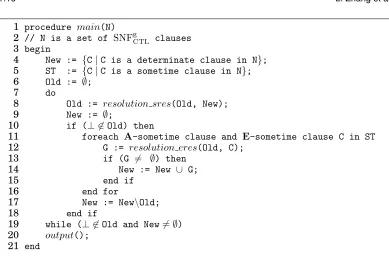
1 procedure main(N)
2 // N is a set of SNFgCTL clauses
3 begin
4 New := {C|C is a determinate clause in N};
5 ST := {C|C is a sometime clause in N};
6 Old := ∅;
7 do
8 Old := resolution sres(Old, New);
9 New := ∅;
10 if (⊥ 6∈Old) then
11 foreach A-sometime clause and E-sometime clause C in ST
12 G := resolution eres(Old, C);
13 if (G 6= ∅) then
14 New := New ∪ G;
15 end if
16 end for
17 New := New\Old;
18 end if
19 while (⊥ 6∈Old and New6=∅)
20 output();
21 end
Fig. 1. A decision procedure
—Hi+1=W ni+1
j=1 Vtj
k=1q k
j, for some literalsqkj,1≤j≤ni+1,1≤k≤tj, and — there exists the following set of clauses inT,
P11⇒ ∗C11 P1l⇒ ∗C1l
..
. ...
P1
m1 ⇒ ∗C
1
m1 · · · P
l
ml ⇒ ∗C
l ml
such that these clauses satisfy conditions (1) and (2) of ERES1/ERES2 as well as the restrictions imposed on the form of∗and, moreover,
Wl r=1
Vmr
s=1P r s ≡
Wni+1
j=1 Vtj
k=1q k j.
The proof of the correctness of this algorithm can be found in [Bolotov and Dixon 2000]. An important step in the algorithm is the task of “looking for merged clauses”. We can use step resolution with ordering and selection to achieve this, see for ex-ample [Zhang et al. 2009b].
4.4. A decision procedure
We present a decision procedure based on the calculusR,SCTLfor determining the satis-fiability of a set ofSNFgCTLclauses in Figure 1.
The procedure takes a set ofSNFgCTLclausesNas input and then splitsNinto the set
[image:16.612.112.501.75.332.2]11 to 16). The union of all the resolvents generated by applications of the eventuality resolution rules becomes the set of new clausesNew. Some of these resolvents may be redundant. Therefore, we eliminate clauses from Newwhich are already in Old(line 17). Finally, after the main loop terminates, we print out the satisfiability ofN (line 20).
4.5. Implementation
The calculus has been implemented as the prover CTL-RP. The implementation uses a classical, first-order resolution theorem prover, SPASS [Max-Planck-Institut f ¨ur Infor-matik 2010; Weidenbach et al. 2007] to implement the rules. In particular, all SNFgCTL clauses, except theA-sometime clauses andE-sometime clauses, are transformed into first-order clauses. Then first-order ordered resolution with selection [Bachmair and Ganzinger 2001] is used to emulate step resolution. However, A-sometime clauses andE-sometime clauses cannot be translated into first-order logic. To apply the rules ERES1 and ERES2 for inferences withA-sometime clauses andE-sometime clauses, respectively, we use the loop search algorithm presented in Section 4.3 to find suitable premises. We can again utilise first-order ordered resolution with selection to perform the task of “looking for merged clauses” in the loop search algorithm and we compute the results of applications of the eventuality resolution rules in the form of first-order clauses. In general, we would expect CTL-RP to perform better on unsatisfiable than satisfiable problems because, for the latter, the clause set must be saturated before it can terminate. Similarly we would expect it to have more difficulty on problems with a large number of complex eventualities.
More details about CTL-RP are given in [Zhang et al. 2009b; Zhang 2010] along with an experimental comparison with a tableau prover for CTL (namely the CTL module for the Tableau Workbench) [Abate and Gor´e 2003]. We will refer to the lat-ter as TWB-CTL. As far as we know, there is no implementation of the calculus in [Bolotov 2000]. There are no standard benchmarks for CTL provers so four types of formulae are considered: standard CTL equivalences; formulae representing a small, hand-crafted, finite state transition system; randomly generated state transition sys-tems; and a specification of the Alternating Bit Protocol (see for example [Huth and Ryan 2004]). Both provers solve the standard CTL equivalencies in 0.01 seconds or less. CTL-RP outperforms TWB-CTL for the hand-crafted and random state transition systems in terms of the time taken to solve problems and the number solved within the specified time limit. CTL-RP completes all the Alternating Bit protocol problems whereas TWB-CTL does not terminate on any of these problems.
5. CORRECTNESS OF THE CALCULUSRCTL,S
Next we consider the correctness of the transformation into normal form, and the soundness, completeness and termination of the calculus.
5.1. Correctness of the transformation toSNFgCTL
In the following we show that our transformation
(1) preserves satisfiability, (2) is terminating, and
(3) allows only a polynomially bounded number of transformation rule application.
The proofs of that each transformation rule preserves satisfiability have been moved to the Electronic Appendix.
THEOREM 5.1. LetTt= ∆∪ {ψ}andTt+1= ∆∪Rtbe two sets of CTL clauses such
thatTt+1 is obtained by an application of a transformation rule of the formψ→Rtin
the setTrans to the formulaψinTt. ThenTtis satisfiable iffTt+1is satisfiable.
PROOF. To prove this theorem, we need to show that every transformation rule in the setTrans preserves satisfiability.
Lemma A.4, A.5, A.6, A.7, A.8 and A.9 prove that the transformation rulesTrans(1),
Trans(3), Trans(5), Trans(6), Trans(10) and Trans(11) preserve satisfiability, respec-tively.
The other operators and rules not proved explicitly are similar to the cases shown. The proofs for Trans(2) are similar to Trans(1), for Trans(4), Trans(7), Trans(8) and
Trans(9)are similar toTrans(6)and forTrans(12)are similar toTrans(11).
The definitions relating to and the proof that each application of a transformation rule to a clause Γin a setT of CTL clauses results in a set T0 of CTL clauses weighs strictly less thanTcan be found in the Electronic Appendix.
THEOREM 5.2. LetT0, T1, . . . be a sequence of sets of CTL clauses such thatT0 =
init(ϕ)for some CTL formula ϕandTt+1 is obtained from Ttby applying a
transfor-mation rule to a clause inTt. Then the sequence T0, T1, . . .terminates, i.e. there exists
an indexn, n≥0,such that no transformation rule can be applied to any clause inTn.
Furthermore, all clauses inTnare inSNF g CTL.
PROOF. Follows from Lemma A.17 and Theorem A.16.
Using the following notation of the size of a CTL formula we are able to characterise the computational complexity of the normal form transformation.
Definition 5.3. [Size of a CTL formula] Letϕandψbe arbitrary CTL formulae; and
p be an arbitrary atomic proposition in PPL. We inductively define the size sz of an arbitrary CTL formula as follows:
(1) sz(true) =sz(false) =sz(p) = 1;
(2) sz(¬ϕ) = sz(A2ϕ) = sz(A3ϕ) = sz(A#ϕ) = sz(E2ϕ) = sz(E3ϕ) = sz(E#ϕ) =
sz(ϕ) + 1; and
(3) sz(ϕ∧ψ) =sz(ϕ∨ψ) =sz(ϕ⇒ψ) =sz(A(ϕUψ)) =sz(A(ϕWψ)) =sz(E(ϕUψ)) =
sz(E(ϕWψ)) =sz(ϕ) +sz(ψ) + 1.
THEOREM 5.4. Let ϕ be an arbitrary CTL formula and Tn be a set of SNFgCTL
clauses obtained fromT0 =init(ϕ)bynapplications of our transformation rules. Then
nis linearly bounded in the size ofϕand the setTncan be computed in polynomial time
PROOF. By Lemma A.18 we show that Tn can be computed in less than 47m+ 9 applications of the transformation rules wheremis the size ofϕ.
Regarding the complexity of each application, we assume CTL clauses are stored in a tree data structure. Then according to our transformation rules, by reusing the subtrees representing subformulae as appropriate, generating the results of clauses from the clause which the rule applies to can be accomplished in constant time in the size ofϕ. The pattern matching procedure determining that for a given CTL clause not inSNFgCTL which rule to apply, requires linear time in the size ofϕin the worst case.
Therefore, the setTncan be computed in polynomial time in the size ofϕ.
THEOREM 5.5. Let ϕ be an arbitrary CTL formula and Tn be a set of SNF g CTL
clauses obtained from T0 = init(ϕ) by a linearly bounded applications of our
trans-formation rules in the size ofϕ. Thenϕis satisfiable iffTnis satisfiable.
PROOF. Follows from Theorem 5.2, Lemma A.2, Theorem 5.1, and Theorem 5.4.
5.2. Soundness and completeness
THEOREM5.6 (SOUNDNESS OFR,SCTL). LetT be a set ofSNFgCTL clauses. If there is a refutation ofT byR,SCTL, thenT is unsatisfiable.
PROOF.
Let T0, T1, . . . , Tn be a derivation from a set of SNFgCTL clause T0 = T by the cal-culusR,SCTL. We will show by induction over the length of the derivation that if T0 is satisfiable, then so isTn.
For T0 = T, the claim obviously holds. Now, consider the step of the deriva-tion in which we derive Tt+1 from Tt for some t ≥ 0. Assume Tt is satisfiable and
M =hS, R, L,[ ], s0iis a model structure satisfyingTt.
We show that SRES2 is sound. Assume A2(P ⇒ Ehindi#(C∨l)) and A2(Q ⇒ A#(D∨ ¬l))are inTt. LetTt+1 be obtained by an application of SRES2 toA2(P ⇒ Ehindi#(C∨l)) and A2(Q ⇒ A#(D ∨ ¬l)), that is, Tt+1 = Tt ∪ {A2(P ∧ Q ⇒ Ehindi#(C∨D))}. We show that M also satisfies Tt+1. Consider an arbitrary state
s∈S. IfM, s6|=P orM, s6|=Q, then obviouslyM, s|=P∧Q⇒Ehindi#(C∨D). Assume that M, s |= P andM, s |= Q. FromA2(P ⇒ Ehindi#(C∨l)),A2(Q ⇒ A#(D∨ ¬l)) and the semantics of A2, we obtain that M, s |= P ⇒ Ehindi#(C∨l) and M, s |=
Q ⇒ A#(D∨ ¬l). From the semantics of⇒, we obtain that M, s |= Ehindi#(C∨l) andM, s|=A#(D∨ ¬l). From the semantics ofA#, we obtain that for all successors
s0 of states,M, s0 |=D∨ ¬l. From the semantics ofEhindi#, we have that for the suc-cessor s00 of s such that s00 is on the path χhindis , M, s00 |= C∨l. As s00 is a successor of s, M, s00 |= D ∨ ¬l. Asl and ¬l cannot both be true at state s00, we conclude that
M, s00|=C∨D. From the semantics ofEhindi#, we haveM, s|=Ehindi#(C∨D). There-fore,M, s|=P∧Q⇒Ehindi#(C∨D). Assis arbitrary, from the semantics ofA2, we haveM, s0|=A2(P∧Q⇒Ehindi#(C∨D)).
The cases for SRES1, SRES5 and SRES6 are shown in the Electronic Appendix. For the rule SRES3, the proof is analogous to that for SRES2; for the rules SRES4 and SRES8, the proofs are analogous to that for SRES5; and for the rule SRES7, the proof is analogous to that for SRES6.
Next, we show ERES1 is sound. Assume thatA2(Q⇒A3¬l)is inTtand there ex-ists a setΛE2ofSNFgCTL clauses inTttogether implyingA2(P†⇒E#E2l), whereP† is a disjunction of conjunctions of literals (defined in Section 4.2). Therefore,Msatisfies A2(P† ⇒E#E2l). We show thatM also satisfiesA2(Q⇒A(¬(P†)W ¬l)). Consider an arbitrary statesi∈S. IfM, si6|=Q, then obviouslyM, si|=Q⇒A(¬(P†)W ¬l). As-sumeM, si|=Q. FromA2(Q⇒A3¬l)and the semantics ofA2and⇒, we obtain that
M, si |=A3¬l. If M, si |= ¬l, then by the semantics of AW,M, si |=A(¬(P†)W ¬l). From the semantics of ⇒, M, si |= Q ⇒ A(¬(P†)W ¬l). If, on the other hand,
M, si |= l, then from the semantics of A3, we know that for every path χsi, there
existssj ∈χsi, j > isuch thatM, sj |=¬land for everyk, i≤k < j, M, sk |=l.
For an arbitrary states ∈ S, ifM, s |=A3¬l∧l then by the semantics ofA#and A3,M, s|=A#A3¬l. Therefore, for all the successorss0 ofs,M, s0 |=A3¬l.
Due to the property above and M, si |= A3¬l∧l and M, sk |= l, by an inductive augment we can conclude that for every k, i ≤ k < j, M, sk |= A3¬l. As we know,
M, sk |=l. Therefore,M, sk |=A3¬l∧l. From the semantics ofA3, for all pathsχsk,
there exists sn ∈ χsk, n > k, M, sn |= ¬l. Next, we use a proof by contradiction to
establish that for allk, i≤k < j, M, sk |=¬(P†). Assume thatP†holds atsk. From the semantics ofA2and⇒, we haveM, sk |=E#E2l. From the semantics ofE#andE2, we know that there exists a pathχsk such that for all statessm∈χsk, m > k, M, sm|= l. This is a contradiction. Therefore, ¬(P†) must hold at all the statessk. From the semantics ofAU, we obtain thatM, si |=A(¬(P†)U ¬l). From the semantics ofAW, we obtain that M, si |= A(¬(P†)W ¬l). Thus, M, si |= Q ⇒ A(¬(P†)W ¬l). As si is arbitrary, from the semantics ofA2,M, s0 |=A2(Q⇒A(¬(P†)W ¬l)). The proof for ERES2 is analogous.
Our proof of the completeness of R,SCTL makes use of (reduced) labelled behaviour graphs, which will be defined later in this section. These graphs can be seen as finite representations of the set of all models of a set ofSNFgCTLclauses.
First, we briefly discuss how our proof proceeds. We introduce the idea of augmen-tation, which was originally developed for a resolution calculus for PLTL [Fisher et al. 2001]. Next, we create a finite labelled directed graph, called a labelled behaviour graph, for an augmented set ofSNFgCTL clauses. However, some nodes and some sub-graphs of the labelled behaviour graph for T cannot be used to create a CTL model structure for a set T of SNFgCTL clauses. For instance, a node without any successor nodes in a labelled behaviour graph cannot be used to construct a CTL model struc-ture, as all paths in a CTL model structure are infinite. To remove such nodes and subgraphs from a labelled behaviour graph, we define a set of deletion rules. We call a labelled behaviour graphH a reduced labelled behaviour graph if it is obtained by exhaustively applying deletion rules to H. We show that, if an augmented set T of
SNFgCTL clauses is unsatisfiable, then its reduced labelled behaviour graph is empty. We also prove that each application of a deletion rule corresponds to a derivation from
T byR,SCTL. Therefore, ifTis unsatisfiable, its reduced labelled behaviour graphHredis empty and the sequence of applications of the deletion rules, which reduce the labelled behaviour graph forT to an emptyHred, can be used to construct a refutation inR,SCTL. In the following, we show the detailed completeness proof.
Let T be a set of SNFgCTL clauses obtained by applying the normal form transfor-mation to a given CTL formula. Recall from Section 4.2 an application of ERES1 or ERES2 to the setT may introduce new propositions, for examplew¬lA andwind¬l , intoT. Our completeness proof makes use of the labelled behaviour graph, whose construction depends on the setProp(T)of propositions occurring inT. Due to this we do not want
augmen-tation, which adds clauses associated with these new propositions intoTright from the beginning, i.e. before any resolution rules are applied toT. In this way, we can be sure that no new propositions appear during the application of the resolution rules. That is
Prop(T)stays the same, ifTis augmented. Moreover, we also show that augmentation is correct.
We adapt theaugmentationprocedure used in [Fisher et al. 2001] for PLTL to CTL to establish a relation between the new atomic propositions introduced by applications of ERES1 or ERES2 and eventualities associated with them.
Definition 5.7. [Augmentation] Given a set of SNFgCTL clause T, we construct an augmented set aug(T) as follows: the augmented set aug(T) is the smallest set con-tainingT and satisfying the following conditions:
— For everyA-sometime clause inT,Q⇒A3¬l,aug(T)contains the clauses true⇒ ¬Q∨ ¬l∨wA
¬l
w¬lA ⇒A#(¬l∨w¬lA)
where wA
¬l is the proposition uniquely associated with A3¬l (i.e. wA¬l is the same proposition we used for ERES1).
— For everyE-sometime clause inT,Q⇒Ehindi3¬l,aug(T)contains the clauses
true⇒ ¬Q∨ ¬l∨wind ¬l ,
wind¬l ⇒Ehindi#(¬l∨wind¬l ) wherewind
¬l is the proposition uniquely associated withEhindi3l(i.e.w¬lindis the same proposition we used for ERES2).
Next, we formally prove that our augmentation preserves satisfiability.
LEMMA 5.8. LetTbe a set ofSNFgCTLclauses andMbe a model structure satisfying T. IfT0 is a subset ofT, thenM also satisfiesT0.
PROOF. Straightforward.
LEMMA 5.9. LetT be a set ofSNFgCTL clauses. The augmented setaug(T)is satisfi-able iffT is satisfiable.
PROOF. AsT ⊂aug(T), by Lemma 5.8 ifaug(T)is satisfiable and a model structure
M satisfiesaug(T), thenM also satisfiesT and, thus,T is satisfiable.
Conversely, ifT holds in a model structureM1 at the state s0, then M1 can be ex-tended to another model structureM2by givingwA¬lthe same truth value asl∧A3¬l andwind
¬l the same truth value asl∧Ehindi3¬lin each state inM2for each eventuality ¬linT. We show thatM2satisfiesaug(T)at the states0ofM2.
Assume thatQ⇒Ehindi3¬lis inT. We show thatM2satisfiesA2(true⇒ ¬Q∨ ¬l∨
wind
¬l )andA2(wind¬l ⇒ Ehindi#(¬l∨wind¬l ))i.e. the two clauses added by augmentation forQ⇒Ehindi3¬l. Letsbe an arbitrary state inM2.
(1) We know that M1, s0 |= A2(Q ⇒ Ehindi3¬l). By the definition of M2 and Lemma A.1, we know that M2, s0 |= A2(Q ⇒ Ehindi3¬l). From the semantics of A2, M2, s |= Q ⇒ Ehindi3¬l. By propositional reasoning, M2, s |= (Q∧l) ⇒
(l∧Ehindi3¬l). By the definition of M2, M2, s |= (l ∧Ehindi3¬l) ⇒ w¬lind. There-fore, by the semantics of ⇒, we obtain that M2, s |= (Q ∧l) ⇒ w¬lind. Thus,
M2, s |= true ⇒ ¬Q∨ ¬l∨wind¬l . Since s is an arbitrary state in M2, from the semantics ofA2, we obtain thatM2, s0|=A2(true⇒ ¬Q∨ ¬l∨wind¬l ).
— IfM2, s6|=wind¬l , thenM2, s|=wind¬l ⇒Ehindi#(¬l∨wind¬l ).
— If, on the other hand, M2, s |= wind¬l , then M2, s |= l ∧Ehindi3¬l. Thus, from the semantics ofEhindi3, for the states0 with (s, s0) ∈ [ind], eitherM
2, s0 |=¬l or M2, s0 |= l∧Ehindi3¬l. By the definition ofM2, we know thatM2, s0 |= (l∧ Ehindi3¬l)⇒w¬lind. Thus, eitherM2, s0 |=¬lorM2, s0|=w¬lind. From the semantics of Ehindi#and ∨, M2, s |= Ehindi#(¬l∨w¬lind). AsM2, s |= w¬lind, we obtain that
M2, s|=w¬lind⇒Ehindi#(¬l∨wind¬l ).
As s is arbitrary, from the semantics of A2, M2, s0 |= A2(wind¬l ⇒ Ehindi#(¬l∨w¬lind)).
The proof forQ⇒A3¬linT is analogous. Therefore,aug(T)is satisfied inM2at state
s0.
We now introduce the notion of alabelled behaviour graph. Given a setIndof indices anInd-labelled graphH is an ordered pairH = (N, E), whereN is a set of nodes and
E is a set of directed edges inH of the form(n, ind, n0), wheren, n0 ∈N andind∈Ind. If there exists an edge(n, ind, n0)∈Efor someind∈Ind, thenn0is asuccessorofnand
nis apredecessorofn0. If the labelindis also important for the relation ofnandn0in the context, we also say that n0is anind-successorofnandnis anind-predecessorof
n0. When the label on the edge is not important, we use(n, n0)to denote an edge, which means the label can be any index inInd.
Definition 5.10. [ind-reachable node in a graph] Given a setInd of indices, anind -labelled graph (N, E), and a node n ∈ N, a noden0 ∈ N isind-reachable from n iff there exists an edge(n, ind, n0)∈E or there exists an edge(n00, ind, n0)∈ Eandn00 is
ind-reachable fromn.
Definition 5.11. [reachable node in a graph] Given a graph(N, E)and a noden∈
N, a noden0∈N is reachable fromniff there exists an edge(n, n0)∈Eor there exists an edge(n00, n0)∈Eandn00is reachable fromn.
Definition 5.12. [labelled behaviour graph] LetT be an augmented set ofSNFgCTL
clauses and Ind(T) be the set of indices occurring in T. If Ind(T)is empty, then let
Ind(T) ={ind}, whereindis an arbitrary index inInd. GivenTandInd(T), we construct a finite directed graphG= (N, E)forT as follows.
The set of nodesN ofGconsists of all ordered tuplesn= (V, EA, EE), where
(1) V is a valuation of the atomic propositions occurring inT; (2) EAis a subset of{l|Q⇒A3l∈T}; and
(3) EEis a subset of{lhindi|Q⇒Ehindi3l∈T}.
Informally EA and EE contain eventualities that need to be satisfied either in the current node or some node reachable from the current node.
To define the set of edges E of G we use the following auxiliary definitions. Let
n= (V, EA, EE)be a node inN. LetRA(n, T) ={D|Q⇒A#D∈T,andV |=Q}. Note ifV does not satisfy the left-hand side of anyA-step clause (i.e.RA(n, T) = ∅), then there are no constraints fromA-step clauses on successor node of the nodenand any valuation satisfiesRA(n, T). LetRind(n, T) ={D|Q⇒Ehindi#D∈T andV |=Q}. Let
Rg(T) ={D|true⇒D∈T}.
Let functionsEvA(V, T)andEvE(V, T)be defined as
and
EvE(V, T) ={lhindi|Q⇒Ehindi3l∈T andV |=Q}, respectively. Let functionsUnsatA(EA, V)andUnsatind(EE, V)be defined as
UnsatA(EA, V) ={l|l∈EAandV 6|=l}
and
Unsatind(EE, V) ={lhindi|lhindi∈EE andV 6|=l},
respectively. For a noden= (V, EA, EE)inG, ifl ∈EA(lind∈EE)andV |=l, then we say thatl(lind)is satisfied in noden.
Then E contains an edge labelled by ind from a node (V, EA, EE) to a node
(V0, EA0 , EE0 )iffV0satisfies the setRA(n, T)∪Rind(n, T)∪Rg(T),EA0 =UnsatA(EA, V)∪ EvA(V0, T)andEE0 =Unsatind(EE, V)∪EvE(V0, T). That is, there is an edge labelled
withindfrom(V, EA, EE)to(V0, EA0 , EE0 )iff (i)V0 satisfies all constraints imposed by A-step clauses,E-step clauses with the indexind, and global clauses whose left-hand sides are satisfied byV, (ii)EA0 consists ofA-eventualities not satisfied byV plus ad-ditional A-eventualities triggered byV0, and (iii) E0E consists ofE-eventualities with the index ind not satisfied by V plus additional E-eventualities with the index ind
triggered byV0.
Let R0(T) = {D | start ⇒ D ∈ T}. Then the node (V, EA, EE), where V satisfies the set R0(T)∪Rg(T), EA = EvA(V, T)and EE = EvE(V, T), is an initial node of G.
That is, initial nodes are those nodes such that (i)V satisfies all constraints imposed by initial clauses and global, (ii)EAconsists ofA-eventualities triggered byV, and (iii)
EEconsists ofE-eventualities with the indexindtriggered byV.
Thelabelled behaviour graphH = (N0, E0)for an augmented set ofSNFgCTL clauses
T is the subgraph ofGsuch that the setN0 ⊆N of nodes and the setE0 ⊆E of edges are reachable from the initial nodes ofG.
Definition 5.13. [Path from a node n to a noden0 through a graph] A path from a node n1 to a node nk in a graph is a sequence of nodes n1, n2, . . . , nk such that
(n1, n2),(n2, n3),. . . ,(nk−1, nk)are edges of the graph.
Definition 5.14. [Shortest path from a node n to a node n0 through a graph] A shortest path from a nodento a node n0 in a graph is a path from the nodento the noden0 with the least number of edges amongst all the paths from the nodento the noden0.
Definition 5.15. [Distance] Given a graph(N, E), if a noden0 ∈Nis reachable from another noden∈N, the distance fromnton0is the number of edges in a shortest path fromnton0.
Definition 5.16. [ind-distance] Given a graph (N, E), if a node n0 ∈ N is ind -reachable from a node n ∈ N, the ind-distance from n to n0 is the number of edges in a shortest path such that every edge in it is labelled byind.
LEMMA 5.17. LetT be an augmented set ofSNFgCTL clauses andH = (N, E)be the labelled behaviour graph forT. IfH contains an edge from a noden= (V, EA, EE)∈N
to a node n0 = (V0, EA0 , EE0 )∈ N such thatl ∈ EA0 then either (i) there exists a clause Q⇒A3l∈T such thatV0|=Qor (ii)l∈EAandV 6|=l.
PROOF. From the construction of the labelled behaviour graph, we know EA0 =
LEMMA 5.18. LetT be an augmented set ofSNFgCTL clauses andH = (N, E)be the labelled behaviour graph for T. Then, for every node n = (V, EA, EE)in H, if l ∈ EA
andV 6|=lthenV |=wAl .
PROOF. The proof proceeds by induction over the nodes of a path(n0, n1, . . .)from an initial noden0= (V0, EA0, E
0
E)to the noden= (V, EA, EE). In the base case,nis an initial node. Ifl ∈E0
A, by the construction of initial nodes, there must be anA-sometime clauseQ ⇒ A3l ∈ T andV0 |= Q. By augmentation, true⇒ ¬Q∨l∨wA
l . IfV06|=l, we obtain thatV0|=wAl .
Otherwise we assume that the lemma holds from noden0toni= (Vi, EiA, EEi), i >0, and we prove that it holds for nodeni+1= (Vi+1, EAi+1, E
i+1
E ). Based on the assumption of the lemma,Vi+16|=landl∈Ei+1
A . By Lemma 5.17, sincel∈E i+1
A , either
(1) there exists a clauseQ⇒A3l∈T such thatVi+1|=Qor
(2) l∈EAi andVi6|=l.
In case (1), by augmentation,true⇒ ¬Q∨l∨wA
l ∈Tand sinceVi+16|=l, we obtain that
Vi+1|=wA
l . In case (2) by the induction hypothesis we haveV i|=wA
l . By augmentation we havewAl ⇒A#(wlA∨l)∈T. Thus by the construction ofH, sinceVi+16|=l, we have
Vi+1|=wA
l . Thus, the lemma also holds for nodeni+1.
LEMMA 5.19. LetT be an augmented set ofSNFgCTL clauses andH = (N, E)be the labelled behaviour graph forT. IfHcontains an edge from a noden= (V, EA, EE)∈N
to a noden0= (V0, EA0, EE0 )∈N such thatlhindi∈EE0 then either (i) there exists a clause
Q⇒E3lhindi∈T such thatV0 |=Qor (ii)lhindi∈EE andV 6|=l.
PROOF. By the construction of the labelled behaviour graph,EE0 =Unsatind(EE, V)∪ EvE(V0, T). Therefore, iflhindi ∈ EE0 , thenlhindiis either fromUnsatind(EE, V)or from EvE(V0, T). For the first case,lhindimust be inEEandV 6|=l. For the latter, there exists a clauseQ⇒Ehindi3l∈TandV0|=Q.
LEMMA 5.20. LetT be an augmented set ofSNFgCTL clauses andH = (N, E)be the labelled behaviour graph forT. Then for every noden= (V, EA, EE)inH, iflhindi∈EE
andV 6|=l, thenV |=wind l .
PROOF. The proof proceeds analogously to the proof of Lemma 5.18 and uses the fact thatT contains the clausewind
l ⇒Ehindi#(wlind∨l).
LEMMA 5.21. Let T be an augmented set of SNFgCTL clauses and T0 be a set of
SNFgCTL clauses obtained fromT by adding any combination of initial,A-step, E-step or global clauses which only involve propositions and indices occurring inT. Then the labelled behaviour graphH0 = (N0, E0)forT0 is a subgraph of the labelled behaviour graphH = (N, E)ofT.
PROOF. This is established by induction on the length of the shortest path from an initial node to a node inH0. For the base case, where the length of the path is zero, we show that any initial node inH0 is an initial node inH.
AsT0 has been constructed by adding a combination of initial,A-step ,E-step and global clauses to T, we have R0(T) ⊆ R0(T0) and Rg(T) ⊆ Rg(T0). Take any initial node n0 = (V0, EA0, E
0 E) in H
0. By Definition 5.12, V0 satisfies R
0(T0)∪Rg(T0). As
Next we assume that every nodeni = (Vi, EAi, E i
E), where the length of the shortest path in H0 from an initial node toni ism, is inH. We show that every nodeni+1 =
(Vi+1, Ei+1 A , E
i+1 E )inH
0 with an incoming edge(n
i, ind, ni+1)∈E0, ind∈Ind(T)is also inH.
Vi+1 satisfies R
g(T0)∪RA(ni, T0)∪Rind(ni, T0). Thus Vi+1 also satisfies Rg(T)∪
RA(ni, T)∪Rind(ni, T), asRg(T) ⊆ Rg(T0),RA(ni, T) ⊆ RA(ni, T0)and Rind(ni, T) ⊆
Rind(ni, T0). Furthermore asT andT0 contain the sameA- orE-sometime clauses in
T,EAi+1andEEi+1will be the same in both graphs. Thusni+1is also present inH as is the edge(ni, ind, ni+1).
The proof that all the edges inH0 are also in H is analogous to the proof above for nodes.
Therefore,N0⊆N, E0 ⊆EandH0 ⊆H.
Definition 5.22. [Terminal node] A node n in a labelled behaviour graph for an augmented setT ofSNFgCTL clauses is a terminal node iff there exists an indexind∈
Ind(T)such that no edges labelled withinddepart fromn.
Definition 5.23. [ind-labelled terminal subgraph forlhindi] For a labelled behaviour graph (N, E) for an augmented set T of SNFCTLg clauses, a subgraph (N0, E0) is an
ind-labelled terminal subgraph forlhindiof(N, E)iff
(ITS1) N0⊆N andE0⊆E;
(ITS2) for all nodesn,n0 ∈N and edges(n, ind0, n0)∈E,n0∈N0and
(n, ind0, n0)∈E0 iffn∈N0andind=ind0; and
(ITS3) for every noden= (V, EA, EE)∈N0,lhindi∈EEandV |=¬l.
Definition 5.24. [Terminal subgraph for l] For a labelled behaviour graph(N, E)
for an augmented setT ofSNFgCTLclauses, a subgraph(N0, E0)is a terminal subgraph forlof(N, E)iff
(TS1) N0⊆N andE0⊆E;
(TS2) for every noden ∈N0 there exists some indexind ∈Ind(T)such that for all edges(n, ind, n0)∈E,n0∈N0 and(n, ind, n0)∈E0; and
(TS3) for every noden= (V, EA, EE)∈N0,l∈EAandV |=¬l.
LEMMA 5.25. Given a labelled behaviour graph H = (N, E) and a node n = (V, EA, EE) ∈ N, if, for every eventualitylhindi ∈ EE,lhindi can be satisfied innor in
some nodeind-reachable fromn, thennis not in any ind-labelled terminal subgraph H0= (N0, E0)forlhindiofH.
PROOF. LetH0 = (N0, E0)be an arbitraryind-labelled terminal subgraph for some arbitrary eventuality lhindi of H. Proving this lemma is equivalent to proving that if
n∈N0, thenl
hindicannot be satisfied innnor in any nodesind-reachable fromninH. Assume thatn ∈N0. According to property (ITS2), all nodes which areind-reachable from n are also in N0. By property (ITS3), for every node n0 = (V0, E0A, EE0 ) ∈ N0,
lhindi ∈ EE0 andl is not satisfied inn0. Therefore, lhindicannot be satisfied innnor in any nodeind-reachable fromninH.
Definition 5.26. [Reduced labelled behaviour graph] Given a labelled behaviour graph H = (N, E) for an augmented set of SNFgCTL clauses T, the reduced labelled behaviour graphHredforT is the result of exhaustively applying the followingdeletion
rulestoH.